
Rahul Gandhi’s insecurity prevents Priyanka from coming forward, Shakil Ahmed again accuses the Leader of the Opposition

The former Congress leader continues to attack Rahul Gandhi. Former Union Minister Shakil Ahmed has leveled a new accusation against Rahul Gandhi and Priyanka Gandhi. Ahmed says that Priyanka is unable to move forward because of Rahul’s insecurity. New Delhi: Former Congress leader Dr. Shakil Ahmed on Sunday spoke openly about the party’s continuous electoral failures, Rahul Gandhi’s leadership, and Priyanka Gandhi’s potential role. Shakil Ahmed attributed the party’s disappointing performance to the leadership’s working style, internal insecurity, and family-centric decisions. He clarified that he is not against Rahul Gandhi, but it is necessary to speak the truth for the good of the party. He said that Priyanka Gandhi is unable to come forward because of Rahul Gandhi’s insecurity. Paid the price for trying to explain things to Rahul Shakil Ahmed said that Sonia Gandhi united the Congress, which had various factions like those of Rajiv Gandhi, PV Narasimha Rao, and Sitaram Kesri, and created a strong ‘Sonia Gandhi’s Congress’, rescuing the party from crisis and taking it to new heights, but Rahul Gandhi could not even make this Congress of Sonia Gandhi his own. He said, “We are not against Rahul Gandhi. I spent a lot of time with him, talked to him a lot. Wherever I saw a mistake, I would point it out in the room, saying that this shouldn’t be done. I understood that the good of the Congress is the good of the country, but perhaps Rahul was hurt, and I had to pay the price for it.” Rahul Gandhi is clearly ‘arrogant’ Shakil Ahmed clearly called Rahul Gandhi ‘arrogant’. Giving the example of the party president election, he said that Shashi Tharoor had stood for election, and he wanted to vote for Tharoor, but since Sonia and Rahul made Mallikarjun Kharge the official candidate, he voted for Kharge so that his vote would not be wasted. Kharge still says that Rahul and Sonia made him the president. He said that when Sonia, Rahul, and Priyanka are together, whoever the Nehru-Gandhi family wants will be the president. Other leaders remain uncertain about what to do.” Regarding Priyanka Gandhi, Shakeel said that he hasn’t had much contact with her, but her speeches connect with the public the most. There is a sense of Indianness in her speeches. Sonia upheld the culture, but Priyanka was born here, so she speaks more accurately and effectively. Trust in the Nehru-Gandhi family in Congress He believes that there is trust in the Nehru-Gandhi family in Congress, and the decision regarding leadership rests with the family, but many leaders say that Rahul’s insecurity is preventing Priyanka from being brought forward. She became an MP after 30-32 years in politics, served as a general secretary, but was not given charge of any major state. After the UP defeat, she was made the secretary of a small state like Assam, so that she wouldn’t come to the forefront. The party continued to fail, but Rahul remained the face. Shakeel said, “Rahul is the owner of the party. Whether Priyanka wants to come to the front or wants to work behind her brother is an internal matter. There seems to be a lot of affection between the two. From the outside, Priyanka’s public connection and speeches are better than anyone else’s.” Edited by: Anil Kumar About the Author Anil Kumar is part of the homepage team at Navbharat Times Digital. He has about 16 years of experience in both print and digital media. He has been associated with Navbharat Times Online since January 2021. Courtesy: Hindi News
Dakshayani Velayudhan: A Voice of Equality in India’s Constituent Assembly

Dakshayani Velayudhan was the only Dalit woman in India’s Constituent Assembly, who fearlessly fought caste injustice and inequality. Dakshayani Velayudhan: The Fearless Dalit Woman Who Shaped India’s Constitution and Demanded Equality On December 15, as India reflects on its long journey toward equality and justice, history invites us to remember a woman whose courage challenged centuries of silence. Her name is Dakshayani Velayudhan, the only Dalit woman to be a member of India’s Constituent Assembly — a voice that refused to be ignored at a defining moment in the nation’s birth. Born into a society rigidly divided by caste, Dakshayani Velayudhan grew up witnessing exclusion not as an abstract idea, but as lived reality. From restricted access to education to everyday discrimination, caste shaped every aspect of life. Yet she chose not to accept injustice as destiny. Breaking Barriers in a Divided Society Dakshayani Velayudhan was born in 1912 in what is now Kerala, at a time when Dalits were denied basic human dignity. Education itself was an act of rebellion. She pursued her studies against formidable odds and went on to become a teacher — a role that allowed her to empower others even before she entered national politics. Her personal journey reflected a broader struggle for dignity. In an era when Dalit voices were actively suppressed, Dakshayani chose to speak — not cautiously, but boldly. A Historic Role in the Constituent Assembly India’s Constituent Assembly was tasked with drafting the framework of a new nation. It was dominated by elite, upper-caste men. In this setting, Dakshayani Velayudhan stood alone as the only Dalit woman member. Her presence itself was historic, but it was her words that left a lasting impact. She questioned whether political freedom meant anything without social equality. She warned that a Constitution filled with ideals would fail if society continued to practice discrimination. While many spoke of unity in abstract terms, Dakshayani spoke of lived injustice — of humiliation, exclusion, and systemic inequality. Challenging Power Without Fear Dakshayani Velayudhan did not hesitate to challenge even the most powerful figures of her time. She criticized the idea of celebrating freedom while millions remained oppressed by caste. Her interventions were sharp, moral, and deeply principled. She famously argued that dignity is not charity — it is a right. To her, equality was not something to be granted gradually; it was fundamental to the idea of India itself. At a time when voices often trembled before authority, hers carried clarity and conviction. Equality Beyond the Constitution For Dakshayani, the Constitution was not meant to be a symbolic document. She believed it had to be a living promise — one that actively dismantled caste hierarchies and protected the most marginalized. She expressed skepticism toward excessive reliance on laws without social reform. True freedom, she believed, required transformation of attitudes, not just institutions. Her perspective added moral depth to constitutional debates and ensured that the concerns of Dalits and women were not erased from India’s foundational moment. A Legacy That Remains Overlooked Despite her historic role, Dakshayani Velayudhan remains largely absent from mainstream history narratives. Her contributions are often overshadowed, her courage under-acknowledged. Yet her ideas feel strikingly relevant today. As India continues to grapple with caste discrimination, gender inequality, and social justice, her words resonate with renewed urgency. She reminds us that progress is incomplete if it excludes the most vulnerable. Why Dakshayani Velayudhan Matters Today Dakshayani Velayudhan’s legacy is not confined to the past. It challenges present generations to question power, resist injustice, and demand accountability. She stood in halls dominated by privilege, carrying the hopes of millions who had never been heard. Alone, yet unshaken, she proved that one voice — grounded in truth — can confront an entire system. Remembering a Forgotten Architect of Equality Dakshayani Velayudhan was not just a member of the Constituent Assembly. She was a conscience within it. A reminder that freedom without equality is hollow. Remembering her is not merely an act of history — it is an act of responsibility. Because nations are not built only by laws and leaders, but by those brave enough to demand justice when silence feels safer. Her voice still calls out — to remember, to rise, and to resist injustice. Shivani Poli Courtesy : One World New Note: This news is originally published on https:/oneworldnews.com/bha and is used purely for non-profit/non-commercial purposes, especially human rights
Caste within caste: The dual reality of OBC politics

OBCs are both oppressed and, at times, oppressors. They suffer caste, but they also reproduce it. This duality must be named if we are to build a politics that is honest, transformative, and inclusive. Indian society rests on a graded hierarchy called caste, which Dr BR Ambedkar described as “an ascending scale of reverence and a descending scale of contempt.” This description captures the everyday reality of how respect and humiliation are distributed. From this recognition follows Ambedkar’s most urgent demand: the annihilation of caste. Ending caste is not only a moral aspiration but the central reform required to build genuine social democracy. Public understanding of caste has largely been shaped through a Dalit lens– a powerful and necessary perspective which exposes the brutality of untouchability and structural violence. Yet it is not enough to capture the full complexity of caste. What remains less examined is the position of those just above Dalits in this hierarchy: the thousands of communities grouped under the administrative category of Other Backwards Classes. Caste, in India, is often narrated as a binary of upper castes versus Dalits. This framing, while politically potent, erases the layered realities of OBCs. This vast and diverse category experiences exclusion even as some of its groups reproduce it. OBCs are not outside the caste– they are shaped by it, harmed by it, implicated in its reproduction, and, at times, perpetuate it. But their struggles cannot be dismissed simply because of this. Reducing them solely to perpetrators is to criticise without any nuanced understanding of the OBC problem. Their position in the caste order demands recognition of both the exclusions they face and the contradictions they embody. Graded inequality and the OBC experience Dr BR Ambedkar’s metaphor of caste as “graded inequality” is especially instructive here. OBCs, positioned on the middle rungs of this ladder, often internalise both ends of the spectrum. They seek validation from those above while distancing themselves from those below. This is not a moral failure but structural conditioning. It shows how caste works not only through institutions but also through desire, shame, and aspiration. The OBC experience is marked by constant negotiation between proximity and exclusion, between visibility and voicelessness. Their contradictions are not incidental; they are central to how caste reproduces itself across generations. Unlike Dalit and Adivasi communities, whose exclusion is marked by spatial segregation and cultural distinctiveness, the case of OBCs is more complex. As the sociologist TK Oommen notes, OBCs are above the ritual pollution line in the caste hierarchy. They are not excluded from village social life, nor do they possess a culturally distinct identity like Adivasis. They share language, religion, and many aspects of everyday life with dominant caste groups. Yet, despite this proximity, elite formation among OBCs has been slow. The size of their elite category remains disproportionately small compared to their numerical strength in the population. From occupation to intellectual absence This paradox of cultural inclusion and structural exclusion has shaped the trajectory of OBC aspirations. After independence, only a small section of OBC families who had the means encouraged their children to pursue professional fields such as engineering, medicine, and government services. These careers were seen as secure routes to mobility, respectability, and survival, though they remained accessible to only a limited percentage of the community. For many others, traditional caste-based occupations became economically unsustainable, forcing a transition into informal and precarious labour, undervalued, unprotected, and excluded from formal skill recognition. In this pursuit of material advancement, OBCs were largely absent from the philosophical and intellectual realms. Upper castes dominated the humanities and social sciences, while Dalit thinkers built powerful traditions of resistance and critique. OBCs, by contrast, did not cultivate a sustained presence in academic theory, research, or public thought. The pressure to prove worth to dominant-caste institutions and the state arose because OBC labour and knowledge were historically undervalued. With traditional occupations collapsing, technical success in engineering, medicine, and government services became the recognised pathway to dignity and survival. With little mentorship in critical disciplines and an internalised belief that philosophy and politics belonged to others, OBCs were steered away from intellectual spaces. The absence of a pan-India OBC intellectual movement is not apathy but the result of structural exclusion and lack of ideological space. Even among the few who entered the realm of thought, exclusion persisted. Kancha Ilaiah Shepherd, one of the most prominent OBC intellectuals, faced sustained hostility for naming caste, challenging Hindu orthodoxy, and asserting a Bahujan epistemology. His marginalisation is not only political, but also philosophical. It reflects the discomfort of dominant institutions with OBC thought that refuses to be servile, apologetic, or assimilated. Structural violence and everyday exclusion The absence of OBC voices in intellectual spaces is not just about ideas; it translates into lived silences. This silence is both imposed and internalised. OBC students in elite institutions often carry the burden of invisibility. They are rarely seen as theorists, seldom invited into spaces of reflection, and often discouraged from pursuing the humanities. Some endure this burden quietly. Others break under it. The suicides of OBC students are not isolated tragedies; they are structural indictments. They show how caste operates not only through denial of opportunity but also through denial of belonging. In most Hindu temples, the priesthood remains the monopoly of the upper castes. OBCs, despite being deeply embedded in the ritual and cultural life of villages, are denied access to sacred roles. Their labour sustains religious institutions, yet their bodies are kept outside the sanctum. Kancha Ilaiah Shepherd has long critiqued this Brahminical monopoly over spiritual life. Building on his insight, this exclusion can be understood as a form of spiritual apartheid — a system that denies OBCs dignity in the very spaces they help sustain. Even in marriage, caste boundaries remain rigid. Inter-caste marriages between OBCs and upper castes are rare and often resisted, revealing the deep social distance that persists despite constitutional equality. Political representation is equally fragmented. While OBCs hold electoral strength in
Caste-based violence in a Gujarat village: Dalit youth abused and beaten for refusing to lend his glasses

A man named Devshi Koli asked the youth for his glasses. When Solanki refused, Devshi made casteist remarks, leading to an argument. The three men together beat Solanki with punches and kicks and threatened to kill him. When villagers gathered, the accused fled on motorcycles. Patan – A case of caste-based violence has come to light in Piprala village of Santalpur taluka in Patan district of Gujarat, where a 26-year-old Dalit laborer, Tulsi Solanki, was attacked. Three men attacked him with sticks, fists, and kicks, hurled casteist abuses, and threatened to kill him after he refused to lend one of them his glasses. The incident took place on Tuesday evening around 7 pm near the Hanuman temple. Tulsi Solanki was standing near the Hanuman temple on Tuesday evening. At that time, a man named Devshi Koli asked him for his glasses. When Solanki refused, Devshi made casteist remarks, leading to an argument. About 30 minutes later, Devshi returned on a motorcycle with his accomplice Bhikhu Koli and started abusing and questioning Solanki again. Solanki’s parents, Vela and Demaben, also arrived at the spot and started protesting against the accused. Meanwhile, the third accused, Mandan Koli, arrived on another motorcycle with a stick. Mandan struck Solanki on his left shoulder with the stick, causing him to fall. Then Mandan hit him on the knee of his left leg. Bhikhu Koli pushed Solanki’s father to the ground. The three together beat Solanki with punches and kicks and threatened to kill him. When villagers gathered, the accused fled on motorcycles. Solanki sustained serious injuries in the attack. He was first taken to Santalpur Government Hospital, where after primary treatment, he was referred to Dharpur Hospital. His condition is reported to be stable, but the injuries are serious. The victim’s family filed a complaint at the Santalpur police station late Tuesday night. The police have registered a case against Devshi Koli, Bhikhu Koli, and Mandan Koli under various sections of the Bharatiya Nyaya Sanhita (BNS). In addition, relevant sections of the Scheduled Castes and Scheduled Tribes (Prevention of Atrocities) Act have also been applied. The Santalpur police have launched an investigation, but the accused have not yet been arrested. The police say they will apprehend the accused soon. Geetha Sunil Pillai Courtesy: Hindi News
Dalit Sarpanch Abducted and Assaulted in MP’s Morena: Activists Demand Immediate Action Under SC/ST Act
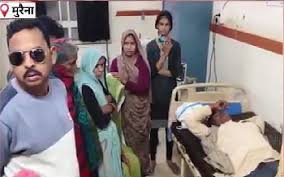
The incident came to light through a viral video and post shared by prominent Dalit activist and Azaad Samaj Party founder Sunil Astay, a former Bhim Army state in-charge in Madhya Pradesh. Morena- A Dalit sarpanch was allegedly abducted from his home in Kelaras village, Morena district, and subjected to a brutal beating by a group of 20-25 individuals described as “casteist elements.” The attack, which occurred earlier on Saturday, has been condemned as a direct assault on India’s constitutional framework, social justice, and democratic representation. The incident came to light through a viral video and post shared by prominent Dalit activist and Azaad Samaj Party founder Sunil Astay, a former Bhim Army state in-charge in Madhya Pradesh. In the post, Astay detailed the abduction and assault, emphasizing its gravity: “The abduction of the Dalit sarpanch from his home in Kelaras, Morena district, Madhya Pradesh, and the beating by casteist elements is extremely serious, condemnable, and a direct attack on the democratic system. This incident is not just against one individual but against the Constitution, social justice, and Dalit representation.” The accompanying video, aired on local channel Vistar News, shows on-the-ground reporting from the scene. It depicts the sarpanch’s family and villagers gathered outside the local police station, demanding swift intervention. According to the report, the assailants stormed the sarpanch’s residence in the Kelaras police station area, forcibly kidnapped him, and transported him to a nearby village where they allegedly thrashed him severely. The attackers then returned him to his home, locked him inside, and fled before police arrived. The sarpanch sustained serious injuries and is receiving treatment. The family has alleged possible motives linked to a financial dispute, though details remain unconfirmed. The clip urges police to take “strict and immediate action,” underscoring a pattern of unchecked caste-based violence in the region. Astay tagged key officials, including Madhya Pradesh Chief Minister Dr. Mohan Yadav, Morena Superintendent of Police, and the state government holding them accountable for administrative inaction. He warned: “When an elected Dalit public representative is not safe, the security of ordinary Dalit citizens automatically comes under question. The administration’s inaction and silence are emboldening criminals and reveal a complete failure in preventing caste violence.” Geetha Sunil Pillai Courtesy : The Mooknayak Note: This news is originally published on https:/themooknayak.com/bha and is used purely for non-profit/non-commercial purposes, especially human rights
Dhanbad: Dalit Community Outraged Over De-reservation of Municipal Corporation Seat, Holds Massive Protest at Randhir Verma Chowk

Dhanbad Municipal Corporation Elections: Dalit Community Outraged Over Loss of SC Seat. Massive protest at Randhir Verma Chowk, know what’s happening in the High Court. Dhanbad/Jharkhand: Amidst the buzz of the upcoming local body elections, the Dalit community’s anger has erupted against the government’s decision to de-reserve the Dhanbad Municipal Corporation seat. On Thursday, hundreds of people from the community held a one-day protest at Randhir Verma Chowk over this issue. The protesters strongly opposed the state government’s decision, calling it discriminatory and demanding its immediate withdrawal. Those participating in the protest said that based on the 2011 caste census, the Dhanbad Municipal Corporation seat was reserved for the Scheduled Caste (SC) category. However, recently the government has declared it unreserved, causing widespread anger among the Dalit community. The protesters termed this move an attack on their constitutional rights and a conspiracy to eliminate their social representation in local governance. Slogans raised against the government Those present at the protest site raised slogans against the government and alleged that the administration is undermining social justice by disregarding established rules. They said that this de-reservation decision has deeply hurt the sentiments of the Dalit community and threatens to weaken their political participation in the municipal administration. Case in High Court, judgment reserved Addressing the crowd, social activist Shantanu Chandra, also known as Bablu Paswan, said that a legal battle has been initiated against this injustice. He informed that a petition challenging the government’s decision was filed in the Ranchi High Court. The hearing on this matter has been completed and the court has reserved its judgment. “We will not remain silent against injustice” Shantanu Chandra further said that the community has full faith in the judiciary and hopes that the outcome will be in their favor. However, they questioned the government’s intentions, stating that their struggle would continue until justice is served and the decision is reversed. They declared defiantly, “We have full respect for the judicial process, but at the same time, we will not remain silent against injustice.” The protesters warned that if the government did not reconsider its decision, the movement would be intensified in the coming days. The protest concluded peacefully, with everyone reiterating their resolve to continue fighting for their rights through both legal and democratic means. Rajan Chaudhary Courtesy: Hindi News
How the 16-year-long Namantar Andolan led by Dalit communities created a new aesthetic in literature

The campaign, which began in 1978, sought to rename Marathwada University in recognition of Dr BR Ambedkar’s contribution to social welfare. This statement was in response to the historic Namantar Andolan, a 16-year struggle waged by Dalits to rename Marathwada University in recognition of Dr BR Ambedkar, not as an act of charity to Dalits, but as a right, challenging the dominant cultural and moral order and asserting normative self-esteem. Started in 1978, it finally culminated in 1994 with Namvistaar, naming the university D Babasaheb Ambedkar Marathwada University (BAMU), portraying the “moral incapacity” of the social order, reflected in the state, to accept the dignity of Dalits, exposing the fault lines that run deep due to the psychic prevalence of conscious/unconscious caste-feudalism. This movement is marked by several notable events – the Long March, inspired by the Chinese Long March; the famous Jail Bharo Andolan; a unique show of Dalit-Muslim solidarity; and the creation of the novel “Dalit Public.” The movement spread across Delhi, Haryana, Bihar, Madhya Pradesh, Andhra Pradesh, Tamil Nadu, and Maharashtra. Dalit literature, which asserted the aesthetic equality of being Dalit, breaking free from the traditional, graded, hierarchical, phallocentric caste system, played a crucial role in this movement, not just contributing to the literary writings, but also acting as a conscience-building tool. From ‘reform’ to ‘radical’ This provided a further impetus to Dalit literature, in which Dalit writers crafted a new language of protest based on anger, using that which challenged the Brahmanical hegemony in the space of literature, i.e., through a defiant public spectacle, and the crafting of an antithetical, vernacular Ambedkarite counter-public that countered the Brahmanical public sphere by bypassing mainstream media, non-state actors, and academic gatekeeping. The ballads of Shahid Vilas Ghogare, songs sung by Vitthal Umap and Shambhaji Bhagat, the poetry of Aai by Jyoti Lanjewar, and an intellectual platform like Asmita Darsha, edited by Gangadhar Pantawane, along with numerous poems and writings in the regional languages, documented this historic struggle as a “public spectacle” of anguish. Thus, Dalit literature can be seen here employing the politics of montage – dialectical montage, symbolic montage, and parataxic syntax. Dialectical syntax may be seen in Shahir Vilas Ghogare’s lines, where he presents a contradiction: urban Dalits, who boast of staying in cities – Pune and Mumbai – saying “Jai Bhim”, yet live like the worthless. This can also be connected to the deployment of symbolic montage, where Dr Ambedkar aimed to break the shackles of caste-class-feudalism in villages and encourage Dalits to migrate to cities for their socio-economic and political emancipation. But the verses also point to the Dalits still facing atrocities based on caste, where they have to hide their caste even in the urban areas. Throughout the song, there is an episode of Pochiram Kamble, who was well-off materially but was killed for supporting the movement and saying the words “Jai Bheem.” Thus, Ghogare puts forth a deeper understanding of the machinations of caste in urban-rural areas, whose assault continues in both tangible and intangible realms, helping in understanding the opposition and hatred to Dr Ambedkar’s name for renaming the Marathwada University. The performance of this ballad was a chaotic juxtaposition of the deployment of heterogeneous elements – vernacular language, use of abuse in the composition, and the imagery that demonstrated the undignified living of Dalits in urban areas, the continuation of caste atrocities on Dalits in rural areas, and the denial of material rights to the Dalits, despite being legal citizens, in the independent republic of caste, demonstrating a “caste world” permeated by the banality of caste-evil. The Dalit feminist standpoint “I have seen you At the front of the Long March The end of your sari is tucked tightly at the waist Shouting, “Change the name” Taking the blow of the police stick on your upraised hands Going to jail with head held high…” The above lines have been excerpted from the poem Aai by poet Jyoti Lanjewar, who foregrounds the participation of women in the Namantar Andolan, especially by portraying the image of the “labouring mother” in the famous long march of 1979. Women were not mere passive agents but active participants fighting the brutality of the state and society from the forefront. Her other collections, such as Disha and Ajuna Vadal Uthale Nahi, are agencies that evoke images of Dalit women, where these visuals correct the anomalies in history, foreground her-story, and create a political resonance. The writings of Urmila Pawar, especially Aydaan, document the impact the movement had on her as she navigated the complexities of being a Dalit woman, making and unmaking her identity. Women like Jamnabai Appa Gaikwad, Sangeeta Deepak Pradhan, and Rukhmini Sakharam Satpute, who participated in this movement actively, represent the her-stories – portrayal of a distinct Dalit-feminist standpoint, where Dalit women, in the words of Uma Chakravarti, face “multiple patriarchies.” Later, due to the breathing space provided by the experiences of this movement, during as well as after the movement, there was a flood of writings by Dalit women, putting forth their saga, stories, and struggles in works like Jina Amucha by Babytai Kamble, Majhya Jalmachi Chittarkatha by Shantabai Kamble, Antahsphot by Kumudtai Pawade, and many more. Thus, the Namantar Aandolan brought about a metamorphosis in Dalit literature, which rejected liberalism as orthodox piety, employed strong yet raw language, and served as the agency of historical documentation – the martyrs, such as Pochiram Kamble, Gautam Waghmare, Vilas Dhone, Janardhan Mavde, and others, were documented. In the words of George Lukacs, literature captures the totality of this struggle – the power structure and the forces and their agencies that exercise power, looking beyond subjectivity and going beyond individualistic accounts to provide a collective narrative of the struggle as a whole. Nikhil Sanjay-Rekha Adsule Courtesy : Scroll Note: This news is originally published on https:/scroll.in/bha and is used purely for non-profit/non-commercial purposes, especially human rights
Dalit Youth Brutally Beaten in Rampur: Four Villagers Accused, Dispute Arose While Returning from Market

Rampur. A serious case of assault on a Dalit youth has come to light in Purainia Kala village of Milak tehsil in the district. It is alleged that four people from the same village verbally abused and attacked the youth with sticks and rods, leaving him seriously injured. The injured youth reached the Milak police station and demanded strict legal action against the accused. The victim has been identified as Harpal. Harpal told the police that he is originally from Purainia Kala village but currently lives in Rudrapur, Uttarakhand, where he works in a factory. He had come to his ancestral village about two days ago. According to the victim, on Thursday evening, around 4 pm, he was returning home after buying goods from the market. At that time, some people were playing cards under a banyan tree at the village square. These included Chandrapal, Vedpal, Ramashankar, and Deshraj. During this time, he had an argument with Chandrapal over some matter. Harpal alleges that after the argument, all the accused ganged up and started using abusive language against him. When he protested, the four attacked him. He was seriously injured in the assault with sticks, rods, and fists. Hearing the commotion, people from the surrounding area arrived at the spot, and only then did the attackers leave him in an injured state and flee. After the incident, with the help of his family and villagers, the injured Harpal was brought to the Milak police station. Considering the seriousness of the matter, the police have conducted a medical examination. Several injury marks were found on the victim’s body. The Milak police station says that an investigation has been started based on the victim’s complaint. Further legal action will be taken against all the accused based on the evidence. The police are also investigating whether there was any old enmity behind the dispute. A tense atmosphere prevails in the village after this incident. The villagers say that strict action should be taken against the accused so that such incidents do not recur in the future. Currently, the police are investigating the entire matter and have assured the victim that justice will be served. Rohitash Mani Courtesy: Hindi News
Two Dalit Families’ Homes Burned Down in Prayagraj: Belongings Reduced to Ashes, Families Left Homeless; They Plead for Help

A massive fire broke out on Wednesday in the Dalit settlement of Kohdar Pahari, under the Meja police station area of Prayagraj. Two Dalit families’ homes were completely destroyed in the incident. The affected families include Ram Milan Harijan (son of Jagannath Harijan) and Jagarnath (son of Ram Khelawan). Social worker Sanjay Kesarwani said that the fire started suddenly, causing panic in the settlement. By the time the fire department arrived, both houses had been completely reduced to ashes. All the household belongings kept in the houses were destroyed in the fire. As a result, both Dalit families have become homeless. They now have no means of shelter or food. The affected families have appealed to the government and administration for immediate financial assistance and rehabilitation. Rajesh Kumar Vishwakarma Courtesy: Hindi News
We Must Not Choose Between “Caste” And “Civic sense”

Caste explains the moral history of filth in India; collective-action failure explains its daily reproduction Why are Indian streets so often strewn with litter? Why do so many of us treat public spaces with such complete disregard? I have wrestled with these questions for many years—both as an ordinary citizen and as a Dalit who has studied Indian society academically and also lived within its social hierarchies as a fact of everyday life. Suraj Yengde’s recent piece offers a straightforward answer to this larger question of cleanliness and civic sense—caste. His well-placed assertion is that caste has trained much of Indian society to outsource responsibility to others. Imagine cleaning as the “job” of a designated group of Dalits, and it becomes easier to treat mess as morally weightless and inconsequential. In this arrangement, filth becomes public, but shame becomes privatised—or made invisible altogether—and accountability is shifted to others. I agree with this completely. It explains why most Indians are meticulously clean inside their homes, but readily throw garbage where it doesn’t belong, showing little concern for what happens outside their gates. But my own life experiences push me toward a more complicated picture. Caste is indeed a necessary explanation for India’s sanitation order (or rather, disorder) and civic sense. Who cleans your streets first thing in the morning, whose labour is stigmatized, and who is considered “designated” to clean “our mess”? Caste explains this division of labour and the moral permission it creates. But it does not fully explain why public neglect persists and keeps reproducing itself, even in situations where caste hierarchy is not the immediate or visible operating mechanism. To understand the everyday stability of littering and disregard for public goods, we also need to see sanitation as part of a wider social logic of chalta hai—a low-trust environment in which individuals routinely assume that public rules will not be followed or fairly enforced and therefore feel it is “rational” to break them first. The result is not just a caste problem but a public-goods trap, one whose moral authority draws on caste but whose daily reproduction is driven by collective-action failure. Let me give a concrete example. A few years ago, I attended an Ambedkar Jayanti rally in Delhi. For most Dalits, this day carries the same importance as, if not greater than, a national holiday. It is a day to celebrate hard-earned dignity, equal rights, and an unfinished struggle. The atmosphere was highly charged, with blue flags everywhere, slogans of “educate, agitate, organise,” speeches, songs, and dancing, in an intense sense of community. But as the crowd dispersed toward the end of the day, the pride turned into embarrassment. The road along which the procession had moved was blanketed with trash of pamphlets, plastic water bottles, paper plates, cigarette butts, and everything a large crowd could throw on the street. After the programme concluded, volunteers started cleaning up. However, the irony was sharp enough to hurt. We had spent the day invoking a politics of dignity and ended it by turning a shared public space into a dumping ground. My first instinct was to reach for excuses. The crowd was huge. There were no dustbins. The municipality should have planned better. Where were people expected to dispose of the litter—in their pockets? But these explanations didn’t touch the deeper truth, which is that we had behaved like nearly every other large gathering in India. It was no different from a student political rally I attended at Delhi University, where roads were plastered with posters, or a public roadshow by any politician, big or small. We left the mess for “someone else” to handle. And that “someone else” was a sanitation worker from a Dalit community itself, which made the moment even more bitter. This episode doesn’t disprove Yengde’s point. It revealed something deeper and adjacent to it, and pushed me to extend this narrative further. Even those who don’t believe in any caste hierarchy or champion the cause of Dalits can still fall into the habit of treating public space as morally disposable. Oppression does not automatically produce better public conduct. It produces people living within the same social environment, responding to the same incentives, and absorbing the same norms. I saw the same logic at work in the South Haryana village where I grew up. Everyday life was full of small acts of rule-breaking, routinely justified as necessary or common sense. Until recently, illegal hookups to electric poles (in simple terms, electricity theft) were common to avoid bills, cutting across caste groups. Giving a small bribe, known as ghoos or bakshish, to a traffic constable to avoid receiving a challan was/is a common practice. Calling a “politically connected” person in the tehsil or any government office, for that matter, to get some paperwork done. Finding jugaad for everything, from land registry to marriage certificates to even securing a hospital bed in a big Delhi hospital. Then there were election-time “gifts,” usually liquor or cash, to secure votes. I don’t want to take this piece in the direction of petty corruption—that’s a topic for another day—but these are everyday ‘Indian things’ cutting across caste backgrounds. It is true that those in power are often upper caste, but given the chance, no Dalit is magically immune to this great Indian phenomenon. These examples, among thousands of others, point to something very uncomfortable, that is, public order in India is treated as negotiable across the board, and oftentimes rules are mere suggestions. People curse corruption and rule-breaking, and then participate in it when they benefit from it and the consequences are low. Over time, this arrangement becomes a learned equilibrium. You become part of a large machine whose wheels need constant greasing to keep it moving. Consider a telling parable from North India about a farmer (Annadata Kisaan). He might quietly pull a sugarcane from his neighbour’s field, yet loudly accuse others of stealing from his crop, forgetting that their fields lie just as close to his.