
SP to Increase Focus on Dalit Voters Ahead of UP Elections, Plans to Hold ‘Save the Constitution, PDA Jan Panchayats’ in the State
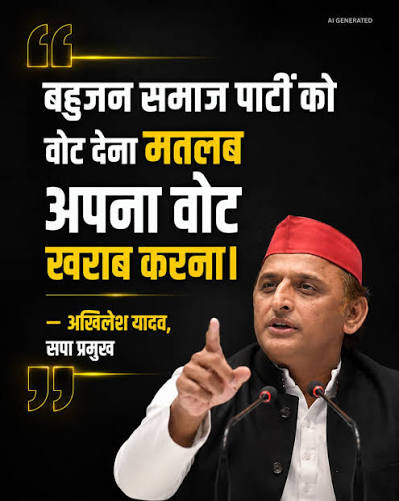
Ahead of the UP Assembly elections, the SP has further increased its focus on reserved seats. The party will organize ‘Save the Constitution, PDA Jan Panchayats’ in all reserved seats across the state. SP Focuses on Dalit Voters Lucknow: The Samajwadi Party, which is preparing for the assembly elections, has further increased its focus on reserved assembly seats. After launching the Samajwadi Chhatra Sabha uniform, the party will now organize ‘Save the Constitution, PDA Jan Panchayats’ in all reserved assembly seats across the state. The responsibility for this has been assigned to Samajwadi Baba Saheb Ambedkar Vahini, the SP’s frontal wing. It will organize ‘Save the Constitution, PDA Jan Panchayats’ in Aurai in Bhadohi, Ajgara in Varanasi, and Chakia in Chandauli on September 12, 13, and 14. The campaign will then be expanded to Dalit-dominated general constituencies. Focus on Dalit-dominated settlements The party leadership believes that strengthening the PDA (Backward, Dalit, and Minority) social equation can increase its reach among the Dalit community. As part of this strategy, issues such as the Constitution, social justice, and reservation will be prominently raised in the Jan Panchayats. According to party sources, the Samajwadi Party is preparing to field Dalit candidates in approximately 100 seats in the upcoming assembly elections. The Samajwadi Baba Saheb Ambedkar Vahini is continuously organizing programs among Dalit voters and strengthening the party at the booth level. The Vahini will organize Save the Constitution PDA Jan Panchayats in all reserved and Dalit-dominated constituencies. Programs for this are ongoing. Why the emphasis on reserved seats? There are approximately 84 assembly seats reserved for Scheduled Castes in the state. Dalit voters directly play a decisive role in elections in these seats. The SP will first take the message of “Save the Constitution” and “Save Reservation” to these seats to increase its acceptance among Dalit voters. By handing over the campaign to the Samajwadi Baba Saheb Ambedkar Vahini, the party has clearly indicated that it is prioritizing Dalit leaders, rather than Yadav leaders, to reach out to the Dalit community. This will send a message that the party wants to give representation to Dalit leadership. Edited by: Prashant Singh About the Author Prashant Singh is a consultant writer at Navbharat Times Online. He has 1.5 years of experience in journalism. He is currently part of the Uttar Pradesh and Uttarakhand teams. Previously, he covered news in West Bengal, Tamil Nadu, Kerala, Maharashtra, Andhra Pradesh, Jammu and Kashmir, Punjab, Haryana, Goa, and the Northeast. Courtesy: Hindi News
AICC pleased with Revanth Reddy’s stand on Dalit issue
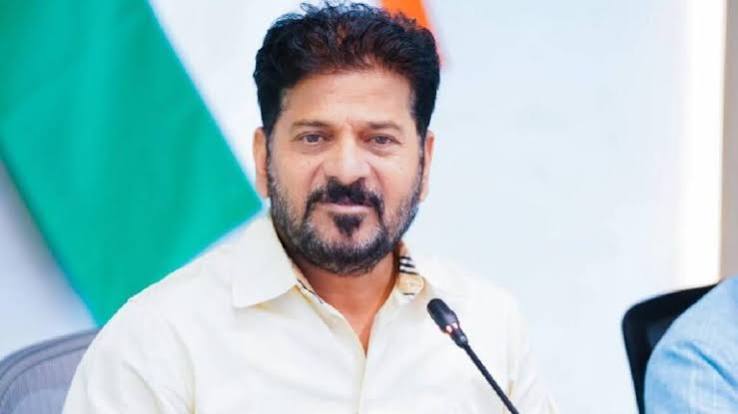
Hyderabad: The Congress high command is learnt to be pleased with Telangana Chief Minister A. Revanth Reddy’s handling of the recent controversy involving Assembly Speaker Gaddam Prasad Kumar, with the issue also fitting into the party’s larger national campaign on Dalit dignity and social justice. According to party sources, the AICC leadership has taken positive note of the Chief Minister’s response and has conveyed its appreciation to the Telangana Pradesh Congress Committee. AICC Incharge Meenakshi Natrajan too reportedly spoke to TPCC Mahesh Kumar Goud. Congress leaders are also said to have received encouraging feedback from Dalit organisations and sections of the community following the developments. The controversy began after BRS MLCs Tata Madhusudhan and Naveen Kumar Reddy were accused of making derogatory remarks against Gaddam Prasad Kumar, who belongs to the Scheduled Caste community. The two leaders were subsequently arrested, though a Hyderabad court rejected their remand and they were released on bail. The political row intensified after Congress workers organised a “Chaavu Dappu” protest near former Chief Minister K. Chandrashekar Rao’s Erravelli farmhouse. BRS workers were subsequently accused of conducting a “purification” ritual at the site after the protest. The Congress described the act as an insult to Dalits, while the BRS disputed the Congress version of events. Revanth Reddy strongly backed Speaker Gaddam Prasad Kumar in the Assembly and announced a comprehensive investigation into the episode. The Telangana episode comes at a time when Congress is already raising a similar controversy involving its national president Mallikarjun Kharge. After Kharge, who belongs to the Scheduled Caste community, addressed a rally at Ramlila Ground in Haldwani, Uttarakhand, on August 8, a ritual was subsequently conducted at the venue. Congress alleged that it was a “purification” exercise carried out because Kharge had addressed the gathering there. The controversy has since become a national political issue, with an FIR being registered under provisions including the SC/ST (Prevention of Atrocities) Act. Against this backdrop, Congress leaders see Revanth Reddy’s response in Telangana as strengthening the party’s wider political narrative on Dalit dignity. The development also adds to what Congress has been projecting as its Telangana model of social justice. The Revanth Reddy government conducted a comprehensive caste survey covering around 97 per cent of the state’s population. Telangana has also enacted legislation for sub-categorisation of Scheduled Castes, dividing 59 SC communities into three groups for the distribution of reservation benefits. With the BC caste survey, SC sub-categorisation and now the government’s stand in the latest Dalit controversy, Congress is seeking to present Telangana nationally as an example of its social justice agenda. For the AICC, the latest episode is learnt to have further strengthened that political pitch, with Revanth Reddy’s handling of the issue receiving positive feedback from the party leadership. By Naveena Ghanate Courtesy : Telugu 360 Note: This news is originally published on https:/telugu360.com/bha and is used purely for non-profit/non-commercial purposes, especially human rights
BRS-Congress spar over alleged insult to Telangana Dalit Speaker; 2 MLCs arrested
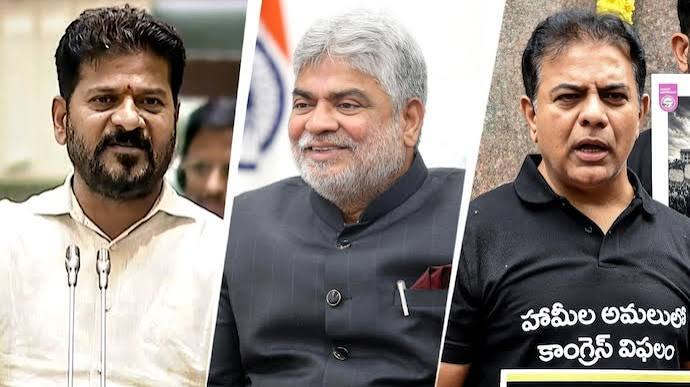
Two BRS MLCs were arrested over alleged remarks against Telangana Assembly Speaker Gaddam Prasad Kumar, triggering protests and demands for an apology from KCR. KTR and other party leaders were detained as the BRS accused the Congress government of suppressing the Opposition. A full-blown political war erupted in Telangana on Tuesday after police arrested two BRS MLCs over allegedly derogatory remarks against Assembly Speaker Gaddam Prasad Kumar. The Congress called the remarks an insult to Kumar, a Dalit leader, and demanded an apology from BRS supremo K Chandrasekhar Rao. Congress workers and Dalit activists also marched towards KCR’s farmhouse. The BRS accused the ruling party of using the controversy to cover up its failures and renewed its allegations of police high-handedness against its women legislators. WHAT TRIGGERED THE ROW The controversy began on Monday after the Speaker’s Officer on Special Duty accused BRS MLCs Thatha Madhusudan and N Naveen Kumar Reddy of making derogatory remarks against him. The complaint alleged that the two MLCs launched a “malicious, unprovoked and premeditated verbal tirade” targeting the Speaker’s integrity, authority and constitutional conduct. However, Madhusudan denied making any derogatory remarks and expressed regret if they had hurt the Speaker. The government also accused BRS leaders of attacking officials and removing their shirts in the presence of women officials. The BRS countered by alleging that former ministers Sabitha Indra Reddy and Sunitha Lakshma Reddy were surrounded, dragged and manhandled by the police. TWO BRS MLC ARRESTED A case was registered against Madhusudan and Reddy at the Saifabad police station under relevant provisions of the Bharatiya Nyaya Sanhita and the Scheduled Castes and Scheduled Tribes (Prevention of Atrocities) Act. Both MLCs were arrested on Tuesday. Chief Minister A Revanth Reddy described the alleged remarks as an insult to Telangana’s four crore people. Reddy and Deputy Chief Minister Mallu Bhatti Vikramarka later met the Speaker and assured him that action would be taken against those responsible. ASSEMBLY SEEKS KCR APOLOGY The Telangana Assembly adopted a resolution condemning the alleged remarks and called on KCR to take responsibility for his party members’ conduct and tender an unconditional apology. The resolution also condemned the two MLCs for allegedly removing their T-shirts in public in the presence of women. The House decided to forward the resolution to the Legislative Council chairman for appropriate action against the two MLCs. PROTEST REACHES KCR’S FARMHOUSE The row then spilled out of the Assembly as Congress workers and Dalit activists marched towards KCR’s farmhouse at Erravelli, accusing the BRS of insulting Dalits. However, police stopped the protesters before they could reach the farmhouse. KTR and other BRS leaders left the Assembly for Erravelli but were stopped and taken into preventive custody over possible law and order concerns. He alleged that police were allowing Congress workers to approach the farmhouse while preventing BRS leaders from reaching it. He also accused the ruling party of trying to attack KCR. BRS HITS BACK AT CONGRESS The BRS Working President accused the government of using the Speaker as a shield to divert attention from its failures and silence the Opposition through arrests and police cases. He demanded an apology from the government over the alleged mistreatment of the two women BRS MLAs. The former minister also targeted the Congress over its alleged failure to fulfil election promises related to jobs, farm support, unemployment assistance and welfare benefits. Abdul Basheer Courtesy : India Today Note: This news is originally published on https:/indiatoday.com/bha and is used purely for non-profit/non-commercial purposes, especially human rights
Samajwadi Party ready to adapt to Gen Z, adopting blue along with green and red
The Samajwadi Party is introducing a new dress code for its student wing. The party has adopted blue along with its traditional iconic colors, green and red. Through this color, the SP aims to connect with the youth and Dalits. The Samajwadi Party is adopting blue as its symbol along with green and red. Parvez Iqbal Siddiqui, Lucknow: Red and green have been the official colors of the Samajwadi Party (SP) since its inception. The SP was founded on October 4, 1992. Since then, its symbols have remained red and green. However, the SP is now expanding its symbolism and is also adopting blue. Blue is a powerful symbol of Dalit resistance. Blue T-shirts and jeans for the student wing The Samajwadi Party’s student wing, called the Samajwadi Chhatra Sabha, is ready to adopt a completely new and modern look. It resonates better with Gen Z. It’s a dress code that includes a blue T-shirt and jeans, or a shirt and trousers of the same shade. Akhilesh and Shivpal in Blue Scarves This isn’t the first time blue has been included in the SP’s official colors. Recently, on August 31, during a meeting of the party’s district and city presidents across the state, senior party leaders, including SP chief Akhilesh Yadav and National General Secretary Shivpal Yadav, were seen wearing blue scarves with the party’s election symbol, the bicycle, printed in red. The blue scarves were different from the previous red and green scarves, which were replaced by a red-checked gamchha during the 2024 Lok Sabha elections. When asked about the blue scarves, party officials deflected the question. Blue to woo Dalits SP officials claim that the color blue was adopted because it represents the vast open sky, under which everyone is equal and free from caste-based discrimination. It is a different matter that it was also the favorite color of Dr. B.R. Ambedkar. Blue has also been the color of Dalits. This community is now an important part of the Samajwadi Party’s PDA agenda. It is believed that the party leadership may formally announce the new dress code for the Chhatra Sabha at a special event to be held at the SP headquarters in Lucknow in the next few days. Choice of Color Popular with Youth According to sources, the SP leadership has decided to give the members of the party’s student wing a distinct identity from the rest of the party’s organizations. However, sources said that the red and green colors have been retained in the Chhatra Sabha’s logo, its basic elements, shape, and color scheme. Party strategists say that since the Chhatra Sabha comprises mostly Gen Z students, the party leadership decided to choose colors popular among the youth. Edited by: Suryakant Pathak About the Author Suryakant Pathak is a consultant at Navbharat Times (Digital). He has been associated with the digital wing of Navbharat Times, part of the Times of India Group, since June 2025. Suryakant Pathak serves on the Bihar desk at NBT Digital. Courtesy: Hindi News
After Thalapathy Vijay’s TVK, Rahul Gandhi’s PM candidacy suffers another major setback, CPM says Congress should not rush.
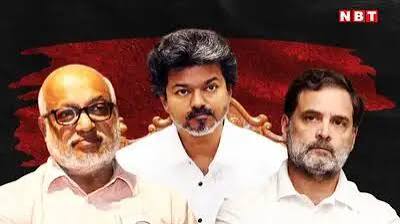
The Congress party is unwilling to accept anything less than Rahul Gandhi’s PM candidacy in the India Bloc. However, its support base in the alliance is eroding in South India over this issue. Following TVK, the CPM has declared that Congress is not doing the right thing. Congress’s hopes for Rahul Gandhi are facing a setback from South India itself (Photo – NavbharatTimes.com) New Delhi: In Tamil Nadu, Chief Minister Thalapathy C. Joseph Vijay’s party, TVK, declared him the opposition’s prime ministerial candidate for 2029, infuriating his ruling ally, the Congress. The party immediately declared that Rahul Gandhi would be its candidate, and no one else could be. Now, the CPM has also stated that Congress is rushing things, as nothing has been finalized within the India Bloc. Blow to Rahul Gandhi from South Indian States Congress leader Rahul Gandhi was the by-default leader of the opposition alliance, the India Bloc, in the 2024 Lok Sabha elections. Under his leadership, the party won a record 99 seats in the last three elections. Of these, 42 came from South Indian states alone. However, it now appears that Congress allies in South India have rejected Rahul Gandhi’s leadership of the India Bloc and his potential candidacy for the post of Prime Minister in the 2029 Lok Sabha elections. ‘Declaring Rahul as the Prime Ministerial candidate is illegitimate’ The CPM is a key ally of the Congress Party in the India Bloc. Furthermore, the CPM is also the leader of left-wing parties across the country. In an interview with our sister English newspaper, ET, CPM General Secretary MA Baby made it clear that Congress is making a gross mistake by projecting Rahul Gandhi as a Prime Ministerial candidate, as the India Bloc has not yet made any such decision. The India Bloc has not made any decision to project anyone as our Prime Ministerial candidate for the 2029 general elections. We have not even discussed this issue. Therefore, it is premature and illegitimate for Congress leaders to declare Rahul Gandhi as the India Bloc’s prime ministerial candidate for the 2029 elections. MA Baby, CPM General Secretary Our candidate is Rahul Gandhi – Congress Earlier, when the ruling TVK in Tamil Nadu attempted to portray Chief Minister C. Joseph Vijay as a strong opposition PM candidate in the upcoming elections, Congress was enraged. State Congress President Manickam Tagore made it clear that the party would not compromise on Rahul Gandhi’s name. Our candidate is Rahul Gandhi. There is no doubt about this. Manickam Tagore, State Congress President, Tamil Nadu TVK MLA declares Vijay as PM candidate In fact, the controversy over the PM candidacy among India Bloc allies began when Kanimozhi Santosh, MLA of the ruling TVK in Tamil Nadu, said that Rahul Gandhi, the Leader of the Opposition in the Lok Sabha, would help TVK President and Tamil Nadu CM C. Joseph Vijay become Prime Minister in 2029. It was Rahul Gandhi who placed our leader (CM Vijay) in the Chief Minister’s chair. Similarly, in 2029, Rahul Gandhi will hold our leader’s hand and take him to the Prime Minister’s chair. Kanimozhi Santosh, TVK MLA Arguments against Rahul Gandhi’s candidacy The CPM General Secretary says that the India Bloc was formed to defeat the Modi government. When the India Bloc wins against the Modi government, the parties in the alliance will decide who will be the Prime Minister. He said that even Manmohan Singh’s name was not finalized earlier. Some Congress leaders are probably talking about making (Rahul) Gandhi the PM candidate because he is the Leader of the Opposition in the Lok Sabha. However, Mallikarjun Kharge, in addition to being the Congress President, is also the Leader of the Opposition in the Rajya Sabha. MA Baby, CPM General Secretary ‘Congress has the right to stake claim if India Bloc wins’ The India Bloc leader says, “In the past, we have seen some regional parties come together after the elections and stake claim to form the government, which Congress had to support from outside.” However, if India Bloc wins the elections, Congress can stake claim to the PM post, just as some other (allied) parties can. MA Baby, CPM General Secretary Authored by: Anjan Kumar About the Author Anjan Kumar is an Assistant Editor at Navbharat Times Online and has been a journalist for over 24 years. Anjan joined Navbharat Times Online in April 2025 and has been writing on topics such as politics, elections, judiciary, defense, foreign affairs, current affairs, and business in digital media for the past 10 years. Courtesy: Hindi News
A man released on bail has now been arrested under the Protection of Children from Sexual Offences (POCSO) Act… Accused of raping a Dalit minor in Mathura

A man released on bail in Mathura has been accused of raping a Dalit minor. Police have registered a case under the Protection of Children from Sexual Offences (POCSO) and the SC/ST Act and arrested him. In Mathura district, Uttar Pradesh, a man released on bail has been arrested for raping a Dalit minor. According to the agency, an official statement stated that the accused, identified as Jai Kishan (25), a resident of Mora village, was apprehended by local police near the Bati Maghera crossing on September 5. Police sources stated that on September 3, the minor girl was working in the fields when Jai Kishan took her to a nearby secluded area and raped her. They stated that Kishan threatened the girl with dire consequences if she told anyone about the incident and fled. A case has been registered under several sections… Sources said that based on the complaint, a case has been registered against Kishan under sections 65(1) (rape) and 351(3) (criminal intimidation) of the Indian Penal Code, as well as several sections of the Protection of Children from Sexual Offences (POCSO) Act and the Scheduled Castes and Scheduled Tribes (Prevention of Atrocities) Act. The accused has been involved in several crimes before… According to police sources, the accused has a prior criminal record and was released from jail on bail about a year ago after serving a three-year sentence. They said that in 2022, Jai Kishan was involved in a fight with a man from his village, during which he allegedly gouged out the victim’s eyes with his fingers. Police said that after his arrest on September 5, the accused was produced in court. Further legal action is underway in the case. Edited by: Mohammad Saqib Majeed Courtesy: Hindi News
Akhilesh wears blue scarf instead of red:SP student wing members to switch to blue T-shirts and jeans; party targeting Dalits or Gen Z?
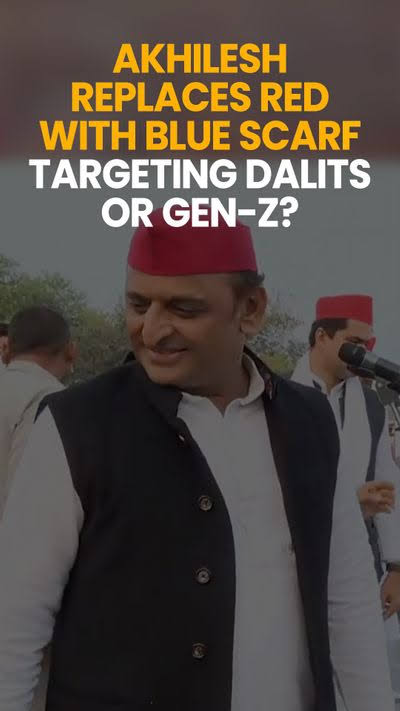
From Parliament in Delhi to election rallies in Uttar Pradesh, Akhilesh Yadav has often been seen wearing a red scarf and red cap. Along with the kurta-pyjama, these have become something of a dress code for Samajwadi Party leaders, giving office-bearers a distinct identity much like the party flag and symbol. But at a meeting of district presidents held in Lucknow on August 31, 2026, Akhilesh was seen wearing a blue scarf around his neck. Six days later, a message reached workers of the Samajwadi Party’s student wing, Samajwadi Chhatrasabha, telling them they would now wear blue T-shirts and jeans. Until now, they had worn maroon shirts and white trousers. The SP organisation has also sent blue T-shirts to student leaders, bearing the Samajwadi Chhatrasabha logo. This is the wing that remains active among students in universities and colleges across Uttar Pradesh. Is the SP using these changes to woo Dalit voters or Gen Z ahead of the elections? Read the report… Understand the change in the SP’s dress code August 31- District presidents’ meeting A meeting of district presidents and metropolitan presidents from all 75 districts was held at the Samajwadi Party office in Lucknow. The agenda was election preparations. Everyone wore red scarves around their necks. When Akhilesh Yadav arrived on stage, Shivpal was with him. Neither was wearing the usual red scarf. Both were wearing blue scarves instead. It was an unspoken message to party office-bearers. However, when Akhilesh was asked about the blue scarf, he replied in a measured tone, “The weaver brothers made it for us. So that we look a little different.” He then laughed. September 6- Message reaches Chhatrasabha workers Samajwadi Chhatrasabha is the SP’s student wing. It too has a dress code, with members wearing maroon shirts and white trousers. This was changed on September 6. Student workers have now been sent blue T-shirts and jeans. The T-shirts feature the Chhatrasabha logo and a bicycle. However, the SP’s official launch of the new dress code is scheduled for September 8. What is Akhilesh trying to achieve with the colour blue? Akhilesh Yadav has been seen wearing blue scarves before, particularly on occasions such as BR Ambedkar’s birth anniversary or at rallies in Dalit-dominated areas. According to political analysts, the SP is pursuing two major objectives through the change: Dalit vote bank – Dalits account for 21.1% of Uttar Pradesh’s voters. Wearing a blue scarf is an attempt to send the message that the SP is now a direct claimant to the politics of Dalit rights. As the BSP’s political base in UP continues to weaken, the SP wants to take over that space completely. In political history, blue has long been a symbol of Ambedkarite ideology and Bahujan politics. Through this, the SP wants to give its PDA (backward classes, Dalits and minorities) slogan a visual identity, rather than leaving it confined to speeches. Gen Z and young voters – Samajwadi Chhatrasabha has units in 80 universities and more than 8,000 colleges across UP. Until now, its members were seen in maroon shirts and white trousers. The party believes blue jeans and T-shirts will make it easier to connect with students on university and college campuses. Message to Dalits through blue, will it help? Until 2022, a large section of Dalits, particularly non-Jatavs, along with non-Yadav OBC voters, remained a strong support base for the BJP. The trend changed in the 2024 Lok Sabha elections. The ‘Constitution is in danger’ narrative and Akhilesh Yadav’s PDA strategy led to a rapid shift of the BSP’s traditional Dalit vote, along with non-Jatav Dalit and OBC voters who had moved away from the BJP, towards the SP-Congress alliance. As a result, the BJP was reduced to 33 seats in UP, while the SP emerged as the largest party with 37 seats. Akhilesh is once again trying to build the same narrative just before the elections, in an effort to secure Dalit voters’ support in the Assembly polls. Blue is considered a symbol of equality and equal rights. It can also be seen as a symbol of the thinking of Dr Ram Manohar Lohia and Dr BR Ambedkar. This is a student organisation, so changes are being made to increase youth participation. We are not limited to UP; we are also doing good work in Delhi and Madhya Pradesh. This new dress code will apply to the entire Chhatrasabha organisation across the country. Since the 2019 Lok Sabha elections, the BSP’s influence has become more deeply embedded in the SP. This was the period when the Samajwadi Party and Bahujan Samaj Party entered into an alliance for the Lok Sabha elections.The alliance broke up after the elections. After that, several prominent BSP leaders left the party and joined the SP. These included major Dalit faces such as Inderjit Saroj, RK Chaudhary and Tribhuvan Dutt. The SP then also began observing the birth and death anniversaries of Dalit icons, including Dr BR Ambedkar and Kanshi Ram.Before long, the backdrop at the Samajwadi Party office changed. Pictures of various Samajwadi leaders replaced the bicycle that had been on the backdrop. Along with green and red, blue was also added. Since then, Akhilesh Yadav has increasingly been seen wearing blue scarves on different occasions. Every colour has its own meaning. All Bahujan people identify with the colour blue. As for the dress code, changes happen in everything from time to time, and this is also being changed. It may be premature to link it to vote-bank politics. Our party works in line with what today’s youth and students think. Syed Yasir Raza | Lucknow Courtesy : Bhaskar English Note: This news is originally published on https:/bhaskarenglish.com/bha and is used purely for non-profit/non-commercial purposes, especially human rights
SP to field Dalit candidates on general seats as well! Efforts to strengthen PDA, Gen-G candidates to get opportunities
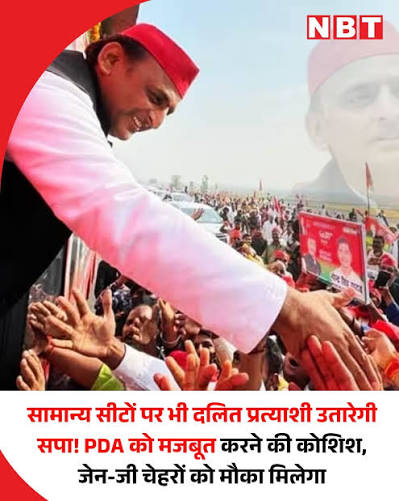
In view of the PDA’s success in the 2024 assembly elections, the Samajwadi Party is preparing to field Dalit candidates on general seats as well. Anand Tripathi, Lucknow: In view of the PDA’s success in the 2024 assembly elections, the Samajwadi Party is preparing to field Dalit candidates on general seats in addition to reserved seats. The party has indicated it will field Dalit candidates on approximately 14-15 general assembly seats in addition to the reserved seats. The party has instructed potential candidates to prepare for these seats. If this plan is implemented, the total number of Dalit and tribal candidates for the SP could reach around 100. In the 2024 Lok Sabha elections, the SP also fielded Dalit candidates on two general Lok Sabha seats. Avdhesh Prasad won the Faizabad seat. In Meerut, the SP candidate lost in a close contest. Which seats are in focus? The SP may field Dalit candidates on general seats such as Sarojininagar in Lucknow, Unchahar in Rae Bareli, Chauri Chaura in Gorakhpur, Agra North, Meerut Sadar, and Hardoi Sadar. Furthermore, there are several assembly seats in Purvanchal where the party is preparing to field Dalit candidates on general seats. Of the 403 seats in the Uttar Pradesh Assembly, 84 are reserved for Scheduled Castes (SCs) and two for Scheduled Tribes (STs). The party is particularly focusing on areas where Dalit voters constitute 20 to 25% and are in a position to influence election results. Who will get the opportunity? The party is preparing to field Dalit candidates on general seats, which will include junior-level candidates. Young leaders associated with the Samajwadi Party Chhatra Sabha and Lohia Vahini may also be considered. Part of Strengthening the PDA Formula According to senior SP leaders, this strategy is part of further strengthening the party’s PDA (Backward, Dalit, and Minority) formula. The party believes that the PDA’s social mobilization paid off in the 2024 Lok Sabha elections, and preparations are underway to further expand this model in the assembly elections. The Dalit vote has long been the BSP’s mainstay in politics, but the BSP’s performance has consistently weakened in the last few elections. Consequently, the SP believes that a large segment of the Dalit community is looking for new political options. This is why the party is organizing PDA conferences across the state, with the Ambedkar Vahini actively participating. Edited by: Pawan Nautiyal About the Author Pawan Nautiyal works as a consultant writer for the Uttar Pradesh and Uttarakhand sections of Navbharat Times. He has over 14 years of extensive journalistic experience in print, electronic, and digital media. Originally from Uttarakhand (Uttarkashi), Pawan has a deep understanding of the politics, socio-economic issues, crime and utility news of both the states. Courtesy: Hindi News
Shedding old AHINDA allies, Congress leader Siddaramaiah plans to revive ‘HINDA’ with new team
During his recent visit to Siddaramaiah’s Varuna Assembly constituency in Mysuru district, Dr Parameshwara had reportedly suggested that Dalits should groom Yathindra as a future leader. BENGALURU: Former Chief Minister Siddaramaiah and Deputy Chief Minister Dr G Parameshwara appear set to revive the Congress’ HINDA (Kannada acronym for Backward Classes and Dalits) plank to consolidate its Backward Classes and Dalit support base ahead of the 2028 Assembly elections. A Backward Classes Federation rally to felicitate Siddaramaiah at Bengaluru’s Palace Grounds on Sunday is expected to showcase the emerging social coalition, with Dr Parameshwara likely to take centre stage at the event. The rally may pose a subtle political threat to CM DK Shivakumar who is likely to project himself as the Congress’ CM face in 2028. Siddaramaiah had successfully championed the AHINDA (Kannada acronym for minorities, backward classes and Dalits) plank, which played a key role in his becoming CM twice. However, in the changed political scenario, with some of his erstwhile associates, including Public Works Minister Satish Jarkiholi and Housing Minister BZ Zameer Ahmed Khan, seen distancing themselves from him, Siddaramaiah is now expected to focus on rebuilding the HINDA coalition with a new set of leaders, political analysts opine. Siddaramaiah’s son and Urban Development Minister Dr Yathindra could also be projected as his ideological successor at the rally, particularly as sections of the Kuruba community have been keen to see him emerge as a future leader, sources said. During his recent visit to Siddaramaiah’s Varuna Assembly constituency in Mysuru district, Dr Parameshwara had reportedly suggested that Dalits should groom Yathindra as a future leader. The move is being seen as a reciprocal gesture towards Siddaramaiah, who had backed Dr Parameshwara for the CM’s post and later played a role in him getting the DCM position. Siddaramaiah had recently said he lobbied with the Congress high command to restrict the government to a single Deputy CM so that Dr Parameshwara could get the post. Dr Parameshwara, in turn, promptly acknowledged Siddaramaiah’s role. Against this backdrop, Dr Parameshwara is likely to be projected as the prominent Dalit face of the Siddaramaiah camp and potentially as one of the contenders for the CM race ahead of the 2028 polls, analysts said. The guest list for Sunday’s event has also attracted attention. Several prominent leaders associated with Siddaramaiah’s earlier AHINDA campaign, including Satish Jarkiholi, Zameer Ahmed Khan and former minister Dr HC Mahadevappa, have not been invited. In contrast, KPCC president BK Hariprasad and ministers Santhosh Lad, Puttaranga Shetty, Madhu Bangarappa, Byrathi Suresh and Ajay Singh, besides former minister KN Rajanna, have been invited. However, KM Ramachandrappa, president of the Karnataka Rajya Hindulida Jaatigala Okkuta, said there was no political motive behind the guest list. “As the event is being organised to mark the silver jubilee of the Okkuta, only Backward Classes leaders have been invited. We have invited Dr Parameshwara as a representative of the government and will submit certain demands, including implementation of the Backward Classes survey report,” he told The New Sunday Express. Chairman of the Karnataka State Backward Classes Commission Madhusudhan R Nayak and former commission chairpersons Prof Ravivarma Kumar, H Kantharaju and Jayaprakash Hegde have also been invited to the event. Devaraj B Hirehalli Courtesy : TNIE Note: This news is originally published on https:/thenewindianexpress.com/bha and is used purely for non-profit/non-commercial purposes, especially human rights
Not all colours of the rainbow: How this new short film dives into the life of the LGBTQIA+ community, and more
What happens when you can be a transperson with your lover, but scared of coming out as Dalit? The short film Tara is looking for that answer, and an OTT home Often, the intersections that make a person, doesn’t fit into our version of reality. Tara, a 20-minute fictional film, beautifully puts across the conundrum of which part of ourselves is palatable to our nearest and dearest, even a lover. The protagonist of the movie, Tara, is a transwoman who falls in love with a heterosexual man. Tara is tapped into her female sensuality, and so when she meets Aman, the frontman of the band that is playing at a party, their chemistry is palpable. Writer-director Ashutosh S Shankar, who is a psychology graduate and spends his time between Mumbai and Pune, is a queer Dalit and explains that the story came out from the conversations of between his trans friend in Pune and him. “She and I kept talking about how we are forced to manoeuvre our way around our identities,” he says. The 26-year-old was more inclined to movies since his childhood. “I tried my hand at filmmaking. I did a couple of internships, I even worked at a production houses and took up director’s assistant gigs for a couple of years. At the same time, I was writing a bunch of scripts, getting a certain worldview of the politics, coming from the community. But I was also trying to make sense of these identities. I kept asking myself ‘How do I make sense of this?’” he adds. One of the things that really stood out to us was that when Tara takes Aman back to her place she asks him to wait outside the door for two minutes. When she finally opens the door to let him in there is a wall that seems to be missing a frame, only the rectangle imprint remains. Most might miss it, but for those who know, know. That comes from a personal experience of Shankar’s, he tells us. “Whenever my father’s colleagues would come home, we would hide Babasaheb’s portrait and it was after many years when we as a family decided that we are no longer going to do this anymore,” he explains. The expression on Tara is one of guilt and helplessness as she puts back the frame on the wall after Aman leaves. As we see Tara fall in love, we also see her fear developing — the fear of being found out — a fear that many from the Dalit community suffer from while navigating the world. “Right now am I in a position that I can say who I am, but many of us can’t because there are real life consequences that have to do with you earning a living if you come and say you are a Dalit,” he says. The movie is also produced by Zena Sagar, who herself is a transwoman, and has been one of the agitators leading the Against Trans Bill Campaign against the Transgender Persons (Protection of Rights) Amendment Act, 2026 which came to effect in March. “When we began making the movie a year ago, the Transgender Act was not there and now the release of the film is even more vital. People like Zena and hundreds of trans persons have been at the receiving end of transphobia and have been completely stripped of their autonomy,” he says. Currently, the film has been featured at film festivals, and the producers and Shankar are trying to find a limited release or even an OTT platform, but it has been difficult. “A theatre release is difficult for short films because of the duration so we are trying for some kind of OTT release, but the terms are very unfair,” he says. “One OTT platform offered us only Rs 40,000 which is not even a fraction of what it took us to make the movie to make with the additional rider that we cannot show the movies at any festivals. While it works for many, I am holding out for something better,” he adds. We hope Shankar finds someone because otherwise how will you know what happened between Aman and Tara? Our lips are sealed. Arpika Bhosale Courtesy : Mid-Day Note: This news is originally published on https:/mid-day.com/bha and is used purely for non-profit/non-commercial purposes, especially human rights