
‘500 farmers join CJP protest’: Sonam Wangchuk gets support from Rakesh Tikait, Kejriwal at ‘packed’ Jantar Mantar
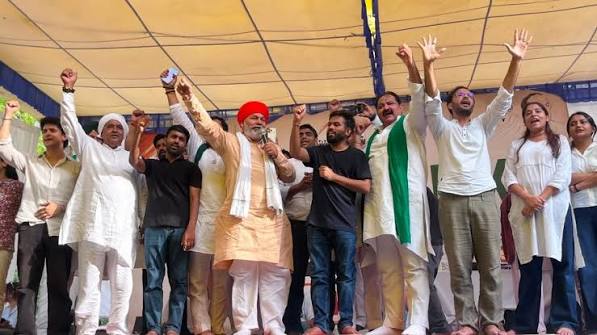
NEW DELHI: Climate activist and educator Sonam Wangchuk’s protest gathered fresh momentum on Thursday as farmer leader Rakesh Tikait reached New Delhi’s Jantar Mantar with around 500 farmers, strengthening the ongoing agitation against the Centre and adding to the demand for Union education minister Dharmendra Pradhan’s removal over the NEET fiasco. The development came as Wangchuk’s indefinite hunger strike entered its 19th day, with doctors warning that his health has become increasingly fragile after he lost more than 9 kg. Welcoming Tikait’s support, the Cockroach Janta Party (CJP) posted on X, “jhukti hai sarkaar, jhukane wala chahiye!” The protest also received backing from several opposition leaders and parties on Thursday. After remaining silent for weeks, the Congress made its first official intervention, reaching out to Wangchuk and urging him to end his indefinite fast while assuring him that the party would continue to demand Dharmendra Pradhan’s removal. The appeal came on the 19th day of Wangchuk’s hunger strike. Congress general secretary K C Venugopal said, “we share the anguish and outrange the Wangchuk feels, especially due to the lack of accountability within the Modi Govt – for the collapse of the examination system in particular.” Congress leader Sachin Pilot also expressed solidarity with the activist and appealed to him to end his fast. Referring to Rahul Gandhi’s stand, Pilot wrote on X, “The ordeal faced by students and their families due to the paper leak and various irregularities has shaken everyone. Rahul Gandhi ji and our party believe — the youth are the future of the country. No injustice of any kind will be tolerated against them. Students must get justice.” Earlier in the day, former Delhi chief minister and AAP supremo Arvind Kejriwal also joined the protest at Jantar Mantar and shared the stage with Wangchuk before a large gathering. Kejriwal demanded the resignation of Dharmendra Pradhan and went a step further by backing Wangchuk as his replacement. He said, “Exam papers are being leaked constantly, day after day. There are irregularities in the papers and flaws in the evaluation process… When the NEET paper leaked, 20 students committed suicide, yet the government took no measures to assure anyone that leaks wouldn’t recur. Further leaks followed the NEET incident, and the CBSE evaluation system was compromised, yet no action was taken against the company involved.” He added, “It appears the government is consumed by arrogance. I want to tell the government: either listen to the voice of the youth, or these very young people will throw you out of power in 2029… I urge the Prime Minister and the country’s 1.4 billion citizens to desire that Sonam Wangchuk be appointed as the education minister in his place.” Earlier in the day, Samajwadi Party MP Dimple Yadav also extended support to Wangchuk’s protest and visited Jantar Mantar. Moreover, apart from several senior opposition leaders, including Arvind Kejriwal, Mamata Banerjee and Akhilesh Yadav, the CJP-led protest has also drawn support from prominent public figures. Stand-up comedian Kunal Kamra and actors Swara Bhaskar and Prakash Raj visited Jantar Mantar to express solidarity with Sonam Wangchuk. Meanwhile, doctors treating Wangchuk warned that his condition continues to worsen as the hunger strike entered its 19th consecutive day. His attending physician, Dr Satish Lamba, cautioned that the activist could face multi-organ complications if the fast continues. Wangchuk began his indefinite hunger strike on June 28 after joining a protest organised by the Cockroach Janta Party (CJP). During a medical briefing, Dr Lamba said Wangchuk has lost more than 9 kg and now weighs 56.9 kg. His condition is being monitored round the clock by a team of doctors. “Today, on the 19th day of hunger strike, his total weight loss exceeds 9 kilograms. His blood sugar today is 80 mg/dL, and his pulse is 72 beats per minute. His blood pressure readings are 105/61 mmHg while lying down and 101/65 mmHg while sitting,” Dr Lamba reported. Doctors said Wangchuk remains hydrated and mentally alert, but medical tests show that his body has entered the second stage of prolonged starvation, significantly increasing the risk of serious health complications if the hunger strike continues. Courtesy : TOI Note: This news is originally published on https:/timesofindia.com/bha and is used purely for non-profit/non-commercial purposes, especially human rights
Kheri: 15-Year-Old Dalit Girl, Allegedly Raped, Dies by Suicide Days After Testifying Against Accused

A 15-year-old Dalit girl who was allegedly raped took her own life at her home in a village under Neemgaon police station in Kheri district on Monday. The teenager was found hanging from a noose inside her house, sending shockwaves through the local community. The case has become highly sensitive because the victim and the accused belong to different communities. Police officials acted quickly to prevent any unrest. Senior officers, including Superintendent of Police Khyati Garg and the local Chief Judicial Officer, rushed to the spot after receiving the news. Police forces have been deployed in the village to maintain peace and order. Accused Arrested Earlier This Month The tragedy follows a complaint filed by the girl’s mother on July 5. Based on her statement, police registered a case under Section 65 of the Bharatiya Nyaya Sanhita, which deals with rape of a girl under 16 years of age, along with relevant sections of the POCSO Act. According to the complaint, the 21-year-old accused, who lives in the same village, entered the girl’s house around 5 pm on July 5 when her family members were working in the fields. Police arrested him that very night and sent him to jail the next day. SP Khyati Garg shared details about the case. She said, “Preliminary investigation by the local officer has revealed that the girl and the accused were in a relationship for over two years. The victim had initially denied the rape allegations, but after the FIR was lodged, she confirmed them in her statement recorded before the court under BNSS Section 183.” Police Investigate Circumstances Leading to Suicide Authorities are now trying to understand what drove the young girl to take such a drastic step. Police have not ruled out the possibility that she was under severe emotional stress after giving her testimony against the accused in court. A police official speaking on the condition of anonymity said, “Testifying in such cases can be extremely traumatic for young survivors. We are looking into all aspects of what she went through in the days after her statement.” The girl’s body has been sent for postmortem examination. Officials have made it clear that further legal action will depend on the postmortem report findings. A local resident who knew the family shared, “She was such a young girl. Her family is devastated. No one expected this to happen.” The incident has raised fresh concerns about the mental health support available to survivors of sexual violence, especially those from marginalized communities. Police continue to investigate all circumstances that led to this heartbreaking event. Courtesy : TOP Note: This news is originally published on https:/theobserverpost.com/bha and is used purely for non-profit/non-commercial purposes, especially human rights
CO Soumya Asthana, who was investigating the Lalita Gautam murder case in Meerut, has been removed; CO Ramprakash will take over the investigation.

A major reshuffle has been made in the Meerut Dalit student murder case. CO Soumya Asthana, who was investigating the Lalita Gautam murder case, has been removed. A departmental inquiry has also been initiated against her. A departmental inquiry has been initiated against CO Soumya Asthana The newly appointed CO of Brahmapuri will investigate the murder case. The Lalita Gautam murder case has been in the news across the state. Rambabu Mittal, Meerut: A major administrative change has been made in the investigation of the infamous Dalit student Lalita Gautam murder case. CO Soumya Asthana, who was investigating the case, has been removed from the investigation. Her jurisdiction has also been changed. The investigation of this highly controversial murder case has now been handed over to the newly appointed CO of Brahmapuri, Ramprakash. Investigation initiated against CO Soumya Asthana According to sources, an internal departmental inquiry has also been initiated against CO Soumya Asthana. He is accused of being lenient towards some of the accused in the case and attempting to provide them relief during the investigation. In light of these allegations, the police department has decided to change the investigating officer. However, the department’s final conclusion on these allegations will only be revealed after the departmental inquiry is complete. The Lalita Gautam murder case has been a topic of discussion across the state since its inception. The victim’s family and various social organizations have consistently demanded a fair investigation. Meanwhile, the decision to change the investigating officer is being considered a significant administrative step in the case. PAC constable Ankit remains in the news The most discussed aspect of the case has been the accused, Ankit, a constable in the PAC. It is reported that during the initial investigation about 50 days ago, it was stated that insufficient evidence was found against him. However, events quickly changed, and following the lathi charge during a Dalit protest, the police arrested and jailed the accused, Ankit. This action raised many questions about the investigation process and the role of the police. CO Ramprakash will investigate As the new investigating officer, CO Ramprakash will thoroughly review the entire case again. Police officials say that all available evidence, witness statements, and technical facts will be examined impartially to bring the investigation to a logical conclusion. Victim’s family hopes for justice The change of investigating officer in the Lalita Gautam murder case and the initiation of a departmental inquiry have once again brought the case into the spotlight. All eyes are now focused on the new investigation. The victim’s family hopes that the new investigation will be impartial and that effective action will be taken against the culprits based on the evidence. It will also reveal whether there was any negligence or bias in the departmental investigation. Edited by: Vivek Mishra About the author Vivek Kumar Mishra is a Senior Digital Content Producer at Navbharat Times Online (NBT.Com). He monitors the political developments in Uttar Pradesh. UP Political Analysis, keeping an eye on the events taking place in Uttar Pradesh. Courtesy: Hindi News
Lights, camera, caste

This remarkable compendium of scholarship on the intersection of caste and Indian cinema opens up a conversation that goes beyond the portrayal of characters on screen. For several decades, scholars believed that caste does not exist in Indian cinema, or if it does, that it could be studied only through the oppression of Dalits or lower castes. Making a significant departure in cinema studies, The Routledge Companion to Caste and Cinema in India emphasises that caste is an everyday phenomenon in India, and so is its representation in cinema—both on the screen and behind the scenes. The volume, co-edited by Joshil K. Abraham and Judith Misrahi-Barak, begins on a provocative note. The editors note in their Introduction that a year before Raja Harishchandra (1913) was released, a filmmaker named Ramchandra Gopal Torne had already released Shree Pundalik. If Dadasaheb Phalke, and not Torne, came to be known as the father of Indian cinema, was it because the former was born in a Chitpavan Brahmin family? Misrahi-Barak is currently Professor Emerita at the University of Montpellier Paul-Valéry. Abraham, a brilliant scholar, tragically ended his life in December 2025, when he was just 43. The two editors had earlier collaborated on a volume, Dalit Literatures in India (Routledge, 2015). The present work extends the discussion from Dalits to the entire spectrum of caste. The volume brings together 29 essays on various films produced in different Indian languages over the last 100 years. Some contributors are renowned scholars associated with different institutions across continents, while some are young researchers. Such is the staggering spectrum of the films examined that even an ardent cinema lover might find several titles unfamiliar. This volume, which brings together 29 essays on films made in different Indian languages over the last 100 years, helps us understand not only how caste is depicted and received in cinema, but also how it operates in society at large. This volume, which brings together 29 essays on films made in different Indian languages over the last 100 years, helps us understand not only how caste is depicted and received in cinema, but also how it operates in society at large. | Photo Credit: By special arrangement The Routledge Companion to Caste and Cinema in India Edited by Joshil K. Abraham and Judith Misrahi-Barak Routledge India Pages: 440 Price: Rs.1,595 The films can be divided into three broad categories: those which bring a clearer focus on caste, those that invisibilise caste, and the ones that have not been perceived as about caste at all. It is here that the volume often becomes most penetrating. Lagaan (2001) and Chak De! India(2007) are projected as nationalistic works that seek to dissolve sectarian differences and unite the nation. Such is the power of a nationalistic theme that most scholars missed the uneasy matrix of caste that dominates the narrative. In the former, it is thanks to the kindness of the privileged-caste protagonist Bhuvan that the untouchable Kachra gets a place in the team. In the latter, it is the Brahmin Vidya Sharma who alone can captain the hockey team. In his essay, “‘Untouchable’ Body, Labour and Remuneration in Lagaan”, the scholar Purnachandra Naik argues that Kachra serves the role of a subservient and selfless untouchable, the ideal image of a Dalit that Mohandas Karamchand Gandhi had once envisaged. Commenting on the popular reception of Kachra’s role, Naik writes that he is the surplus labour(er) who is “not only expropriated on screen but also commodified and treated off screen for sadistically casteist popular consumption and profit”. Clearly, films made on progressive themes may also betray the caste biases of the filmmaker. In an incisive essay titled “Caste Voyeurism and Kannada New Wave Cinema”, Mahima Raj C. examines two iconic movies to argue that even the dead bodies of oppressed castes receive unfavourable treatment on screen. The corpse of a Brahmin man is at the centre of the narrative in Samskara (1970), and the corpse of a Dalit man in Grahana (1978)—but the two are not shown in the same way. The Brahmin’s corpse and its final rites consume a large part of the theological debate in the movie, based on the eponymous novel by U.R. Ananthamurthy. But the body is never shown entirely on the screen, except for the shot when he dies—a close shot of his face with mouth wide open. By contrast, Grahana “runs wild” in its portrayal of the Dalit man’s “degenerating body images”. Elite filmmakers, distanced from reality One also senses that as India sees increasing political assertion by oppressed castes, elites have become more distanced from the reality. Is it their coping mechanism to avoid the questions that now land with greater force? Consider this. When Achut Kanya (1936) was being made, its director Himanshu Rai and producer Franz Osten worked to erase caste divisions on the set. Not only did every crew member eat together at the canteen, but Rai even asked the protagonist Ashok Kumar Ganguly to drop his Brahmin surname. In the following decades, several eminent male actors would go simply by “Kumar” . It was a quiet transformation that India could once undergo. In absolute contrast, one can turn to the contemporary filmmaker Anubhav Sinha who is known for films that confront social reality. In an interview he gave after Article 15(2019), a film on caste violence, he proudly proclaimed that he did not know the caste of any of his 300 crew members. He simply deluded himself into believing that caste had vanished during the making of his film. Only those who have never been the victims of caste can afford that delusion. Obviously, then, in Article 15 it is a St. Stephen’s graduate, a Brahmin IPS officer, who alone can be the saviour of the Dalits. There is a sharp decline in the social consciousness of contemporary filmmakers when compared to the likes of Shyam Benegal and Govind Nihalani, who pioneered the new wave Hindi cinema in the 1970s. Caste and Cinema is a remarkable
Foundation stones laid for Dalit families’ homes at Pariyathukavu

Higher Education Minister Roji M. John inaugurating the foundation stone-laying ceremony for homes to be built for seven Dalit families under the Paryathukavu Unnathi project on Thursday. Higher Education Minister Roji M. John inaugurating the foundation stone-laying ceremony for homes to be built for seven Dalit families under the Paryathukavu Unnathi project on Thursday. | Photo Credit: R.K. Nithin Higher Education Minister Roji M. John on Thursday laid the foundation stones for houses of seven families belonging to a Dalit settlement at Pariyathukavu near Malayidamthuruth, close to Kizhakkambalam in Ernakulam. The houses are being funded by the State government as part of their rehabilitation on the same land. “Supporting marginalised sections of society is the policy of the State government, and the function exemplified this commitment,” Mr. John said after laying the stones. The Minister attributed the successful outcome to a collective effort involving Chief Minister V.D. Satheesan, ministers, the district administration, and a team of legal experts led by the Advocate General. The government will continue to support the families beyond the construction of houses, he said. Presiding over the function, Kunnathunadu MLA V.P. Sajeendran handed over the cheque for the advance amount to the building contractor. Benny Behanan, MP, attended. Each family will be provided with a 1,000-sq.ft. house, to be completed under government supervision within a year through sponsorship. The houses will have three bedrooms with attached bathrooms, a dining hall, a living room, a sit-out, and a kitchen. All seven families have been allotted five cents with road access. The dispute was amicably resolved last month after the family of the late Kannatt Sankaran Nair, who had won ownership rights over the land through a prolonged legal battle, agreed to allot five cents each to the seven families residing in the settlement within the 2.69 acres of disputed property. It was also agreed that the government would withdraw the cases registered against those who had protested during the 15 attempts to evict the families following a Supreme Court order The Hindu Bureau Courtesy : The Hindu Note: This news is originally published on https:/thehindu.com/bha and is used purely for non-profit/non-commercial purposes, especially human rights
From the memoir: What waiting in line at toilets taught a Dalit writer about social inequality
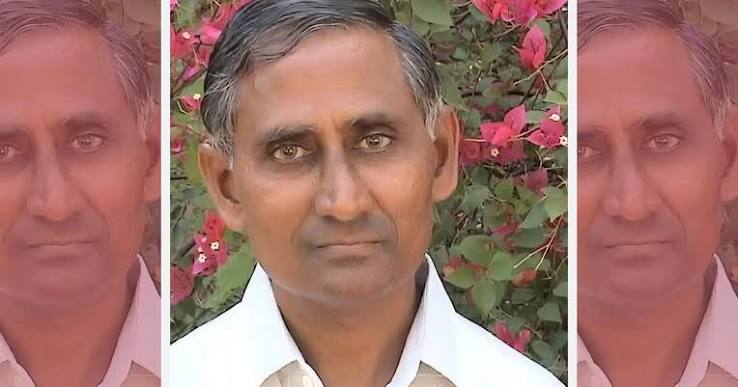
An excerpt from ‘Homes without Windows’, by Chandu Maheria, translated from the Gujarati by Hemang Ashwinkumar. I think my life shares as deep a bond with my excretory system as it does with my respiratory system, for whenever I jog my memory and drag it to the far end of my early childhood, the odd things that invariably surface on that mnemonic landscape are the sordid toilets of the neighbouring chawl, named after its owner Hiralal. And rightly so. For, as if the question of filling the bottomless pits of hunger was not vexed enough, the daily dilemma of emptying our bowels had made our lives, both personal and social, embarrassing and miserable. The rub was that our chawl didn’t have even a single public toilet attached to it, something that compelled us to use those hellish toilets of Hiralal’s chawl. Kids like us could squat anywhere on the footpath outside, but what would the elders do? And what about the women? Our chawl was inhabited in large part by the Rohits, people of the tanner caste, who had migrated from Charotar, a large swathe of fertile land covering districts like Kheda and Anand in central Gujarat. However, the rest of the chawls, including that of Hiralal, were populated by the Vankars, people of the weaver caste, from Mehsana, a district in north Gujarat. Deprived of the social respectability that separate toilets attached to one’s chawl brought, we had to sheepishly go relieve ourselves at Hiralal’s. Toilets of their own had got the Hiralalwallas inebriated with a sense of entitlement, so they threw their weight around, name-called us with slurs like the chanotara and let go of no opportunity to harass us. We too got even with them by calling them – not publicly, however – bloody patanwadia, the people from Patan district. And all this cheek was for toilets that were no better than hellholes. Can you beat that? Unlike the ones we commonly use these days, the floor of those toilets was not set in marble or glossy, ceramic tiles. With coats of plaster dropping off its walls, the goddamn structures sported big patches of brick-and-mortar design at several places. And in most cases, the lousy excuse for a door had neither a stopper nor a chain latch to boast of. Something that left the squatter on the edge throughout the business … to the mercy of Lord Rama, if you will. A soiled, soggy chamber pot, flanked by two parallelly placed uneven stones, was all one had in the name of a toilet seat. No marks for guessing, one of the stones would either be broken or on the verge of it, which made the whole human squat installation lean on one side. Even in such an awkward position, the user literally had to hold fast to the makeshift chain, or whatever that secured the rickety door, lest someone from outside pulled it open, out of innocence or sheer malice. As the wavy line of prospective users grew outside, a howl of protest from the disgruntled and impatient queuers soared, warning the user inside to make haste. At such moments, if someone snitched about such and such chanotaro occupying such and such toilet, the precariously hinged door would be yanked open with a bang and the water in the brass pot, carried for washing and flushing, would be drained with a resounding kick. Despite waiting in the queue till your legs ached, at the time of your turn, if a patanwadia kid materialised – God knows from where – you had to forgo your right to use the loo and give the queue-jumper the right of way. Again, a rowdy Vankar harrying a chanotari, filling her pitcher with water from the public tap, by thrusting his filthy toilet pot midstream and letting it overflow was a common sight. A strange thing to say but it was in these queues that I had learnt my first lessons in social inequality. All these people were extremely beleaguered, a harried lot that had come here to escape poverty, untouchability, oppression and exploitation, and yet they saw hierarchy and hatred as natural ways of being, such that even the slightest breach in the set order resulted in exchanges of expletives and blows. Though not untouchability in its conventional sense, these practices were rooted in direct discrimination, in an ordained difference between the high and the low, that had seeped right up to the bottom of the caste order. One scene in particular comes back to me repeatedly, no matter how hard I try to forget it. The first house at the mouth of our chawl was that of Bala Dhedh, a Vankar from Kheda and thus, a chanotaro for the patanwadia. In the “thatch” – a kutcha hut – attached to the house stayed Neno Ma’raj, a man of priestly Garoda caste, considered the highest among the Dalits. A mill worker of no consequence, Ma’raj would, in a blatant exhibition of his caste pride, lay his string cot out on the footpath every evening and lounge there like a maharaja, a veritable badshah holding his royal court. At such a time, the area became off-limits for everyone, even for a mangy-looking cur. For if the poor thing came up, barking or sniffing, from within the chawl, an affronted Ma’raj would fly into a lion rage, hurl a stick at it and roar, “Buzz off in, you … stay in ….” In his exhaustive, eye-opening study of the forms of untouchability practised by non-Dalits and Dalits (among themselves) in Gujarat, my friend Martin Macwan has pegged the numbers at ninety-eight and ninety-nine, respectively. Where would this kind of untouchability, and its distinctive, discriminatory form, figure in those lists? And in the dragnet of such divisions and sub-divisions, what happens to Dalit biradari, the idea of fraternity and caste solidarity? I have often wondered why we Dalits use the same word gandh [odour] to refer to both fragrance and stench. Perhaps, in
Dalit child beaten and locked in a straw room: Mother assaulted and subjected to casteist slurs in Shahjahanpur; FIR filed 15 days later on SP’s orders

A case of assault and alleged casteist harassment of a Dalit child and his mother has come to light in the Nigohi police station area of Shahjahanpur. It is alleged that a neighbor first beat the child and locked him in a straw room. The mother who went to rescue him was abused, subjected to casteist remarks, and assault. The victim alleges that the police did not take action on the initial complaint. Finally, after the intervention of the Superintendent of Police (SP), an FIR was filed 15 days after the incident. According to the FIR, the incident occurred around 3 pm on June 30 in Jathiura village. The victim’s son was playing outside the house. It is alleged that the neighbor, Sanjeev, grabbed him, beat him, and locked him in a straw-filled room. When the child’s mother went to rescue him, the accused also abused her, used casteist slurs, and threatened to kill the mother and son. Lives Saved When Villagers Arrive According to the victim, villagers rushed to the scene after she raised an alarm. Seeing the crowds approach, the accused fled, saving the mother and child. The victim alleges that she filed a complaint at the Nigohi police station on the same day as the incident, but no action was taken. She also filed a petition the following day, on July 1st, but no case was registered. She claims the police colluded with the accused and drove her away from the police station. Despite multiple complaints, no hearing was held. Entered the House and Pressured to Settle at Gunpoint The victim alleges that on July 6th, the accused entered her house, assaulted her, held a pistol to her chest, and pressured her to withdraw the complaint. He threatened to kill her if she resisted. The victim also alleges that a police inspector pressured her to reach a settlement, which frightened her and forced her to agree to the settlement. A case was filed after a complaint to the Superintendent of Police. The victim claims that the accused continues to threaten to implicate her in a false case and is also being pressured by the police. She subsequently complained to the Superintendent of Police. Following the SP’s intervention, an FIR was registered against the accused at the Nigohi police station. Police stated that action had previously been taken for breach of peace. Nigohi Inspector-in-Charge Rajiv Kumar stated that action had previously been taken against the accused for breach of peace. However, following the victim’s complaint and demand for action, a case has been filed based on the written complaint. The matter is being investigated and further legal action is being taken. Courtesy: Hindi News
UP Dalit woman murder: Probe reveals cop ‘conspired’ with brother to kill Lalita Gautam

MEERUT: A Provincial Armed Constabulary (PAC) constable was arrested on Wednesday for allegedly conspiring with his brother in the murder of a 20-year-old Dalit woman in UP. The accused has been identified as 31-year-old Ankit. He is the latest person to be arrested in connection with the murder of Lalita Gautam, news agency PTI reported. His brother, Ankush Kumar, had earlier been arrested for allegedly killing Gautam following an argument. According to police, Gautam’s father approached TP Nagar Police Station on May 16 and reported that his daughter was missing. Her body was found the next day in a forested area near Upsiya village. Based on a complaint filed by her father, an FIR was registered against Ankush Kumar on charges of murder. Police arrested him on May 18 on the basis of CCTV footage and other evidence, PTI reported. Police also said that although Gautam’s father alleged her body had been disfigured using a chemical, the post-mortem examination did not support the claim. During the investigation, police found that Ankit, who was on leave from the PAC at the time of the incident, was present at the crime scene and had allegedly conspired with his brother and helped destroy evidence. According to police, Ankit had availed leave from May 11, claiming that his wife was pregnant and expected to deliver on May 15. However, witnesses and villagers disputed this claim. Investigators said Ankit returned to his village on May 11, the same day Gautam wrote a letter expressing fear for her life. The probe further revealed that Ankit was upset over an earlier dispute involving Gautam and his brother. The Kalyanpur village resident has been booked under sections related to murder, destruction of evidence and criminal conspiracy, along with provisions of the SC/ST (Prevention of Atrocities) Act. Courtesy : TOI Note: This news is originally published on https:/timesofindia.com/bha and is used purely for non-profit/non-commercial purposes, especially human rights
Dalit youth allegedly beaten for demanding wages: Died during treatment in Chitrakoot; family files murder case and demands action

A Dalit tribal Kol youth, injured in an alleged assault at a brick kiln in the Manikpur police station area of Chitrakoot, died while undergoing treatment at the district hospital. The family has accused the kiln operators of brutally beating him, the police of failing to listen to his complaint, and a hospital doctor of inhumane behavior. The family is demanding action by filing a murder case. According to the family, they took the injured youth to the Manikpur police station hoping for justice, but instead of registering their complaint, they were turned away. Subsequently, the youth was admitted to the district hospital for treatment, where his condition remained critical throughout treatment. The deceased’s family has also made serious allegations against a doctor at the district hospital. They claim that the youth’s leg was not functioning. While trying to check his leg, the doctor allegedly burned his leg with a lighter, worsening his condition. The young man died during treatment around 10 p.m. on Wednesday night. Upon receiving the news of his death, his family was enraged. They alleged that if the police had acted promptly and the hospital had provided sensitive treatment, the young man’s life could have been saved. The family has demanded that a murder case be filed against the kiln operators, an investigation into the role of the police officers who failed to act on the complaint, and strict action be taken against the doctor involved. Currently, questions are being raised about the police’s performance and hospital management in the case. However, no official statement has yet been issued by the police or the health department on these allegations. Attempts were made to contact Manikpur police station in-charge Ajit Pandey, but he was unsuccessful. Jitendra Kumar | Chitrakoot Courtesy: Hindi News
Dalit boy stabbed by two classmates at Sivaganga school

Sivaganga: Police apprehended two 17-year-old Class XII boys on charges of stabbing a 16-year-old classmate belonging to the dalit community at the Adi Dravidar Welfare Higher Secondary School in Mallal near Sivaganga on Wednesday. Police said the victim was admitted to the intensive care unit of Sivaganga Govt Medical College Hospital and his condition is stable. A senior police officer said the incident stemmed from bullying based on caste identity and that the attackers were thevar boys. Last week, the victim was provoked by one of the attackers who mocked him. The enraged boy inflicted a bleeding injury on him using an iron nail. Subsequently, the school administration took up the matter with the parents of the boys and decided to drop it with warnings to both boys. The injured 17-year-old boy was absent for the past week and returned to the school on Wednesday. Before the classes began, he along with another boy tried to attack the victim. “The two boys chased the victim around the campus and finally caught him inside the staff room. As one was holding him, another boy stabbed him using a blade at four places on his chest and back,” a police officer said. Sipcot police rushed to the spot and detained one of the attackers, who was captured by school staff. Another boy was detained in the evening. Police registered a case under sections 296(b), 115(2), 127(2), and 109 of BNS and Scheduled Castes and Scheduled Tribes (Prevention of Atrocities) Act. The boys were lodged in a govt observation home. The school education department has also initiated an inquiry. It may be recalled that the department last week sent an advisory to govt and private schools to avoid caste, religious, and political events in schools to strengthen the safety and unity among students. Courtesy : TOI Note: This news is originally published on https:/timesofindia.com/bha and is used purely for non-profit/non-commercial purposes, especially human rights