
Raksha Bandhan celebrated with 100 families of Dalit community: Youth Congress District President tied Rakhi to sisters in Amethi
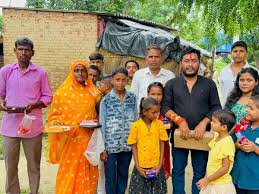
Youth Congress District President Shubham Singh celebrated this festival with more than 100 sisters of Dalit community in Amethi on Saturday. He assured all the sisters that he will stand with them in every situation in their happiness and sorrow. Shubham said that it is his resolution to reach the person standing in the last row of the society and understand their feelings. Youth Congress District President said that Raksha Bandhan is not just a thread. It is a symbol of trust, love and security. He said that the belongingness and blessings received by celebrating this festival among the deprived class is the biggest honor for him. Many workers including Rinku Kumar, Pawan Verma, Dinesh Kori, Ravi Maurya were present in the program. Everyone together made this special day memorable. Arun Kumar Gupta Courtesy : Hindi News
Dalit woman rape case: Police arrested the accused in Etah, sections increased after the statement of the victim
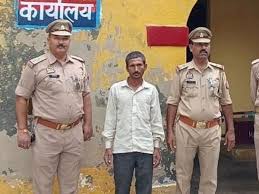
Awagarh police station of Etah district has arrested a person and sent him to jail on the charge of raping a 48-year-old Dalit woman. Earlier, a case of molestation was registered against the accused in Awagarh Kotwali. The victim had accused the accused of forcefully raping her and biting her face. After the statement of the victim was recorded before the magistrate, the section of rape was added in the case. The incident took place on Wednesday when the victim was returning home with grass. During this time, the accused Hanif, who was already naked, raped the woman. When the victim informed her family about the incident, they caught the accused and admitted him to the hospital. The police arrested the accused Hanif on August 9 at around 12:10 pm. The accused has been charged under sections 64(1), 352, 351(3), 115(2) B.N.S. And a case is registered under 3(2)va SC ST Act. 42-year-old Hanif son of Noor Mohammad is a resident of Jinawali village. After the arrest, necessary legal action is being taken at the police station. Etah Police Captain Shyam Narayan Singh has issued strict instructions to maintain law and order. Continuous action is being taken against the criminals. The police team that made the arrest included Sub-Inspector Vijay Singh, Head Constable Omveer Singh and Head Constable Ramtej Singh. According to police officials, such action against criminals will continue so that law and order is maintained in the area. Nand Kumar Courtesy : Hindi News
Dalit forum condemns attack on YouTubers

Mangaluru: The Karnataka Dalit Horata Samiti condemned the attack on YouTubers and a reporter from a private Kannada news channel in Dharmasthala recently. Samiti district leader SP Anand told reporters on Saturday, that while the Dakshina Kannada police arrested one person in connection with the incident, around 50-60 individuals were involved in the attack. “All those responsible must be arrested and booked under stringent laws,” he demanded. Anand pointed out that one of the injured, cameraman Abhishek, belongs to the Dalit community. “The FIR should also include provisions of the Scheduled Castes and the Scheduled Tribes (Prevention of Atrocities) Act, along with sections related to robbery,” he said. The Samiti plans to petition the DK superintendent of police and home minister on the matter. According to Anand, the miscreants alleged that false propaganda was being spread on social media about Dharmasthala’s sacred place. “We too respect Dharmasthala and are not against it. We only want the police to identify those who orchestrated the attacks,” he said. He welcomed the Special Investigation Team’s probe into the alleged mass burial case in Dharmasthala and urged it to bring out the truth. “It is an attack on the democratic process, which is aimed at uncovering the truth,” he said. Samiti leader Anil Kumar alleged that the assault was a deliberate conspiracy to suppress facts. “All wrongdoers must be punished. Law is equal for all in this country,” he asserted. Courtesy : TOI Note: This news is originally published on https:/timesofindia.com/bha and is used purely for non-profit/non-commercial purposes, especially human rights.
Officials demolish wall denying Dalits access to government land in Tamil Nadu
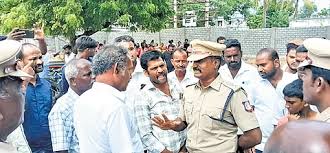
Ahead of the wall’s demolition, a contingent of around 200 personnel led by District SP K Josh Thangaiah took position at the spot. KARUR: Two days after issuing eviction notice to the caste Hindu residents, revenue authorities amid tight police security on Saturday demolished a wall, allegedly constructed to restrict Dalits from accessing a parcel of government land, at Muthuladampatti in the district. Ahead of the wall’s demolition, a contingent of around 200 personnel led by District SP K Josh Thangaiah took position at the spot. Noticing this, caste Hindu women in the locality surrounded the wall in a bid to prevent its demolition. Following this, the police held peace talks with members of both communities, who reside in separate settlements in Muthuladampatti, at the office of the Karur RDO. After officials assured that the concerns of both sides would be addressed, the wall was demolished, officials said. It may be noted that the Dalit residents alleged that the caste Hindus raised the wall on the parcel of poramboke land to restrict their access to it as well as the locality where the latter reside. Refuting the allegations, the caste Hindu residents claimed that the wall was constructed to protect the government land they have been “occupying for decades from miscreants”. The “untouchability wall” came under opposition from several quarters, including the Tamil Nadu Untouchability Eradication Front, whose members on Friday threatened to demolish it themselves if official orders were not complied with. Courtesy : TNIE Note: This news is originally published on https:/thenewindianexpress.com/bha and is used purely for non-profit/non-commercial purposes, especially human rights.
Dalit women survivors seek separate law for caste crimes
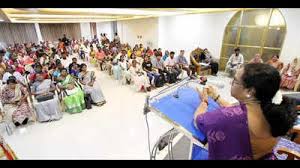
Madurai: Dalit women survivors of caste violence, especially murder of spouses, have emphasised their demand for a separate law to deal with crimes involving inter-caste love marriages or relationships. In several such cases, the SC/ST (Prevention of Atrocities) Act may not be applicable, they said. At a programme organised by the dalit rights NGO, Evidence, in Madurai on Saturday, activist and survivor Kausalya said that even now, the state and central govts do not have any data on caste (‘honour’) killings. Her husband Shankar was murdered in a gruesome instance of caste violence in 2016. “When there is no separate law to deal with these cases, some of the accused named remain free. Every time a caste killing happens, I feel depressed and saddened. Recently, I reached out to the girl who was Kavin’s lover as I knew the pain she must have been feeling,” she added. When a woman is subjected to caste crimes directly or indirectly by physical or verbal means by her own family, she is often forced to toe their line due to fear. “Only when the perpetrator is from another caste and the victim is SC, can the SC/ST Act be invoked. Convictions are also difficult to get. A separate law is the need of the hour,” said A Kathir, executive director, Evidence. Two other survivors, Arulmozhi and Rekha, also shared their experiences of facing caste violence, and stressed how important it was for dalit women to stand together. Rekha said she is working hard and studying to complete engineering. They said mustering the courage to speak out against the violence is more important than worrying about what society thinks. A S Kumari, chairperson, state commission for women, stressed the need for women from marginalised backgrounds to speak out about crimes and issues they face or witness regularly. “In cases of domestic violence as well, we see many women coming forward to complain at police stations. But the husband comes out of jail in a while and his wife is subjected to abuse again, and stripped of freedom. We need stricter laws. Only when women come together, society can change,” she said. Courtesy : TOI Note: This news is originally published on https:/timesofindia.com/bha and is used purely for non-profit/non-commercial purposes, especially human rights.
Dalit man killed over Rs 70 in 2020: 2 brothers get life imprisonment

AGRA: An SC/ST court in Aligarh sentenced two brothers, Virendra Singh and Hoshiyar Singh, both in their early 50s, to life imprisonment for murdering 26-year-old Dalit man Manoj Jatav over a Rs 70 dispute in 2020. The judgement, delivered on Friday, was made available on Saturday. Prosecution officer Chaman Prakash Sharma said that on June 5, 2020, Manoj and his cousin had gone to a shop in Sarkoriya village, where the shopkeeper demanded Rs 70 that Manoj owed, leading to an argument. Later, the brothers and four others allegedly attacked Manoj’s house, killing him and injuring his uncle, Arun. Police booked all six accused under IPC sections for murder, rioting, unlawful assembly, attempt to murder, insulting the modesty of a woman, and criminal conspiracy, along with the Arms Act and SC/ST Act. Five were granted bail months later, but Virendra remained in custody. After the trial, four co-accused were acquitted for lack of evidence, while Virendra and Hoshiyar were convicted and fined Rs 55,000 each. They were taken into custody after the verdict. “The case was being heard in the SC/ST court. After examining all evidence and witnesses, the court on Friday acquitted the four co-accused but convicted Virendra and Hoshiyar, imposing life terms and a fine of Rs 55,000 each. As the court pronounced its judgement, both convicts were taken into police custody and sent to jail,” prosecution officer Sharma said. Courtesy : TOI Note: This news is originally published on https:/timesofindia.com/bha and is used purely for non-profit/non-commercial purposes, especially human rights.
In The Salt Pans Of Thoothukudi, A Rs-10 Patriarchal Tax On Dalit Women Speaks To Enduring National Discrimination
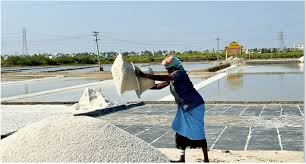
A mural beneath an overpass in Thoothukudi, Tamil Nadu, depicts a woman salt worker, highlighting the role of women in the region’s salt economy/ MANIDEEP GUDELA Decades after equal pay laws, Dalit women in the Thoothukudi salt pans of Tamil Nadu still earn Rs 10 less daily or Rs 300 less monthly than men. They carry 25-kg baskets under the scorching sun, yet tradition justifies the gap and serves as a reminder that men are still regarded as superior. Despite court rulings and hard labour, gender—and caste—discrimination persists across generations. Thoothukudi, Tamil Nadu: At sunrise, the salt pans in this southeastern district shimmer like glass and, by noon, feel like a furnace, with temperatures soaring to 40 deg C. The feet of the women workers—mostly Dalits—are cracked from years of standing in saline water. Their backs are bent under the weight of 25-kg salt sacks, carried from drying plots to storage sheds. For this exhausting, debilitating work, they earn Rs 590 a day—less than the Rs 679 daily state minimum wage paid to skilled workers at a nearby power plant. That wage is barely enough to live on—but what galls the women most is that they earn Rs 10 less than the men. Not because they work less. Not because the industry cannot afford to pay them equally. But simply, they say, because tradition demands it. The Rs 10 missing from a woman’s wage is so small it can almost go unnoticed. But that invisibility makes it a daily, invisible denial of dignity. The patriarchal tax is compounded across generations. “The mother accepted Rs 1 less—a supervisor recalls that was the gap in his parents’ time. Today, the daughter accepts Rs 10 less. If the pattern continues, a few decades from now, the granddaughter will take home Rs 100 less for the same work.” The Tax That Preserves Power It is clear that the Rs-10 patriarchal tax in Thoothukudi is not about profit. It appears to be a tool to preserve a social hierarchy that reinforces and reminds women of their place in power structures. At the end of the month, a woman would have earned Rs 300 less than a man, less than half a day’s wage. The underpaying is not because the owner needs the savings, but because underpaying women is a societal tradition that goes unchallenged. In a 20-acre salt pan, where 25 people work, 20 of them women, the Rs-10 wage gap—you could call it a patriarchal tax on women—amounts to a savings of no more than Rs 6,000 for the employer. That is a negligible sum for the industry, yet it is a calculated reminder of who holds power and who is subservient. R (name changed), a salt pan supervisor in his fifties, overseeing the day’s work. Supervisors, mostly men, manage operations, monitor tasks on site, and keep track of the workers/ MANIDEEP GUDELA Such stories are common in India’s informal economy, which employs about 85% of India’s workforce of about 440 million, with marginalised communities constituting approximately 70% of this workforce: this is also where more than 81% of Indian women work. This is where the most pervasive forms of gendered labour exploitation occur, deeply rooted in caste and patriarchal structures within the production system, with women in the informal sector earning 34% less than their male counterparts. This was evident in Thoothukudi, home to one of India’s major salt-producing belts. The Paraiyars: Bottom Of The Heap Tamil Nadu ranks second in salt production in India, with Thoothukudi district at the heart of the state’s salt industry. Spread over 25,000 acres, the industry in Thoothukudi contributes 70% of the state’s salt output, playing a crucial role in the local economy, directly employing 30,000 workers. A 45-year-old woman, who says she has worked for over two decades in the salt pan, pours dried salt into heaps using an aluminium basket/ MANIDEEP GUDELA Dalit women, primarily from the Paraiyar community, form the backbone of this labour-intensive industry. Known locally as uppalaththu kooli (salt pan labourers), their families have worked in the salt pans for generations. Historically landless, Paraiyars are concentrated in Tamil Nadu’s central and southern districts. The salt pans, mostly leased from the government, are controlled by the Nadars—a powerful, dominant caste in the region. That Dalit women make up the majority of the workforce is no coincidence. Caste has long dictated who performs the most gruelling and degrading labour; gender only deepens this entrenched hierarchy. Dalit men are slightly better off, often working in supervisory or processing roles. It is the women who remain trapped in the most physically demanding tasks. “Our work is more tedious than theirs,” said G*, who is in her 50s and has worked at the pans for over 40 years. “We have to draw pan lines, refill the plots with brine, and sometimes collect the salt too. The men only collect salt—we largely have to do everything.” Salt work is seasonal and closely tied to rainfall. The season typically begins in February and continues until August or September, depending on the monsoon. Workers are paid a daily wage. “There’s no salary on days when there’s no work,” said G. “During the monsoon, we have no income. Even if we’re injured and return home midway through the day, we lose the entire day’s wage.” A Microcosm Of A National, Global System The wage gap in Thoothukudi’s salt pans isn’t an exception. It’s a microcosm of the global system that devalues women’s labour, a pattern of exploitation rooted in patriarchal and capitalist structures. Even though 43% of Tamil Nadu women participated in the workforce (vs 32.5% nationally), according to Periodic Labour Force Survey (PLFS) data for 2020-21, the latest available, the state has one of India’s widest gender pay gaps with women earning just 74 paise for every rupee men earn in regular salaried jobs. This is not limited to Tamil Nadu. According to the ministry of agriculture’s data for 2020-21, a woman agriculture field labourer earns Rs 88 per
Pune | Three Dalit Women Allege Illegal Arrest | Protests Erupt Outside District Collector’s Office
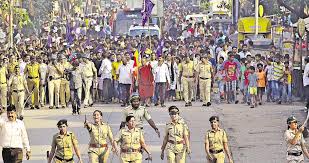
On August 1, Pune Police allegedly took three young Dalit women into illegal custody. According to the women, police raided their homes, hurled casteist slurs, made derogatory comments about their sexuality, and physically assaulted them. A week had passed since the alleged harassment and atrocities inflicted on three women in Pune; however, no FIR has been registered yet. The police claim that, based on a preliminary inquiry, there is no evidence to support the women’s allegations, and therefore, an FIR cannot be filed. The city witnessed a protest outside the District Collector’s office, demanding that action be taken against the police. Courtesy : Outlook India Note: This news is originally published on https:/outlookindia.com/bha and is used purely for non-profit/non-commercial purposes, especially human rights.
Chandigarh News: Appointed chairmen of boards and corporations two years before the elections, targeting 32 percent Dalit and 10% Brahmin-Rajput votes
-CM said, work diligently for the welfare of the society and the progress of PunjabAdvertisement: 0:14 Chandigarh/Jalandhar. Aam Aadmi Party has appointed chairmen of various boards and corporations in the state before the 2027 assembly elections. Apart from 32 percent Dalit population, the government has also targeted the Brahmin-Rajput vote bank. Punjab Chief Minister Bhagwant Singh Mann has called upon the newly appointed chairmen to work hard and diligently for the welfare of the society and the progress of Punjab. Almost all the major castes of the society have been included in these appointments. Experts believe that this step is directly related to the upcoming assembly elections. The population of Dalits in Punjab is about 32 percent, which is the highest compared to any state in the country. Apart from this, there is also a large number of backward castes and economically weaker sections here. Appeasing these castes, giving them representation and providing direct benefits has become the key to winning elections for any political party. In Punjab, the population of Rajput community is 6 percent and that of Brahmin community is 4 percent. Courtesy: Hindi News
Manuvadis built a wall of untouchability
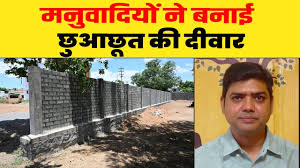
People of Arunthathiyar community, which comes under Scheduled Caste, have alleged that Manuvadis of Thottiya Nayakkar caste have built this wall. They allege that this wall has been built to stop the movement of Dalits. Dalit society has called it ‘wall of untouchability’. The question is also whether any community can build a wall on any government land? The silence of the local administration on this question has put it under question. Karur, Tamil Nadu. Manuvadis have built a 200 feet long and 10 feet high wall in a village. It is alleged that this wall has been built so that Dalits of the village can be stopped from going to the areas of Thottiya Nayakkar. People of Dalit society are calling this wall a wall of untouchability. The matter is of Karur district of Tamil Nadu. The matter has heated up due to this wall built in Muthuladampatti village of the district. People of the Arunthathiyar community, which comes under the Scheduled Caste, have alleged that Hindus of the Thottiya Nayakar caste have built this wall. They allege that this wall has been built to stop the movement of Dalits. The Dalit community has called it a ‘wall of untouchability’. The special thing is that this wall has been built on government-owned public land and it is located just one kilometer away from the Karur Collector’s office. According to the report of “The Hindu”, Dalits say that when they came to know about the construction of the wall, they complained about it to the revenue officials. The village administrative officer of Thanthoni village inspected the spot and verbally asked the Thottiya community to stop the work, but they ignored these instructions and completed the construction of the wall quickly. Seeing the matter escalating and after the protest of the Dalit community, officials of the Revenue and Police Department had to intervene. However, despite two meetings held on July 13 and July 29, no solution has been found. 57-year-old P. Marudhai, who belongs to the Dalit community, said, “This wall is a symbol of isolating us in our own village. This is outright caste discrimination and a way to humiliate us.” They allege that the Manuvadi people do not allow them to use the public ‘drama stage’ during temple festivals, even when they want to build a separate stage or toilet for themselves, they are stopped. According to the report, 50-year-old S. Duraiasamy said, “We are forced to go to the Manuvadi areas without slippers. If we go wearing slippers, they abuse and shout at us.” However, on the other hand, people of the Thottiya Nayakar community are denying this and giving some other reason for building the wall. According to the report, 62-year-old R. Kandasamy completely denied the allegations and said, “We built the wall so that drunk outsiders do not disturb us in our area. This place has been in our use for years.” On the other hand, the administration is beating around the bush in this matter. Karur Collector M. Thangavel told The Hindu, “I cannot say right now whether this is a wall of untouchability or not. I have ordered the Revenue Department officer to investigate and am waiting for his report. The situation can be clarified only after receiving the report.” But the big question here is, can any person build a wall on any government land without any permission? That too on the land where people come and go. Whatever this wall has been built for, it is clear that it is unconstitutional and illegal. Now the question is, why is the administration trying to complicate the matter instead of immediately demolishing this illegal wall? Siddharth Gautam Siddharth Gautam, who has an interest in journalism and writing, is a graduate from Delhi University. There he has been the winner of many university-level writing competitions. He has been associated with Dalit Dastak for the last two years and is working as a sub-editor. Courtesy : Hindi News