
No Parliament business, four days into monsoon session
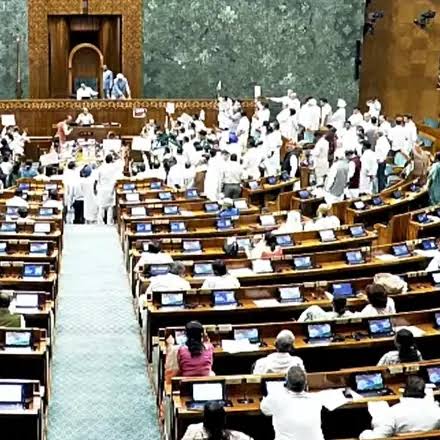
NEW DELHI: If the first four days are any indication, monsoon session of Parliament is staring at a washout, with the opposition digging in its heels over its demand for resignation of education minister Dharmendra Pradhan, rebuffing invitations from govt for a discussion, reports Subodh Ghildiyal. Amid protests, Lok Sabha and Rajya Sabha failed to transact business for the fourth consecutive day on Thursday. The stalemate could not be broken despite Speaker Om Birla meeting Rahul Gandhi, Akhilesh Yadav and Supriya Sule to defuse the situation. Home minister Amit Shah and parliamentary affairs minister Kiren Rijiju also met Birla. Opposition MPs took out a ‘candlelight march’ Thursday to the Gandhi Smriti in solidarity with the protesting students, two days after they held a dharna outside the PM’s residence and were forcibly evacuated by police. The MPs belonging to Congress, SP, TMC, Left parties, RJD, Shiv Sena and others met at Rahul Gandhi’s residence. From there, they marched to the Gandhi Smriti holding their phone torches. The marchers included Rahul, K C Venugopal, Ramjilal Suman, Supriya Sule, Priyanka Gandhi Vadra, N K Premachandran, John Brittas, Sandosh Kumar, Sudhakar Singh, Misa Bharti, Arvind Sawant, Saugata Roy and Mahua Moitra. Rahul said, “We go to remember the students we lost – the children driven to take their own lives after the NEET paper leak. And we go to stand with the students who lie injured today – beaten for peacefully demanding justice and accountability. India’s students are not alone. The entire opposition stands with them and their demands.” Congress’s P Chidambaram said, “All roads are barricaded, and hundreds of policemen are mobilised to ‘secure’ the roads of Delhi. What is govt afraid of? Why this sense of panic?” Earlier, Congress rubbished PM Modi’s statement assuring the protesting youth. Congress president Mallikarjun Kharge said the students don’t need platitudes after govt used pellet guns, shock batons and tear gas on them. Courtesy : TOI Note: This news is originally published on https:/timesofindia.com/bha and is used purely for non-profit/non-commercial purposes, especially human rights
‘Don’t insult students’ intelligence’: Rahul Gandhi slams PM Modi’s midnight video on paper leaks
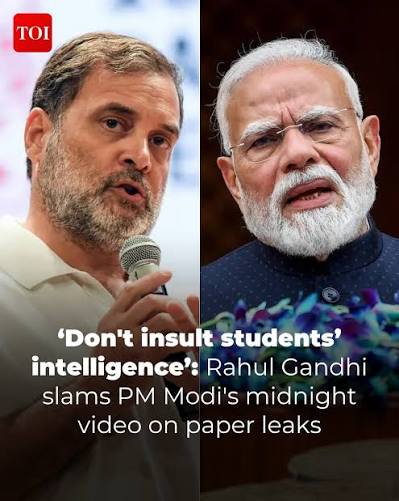
NEW DELHI: Leader of opposition in Lok Sabha, Rahul Gandhi early Friday attacked Prime Minister Narendra Modi accusing him of sidestepping the demand for Union education minister Dharmendra Pradhan’s resignation over the alleged NEET-UG 2026 paper leak. Reacting to the Prime Minister’s late-night video message on the issue, Rahul said PM Modi should not “insult the intelligence” of students and demanded Pradhan be sacked saying the PM’s address failed to raise students’ key concerns. In a post on X, Rahul wrote, “Mr Modi, our students are demanding Dharmendra Pradhan’s resignation. Don’t insult their intelligence with this pathetic midnight video.” Listing his demands, he said: “1. Sack Pradhan.2. Punish those who beat students. Apologise.” — RahulGandhi (@RahulGandhi) The leader of oppostion’s remarks came hours after Prime Minister Modi announced that the government would bring a Bill in Parliament next week providing for stringent punishment against those involved in examination paper leaks. In a self-recorded video shared on X late Thursday night, the Prime Minister said the proposed legislation, which includes provisions for Fast-Track Courts and stricter penalties, would be discussed by the Union Cabinet on Friday before being introduced in Parliament when the second week of the Monsoon Session begins on Monday. “Friends, I know that paper leaks are not an ordinary matter. For lakhs of students and their parents, it is extremely painful,” PM Modi said. “Our most important responsibility was to ensure that a whole year for the students is not wasted. It was very important to conduct the exams immediately. The government used its full strength to arrange exams for nearly 22 lakh students in the shortest possible time. And just five or six days ago, on the 19th, the results were also announced,” he said. The Prime Minister said the government was now moving towards stronger legal action. “Today I have issued directions to the departments to set up Fast-Track Courts. The departments worked tirelessly and, late last night, provided me with a draft. This draft, which includes provisions for Fast-Track Courts and stringent punishments, will be discussed in the Cabinet tomorrow,” he said. He added that after incorporating suggestions from Cabinet colleagues, the Bill would be finalised and introduced in Parliament next week. “Nothing is more important than the welfare and future of our youth. Those who try to harm the future of our youth will not be spared,” PM Modi said. The opposition has been demanding Pradhan’s resignation and a detailed discussion on the alleged NEET-UG paper leak during the Monsoon Session, with the issue triggering protests both inside Parliament and on the streets. Activist Sonam Wangchuk ended his 26-day hunger strike on Friday at Medanta Hospital in the presence of Union ministers J P Nadda and Jitendra Singh, along with senior leaders of the Apex Body of Leh. In a post on X, Wangchuk said he decided to end the fast after prolonged discussions and in view of the possibility of violence. “Just now in the presence of Union Ministers JP Nadda & Dr. Jitendra Singh and the senior leaders of Apex Body of Leh Ladakh I finally broke my fast after 26 days… This was done after a long negotiation on various conditions and in view of possible violence in the country,” he said. “I will explain the conditions in detail in a separate video very soon. Meanwhile urge you all to stay very vigilant about not allowing violence of any kind anywhere,” he added. Meanwhile, the Cockroach Janata Party (CJP) has called for nationwide peaceful protests on Friday, reiterating its demand for Education Minister Dharmendra Pradhan’s resignation over the alleged examination irregularities. Courtesy : TOI Note: This news is originally published on https:/timesofindia.com/bha and is used purely for non-profit/non-commercial purposes, especially human rights
Rahul Gandhi’s protest outside PM house ‘insincere’: Sonam Wangchuk’s wife
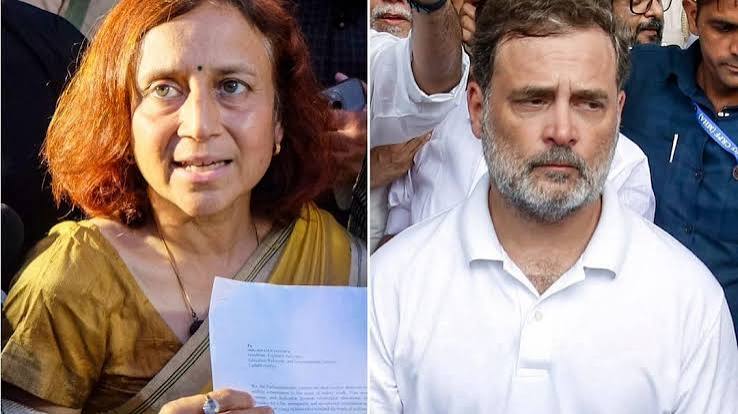
NEW DELHI: Activist Sonam Wangchuk’s wife, Gitanjali J Angmo, has criticised the flash protest led by Congress neta Rahul Gandhi near PM Narendra Modi’s residence on July 21 as “insincere”. “The protest outside the PM’s house lacked sincerity. It would have been more sincere if it had been done by joining hands at Jantar Mantar. So, the public cannot be fooled anymore. This is an awakened India,” Angmo told India Today in an interview. “The awakened India movement has shown us and shown every political functionary that they now have to walk the talk. They cannot gaslight or be insincere anymore. They have to be sincere, otherwise, they will be thrown out by this young generation that has understood what they have to do and what they have to stand for…” Her remarks came two days after Rahul and other senior netas staged a sit-in near the PM’s residence at 7 Lok Kalyan Marg over the crackdown on student protesters during their march towards Parliament on July 20. Taking on BJP, Angmo said, “I am very ashamed to say that BJP calls itself a Hindu nationalist party. Because there is nothing about them that is Hindu, and there’s nothing about them that is nationalistic,” she was quoted as saying. “Everybody was there for a cause. That was a demonstration of what Hinduism is. Obstruction of justice, obstruction of freedom, obstruction of protest and terming youths as anti-nationals – this is not nationalism,” she said. In an X post, Angmo, who is the co-founder of Himalayan Institute of Alternatives Ladakh (HIAL), said, “As an educator, I find it deeply painful to watch the image of our students being tarnished on media… The students’ protest is taking place peacefully at Jantar Mantar. If there are reports of violence elsewhere in Delhi, please do not rush to attribute them to this movement without evidence.” She added, “Our children deserve to be protected, not portrayed as villains. Their voices deserve to be heard, not drowned out by narratives that serve vested interests.” Courtesy : TOI Note: This news is originally published on https:/timesofindia.com/bha and is used purely for non-profit/non-commercial purposes, especially human rights
Dalit Christian wins burial rights after long struggle

Chennai, A Dalit Catholic teacher was finally buried in a common cemetery in Tamil Nadu after his community fought for more than two decades against caste‑based exclusion, marking a milestone in the struggle for equality within the Church, UNI reported. The burial of A. Raju, 72, in Kottapalayam village of Trichy district, came late July 19 night after three days of tense standoff between Dalit Christians and dominant‑caste Reddis, who had long barred Dalits from using the cemetery, according to UNI. Struggle Dalit Catholics filed suit in 2014 at the District Munsif Court, demanding equal burial rights. In August 2024, the court decreed that Dalits could use the cemetery attached to St. Mary Magdalene Church. The Bishop of Kumbakonam Diocese and the parish priest were named defendants. Despite the ruling, enforcement lagged. When Raju died last week, his body lay at home just 300 meters from the cemetery while Reddis blocked access. Negotiations with parish priest Fr. Michael Raj failed, and police could not resolve the impasse. Community Protest Dalit Christians staged dharnas and petitioned officials, including the district collector, but no action followed, UNI said. Advocate Dhas Prakash, who represented the Dalits, told UNI: “Since the deceased was the petitioner in the case, the Dalits decided his body should be buried in the common cemetery.” The dispute highlighted broader discrimination. Dalit elders noted that only this year were their contributions accepted for the parish’s annual car festival, underscoring exclusion from religious life. Government Intervention On July 19 evening, Musiri Revenue Divisional Officer S.S. Kuntia summoned both sides and the parish priest for talks. At 9:30 p.m., officials ruled that Raju could be buried in the common cemetery — but only his body, not a blanket right for all Dalits. Dalit leaders accepted the compromise, calling it a partial but symbolic victory. “This is historic,” one elder told UNI. “For the first time, a Dalit Christian has been laid to rest in the common cemetery.” Midnight Burial By midnight, Raju’s funeral procession entered the cemetery. Crackers burst as mourners carried his body past the gates that had been closed to Dalits for generations. The burial marked the end of a long struggle, though activists stressed that the fight for full equality continues. The case underscores persistent caste discrimination within Tamil Nadu’s Catholic institutions. While the burial was limited to one individual, Dalit Christians believe it sets a precedent for enforcing the 2024 court decree. “This is not just about one man,” Prakash told UNI. “It is about dignity for an entire community.” Courtesy : Matters India Note: This news is originally published on https:/mattersindia.com/bha and is used purely for non-profit/non-commercial purposes, especially human rights
Double murder of Dalit brothers, accused SP MLA ‘disappears’, yet why is Akhilesh silent?

Even after a case was registered against Hakim Lal Bind, SP MLA from Handia, Prayagraj, for the murder of two Dalit brothers, he has not been arrested. Police say the MLA has been out of contact for the past 15 days. Meanwhile, political questions have intensified regarding the silence of the Samajwadi Party and Akhilesh Yadav, who have been vocal on law and order and PDA politics. Opinion: Hakim Lal Bind, Samajwadi Party MLA from Handia, Prayagraj, has been charged with murder in the death of two brothers. However, since the FIR was filed, the MLA has been out of police reach for the past 15 days. He has not yet recorded his statement. Police say his mobile phone is switched off and he cannot be contacted. The most discussed topic in this entire incident is the silence of the Samajwadi Party’s top leadership. SP President Akhilesh Yadav, who has consistently criticized the BJP government on issues of crime, law and order, and the PDA (Backward, Dalit, and Minority) in the state, has yet to publicly comment on the matter. There has been no official statement from the party, nor has any organizational action been reported against the MLA. The MLA is accused of land grabbing. The two brothers whose deaths have come to light belonged to the Dalit community. The deceased’s family alleges that the younger brother, and then the elder brother, were murdered 22 days later over a dispute regarding ancestral land, and their bodies were hanged. A murder case has been filed against several individuals, including Hakim Lal Bind. The police are investigating the case, but they say the MLA is not cooperating. According to Handia police, the MLA’s mobile phone is switched off and he cannot be contacted. Police also visited his home, but he was not found there. Why are questions being raised about the SP’s top leadership? This issue is also in political discussion because the Samajwadi Party has been calling the PDA its biggest political campaign for the past several months. The party has consistently claimed that it raises the voice of the backward, Dalit, and underprivileged communities. It has also demanded answers from the government on every law and order issue. Consequently, the top leadership’s silence, despite its own party MLA facing serious charges like murder and being out of reach of the police, has become a subject of questioning within the opposition and political circles. SP chief Akhilesh Yadav has consistently raised questions about the law and order situation in Uttar Pradesh. But now, when a case has been filed against his own party MLA for the murder of a Dalit, he remains silent. Far from taking action against his MLA, he has not even made any public comment on the entire matter. Why does the SP remain silent when it comes to its leaders? However, this is not the first time questions have been raised about the Samajwadi Party’s silence regarding allegations against its leaders. Earlier, Akhilesh Yadav had not responded to the assault on a female SP worker in Chandauli. He also remained silent on the attack on MLA Maharaji Prajapati’s residence in Amethi. He also remained silent on several high-profile murders in Purvanchal. He also made no public statement on the Surya Chauhan murder case in Ghaziabad. Consequently, the opposition has consistently alleged that Akhilesh Yadav remains silent whenever Samajwadi Party leaders are named in criminal cases, or when allegations are leveled against individuals belonging to the Muslim and Yadav communities. (Author Bhavesh Pandey is an advocate in the Lucknow bench of the Allahabad High Court and writes on political and social issues.) (Disclaimer: The views expressed here are the author’s personal opinions.) Courtesy: Hindi News
Dalit family forced to live in thatched roof for five years: Fear of snakes and scorpions during rains in Ayodhya, administration unaware, awaiting permanent housing

A poor Dalit family in Banshu Ka Purwa, Deva Suryabhanpur village, Maya Bazaar block, Ayodhya, has been waiting for permanent housing for the past five years. The family has not yet received benefits under the Chief Minister’s Housing Scheme, forcing them to live in a dilapidated thatched roof. During the rainy season, the family faces extremely difficult conditions. Water leaks from the roof and there is a constant threat of walls collapsing. At night, the family is terrified by mosquitoes, scorpions, and snakes. Last year, the family’s daughter had to be taken to the hospital after being bitten by a scorpion. During the rainy season, the entire house becomes filled with mud and water, leading to the spread of diseases. The children’s studies are also affected, as their books and notebooks get soaked and damaged. Families like Ramkaran, son of Ramkumar, and Samarjeet, son of Ramkumar, residents of Banshu Ka Purwa, are forced to live in thatched roofs due to lack of housing. Waterlogging makes it even more difficult for them to live with their families. Suffering from the situation, Ramkaran stated that he has complained to the Sarpanch, Secretary, and Block Office ten times. Each time, he receives assurances that his name will be included in the next list, but this wait has been unending for five years. He expressed concern about where they will go if their roof collapses during the rainy season. Ramkaran’s wife, while narrating her plight, said that they sit with a diya (lamp) burning all night because they are afraid of snakes and scorpions. Village head representative Ravi Upadhyay stated that the family’s housing application will soon be sent to the Block Office. Meanwhile, BDO Maya Bazaar Vikas Kumar Mishra stated that the matter will be investigated. If the family is found eligible, their housing will be approved under a special campaign. Santosh Kumar | Maya Bazaar, Ayodhya Courtesy: Hindi News
The Forgotten Stakeholders of the Ken-Betwa Project: Why Dalit Voices Must Matter in India’s Largest River-Linking Experiment

The Ken-Betwa River Link Project, when it is discussed, tends to be overshadowed by the discussions on irrigation potential, ecological impacts and the future of the Panna Tiger Reserve. These are clearly important issues, but one crucial aspect has been largely ignored. It is the impact on Dalit people whose lives and livelihoods are intrinsically linked to the land now destined for transformation. As India embarks on one of its most ambitious water infrastructure projects, the question is not whether rivers can be interconnected but whether it is possible to grow in a socially just and inclusive manner. Development has never been asocial Major infrastructure investments rarely impact all communities equally. People who own property, have money and political power are usually better placed to get compensation or to rebuild their lives. Marginalised communities, particularly Dalits, tend to come into such processes with fewer assets, less bargaining power and a greater dependence on shared resources. In Bundelkhand, many Dalit households depend on agricultural wage labour, grazing grounds, woods, riverbanks and village commons for their survival. Even if they do not own the land being acquired, they risk losing access to economic networks that support their everyday life. That creates a dangerous paradox: a project aimed at reducing regional inequality may actually exacerbate existing socioeconomic inequities if rehabilitation policies are exclusively targeted at landowners. Hidden costs of displacement Public debate around rehabilitation often centres on compensation for seized land. But many Dalit households rely on labour for their livelihood, rather than ownership. Relocation of villages changes agricultural patterns and may eliminate job opportunities. While landowners may be compensated or given alternative plots of land, agricultural workers tend to lose both their livelihoods and social support systems. Seasonal jobs, access to forests for fuelwood, collection of minor forest produce, cattle grazing and informal economic activity could be lost overnight. Without understanding these losses, rehabilitation risks being a bureaucratic exercise rather than an exercise in meaningful justice. The pay is as important as the representation The Constitution guarantees equality before the law, but in reality participation in development planning is uneven. Important questions need to be asked: Were Dalit settlements consulted separately in public hearings? Were their interests tracked separately from the big landholding interests? Do rehabilitation committees effectively represent the scheduled castes? Are compensation schemes intended to recognize dependence on a livelihood, not just legal ownership? These questions are meant to bolster, not to stymie, growth. The Indian environmental governance framework is more about involvement. But meaningful participation also requires an understanding that communities are not homogenous. Social hierarchies in communities often determine who gets to be heard and whose concerns are dismissed. Learning from Previous Development Projects The history of India’s big dams, mining projects, industrial corridors and urban expansion tells us a familiar story: exposed areas often pay higher prices with fewer long-term benefits. Research on displacement in infrastructure projects has often found that Scheduled Castes and other marginal groups recover livelihoods more slowly due to a lack of economic assets and institutional support. The Ken-Betwa project is a chance to break free from this trend. Anusreeta Dutta Courtesy : TOP Note: This news is originally published on https:/theobserverpost.com/bha and is used purely for non-profit/non-commercial purposes, especially human rights
Dhampur: Two accused arrested and charged after altercation with woman

Dhampur police have arrested and charged two young men in connection with the assault of a Dalit youth. The incident occurred after an alleged altercation with a woman. The incident occurred near Chak Sahajani village in Dhampur, where a Dalit youth was assaulted by three or four unidentified youths. Vivek Kumar, son of Pramod Kumar, a resident of Nangli Ladan village in the police station area, filed a police complaint. Vivek told police that he works as a mechanic at a local business. He had frequent disputes with a woman, Sonu, and her family at the same business. This dispute occurred on Wednesday. According to police, two young men living in the neighborhood, along with their friends, assaulted Vivek at the instigation of Sonu’s family. Inspector Ravindra Pratap Singh stated that the arrested accused have been identified as Adnan from Bamnoli and Ali from Delhi Bhatpura. They were accompanied by two other unidentified individuals. Police have arrested Adnan and Ali and issued a challan against them. Based on Vivek’s complaint, police have also named Sonu, wife of Manish. Shahbaz Anwar | Dhampur Alaihpur (Dhampur), Bijnor Courtesy: Hindi News
An unflinching portrait of Dalit life | Review of Chandu Maheria’s Homes without Windows
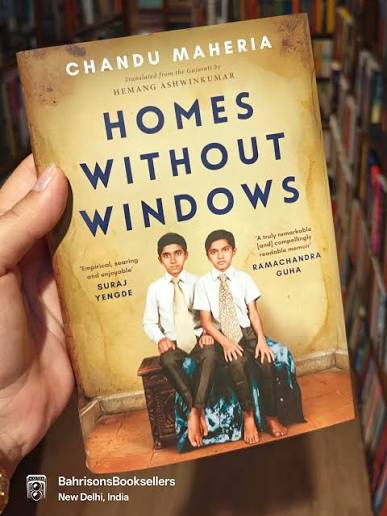
Translated by Hemang Ashwinkumar, Maheria’s book offers an intimate account of caste, poverty, and survival in urban Gujarat but is undermined by an embellished translation Monsoon arrived in Gujarat just as I finished reading Homes without Windows, a collection of 11 autobiographical essays by Dalit activist Chandu Maheria, translated by Hemang Ashwinkumar. Originally written in the Gujarati and published in non-literary magazines, these essays are now available in English. “Today, when I utter stuff like I don’t like monsoon or the prospect of getting wet in rain, my audience gasps, their eyebrows raised in mock surprise. How could someone, who has spent most of his life’s monsoons in just two pairs of mostly wet clothes, still like to get soaked is a question beyond them…,” writes Maheria in one of the essays. For him, the monsoon evokes memories of hellish public toilets, the scramble to cover the house with a sheet of cheap tarpaulin, rainwater flooding homes and streets, and his mother praying to Varun, the god of rain. In the chawls of Rajpur, where Maheria spent most of his life, there was little time to marvel at the beauty of a rainbow. A life of deprivation When you enter Ahmedabad, the commercial capital of Gujarat, from the eastern side, a dense web of chawls lines both sides of the main road, inhabited mostly by Muslims, Dalits, Christians, and poor communities. Maheria takes us into the heart of this labyrinth. He introduces us to its seasons and festivals, its sorrows and moments of happiness despite scarcity and untouchability, its schools, toilets, and hospitals, and the enduring presence of B.R. Ambedkar and M.K. Gandhi in the lives of its people. Maheria’s childhood was marked by extreme food deprivation. His father, a textile mill worker, was the sole breadwinner of a family of nine. During Maheria’s early school years, the children received a glass of milk every day before classes, but little else. Maheria writes about those dark days with disarming honesty. There were times when a relative who delivered tiffin boxes would stop by their home at the end of his rounds and let the family eat the leftovers from the boxes. At the end of the chapter, Maheria expresses his gratitude for the reservation policy, which enabled him and his siblings to pursue education and secure jobs and escape those years of hardship. In another chapter, he writes, “As if the question of filling the bottomless pits of hunger was not vexed enough, the daily dilemma of emptying our bowels had made our lives, both personal and social, embarrassing and miserable.” Their dingy dwelling, Abu Kasai’s chawl, did not have a single public toilet of its own, forcing its residents to use the filthy toilets in the neighbouring Hiralal’s chawl. Decades later, a large, modern, and well-maintained public toilet stands there, yet it remains beyond the reach of the daily-wage poor and the unemployed because it costs one rupee per visit. As a result, it is seldom used by the local residents, who have wryly come to call it ‘The Mayor’s Bungalow’. Maheria, a noted scholar of Dalit life in Gujarat, has important points to make in the ever-contentious debate on Gandhi and Ambedkar. Unlike many of his Dalit friends, he admires Gandhi. He writes, “Gandhi might have been anything — call him whatever names — but one thing he was certainly not was anti-Dalit.” Maheria loved wearing Khadi despite his mother’s opposition; his father too was anti-Gandhi. Yet Maheria affectionately refers to Gandhi as “That Fellow, Gandhido.” When Maheria was just two years away from retirement, he received a promotion along with a transfer to a town called Dhoraji in the Saurashtra region. There the author says he repeatedly encountered the question, “Tame keva? (What caste are you?)”, which he had never been asked in urban Gujarat. While much of his writing focuses on Dalit life in urban Gujarat, his two-year stay in this dusty town offers a glimpse into caste discrimination and the ways in which Dalits and Muslims are excluded from the broader development agenda. It also shows how these communities are pushed into segregated ghettos on the outskirts of so-called developing towns. Losing the writer’s voice Having read the original Gujarati essays alongside their English translations, I have a few observations about Ashwinkumar’s translation. A translator’s foremost responsibility is to preserve the original author’s voice and tonal quality. Maheria’s language is simple and he rarely uses ornamental expressions; his economy of words is almost Gandhian. In many places, however, the English translation departs from this restraint by adding flourishes. In the chapter on Diwali, for instance, the translation reads: “Ramanbhai worked tirelessly…treating the wall as a wide canvas, painting it in broad strokes. Thanks to his speed and finesse, the whole drawing room, the biggest room in the house, would be taken care of by the afternoon.” In the original Gujarati, this is a single sentence. The added phrases do not align with Maheria’s sparse style. Moreover, the sentence is factually inaccurate: in the original, there is no drawing room; it refers instead to a small, single thatched room in a chawl. The use of the words “drawing room” creates a misleading impression. A translator should remain faithful to the original text and avoid such liberties. Despite these concerns, Homes Without Windows remains an important and deeply affecting work. Maheria’s essays offer an intimate, lived account of caste, poverty, and survival in urban Gujarat. What stays with the reader is the dignity and wit with which he recounts them. Maheria’s voice continues to insist on being heard. Mehul Devkala The reviewer is a Gujarati poet, writer, and award-winning filmmaker. Courtesy : The Hindu Note: This news is originally published on https:/thehindu.com/bha and is used purely for non-profit/non-commercial purposes, especially human rights
Judge asks Pentagon how troop TRT differs from care denied to trans men

A US judge has asked the Pentagon to explain how testosterone therapy for troops differs from hormone treatment for transgender men. The order sharpens scrutiny of the military’s unequal medical standards as Trump’s ban remains in force. A US judge has asked the Pentagon to explain how testosterone replacement therapy for troops differs from hormone treatment given to transgender men in the military, as she hears a legal challenge to President Donald Trump’s ban on transgender service members. US District Judge Ana Reyes in Washington raised the issue after Defence Secretary Pete Hegseth announced a new initiative to screen troops for low testosterone and offer voluntary treatment. Reyes said the court wanted both sides to address the medical and logistical similarities and differences between testosterone replacement therapy, or TRT, for trans men and for other service members, including cis individuals. In her order on Wednesday, Reyes pointed to language in Trump’s ban which says “the Armed Forces must adhere to high mental and physical health standards … without the benefit of routine medical treatment or special provisions.” She also sought information on the Pentagon’s “basis for treating trans men and other service members differently between this new policy and the Military Ban”. The order came a week after Hegseth said the Pentagon was launching a screening programme for “testosterone deficiency” among troops, saying it was needed to help them perform at their “absolute best”. He said annual screenings would be part of mandatory medical checks for service members aged 30 and above, while those under 30 could choose to be tested. In a video posted on social media, Hegseth said testosterone replacement therapy would be voluntary. The issue comes amid wider advocacy by other Trump administration officials for easier access to testosterone replacement therapies for men. However, the messaging from Hegseth and others has mixed established science on the hormone with broader claims that are less substantiated. Testosterone levels in men naturally decline with age and have long been linked to problems such as erectile dysfunction, low libido, mood changes and weight gain. Experts, however, have debated for years how such problems should be diagnosed and whether replacing the hormone is the right treatment. Reyes, who was nominated by President Joe Biden, is handling one of the lawsuits against Trump’s transgender military ban. Transgender active-duty service members and former personnel seeking to re-enlist filed the case in late January 2025, soon after Trump began his second term. Reyes had earlier ruled against Trump’s executive order excluding transgender troops, but a divided federal appeals court panel later sent the case back to her after partly upholding her order and finding that the ban was unlawful and that the service members who sued could not be removed. She has since granted the case class-action status, meaning any eventual outcome could apply to all service members. For now, Trump’s ban on transgender troops remains in force, with the US Supreme Court allowing the Pentagon to enforce it while the legal battle continues. Reyes’ latest order has brought fresh focus to how the military is treating testosterone therapy for different groups of service members. Courtesy : India Today Note: This news is originally published on https:/indiatoday.com/bha and is used purely for non-profit/non-commercial purposes, especially human rights