
Dalit youth beaten up again in Gujarat for keeping beard and moustache, police searching for accused

Gujarat Dalit Man Assault News: Once again a case of Dalit youth being beaten up for keeping beard and moustache has come to light in Gujarat. It is alleged that some upper caste people beat up a 27-year-old Dalit in Junagadh district. The police have started investigating the entire matter after receiving the complaint. Dalit youth beaten up in Junagadh for keeping beard and moustache. Ahmedabad/Rajkot: In the month of June, Dalits of Odisha were forced to crawl on the ground. Then those pictures had shamed the whole country. Now in Gujarat, just before Independence Day, an incident of Dalit youth being attacked for keeping beard and moustache has come to light. It is alleged that in a village in Junagadh district, a 27-year-old man was allegedly beaten up by five upper caste people for keeping moustache and beard and was abused with casteist slurs. The incident took place in Vajali village of Visavadar taluka on August 11 and came to light after the victim Sagar Makwana lodged a complaint at the Visavadar police station on Tuesday. When and how did this whole incident happen? According to the information, the victim Sagar Makwana’s father-in-law was seriously injured in the incident. At the Junagadh Civil Hospital, Makwana lodged a named complaint against Shailesh Jebalia, Lalo Bhupat Kathi Darbar and three unidentified persons. According to the complaint received by the police, Makwana, who lives in Manganath Pipli village, was towing his motorcycle after it broke down. While he was towing the bike, Jebalia and Bhupat confronted him and expressed their anger over him having a moustache and beard. The FIR states that they started abusing him on caste lines and warned him not to impersonate upper caste people. When the quarrel escalated and the trio started beating him, Makwana somehow fled to the house of his father-in-law Jeevan Karsan, which was nearby. Police on the lookout for the accused According to the complaint lodged with the police, Karsan suggested that they talk to Jebalia as he lives in the same village and settle the matter. When they reached near Jebalia, Bhupat reached there in a car with three others. The five abused the two men with casteist slurs and then assaulted them. The assailants fled from the spot as locals gathered at the spot. The villagers rushed the two injured to the hospital, where Karsan is said to be in a critical condition. According to Assistant Superintendent of Police (Visavadar) Rohit Kumar, the accused live in the same village where the complainant’s father-in-law lives. A team has been formed to nab them and they will be arrested soon. The victim Makwana is an agricultural labourer. Curated by: Achalendra Katiyar About the author Achalendra Kumar Katiyar is working with Navbharat Times Online. He started his career with DLA newspaper in 2008. He has worked with I Next, Aaj Samaj and Dainik Hindustan in a journey of 17 years. He keeps an eye on every development in Gujarat, Maharashtra and other western states. He has a good understanding of politics. Courtesy : Hindi News
Nails pulled out, third degree given… After being released from jail, three Dalit youths accuse Dewas police, were arrested for breaking the idol
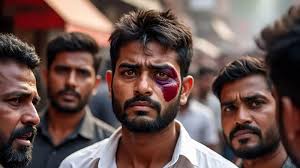
Dewas News: Three Dalit youths were arrested in Dewas for breaking the idol. They have been released on bail. After this, the family has alleged that the police has given third degree. Former minister Arun Yadav has demanded the suspension of the policemen from the DGP. Dewas: Investigation has started into the allegations of assault on three Dalit youths in police custody in Dewas district of Madhya Pradesh. Ravi Ajmeri, Ritesh Ajmeri and Ritesh Sinam have been arrested on August 6. They were accused of breaking religious idols in the industrial area of Dewas. The idols of Lord Ganesha and Goddess were vandalized. The police registered a case and scanned more than 50 CCTV footage. After this, the accused were identified and arrested. Sent to jail after being produced in court At the same time, the accused were produced in court after the arrest and sent to jail. After getting bail, the family members of the accused are making serious allegations against the police. Former Union Minister Arun Yadav is sharing the video and alleging that three innocent Dalit children Ritesh, Ravi and Ritesh were brutally beaten up in Bavadia police station of Dewas. Third degree torture was done. Even the nails were pulled out. Arun Yadav has said that when there is no evidence then why such inhuman torture? Demand to suspend policemen Along with this, Arun Yadav has demanded that DGP Sir, immediately suspend the guilty policemen, set up a high-level inquiry and give justice to the Dalit children. At the same time, the family has alleged that three youths were severely beaten and tortured in police custody, which also includes the allegation of pulling out nails. Dewas SP Puneet Gehlot, while talking to an English newspaper, said that an independent investigation has been ordered. Gehlot said that the allegation is that the police have tortured them. While they were produced in the court after the medical test. After bail, they are claiming assault. The SP said that the arrest was made on the basis of solid evidence. At the same time, the police department has started investigating these allegations. The SP said that an impartial investigation will be conducted. Edited by: Muneshwar Kumar About the author Muneshwar Kumar is the Principal Correspondent at Navbharat Times Online. Has 14 years of experience in journalism. Has special interest in politics, crime, current affairs and off-beat news of Madhya Pradesh. Also has experience of ground reporting in many elections. I have been associated with Navbharat Times Online since 2020. Courtesy: Hindi News
Every Identity Counts: Breaking Barriers for Transgender Youth in India
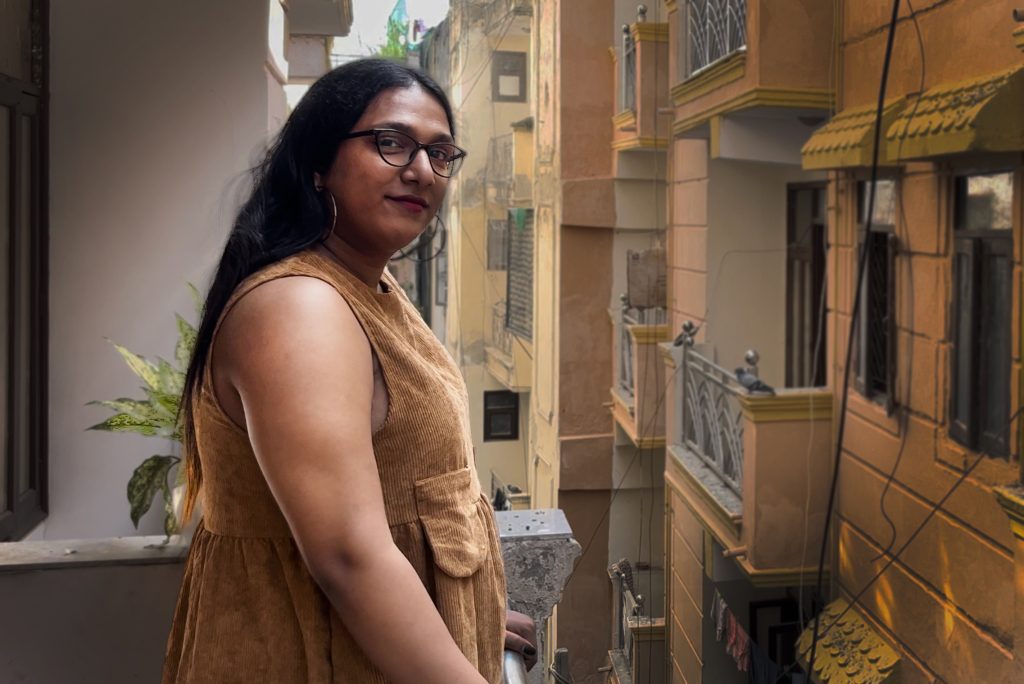
Education and employment are the bedrock on which individuals build a self-dependent life—or at least, that’s the case for most. For people whose identities don’t conform to societal norms, even accessing basic education or formal employment often becomes an uphill battle. This was the case for Sonali Khan too. A 27-year-old trans woman, Sonali had to drop out of school because of incessant bullying from classmates. Teachers turned a blind eye, and the environment became so hostile that continuing wasn’t an option. When she finally gathered the courage to come out, she was met not with support, but with rejection. Her family abandoned her. The neighbours she grew up with ridiculed her and ignored her plight. Like many transgender youth in India, Sonali was pushed to the margins—not by choice, but by circumstance. According to the National Human Rights Commission of India, nearly 50% of transgender persons never attend school, and only 6% are employed in formal sectors. The rest, like Sonali, often find themselves in informal work or survival-based livelihoods, battling the compounded challenges of stigma, poverty, and exclusion. “I had to leave school when I was in 12th standard because of the daily ridicule, and soon after, my family threw me out,” said Khan, who now lives in Delhi. A person working on a laptop at a desk surrounded by colorful maps and personal items. The challenge of identity documentation Although the last census in 2011 put the number of transgender persons in India at 487,803, the actual figure is expected to be much higher now. Many understandably choose not to disclose their gender identity, and even if they do, they often lack official documents that reflect their true identity. Lack of identity documents, persistent stigma, and poor access to education continue to keep transgender persons away from formal employment. Those who embrace their true identity often start by dropping their “deadname”— the birth name they no longer use. This, however, brings new challenges, especially when accessing government welfare schemes that require valid identity cards. Many transgender people still hold ID cards under their deadnames, making them ineligible for these schemes. Without updated ID documents, they also struggle to find jobs, rent homes, or access healthcare. “Getting a job is not easy if you are a trans person. I applied for over 50 jobs, got called for interviews for three of them, and was promptly dismissed when they realized I was a trans woman,” said Khan. Legal progress and policy measures The Government of India has recognized these challenges—leading to several progressive legal reforms . These include the historic 2014 NALSA Judgement, which affirmed the right of transgender persons to self-identify their gender, and the Transgender Persons (Protection of Rights) Act, 2019, which prohibits discrimination and outlines measures for education, employment, and healthcare access.. While these are among the most progressive measures around the world, there is a long way ahead in terms of their implementation. Schemes and initiatives for empowerment In 2022, the Ministry of Social Justice and Empowerment (MoSJE) launched the ‘Support for Marginalized Individuals for Livelihoods and Enterprise (SMILE)’ scheme. This initiative focuses extensively on rehabilitation, medical facilities, counselling, education, and skill development for the transgender community. SMILE Scheme provides financial assistance to Transgender students in secondary and senior secondary school (classes IX to XII) to promote their education and reduce dropouts. Furthermore, MoSJE has initiated various skill development initiatives though Garima Grehs (Shelter homes) and other partners. These initiatives aim to provide safe housing, training, and support for livelihood opportunities. However, getting more transgender persons to register on the National Transgender Portal, operated by the MoSJE, which is the official government platform for accessing identity cards and welfare schemes, remains a challenge. UNDP’s role in driving change UNDP played an important role in developing the framework document on transgender welfare in India, in collaboration with community-based organizations (CBOs). This document serves as a guiding blueprint for government programmes, outlining key priorities and recommendations to improve access to education, employment, healthcare, and social protection for transgender persons. It provided inputs for designing of the SMILE scheme, ensuring it addressed real challenges faced by the community. Additionally, as part of a global initiative, UNDP India worked with community-based organizations in Bihar to help the transgender community obtain Transgender identity cards. The project includes enrolling trans persons in the National Transgender Portal. The portal facilitates the issuance of Transgender Identity Cards through district authorities. Upon successful enrolment, a trans person receives a Transgender Identity Card, which can be used to update documents such as bank accounts and PAN cards with the person’s new name. Further, it will facilitate their access to Government welfare measures. A call for inclusion this International Youth Day While these initiatives are bringing change on the ground, it is time that all stakeholders double down on efforts to usher in a more rapid transformation. This International Youth Day, while we seek to include the younger generation in governance and make them active partners in achieving the SDGs, let us not forget that non-binary and transgender youth, too, have an equal stake—and an active role to play. For Sonali, having her identity recognized is more than a matter of paperwork. It is the difference between being shut out of opportunities and being able to rebuild her life with dignity. Her journey reflects what is at stake for thousands of young transgender persons across India. The world can’t afford to leave them behind if we are truly committed to building inclusive, resilient, and just societies. Their voices, experiences, and leadership are essential to shaping a future where no one is forced to choose between their identity and their dignity. It’s time to move beyond token inclusion and ensure that every young person, regardless of gender identity, has the opportunity to learn, to thrive, and to lead. Blog by Dr. Chiranjeev Bhattacharjya, Programme Analyst – Health, and James Jose, Communications Officer – Health System Strengthening, UNDP India. Courtesy : UNDP India Note: This news is
Rahul Gandhi takes EC dig over tea with ‘dead voters’
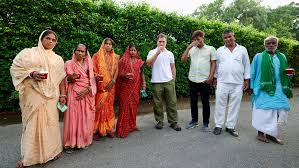
NEW DELHI: Sharpening his criticism of the SIR of electoral rolls in Bihar, Congress MP Rahul Gandhi on Wednesday remarked that he had had the unique experience of having tea with some “dead” voters from Bihar. Rahul and other INDIA bloc netas are all set to embark on a ‘Vote Adhikar Yatra’ starting Aug 17, to make the “battle against vote chori a mass movement”. Congress said, “Seven voters in Bihar, all very much alive, shared tea with Rahul Gandhi today – even as the Election Commission’s SIR lists them as ‘dead’.” “There have been many interesting experiences in life, but I never got the chance to have tea with ‘dead people’. For this unique experience, thank you Election Commission!” Rahul said on X. Congress said they voters, who belong to RJD MP Tejashwi Yadav’s constituency of Raghopur, were removed from the electoral rolls despite having completed the requisite paperwork. Congress also hit back at BJP for its claim of irregularities on seats contested by some top opposition netas, with Pawan Khera telling PTI the data shared points to the governing party’s collusion with EC and demanding that 2024 Lok Sabha polls be considered “null and void”. Courtesy : TOI Note: This news is originally published on https:/timesofindia.com/bha and is used purely for non-profit/non-commercial purposes, especially human rights.
Supriya Sule backs Rahul Gandhi on ‘voter discrepancies’ in poll rolls, seeks discussions in Parliament
Pune: NCP (SP) working president Supriya Sule on Wednesday came out in support of Congress MP and Leader of the Opposition in Lok Sabha Rahul Gandhi’s “vote theft” claim and sought a detailed discussion in Parliament over the alleged discrepancies in electoral lists. “Rahul Gandhi has not made some mere allegations, but has brought to the for facts about discrepancies in the voters’ list. Based on this, we are demanding an explanation from the Election Commission of India,” she said. Supriya was among the 300 MPs who took part in the “long march” to the ECI’s office on Aug 11, and they were stopped midway by Delhi police. “We took out the march in a peaceful and democratic manner, but we were stopped. We have been demanding a discussion in Parliament on the issue of voters’ list discrepancies. But it is not happening. There should be discussions on important issues in a healthy democracy. However, when opposition members try to speak in the House, their microphones are being switched off,” Supriya said during a media interaction in Baramati on Wednesday. After Rahul Gandhi’s claim of “vote theft”, NCP (SP) Chief Sharad Pawar said that two people had approached him to ensure victory at 160 seats in the state Assembly polls. Speaking on the issue, Supriya said: “He (Sharad Pawar) has issued a statement, not made any allegations. We, as the Opposition, are only demanding that the entire election process should be transparent. Every person has an equal right to one vote each. But if there are multiple registrations, the ECI should clarify.” The Baramati MP also reacted to the tariffs imposed by the US President on India. “The way the govt had roped in Opposition members to put forward the country’s stand on Operation Sindoor in various countries, why can’t it do the same on the tariff issue?” Courtesy : TOI Note: This news is originally published on https:/timesofindia.com/bha and is used purely for non-profit/non-commercial purposes, especially human rights.
Cong launches statewide protest from Jaipur against ‘vote theft’
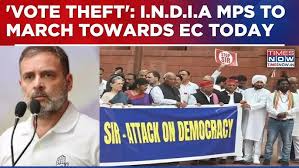
Jaipur: In a spirited demonstration Wednesday, Congress workers, including a significant number of women, took to the streets chanting slogans like “Vote Chor, Gaddi Chhod” and “Rahul Gandhi Zindabad.” The march, which started from the party’s state headquarters near Chandpole and concluded at the Shaheed Smarak on MI Road, aimed to support allegations of “vote theft” made by Rahul Gandhi against the Election Commission of India (ECI). Carrying hundreds of national and party flags, banners and placards, the protest saw volunteers actively distributing leaflets explaining its purpose. Congress state president Govind Singh Dotasra led the charge, asserting, “Today we began a state-level protest after Gandhi provided evidence of vote manipulation, not just allegations. We will continue demonstrations at district and local levels.” Dotasra accused the ECI of denying data requests related to BJP’s electoral victories in various constituencies, stating, “BJP’s wins in Jaipur Rural, Bhilwara, Rajsamand and in bypolls like Jhunjhunu, Ramgarh and Deoli-Uniara followed a clear pattern — missing names of voters who traditionally support Congress.” The protest saw a large turnout of party workers, bolstered by the presence of senior politicians, including former CM Ashok Gehlot, opposition leader Tikaram Jully and Tonk MLA Sachin Pilot, showcasing unity within the party’s state leadership. The demonstration followed Gandhi’s recent detention during a march in Delhi, which included other opposition leaders. Gehlot remarked, “The protests in Delhi sent a nationwide message about vote theft. This protest is to protect democracy and will continue until the election commission provides the requested data.” Other leaders echoed the sentiment, with Jully asserting that opposition votes were being suppressed. Traffic on MI Road was disrupted for nearly an hour due to the protest but it concluded peacefully at the Shaheed Smarak, with heavy police presence ensuring no major incidents occurred. Dotasra announced plans for similar protests and candle marches across Rajasthan in the coming days. Courtesy : TOI Note: This news is originally published on https:/timesofindia.com/bha and is used purely for non-profit/non-commercial purposes, especially human rights.
NFL trailblazer Justine Lindsay returns, igniting waves as Carolina Panthers’ transgender cheerleader

Justine Lindsay is back with the Carolina Panthers this NFL season, making history once again as the league’s first and only openly transgender cheerleader. Her presence breaks barriers, reshaping the NFL’s cultural landscape while inspiring millions worldwide. Lindsay’s journey is more than about football—it’s a powerful symbol of courage and inclusion. Fans and advocates alike are watching closely as she redefines what it means to belong in sports. How Justine Lindsay electrifies the NFL stage as the league’s only openly transgender cheerleader Justine Lindsay’s return to the Panthers’ squad highlights the NFL’s growing commitment to diversity. As the league’s singular openly transgender cheerleader, she commands attention not just for her talent, but for her bold representation. Her visibility challenges traditional norms and sparks vital conversations around acceptance in professional sports. Each performance sends a message: the NFL is evolving, and inclusion is here to stay. — _MLFootball (@_MLFootball) Justine Lindsay’s powerful campaign to empower trans kids and revolutionize youth sports access Beyond the cheerleading field, Lindsay passionately advocates for transgender children’s rights, especially their ability to participate in youth sports. She emphasizes that sports provide vital opportunities for self-expression, confidence, and community. Lindsay insists that denying trans youth access to athletics not only harms their mental health but also deprives them of essential life skills. Her advocacy fuels nationwide debates, spotlighting the importance of inclusive policies in grassroots sports. How Justine Lindsay’s trailblazing presence inspires millions across the world to embrace authenticity and diversity Lindsay’s story resonates far beyond the NFL stadiums. Her bold visibility empowers countless transgender individuals and allies across the globe. By standing tall in a high-profile role, she dismantles stigma and fosters empathy. Fans from diverse backgrounds celebrate her as a trailblazer, someone who proves that authenticity and talent can thrive together on the biggest stages. Justine Lindsay’s journey isn’t just about breaking records; it’s about breaking down walls. As she returns to the Panthers, she invites the world to rethink who belongs in sports—and why. The NFL may never look the same again. Courtesy : TOI Note: This news is originally published on https:/timesofindia.com/bha and is used purely for non-profit/non-commercial purposes, especially human rights.
Retired JNU professor reveals – 200 years of privilege is the secret of success of ‘upper castes’
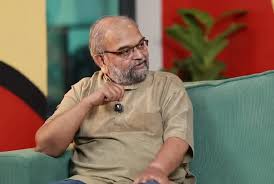
In an interview with Kunal Kamra, Professor Deshpande exposed the ‘merit’ of upper castes, told how caste gave land to his grandfather, job to his father and ‘merit’ to him New Delhi: Retired sociologist Professor Satish Deshpande of Jawaharlal Nehru University (JNU) has made a shocking revelation on the caste system in India. He told how people of upper castes attribute their success to “merit”, while in reality it is the result of caste privileges received for hundreds of years. In comedian-commentator Kunal Kamra’s podcast ‘Nope’, sociologist Professor Satish Deshpande exposed the fundamental contradiction in an explosive discussion on India’s caste system where on the one hand the Constitution declared caste to be abolished, but in practice it is still deeply ingrained in every layer of Indian society. Professor Deshpande explained with the example of his own family how upper caste privileges are transmitted for generations. He said, “My grandfather got 200 acres of land during the Peshwa rule as a Brahmin. If he had been from some other caste, he would not have got this land. After independence, the land reforms reduced it, but my father was made an engineer by selling the same land.” This admission breaks the myth that the success of upper castes is purely a result of individual merit. Deshpande candidly said, “My grandfather was not very smart. So when the new laws came after independence, a lot of land was lost from him. But whatever was left, some of that land was sold and my father and one of my uncles were made engineers and doctors. So I am the son of an engineer, so I think what do I have to do with caste? I am an embodiment of merit, but how did I get merit? How did I go to expensive schools and good colleges? Because my father was an engineer. How did my father become an engineer? Because my grandfather had land. Why did my grandfather have land? Because his caste was so and so. If he belonged to some other caste, he would not have had any land and I would not be sitting here. But by the time my generation came, this language of merit became so strong that people like me really started believing that whatever they are is only and only because of merit, it has nothing to do with caste. The oppressed have to wear their caste like a badge; the privileged have the privilege to forget it. Professor Satish Deshpande Deshpande first rejected the narrative that caste was a colonial creation. He acknowledged that British rule certainly fostered caste divisions for administrative control but he insisted that caste was and is an indigenous hierarchical system. “We can blame the British for many things, but caste is not one of them”. The Constitution of India after independence formally abolished caste discrimination and declared the country a casteless republic, Deshpande said. But the same Constitution also introduced reservations, recognising that centuries of oppression required redress. This dual policy of outlawing caste while simultaneously institutionalising caste-based quotas created a fundamental tension that India has yet to resolve. The illusion of merit and the invisibility of privilege The most striking point Deshpande raised was how upper caste Indians often deny caste by claiming that their success is entirely merit-based. He explained this with a personal example: his grandfather, a Brahmin, Caste-based privileges under the Peshwa regime meant that the peasants owned substantial land. Even the land they lost after land reforms funded his father’s education, which in turn enabled his own advancement. He acknowledged, “I am where I am because of generations of caste privilege. Yet my education and social status allow me to pretend that caste doesn’t affect me.” He argued that this selective blindness is a luxury only of the privileged. For the underprivileged castes, caste is an inescapable reality – a marker of identity that they have to constantly produce in order to demand their rights. “The oppressed have to wear their caste like a badge; the privileged have the privilege of forgetting it.” Deshpande said, “There has been a huge rift in caste. Those who have benefited the most from caste feel that caste today means only lower caste. People like us have nothing to do with caste. And on the other hand, those who belong to these so-called lower castes feel that without raising the slogan of no caste, we will not get anything. So one section has become hyper visible. Their caste has become hyper visible. They will not get anything without caste. And another section’s caste has become invisible, so because of this, dialogue has become impossible. Those who have suffered the most from caste have had to raise the flag of caste every time. Regarding casteism, which is deeply ingrained in society, Prof Deshpande said, “How can we abolish the institution that governs everyday life? This question has always put us in a dilemma – a shame and hesitation that we have expressed in different ways. It is a suppressed truth that has remained in our subconscious. After independence, the first thing we did was to declare the abolition of caste in the Constitution. But the same caste system forced us to accept that a large section of the country has been suppressed for centuries – not only socially but also morally and legally. As compensation for this historical injustice, we created the system of reservation. The contradiction here is clear: on the one hand the Constitution declares the end of caste, that now we are a republic, caste distinctions have ended, while on the other hand it makes special provisions for some castes. Superficially this seems progressive, but it reflects a double mentality – the desire to abolish caste and at the same time the need for historical compensation. He says that the foundation for this was laid by the Poona Pact of 1932, when after Gandhiji’s fast, reservation was accepted within the Hindu electorate instead of a separate
SC Panel Chief Visits Injured Dalit Youth In Tirupati, Assures Govt Support
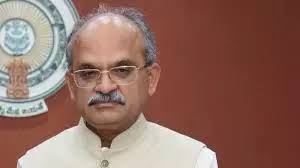
Pavan Kumar, a resident of Pulicherla in Chittoor district, was allegedly abducted and assaulted on August 9 by YSRC Tirupati social media in-charge Anil Reddy and his aides over a dispute involving a rented two-wheeler. TIRUPATI: Andhra Pradesh Scheduled Castes Commission chairman K.S. Jawahar on Tuesday assured full government support to Pavan Kumar, the Dalit youth injured in a recent assault in Tirupati. Pavan Kumar, a resident of Pulicherla in Chittoor district, was allegedly abducted and assaulted on August 9 by YSRC Tirupati social media in-charge Anil Reddy and his aides over a dispute involving a rented two-wheeler. He was reportedly beaten with a police baton, and suffered a fracture below his left knee. He was currently undergoing treatment at S.V.R. Ruia Government General Hospital. After visiting Pavan in the hospital, Jawahar told the media that the victim had identified about 25 attackers, including 16 by name. Cases have been registered against them. He said the government would ensure that Pavan receives all entitlements under the SC/ST (Prevention of Atrocities) Act and that strict legal action would be taken against the culprits. Jawahar described the incident as unfortunate, especially in a sacred place like Tirupati. He said the Commission would stand by Dalits across the state. He also indicated that a special court could be set up for speedy trial if required. Local MLA Arani Srinivasulu, Yadava Corporation Chairman G. Narasimha Yadav, and other leaders were present. Courtesy : Deccan Chronicle Note: This news is originally published on https:/deccanchronicle.com/bha and is used purely for non-profit/non-commercial purposes, especially human rights.
Karnataka: Rajanna’s sacking threatens ‘pro-Dalit’ stance of Congress, credibility of Siddaramaiah
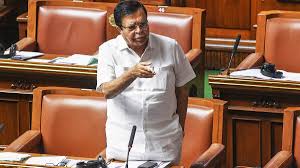
The sacking of Karnataka cooperation minister K.N. Rajanna, a Scheduled Caste leader, has plunged the Siddaramaiah government into a political crisis The sacking of Karnataka cooperation minister K.N. Rajanna, a Scheduled Caste leader from Tumakuru, on the first day of the monsoon session of the state legislature, has the Siddaramaiah government on the back foot as the BJP claimed that the Congress party is showing its “true anti-Dalit” face. The saffron party dubbed the removal of two Dalit ministers—B Nagendra over allegations of corruption in the Valmiki Corporation scam and now Rajanna for refusing to toe the line of the party on the vote theft charges—as “Dalit victimisation”. Chief Minister Siddaramaiah removing Rajanna, one of his close aides, from the cabinet on Monday, reportedly following orders from the party high command, has raised questions over Siddaramaiah’s own position and the stifling of Dalit voices within the party. While Rajanna’s unceremonious removal from the cabinet is being attributed to his recent comments on the voter fraud that directly challenged LOP in Parliament Rahul Gandhi’s claims and narrative on the “vote theft”, Rajanna’s alleging a “conspiracy” against him for his sacking, has put the government and the party in a tight spot. “When was the voter list made? It was made when we (Congress) were in power. What’s the point of discussing it now? It is true that there have been illegalities and we should be ashamed as they took place right before our eyes. We should have examined when the draft electoral rolls were out. There has been voter fraud in Mahadevapura like duplicate voting, bulk voters in a single address. But it was our responsibility as the party and the government to file objections to the draft rolls,” Rajanna had responded on the voter fraud issue, even as the Congress party had launched a national-level “Vote Chori” campaign, squarely accusing the Election Commission of “colluding” with the ruling BJP at the Centre for the vote. After his sacking, Rajanna told the media that there was a “conspiracy” against him and he would reveal everything at an appropriate time. “There has been a misunderstanding, and I will explain it to Rahul Gandhi and K.C. Venugopal. It is the party’s decision and we cannot question it,” said Rajanna, even as his son and MLC Rajendra turned emotional and rushed to meet the chief minister after the sacking was made official by the governor’s office on Monday evening. BJP trains guns on state govt On Tuesday, LOP in Assembly MLA R. Ashok said, “Rajanna has been punished for speaking the truth and busting Rahul Gandhi’s false narrative.” State BJP president B.Y. Vijayendra alleged that the Congress constantly tried to silence the Dalit leaders in the party. “In Congress, truth is treated as a threat, especially when it comes from a leader of a marginalised community whose voice they have long tried to silence. The pattern is clear. In the case of ST Welfare Minister Nagendra, funds earmarked for the development of the community were siphoned off to finance Congress’s election expenses. Instead of holding the CM and DCM D.K. Shivakumar accountable, the blame was placed entirely on Nagendra, and the matter was quietly closed,” said Vijayendra. Referring to the Congress leadership stalling the Dalit ministers’ dinner meeting organised by Home Minister G. Parameshwara recently, Vijayendra accused the Congress high command of “dictating” what the SC/ST ministers could do or not do. “Even when SC/ST MLAs and ministers gather informally for a meal, the high command dictates that such meetings cannot happen without their physical presence, as though leaders from these communities cannot meet independently. This is the true face of Congress—anti-Dalit, anti-ST, anti-democratic and anti-truth,” mocked the BJP leader. The BJP further said Siddaramaiah, who claims to champion the ‘Ahinda’ (minorities, dalit and backward classes) stands exposed. “This has exposed the hollow claims of Siddaramaiah as he has never defended the Ahinda when targeted. Instead, he bows to the diktats of the Delhi High Command to safeguard his own position as the chief minister,” alleged Vijayendra. Interestingly, Congress MLC B.K. Hariprasad, an OBC leader and a vocal critic of Siddaramaiah, said, “When you are in politics, one has to face conspiracies, especially if you are from the SC, ST or OBC communities. This is a lesson for Rajanna. But I am sure he will not remain mum. I have known him since his Youth Congress days.” BJP leader from Valmiki (ST) community B. Sriramulu said Rajanna was dropped from the cabinet for his “straight forward” and “harsh” words. “The CM dropping him from the cabinet, yielding to pressure from some invisible hands, is an insult to the Valmiki community,” he said. In June 2024, Nagendra was forced to resign from the cabinet after the Valmiki Corporation scam—misappropriation (diversion) of Rs 187 crore allegedly to fund the Telangana assembly polls—was exposed. Nagendra was arrested by the Enforcement Directorate in July under money laundering charges and released on bail in October. The BJP has claimed that Nagendra was made the fall guy though the alleged scam was about the diversion of funds for elections. The opposition parties had demanded the chief minister, who is the finance minister, to resign. Following the Stadium stampede incident that claimed 11 lives, the BJP had strongly condemned the suspension of then Bengaluru police commissioner B. Dayananda (also belonging to ST community), and accused the Siddaramaiah government of making the top cops the political “scapegoats”, even as the citizens, retired cops, and Dalit organisations expressed their dismay over the suspension of an efficient and upright officer. Congress: A divided house The removal of both Nagendra and Rajanna from the cabinet, against Siddaramaiah’s will, has exposed the widening rift between the warring factions in the ruling party. The Shivakumar faction seems to have an upper hand. The high command not only stopped the various events organised by Siddaramaiah loyalists meant to bolster the image of the CM, but also stalled the implementation of the old caste survey (Kantharaj Commission report)