
54 Rajputs tied and brutally attacked:Women gangraped, victims buried alive; Congress never regained Bihar Chief Ministership after the massacre

In the second episode of Dainik Bhaskar’s election series ‘Massacre’, today is the story of the Dalelchak Baghaura massacre, after which the Congress, which ruled Bihar for 40 years, could never make its CM again… One night of May 29, 1987. Location – Aurangabad district of Bihar. The same Aurangabad where the country’s only west-facing Sun Temple is located. A crowd of about 500 people was advancing, chanting the slogan ‘MCC Zindabad’. They had guns, axes, sickles, and cans of kerosene oil in their hands. After a while, everyone stopped at one place. They talked for a bit. Then half of them started moving towards Baghaura village and the other half towards Dalelchak. Both villages are one kilometer apart. Here, the Rajputs had dominance. Gaya Singh of Baghaura was the head clerk in the forest department. He had the only concrete house in the village. He had built it with passion. The eyes would stop at the gateway from afar. Around 8 PM, suddenly some noise was heard. When he opened the door and looked, a crowd of 200-300 people was standing in front. Gaya Singh hastily closed the door. They hadn’t even taken two steps when the crowd pushed and broke the door. First, the men of the house were dragged out and lined up. Meanwhile, two boys tried to escape unnoticed, but the attackers fired shots. Both fell right there. The attacker went near them. Their breaths hadn’t completely stopped yet. He struck a machete on the neck. Then, wiping his sweat, he said- ‘What are you looking at… go and bring their women.’ 20-25 attackers entered and started throwing women and children outside. Everyone was screaming- ‘Don’t kill us. Let us go. We beg you.’ One attacker spoke up- ‘#&#$% these people show a lot of arrogance. They make our women work. Dishonor their women in front of them. Only then will the revenge be complete.’ The attackers pounced on the women and girls. They tore their clothes. They began to rape them. After a while, a middle-aged man spoke up- ‘Enough. Now kill them all.’ The attackers dragged the women into the veranda. They placed their necks on the cot and pressed hard. One attacker picked up an axe and one by one beheaded the five women. Blood spread all over the veranda. The attacker said- ‘Dispose of them all.’ 8-10 people started digging a pit in front of the house with shovels. In a short time, the pit was ready. The attackers put the women’s bodies in the pit and filled it with soil. ‘Now tie these #@$%*& and take them to the banyan tree. The villagers should also see what happens when they clash with us.’ Hearing this, the attackers tied the hands and feet of Gaya Singh and his family members. They dragged them to the banyan tree. There was a large banyan tree at the beginning of the village. 30 May 1987, Dalelchak Baghaura village. Rajputs were killed by tying them to this banyan tree. Source: Library 30 May 1987, Dalelchak Baghaura village. Rajputs were killed by tying them to this banyan tree. Source: Library By now, there was chaos in the village. The attackers were dragging women, men, and children from Rajput families one by one to the banyan tree. Many people were jumping from the roofs and running towards the fields. The attackers were continuously firing. Some people were killed on the spot. A 40-year-old man was returning home with a tractor. Seeing the attackers, he screamed, ‘Oh uncle, we are not Rajputs. We work at their house. We are Harijans, Harijans.’ #$%@#$ Lying… saying this, a middle-aged man struck him on the back with an axe. Two attackers tied him to the seat of the tractor. Then they poured a can of kerosene oil on the tractor and set it on fire. Within minutes, the driver died in agony. Meanwhile, in the nearby village of Dalelchak, Kamla Kunwar had just returned from her in-laws’ house a few hours earlier. Her father was preparing for a feast. Guests had already arrived. Suddenly, the dogs started barking. Kamla said to her sister Lalita- ‘Go and see who is outside?’ Lalita peeked and saw hundreds of armed men advancing towards the village. She screamed- ‘Papa, Mummy, everyone run, the Naxalites have come.’ Both sisters, their parents, and other relatives started running towards the fields. Just then, the people next door stopped them. They said- ‘You people are not in any danger. Just hide in the house.’ Within minutes, the crowd stormed into the village. They entered the Rajputs’ houses and started a massacre. Kamla and Lalita hid in a pile of hay behind the house. The rest of the family and relatives were caught. A two-year-old child was sleeping on the bed. He started crying upon seeing the crowd. The attacker shouted – ‘Kill this bastard first.’ As soon as he heard this, a middle-aged man picked up the child and threw him on the threshold. His head split open. The attacker grabbed the child by the hair and lifted him. Another struck the child’s neck with an axe. The child’s head remained in the attacker’s hand, and the body fell to the ground. 30 May 1987, the children of the Dalelchak Baghaura massacre whose entire families were killed in the massacre. Source: Library 30 May 1987, the children of the Dalelchak Baghaura massacre whose entire families were killed in the massacre. Source: Library One pointed towards the women and said, ‘Violate their honor and finish them off.’ The attackers did just that. After raping, they beheaded the women and girls. Kamla’s father could not bear to see this. He charged at the attackers, cursing them, but they caught him. Two attackers held his legs and two held his arms. A 20-year-old boy struck him in the stomach with an axe. He screamed. Then the attacker shoved the butt of a gun into his mouth. Within minutes, he was writhing in
Opinion: We must talk about Savarna women’s complicity in caste violence

Dominant caste women are not a monolithic entity. Their engagement with caste may not be uniform. Some might be victims of it. Some are complicit in it. Some resist only the misogyny. But true liberation is possible only if they dismantle both caste and patriarchy. There appears to be a marked shift in the caste discourse after the brutal murder of Kavin Selvaganesh, a 27-year-old Dalit IT professional. Onus was placed on Subhashini, and suspicions were raised about her culpability. Her video, defending her parents’ innocence, garnered severe criticism. And she was chastised for her appeals to “drop” the issue, whitewashing the crime and failing to take a stance against the perpetrators. Many also questioned the Dravida Munnetra Kazhagam-led (DMK) state government’s ineffectual anti-caste politics and its general apathy towards Dalits. People shared their anxieties regarding the increase in violent caste pride among intermediate castes. On July 27, Kavin was brutally hacked to death in Tirunelveli for his relationship with Subhashini, a woman from the dominant Maravar caste. Kavin was an IT employee based in Chennai and was killed in broad daylight at KTC Nagar in Tirunelveli. Both victim and perpetrator The criticism of Subhashini deviated from how public narratives largely frame dominant caste women as victims of so-called honour killings. The murders of Dalit individuals who are in intercaste relationships are often referred to as ‘honour’ killings. The caste-supremacist view dictates that such relationships are a threat to the maanam (honour) of dominant communities. In a caste-punitive society, murder is wielded as a means to keep intercaste relationships in check and uphold caste endogamy. In many caste killings, the loss of life has been that of a Dalit man, either hacked to death in broad daylight like Shankar in 2016 or found dead on deserted railway tracks like Ilavarasan in 2013. Each of them was punished for being in love with dominant caste women. In 2016, V Shankar, a Dalit man, and his wife Kowsalya, who belongs to the Kallar caste, were brutally attacked in Tiruppur district. While Shankar succumbed to his injuries on the spot, Kowsalya survived despite her wounds. Kowsalya held firm and testified against her family, seeking justice for her husband. Events after the 2013 caste killing of Dalit youth Illavarasan in Dharmapuri district played out differently. Following the suicide of her father, Divya, Illavarasan’s partner, returned home to her mother. Divya is from the Vanniyar community. She succumbed to the pressures of a caste society a few days before Ilavarasan’s death. Kowsalya is now a fierce anti-caste activist, while Divya leads a quiet life, staying out of the limelight. However, both women were considered victims. The reason why Subhashini was held accountable by social media users is the changing perspectives of women’s roles in Tamil caste society. Dominant caste women are no longer regarded solely as victims but as active benefactors of the system. Several critiques even flipped the derogatory narrative of naadaga kaadhal (fake love), using it to describe how Subhashini cost Kavin his life. The term naadaga kaadhal was first used by the Pattali Makkal Katchi (PMK), a Vanniyar-majority party, to falsely accuse Dalit men of ‘luring’ dominant caste women. Vanniyars are categorised as Most Backward Class (MBC). There is no denying that caste, like patriarchy, oppresses all women. Both systems rob women of their autonomy, agency and personhood and fundamentally treat them as mere birthing vessels meant to further male and caste lineage. The practice of endogamous monogamy was institutionalised in order to ensure the idea of ‘purity’ in bloodlines. As a result, a woman’s freedom was curbed, and restrictions were placed to control who she can love and marry. Despite the knowledge that both patriarchy and casteism thrive on women’s subjugation, dominant caste women’s critique and opposition have been uneven. While women from all quarters put up a fierce fight to dismantle patriarchy, the struggle against casteism is largely led by Dalit women. Many dominant caste women content themselves with tepid criticisms. This is because the hierarchical and gradational nature of caste offers them considerable privilege. A privileged caste position provides women with social and cultural capital that their gender identity does not. Caste privilege helps them navigate patriarchal hurdles and even reap some extra benefits along the way. Challenging portrayals of Savarana women in cinema Mari Selvaraj’s portrayal of dominant caste women in his films offers insightful examples of how such caste privilege works. In director Mari Selvaraj’s Maamannan (2023), Rathnavel’s (Fahadh Faasil) wife Jyothi (Raveena Ravi) is docile and subservient. She, quite literally, has a silent presence in the film, as she has no dialogues. Despite being confined to her house for the most part, she ultimately bags a seat at the Legislative Assembly, clearly a fruit of her dominant caste status. One can argue that she stands in the election only at her husband’s bidding and is a puppet in his hands, calling attention to her oppression as a woman. Nevertheless, it is undeniable that her path to power is relatively easier and not as arduous as that of the film’s eponymous Dalit protagonist (Vadivelu). His life and dignity and that of his family’s are perpetually at stake. A reading like this might go against the grain of what the director believes in and wants to convey. Mari, in many of his interviews, maintains the conviction that women are hapless victims and that their victimisation by patriarchy is worse than the caste marginalisation faced by a man. Regardless of his position, due to the realistic tenor of his films, the caste privilege of dominant caste women is apparent in the upper hand they have over Dalit men. Take, for instance, Jo (Anandhi) from Pariyerum Perumal (2018). When the dominant caste Jo falls in love with Pariyan (Kathir), she has the freedom and space to be honest about her feelings and express them boldly. On the other hand, Pariyan, a first-generation Dalit law student, is attacked multiple times to force upon him the realisation that he is forbidden
4 years’ jail for AAP MLA in Dalit woman assault case
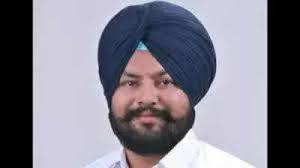
TARN TARAN: A court in Punjab’s Tarn Taran district sentenced Manjinder Singh Lalpura, AAP MLA from Khadoor Sahib, to four years in prison in a 12-year-old case of assault and molestation of a Dalit woman. On Wednesday, the court had convicted 11 people, including six policemen, in the case. Pronouncing the sentence on Friday, additional sessions judge Prem Kumar awarded four-year jail term to Lalpura and six others, while three accused were sentenced to one-year imprisonment each. One of the accused, Harvinder Singh, currently lodged in Delhi’s Tihar Jail, did not appear in the court and his sentencing is scheduled on Sept 16. Another accused, Paramjit Singh, died during the trial. “The court also imposed a fine of Rs 50,000 on each of the accused and directed that compensation be paid to the victim as per the law,” the survivor’s lawyer, Amit Dhawan, said. Following the pronouncement of the sentence, the MLA was taken into custody and sent to jail. On Sept 4, 2013, a taxi driver and a few other men assaulted and molested a 19-year-old woman when she and her family members were attending a wedding. A police team that arrived at the scene also assaulted the woman. Courtesy : TOI Note: This news is originally published on https:/timesofindia.com/bha and is used purely for non-profit/non-commercial purposes, especially human rights
Kashi court agrees to hear plaint against Sonia, Rahul over remarks on PM Modi, his mom
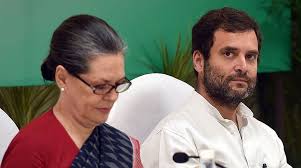
Varanasi: The special MP/MLA court of additional chief judicial magistrate (ACJM), Varanasi, has agreed to hear a criminal complaint in connection with the alleged hate speech at a Congress rally in Bihar where objectionable comments were made against Prime Minister Narendra Modi and his mother. The court admitted the plea moved by Shashank Shekhar Tripathi — an advocate and convener of BJP’s legal cell in the Kashi region — under section 223 of BNS, and will hear the parties concerned on Sept 17 to decide the maintainability of the case. Tripathi said that this complaint has been filed against Congress leaders Rahul Gandhi, Mallikarjun Kharge, Sonia Gandhi, and the party’s official social media platforms. The complaint alleged that during a Congress-RJD rally in Darbhanga, Bihar, offensive and derogatory slogans were chanted against PM Modi and his late mother. Objectionable and inflammatory posts were also shared from Congress’s official social media platforms, attempting to tarnish the image of the PM, central govt, and constitutional institutions. Such conduct has raised concerns about social tension, enmity, and disturbance of peace, the complaint added. Tripathi said that continuous insults, baseless accusations, and inflammatory propaganda against the PM and constitutional institutions are merely conspiracies to weaken democracy. “The court’s acceptance of our complaint and initiation of proceedings is a significant step towards restoring the dignity of democratic institutions,” he said. Courtesy : TOI Note: This news is originally published on https:/timesofindia.com/bha and is used purely for non-profit/non-commercial purposes, especially human rights
‘Permission leni chahiye thi’ moment at UP meet: Rahul Gandhi, BJP minister engage in heated argument
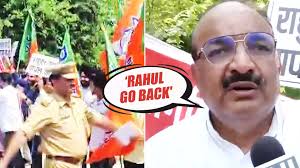
NEW DELHI: Leader of opposition in Lok Sabha Rahul Gandhi and Bharatiya Janata Party MLC Dinesh Pratap Singh engaged in a heated argument during a meeting in Raebareli. The video of the Thursday-incident has gone viral on social media where Rahul could be seen asking Singh to take permission of the chair before speaking. “I am chairing this meeting. If you have something to say, ask first, and then I will give you a chance to speak,” Rahul said during the District Development Coordination and Monitoring Committee (DISHA) meet. Reacting to the incident later, Singh criticised Rahul saying that the Raebareli MP “comes across as an owner” of the meet instead of the chair, which, he said was “not acceptable” to him. “In the DISHA meeting, the MP is the chair of the meeting of the constituency. As per the guidelines rural development department, implementation, supervising of 43 programmes is his responsibility. When Rahul Gandhi comes, he comes across as an owner, which was not acceptable to me. You will see myself supporting Rahul Gandhi when he does service to the people of Raebareli, but when he uses the platform to criticise the government, then I will be standing against him. I was expecting him to speak about DISHA meeting. Hence, I opposed,” he said. “The chief minister should take note of such conduct. What message does it send about cabinet discipline?” he told PTI. Singh, a legislative council member from Raebareli was formerly a Congress leader. He joined BJP workers in a protest against Gandhi, demanding his apology over alleged abusive remarks against Prime Minister Narendra Modi’s mother during Bihar rally. Courtesy : TOI Note: This news is originally published on https:/timesofindia.com/bha and is used purely for non-profit/non-commercial purposes, especially human rights
Why did Rahul Gandhi not attend the Vice President’s oath ceremony? Congress gave Dhankhar’s answer
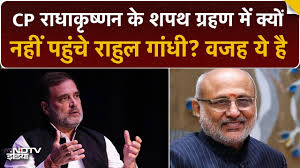
A political controversy has erupted over Rahul Gandhi’s absence at CP Radhakrishnan’s swearing-in ceremony as Vice President. Responding to BJP’s questions on this issue, the Congress said that the issue is not Rahul Gandhi’s presence, but the presence of Jagdeep Dhankhar, who finally got permission to speak. New Delhi: CP Radhakrishnan took oath as the 15th Vice President of the country on Friday. During this, Leader of Opposition in the Lok Sabha Rahul Gandhi was absent, due to which a political uproar has erupted. While BJP is raising questions on one hand, on the other hand, Congress has now responded. Congress said, the issue is not whether Rahul Gandhi was there or not. The issue is that Dhankhar was present there. Finally he got permission to leave his house and come out. What did Pawan Khera say on Rahul Gandhi not attending the swearing-in ceremony Regarding Rahul Gandhi’s absence from CP Radhakrishnan’s swearing-in ceremony, Congress leader Pawan Khera said, the issue is not whether Rahul Gandhi was there or not. The issue is that Dhankhar was present there. After all, he has got permission to leave his house and come out. He questioned, when will Jagdeep Dhankhar be allowed to speak? This is our question. Jagdeep Dhankhar had arrived at the swearing-in ceremony Many leaders including Prime Minister Narendra Modi, Home Minister Amit Shah, Defense Minister Rajnath Singh and Bharatiya Janata Party (BJP) President JP Nadda, Rajasthan Chief Minister Bhajanlal Sharma, Andhra Pradesh Chief Minister N. Chandrababu Naidu were present at Radhakrishnan’s swearing-in ceremony. Former Vice Presidents Hamid Ansari and Venkaiah Naidu also attended the ceremony. Dhankhar also attended the swearing-in ceremony. He was seen in public for the first time after resigning from the post of Vice President. Curated by: Abhishek Pandey About the author Abhishek Pandey is currently a consultant writer at Navbharat Times Online. He has more than three years of experience working on news related to current affairs, politics, crime and public concern. Along with this, he has closely covered the Uttar Pradesh Assembly elections in 2022, Lok Sabha elections 2024. Courtesy: Hindi News
Dalit rights activist Immanuel Sekaran memorial to be opened in two months in TN’s Paramakudi
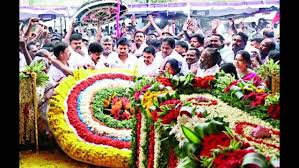
Ministers Thangam Thennarasu, Sattur Ramachandran, P Moorthy, KR Periakaruppan, and Raja Kannappan were present. RAMANATHAPURAM: Construction work of the mani mandapam (memorial hall) and installation of a statue of Dalit rights activist Immanuel Sekaran at Paramakudi is nearing completion, and they would be inaugurated within two months, Deputy Chief Minister Udhayanidhi Stalin said on Thursday. Speaking to reporters after paying homage to Immanuel Sekaran on his 68th death anniversary, Udhayanidhi recalled that Chief Minister MK Stalin had announced construction of the memorial and allocated Rs 3 crore, based on a request from Sekaran’s family and followers. “The work will be completed shortly and the memorial will be inaugurated within two months,” he said. Ministers Thangam Thennarasu, Sattur Ramachandran, P Moorthy, KR Periakaruppan, and Raja Kannappan were present. Leaders of several political parties, including TNCC chief K Selvaperunthagai, AMMK leader TTV Dhinakaran, NTK chief Seeman, and functionaries of AIADMK, DMDK, TVK, and VCK also paid their respects. Selvaperunthgai told reporters that the BJP was behind the rift in the AIADMK and the PMK. Further, he said AIADMK general secretary Edappadi Palaniswami had demanded naming Madurai airport after Muthuramalinga Thevar only to score political points. Seeman said the airport should be named after Pandian Nedunchelian. Courtesy : TNIE Note: This news is originally published on https:/thenewindianexpress.com/bha and is used purely for non-profit/non-commercial purposes, especially human rights
Dalit Youth Beaten with Iron Rod in Kanpur After Demanding ₹6,000 Payment
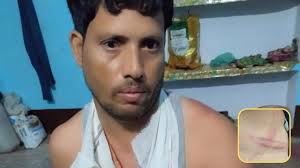
In Shivrajpur, Kanpur, a Dalit youth named Sudhir Kumar was brutally beaten with an iron rod by two brothers from an influential family after he asked them to repay money owed for flour milling. Sudhir, who runs a small flour mill, said he had been requesting payment for a long time. When he reminded them again, they became angry. “I was walking home from my mill when Manoj Singh and Mohit Singh Chandel stopped me. I asked them to return ₹6,000 they owed for flour milling. They abused me, started beating me, and then hit me with an iron rod lying nearby. I was bleeding badly,” Sudhir told TV9. Sudhir alleged that despite filing a written complaint at the Shivrajpur police station, no action has been taken. He claimed the outpost in-charge, Shubham Pandey, was under pressure from the accused. “It’s been two days since I complained. No FIR has been filed. The accused are roaming freely and even threatening to kill me,” he said. He added that several people had approached him to compromise, but he fears for his life if action is not taken. “The attackers come from a powerful family. They are using their influence to escape punishment,” Sudhir said. Shivrajpur Police Station Head Varun Sharma confirmed receiving the complaint and stated, “The matter is being investigated.” Courtesy : TOP Note: This news is originally published on https:/theobserverpost.com/bha and is used purely for non-profit/non-commercial purposes, especially human rights
Know the story of the formation of Mauritius, Dalits have the biggest contribution
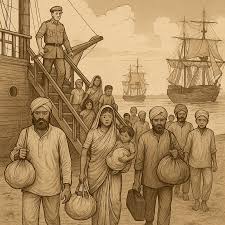
The first ship Atlas reached Mauritius from Calcutta on 2 November 1834. It mainly had people from Bihar, Eastern Uttar Pradesh, Jharkhand and Bengal. In which a large population was of Dalit, backward and deprived castes. The Dalit communities that went from these areas mainly included Chamar, Dhobi, Dom, Pasi, Musahar, Kahar, Nai etc. castes. It is about the year 2021. A man from Mauritius came to India in search of his roots. This search brought him to Purvanchal. This was surprising for him. Then a research started. What came out in this research started bringing out the story of the contribution of Dalits of Purvanchal in making Mauritius layer by layer. BHU’s DN Scientist Professor Gyaneshwar Choubey, who did this research, has collected important information in four years of research. According to research, about 55% of the DNA of the total population of Indians living in Mauritius matches with the Bhojpuri speaking Dalit community of UP’s Purvanchal and Bihar. In this, the DNA of the Dalit community of Purvanchal, especially Buxar, Ara, Bhabua, Chhapra and Sasaram, has been matched. Currently, the population of Mauritius is 12 lakhs. That is, the Dalits have contributed the most in making the beauty of Mauritius, which is discussed all over the world today. Mauritius was discovered in 1502. Africans were settled here in 1670. The British captured Mauritius in 1810. The first time Dalits went here also has its own story. When did Dalits go to Mauritius for the first time? In 1834, the British government abolished slavery, but they needed laborers for sugarcane cultivation. After this, indentured laborers were taken from India. British agents used to take these labourers on a 5-year contract in the name of “Girmit” (agreement). The first ship Atlas reached Mauritius from Calcutta on 2 November 1834. It mainly had people from Bihar, Eastern Uttar Pradesh, Jharkhand and Bengal. In which a large population was of Dalit, backward and deprived castes. The Dalit communities that went from these areas mainly included Chamar, Dhobi, Dom, Pasi, Musahar, Kahar, Nai etc. castes. Role of Dalits in making Mauritius Sugarcane cultivation and sugar industry are the backbone of Mauritius’ economy. Most of the work of building it was done by Indian labourers, a large number of whom were Dalits. Dalit migrants were at the forefront in the construction of all these infrastructures – farms, factories, roads, railways and ports. Although they were assigned the most difficult and humiliating work, this labour became the economic foundation of Mauritius. Those who went to Mauritius included Dalit women, who worked equally with men in the fields, and also faced exploitation as domestic servants. The great novelist William has written that “these Bhojpuri speaking people of the weakest section of UP and Bihar used to cultivate sugarcane and cotton while tied in chains. This work was unbearably painful. But they endured that pain and established themselves in Mauritius. The report shows that among the Indian population present in Mauritius, 55 percent of the people have DNA matching with the Bhojpuri speaking Dalit community. 35 percent of the DNA was of people coming from the Dravidian society while 4 percent of the DNA matches with the Brahmin and Kshatriya society. The special thing is that despite being in Mauritius, this community has not forgotten its language and culture even today. Bhojpuri and Chhath still reside in the veins of the people here. That is, the Dalit community, which the Indian scriptures and society still consider the most incapable and small, has created a country like Mauritius. Ashok Das Ashok Das (Ashok Kumar) is the country’s first person to do journalism by keeping the Dalit-tribal society at the center. He is a well-known journalist. He is the founder and editor of ‘Dalit Dastak Media Sansthan’. His journalism has been appreciated in countries like America, Canada, Sweden and Dubai including India. He has also traveled to these countries. Features about Ashok Das’ journalism have been published in many newspapers and magazines of the country and abroad, including DW (Germany), The Asahi Shimbun (Japan), The Mainichi Newspaper (Japan), The Week Magazine (India) and Hindustan Times (India). Ashok has given a lecture at the world-renowned Harvard University in America in February 2020. He has received a fellowship from the world’s largest organization of investigative journalism, Global Investigation Journalism Network, for the conference organized in Gothenburg, Sweden in 2023. Courtesy: Hindi News
Rape and forced marriage… 17-year-old Dalit minor trapped in the lure of a job, pleaded for justice
A case of rape and forced marriage of a 17-year-old Dalit minor on the pretext of a job has come to light in Churu. The accused Sonu abducted the victim by luring her and molested her. Despite the case being registered, the accused is still absconding and is threatening the victim’s family. The victim has reached the SP office with her family and pleaded for protection and justice. Churu: The incident with a 17-year-old Dalit minor girl in Churu district has shaken the entire area. This student studying in class 12 was kidnapped on the pretext of a job. The victim has alleged that Sonu, a resident of Rajgarh, lured her and with the help of his friends brought her to Churu in a Bolero car. Here she was raped. According to the victim, the accused later took her to Bikaner and raped her several times. It is shocking that the accused was already married, but he hid this fact from the victim. When the minor protested, the accused forced her to marry him. According to the victim, the accused Sonu took her to a temple in Amritsar and forcibly married her. The victim has made another serious allegation that before taking her from the house, Sonu had given sleeping pills to her family members so that no one could stop them. This incident was revealed when the police brought both of them back on 25 August 2025. The girl narrated the entire story in front of her family and the police. A case was registered on the basis of her statement, but the accused Sonu is still out of police custody. Accused’s threat and allegation of inaction on the police The victim’s family is constantly accusing the police of negligence. They say that the accused Sonu is still roaming freely and is constantly threatening the victim’s father. Due to this fear and mental pressure, the victim and her family are extremely upset. On Friday, the victim along with her family reached the Superintendent of Police (SP) office and pleaded for justice. They have demanded that the accused Sonu and his accomplices be arrested as soon as possible and given strict punishment so that the victim can get justice. Police statement and investigation status Police officials say that the case is under investigation and efforts have been intensified to catch the accused. However, the family says that the police have not taken any concrete steps yet. Such incidents make it clear that crimes against the weaker sections of society are increasing and questions are being raised on law and order. This case is not only a criminal incident, but also an example of atrocities against the Dalit community. Reported by : Manoj Kumar Sharma Edited by : Vicky Rathore Courtesy: Hindi News