
Anil Kapoor and the rise of angry Dalit-Bahujan hero

Bollywood shows Dalit-Bahujan characters as helpless victims. Recent film ‘Subedaar’ is an act of resistance. Anil Kapoor’s film *Subedaar* is a significant shift in Indian cinema, portraying a Dalit-Bahujan protagonist as a powerful, angry mainstream action hero. Traditionally, Dalit characters have been depicted as helpless or needing saviors. *Subedaar* breaks this mold by showing a marginalized character actively fighting feudal oppression and caste discrimination, signaling a democratizing trend in Bollywood narratives. Recall the visceral frustration of Inspector Vijay Khanna in Zanjeer or Samar Pratap Singh in Shool. These iconic figures were fearless, determined to dismantle the local mafia through an indiscriminate use of righteous violence. It was a powerful fist of fury that the audience admired as it was meant to dislodge the corrupt-criminal authority of the villain. In both Amitabh Bachchan’s Zanjeer (1973) and Manoj Bajpayee’s Shool (1999), India’s semi-urban sites were presented as caste-neutral. At the very least, they relegated the socially vulnerable castes to a poor, helpless mass devoid of agency. To contest such depressing terrain, the macho heroic figures would overtly demonstrate their social elite identity, and often perform to retain the hegemonic domination of the ruling elites over cultural and political spheres. Ironically, very few filmmakers have explored the possibility of presenting a similar hero marching from a Dalit-Bahujan social background. Historically, Dalit characters in Indian cinema fall into one of three tropes: the helpless victim of feudal atrocity (Damul, 1985), the violated body (Bandit Queen, 1994), or the individual incapable of achieving justice without a savarna saviour (Article 15, 2019). While films such as Manjhi (2015) and Newton (2017) have introduced more nuanced Dalit protagonists, they often lack the heroic agency or the mainstream charisma of a traditional Bollywood action star. Anil Kapoor’s recent film, Subedaar, in this context, is a significant alteration. It elevated the idea of social subalternity by imagining that a downtrodden character can perform like a mainstream hero and emerge victorious. Director Suresh Triveni’s film is thus a robust act of resistance against the conventional norms associated with popular cinema’s macho hero. While it retains the grit and tension of the classic action genre, it distinguishes itself creatively through a lens of dense social realism, capturing the entrenched caste and communal entanglements. Subedaar offers a subtle subaltern protagonist, embedded in the caste-driven oppressive structure, but ready to dismantle it through his gutsy style and heroic anger. Caste identities in the film are coded in cultural symbols, tonalities, and expressions that the audience has to dissect. Distinct from earlier films that portrayed Dalit characters with stereotypical notions, this film invites the audience to apply its intelligence. In the landscape of feudal oppression Set against the rugged ravines of Chambal, the narrative unfolds in a mofussil town gripped by a sand mafia led by Babli Didi (Mona Singh) and her psychopathic brother Prince (Aditya Rawal). Their characters personify rabid feudal-caste arrogance, exploiting the marginalised poor with impunity. While this trope is a staple of popular masala genre (from Sholay to China Gate) as well as parallel cinema (Damul, Paar, Mirch Masala), Subedaar revisits the formula with nuanced cultural symbolism, offering a refreshing socio-political twist. Kapoor portrays the titular Subedar Arjun Maurya, a restrained but angry retired soldier who joins his daughter after the death of his wife. Maurya and his daughter Shyama (Radhika Madan) are harassed and humiliated by two distinct sets of villains, showcasing how the criminal mafia and feudal order of the town make the life of poor inhabitants precarious. Maurya faces overt abuses, harassment, and mocking by mafia leader Prince, while his daughter faces sexual violence for asserting her individuality. Such brutal context legitimises the emergence of an angry hero. The father-daughter duo refuses to play a submissive role, fearlessly challenges the goons, and after a bloody struggle, defeats the feudal lords. At the outset, the film appears to be a regular action flick. But its portrayal of feudal arrogance, subtle anecdotes about caste-based inequalities, and veiled reference to the practice of untouchability, suggest that the director is critically reflecting upon the social demography of the region. He is making a political statement. For example, a pivotal subplot involves a second-hand Jeep that is severely damaged by the goons. The vehicle is a gift from Maruya’s deceased wife, intended to provide him a dignified presence in the city. In the context of the self-respect movement, the ownership of a vehicle by a Dalit man is a potent symbol of mobility and the reclamation of public space, often disliked by the conservative social elites. In scattered episodes, the audience sees the mocking and damage done to the Jeep by the villains, because they see Maurya as unworthy of owning one. The Dalit-Bahujan subplot The choice of the surname “Maurya” is crucial. In the political milieu of North India, Maurya is a popular Dalit-Bahujan identity often associated with a burgeoning defiance of Dalits against elite domination. In the web series Mirzapur (2018), Inspector RS Maurya (Amit Sial) is a complex Dalit character who cunningly hobnobs with powerful elites while facing caste-based discrimination. In Subedaar, while the protagonist’s social identity is never explicitly mentioned, it is etched into the film using silent symbols and anecdotes to suggest his secluded caste location and powerlessness. A telling scene involves Prince beating a vulnerable woman and then washing his hands. It represents a ritualistic performance of “purity” versus “pollution” by Brahmanical elites. Furthermore, Prince’s act of urinating on Maurya’s Jeep mirrors real-world caste atrocities. In another sequence, we see an abandoned and depleted Dalit village that gives shelter to the fugitive protagonists, endorsing the director’s intent to portray social realities. A mainstream Dalit hero Subedaar investigates caste and gender as intersecting axes of oppression. By defying the conventional portrayal of marginalised groups as powerless victims, the film grants them the agency to defeat their oppressors through their angry power and physical strength. The father-daughter duo performs like popular heroes as they are pushed to the brink by systemic corruption and harassment. Maurya, like any
Supreme Court Lets Transwoman Apply for Delhi Government Teacher Recruitment, Seeks Response On Wider Plea

The Supreme Court of India has granted interim relief to a transgender applicant while agreeing to examine systemic gaps in public recruitment. In a significant step toward inclusive employment, the Supreme Court of India on April 10, 2026, permitted a transwoman, Jane Kaushik, to apply for teacher recruitment in Delhi government schools under the “transgender” category. A bench of Justices J.B. Pardiwala and K.V. Viswanathan issued notices to the Delhi government and the DSSSB after Kaushik revealed that the recruitment portal restricted applicants to “male” or “female” binaries. The Court has now agreed to examine her larger plea for a comprehensive recruitment policy and separate vacancies for transgender persons in public employment, ensuring their constitutional rights aren’t reduced to a “dead letter.” Breaking the Binary: A Fight for Representation The petitioner, Jane Kaushik a highly qualified educator with degrees in Political Science and Education approached the apex court highlighting the “grossly apathetic attitude” of state institutions. Despite the landmark 2014 NALSA judgment, the Delhi Subordinate Services Selection Board (DSSSB) portal continued to exclude non-binary identities. During the hearing, Justice Pardiwala noted that while Kaushik was registered as a transgender person, she was physically unable to submit applications for specific teaching posts. “You are absolutely right,” the bench remarked to Kaushik’s counsel, reviving a previous interim relief that allows her to apply for any vacancy of her choice, regardless of the gender mentioned in the advertisement. This legal battle follows years of systemic hurdles; Kaushik was previously forced to resign from a school in Uttar Pradesh and denied a role in Gujarat due to her gender identity. While the Supreme Court had established an advisory committee in October 2025 to draft an “Equal Opportunity Policy,” Kaushik argued that an advisory body lacks the adjudicatory power to protect individual fundamental rights. Her plea seeks more than just a job; it demands a dedicated recruitment framework, including age relaxations and specific vacancies, to prevent transgender candidates from “aging out” of the system while waiting for bureaucratic wheels to turn. The Logical Indian’s Perspective At The Logical Indian, we believe that true progress is measured not by the laws we write, but by the dignity we afford to our most marginalised citizens. It is disheartening that over a decade after the NALSA verdict, a qualified educator must still knock on the doors of the highest court just to fill out a job application. Employment is more than a livelihood; it is a tool for social integration and self-respect. We urge the Delhi government and the Union to move beyond “committees” and implement a recruitment policy that reflects the diverse reality of our society. A classroom led by a transgender teacher is not just a win for employment it is a lesson in empathy and coexistence for the next generation. Sandipta Ghosh Courtesy : TLI Note: This news is originally published on https:/thelogicalindian.com/bha and is used purely for non-profit/non-commercial purposes, especially human rights
Identity On Trial: Constitutional Debate On Transgender Rights In India

In recent weeks, a familiar yet unsettled question has returned to discussion: who has the authority to define identity? For transgender people, it is not merely a discussion, but one that shapes their access to education, employment, and ultimately, dignity. The marginalisation of transgender persons has been consistent, as society confines them to roles of entertainment and cultural bridges. Moreover, the recent amendments to the Transgender Persons (Protection of Rights) Act, 2019 have raised several questions regarding the dignity, opportunities, and welfare of the transgender community. Constitutional Foundation It was held in NALSA v. Union of India by the Supreme Court of India that every person has the right to self-identify their gender. This means that gender identity is based on the personal autonomy and dignity of an individual. The identification of one’s gender is independent of any medical or surgical intervention. Self-identification is thus recognised and protected as a part of fundamental rights. This principle flows from Article 14 of the Constitution, which guarantees equality before the law to all persons. The Court expanded its scope to include transgender persons, emphasising their entitlement to substantive equality. Further, Article 19(1)(a) has been interpreted to include the right to express one’s gender identity through behaviour, self-presentation, and appearance—recognising gender expression as constitutionally protected. Additionally, Article 21, as affirmed in Justice K.S. Puttaswamy v. Union of India, guarantees dignity, autonomy, and privacy. Gender identity, being central to personhood, falls within this protection. In Navtej Singh Johar v. Union of India, the Court reinforced that constitutional morality must prevail over social morality, strengthening identity-based rights. Taken together, the constitutional position is clear: self-identification is not merely a policy choice, but a right firmly grounded in dignity, equality, and autonomy under the Constitution. The Amendment and Its Implications The Supreme Court’s landmark judgment of 2014 in National Legal Services Authority (NALSA) v. Union of India transformed transgender rights in India by recognising gender identity as a constitutional right based on equality, dignity, and autonomy. It also directed the government to provide reservations—an aspect that still largely remains on paper—and to implement other welfare measures for the third gender. However, the recent amendment to the Transgender Persons (Protection of Rights) Act, 2019, which aims to maintain dignity and protect rights, is being opposed by the transgender community, as it is seen to undermine the right to self-identity—where a person could identify as transgender based on self-perceived identity. Under these changes, a medical process is involved in verifying identity before certification by the District Magistrate, as was the case earlier. This approach contradicts the Supreme Court’s NALSA judgment, which clearly held that no compulsory medical procedure is required for the self-identification of a transgender person. While the amendment recognises traditional identities such as Hijra and Kinner, it narrows the scope of individual self-identification, potentially excluding those identified outside these community-based categories. From a technical standpoint, the amendment introduces three key changes. Firstly, it dilutes the principle of self-identification, central to prior jurisprudence. Second, it mandates medical or administrative certification, reinforcing external scrutiny. Third, it adopts a restrictive definition, limiting inclusivity. Thus, the amendment sits at the intersection of state regulation and individual rights, raising important constitutional questions. Constitutional Tensions & Social Impact The recent amendment raises a critical constitutional issue within the broader framework—whether Parliament can impose conditions that dilute judicially recognised fundamental rights. In NALSA v. Union of India, the Supreme Court held that self-identification of gender is integral to Articles 14, 19, and 21. However, the amendment’s requirement of medical or administrative certification shifts this right from self-determination to state validation, creating a doctrinal conflict with established principles. While Parliament has the authority to legislate, such measures are generally assessed against the standard of reasonableness and proportionality. As noted in Justice K.S. Puttaswamy v. Union of India and Anuradha Bhasin v. Union of India, state action should be proportionate and balanced with individual rights. Thus, the amendment reflects an evolving balance between state regulation and individual rights, and may shape future constitutional interpretation. The authentication process under the medical board raises concerns regarding the dignity of transgender people, as they are required to undergo verification of their gender identity. From a humane perspective, this process may involve the examination of physical or medical characteristics by the medical board, which can amount to a violation of their dignity and fundamental rights. However, there is no such mandatory procedure for individuals identifying as male or female, whose gender identity is generally accepted without scrutiny. As held in the NALSA judgment, the Supreme Court categorically stated that self-identification of gender is a fundamental right, and that no medical or surgical requirement can be imposed as a precondition for legal recognition. Reform or Regression? The amendment raises a critical policy debate: can the State subject gender identity to institutional verification, overlooking the constitutional guarantees of dignity and autonomy? The State argues that mandatory gender verification by a medical board is necessary to prevent the misuse of benefits. However, this raises a pertinent question: why would a person, whose gender identity is already socially and legally recognised, choose to identify as transgender merely to access welfare benefits? Critics argue that such regulation comes at the cost of constitutional values. By requiring medical or administrative validation, the amendment shifts identity from a fundamental right towards a status approved by the State. This raises concerns of gatekeeping, where access to legal recognition becomes dependent on institutional criteria. There is also a broader concern regarding exclusion. The narrower definition of “transgender” may risk marginalising non-binary individuals, which appears inconsistent with the inclusive approach in NALSA v. Union of India and reinforced in Navtej Singh Johar v. Union of India. This debate ultimately revolves around a deeper constitutional question—whether the State’s interest in regulation justifies intrusion into aspects of personal identity. It is not merely a question of policy design, but of constitutional principle: whether identity is to be recognised by the State or regulated by it. A sound path, grounded in
Watch: PM Modi, Rahul Gandhi engage in candid conversation during Jyotiba Phuletribute ceremony
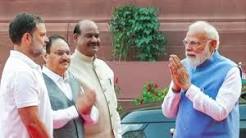
NEW DELHI: Prime Minister Narendra Modi and Leader of Opposition in Lok Sabha Rahul Gandhi on Saturday were seen engaging in a brief and candid conversation during the tribute ceremony held on the occasion of Mahatma Jyotiba Phule’s 200th birth anniversary at the Parliament premises. The interaction came at a public event attended by top constitutional leaders, including President Droupadi Murmu, Vice President CP Radhakrishnan, Lok Sabha Speaker Om Birla and other senior leaders, who gathered at Prerna Sthal to pay floral tribute to the social reformer. The brief exchange between PM Modi and Rahul Gandhi drew attention, especially given the history of sharp political confrontation between the two leaders. This comes after both leaders have frequently targeted each other in public speeches and political rallies. Congress leader Rahul Gandhi has in the past accused Prime Minister Modi of being a ‘compromised’ leader and alleged that India’s foreign policy was being influenced externally. “Our foreign policy is PM Modi’s personal foreign policy… Everyone considers this a universal joke… Donald Trump knows exactly what PM Modi can and cannot do. If the Prime Minister is compromised, our foreign policy is compromised,” Rahul Gandhi had said earlier. Prime Minister Narendra Modi has also responded strongly to opposition criticism in the past, often taking indirect jibes at Rahul Gandhi during public rallies. In one such instance, addressing a rally in Gogamukh in Assam ahead of polls, PM Modi referred to the Congress leader as a ‘self-proclaimed prince’. “Rajkumar” (self-proclaimed prince), PM Modi had said while targeting Rahul Gandhi in an earlier public address. Earlier in the day, both leaders had separately paid tribute to Mahatma Jyotiba Phule, one of India’s most prominent social reformers known for his work on women’s education, caste equality and empowerment of marginalised communities. President Droupadi Murmu, Prime Minister Narendra Modi, Lok Sabha Speaker Om Birla, and Leader of Opposition Rahul Gandhi were among those who offered floral tributes at Prerna Sthal in Parliament. In his message on X, PM Modi praised Phule’s contribution to social justice and education, calling him a pioneer who empowered the marginalised through knowledge and reform. Rahul Gandhi, in his post on X, also highlighted Phule’s lifelong struggle against discrimination and inequality, saying his ideals continue to inspire the path towards social justice. “On the birth anniversary of the great social reformer Mahatma Jyotiba Phule, I offer my humble salutations to him. He dedicated his entire life to protecting the rights and entitlements of the marginalised. His struggle against discrimination and inequality showed the nation the path to equality and justice,” Rahul Gandhi said. Mahatma Jyotiba Phule, born on April 11, 1827, in Satara, Maharashtra, is widely regarded as a pioneer of India’s social reform movement. He, along with his wife Savitribai Phule, played a key role in advancing women’s education and challenging caste-based discrimination through the Satyashodhak Samaj. Courtesy : TOI Note: This news is originally published on https:/timesofindia.com/bha and is used purely for non-profit/non-commercial purposes, especially human rights
Rare Modi-Rahul interaction breaks the internet
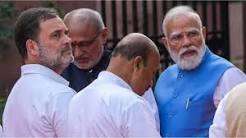
NEW DELHI: Prime Minister Narendra Modi and the leader of opposition in Lok Sabha, Rahul Gandhi, on Saturday exchanged pleasantries and talked briefly at an event, a rarity in the otherwise cold and indifferent equation between them. It is not often that Rahul joins ministers and high functionaries like Lok Sabha Speaker Om Birla to greet the PM at commemorative events often held in Parliament complex but he did so on Saturday at a programme to pay tributes to reformer Jyotirao Phule. As he acknowledged greetings from everyone, Modi appeared to ask Rahul something and both then chatted for a while as they waited for Vice-President C P Radhakrishnan and President Droupadi Murmu. The exchange went viral on social media and piqued interest in political circles. There were suggestions that Modi inquired about the health of Rahul’s mother Sonia Gandhi who was recently admitted to a hospital. However, there was no official word on what transpired between them. Rahul has often in the past skipped such events and has often been accused by BJP of not giving due regard to state events and high dignitaries. Congress, too, in turn has often alleged govt does not accord protocol that is due to the LoP. Unsurprisingly, the pleasantries exchanged between Modi and Rahul created a buzz. Govt has announced a two year-long programme in the run-up to Phule’s 200th birth anniversary next year. To oversee the nationwide commemoration starting from 11 April 2026 to 11 April 2028, govt has set up a high-level committee under the PM’s chairmanship. Courtesy : TOI Note: This news is originally published on https:/timesofindia.com/bha and is used purely for non-profit/non-commercial purposes, especially human rights
Cow dung slurry poured over Dalit man for ‘preparing’ beef in Odisha

A clip captured a police officer observing the incident without intervening. Kalahandi: Self-proclaimed cow vigilantes in Odisha’s Kalahandi district humiliated a Dalit man by parading him with a garland of shoes and pouring cow dung slurry on him for allegedly preparing beef. A video of the incident surfaced on Thursday, April 9, from Bhawanipatna town, where the cow vigilantes were seen publicly humiliating the man. Videos circulating online showed the unidentified victim sitting on the ground with a garland made of shoes around his neck and a large amount of meat placed in front of him that he allegedly prepared. As the villagers took his videos, a person approached the victim and placed a steel bowl over his head, drawing laughter from the crowd. Another person sprinkled white dust on his face when a resident carrying a bucket of cow dung slurry poured it over the victim. The clip also captured a police officer observing the incident without intervening. The Odisha Police did not immediately respond to a request for comment. Odisha Indian National Congress leader Amiya Pandav shared the video on social media, accusing Hindutva group Bajrang Dal of attacking the Dalit man. Courtesy : The Siasat Daily Note: This news is originally published on https:/thesiasatdaily.com/bha and is used purely for non-profit/non-commercial purposes, especially human rights
Row erupts at Telangana University over ‘Urban Naxal’ allegations against Dalit professor , student
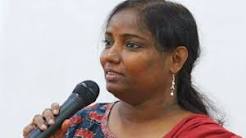
Hyderabad: A controversy has broken out at Satavahana University in Telangana after a Dalit woman professor and a student were allegedly labelled as “Urban Naxals.” The allegation drew criticism from academics and rights groups. Seeking immediate intervention, the Telangana Save Education Committee called the allegations baseless and detrimental to the academic environment. In a statement, the committee identified Surepalli Sujatha, Head of the Sociology Department and Principal of the Arts College, and Karike Mahesh, an Economics student, as those targeted. According to the committee, a group of students submitted complaints to local authorities, including the district Collector and a Member of Parliament, while also circulating allegations in print and on social media linking the two to Maoist organizations, as reported by The observer Post. Senior members of the committee condemned the allegations and stated that any move against the professor, despite her qualifications and responsibilities, would be unjustified and that any actions risked sending a negative message to marginalised communities within educational institutions. The committee also expressed concern that the controversy could affect the university’s academic atmosphere, as it caters to students from rural, Dalit and Adivasi backgrounds. It also criticised the Vice-Chancellor for not responding to the situation and called for steps to safeguard institutional autonomy and academic freedom. Courtesy : Vartha Bharati Note: This news is originally published on https:/varthabharati.com/bha and is used purely for non-profit/non-commercial purposes, especially human rights
Dhar: ‘Aditya’ Revealed to be Abdul; Aadhaar Card Exposes ‘Love Jihad’ Plot—Accused Was Exploiting Woman Under Pretext of Marriage

Dhar: A case involving the concealment of identity to establish a relationship with—and subsequently rape—a Dalit woman has come to light in Dhamnod, located in the Dhar district. The accused’s true identity was exposed through his Aadhaar card. After the truth was revealed, the accused pressured the woman to convert her religion and threatened to kill her if she refused to comply. A case of ‘Love Jihad’ has surfaced in Dhar, a tribal-dominated district in Madhya Pradesh. The accused had befriended a young woman from the Dalit community at a mobile phone shop. Subsequently, posing under a Hindu name, he gave the woman false assurances of marriage, took her to a hotel, and raped her. However, while at the hotel, the woman spotted a photocopy of the accused’s Aadhaar card in his pocket, which listed his name as Abdul Hadi Pathan and his father’s name as Hussain Pathan. When his true identity was exposed, the accused threatened the woman and pressured her to undergo religious conversion. Meanwhile, the victim, accompanied by her family, reached the police station, where the police have registered a case against the accused under various sections of the law and have initiated an investigation. A police team was also dispatched to Khargone in search of the accused, but he has not yet been arrested. **The Story Began at a Mobile Shop** At the Dhamnod police station, the victim informed the police that approximately two years ago, she had met a young man named Aditya Thakur at a mobile shop located near the Maheshwar bus stand. The accused concealed his true identity and befriended the woman. During their conversations, the woman had disclosed to the accused that she belonged to the Balai community. Despite this, the accused continued to hide his identity and maintained the pretense of being in love with her. **How Was the Case Exposed?** According to the complaint, on December 10, 2025, the accused took the woman to the Deepak Hotel & Lodge, located at Maheshwar Phata in Dhamnod, where he raped her against her will. When she resisted, the accused claimed that both of them were Hindus and would soon get married. Subsequently, using the false promise of marriage as a pretext, he continued to sexually exploit the woman repeatedly. Subsequently, the accused intimidated and coerced her into accompanying him to the Mahakali Hotel and Lodge, where he raped her once again. During this incident, the young woman discovered a photocopy of an Aadhaar card in his pocket, which exposed his true identity. ‘Convert to Islam, and I will marry you’ When the young woman confronted him regarding his deception, the accused retorted threateningly, “So what if I am a Muslim? You simply change your religion and become a Muslim; I will then marry you.” When she resisted, the accused further threatened to kill her. Case Registered Against the Accused Acting on the victim’s complaint, the Dhamnod police have registered a case against the accused, Abdul Hadi Pathan, under sections pertaining to fraud, forcible rape, criminal intimidation (threats to life), the SC/ST Act, and the Freedom of Religion Act. Station In-charge Praveen Thackeray stated that the victim had approached the police station to lodge her complaint. Her statement has been officially recorded in the presence of a female police officer. It was revealed that the accused had befriended the young woman by concealing his true identity and using a false name. A formal case has been registered, and appropriate legal action is currently underway. Courtesy: Hindi News
Policing the Self: A Law That Subjects Transgender Identity to Certification and Surveillance

A democratic law on transgender rights would begin by trusting the person—recognising self-identification without bureaucratic mediation The 2026 amendment shifts transgender identity from a matter of self-determination to state certification, deepening bureaucratic control and surveillance. It conflicts with Supreme Court jurisprudence affirming dignity, privacy, and self-identification, particularly in NALSA and subsequent landmark rulings. By narrowing definitions and excluding “self-perceived sexual identities,” the law reflects an ideological push toward fixed, state-sanctioned identities. The Transgender Persons (Protection of Rights) Amendment Act, 2026, is being projected as a measure for protection and clarity. In substance, however, it does something more sinister: it recasts transgender existence as a matter to be policed, certified, monitored, and ideologically contained. It does not proceed from the premise that gender identity is a domain of personal autonomy protected by the Constitution. Rather, it proceeds from suspicion. It imagines the transgender person not as a rights-bearing citizen but as a problematic social figure requiring state management. In this sense, the Act is not merely flawed legislation. It is the legal expression of a deeper political morality—one that is profoundly consonant with the Hindutva project of enforcing a disciplined social order built around fixed identities, patriarchal family norms, and suspicion of all forms of embodied difference. On the one hand, this case brings forward certain issues regarding the position of the US on the international arena, namely whether the country can still play an influential role or if it is now experiencing the period when its decisions are doubted. – Anupam Sai The 2026 amendment must be read alongside the already discredited architecture of the 2019 Act. The original Act had been widely criticised for violating the very principles the Supreme Court had affirmed in National Legal Services Authority v. Union of India (NALSA), where the Court held that gender identity is rooted in self-identification and is inseparable from dignity, liberty, and equality. The amendment does not cure that foundational defect. If anything, it sharpens it. It tightens the state’s hold over identity and, in doing so, reveals the ideological discomfort that the present regime has with the transgender concept itself. What is especially alarming is the amendment’s move to remove the Act’s broader definition of “transgender person” and instead list categories of persons included, while explicitly stating that the law does not include, and never included, persons with “different sexual orientations and self-perceived sexual identities.” PRS Legislative Research notes this as one of the Act’s key changes. The same summary also notes that the Act makes a revised certificate mandatory after surgery and requires the medical institution to furnish information about such surgery to the District Magistrate. This is not mere drafting. It is an attempt to redraw the field of legitimate gender identity in a way that makes it narrower, more surveillable, and more governable. At the heart of the constitutional problem lies a very simple question: who owns identity? In a constitutional democracy, identity belongs to the person. In this Act, identity belongs to the state. The core vice of the amendment is that it remains fundamentally incompatible with the doctrine of self-identification laid down by the Supreme Court. In NALSA, the Court recognised the right of persons to determine their gender identity as male, female, or third gender, and treated that right as intrinsic to dignity and freedom. Later constitutional developments only strengthened this logic. In Puttaswamy, privacy was recognised as including decisional autonomy and bodily integrity; in Navtej Johar, the Court held that identity, orientation, dignity and intimacy cannot be subordinated to majoritarian morality. The Court also made clear that constitutional rights cannot depend on social approval, and that constitutional morality must prevail over popular or sectarian moral codes. The amendment stands against this entire constitutional trajectory. It does so first by preserving the logic that identity must be mediated by official certification, and second by deepening the state’s role in tracking bodily transition. Even before this amendment, the 2019 framework had been criticised for forcing transgender persons into a bureaucratic recognition regime under the District Magistrate. The draft rules had gone so far as to require a psychologist’s report and residency proof, until criticism forced some softening. PRS had pointed out that such requirements were incompatible with self-perceived identity and especially burdensome for a community often facing homelessness, ostracism and unstable residence. A member of Lesbian Gay Bisexual Transgender and Queer (LGBTQ) community wearing a t-shirt that reads “Yes, we exist India” as seen outside August Kranti Maidan, celebrating 16 years of the official pride march in Mumbai. The rainbow flag signifies joy but the march remains a protest at its core demanding the fundamental rights still denied to the LGBTQ community in India. – null The amendment intensifies the same logic by making revised certification mandatory after surgery and by requiring the medical institution to report the surgery to the District Magistrate. That move is constitutionally indefensible. It converts one of the most intimate dimensions of personhood into a matter of administrative reporting. It effectively deputises hospitals into a surveillance chain. It assumes that the state has a legitimate interest in being notified when a person’s body changes in ways relevant to their gender identity. That is not protection. That is biopolitical supervision. No comparable burden is imposed on cisgender citizens to establish or continually validate the coherence between their body, identity and state records. The transgender citizen alone is made to pass through documentary and institutional checkpoints. That asymmetry offends Article 14 not only because it is unequal, but because it is irrationally unequal. It burdens a vulnerable class precisely in the domain where the Constitution demands maximum protection. The amendment is equally vulnerable under Article 21. Gender identity is not an external administrative category like land ownership or vehicle registration. It is bound up with selfhood, bodily autonomy, dignity, privacy, and the right to live without humiliation. A law that allows the state to mediate or monitor this sphere invades the core zone of decisional autonomy that the Court has
Transgenders In Madhya Pradesh Seek Separate Public Toilets, Horizontal Reservation

The Madhya Pradesh Social Justice Department is drafting a transgender policy expected by year-end, focusing on documentation, infrastructure and welfare issues. Community members have demanded separate public toilets and horizontal reservation, citing barriers in identity documents and employment. Officials said consultations are underway with stakeholders, including the Transgender Board. Bhopal (Madhya Pradesh): The social justice department is drafting a comprehensive transgender policy, expected by the year-end, to address the systemic challenges faced by the community in Madhya Pradesh. Based on direct feedback from community members, the policy aims to streamline access to essential documents and improve public infrastructure to ensure a more dignified life for transgenders. Atal Bihari Institute of Policy Analysis is likely to be roped in by the department to prepare the policy. A senior officer of the social justice department told Free Press that a convention was held recently where members of the community expressed the need for separate public toilets, as they feel uncomfortable using existing facilities in public places such as markets. As they are often disowned by families, many do not have birth certificates. This leads to a multitude of problems. Moreover, they face significant hurdles in obtaining Aadhaar cards, particularly after undergoing sex reassignment surgery. Regarding reservation, the government currently includes them in the Other Backward Class (OBC) category. However, community members point out that many among them also belong to Scheduled Castes and Scheduled Tribes. In such a situation, they argue that OBC reservation is not justified and are demanding horizontal reservation instead of vertical. Social stigma also creates obstacles in securing accommodation and employment. The department has recorded 1025 transgenders in the state. Consultations on policy begin Principal Secretary, social justice department, Sonali Ponkshe Vayangankar told Free Press that the Madhya Pradesh government has constituted a Transgender Board, which held its meeting on March 30. Minister Narayan Singh Kushwah chaired the meeting, where various important issues were discussed. The Minister directed all departments to ensure speedy disposal of issues related to the community. A transgender policy will be drafted by consulting stakeholders by the year-end. Courtesy : TFPJ Note: This news is originally published on https:/thefreepressjournal.com/bha and is used purely for non-profit/non-commercial purposes, especially human rights