
Dalit wedding procession attacked after dispute over Dr Ambedkar songs in Uttar Pradesh, 4 arrested
BAREILLY: Two days after a Dalit community wedding procession was allegedly attacked after a dispute erupted over songs related to Dr Bhimrao Ambedkar being played, police arrested four men belonging to OBC on Friday evening and sent them to jail. The accused, who were inebriated, had stopped the procession and allegedly passed caste-related remarks which led to a heated argument and the accused then called their relatives and attacked the members of the wedding procession. Local police had tried to close the matter through mediation however, after it came into the notice of senior cops, an FIR was lodged on Thursday night. Harshita Singh, circle officer, said, “The four accused of assaulting the wedding guests and attempting murder have been sent to jail. The ST/SC case will also be investigated.” On Wednesday night, a wedding procession for Arjun’s daughter Kajal from Rustampur village in the Kotwali area came from Dhanora Gori, Sirouli. Around 11:30 PM, when the groom Suraj’s procession was advancing, songs related to Dr Ambedkar were being played. Four young men from other castes in the village objected to these songs and allegedly made offensive comments. During this time, three individuals, including the groom’s cousins, were severely beaten. One of the accused was also alleged to have taken 20,000 rupees and a mobile phone during the assault. In this incident, a case was filed by the groom’s cousin, Girish Prasad, against Sonu Yadav, Pinku Yadav, Kanchan Yadav, and Pramod Yadav for attempted murder, assault, and under the ST/SC Act. On Friday, the police sent the accused to jail. Until the third day after the incident, police forces remained stationed in the village.t Courtesy: Times of India Note: This news is originally published on https://timesofindia.indiatimes.com and is for use by the non-military/non-commercial community, especially those in the human rights sector.
Inside rural India’s movement for gendered property rights
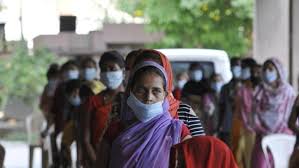
Three years ago, Arvind Hamdapurkar, a social worker from Pathri in Parbhani district, unintentionally scared his wife, Jayshree, by transferring the house he bought with his life savings of Rs 1.5 lakh to her name. “She thought I was planning to leave her,” laughs Hamdapurkar, who began to rethink his views on women’s rights after joining a course run by the NGO CORO India. “I used to wonder if women could handle the process,” he admits, until a book called ‘Stree Purush Tulna’ opened his eyes to his own ingrained misogyny. While friends from Marathwada questioned why he didn’t opt for a joint name, a certificate he received on April 28 reaffirmed his conviction: “I feel proud of doing the right thing.” That certificate was awarded at Siddharth College of Commerce and Economics in Fort, where Hamdapurkar was one of 28 participants—including 24 women, three men, and one transgender person—to complete CORO India’s year-long grassroots course on women’s property rights. Organised in collaboration with the Womanity Foundation, the event brought together activists, lawyers, civil servants, and writers to celebrate the culmination of a programme that not only educated but transformed lives. The training, which began in January 2024, reached rural pockets and had a real-world impact. “It wasn’t just about sections and penal codes but about the process behind the making of the laws,” said Hamdapurkar, recalling why the course piqued his interest. Participants didn’t just learn. They acted. Several began acquiring property in their own names. A transgender participant, for instance, started the process of transferring property to their disciple. Programme head Amita Jadhav explained the motivation behind the initiative by referencing the Manusmriti. “About the rights of women, Manusmriti says ‘father in childhood, husband in youth and son in old age takes care of woman.’ So a woman is not independent. Since a woman is secondary on so many levels, she should be entitled to certain rights.” Panellist Sanjay Phunde, senior health officer at the BMC, highlighted the chasm between legal rights and lived realities. “When women lack documentation of marriage, inheritance or land, their rights tend to be overlooked,” he said. He also called for gender-neutral language in governance and social discourse. “‘Meri beti yani ki paraya dhan’—this Indian mindset of men being assets and women being liabilities needs to change.” Advocate Ashvin Thool stressed the need to challenge not just laws, but also patriarchal practices and mentalities. He cited the frequent omission of marriage registration, particularly in child marriages, which complicates legal recourse. Jayashri Kurane, a social worker from Kolhapur, emphasized strengthening partnerships with gram panchayats to raise awareness, while senior writer Sandhya Pawar offered a historical perspective: “The system women are demanding property rights from once considered women as property.” Transgender rights were also a key focus. “When we talk about property rights, often only women are considered. But transgender persons also have rights,” said a participant. “Families often don’t accept them or transfer property to their names. Though legal reforms exist, awareness is low. If we truly want to create an inclusive society, we must recognise the rights of all genders. Property rights belong to everyone.” The discussions covered a wide range of issues: inheritance rights, land under lease, property claims of forest dwellers, and the legal status of child marriages without documentation. Resolutions were adopted, including proposals to add transgender representation in the Maharashtra Revenue Act, 1966, mandate registration of children in ancestral property, simplify documents for nomadic communities, and ensure separate registration for single women in local records. Participants also advocated that spouses should be automatically enrolled as heirs to each other’s self-earned property. The ceremony concluded with certificates distributed by dignitaries like Shivani Gupta, Sujata Khandekar, and Mumtaz Shaikh. Gupta applauded the commitment of the participants, while Khandekar voiced hope for a wider movement across Maharashtra. Mahindra Rokde summed up the collective spirit: “You are working to break the yoke that Manusmriti imposed.” Courtesy: Times of India Note: This news is originally published on https://timesofindia.indiatimes.com/ and is for use by the non-military/non-commercial community, especially those in the human rights sector.
Victory for campus justice: SC orders TISS to reinstate suspended dalit scholar immediately
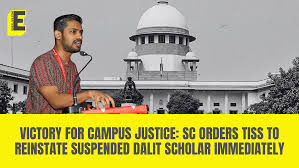
After 380 days of fight, left student leader regains educational rights in a landmark ruling Ramadas, who comes from Kerala’s Wayanad and studies Development Studies at TISS Mumbai, began his legal battle in May 2024. A year after his controversial suspension, Dalit PhD scholar and left student leader Ramadas KS has won his legal battle against the Tata Institute of Social Sciences (TISS). According to Maktoob Media, the Supreme Court of India today, Friday, May 2, directed TISS to reinstate Ramadas as a student with immediate effect while hearing his petition challenging the two-year suspension and ban on entry to any TISS campus. “Today, the Honourable Supreme Court has ordered TISS to reinstate me as a student with immediate effect, hearing my petition against the two-year suspension and debarring entry to any TISS campuses in three different states,” Ramadas shared in a Facebook post. Reflecting on his journey, he added: “On the 366th day of legal proceedings since approaching the High Court, I am officially a student again -from Today- at the very institution that denied me education 380 days ago.” Ramadas, who comes from Kerala’s Wayanad and studies Development Studies at TISS Mumbai, began his legal battle in May 2024. He argued that the university imposed the suspension without properly considering his explanations, while the institution justified its actions based on an Empowered Committee’s findings regarding his conduct, including participation in protests. A former general secretary of the Progressive Students’ Forum (PSF) at TISS Mumbai, Ramadas is now a member of the Central Executive Committee of Students’ Federation of India (SFI) and Joint Secretary of SFI Maharashtra. He has been a vocal critic of the institute administration’s policies. In his statement, Ramadas connected his struggle to broader issues: “The denial of education to any student was never about affecting just one individual- it was about the fundamental rights of countless students and the question of campus democracy in our higher education system.” Courtesy: Edex Live Note: This news is originally published on https://www.edexlive.com/news and is for use by the non-military/non-commercial community, especially those in the human rights sector.
Beyond Bihar, Caste Census is Meant to Woo Estranged OBCs & Dalits in UP
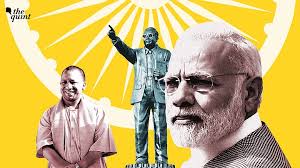
The somersault on caste survey may be calculated to alter a growing sense of duplicity by BJP among OBCs & Dalits. The Narendra Modi government’s decision to concede the longstanding demand of Opposition parties and some of its own National Democratic Alliance (NDA) allies for a caste census is guided by pressing electoral compulsions. It underlines the anxiety to woo Other Backward Castes (OBC) and Scheduled Caste (SC) voters by the Bharatiya Janata Party (BJP) and its ideological mentor, the Rashtriya Swayamsevak Sangh (RSS), both resistant for long to the collection of caste demographic data on the plea this would divide Hindu society. The immediate trigger may well be the upcoming Bihar Assembly polls, to be held within a few months. But the ruling party is even more worried about its prospects in the country’s most populous and politically crucial state of Uttar Pradesh where it got a drubbing last year in national elections largely because of disenchantment among OBCs and Dalits, whose support had been critical to ensure the BJP’s remarkable winning run in the recent past. Two Birds with One Stone The 2024 Lok Sabha results in Uttar Pradesh stunned the ruling party, which had earlier swept the state in successive Parliamentary and Assembly polls. Since then, the top leadership in both the BJP and the RSS have been preoccupied with strategising on how to reverse its waning support among OBC and Dalit voters. According to the usually reliable CSDS-Lokniti post-poll survey, the BJP-led NDA votes slid by 19 percent among the powerful Kurmi-Koeri backward caste and 13 percent among other non-Yadav OBCs in 2024 as compared to Lok Sabha election from five years ago. The party also lost 19 percent of the non-Jatav Dalit vote in 2024. This is what then led to the dismal fall of the NDA from 64 to 36 out of 80 Parliamentary seats from one election to the other. The BJP did manage to significantly wrest back the initiative in Uttar Pradesh by choosing as many as four OBCs and one Dalit of the eight party candidates in Assembly bypolls in the state in late November, winning a majority of them. However, considerable disquiet remains within the party and the RSS leadership with regard to reconsolidating the BJP’s shrinking OBC-Dalit voter base. Surrendering to one of its key demands of a comprehensive caste survey along with the long-delayed national census due to start this year illustrates this very fact. In a recent article, Swarajya, a pro-BJP magazine, carried an extensive report pointing out that “without a clear strategy to regain OBC support, the BJP faces a tough challenge in the 2027 Uttar Pradesh Assembly elections. The UP unit of the BJP has much to worry about with respect to winning back the trust of OBC voters after the 2024 Lok Sabha election setback.” The article also added, “Moreover, the narrative of ‘Thakurvaad’ (favouritism for Thakur or Rajput castes) under UP Chief Minister Yogi Adityanath, who belonged to the Thakur community before joining the Gorakhnath monastic order, does not appear to be helping the BJP.” Although Adityanath, along with all other BJP luminaries, has publicly fallen in line with the Centre’s decision to carry out a caste census, the saffron-clad monk-turned Chief Minister of Uttar Pradesh had until recently been a fierce opponent of such a move. Just a few months ago in an excusive interview with Network18 TV channel at the Mahakumbh in Prayagraj, when asked about the caste census demanded by the Congress and the Samajwadi Party, Adityanath warned “followers of Sanatan Dharma” to be cautious of “those trying to divide people”. “Dividing the society for your political interest, or in the name of caste, region, or language is nothing less than treason.” Yogi Adityanath (to Network18) Last year, while campaigning for the Lok Sabha polls, the CM castigated the demand by Opposition parties for a caste census, calling them “jaati ke saudagar (merchants of caste)” and cautioned his audience that “such elements would trade your interests for the sake of castes and then vanish.” OBC Leaders Close Ranks as Dalits Remain Estranged Interestingly, in sharp contrast to Adityanath, his Deputy Chief Minister Keshav Maurya and Minister of State in the Modi government Anupriya Patel, leader of a key BJP ally in UP, Apna Dal (Soneylal), both OBC leaders, have for long demanded a caste census in defiance of the official stand of the BJP. The two are reportedly keen to puncture the CM’s all-powerful status in the state with the quiet backing of Union Home Minister Amit Shah. Last year, Patel openly criticised the state government for outsourcing government jobs dodging reservation, which she said could become transparent after a caste census. A few months ago, BJP’s OBC legislator and anti-cow slaughter activist Nand Lal Gurjar created a public furore about the Yogi government being full of corrupt officials led by the chief secretary Manoj Kumar Singh. He alleged that when he tried to complain about the officials, most of them upper caste, they had ordered the police to manhandle him. He has been served a notice by the party but has reportedly the private support of Keshav Maurya. The BJP’s caste conundrum has been compounded by its growing alienation from Dalits in the state. Over the past decade, the ruling party had managed, apart from enlisting significant support from non-Yadav backward castes, to make significant inroads among the Dalit electorate, particularly those belonging to non-Jatav sub-castes, both providing the extra electoral ballast to consolidate support from the upper castes to ensure the BJP a comfortable victory. Desperate attempts by the Yogi government to woo back the estranged Dalit community by celebrating, for the first time, Babasaheb’s birth anniversary with much public pomp and fanfare, badly backfired. In fact, the widespread vandalising of BR Ambedkar’s statues on his birth anniversary last month by upper caste villagers, with the open connivance of the police, has led to further alienation among Dalits from the BJP. Both OBCs and Dalits are also
14yo Dalit girl raped for 7 mths, police turnaway parents; SHO shunted, SI suspended

Meerut: A station house officer in UP’s Bulandshahr was attached to police lines and a sub-inspector was suspended for “laxity” after they turned away the parents of a 14-year-old Dalit girl who was allegedly raped for months by a 50-year-old local villager and later found pregnant. The matter came to light on April 28 when the girl complained of abdominal pain, and the family noticed a bump. She was taken to hospital, where her pregnancy was confirmed. The minor revealed that she was first raped about seven months ago by a man from her village when she went to graze goats. She said that the 50-year-old man violated her and threatened to kill her family if she disclosed the matter to anyone. The accused continued to rape her for months — both alone and with his associates. Her family then approached the nearby thana. They claimed that they were turned away and the accused was let off. “Police and some villagers put pressure on us to sign an affidavit and attached our Aadhaar cards with it before turning us away from the thana. We do not know what was written on it. We were also threatened,” said her father, a marginal farmer. The family later met Bulandshahr SSP Dinesh Kumar Singh, who ordered a probe. “On the basis of the probe report, an inspector was sent to the police lines, while a SI was suspended for laxity in his duty. An FIR was registered under section 65 (1) (rape) and the Pocso Act. The accused was arrested, and the girl is under medical observation. Appropriate action will be taken,” circle officer Ram Karan told TOI. Courtesy: Times of India Note: This news is originally published on https://timesofindia.indiatimes.com/ and is for use by the non-military/non-commercial community, especially those in the human rights sector.
Four held for attacking Dalit minor in Dharmapuri
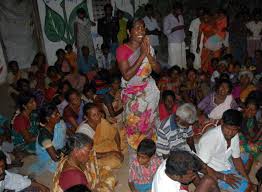
Ramakrishnan allegedly used casteist slurs and attacked the two youths. He also directed four others to apprehend the boy, tied him to a post, and beat him up with iron rods. DHARMAPURI: The A Pallipatti police have arrested four people and are on the lookout for one more person involved in the attack of a 16-year-old SC youth near Thenaraikottai village in Dharmapuri. Police said, “On Wednesday night, a 16-year-old boy along with his 20-year old relative both belonging to the SC community had gone to a petrol station near Thenkaraikottai village to refuel their two-wheeler. The 16-year-old had worked for the owner of the petrol bunk V Ramakrishnan (66) for a few days in the past and when they met, an argument broke out between them. Enraged, Ramakrishnan allegedly used casteist slurs and attacked the two youths. Ramakrishnan also directed four others to apprehend the 16-year-old boy, tied him to a post, and beat him up with iron rods. The other youth escaped and notified the minor’s family, who rescued and admitted him to Harur GH.” On Thursday, the boy filed a complaint with A Pallipatti police and a case has been registered under seven sections of BNS and under SC/ST POA Act against five people, of which R Selvam (38), R Senthil (43), V Selvaraj (32) T Senthil (45) have been arrested. Meanwhile, the prime accused, V Ramakrishnan has been hospitalised. “Ramakrishnan has also filed a complaint with A Pallipatti police stating that the two youths had attacked him which had resulted in the brawl. We have also booked a case against the two youths and further investigation is on,” police said. Courtesy: New Indian Express Note: This news is originally published on https://www.newindianexpress.com/ and is for use by the non-military/non-commercial community, especially those in the human rights sector.
Minor Dalit Girl Brutally Thrashed On Moving Bus For Opposing Molestation In UP’s Lakhimpur Kheri, Accused Arrested After Assault Video Goes Viral

An incident of violence against a 16-year-old Dalit girl has come to light from Uttar Pradesh’s Lakhimpur Kheri. The minor was brutally beaten on a moving bus by miscreants after she protested against their harassment. When the bus driver and conductor tried to intervene, they too were assaulted by the perpetrators. A video of the incident has gone viral on social media, showing the perpetrators slapping the victim and pulling her by her hair. According to reports, the incident occurred in the Padhua police station area of Nighaasan. What’s particularly shocking is that approximately 50 passengers on the bus reportedly watched the assault without intervening to help the victim. One passenger recorded the entire incident, and the video has since gone viral on social media. Bus driver Saleem told Hindi newspaper Dainik Bhaskar that he was driving from Dehradun to Lakhimpur when the incident occurred. “There was a girl sitting on the bus who was traveling to Lakhimpur. Some boys on the bus were harassing her. When she informed me about this, I tried to reason with the boys, but they started arguing and physically assaulting me,” Saleem said. Saleem stated that he stopped the bus at Padhua police station and filed a complaint against the youths. However, he claims that instead of taking action, the police merely counseled them and sent them away. The driver has also accused the miscreants of robbing him of Rs. 25,500. The Uttar Pradesh Congress shared the video of the incident on social media and criticised the government. In an X post, UP Congress said, “In Lakhimpur Kheri, miscreants harassed a Dalit minor girl on a moving bus, and when she protested, they beat her mercilessly. The miscreants were so emboldened that they didn’t spare the driver and conductor who came to intervene and beat them badly too.” Attacking UP Chief Minister Yogi Adityanath, the post further said, “Under Baba ji’s rule, criminals protected by power tarnish the honor of our sisters and daughters every day, but how dare Baba ji acknowledge his failure. Such a government deserves only condemnation!” The Lakhimpur Kheri Police have since issued a statement saying that a case has been registered at Padhua police station under appropriate sections. They further stated that the named accused have been arrested and charged, and legal proceedings are underway. Courtesy: Free Press Journal Note: This news is originally published on https://www.freepressjournal.in/ and is for use by the non-military/non-commercial community, especially those in the human rights sector.
Supreme Court Grants Relief To TISS Dalit Scholar Suspended Over Protest March, Allows Him To Continue PhD
The Supreme Court on Friday (May 2) directed the Tata Institute of Social Sciences to reinstate Dalit Ph.D. scholar and Left student leader Ramadas K.S, who was earlier suspended for alleged “misconduct” and “anti-national activities.” A bench comprising Justice Dipankar Datta and Justice Manmohan did not invalidate the suspension. However, it directed that the suspension be reduced to the period already undergone until yesterday. The bench expressed the view that Ramadas should be allowed to conclude his PhD. It was in April 2024 that the TISS suspended Ramadas from the institute for two years and debarred his entry across all its campuses. The action came after Ramadas participated in a protest against the Central Government and the BJP, and opposing the implementation of the National Education Policy (NEP) in a demonstration called the ‘Parliament march’ in January 2024 under the banner of TISS- PSF (Progressive Students’ Forum). Ramadas approached the Supreme Court challenging the Bombay High Court’s verdict, which upheld his suspension. The High Court observed that the said protest/march was politically motivated and noted that TISS was correct in finding that Ramadas created an impression that the views expressed in the march represented the views of the institute and that this brought disrepute to the institute. It was in 2015 that Ramadas first enrolled with the TISS for a Master’s degree in the course Media and Cultural Studies. He was awarded a scholarship from the institute. In 2018, he enrolled in the integrated M.Phil. and Ph.D. course in Development Studies. In 2023, he was awarded a National Fellowship in Scheduled Caste by the Union Ministry of Social Justice in view of his performance in the UGC-NET examination. Courtesy: Live Law Note: This news is originally published on https://www.livelaw.in and is for use by the non-military/non-commercial community, especially those in the human rights sector.
Supreme Court orders return of Ph.D. scholar Ramadas to TISS
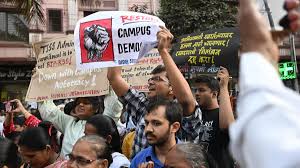
A Bench headed by Justice Dipankar Datta gave relief to Mr. Ramadas, who had challenged his suspension and ban from entering any TISS campus. A protest outside Tata Institute of Social Sciences against the suspension of Ph.D. scholar Ramadas K.S. on March 26, 2025. The Supreme Court on Friday (May 2, 2025) allowed Dalit Ph.D. scholar and Left student leader Ramadas K.S. to be reinstated in the Tata Institute of Social Sciences (TISS) while reducing his two-year suspension for alleged misconduct to the period already undergone. A Bench headed by Justice Dipankar Datta gave relief to Mr. Ramadas, who had challenged his suspension and ban from entering any TISS campus. A TISS empowered committee on April 17 2024 suspended Ramadas from the institute for two years and debarred his entry across all its campuses. Bombay HC dismisses TISS Ph.D student’s plea against his suspension for ‘anti-national activities’ The Bench noted the submissions of advocate Rajeev Kumar Panday, appearing for TISS, and perused the documents which prompted the committee to suspend the scholar for two years. Mr. Panday argued that the Bombay High Court was correct in not interfering with the suspension. However, the court took note of the fact that Mr. Ramadas was doing his Ph.D. from the institution and should be allowed to conclude it. “Today, the Honourable Supreme Court has ordered TISS to reinstate me as a student with immediate effect, hearing my petition against the two-year suspension and debarring entry to any TISS campuses in three different States… On the 366th day of legal proceedings since approaching the High Court, I am officially a student again –from Today – at the very institution that denied me education 380 days ago,” Mr. Ramadas was reported to have posted on social media. “I am happy. It is a relief for me. My first prayer was to go back to TISS and to study. That has been granted. I have not yet decided when I will rejoin. After the judgment comes in, I will study it and will go back thereafter. The court said, ‘Let him study.’ I respect the SC verdict,” Mr. Ramadas told The Hindu. Courtesy: The Hindu Note: This news is originally published on https://www.thehindu.com and is for use by the non-military/non-commercial community, especially those in the human rights sector.
Centre’s caste census move may alter UP’s political dynamics
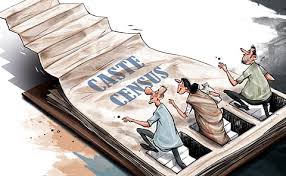
The move is likely to give momentum to long-pending demands from BJP allies in the state for a sub-quota within the OBC and SC/ST categories. The Centre’s decision to include caste enumeration in the upcoming census is set to create political ripples in Uttar Pradesh, the country’s most politically significant state. LUCKNOW: The Centre’s decision to include caste enumeration in the upcoming census is set to create political ripples in Uttar Pradesh, the country’s most politically significant state, by reshaping caste-based alignments that dominate its political landscape. The move is likely to accelerate long-pending demands from BJP allies in the state for a sub-quota within the OBC and SC/ST categories. Parties such as Om Prakash Rajbhar’s Suheldev Bhartiya Samaj Party (SBSP), Dr Sanjay Nishad’s NISHAD Party and Anupriya Patel’s Apna Dal (S) have consistently advocated the division of broader caste groups into sub-categories to ensure equitable distribution of reservation benefits. The demand for “quota within quota” stems from the findings of the Rohini Commission, constituted in 2017 to examine sub-categorisation of OBCs. Headed by Justice G Rohini, retired Chief Justice of the Delhi High Court, the four-member panel submitted its report in 2023, recommending a fairer allocation of reservation based on internal disparities among OBC communities. This argument for equitable distribution was previously echoed in Uttar Pradesh when the state government set up a social justice committee under retired judge Justice Raghvendra Kumar. The committee, in its 2018 report, recommended dividing OBCs into three groups: backward (12 sub-castes), more backward (59 sub-castes) and most backward (79 sub-castes). Similarly, the Dalits were also split into three groups: Dalit (4 sub-castes), Ati Dalit (31) and Maha Dalit (46). While Apna Dal (S), largely representing the backward Kurmi community, supported the caste census, it remained lukewarm to the committee’s recommendations, possibly fearing a backlash from socially dominant Kurmis. To push the agenda further, SBSP chief and Uttar Pradesh minister Om Prakash Rajbhar met Union Home Minister Amit Shah on Thursday. According to SBSP national general secretary Arun Rajbhar, the issue remains high on the party’s agenda. It is worth noting that SBSP had allied with the BJP during the 2017 assembly elections, and OP Rajbhar was inducted into the Yogi Adityanath cabinet. However, the party later parted ways in 2019 over the non-implementation of the social justice committee’s recommendations. “The party is thankful to PM Modi and the BJP’s central leadership for deciding in favour of caste census to help determine the social, economic, and political position of various OBCs and the SC population, ensuring a better distribution of resources leading to social justice in the true sense,” said Rajbhar. Political experts believe that while the Centre’s move could strengthen the BJP’s grip over its smaller allies, who frequently invoke the sub-quota demand to stay relevant, it may also intensify caste-based mobilisation. The sub-categorisation could potentially alter electoral calculations by directing more quota benefits towards marginalised sub-castes. Rajbhar added that the social justice committee’s report was a “clear reflection of the socio-economic conditions of the oppressed classes.” Sources indicated that the SBSP continues to press for factoring in the committee’s recommendations to carve out quotas within the broader OBC and SC/ST categories. Courtesy: New Indian Express Note: This news is originally published on https://www.newindianexpress.com and is for use by the non-military/non-commercial community, especially those in the human rights sector.