
BJP trying to portray Rahul as anti-Dalit leader: TPCC president Jagga
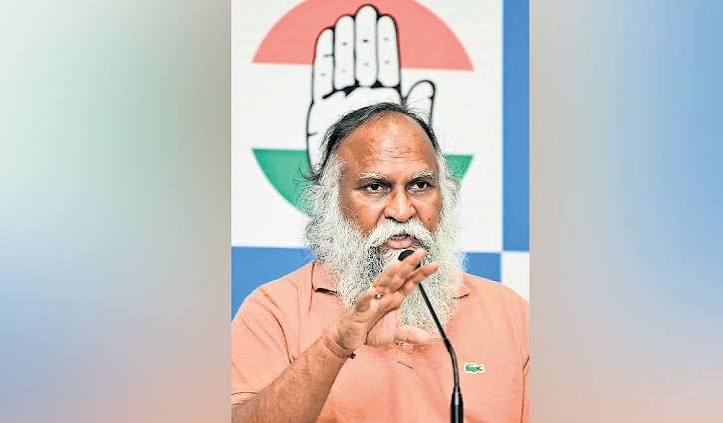
Jagga Reddy also recalled that how the BJP had appointed Bangaru Laxman as its national president but later removed him, this reflected the BJP’s approach towards Dalit leaders. HYDERABAD: Accusing the BJP of deliberately misrepresenting Rahul Gandhi’s remarks to portray him as “anti-Dalit”, Congress working president T Jayaprakash Reddy on Thursday said that saffron party leaders have no moral right to level such allegations. Addressing the media at Gandhi Bhavan here, he said: “The BJP and its affiliated organisations had recently tried to create an anti-Dalit image for Rahul Gandhi.” Referring to “some BJP-affiliated organisations performing purification rituals” after AICC president Mallikarjun Kharge’s visit to Uttarakhand, he said: “Rahul Gandhi had questioned such conduct. He advised the BJP and its affiliated organisations against indulging in such practices. But the BJP is intentionally giving a distorted interpretation of Rahul Gandhi’s comments and using them for political propaganda.” The former Sangareddy MLA, who is popularly known as Jagga Reddy, said that Rahul Gandhi was the “boss” of the Congress but neither he nor his family members have any arrogance. “In contrast, the BJP functions with arrogance, and it routinely opposes and works against the Congress and its leaders,” he added. “Whenever Rahul Gandhi walks alongside Mallikarjun Kharge, he lends support to him,” Jagga Reddy said, citing this as an example of Rahul Gandhi’s respect for Kharge. Jagga Reddy also recalled that how the BJP had appointed Bangaru Laxman as its national president but later removed him, alleging that such decisions reflected the BJP’s approach towards Dalit leaders. Courtesy : TNIE Note: This news is originally published on https:/thenewindianexpress.com/bha and is used purely for non-profit/non-commercial purposes, especially human rights
Karimnagar Dalit families’ Indiramma homes caught in 22A list
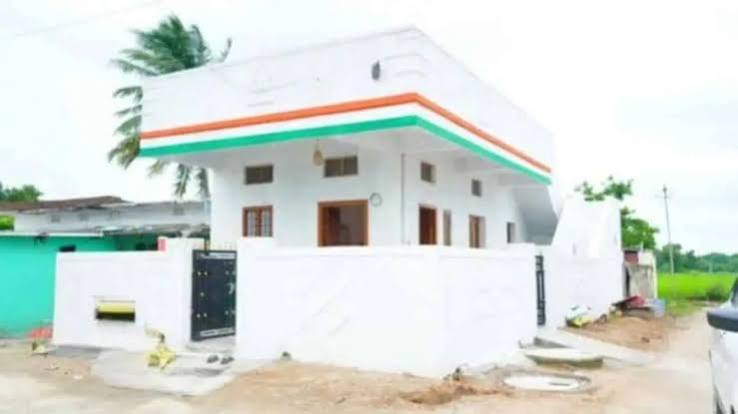
The listing has triggered panic among families who say they only learned of the restriction when they tried to deal with their properties. Hyderabad: Nearly 45 acres of land on which Indiramma houses were built for Dalit families decades ago in Karimnagar district has landed on the state’s prohibited property list under Section 22A of the Registration Act, leaving hundreds of beneficiaries unable to register or transfer their own homes. The affected land spans six villages in Gangadhara mandal: Gangadhara, Gattubuthkur, Garshakurthy, Kondaipalli, Burugupalli and Kachireddypalli, where the state government had allotted two guntas of land to each Dalit family in 1975-76 and constructed houses under the Indiramma scheme. The plots were registered in the beneficiaries’ names at the time, residents said, but were quietly added to the 22A prohibited list without any prior intimation. The listing has triggered panic among families who say they only learned of the restriction when they tried to deal with their properties. Many have since approached revenue officials and filed representations through Prajavani, the government’s public grievance redressal programme, demanding that the land be delisted. Kondaipally sarpanch Malliala Vinaysagar, also known as Thirupathi, said three acres in his village alone had been swept into the 22A list. About 80 Dalit families were sanctioned Indiramma houses there in 1975-76 and built them on patta land donated by a local landlord, patta land, not government or assigned property, he said. Officials who received the beneficiaries’ representation acknowledged the error and assured that the matter had been escalated to higher authorities for correction, Vinaysagar said. Gangadhara tahsildar Ambati Rajitha, responding to the concerns, distinguished assigned and patta land. Assigned land will continue to remain under the 22A restriction, she said, but houses built on patta land are eligible for removal from the list. In Kondaipally’s case, she said revenue records confirm the houses stand on patta land, and she has written to the district collector seeking the delisting. The houses will be removed once a response is received from higher officials, she added. The problem is not confined to Gangadhara. Agricultural land in Choppadandi mandal, including plots in Gumlapur, Ragampet, Chityalapalli and Chakunta, has also reportedly been caught up in the prohibited list, with affected landholders similarly filing representations through Prajavani. The Karimnagar cases mirror a wider pattern playing out across Telangana this year. Property owners in Hyderabad and several districts have reported valid plots, flats and houses being pushed into the 22A category, in some instances because a single subdivision within a survey number was classified as government land, dragging the entire survey number into the ban. In Patancheru constituency alone, BRS leader T Harish Rao has claimed more than 50,000 acres across five mandals were placed under the restriction. Chief Minister A Revanth Reddy has publicly assured that genuine owners will not lose their properties and has promised orders to denotify wrongly listed land. For the Dalit families of Gangadhara mandal, however, the assurance so far remains limited to verbal commitments from local officials, with the final decision resting on a response from the district collector’s office. Courtesy : TSD Note: This news is originally published on https:/thesiasatdaily.com/bha and is used purely for non-profit/non-commercial purposes, especially human rights
In letter, Sonia told of ‘administrative and political suppression’, says Telangana minister Surekha
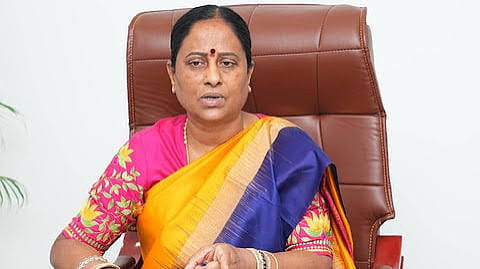
A major grievance in the letter was the alleged curtailment of her authority as Minister. Surekha claimed that several important decisions were taken without her knowledge and that directions. HYDERABAD: Days before the AICC cleared her ouster from the state Cabinet, Endowments Minister Konda Surekha had sought Congress Parliamentary Party chairperson Sonia Gandhi’s intervention, alleging that she was subjected to “sustained political and administrative suppression” by Chief Minister A Revanth Reddy and sections of the ruling party. On Thursday evening, Surekha released a 10-page letter dated August 22 that she had sent to Sonia Gandhi. The letter was also addressed to Rahul Gandhi, Mallikarjun Kharge, KC Venugopal and Meenakshi Natarajan. A major grievance in the letter was the alleged curtailment of her authority as Minister. Surekha claimed that several important decisions were taken without her knowledge and that directions from the CMO had reduced her role to a largely nominal one. She cited the constitution of the Yadadri Temple Trust Board and the transfer of funds meant for the development of the Sammakka-Saralamma temple as examples of being sidelined. She also alleged that her former OSD N Sumanth was removed without informing her and was subsequently subjected to police action. Surekha also alleged delays in funds for projects including the Smart City Model Bus Stand and Bondi Vagu development in her Warangal East constituency, claiming that several works had not received the same priority as those in neighbouring constituencies. She objected to Station Ghanpur MLA Kadiyam Srihari holding a review meeting with Endowments officials without informing her, saying such actions undermined the authority of the minister concerned. Surekha further alleged that local leaders and public representatives were being encouraged to act against her and that attempts were being made to politically isolate the Konda family in the erstwhile Warangal district. She also alleged that different political standards were being applied to Congress leaders, referring to Revanth’s remarks on former MLA T Jayaprakash Reddy’s possible electoral plans and his appeal at Parkal for the re-election of MLA Revuri Prakash Reddy. Another grievance concerned the show-cause notice issued to her over remarks made by her daughter, Susmita Patel. Surekha questioned whether a minister could be held responsible for the personal statements of a family member merely because she was the mother. Despite her grievances, Surekha said her faith in the Congress, its ideology, democratic values and national leadership remained unwavering. Courtesy : TNIE Note: This news is originally published on https:/thenewindianexpress.com/bha and is used purely for non-profit/non-commercial purposes, especially human rights
Vijay will be PM with Rahul Gandhi’s support, says TVK MLA
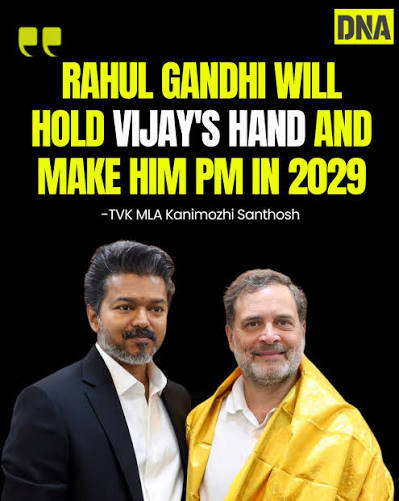
The statements drew attention, with a section of TVK supporters putting up wall posters in Madurai and other parts of the state, claiming that Vijay would become the next PM. CHENNAI: The ‘Rahul or Vijay for PM’ debate is rumbling on with leaders of TVK and Congress wanting their chieftain to be the prime ministerial candidate for the 2029 Lok Sabha elections. While Congress leaders have made it clear that Rahul Gandhi remains their choice, TVK legislator Kanimozhi Santhosh on Wednesday said Vijay would become the PM, with Rahul himself paving the way for him. Kanimozhi – an astrologer – who claims to have predicted C Joseph Vijay’s ascension to CM-ship, was confident that Rahul will make Vijay the PM in 2029. On Wednesday, the Kavundampalayam MLA, before taking part in the Assembly proceedings, predicted that Vijay would become PM in 2029. She said the next PM would come from TN. She further elaborated, “It was Congress leader Rahul Gandhi who helped our Thalapathy (Vijay) sit in the CM’s seat. So, he himself will hold Thalapathy’s hand and take him to Delhi in 2029 and make him sit there (as PM).” When asked by the media who would be Tamil Nadu CM if Vijay became PM, she replied, “Let’s see when it comes.” On the other hand, Congress is batting for Rahul, saying he has the support of the Tamil Nadu CM. Congress floor leader Tharahai Cuthbert on Wednesday told reporters that Rahul was the accepted leader and claimed that Vijay had also made it clear that Rahul should become the PM. She described the claims of TVK cadre as “fan mentality”. She said, “They still have a fan mentality. So naturally, they will consider their own leader to be the PM. There are no two opinions when it comes to the views of Vijay’s fans. There is nothing wrong in what they are doing. Therefore, you should not draw any conclusions based on this.” The statements drew attention with a section of TVK supporters putting up wall posters in Madurai and other parts of the state, claiming that Vijay would become the next PM. Meanwhile, BJP state president Nainar Nagenthran and senior BJP leader Pon Radhakrishnan on Wednesday claimed that cracks are appearing in the TVK-Congress alliance over the PM’s chair issue. On Tuesday in Tenkasi, Energy and Law Minister C T R Nirmal Kumar told reporters that there was no confusion within the alliance, and urged the media not to blow the issue out of proportion. S Kumaresan Courtesy : TNIE Note: This news is originally published on https:/thenewindianexpress.com/bha and is used purely for non-profit/non-commercial purposes, especially human rights
Raj Gopal backs high command on cabinet picks
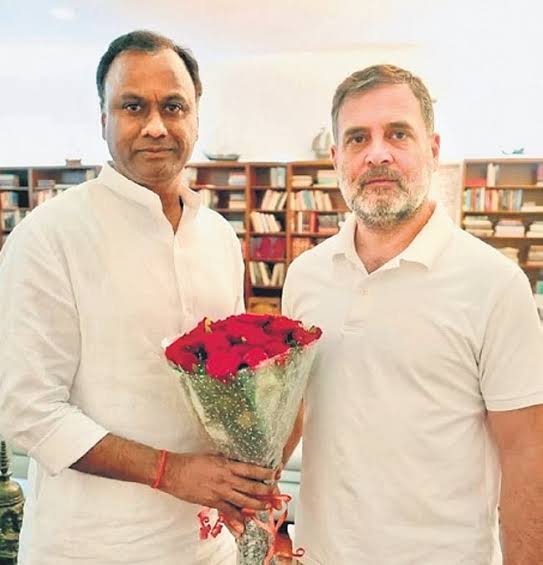
Hyderabad: Munugode MLA Komatireddy Raj Gopal Reddy on Thursday said decisions on the proposed cabinet expansion and allocation of ministerial berths rested entirely with the Congress high command, adding that he would abide by whatever decision party leader Rahul Gandhi takes. Speaking at Sarvel village in Yadadri-Bhuvanagiri district after laying the foundation stone for road development works, Raj Gopal Reddy said his priority was to ensure that Congress workers who stood by the party during its decade-long struggle against the BRS were given due recognition. “Leaders who worked for the party when it was in opposition should not be overlooked. Genuine Congress workers deserve justice,” he said. Amid speculation over the cabinet expansion, Raj Gopal Reddy said individual leaders had no role in deciding who should be inducted into the cabinet. “Who gets which post is for the high command to decide. I have complete faith in Rahul Gandhi and will abide by his decision,” he said. He clarified that his remarks should not be construed as a demand for any ministerial post, reiterating that his concern was to ensure deserving Congress workers received their due recognition. Courtesy : TOI Note: This news is originally published on https:/timesofindia.com/bha and is used purely for non-profit/non-commercial purposes, especially human rights
Rahul Gandhi Punjab visit: Cong submits route, meeting plan
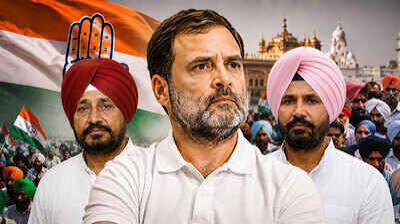
Chandigarh: With the BJP, AAP and SAD already hitting the ground for the Punjab assembly elections, the Congress’s top functionaries from Punjab on Thursday met Lok Sabha leader of the opposition Rahul Gandhi’s team to plan his proposed visit to Punjab. AICC Punjab in charge Bhupesh Baghel, Punjab Congress president Amrinder Singh Raja Warring and assembly LoP Partap Singh Bajwa also submitted a detailed plan covering routes and meetings for Rahul’s visit. AICC national media coordinator Hari Shankar Gupta had said on Wednesday that Rahul was likely to visit Punjab within 10 days, with the schedule almost finalised. The development comes as Punjab BJP is also preparing a four-phase anti-drug yatra covering all 117 assembly constituencies after mid-Sep. The party is finalising the schedule based on the availability of its national leadership. Rahul is likely to visit Punjab around mid-Sep, though the duration and dates have not been finalised. The state unit has proposed one-, two- and three-day options, with meetings planned with farmers, ex-servicemen and other sections of society. “There is no final decision on the duration. A proposal has been submitted to Rahul ji’s team, which handles logistics, route plans and meetings. After approval from his office, our preparations will begin,” Baghel told reporters. He said a date had been proposed but the visit would depend on Rahul’s availability. Courtesy : TOI Note: This news is originally published on https:/timesofindia.com/bha and is used purely for non-profit/non-commercial purposes, especially human rights
FIR can’t silence Rahul; Congress will return to power, says DK Shivakumar

The CM urged the BJP to apologise to the entire country for the purification ritual carried out after AICC president Mallikarjun Kharge addressed a gathering in Uttarakhand. BENGALURU: Chief Minister DK Shivakumar on Wednesday predicted that the Congress would return to power in Karnataka in 2028, and at the Centre in 2029. Addressing a party protest at Freedom Park against what he described as a “malicious” FIR registered against Rahul Gandhi in Uttarakhand, Shivakumar said the Congress leader would neither apologise nor give an undertaking to authorities. “The BJP is trying to suppress everyone’s voice, and its last days are approaching. In 2028, the Congress government will come to power in Karnataka and in 2029, the Congress will form the government at the Centre,” he said. The CM urged the BJP to apologise to the entire country for the purification ritual carried out after AICC president Mallikarjun Kharge addressed a gathering in Uttarakhand. He termed it an insult to India’s social harmony. Shivakumar accused the ruling party of attempting to suppress voices critical of its actions. “Rahul Gandhi is a born fighter. Even if 100 cases are registered against him, he will not be afraid of such empty threats. Unlike others, Rahul Gandhi will neither give an undertaking nor apologise,” he said. Former CM Siddaramaiah alleged that filing an FIR against Rahul was a grave injustice. “A case of atrocities on Dalits has been registered for no reason. This is very regrettable. According to the Constitution, a case should be filed against those who practice untouchability. But the Central government is taking action against Rahul Gandhi with malicious intent to silence him,” he said. “PM Narendra Modi, BJP and Amit Shah have dared to silence the Leader of Opposition by filing an FIR. Congress workers staged a protest against them for smearing democracy, and were protesting in all districts,” KPCC president BK Hariprasad said. Courtesy : TNIE Note: This news is originally published on https:/thenewindianexpress.com/bha and is used purely for non-profit/non-commercial purposes, especially human rights
Delhi High Court asks Centre, police to frame SOP for arrest, detention of transgender persons

The petitioner submitted that in May, the NHRC issued the ‘Advisory for Ensuring the Welfare of Transgender Persons, 2.0’ for formulation of a comprehensive Standard Operating Procedure to govern the arrest, detention, search, interrogation and imprisonment of transgender persons The high court here on Wednesday asked the Centre and Delhi Police to take appropriate steps for the formulation of an SOP on the arrest and detention of transgender persons here. A bench of Chief Justice D K Upadhyaya and Justice Tejas Karia issued notice to the central government, police as well as the Delhi government on a public interest litigation (PIL) by a law student, and asked them to consider an advisory by the National Human Rights Commission (NHRC) on the issue. The plea by Taaran Chandna said while the Delhi Police has a standing order for the arrest of women and senior citizens, it is “wholly silent” on transgender persons. The petitioner submitted that in May, the NHRC issued the ‘Advisory for Ensuring the Welfare of Transgender Persons, 2.0’ for formulation of a comprehensive Standard Operating Procedure (SOP) to govern the arrest, detention, search, interrogation and imprisonment of transgender persons. However, no such SOP or guideline has been formed for Delhi, he said. “We call upon the Union of India, the Delhi Police and the State government to file their reply. In the meantime, we direct that the advisory issued in May 2026 shall be considered and appropriate steps as permissible in law shall be taken,” the bench said. The court also asked authorities to file an affidavit detailing the steps taken by them in compliance with the advisory and listed the matter for hearing on November 18. In the PIL, Chandna said the SOP governing the arrest and personal search of transgender persons by Delhi Police was needed to protect their fundamental rights to bodily integrity, dignity, equality and non- discrimination guaranteed under the Constitution of India. The “concrete and continuing harm” due to the “vacuum” can be seen when the police in May 2025 arrested three transgender persons in an FIR, the plea said. It alleged that despite one of them possessing female genital anatomy and another holding a valid Certificate of Identity, all three were personally searched by a male police officer “without any enquiry into their gender identity, without seeking self-declaration, and without consent”. Courtesy : The Telegraph Note: This news is originally published on https:/thetelegraph.com/bha and is used purely for non-profit/non-commercial purposes, especially human rights
From silence to testimony: Dalit women’s words as counter-history

Dalit women’s autobiographical writing in India is emerging as a formidable archive of political resistance, functioning less as personal memoir and more as collective testimony to centuries of caste, gender and class oppression, according to a comprehensive analysis by Professor Garima Srivastava. In an unpublished paper titled “The Great Call of the Voiceless: Dalit Women’s Autobiographies”, Srivastava examines narratives across Tamil, Bengali, Marathi and Hindi literatures, arguing that these texts are not merely literary exercises but radical acts of reclaiming identity from the margins of Indian society, where entrenched power structures have historically silenced Dalit voices while mainstream publishing circulated unchallenged and educational curricula deliberately excluded non-Brahminical perspectives. Srivastava, who is with the School of Language, Literature and Culture Studies, Jawaharlal Nehru University, contends that Dalit literature as a whole constitutes a literature of resistance, born from accumulated discontent and an effort to move from untouchability to visibility. She emphasizes that Dalit women have faced multi-layered exploitation, trampled upon in the name of patriarchy, gender and caste by upper-caste men and women alike, and even by Dalit men. The lack of education and basic facilities long denied them the ability to think and decide in their own favour, yet their autobiographies now demand analysis through a feminist lens that seeks to replace male-centered consciousness with an alternative history written from the periphery. Drawing on the Latin American concept of testimonio, Srivastava cites scholar John Beverly to argue that these texts function as first-person narratives where the protagonist bears witness to collective suffering, bringing readers close to the oppressed with an authenticity that statistics alone cannot convey. The paper asserts that Dalit autobiographies cannot be understood as individual life stories alone; rather, they are community narratives that document torture, labour exploitation and sexual violence while attempting to reconstruct the self against fragmentation and destruction. The analysis traces this literary emergence to the women’s movements of the 1980s, when small booklets and translations began reaching audiences outside large publishing houses. Yet Srivastava notes that educational institutions have systematically excluded Dalit literature from syllabi, studying caste only through sociological lenses while avoiding Ambedkarite or Satyashodhak viewpoints. She warns that generalized feminist slogans claiming all women are Dalits often marginalize the specific institutional question of caste, blurring the distinct oppression faced by Dalit women and overlooking the interrelationship between social structure and contemporary change. Among Tamil narratives, the paper highlights Veeramma’s dictated autobiography “Life of an Untouchable,” where she describes how members of her Paraya community prostrated themselves before upper castes and how her childhood marriage to an older man felt like kidnapping by those who made her a woman. Veeramma transforms her personal account into community testimony by addressing an imaginary interlocutor, contrasting past wages of one and a half rupees with government-mandated rates today, declaring that in this Kali Yuga the government itself takes care of people like her. Bama Faustina Mary’s “Karukku,” the first Tamil Dalit autobiography to gain wide readership, moves deliberately from I to we, comparing her sharpened words to a thorny leaf that makes oppressors feel the sting. A Christian Dalit, Bama exposes caste discrimination within the church and the nexus between state power and upper-caste violence, including police atrocities where Dalit women were left behind to face daily sexual assault while men fled to the jungles. In Bengal, Baby Haldar’s “Aalo Andhari” traces her journey from child marriage at twelve and domestic servitude in Delhi to literary recognition, inspired by Prabodh Kumar, grandson of Premchand, who encouraged her to read and write. Srivastava highlights Baby’s transformation from a woman terrified of train conductors questioning her presence in a particular bogie to someone who fearlessly produces her ticket, and her refusal to adopt her husband’s surname, questioning why girls must change their identity after marriage when boys do not. Kalyani Thakur’s “Ami Keno Chandal Likhi” makes the political personal by adding Chandal to her surname in 2003, documenting how she was denied a chair in government offices, made to sit in corners without fans while colleagues were troubled by her very existence, and forced to bring mats from home to sit in school verandahs outside the classroom. The Marathi autobiographies form what the paper calls a golden age of Dalit testimony. Shantabai Dhanaji Dani’s “Raatra Din Amha” recounts childhood hunger so severe that her mother beat her for begging a neighbour for bread, then cried and fed her late at night. In college, Dani was served food thrown from a distance into her plate and barred from the girls’ bathroom, confined behind a bamboo barricade. Mukta Sarvagond’s “Mitaleli Kavade” details how Dalit labourers cleaned wedding grounds with their bare hands and received kheer that had been placed on piles of human excreta as remuneration for four months of work. Baby Kamble’s “Jin Amuchya,” written secretly on scraps of paper hidden from her husband, exposes domestic violence within the Mahar community, where she notes that if Mahars are the other for Brahmins, Mahar women are the other for Mahar men. Kumud Pawade’s “Antahsphot” chronicles her forbidden pursuit of Sanskrit, facing professors who asked what sin caused them to learn the language from a Dalit woman, while Urmila Pawar’s “Aaydan” describes how her illiterate mother, a bamboo weaver, confronted a teacher who beat Urmila for refusing to clean cow dung, threatening him until he retreated and transforming her daughter’s sense of possibility. Pawar later critiques the patriarchy within Dalit movements themselves, noting that women were denied chairs and leadership roles even in meetings organized for them. Mallika Amar Sheikh’s autobiography breaks silence on the private brutality of public revolutionaries, describing her husband Namdev Dhasal, founder of the Dalit Panthers, as a violent drunkard who sidelined her while party workers applauded male dominance. In Hindi, Kaushalya Baisantri’s “Dohra Abhishap” explicitly addresses the double curse of being born both Dalit and female, while Sushila Takbhaure’s “Shikanje Ka Dard” frames caste oppression as a claw that crushes Dalit women into cages. Kaushal Panwar’s “Bavandaron Ke Beech” recalls a teacher who slapped her
Rain in Prayagraj causes houses in Dalit Musahar settlement to collapse: Many families forced to live under tarpaulins.

Incessant rain has caused several mud houses to collapse in the Dalit Musahar settlement of Babhani Hethar village in Prayagraj’s Manda development block. The affected families are forced to live under tarpaulins. The mud houses of several families, including Samaruh Musahar, Dangar Musahar, Bablu Musahar, Arjun Musahar, and Bhim Musahar, collapsed. Buried under the debris, their food grains, clothes, bedding, utensils, and other household items were damaged. It is a matter of relief that all the families had evacuated at the time of the incident, resulting in no damage. Following the house collapse, these families have set up temporary shelters under tarpaulins. Living in the open amid the incessant rain is causing significant difficulties for children and the elderly. These families are facing a significant problem of shelter and food. The affected families have demanded immediate financial assistance, food grains, tarpaulins, and housing from the administration. Villagers say that if relief is not provided soon, the suffering of the affected families may worsen. Aman Sonkar | Manda (Meja), Prayagraj (Allahabad) Courtesy: Hindi News