
‘You don’t belong to anyone else, but yourself’: Rahul Gandhi’s message to young women
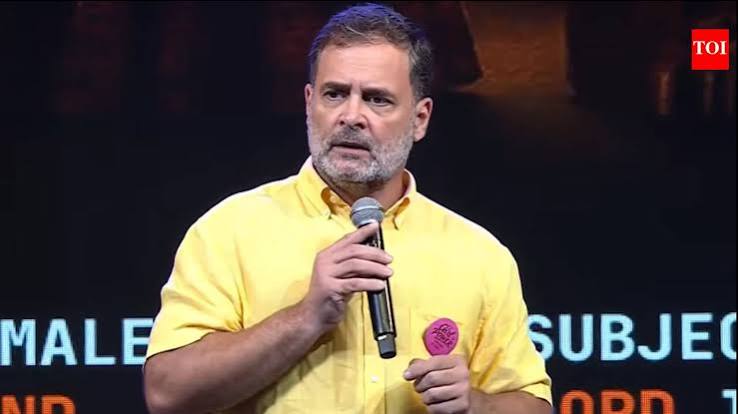
NEW DELHI: Congress leader Rahul Gandhi on Friday described India’s 70 crore women as the country’s “biggest asset”, saying they are more forward-looking than men and have a crucial role in shaping the nation’s future. He also invoked the idea of women’s autonomy and said that a woman should have the exclusive ownership of her own life. Speaking at the fourth event of ‘Chhatron Ki Goonj’ at the AISSMS College Ground in Pune, Maharashtra, he invoked a verse from the Manusmriti and contrasted it with his call for the empowerment and autonomy of women. Rejecting the idea of women being liable to other men, he asserted that a woman’s exclusive ownership belongs to herself. While acknowledging that the relationships in a woman’s life are important, he stressed that they do not determine her identity or ownership. Speaking on the central theme of the evening, “break the cage”, Rahul Gandhi called on the audience to recognise the individuality that sets each person apart and to resist the pressures that seek to confine them to predetermined identities or expectations. He said the most important message he wanted people to take away from the evening was a simple but powerful one: “Every single one of you is unique in this universe.” Elaborating on the idea, Rahul Gandhi stressed that individuality is not merely about being different from others, but about recognising one’s own worth and identity. “You are unique. You are special. You are an individual,” he told the audience. He emphasised that every person has a distinct way of looking at the world, a different set of aspirations and the ability to imagine a life beyond the boundaries imposed on them. Rahul further connected this sense of individuality to the freedom to dream and choose one’s own path. “And you have your own dream, your own vision for your life,” he said. The emphasis, he suggested, was not simply on having dreams, but on having the freedom to define those dreams for oneself rather than allowing society, circumstances or established notions of what one ‘should’ be to determine them. Through the theme of “break the cage”, the LoP framed personal freedom as the ability to step outside these limitations and acknowledge that no individual should be reduced to a role, label or identity prescribed by others. His message was that recognising one’s uniqueness is the first step towards claiming the freedom to shape one’s own future, pursue one’s aspirations and live according to one’s own vision of life. Rahul Gandhi attacks Manusmriti Rahul Gandhi launched a sharp attack on the Manusmriti over its treatment of women, criticising the text’s prescription that women should remain under the authority of male relatives throughout their lives. He contrasted the idea with his call for women’s autonomy, arguing that a woman’s identity and freedom should not be defined by her relationship with her father, husband or sons. Quoting from the Manusmriti, Rahul Gandhi said, “I (would) like to quote here the Manusmriti, which says clearly that in childhood a female must be subject to her father, in youth she belongs to her husband and, when her lord is dead, she belongs to her sons. A woman must never be independent.” Calling the words unacceptable, Rahul Gandhi added, “These words are a shame. These words should not have been spoken.” He said the country should instead recognise women as individuals with their own aspirations and agency, describing India’s 70 crore women as its “biggest strength” because of their “70 crore unique journeys, unique imagination, unique dreams”. His remarks framed the debate around women’s independence as a broader question of individual freedom, with Rahul arguing that women should have the right to define their own identities and determine the course of their lives rather than be treated as belonging to male relatives. Event follows political storm, clashes The event follows a political storm and clashes between student organisations. The programme was preceded by a midnight clash between the NSUI and ABVP at the COEP Technological University hostel. It happened after ABVP claimed that female students were being forced to attend the event. Meanwhile, Congress leaders countered the claims, saying two female students, who had earlier expressed their support for the event, were threatened and confined inside the hostel. BJP has also accused Congress of paying influencers and manufacturing crowds for the event. Meanwhile, Congress has alleged that the ruling establishment was attempting to disrupt Rahul Gandhi’s student outreach. NSUI-ABVP clash erupts at COEP hostel Tensions escalated on Friday night when NSUI and ABVP members clashed at the COEP hostel campus ahead of the LoP’s interaction. Police resorted to a lathi charge to control the situation, while several injured activists were taken to Sancheti Hospital. According to police sources cited in the material, the Shivajinagar Police registered cases against 50 to 60 people, including six named NSUI and Youth Congress activists, following a complaint by an ABVP member. The confrontation reportedly centred on student participation in LoP Rahul Gandhi’s programme. NSUI activists said they were responding to distress calls from female students, while ABVP alleged that Congress-linked workers were forcibly encouraging hostellers to register for the event. Congress alleges female students were intimidated Congress leaders accused ABVP workers of entering the girls’ hostel and intimidating students who had expressed support for the event. Congress spokesperson Atul Londhe alleged that a female student was cornered and forced to apologise on camera. NSUI state president Sagar Salunke claimed that students had called the organisation for help and alleged that CCTV cameras had been switched off before NSUI members arrived. Salunke also alleged that students, including orphaned students, had been pressured to record videos praising the college administration. The case registered by police followed a complaint from 21-year-old student Malhar Nilesh Patil, who alleged that a student’s video statement had been recorded under pressure at the hostel. Pawan Khera alleges conspiracy to disrupt event Congress leader Pawan Khera alleged that there had been a conspiracy to disrupt LoP’s Pune programme, claiming
Revanth praises Goud on marking two years as TPCC chief
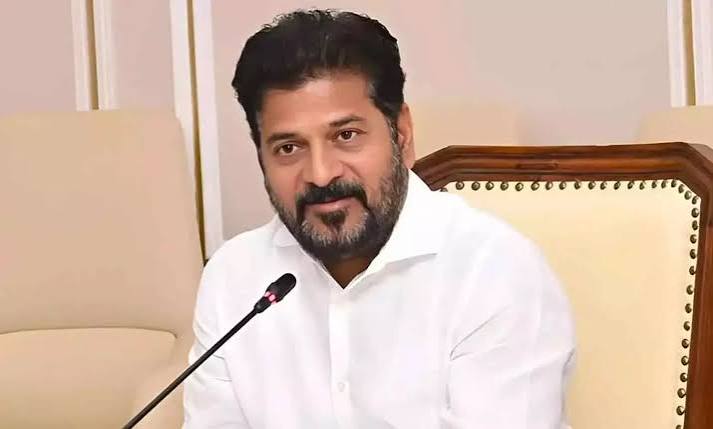
Hyderabad: Chief minister A Revanth Reddy on Sunday praised the work of Congress leader Mahesh Kumar Goud in strengthening the party on the occasion of Goud being appointed as the TPCC president two years ago. In a post on X, Revanth said the appointment of Goud also fulfilled the social justice formula of the Congress party: “From an ordinary worker to the party’s state charioteer, on the occasion of completing two years as PCC president, heartfelt congratulations to MLC Mahesh Kumar Goud. Entrusting the reins of Telangana Congress to a BC son is not merely about assigning a position, but a testament to the Congress party’s commitment to social justice. From the day he took on that responsibility, under the leadership of AICC president Mallikarjun Kharge @kharge, and the guidance of Rahul Gandhi @RahulGandhi, the journey of Mahesh Kumar Goud garu in strengthening the party, standing as a support for the workers, is commendable. With the same dedication, wishing to reach even more milestones in public service, heartfelt congratulations to Mahesh Kumar Goud.” Mahesh Goud’s two years in office was marked by organisational strengthening, social justice initiatives and efforts to improve coordination between the govt and the party. The Congress also drew confidence from electoral victories, including the Jubilee Hills by-election, Nizamabad municipal elections and local body polls in the Reddy-BC leadership combination i.e. CM Revanth Reddy and TPCC president Mahesh Kumar Goud. These victories provided a boost to the party cadre and strengthened the leadership’s efforts to consolidate the organisation. During his tenure, Mahesh Kumar Goud implemented a special action plan aimed at strengthening the Congress from the grassroots level. Particular emphasis was placed on energising party workers from villages and mandals to district-level units and ensuring better coordination between the govt and the party. One of the major organisational initiatives during his tenure was the large-scale training camp for DCC presidents from the erstwhile Telugu states at Vikarabad under the ‘Sanghatan Srujan Abhiyan’. Congress leaders Rahul Gandhi and AICC general secretary KC Venugopal attended the programme. Rahul Gandhi’s appreciation of Mahesh Kumar Goud’s performance during the event was viewed as an important recognition of his organisational efforts. Another key focus was taking the govt’s welfare and development programmes to the people while ensuring that problems emerging at the grassroots were conveyed to the party leadership. Face-to-face interactions with ministers and padyatras were used to strengthen the party’s connection with the public and its cadre. Courtesy : TOI Note: This news is originally published on https:/timesofindia.com/bha and is used purely for non-profit/non-commercial purposes, especially human rights
MPSC aspirants to protest in Pune on Monday; support pours in from CJP, Rahul Gandhi, Aaditya Thackeray
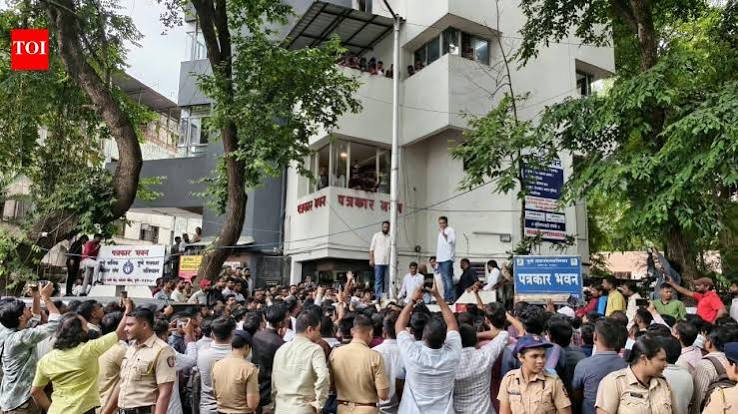
Pune: A day before a protest march announced by Maharashtra Public Service Commission (MPSC) aspirants against alleged irregularities in the recruitment process, demanding either resignation or removal of the commission’s chairperson, the Cockroach Janta Party (CJP) as well as opposition leaders like LOP Rahul Gandhi of Congress and MLA Aaditya Thackeray of Shiv Sena (UBT) extended their support to the agitation. In a post on X, Rahul Gandhi said thousands of students across Maharashtra were protesting peacefully, with their concerns extending beyond a particular examination or recruitment process to a broader loss of faith in the system. “Whether at Centre or in the state, every student is fed up with BJP govt. Paper leaks, stalled recruitments, unaffordable education, inhumane hostel conditions, poisonous food and fraud in DBT. And now, by taking control of a constitutional body like MPSC, it has destroyed the institution’s credibility,” he said. The Congress leader said that every demand from students for their successful future is justified. He said govt must listen to their voice and act immediately, else this echo of students will only grow louder until justice is served. The scheduled protest of MPSC students that will start from Omkareshwar Temple and culminate at the Pune district collector’s office also received backing from CJP chief Abhijit Dipke, who announced that CJP supports the demands. Some office-bearers of CJP also met agitating students to declare that they too will take part in the march. Thackeray, who was in Pune on Sunday to participate in the protest march by Hinjewadi residents and IT professionals for better infrastructure, also met MPSC aspirants later in the day and announced his party’s support for them. “We stand with MPSC students. The local Shiv Sena (UBT) and Yuva Sena will participate in Monday’s march,” he said. NCP (SP) MLA Rohit Pawar met MPSC aspirants on Saturday and addressed a press-conference alongside them to announce the proposed protest march. Pawar has also been raising concerns over the FDA inspector recruitment examination, which came under scrutiny following allegations of a question paper leak. Police have arrested several people in connection with the case and the exam was cancelled in Aug after leak was confirmed. The developments come after state govt formed a committee on Sept 4 to review the existing recruitment examination system and recommend measures to make it more transparent and reliable. Meanwhile, BJP MLA Vikram Pachpute, who met MPSC aspirants in Pune on Sunday, said efforts were being made to resolve the issue through dialogue and to persuade the protesting students. He said the agitation should not be exploited for political gains. On the demand for the removal of MPSC chairperson Vivek Bhimanwar, Pachpute said the commission is an autonomous body and its chairperson is appointed by the governor. “Govt does not even have the authority to demand his resignation,” he said. Courtesy : TOI Note: This news is originally published on https:/timesofindia.com/bha and is used purely for non-profit/non-commercial purposes, especially human rights
After meeting Bihar youth, Rahul slams PM Modi, Samrat Choudhary
NEW DELHI: Congress functionary Rahul Gandhi Sunday lashed out at PM Narendra Modi and Bihar chief minister Samrat Choudhary over the police action against protesting students in the state, asking while their broken bones would be fixed, if their shattered dreams could be restored. Gandhi shared a video of his recent meeting with students and youngsters from Bihar who, he said, endured “horrific police brutality” for raising their voices against alleged irregularities in the examination system. In his post accompanying the video, Rahul said, “Imagine, what sin had these children committed that they were shot with bullets? They had only asked the govt for three things – education, employment, and accountability.” Patna witnessed a pitched battle between job aspirants and police last month as demonstrators tried to march to the CM’s residence demanding a single-tier teacher job exam and a transparent recruitment process. He also drew attention to students issues in Maharashtra saying, “Thousands of students are on the streets, protesting peacefully -the reason isn’t just one exam or recruitment, but a trust that’s been shattered by the entire system.” Gandhi stressed that govt must listen to their voice and act immediately – otherwise, this ‘Chhatron ki Goonj’ will only grow louder until justice is served. His remarks came after Maharashtra constituted a high-level panel to undertake a comprehensive review of the existing recruitment examination system in the state and suggest measures to make it more transparent, secure, reliable and candidate-friendly. Courtesy : TOI Note: This news is originally published on https:/timesofindia.com/bha and is used purely for non-profit/non-commercial purposes, especially human rights
Shedding old AHINDA allies, Congress leader Siddaramaiah plans to revive ‘HINDA’ with new team
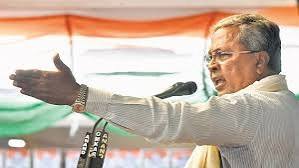
During his recent visit to Siddaramaiah’s Varuna Assembly constituency in Mysuru district, Dr Parameshwara had reportedly suggested that Dalits should groom Yathindra as a future leader. BENGALURU: Former Chief Minister Siddaramaiah and Deputy Chief Minister Dr G Parameshwara appear set to revive the Congress’ HINDA (Kannada acronym for Backward Classes and Dalits) plank to consolidate its Backward Classes and Dalit support base ahead of the 2028 Assembly elections. A Backward Classes Federation rally to felicitate Siddaramaiah at Bengaluru’s Palace Grounds on Sunday is expected to showcase the emerging social coalition, with Dr Parameshwara likely to take centre stage at the event. The rally may pose a subtle political threat to CM DK Shivakumar who is likely to project himself as the Congress’ CM face in 2028. Siddaramaiah had successfully championed the AHINDA (Kannada acronym for minorities, backward classes and Dalits) plank, which played a key role in his becoming CM twice. However, in the changed political scenario, with some of his erstwhile associates, including Public Works Minister Satish Jarkiholi and Housing Minister BZ Zameer Ahmed Khan, seen distancing themselves from him, Siddaramaiah is now expected to focus on rebuilding the HINDA coalition with a new set of leaders, political analysts opine. Siddaramaiah’s son and Urban Development Minister Dr Yathindra could also be projected as his ideological successor at the rally, particularly as sections of the Kuruba community have been keen to see him emerge as a future leader, sources said. During his recent visit to Siddaramaiah’s Varuna Assembly constituency in Mysuru district, Dr Parameshwara had reportedly suggested that Dalits should groom Yathindra as a future leader. The move is being seen as a reciprocal gesture towards Siddaramaiah, who had backed Dr Parameshwara for the CM’s post and later played a role in him getting the DCM position. Siddaramaiah had recently said he lobbied with the Congress high command to restrict the government to a single Deputy CM so that Dr Parameshwara could get the post. Dr Parameshwara, in turn, promptly acknowledged Siddaramaiah’s role. Against this backdrop, Dr Parameshwara is likely to be projected as the prominent Dalit face of the Siddaramaiah camp and potentially as one of the contenders for the CM race ahead of the 2028 polls, analysts said. The guest list for Sunday’s event has also attracted attention. Several prominent leaders associated with Siddaramaiah’s earlier AHINDA campaign, including Satish Jarkiholi, Zameer Ahmed Khan and former minister Dr HC Mahadevappa, have not been invited. In contrast, KPCC president BK Hariprasad and ministers Santhosh Lad, Puttaranga Shetty, Madhu Bangarappa, Byrathi Suresh and Ajay Singh, besides former minister KN Rajanna, have been invited. However, KM Ramachandrappa, president of the Karnataka Rajya Hindulida Jaatigala Okkuta, said there was no political motive behind the guest list. “As the event is being organised to mark the silver jubilee of the Okkuta, only Backward Classes leaders have been invited. We have invited Dr Parameshwara as a representative of the government and will submit certain demands, including implementation of the Backward Classes survey report,” he told The New Sunday Express. Chairman of the Karnataka State Backward Classes Commission Madhusudhan R Nayak and former commission chairpersons Prof Ravivarma Kumar, H Kantharaju and Jayaprakash Hegde have also been invited to the event. Devaraj B Hirehalli Courtesy : TNIE Note: This news is originally published on https:/thenewindianexpress.com/bha and is used purely for non-profit/non-commercial purposes, especially human rights
Not all colours of the rainbow: How this new short film dives into the life of the LGBTQIA+ community, and more

What happens when you can be a transperson with your lover, but scared of coming out as Dalit? The short film Tara is looking for that answer, and an OTT home Often, the intersections that make a person, doesn’t fit into our version of reality. Tara, a 20-minute fictional film, beautifully puts across the conundrum of which part of ourselves is palatable to our nearest and dearest, even a lover. The protagonist of the movie, Tara, is a transwoman who falls in love with a heterosexual man. Tara is tapped into her female sensuality, and so when she meets Aman, the frontman of the band that is playing at a party, their chemistry is palpable. Writer-director Ashutosh S Shankar, who is a psychology graduate and spends his time between Mumbai and Pune, is a queer Dalit and explains that the story came out from the conversations of between his trans friend in Pune and him. “She and I kept talking about how we are forced to manoeuvre our way around our identities,” he says. The 26-year-old was more inclined to movies since his childhood. “I tried my hand at filmmaking. I did a couple of internships, I even worked at a production houses and took up director’s assistant gigs for a couple of years. At the same time, I was writing a bunch of scripts, getting a certain worldview of the politics, coming from the community. But I was also trying to make sense of these identities. I kept asking myself ‘How do I make sense of this?’” he adds. One of the things that really stood out to us was that when Tara takes Aman back to her place she asks him to wait outside the door for two minutes. When she finally opens the door to let him in there is a wall that seems to be missing a frame, only the rectangle imprint remains. Most might miss it, but for those who know, know. That comes from a personal experience of Shankar’s, he tells us. “Whenever my father’s colleagues would come home, we would hide Babasaheb’s portrait and it was after many years when we as a family decided that we are no longer going to do this anymore,” he explains. The expression on Tara is one of guilt and helplessness as she puts back the frame on the wall after Aman leaves. As we see Tara fall in love, we also see her fear developing — the fear of being found out — a fear that many from the Dalit community suffer from while navigating the world. “Right now am I in a position that I can say who I am, but many of us can’t because there are real life consequences that have to do with you earning a living if you come and say you are a Dalit,” he says. The movie is also produced by Zena Sagar, who herself is a transwoman, and has been one of the agitators leading the Against Trans Bill Campaign against the Transgender Persons (Protection of Rights) Amendment Act, 2026 which came to effect in March. “When we began making the movie a year ago, the Transgender Act was not there and now the release of the film is even more vital. People like Zena and hundreds of trans persons have been at the receiving end of transphobia and have been completely stripped of their autonomy,” he says. Currently, the film has been featured at film festivals, and the producers and Shankar are trying to find a limited release or even an OTT platform, but it has been difficult. “A theatre release is difficult for short films because of the duration so we are trying for some kind of OTT release, but the terms are very unfair,” he says. “One OTT platform offered us only Rs 40,000 which is not even a fraction of what it took us to make the movie to make with the additional rider that we cannot show the movies at any festivals. While it works for many, I am holding out for something better,” he adds. We hope Shankar finds someone because otherwise how will you know what happened between Aman and Tara? Our lips are sealed. Arpika Bhosale Courtesy : Mid-Day Note: This news is originally published on https:/mid-day.com/bha and is used purely for non-profit/non-commercial purposes, especially human rights
Dalit youth beaten for protesting the theft of a submersible pump: Caste-related abuses and death threats, FIR filed
A Dalit youth was beaten and subjected to caste-related abuse in Suriyawan, Bhadohi, for protesting the theft of a submersible pump. Following court orders, police have registered a case against the accused, Ajay Shukla, and three unidentified individuals. The victim, Jawahar Lal Gautam, a resident of Mauramshala, stated that on the night of June 12th, he had attended a wedding. During the incident, the submersible pump was stolen from his hand pump. On June 16th, he learned that Ajay Shukla, a resident of Mauramshala (Khanapur), had stolen the submersible pump along with three or four unidentified individuals. The victim alleges that on the evening of June 18th, when he went to the house of the accused, Ajay Shukla, to ask for his submersible pump, Ajay hurled caste-related abuses at him, kicked and punched him, and threatened to shoot him if he returned home. After the incident, the victim filed a complaint with the Bhadohi Superintendent of Police after failing to receive a hearing at the local level. Police have subsequently registered a case under sections 303(2) (theft), 115(2) (voluntarily causing hurt), 352 (insult with intent to provoke breach of the peace), 351(3) (criminal intimidation) of the IPC and sections of the SC/ST Act and have begun an investigation. Shyam Shukla | Masudhi (Bhadohi), Bhadohi (Sant Ravidas Nagar) Courtesy: Hindi News
Mayawati Fires Nephew Akash Anand Again Despite Dalit Bahujan Leadership Vacuum
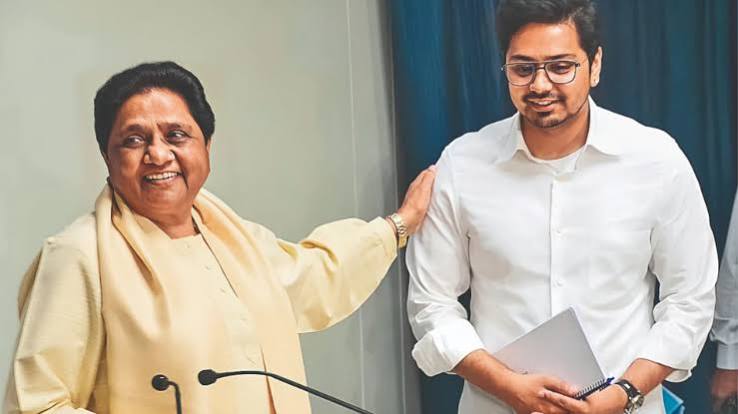
BSP sources claim Mayawati was upset Akash Anand had departed so drastically from her own measured, tame speeches. Mayawati’s repeated sidelining of Akash Anand, reliance on Satish Mishra and outreach to Brahmin, Thakur and Jat leaders reveal deep churn in the BSP and Dalit politics in UP ahead of 2027. Ajoy Bose asks: Can this confused strategy revive her party or speed up its decline? The Bahujan Samaj Party (BSP) supremo Mayawati publicly humiliating her nephew and political heir Akash Anand for the third successive year is a new low even for her erratic eccentricity. Coming as it does just a few months before the crucial Assembly polls in Uttar Pradesh, it is the latest blow to a party desperately struggling to survive in what was considered a decade ago as her political bastion. Anand, 30, had been inducted nearly three years ago by Behenji as her successor, ostensibly to rejuvenate the rapidly declining BSP, abandoned by a growing number of young Dalits in recent years. But she herself has shattered his credibility by forcing him on a bizarre rollercoaster ride, propelling him up and down in rapid succession. The young BSP leader’s fluctuating fortunes have seen him being anointed as her political successor in December 2023, abruptly sacked from his post in the middle of the 2024 Parliamentary poll campaign for harshly criticising the Bharatiya Janata Party (BJP) as “terrorist” and “Taliban”, his power reinstated soon after the elections, thrown out again a year later for anti-party activities along with his father-in-law and veteran BSP leader Ashok Sidharth, reinstalled after an abject apology but now once again stripped of his post for being “politically immature”. A Jibe at BJP Costs Anand His Job Insiders in the BSP revealed that the latest blunder by Anand that cost him his job, was a rousing speech at Jewar in Greater Noida late August that savagely indicted both the BJP state and Central government. Flagging off the 2027 election campaign, announcing the name of the local BSP candidate, the young Dalit leader, much like his aunt in her early activist days, used both rhetorical flourish and sarcastic wit to expose the many unfulfilled promises by the ruling party. Although he also criticised the Congress and the Samajwadi Party, the bulk of the speech was a frontal assault on the BJP which was repeatedly cheered by the sizeable crowd. Sources close to the BSP indicated that Mayawati was upset that nephew and successor had departed so drastically from her own measured and tame speeches. She is also believed to have been influenced by her chief adviser, confidante and lawyer Satish Mishra, who is known to be close to the BJP, that it was unwise for such a senior party leader to upset the state administration at such a sensitive period before the elections. Significantly, Satish Mishra already hugely influential has become even more powerful in recent weeks after the recent expulsion of the other important BSP Brahmin leader Anant Kumar Mishra for anti-party activities. Mayawati last month announced that the lawyer-turned-politician would be assigned more responsibilities in view of the coming elections and would be responsible for dealing with the Election Commission as well as his other responsibilities in managing legal and media matters. A veteran Dalit activist who was earlier close to the BSP supremo lamented, “Behenji has grown increasingly dependent on her lawyer’s advice and nobody else in the party really matters”. There is also talk of a revival of the Dalit-Brahmin alliance supposedly forged by Satish Mishra that swept the BSP to an incredible victory nearly two decades ago. Yet, there appears to be no sign of any surge of fresh support for Mayawati among Brahmins who abandoned her long ago as has other caste groups across the board, along with Muslims ,who now feel that under Satish Mishra’s influence the BSP has become a B-team for the BJP. Interestingly, while Akash Anand was missing from both the party meetings held by Mayawati to discuss Uttar Pradesh and national affairs, the new face that was prominent in the front rows was Prince Yukesh Singh, the son of the late BSP leader Uma Shankar Singh, a Thakur businessman from Ballia in eastern Uttar Pradesh. The recently deceased leader, a wealthy construction magnate who faced corruption charges that were later withdrawn with the help of the Uttar Pradesh government, had won three successive Assembly elections from Rasra constituency. BSP insiders said that Prince Yukesh, who has inherited his father’s business, was being groomed to take over his political mantle. There is also some consternation among Mayawati’s dwindling Dalit supporters about her surprising pursuit for electoral support from communities like Brahmin, Thakurs, and Jats who have traditionally been hostile to them. They were surprised at Mayawati’s open support to Jat leader Jayant Chaudhary in the latter’s recent verbal battle with Samajwadi Party leader Akhilesh Yadav. Indeed, considering the long battle between Dalits and Jats in western Uttar Pradesh, it is baffling how the most important Dalit leader has come out in defence of “the dignity of the Jat community”. This confused strategy by Mayawati not prioritising her goals of getting back her core Jatav base along with other Dalits before thinking of a grander all-caste alliance may cost her in the coming elections. Although the alternative Dalit leader Chandrasekhar Azad does not have either the professional cadre or Mayawati’s vast financial resources, he does have considerable personal charisma and a motivated volunteer force. While this may not be enough to win Azad’s party many seats, unless he comes to a deal or at least an understanding with the INDIA bloc, he is likely to draw away even more of the BSP base which dropped in the last Parliamentary polls to just nine percent. Mayawati could have arrested further decline and even improved her miserable performance in the last Assembly election of just a single seat, had she allowed Akash Anand to at least put up a serious fight as an Opposition party to
Dalit Consciousness and the Crisis of Democracy
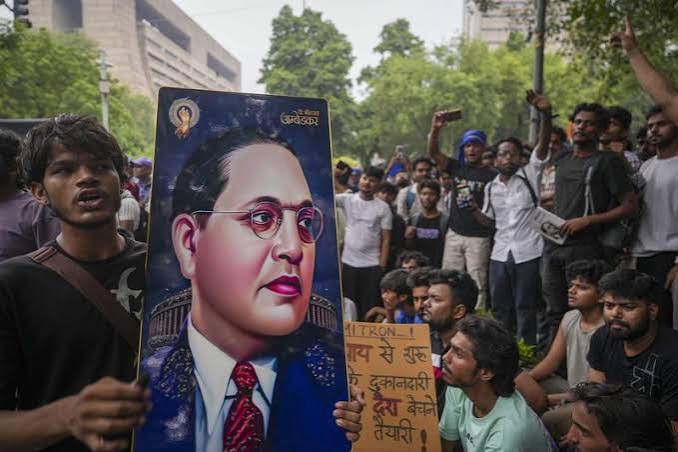
Elections, however regular, cannot sustain democracy if social hierarchies continue to deny dignity and equal opportunity to large sections of society. A Cockroach Janata Party (CJP) supporter holds a portrait of Dr Bhim Rao Ambedkar, as supporters gather during a protest march, at the Jantar Mantar, in New Delhi on July 20, 2026. Photo: PTI/Karma Bhutia. Since the Constitution came into existence, India has experienced a persistent crisis of democracy, irrespective of the political parties in power. One of the deepest structural causes of this crisis is the caste system, historically rooted in the Hindu social milieu, which continues to shape social relations and access to power. Dr. B.R. Ambedkar’s effort to bring justice, liberty, equality and fraternity into the constitution is diametrically opposite to the caste system. The Constitution is an excellent document that could function as a hand book for an elite society. Unfortunately, Hindu India was not prepared to accept the logistics of democracy and undo the inequality built into the caste system. Shudras and Dalits were prohibited from acquiring land, wealth, and education as per Hindu shastras. Therefore, the Constitution did not matter much to their lives. The fundamental rights surely gave rights to the oppressed. Article 14 guarantees equality before law. Article 15 prohibits discrimination on grounds of religion, race, caste, sex, or place of birth. Article 16 ensures equality of opportunity in matters of public employment. These rights, read together with the preamble and the directive principles of state policy, provide a vision of a society free from exploitation and upholding the dignity of every human being. Democracy beyond elections India is frequently celebrated as the world’s largest democracy. Since Independence, it has sustained universal adult franchise, periodic elections, peaceful transfers of power within a constitutional framework. These achievements are no less important in a nation marked by immense linguistic, religious and cultural diversity. Yet, democracy cannot be reduced to elections. Electoral competition is only one dimension of democratic life. Democracy becomes meaningful only when citizens enjoy equal opportunities to participate in public life and influence collective decisions. The distinction between procedural democracy and substantive democracy is therefore crucial. Procedural democracy ensures the right to vote; substantive democracy ensures that every citizen possesses equal dignity, equal opportunity, and equal access to justice. The crisis of Indian democracy emerges precisely from the widening gap between these two ideals. Ambedkar and the democratic revolution India became a republic on January 26, 1950. The written Constitution was adapted and at the implementation level, all the coveted posts were occupied by the privileged caste people. Ambedkar had expressed deep apprehension that political independence, without social transformation, could leave entrenched caste hierarchies substantially intact. Periyar E. V. Ramaswamy said that ‘After India was freed from British rule power was transferred into the hands of Brahmins’. Ambedkar’s campaign for the annihilation of caste did not achieve its intended result. It was his biggest disappointment. By that time, the Shudras, who were in the majority, had acquired some lands and properties and also indulged in some small-scale trading. The Vysyas, being less in number, had parted with their customs to dis-burden themselves. There were agitations and movements by members of the Shudra community in some pockets of the country. But the Dalits, the so-called untouchables, were left in the lurch. Their status quo remained as such intact. Brahmins and members of the dominant caste held power, both at the union and state levels, across the key institutions – the legislature, executive, judiciary and the media. The educational exclusion of Dalits and many other historically disadvantaged communities severely restricted their access to positions of power. The Constitution was limited only to procedural conduct of elections. The rest, like selection of candidates, voting pattern, allocating ministerial berths, all depended on the wishes of the dominant caste and continues to be the case till this day. The most important democratic achievement of the Constitution, in my view, was universal adult franchise – the principle of one person, one vote and one value – to which Ambedkar was deeply committed despite the opposition by many including the unassailable Gandhi. The vote gave Dalits a measure of political identity even when social equality remained absent. Speaking before the Constituent Assembly on November 25, 1949, Ambedkar warned that India was entering a life of contradictions. While there is political equality there is deep social and economic inequality. This contradiction, he argued, would eventually endanger democracy itself unless social democracy accompanied political democracy. Ambedkar recognised caste as the greatest obstacle to democratic citizenship. A society divided into graded inequalities cannot cultivate fraternity, and without fraternity, equality remains fragile and liberty becomes the privilege of the few. The Constitution therefore sought not merely to establish representative institutions but to initiate a social revolution against inherited hierarchies. The crisis of democracy in contemporary India The present democratic crisis in India manifests itself in multiple ways. Democracy has increasingly been equated with electoral victories. Governments derive legitimacy through elections, yet democratic legitimacy also depends upon constitutional morality, institutional autonomy, judicial independence, media freedom, and protection of civil liberties. Elections alone cannot guarantee democratic governance. This aspect needs to be looked into seriously. Especially the post-2014 government that has little respect for democratic norms. Firstly, the composition of the members in the selection committee to appoint the election commission was changed in 2023. The Chief Justice of India (CJI) was removed from the committee which selects the Chief Election Commissioner (CEC) and other members of the Election Commission (EC), thereby denying the participation of the judiciary in the democratic process raising concerns about the independence of the EC. Second, the ownership and editorial independence of sections of the mainstream media have increasingly become subjects of concern, particularly because of their perceived proximity to political and corporate interests. A section of the mainstream media has increasingly been criticised for functioning less as an independent watchdog and more as a supporter of the political establishment. The increasing concentration of media ownership and the
‘Formulate climate policy for marginalised’
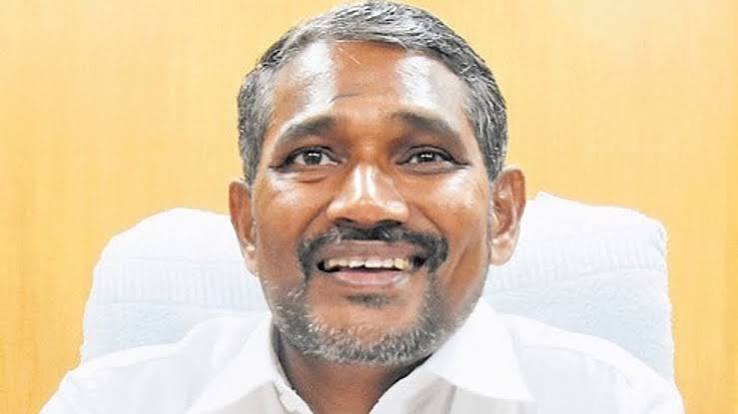
They also highlighted the role of sanitation workers, many of whom belong to Dalit communities, in restoring public spaces after disasters, while lacking adequate occupational safety. CHENNAI: Citing that Dalit and Adivasi settlements in several coastal districts of Tamil Nadu are facing disproportionate risks from floods, cyclones and extreme heat due to poor infrastructure and their location in low-lying areas, activists have sought a dedicated climate-justice policy for the marginalised communities. Following a consultation with activists from across the state, NGOs working in related fields recently submitted a charter of 16 demands to Social Justice Minister Vanni Arasu in this regard. In the charter, Comprehensive Society for Community Development Organisation (COSCO), in collaboration with National Dalit Watch of the National Campaign on Dalit Human Rights, said caste-based spatial segregation had pushed several SC and ST habitations into environmentally fragile areas. The organisations identified vulnerable settlements across Chennai, Cuddalore, Nagapattinam, Pudukkottai, Kancheepuram, Tirunelveli and Kanniyakumari, where they said inadequate drainage, drinking water, sanitation and healthcare infrastructure increased the impact of disasters and worsened inequalities. They also highlighted the role of sanitation workers, many of whom belong to Dalit communities, in restoring public spaces after disasters, while lacking adequate occupational safety. Among their short- and long-term demands is a state-supported programme to train youth in vulnerable coastal settlements in swimming, flood rescue and evacuation. Courtesy : TNIE Note: This news is originally published on https:/thenewindianexpress.com/bha and is used purely for non-profit/non-commercial purposes, especially human rights