
One arrested for murder of transgender person in Mirzapur

Varanasi: Mirzapur police on Friday arrested a man in connection with the murder of a transgender person whose body was found near a railway track at Usarhawa village under Padari police station limits in Mirzapur district. Arshalan, a resident of Ghosia in Bhadohi district’s Aurai area, lodged a complaint at Padari police station on Thursday, alleging that Sattar Khan alias Haseena was murdered and the body dumped near the railway track. Based on the complaint, police registered a case and launched an investigation. During the probe, teams from Padari police, the Special Operations Group (SOG) and the surveillance cell collected electronic and physical evidence and arrested the accused, identified as Sonu Vishwakarma, 25, of Chak Jeevrani in Bhadohi, on Friday. Police also seized the autorickshaw allegedly used in the crime. Padari SHO Pradeep Kumar Singh said during interrogation, the accused confessed to the crime. According to police, Vishwakarma said he was tired of living with Haseena and wanted to end the relationship, but the victim was not allowing him to do so and was allegedly blackmailing him. Police said the accused told investigators that he called Haseena to Ramnagar, served alcohol, assaulted the victim while intoxicated and then strangled her to death. He allegedly transported the body in the autorickshaw and dumped it near the railway track in a secluded area under Padari police station limits. To mislead investigators, the accused allegedly placed a heavy stone on the victim’s neck before fleeing, police said. Courtesy : TOI Note: This news is originally published on https:/timesofindia.com/bha and is used purely for non-profit/non-commercial purposes, especially human rights
Bharathiar University plans separate hostel for transgender students

COIMBATORE: Bharathiar University is planning to establish a separate hostel for transgender students to address accommodation challenges they face. A proposal for this initiative is expected to be presented before the syndicate for approval. Currently, some transgender students pursuing postgraduate programmes in the university have reported difficulties in finding accommodation in private hostels or houses. A transwoman was initially denied admission to the university but was later accepted following public outcry. However, she faced further difficulties in securing accommodation nearby and ultimately had to rent a house in Vellalore, which is more than 25 km away from the university. As a result, her daily commute takes more than two hours. To address these pressing issues, it was suggested that the university consider providing accommodation on campus. According to sources, the university is planning to establish a dedicated hostel with more than 20 rooms for transgender students. University registrar R Rajavel stated that this initiative could serve as a model for fostering an inclusive environment in higher education institutions, inspiring other universities and colleges to follow Bharathiar University’s lead. He said, “A transwoman from the commerce department has raised this concern. We plan to place before the syndicate a proposal to establish a dedicated hostel transgender students. Once it is approved, we will send it to the state govt.” Courtesy : TOI Note: This news is originally published on https:/timesofindia.com/bha and is used purely for non-profit/non-commercial purposes, especially human rights
‘Do I need a character certificate?’: Wangchuk hits back at critics, rejects ‘deal’ with Centre charge
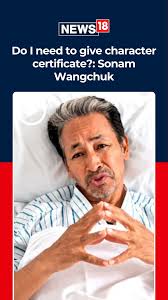
Wangchuk said he ended his hunger strike only after securing a written assurance as he feared an imminent crackdown on protesters in Delhi, recalling the 2025 firing on youths in Ladakh. Sonam Wangchuk has hit out at his detractors who questioned his decision to end his 26-day hunger strike, asking why he needed a “character certificate” to prove his commitment to the students’ movement. Wangchuk said he ended his hunger strike only after securing a written assurance as he feared an imminent crackdown on protesters in Delhi, recalling the 2025 firing on youths in Ladakh, and wanted to prevent any violence against students. The students, led by the Cockroach Janta Party (CJP), are protesting at Jantar Mantar and elsewhere against the NEET paper leak. Their key demands include the resignation of Education Minister Dharmendra Pradhan in connection with the controversy. In a video message shared on X, Wangchuk dismissed allegations that he had struck a deal with the government, saying, “Do I need to prove my sincerity after a 26-day hunger strike? “AFTER 26 DAYS OF HUNGER, DO I NEED TO PROVE MY SINCERITY!!! Do please watch and help spread the word. Find the full 22-minute video on my YouTube channel: Sonam Wangchuk,” he tweeted. Wangchuk said he agreed to end his indefinite fast only after the Centre gave a written assurance that no legal action would be taken against peaceful protesters. He explained that he did not demand the resignation of Education Minister Dharmendra Pradhan during negotiations because his priority was to prevent any legal actions against protesters. He also rejected allegations that he had compromised with the government. “Last night around midnight, I was told the ministers had agreed to give the assurance in writing. I was in a hurry because the situation in Delhi was such; there was apprehension that a major crackdown could happen. “I was watching reports and was reminded of September 24, 2025, when police and CRPF personnel mercilessly fired at the youth of Ladakh. I was afraid something similar could happen here. I felt that if I ended my fast and appealed for peace, perhaps the situation could be diffused,” he said. Responding to criticism over ending his fast in the presence of Union ministers, Wangchuk said those questioning his decision were unaware of the circumstances he faced after being shifted from the protest site. “If I had to make a deal, would I have remained hungry for 26 days? Could I not have struck a deal sitting in an air-conditioned room instead of fasting in Delhi’s heat?” he asked. He alleged that after being taken to Safdarjung Hospital on July 18, he was treated “like a prisoner”, claiming he was denied free movement, prevented from meeting visitors and not allowed to keep a mobile phone or laptop. “It was like being in North Korea,” he said, adding that even after the Delhi High Court allowed him to shift to Medanta Hospital, he was allegedly prevented from leaving Safdarjung Hospital for several hours. Wangchuk said his foremost concern throughout the negotiations wit the Union ministers was to ensure that students participating in the agitation did not face violence or legal action. He said this was also why he did not insist on Pradhan’s resignation during the talks, expressing confidence that the demand would eventually be realised through the movement. “My focus was that students should not suffer. My main concern was legal action and FIRs. I did not think it was necessary for me personally to secure the minister’s resignation,” he said. According to Wangchuk, Union ministers J P Nadda and Jitendra Singh met him at Medanta Hospital and agreed to positively consider compensation for families of students who died by suicide following the alleged NEET paper leak, besides holding a discussion in Parliament on accountability and reforms in the examination system. However, he said the ministers were initially unwilling to provide a written assurance that no cases would be filed against peaceful protesters. “They initially agreed to compensation and discussion in Parliament but were not ready to assure that no cases would be filed against protesting students. They offered only a verbal assurance. I insisted on a written assurance and did not relent until they agreed,” he said. Wangchuk also said he had hoped to end his fast in the presence of MPs, members of the Cockroach Janta Party and representatives from Ladakh, but claimed many of them were not allowed to meet him before the ministers arrived late at night. “The biggest sorrow in my heart is that my colleagues, the students and the MPs who had come to support me could not be present when I ended my fast,” he said. Wangchuk ended his hunger strike shortly after midnight on Thursday after the Centre gave a written assurance that it was positive about not registering cases against peaceful protesters, would hold a detailed discussion in Parliament on examination reforms and paper leaks, and was positively considering compensation for families of students who died by suicide following the alleged NEET paper leak. He had been on an indefinite fast since June 28 after joining the Cockroach Janta Party-led agitation demanding accountability over alleged irregularities in competitive examinations, reforms in the education system and the resignation of Union Education Minister Dharmendra Pradhan. Courtesy : TNIE Note: This news is originally published on https:/thenewindianexpress.com/bha and is used purely for non-profit/non-commercial purposes, especially human rights
Main accused in Maharashtra TET paper leak arrested from Bihar

Earlier, the SIT arrested Suman Kumari Gupta, wife of the alleged mastermind Bijendra Gupta, from Patna after call records and financial transactions reportedly linked her to him. Nearly a month after the Maharashtra Teacher Eligibility Test (TET) 2026 was postponed over a question paper leak, police have arrested the alleged mastermind, Bijendra Gupta, who was living under a false identity in Bihar. Gupta, who was arrested by Bhiwandi Police from Bihar, was brought to Pune Airport, from where he will be taken to Bhiwandi, ANI reported. Gupta allegedly has been linked to multiple paper leak cases. He has allegedly been involved in leaks related to the 2023 Odisha Staff Selection Commission (OSSC) examination, the Bihar Public Service Commission (BPSC) examination and the Madhya Pradesh Public Service Commission (MPPSC) examination. Gupta’s arrest comes after Maharashtra Police earlier arrested three other accused — Kapil Dahiya, Mithun Singh and Sonu Singh, from Bihar and Punjab, in connection with the case. The TET 2026 examination was postponed on June 27, a day before it was scheduled to be conducted, after police in Maharashtra’s Thane district detected that a portion of the question paper had been leaked and arrested three persons. Investigators have since found that the alleged racket extended across Delhi, Agra, Bihar and Haryana. Earlier, the SIT arrested Suman Kumari Gupta, wife of the alleged mastermind Bijendra Gupta, from Patna after call records and financial transactions reportedly linked her to him. Initial probe found that the confidential question papers were allegedly sourced directly from Mahim Patran Pvt. Ltd, a private printing press located in Agra, Uttar Pradesh. The TET paper leak came close on the heels of the national controversy triggered by the NEET-UG paper leak, raising fresh concerns over the integrity of competitive Courtesy : TNIE Note: This news is originally published on https:/thenewindianexpress.com/bha and is used purely for non-profit/non-commercial purposes, especially human rights
Up to 10-year jail & Rs 10 crore fine: Cabinet clears tougher anti-paper leak bill
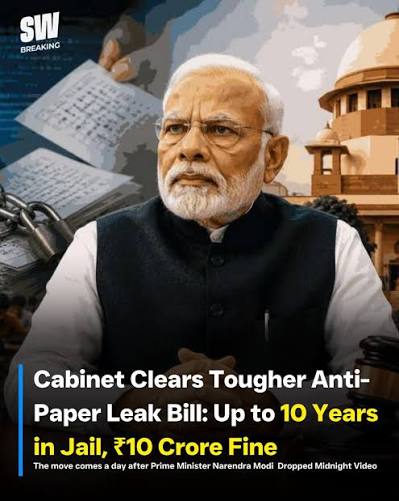
NEW DELHI: The Union cabinet on Friday approved amendments to the Prevention of Paper Leak law, proposing tougher penalties for those involved in examination paper leaks. According to sources, the proposed legislation provides for a maximum jail term of 10 years and a fine of up to Rs 10 crore. It also seeks to increase the minimum imprisonment for individuals convicted in paper leak cases from the current three years to five years. The move comes amid nationwide protests over alleged irregularities in the NEET examination and growing demands for stricter safeguards to protect the integrity of competitive exams. Government to introduce Bill in Parliament soon Parliamentary affairs minister Kiren Rijiju said the government would soon introduce the legislation in Parliament, adding that the PM Modi had directed that there should be no delay in bringing the Bill. “We are preparing to present the bill, but after you receive the briefing on our cabinet decision, we will inform you about our timing. The Prime Minister has said that there should be no delay in the bill we are bringing regarding students. The country also wants what the Prime Minister has said, so it would not be right to resort to any tactics to obstruct it… Congress will fall into this if they continue to disrupt the parliamentary proceedings. We are taking important steps for the future of the students. If the Congress party continues to create all kinds of hurdles to prevent parliamentary discussion, then they will have to face the brunt of the youth of this nation and, in fact, the entire nation,” Rijiju said. Rijiju criticises Opposition over Parliament disruptions Rijiju accused the Opposition of preventing a discussion on the NEET paper leak issue in Parliament, saying the government had repeatedly sought a debate. “For 5 days, we were unable to discuss the NEET paper leak. So, we appealed today as well. Our minister will brief us on the important cabinet decision. Rahul Gandhi was in the House today, so we asked that the debate begin immediately. Now, the Congress party has shown that it’s not interested in debate. Those who were protesting, and Sonam Wangchuk, the most prominent figure among the protesters, also broke his hunger strike and said that the discussion should take place now. I don’t think there’s any benefit in politicising this. We should focus on how to take concrete steps and the future of the students,” he said. The minister appealed to the Opposition to allow Parliament to function, saying the focus should remain on strengthening the examination system. “The future of the students and how we can ensure a proper and very strong system in place for the future of the students; this has to be our priority. By disrupting the parliamentary procedures and the House, it will not yield any result. I would like to request once again of Rahul Gandhi and all the opposition members that better sense should prevail. You cannot indefinitely create trouble in the Parliament to prevent discussion. It is wasting the time of all of the members… It is very critical to let the Parliament function, and when all matters are to be discussed. Taking to the demands of all the members: Why the Congress Party and some of their allies are disturbing the parliamentary proceedings. I do not understand. It would be nice if they could make any demands. But they can make it during their intervention,” Rijiju said. Cabinet decision comes amid talks with protesting students The Cabinet’s decision comes a day after Union ministers held talks with representatives of the Cockroach Janata Party (CJP), which has been leading protests over the NEET paper leak controversy. Following the meeting, CJP leaders said the government had sought time till Saturday afternoon to decide on their demand for Education Minister Dharmendra Pradhan’s resignation. They also claimed the Centre had given in-principle approval to two other demands, including compensation for the families of NEET aspirants who died by suicide and withdrawal of FIRs and legal cases against protesting students. The government initiated the dialogue after social activist Sonam Wangchuk ended his 26-day hunger strike following written assurances from the Centre on reforms to the competitive examination system. Ahead of the Cabinet meeting, Prime Minister Narendra Modi had announced that the government would consider a draft Bill providing for fast-track courts and stricter punishment for paper leak offenders, saying, “More strict actions against paper leaks to come in tomorrow’s Cabinet!” Courtesy : TOI Note: This news is originally published on https:/timesofindia.com/bha and is used purely for non-profit/non-commercial purposes, especially human rights
“Stop the Metro, shut down the Internet… but they couldn’t stop the paper leaks”; Rahul Gandhi’s scathing attack on PM Modi

Following the closure of 18 Delhi Metro stations, Lok Sabha Leader of the Opposition Rahul Gandhi took a dig at PM Modi. He said, “Stop the Metro, shut down the Internet. But PM Modi couldn’t stop the paper leaks.” New Delhi: Students have been protesting at Delhi’s Jantar Mantar for several days over alleged irregularities in the NEET entrance exam. Meanwhile, the government has imposed several restrictions in the capital, including the closure of 18 Delhi Metro stations. Now, Lok Sabha Leader of the Opposition and Congress MP Rahul Gandhi has taken a dig at Modi. “Stop the Metro, shut down the roads, shut down the shops, shut down the Internet, and stop eating,” he said, taking a dig at PM Modi. “Stop the Metro, shut down the roads, shut down the shops, shut down the Internet, and stop eating,” he said. Brutal action against students demanding their rights On Saturday, in a post on the social media platform X, Rahul Gandhi said, “Shut down the metro, block roads, close shops. The government has taken these brutal measures against students demanding their rights.” Rahul raised the pellet gun issue Earlier on Friday, Rahul Gandhi launched a scathing attack on the central government in support of students protesting against the paper leak issue. Rahul Gandhi said, “This young man was hit with a pellet gun while he was peacefully protesting with the Indian tricolor in his hands. The government says that pellet guns were not used during the protest, but the truth is in front of everyone.” He claimed that a student’s eye was seriously injured and he lost his vision in the pellet gun attack. Rahul Gandhi said, “I cannot even say with certainty whether this young man’s eyesight will be saved.” Allegations of firing pellet guns against students The Congress leader alleged that pellet guns were fired and they were beaten with sticks against thousands of young people protesting against the paper leak. He said that the students were only protesting peacefully over issues related to their future and the education system. Demand for Dharmendra Pradhan’s Resignation Rahul Gandhi launched a direct attack on Union Education Minister Dharmendra Pradhan, saying, “Dharmendra Pradhan is a criminal Education Minister. He should be removed from his post. He symbolizes the decline of the country’s education system. He is responsible for the thousands of people on the streets today.” He alleged that the Modi government has attacked the country’s future, while the students are making only three demands. According to Rahul Gandhi, the protesting students’ main demands are: Union Education Minister Dharmendra Pradhan should resign. Strict action should be taken against those who allegedly brutalized the students. Prime Minister Narendra Modi should apologize to the students and the country. Rahul Gandhi appealed to the central government to stop intimidating and assaulting students and to seriously consider and fulfill their demands. Curated by: Abhishek Pandey About the Author Abhishek Pandey is a digital journalist at Navbharat Times. He joined Navbharat Times, the digital wing of the Times of India Group, in July 2025. He currently covers news for the National and Delhi desks. He has four years of experience in journalism, both as a reporter and on the desk. Courtesy: Hindi News
Accused arrested for raping a minor Dalit girl in Muzaffarnagar

Muzaffarnagar (UP): A 21-year-old man has been arrested for raping a six-year-old Dalit girl in the Meerapur police station area of Muzaffarnagar district, a police official said. Station in-charge Rajiv Kumar said on Saturday that the incident occurred on Friday when the girl was playing outside her home. Based on a complaint from the victim’s mother, police have registered a case against the accused, Arjun Sharma, under relevant sections of the Indian Penal Code (IPC), the Protection of Children from Sexual Offences (POCSO) Act, and the Scheduled Castes and Scheduled Tribes (Prevention of Atrocities) Act. According to the complaint, the accused neighbor lured the girl to his home and sexually assaulted her, causing injuries. Police said the victim has been sent for a medical examination and the accused has been arrested. Courtesy: Hindi News
‘Cockroaches Don’t Die’: How a Dalit Student Built India’s Most Disruptive Gen Z Political Movement

When India’s Chief Justice called unemployed youth “cockroaches,” Abhijeet Dipke turned the insult into a movement. Two months later, the 30-year-old Boston University graduate leads what may be the most significant street protests against Narendra Modi since he came to power in 2014. Revolt of the Roaches: How India’s Most Significant Student Uprising in a Generation Came to Be On May 16, 2026, a 30-year-old political communications strategist sitting in Chicago typed six words on X — or something close to that number — in a moment of frustration, and posted them into the void of Indian social media. The frustration had a specific origin. One day earlier, on May 15, India’s Chief Justice Surya Kant had made remarks during a court hearing that were widely reported as comparing unemployed Indian youth to “cockroaches” and “parasites of society.” The Chief Justice later said his comments had been misconstrued by the media. But the damage — or, depending on your perspective, the spark — had already been struck. Abhijeet Dipke, the man who typed those six words, was not the kind of person the Indian establishment had learned to fear. He was a Dalit from Aurangabad — a city in Maharashtra that has since been officially renamed Chhatrapati Sambhajinagar — the son of a man who grew up in extreme poverty and whose own father was just a farmer. He had a journalism degree from Pune and a master’s degree in public relations from Boston University. He had worked for three years on the Aam Aadmi Party’s social media and election campaign team before moving to the United States to study. He did not hold elected office, command organizational resources, or control a media platform. What he had was a phone, a social media account, and a clarity of purpose that the moment seemed to demand. GeographicReference He announced the founding of the Cockroach Janta Party — CJP, a deliberate echo of Modi’s Bharatiya Janata Party’s initials — on May 16, 2026, as a satirical response to the Chief Justice’s remarks. The name was the point: if the powerful called India’s unemployed young people cockroaches, then cockroaches they would be. The party’s slogan — “Voice of the Lazy and Unemployed” — was both self-deprecating and precise. Its founding document described itself as “a political front for the youth, by the youth, for the youth.” What happened next surprised even Dipke. Lakhs of people registered on the party’s website within days. On Instagram, the CJP account accumulated nearly 22 million followers — more than twice the follower count of the BJP’s own Instagram presence, as NPR reported. The satirical party had, in the space of weeks, become something more than satire. The Dalit From Aurangabad: A Biography Written in Caste To understand what Abhijeet Dipke represents — and why the movement he has built carries the specific charge that it does — you have to understand where he comes from. He was born on September 29, 1995, in Aurangabad, Maharashtra, into a Dalit family, as Reuters documented in a detailed profile published July 23, 2026. His family originally traces its ancestral roots to the rural village of Santuk Pimpri in the Hingoli district, before relocating to the MIDC Waluj area of the city following his father’s employment with the Maharashtra Industrial Development Corporation, as BiographyKind’s documented account noted. “My father comes from a very humble background. He grew up in extreme poverty. My grandfather was just a farmer,” Dipke told Reuters in a phone interview from Chicago in May. The family’s trajectory — from subsistence farming in rural Hingoli to an industrial township in Aurangabad to, eventually, a Boston University graduate school — is precisely the kind of upward mobility that post-independence India promised and that, Dipke argues, has become increasingly difficult to achieve. GeographicReference His Dalit identity has not been incidental to his politics. When he arrived in Delhi on June 6, 2026, to lead his first in-person protest, he held aloft a copy of “My Autobiography” by B.R. Ambedkar — the Dalit jurist, economist, and social reformer who drafted India’s Constitution and who remains the defining hero of Dalit political consciousness in modern India, as Reuters documented. The gesture was not accidental. Ambedkar’s life — born into caste oppression, educated abroad, returned to India to demand constitutional rights for the most marginalized — maps onto Dipke’s own trajectory in ways he has made explicit. The Ambedkar connection carries an additional resonance specific to the current moment. Aurangabad sits in the shadow of the Maratha empire’s history and of Ambedkar’s own Maharashtrian roots. Dipke’s city is Ambedkar’s country. And when the Chief Justice of India called unemployed youth cockroaches, a Dalit man from that city was among those who heard the insult most clearly. His caste identity also made him a target as soon as he went public. The Print documented that Dipke faced casteist attacks on social media after he revealed he was Dalit — a pattern that his supporters recognized as consistent with the treatment of Dalit activists and commentators across Indian public life. When a woman threw blue ink at him as he was addressing supporters, smearing his face — in a protest gesture, later explained as an accusation that the CJP had insulted Lord Ram — Dipke posted a video of the incident with the caption “The blue is my color,” as Reuters documented. The reference was unmistakable: blue is the color closely associated with the Ambedkarite movement. GeographicReference Boston, the AAP, and the Making of a Political Strategist Dipke’s route from Aurangabad to the barricades at Jantar Mantar runs through Pune, Boston, and a three-year stint with one of India’s most media-savvy political parties. He completed his undergraduate degree in journalism in Pune before moving to the United States for graduate school. At Boston University — one of the country’s leading communications and public affairs programs — he earned a Master of Science in Public Relations. That academic background, as the Young India biographical account
Barnala Incident Reflects Bhagwant Mann Government’s Anti-Dalit Mindset; Arrest the Accused Immediately: Paramjit Singh Kainth

CHANDIGARH: Paramjit Singh Kainth, Vice President of the BJP Scheduled Caste Morcha, Punjab, strongly condemned the incident involving sanitation workers in Barnala, stating that it reflects the deteriorating law and order situation in Punjab and the Bhagwant Mann government’s alleged insensitivity towards the Dalit community. He alleged that the police action against protesting sanitation workers was carried out under political pressure, which is contrary to democratic rights and the principles of social justice. Kainth said that the National Commission for Safai Karamcharis taking suo motu cognizance of the matter and seeking a report from the Punjab Government is a clear indication of the state’s failure to protect the rights and dignity of sanitation workers. He demanded the immediate arrest of all those responsible, a fair and impartial investigation, and adequate security, appropriate compensation, and legal assistance for the affected sanitation workers. He warned that if the government fails to take prompt action, the BJP Scheduled Caste Morcha will launch a statewide democratic and constitutional agitation across Punjab in support of justice for the affected sanitation workers. Courtesy : Punjab News Express Note: This news is originally published on https:/punjabnewsexpress.com/bha and is used purely for non-profit/non-commercial purposes, especially human rights
Two M.P. Police constables arrested for raping minor dalit girl in Bhopal

According to the police, the incident took place on July 22 and that the minor survivor lodged a complaint on July 23, based on which a case was registered Two Madhya Pradesh Police personnel have been arrested for allegedly raping a minor Dalit girl after abducting her in Bhopal, police said on Friday (July 24, 2026). According to the police, the incident took place on July 22 and that the minor survivor lodged a complaint in Bhopal’s Jahangirabad police station on July 23, based on which a case was registered. Bhopal Additional Commissioner of Police (law and order) Shailendra Singh Chauhan told The Hindu that the accused have been identified as constables Santosh Sen and Jitendra Singh, and that the duo have been arrested. “The complainant approached Jahangirabad Police Station and reported that two individuals, who are basically police constables, called the minor girl and took her in a car somewhere where one of them raped her,” Mr. Chauhan said. Case registered The officer said that a case under relevant provisions, including the Protection of Children from Sexual Offences (POCSO) Act, the Scheduled Castes and the Scheduled Tribes (Prevention of Atrocities) Act, and BNS Sections like 137(2), has been registered, and investigation has been taken up. Mr. Chauhan said that a medical examination was conducted on the survivor. Another officer from Jahangirabad said that the accused had called the girl and lured her on the pretext of taking her to someone’s birthday. “They then took her to a secluded location where Santosh Sen raped her. After this they left the girl at a square in the city,” the officer said, requesting anonymity. The officer said that the girl is currently at her home and her health condition is fine. Mehul Malpani Courtesy : The Hindu Note: This news is originally published on https:/thehindu.com/bha and is used purely for non-profit/non-commercial purposes, especially human rights