
Revanth invites Congress brass for Global Summit
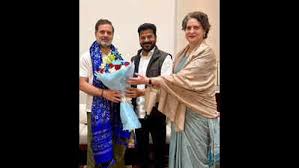
Hyderabad: Chief minister A Revanth Reddy, along with deputy chief minister Bhatti Vikramarka, on Wednesday invited the Congress top leadership, including Sonia Gandhi, Mallikarjun Kharge, Rahul Gandhi and Priyanka Gandhi, to the Telangana Rising Global Summit scheduled to be held at Bharat Future City on Dec 8 and 9. Revanth and Bhatti travelled to New Delhi on Tuesday night, met the AICC president, and extended the formal invitation to him. On Wednesday, the chief minister also invited Prime Minister Narendra Modi, defence minister Rajnath Singh, Union minister Manoharlal Khattar and other AICC leaders. Revanth briefed the Congress leaders on the aims and objectives of the Telangana Rising Vision document and the two-day summit. Congress MPs from Telangana have been tasked with inviting other Union ministers, while Revanth’s cabinet colleagues will extend invitations to chief ministers of various states. Courtesy : TOI Note: This news is originally published on https:/limesofindia.com/bha and is used purely for non-profit/non-commercial purposes, especially human rights
Betrayal of Bahujans, Government has no… Rahul Gandhi launches scathing attack on the government over delay in caste census
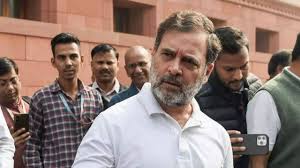
Rahul Gandhi accused the Modi government in the Lok Sabha of having no concrete plan for the caste census. He said this is a betrayal of the Bahujans. The government stated that the census will be conducted in two phases and the population count will be completed in February 2027. New Delhi: Citing the government’s response to his written question, Congress leader Rahul Gandhi claimed that the Modi government has no concrete framework or plan for the caste census. He also said this is a blatant betrayal of the country’s Bahujans. Former Congress President Rahul Gandhi posted on X, “I asked the government a question about the caste census in Parliament. Their response is shocking. No concrete framework, no time-bound plan, no discussion in Parliament, and no dialogue with the public.” He claimed, “There is no desire to learn from the strategies of successful caste censuses conducted by other states. This caste census by the Modi government is a blatant betrayal of the country’s Bahujans.” Rahul Gandhi had asked a written question in the Lok Sabha on Wednesday, “What are the details and likely timelines of the key procedural steps for preparing for the decennial census, including preparation of questions and scheduling? Does the government propose to publish draft census questions and seek input from the public or public representatives on these questions? Is the government considering past experiences, including caste surveys conducted in different states, and if so, what are the details?” What does the government say? In response, Minister of State for Home Affairs Nityanath Rai stated that the census would be conducted in two phases. He stated that the first phase would include house listing and housing enumeration, followed by the second phase of population enumeration. The minister had said, “The population census will be conducted in February 2027, with the reference date being midnight of March 1, 2027, except in the Union Territory of Ladakh, and the Union Territories of Jammu and Kashmir, and the snow-covered remote areas of Himachal Pradesh and Uttarakhand, where the census will be conducted in September 2026, with the reference date being midnight of October 1, 2026.” Rai had said, “The census has a history of over 150 years. Experiences gained from previous censuses are taken into account for the next census. Suggestions are also sought from relevant stakeholders before each census.” Edited by: Ashok Upadhyay About the Author Ashok Upadhyay is a Senior Digital Content Producer at Navbharat Times Online. He has 10 years of experience in journalism. He began his journalism career with Navbharat Times Hindi newspaper in 2014. He specializes in reporting on politics, sports, and the crime beat. He has also worked on the Central Desk at Amar Ujala Dehradun. Courtesy: Hindi News
Defamation case: Pune court directs Rahul Gandhi’s lawyer not to comment on unchallenged summons
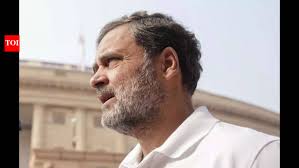
Pune: A magisterial court in the city on Tuesday directed Rahul Gandhi’s lawyer not to comment on unchallenged summons in an ongoing hearing of a defamation case filed by Satyaki Savarkar, the grandnephew of Swatantryaveer Vinayak Damodar Savarkar, against the Congress MP. The case relates to Gandhi’s alleged defamatory remarks against Savarkar during a speech in London. Satyaki filed an application before the court, raising an exception to a couple of paragraphs in a plea filed by Gandhi’s counsel on an earlier occasion. He submitted that the paragraphs were “serious in nature and mudslinging on the conduct of the complainant” and “cast some doubt on the functioning of the impartial judiciary system”. In his order on Tuesday, Judicial magistrate first class Amol Shriram Shinde noted, “The accused has raised some doubts on the functioning of the Court in para Nos. 11 and 13 of Exh. 117. Accused stated in para No. 11 that, complainant managed to secure the order of issuance of summons against the accused… In para No.13 accused further stated that, complainant succeeded in obtaining the summoning order through over reach rather than through lawful proof.” He said, “This court finds that if accused has any grievances against the issuance of summons order then he should challenge it before the appropriate court. But, he cannot make any comment on the order which he did not challenge. Either he has to accept the order or he has to challenge the order before the appropriate court.” In another order, the court also rejected an application filed by Gandhi’s counsel, Milind Pawar, seeking prevention of any further adjournments. The complainant intends to lead further evidence in the matter. “He must be given an opportunity to lead his evidence. A fair trial should be there. Therefore, this court finds that a short adjournment can be granted to the complainant,” the court said while posting the matter for next hearing on Dec 5. Courtesy : TOI Note: This news is originally published on https:/limesofindia.com/bha and is used purely for non-profit/non-commercial purposes, especially human rights
Dalit Women And Gender Justice: The Lasting Impact Of Periyar In Tamil Nadu
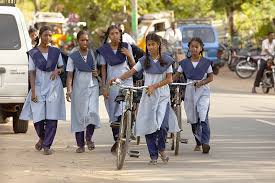
Today, Periyar’s legacy continues to influence Tamil Nadu’s social landscape, driving higher female enrollment in education, empowering first-generation learners, and shaping the voices of Dalit women leaders in movements for social justice. Understanding Periyar’s impact is essential for anyone exploring the intersections of caste, gender, and education in contemporary Tamil society. When N. Aathirai first realised something was wrong in her home in Tiruchirappalli, she did not yet know the word “patriarchy”. She was only a child, but the imbalance was clear. “I just saw the difference in how men and women were treated,” says the 25-year-old psychologist. Years later, living with her in-laws, she understood it more sharply while watching her mother, a history graduate who became a housewife, repeatedly dismissed in her own home. “So much of it came from women having no autonomy,” she says. Her first real attempt to make sense of it came in college, when she picked up Pen Yen Adimai Aan? The title alone startled her, pushing her to confront questions she had only sensed growing up. After graduation, she worked with Pa. Ranjith’s Neelam Social, where conversations on caste and Periyar deepened her thinking. His emphasis on self-respect resonated the most. “Women are taught to value ourselves only in relation to men, how we adjust, how we behave,” she says. “Reading Periyar helped me understand why we were treated the way we were.” Lawyer Mathivadhani, now 29, arrived at these ideas from the opposite direction, through immersion rather than discovery. “My father was a Dravida Kazhakam state spokesperson, so I grew up in the Dravidian movement from the age of three,” she says. Her father handed her Pen Yen Adimai Aanen? at fourteen, insisting she would understand the meaning as she grew older. When he died the next year, the family refused orthodox rituals and honoured him according to Dravidar Kazhagam customs. “That taught me to stand by my principles.” Many of Periyar’s century-old positions now feel embedded in everyday life. Inter-caste marriage is more accepted, dowry is publicly challenged, and women’s education has expanded dramatically. Tamil Nadu’s high female school enrolment and the rise of first-generation women learners reflect Periyar’s insistence that educating a woman transforms society. According to the School Education Department, 74 per cent of Class 12 students enrolled in colleges in the 2023–24 academic year, an increase driven by the Pudhumai Penn scheme for girls and the Tamil Pudhalvan scheme for boys introduced in 2024. Over five academic years from 2017–18 to 2021–22, Tamil Nadu consistently maintained the highest Gross Enrollment Ratio (GER) in higher education, reaching 47 per cent, compared with the all-India average of 28.4 per cent. Mathivadhani shares the example of A. Rajeshwari, a student at the Government Tribal Residential Higher Secondary School in Karumandurai. She cleared the JEE (Advanced) 2025, securing a place at one of the Indian Institutes of Technology (IITs), becoming the first person from her tribal village to do so. “Where else do you hear of such examples?” Mathivadhani asks. She credits Periyar’s ideology and his insistence on educating women for paving the way. Scholar V. Geetha argues that understanding Periyar requires returning to the late 1920s, when the Madras Presidency was alive with debates on women’s rights—from the Devadasi Abolition Bill to raising the age of consent, and the uproar over Katherine Mayo’s Mother India. Periyar entered this turbulent landscape and pushed each debate further. On the Devadasi question, he amplified anti-Brahminical criticism but went further, attacking the very ideal of chastity. By elevating chastity as the defining marker of womanhood, he argued, society bound women to unhappy marriages and curtailed their emotional and sexual autonomy. Former Devadasis, some defending their artistic traditions, others condemning the system, were central to the debate. Periyar’s description of chastity as “a form of slavery” provoked argument for years. His rejection of early marriage emerged from the same concern for autonomy. Witnesses in the Madras Presidency demanded higher marriage ages than elsewhere in India, and Periyar pressed further: marriage, he insisted, must be a choice, not a woman’s destiny. By the 1940s, he was urging women to postpone marriage entirely and enter public life. Here he differed even from Phule and Ambedkar, seeing patriarchy not only as an extension of caste and property but as embedded in intimate relationships. He was equally blunt about compulsory motherhood, dismissing childbirth as a sacred duty. After visiting the Soviet Union in 1931, he praised communal kitchens and childcare centres as models for a more equal family structure. These ideas reshaped how women in the Self-Respect Movement saw themselves. Activist Neelavati famously declared women “the oldest working class”, highlighting the labour performed at home, in factories, fields, and along coasts. Yet translating these ideals into daily life was challenging. Inter-caste couples had little legal protection and relied on movement support. Still, it was through these struggles, Geetha notes, that Periyar’s ideas were tested, interpreted, and expanded by women such as Neelavati and Annapurni. Education was central to this transformation. R. Ovia, founder of the cultural organisation Puthiya Kural, explains Periyar’s approach on two levels: immediate access to schooling, and a deeper liberation from the mindset shaped by religious structures, particularly Hindu traditions. “Education should root women in rationalism and self-respect,” she says. She also emphasises that Periyar’s ideas are dynamic. “They always allow space for growth.” Ovia highlights another critical dimension: it is mostly Dalit men and women who have owned, defended, and expanded Periyar’s ideas, translating them from text to practice. Leaders like Annai Meenambal Sivaraj and Annai Sathyavani Muthu brought Dalit voices into Periyarist movements, nurturing women as leaders. Today, Dalit women are prominent in the Dravidar Kazhagam and other Periyarist platforms. “Only when Dalit women—and equally Dalit men—consider Periyar’s movement as their own can they build a truly effective, rights-based platform,” she says. She stresses that Periyar’s ideas are inseparable. “Women’s liberation, caste abolition, atheism—they are all linked. You cannot pick one part and ignore the rest. To approach Periyar as a women’s liberationist
Eye on polls, Assam Cong leaders meet Kharge, Rahul to discuss strategies

Guwahati: The Assam Congress leadership, headed by PCC president Gaurav Gogoi, met AICC chief Mallikarjun Kharge and LoP Rahul Gandhi in New Delhi on Tuesday, focusing on strategies for the 2026 assembly election and mobilisation. Gogoi said the AICC promised full support to make Assam “BJP Mukt”. “From organisational matters to key issues concerning the Assamese society, Kharge Ji listened to Assam PCC leaders,” he said. With an eight-party opposition alliance already formed for the state election, other opposition parties are now finalising their joint strategy to challenge the BJP and its allies. This meeting was held at a crucial time before the political affairs committee meeting of Assam PCC, expected in mid-December, where the focus will likely be on finalising seat-sharing arrangements with other opposition parties. The eight-party alliance, including Left and regional parties in Assam, is facing challenges with candidates from different parties vying for the same seats. “The deliberation centred on a comprehensive review of the party’s organisational preparedness in Assam and the formulation of a robust electoral strategy for the upcoming polls. The AICC leadership offered detailed guidance and strategic directives to strengthen the party’s outreach, coordination, and election-time mobilisation,” said Bedabrata Bora for Assam PCC. The meeting in New Delhi on Tuesday with the top leadership of the AICC was chaired by Kharge and also attended by AICC general secretary (organisation) KC Venugopal, and AICC general secretary in-charge of Assam Jitendra Singh. From Assam, the delegation was led by Gaurav Gogoi and included Leader of the Opposition in the Assam Assembly Debabrata Saikia, former APCC President Bhupen Bora, MPs Rakibul Hussain and Pradyut Bordoloi, former MP Ripun Bora, Working Presidents Zakir Hussain Sikdar, Rozelina Tirkey, and Pradip Sarkar. Courtesy : TOI Note: This news is originally published on https:/limesofindia.com/bha and is used purely for non-profit/non-commercial purposes, especially human rights
‘Distractions’: Priyanka Gandhi Vadra slams Rajnath’s ‘Nehru-Babri’ remark; how Rahul responded
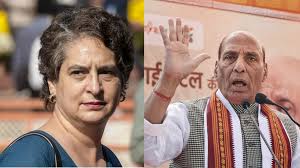
NEW DELHI: Congress MP Priyanka Gandhi Vadra on Wednesday dismissed defence minister Rajnath Singh’s “Nehru–Babri Masjid” remark as a “distraction” from the issues that matter. “These are all distractions. There are many real issues that need discussion. They create a new distraction every day so that we are unable to talk about the people’s concerns,” she told reporters outside Parliament. Her brother, and Lok Sabha Leader of the Opposition, Rahul Gandhi, declined to comment, saying reporters were “wasting their time” by asking him for a reaction. The siblings are great-grandchildren of Jawaharlal Nehru, the country’s first prime minister. Addressing the ‘Sardar Sabha’ in Vadodara, Gujarat, on Tuesday, Rajnath Singh alleged that Jawaharlal Nehru wanted to use government funds to build the Babri Masjid. He added that it was then-home minister Sardar Vallabhbhai Patel who opposed the plan, and described Patel as “truly secular.” “Sardar Vallabhbhai Patel was truly secular. He never believed in appeasement. When Jawaharlal Nehru spoke about spending government funds on the Babri Masjid issue, it was Patel, a son of Gujarat, who opposed it. He did not allow the Babri Masjid to be built with government money,” the senior BJP leader remarked. He added, “Nehru raised the question of reconstructing the Somnath Temple. Patel clarified that the Somnath case was different: the public had donated Rs 30 lakh, a trust had been formed, and not a single rupee of government money was used,” referring to the temple’s reconstruction in Veraval, Gujarat. Singh’s remarks came ahead of December 6, marking the 33rd anniversary of the demolition of the Babri Masjid in Ayodhya, Uttar Pradesh. In November 2019, a Constitution bench of the Supreme Court delivered a unanimous verdict paving the way for the construction of Lord’s Ram temple in the city. The temple was inaugurated on January 22, 2024. Courtesy : TOI Note: This news is originally published on https:/limesofindia.com/bha and is used purely for non-profit/non-commercial purposes, especially human rights
‘He couldn’t walk’, Bengaluru Dalit woman says police torture killed son

The Vivek Nagar Police took Darshan into custody after he was involved in an altercation with his neighbours in Sonnenahalli on 12 November. Synopsis: On 26 November, the mother was informed that Darshan had died at the Nelamangala government hospital. The rehab centre authorities admitted him to the hospital after he had complained of difficulty in breathing. The Criminal Investigation Department of the Karnataka police are investigating a case of alleged custodial torture that led to the death of a 22-year-old Dalit man. The death came just under a month after three police personnel attached to the Varthur Police Station in eastern Bengaluru were suspended for assaulting a domestic worker and her husband in a theft case. The Vivek Nagar Police took the man, Darshan, into custody after he was involved in an altercation with his neighbours in Sonnenahalli on 12 November. Darshan’s mother, Adilakshmi, alleged that the police did not allow her to visit him despite repeated requests. Three days later, the police admitted him to the Unity Rehabilitation Centre at Adakamaranahalli, after reportedly taking ₹2,500 from his mother. Adilakshmi said the police ignored her offer to admit him to the rehab centre. Darshan was reportedly an alcohol addict. The mother said Darshan was assaulted in police custody. “My son was tortured and beaten in custody and later admitted to the rehab. Due to the torture, my son was unable to walk. Police forced me to pay ₹2,500 for his admission to the rehab,” Adilakshmi told reporters on Friday, 28 November. She accused Assistant Sub-Inspector Pawan and two other policemen of assaulting her son inside the station. On 26 November, the mother was informed that Darshan had died at the Nelamangala government hospital. The rehab centre authorities admitted him to the hospital after he had complained of difficulty in breathing, she was told. Police said no case was registered against Darshan. However, they added that the man had gotten into a fight with the personnel at the station. Bengaluru District Superintendent of Police CK Baba said that based on preliminary findings, the Madanayakanahalli police registered an FIR under BNS 103(1) (murder), BNS 127(3), and Section 3(2)(v) of the SC/ST (Prevention of Atrocities) Act. The FIR named a police inspector and three policemen attached to the Viveknagar police station, and the rehab centre owners. The case has now been transferred to the Criminal Investigation Department (CID) for further investigation. “Was told he was recovering” Adilakshmi’s said two officers assaulted Darshan while detaining him outside their residence on 12 November. After he was taken into custody, she repeatedly requested the police to let her see him. On 15 November, the Viveknagar police arranged for his admission to a rehabilitation centre in Adakamaranahalli and reportedly demanded ₹2,500 from her, even though she had insisted that she could take him to a rehab centre herself. When she went to the police station to hand over the money, she again requested to meet her son. She was allowed to see him only from a distance. “He was shaking. His hands and legs were trembling. He could not even walk. He begged me to take him out of there,” Adilakshmi said in her complaint. For several days after his admission to the rehab centre, she repeatedly called the facility to check on her son. Each time, she was told that Darshan was recovering. However, on 26 November, the family received a call informing them that Darshan had died due to breathing problems. When Adilakshmi and her relatives rushed to the rehab centre, they were told that his body had been shifted to the Nelamangala government hospital. “When we saw him, there were injuries on his chest. Both his hands were swollen and his back was bruised. His feet were swollen too,” she stated in her complaint. Naveen, the supervisor of the rehab centre, told the media that the Viveknagar police called them to admit Darshan . “At the time of admission, there were injury marks on him, and we have taken photographs of them. After he complained of breathing difficulties, he was first taken to a nearby private hospital and from there to the government hospital,” he claimed. The People’s Union for Civil Liberties and Association of Prisoners’ Families for Justice, met the inspector of Viveknagar police station on Sunday, 30 November, and enquired details regarding the custodial death. They filed an RTI application seeking CCTV footages from the station. Anisha Reddy (Edited by Majnu Babu). Courtesy : TSP Note: This news is originally published on https:/thesouthpost.com/bha and is used purely for non-profit/non-commercial purposes, especially human rights
Horniman photographic exhibition highlights Indian transgender culture

A new photographic exhibition at the Horniman Museum and Gardens in south London spotlights Indian transgender culture, through images captured by Zoya Thomas Lobo, India’s first transgender photojournalist. The series of 27 photographs in Meeting Mohini: Koovagam through the lens of Zoya Thomas Lobo follows the ancient Hindu festival celebrating the marriage of Hindu goddess Mohini – the feminine avatar of Vishnu* – to Aravan. In the Tamil month of Chithirai, falling between April and May, thousands of transgender women, non-binary and gender non-conforming people gather in the small village of Koovagam to reenact Aravan’s story. Having agreed to sacrifice himself for the greater good, Aravan asked the god Krishna (an avatar of Vishnu) to be married, even if only for a night. Krishna, god of compassion, protection and love, became the goddess Mohini to fulfil Aravan’s wish. Images in the exhibition follow transgender women, non-binary and gender non-conforming people – who have long played a central role in the final two days of the festival – capturing the excitement and joy of the wedding day as well as the sadness and pain of funeral ceremony. The exhibition also focuses on life outside the festival, centring Zoya Thomas Lobo’s own experiences in Mumbai. Meeting Mohini shines a light on not only on the rich history and traditions of one of the oldest recognised transgender and LGBTQI+ communities in the world but also on the barriers and challenges that they face and overcome daily. It is Zoya Thomas Lobo’s first solo exhibition and first exhibition outside India. Navjot Mangat, Senior Curator of Social Practice at the Horniman Museum and Gardens, says: ‘The Horniman is for everyone, yet this is the first time we have focused an exhibition on – and worked directly with – the trans community in this way. We’re incredibly thankful to our collaborators and consultants, and for Zoya’s talent and openness in undertaking this commission for us and creating this exhibition.’ Zoya Thomas Lobo says: ‘Koovagam is a very important festival for trans people and I’m very excited to be using my camera to share our stories, traditions, culture and history. I’m very happy to be sharing my story and my work at the Horniman Museum.’ The Horniman will add the photographs from Meeting Mohini: Koovagam through the lens of Zoya Thomas Lobo – and 175 others taken by her as part of this commission – to its permanent collection, to increase representation of LGTBQI+ communities, and to complement existing Indian and Hindu collections. Meeting Mohini: Koovagam through the lens of Zoya Thomas Lobo opens at the Horniman on 6 December 2025 and is free to visit. Courtesy : London Post Note: This news is originally published on https:/londonpost.com/bha and is used purely for non-profit/non-commercial purposes, especially human rights
Hyd Metro integrates transgender personnel into frontline security

The Hyderabad Metro Rail has inducted 20 transgenders into its security services and after undergoing training, they have started working from Monday. They will be used for baggage scanner, overall station security and other purposes. The Hyderabad Metro Rail, one of India’s largest and most advanced urban transit systems, operates across three corridors with 57 stations, facilitating the daily commute of nearly five lakh passengers. Women constitute approximately 30 per cent of these commuters, and ensuring their safety, comfort, and confidence remains a foremost priority of the Hyderabad Metro Rail system. The HMR authorities said that in line with the Government of Telangana’s commitment to inclusivity, dignity, and equal opportunity, special emphasis has been placed on deploying transgender personnel across various public service sectors. To further enhance the safety and comfort of women passengers and to continuously strengthen the existing safety ecosystem, Hyderabad Metro Rail is adopting proactive, capacity-building measures across its network. These initiatives aim to reassure women commuters, improve their travel experience, and ensure a secure and supportive environment throughout the Metro Rail system, said a HMR official. After successfully completing their Induction Security Training, these trained personnel began performing duties from Monday at selected Metro stations and inside Metro trains. This initiative not only enhances security but also reflects the government’s broader resolve to empower marginalised communities through meaningful employment and social inclusion. The engagement of transgender personnel marks a significant milestone in Hyderabad Metro Rail’s mission to create a safe, inclusive, and commuter-friendly environment. Their presence will strengthen frontline passenger services and reinforce the safety framework, especially for women commuters The key responsibilities of the newly inducted personnel include women commuter Safety- supporting and enhancing safety measures in general areas and in ladies-only coaches. Passenger Guidance and Support -Assisting passengers with directions, information, and on-ground facilitation, and baggage scanner assistance- monitoring baggage scanner operations to ensure smooth and secure passenger movement. Street-level and concourse security involve maintaining a visible, approachable, and reassuring presence across station premises. This role contributes to overall station security by helping ensure a safe, orderly, and welcoming environment at assigned Metro stations. Courtesy : THI Note: This news is originally published on https:/thehansindia.com/bha and is used purely for non-profit/non-commercial purposes, especially human rights
‘You Belong To Filthy Caste’: Parents Allege English Teacher Of Using Casteist Slurs Against Dalit Students In AP
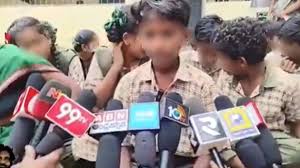
An English teacher at Yandapalli High School in Kakinada district, Andhra Pradesh, is accused of using casteist slurs against Dalit students. Parents and students protested after Headmaster Suresh Bhushan reportedly failed to act on initial complaints. The accused, Srinubabu, allegedly used derogatory language, leading to public outcry. Kakinada: A shocking and disturbing incident has come to light from Andhra Pradesh’s Kakinada district. Parents and students have accused the English teacher at Yandapalli High School of using casteist slurs and derogatory language against students from the Dalit community, reported NDTV. “You belong to a filthy caste… Do you think SCs are some kind of special people?” parents said, quoting the children. The protest took place in front of the high school in U Kottapalli Mandal. The accused teacher has been identified as Srinubabu. Reportedly, he has been consistently humiliating and harassing students from the Dalit community. No Response From Headmaster The affected students and parents had first lodged a complaint with headmaster Bhushan regarding Srinubabu’s behaviour. However, the lack of a proper response from the administration led the affected parties to escalate the matter, culminating in a protest against the alleged institutional indifference and harassment. Courtesy : TFPJ Note: This news is originally published on https:/thefreepressjournal.com/bha and is used purely for non-profit/non-commercial purposes, especially human rights