
Patwari demands dismissal of three ministers before budget session
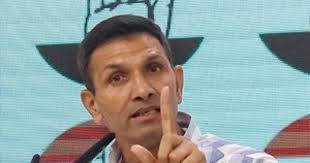
Bhopal: State Congress president Jitu Patwari on Thursday shot a letter to chief minister Mohan Yadav, demanding the dismissal of three ministers from the cabinet before the governor’s address in the state assembly scheduled for Monday. Patwari demanded the removal of minister for tribal welfare Vijay Shah for his offensive statements against lady army officer Colonel Sofiya Qureshi, deputy chief minister Rajendra Shukla for the cough syrup tragedy which allegedly claimed the lives of 23 children, and Kailash Vijayvargiya for the water contamination deaths in Indore. “Madhya Pradesh is a democratically governed state, where every unit of governance is expected to adhere to democratic values, ethics, and constitutional norms. It is unfortunate that the actions of your govt appear to be contrary to public sentiment, fostering anarchy, arrogance, and authoritarian tendencies,” Patwari’s letter to the CM said. It further added that the state’s budget session begins on Feb 16, with the governor’s address scheduled for that day. “It is well known that this address will present more statistics than reality, while the state is grappling with a severe economic crisis and a mounting debt burden, to which your govt appears to be turning a blind eye,” the letter argued. “In this context, a serious and public-spirited issue needs to be brought to your attention. Ministers whose presence in the cabinet is now demanding answers regarding their usefulness,” Patwari’s letter claimed. “Serious allegations of insulting the nation’s daughters and the Indian Army: Vijay Shah; dozens of innocent children died due to poisonous syrup in Chhindwara: health minister Rajendra Shukla; and a minister who failed to provide clean drinking water to the people of his constituency: urban administration minister Kailash Vijayvargiya,” the letter said. Patwari contended that it is extremely unfortunate and shameful that, despite the insult to the army, the deaths of innocent people, and administrative failures, such ministers remain in office. This raises serious questions about the govt’s morality, sensitivity, and accountability, the letter said. Patwari then demanded, “This time is also a test of your moral commitment, responsibility, and leadership abilities. You are expected to respect public sentiment by dismissing these ministers from the cabinet before the governor’s address in the budget session. Otherwise, it will send a clear message that your govt tacitly supports lies, immorality, and the insult to the nation’s daughters and the Indian Army.” While Patwari sent his letter, LOP Umang Singhar called a meeting with the CLP (Congress Legislative Party) on Monday evening to strategise on how to attack the BJP govt on the same three issues. It is expected that the budget session might be noisy, with the Congress preparing to tear into the Mohan Yadav govt on the issues of Bhagirathpura water contamination, Chhindwara cough syrup deaths of children, and Vijay Shah’s prosecution sanction still on hold. Courtesy : TOI Note: This news is originally published on https:/timesofindia.com/bha and is used purely for non-profit/non-commercial purposes, especially human rights
Was a Dalit wedding procession stopped in Etah, or did the wedding party misbehave with another community’s function? A scuffle ensued.
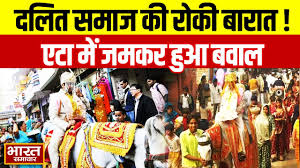
Etah Dalit Wedding: A wedding ceremony in Uttar Pradesh’s Etah district turned into a wrestling match when two groups clashed over dancing to the DJ music. The incident took place in Peepal Tola, Sakiat, where an altercation between the wedding procession and the Tilak ceremony escalated into a violent altercation. Etah News: A wedding ceremony in Uttar Pradesh’s Etah district turned into a wrestling match when the dancing steps of the wedding procession interfered with each other. The incident occurred in the Peepal Tola neighborhood, where the wedding procession was proceeding on one side and the Tilak ceremony was underway on the other. What ensued? A verbal battle broke out over dance steps, leading to the use of sticks and rods. The situation became so severe that the groom had to seek police protection before the wedding rituals. A ruckus over dancing to a DJ The incident began in the Sakiat police station area, where a Tilak ceremony was taking place at a Shakya community home, and people were enjoying the DJ. Meanwhile, a Dalit wedding procession was passing by. Some young men in the procession began dancing to the DJ. However, the hosts were not happy with the uninvited guests’ dancing. An argument ensued, followed by a scuffle, and the situation quickly escalated into free-style wrestling. Dispute between two communities and the Dalit angle As the night progressed, the dispute escalated. The bride’s sister-in-law directly alleged that the miscreants not only stopped the wedding procession but also assaulted them on caste lines. The other side argued that the dispute was about the DJ and indecency. However, it is being exaggerated by creating an angle of Dalit oppression. Meanwhile, a video of the altercation is going viral on social media, showing the wedding guests and the hosts assaulting each other. Police arrived at the scene as soon as the incident was reported. Given the situation, the police took charge and completed the wedding rituals in their presence. Finally, the groom was able to bid farewell to his bride, albeit under police protection. Etah police are proceeding cautiously in this matter. After an initial investigation, the police stated that “the allegations of stopping the wedding procession or targeting the Dalit community do not appear to be true at first glance. The matter stems from a dispute over dancing on a DJ. However, the viral video and complaints from both parties are being seriously investigated.” Courtesy: Hindi News
Uproar over temple entry: Priest snatches offerings from woman’s hand and throws them on the road; you’ll be shocked to know the reason.

At the Hanuman Temple located at Amroha Gate in Moradabad, a priest prevented a Dalit woman from praying. Priest Sachin Sharma insulted the woman with casteist slurs… Read more Jagran correspondent, Moradabad. A Dalit woman who had come to worship at the Hanuman Temple located at Amroha Gate in the Kotwali area was not allowed to enter by the priest. When the woman attempted to worship, he insulted her with casteist slurs. The priest also threw away the offerings she had brought. Police have filed an FIR against the priest based on a complaint. The incident is three months old. Sushma, a resident of Buddhi Vihar in Majhola, stated in her complaint to the Kotwali police that she frequently visits the Hanuman Temple located near Amroha Gate. On December 9, 2025, at around 7 pm, she went to the temple to pray. The temple priest, Sachin Sharma, a resident of Dewan Bazaar, Nawabpura Road, Nagphani, refused to perform the puja after seeing the woman. The woman nevertheless attempted to enter the temple. The priest became enraged and snatched the prasad from her hand and threw it away. He began using casteist slurs in public. Hearing the commotion, people gathered nearby. They also tried to reason with the priest, but he refused to listen. The priest publicly insulted her using casteist slurs and threatened to kill her if she returned to the temple. Passersby present at the scene also protested. Inspector-in-Charge Rajesh stated that an FIR has been registered against priest Sachin Sharma based on the complaint. The incident is old. CCTV footage will not be available, but the entire matter is being investigated. Further action will be taken after the investigation. BY SACHIN CHOUDHARYEDITED BY: ANSHUL BHARTARIYA Courtesy: Hindi News
Villagers skip meeting to resolve anganwadi boycott over dalit cook
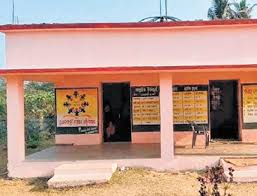
Nuagaon residents refuse to attend meet; only 2 villagers, sarpanch, ward member turn up. KENDRAPARA: The Kendrapara administration’s efforts to convince villagers of Nuagaon under Rajnagar block to end the boycott of the local anganwadi over appointment of a dalit cook failed to yield any result on Wednesday. Acting on the directions of collector Raghuram R Iyer, sub-collector Arun Nayak, Rajnagar tehsildar Jisukrishna Das, district welfare officer (DWO) Arabinda Ray and other officials visited Nuagaon under Ghadiamala panchayat to resolve the issue. However, villagers reportedly refused to attend the meeting. “Only the ward member, sarpanch and two villagers were present, making the chances of a breakthrough slim,” said child development project officer of Rajnagar Dipali Mishra. “Villagers did not attend the meeting as they do not consume food cooked by dalits. No one wants to break this age-old custom. If the administration forces our children and women to eat such food, it may lead to unrest. The administration should appoint a cook from the upper caste to resolve the issue,” said a villager on condition of anonymity. Sources said most villagers preferred to remain silent on the issue. Several educated residents and members of the dalit community are also reluctant to speak. Villagers maintained that nothing unusual has occurred, despite children and women staying away from the anganwadi centre for nearly three months. The riverside village of Nuagaon has around 45 families, including seven dalit households. Ghadimala sarpanch Sailendra Mishra said, “We urged the village leaders to send children to the anganwadi centre, but they ignored our appeals.” He added that pregnant women have also stopped visiting the centre, depriving themselves of services such as supplementary nutrition, health check-ups, iron-folic acid supplements, immunisation and health education. Contacted, collector Iyer said, “The sub-collector has been directed to submit a report after visiting the village. Necessary action will be taken once the report is received.” President of the district unit of Dalit Samaj Nagen Jena alleged that the actions of the villagers violate fundamental rights guaranteed under Articles 14, 19 and 21. “Dalits often face discrimination in temples, but here children and women are being kept away from welfare services. We expect the police and administration to take firm steps,” he said. The anganwadi centre at Nuagaon has reportedly not been functioning since 23-year-old Sarmista Sethi was appointed as a helper-cum-cook at the facility on November 24 last year. Soon after her appointment, the village committee allegedly decided to boycott the centre in protest and stopped sending their kids to the facility as Sethi belongs to the dalit community. Even pregnant and lactating women have refused to visit the centre since then. Ashis Senapati Courtesy : TNIE Note: This news is originally published on https:/thenewindianexpress.com/bha and is used purely for non-profit/non-commercial purposes, especially human rights
Transgender Equality: Court Decision on Transgender Rights in India

This report was published by the Centre for Law & Policy Research, Bengaluru, in December 2024. It presents an overview of the legal landscape of transgender rights in India by presenting case summaries of important judgments and their impact. In 2014, the Supreme Court of India in National Legal Services Authority v. Union of India (NALSA) ruled that transgender people have the right to self-determine their gender identity. This was protected under the constitutional guarantee of life, liberty and equality, and the freedom of expression given under Articles 21, 14, and 19 of the Indian Constitution. Following NALSA and the implementation of the Transgender Persons (Protection of Rights) Act, 2019, multiple cases have been presented to courts on issues of everyday challenges and rights violations. The purpose of this report is to provide access to such important judgements to multiple stakeholders advocating for and promoting transgender rights in India. This includes community members, activists, civil society groups, students and researchers, public officials and government, and other lawyers and judges. This 59-page document is divided into 3 sections: Introduction to the Legal Framework (Section 1); Key Definitions (Section 2); and Case Briefs on Transgender Rights (Section 3). Judgement summaries are further structured into 7 sub-sections: The Right to Self-Determination of Gender Identity; Right to Equal Opportunity in Public Employment; Legal Recognition of Change in Name & Gender; Right to Marriage; Family & Relationships; Criminal Law and Transgender Persons; Access to Education for Transgender Persons; and the Right to Social Security. The jurisprudence of transgender rights is largely based on NALSA in 2014, and other court judgments have extended the reach of fundamental rights as laid down in this case. This was followed by the enactment of Transgender Persons (Protection of Rights) Act, 2019 and the Transgender Persons (Protection of Rights) Rules, 2020. In NALSA, the Supreme Court expanded “sex” in Article 15(1) to include both gender and gender identity and prohibited discrimination on the grounds of gender identity and sexual orientation. The Court affirmed that every individual has a constitutional right to determine their gender identity as per Articles 14 and 15(1), and broadened the interpretation of Articles 19(1)(a) and 21 to include a person’s right to express their gender. Under Section 7 of the Transgender Persons Act, 2019, gender recognition is a two-step process: a trans person needs to apply for recognition as ‘transgender’, followed by medical documents that request a change of gender identity. As it mandates a two-step process, failing to acknowledge the Supreme Court’s NALSA ruling, this provision faced strong criticism from the transgender community and activists. The right to privacy was deemed to be constitutionally protected as per the Supreme Court in Retd. Justice K S Puttaswamy v. Union of India (2017). This was further extended in Navtej Johar v. Union of India (2016), where same-sex relations were decriminalised and Section 377 of the Indian Penal Code was held unconstitutional. In Mulla Faizal v. State of Gujarat (1999), the High Court of Gujarat distinguished between intersex and transgender persons and imposed a duty on authorities to facilitate the correction of name and gender in birth certificates. The case of Arunkumar & Others v. The Inspector General of Registration (2019) recognised that transgender individuals have the right to marry based on their self-identified gender, linking this right to Article 21 of the Constitution. However, the Supreme Court later, in Supriyo v. Union of India (2023), ruled that the right to marry is not a fundamental right for transgender persons, though it clarified that transgender people in heterosexual marriages must be acknowledged under current laws. Due to the binary understanding of gender within Indian penal laws, transgender individuals frequently face denial of legal protection. The Transgender Persons (Protection of Rights) Act, 2019, identifies specific offences and criminalises various forms of abuse – including physical, emotional, and sexual violence. Courts have ruled that laws addressing sexual violence and harassment must be applied inclusively and should not exclude transgender persons from their protection. In Ms. X v. State of Uttarakhand (2019), the court recognised the right to self-identify gender based on an individual’s inner identity or ‘psyche,’ even within criminal law. The judgment also affirmed that offences such as rape apply to transwomen. To address existing legal gaps, the Madras High Court in M. Srinivasan v. State upheld the right to self-identification and confirmed that sexual harassment laws extend to all individuals who identify as women. Section 3 of the Transgender Persons Act, 2019, prohibits discrimination against transgender individuals in educational settings, while Section 13 mandates that state-funded or recognised institutions provide inclusive education. However, despite the Supreme Court’s directive in NALSA to classify transgender persons as socially and educationally backward and grant them reservations, such provisions remain largely unimplemented. The Supreme Court in NALSA also instructed the central and state governments to develop social welfare programs aimed at improving the lives of transgender people. Under Section 8 of the Transgender Persons Act, 2019, the government is required to implement these welfare initiatives and ensure transgender persons can access them. Although some states have set up Transgender Welfare Boards, access to welfare schemes has been limited. Many states lack such programs entirely, and the inclusion of transgender individuals in pension schemes for vulnerable groups has often only been achieved through judicial intervention. Focus and Factoids by Prathima Appaji. PARI Library’s health archive project is part of an initiative supported by the Azim Premji University to develop a free-access repository of health-related reports relevant to rural India. Courtesy : PARI (People’s Archive of Rural India) Note: This news is originally published on https:/peoplesarchiveofruralindia.com/bha and is used purely for non-profit/non-commercial purposes, especially human rights
Who was Jesse Strang? 18-year-old named in Canada school shooting that left 10 dead, dozens injured

Canadian authorities are investigating a deadly shooting that killed 10 at Tumbler Ridge Secondary School after reports named 18-year-old Jesse Strang as the suspected gunman.Two Canadian news outlets, Western Standard and Juno News, reported that Strang was also transgender. The outlets said they received the name from a close family member. The Royal Canadian Mounted Police (RCMP) has not officially confirmed the suspect’s identity. The shooting happened on Tuesday at about 1:20 pm local time in Tumbler Ridge, a small town in northeastern British Columbia, about 1,100 kilometers north of Vancouver. Police responded to reports of an active shooter at the school. A public safety alert was sent out telling residents to stay indoors. According to the RCMP, ten people were killed, including the gunman. More than two dozen others were injured. Police said they believe the shooter died from a self-inflicted gunshot wound inside the school. Investigators also found additional victims at a nearby home that they believe is connected to the case. RCMP Superintendent Ken Floyd told reporters that investigators believe they know who the shooter was. However, police are not releasing the name at this time. Floyd said the decision was made out of respect for the victims’ families and to protect the investigation. Police have also said they do not yet know the motive. They are still working to determine how the victims were connected to the suspect. The shelter-in-place order was lifted later that evening after police said there was no longer a threat to the public. Students and staff who remained inside the school were safely evacuated. Tumbler Ridge has a population of about 2,400 people. Authorities said both the elementary and secondary schools will stay closed for the rest of the week. Counseling and support services are being offered to students, staff, and families. Canadian Prime Minister Mark Carney and British Columbia Premier David Eby released statements expressing sorrow and offering condolences to the families of those killed. Courtesy : TOI Note: This news is originally published on https:/timesofindia.com/bha and is used purely for non-profit/non-commercial purposes, especially human rights
Cess and surcharge money spent to benefit states: FM Sitharaman
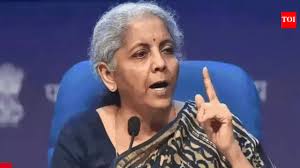
NEW DELHI: Finance minister Nirmala Sitharaman on Wednesday rejected the criticism by states over cesses and surcharges, arguing that it was in line with the Constitutional provisions and the money collected through these levies was spent on schemes that benefited the states. . While responding to the discussion on the Budget in the Lok Sabha, FM said that states should distinguish between the gross tax revenue and the net proceeds that are legally shareable. “States can’t have it both ways. The states should check if the entire net proceeds which form the divisible pool, after removing cess and surcharge from gross tax revenue, is received by them,” she said. The minister said that the Centre was transferring 41% to the states, as was recommended by the Finance Commission. “The 16th Finance Commission analysed the state’s share transferred by the Centre to the states from 2018-19 to 2022-23, and concluded that in each of these years, the devolution made by the Centre exactly matches the recommendation of the Finance Commission. So, we are not the only ones claiming this… There is no scope for any doubt in this for the states,” the minister said. Sitharaman also criticised states such as West Bengal, where Mamata Banerjee’s TMC was in power, arguing that they blamed the Centre for GST, but then imposed additional burden on consumers. “The state govt in West Bengal imposes road levies and charges taxes at the time of new vehicle registration. If there is so much concern about GST burdening citizens, then why impose additional state-level taxes? These could be waived for the people of Bengal, but instead, GST collections are criticised while state taxes continue to be levied,” she said while accusing Abhishek Banerjee of twisting facts on GST. She said govt is incentivising data centres in the country, in what was a rebuttal to Rahul Gandhi’s claims on Indian data. Further, she listed out measures on SEZs, customs reforms and support to MSMEs to counter Rahul’s concerns. “Leader of the Opposition expressed concerns over geopolitics, energy and weaponisation of finance. He said that the Budget acknowledges these challenges, but he didn’t read the Budget and the steps announced in it to address these challenges.” Courtesy :TOI Note: This news is originally published on https:/timesofindia.com/bha and is used purely for non-profit/non-commercial purposes, especially human rights
Revanth meets Kharge, exudes confidence of Cong win in civic polls
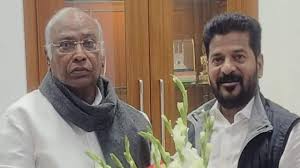
Hyderabad: Chief minister A Revanth Reddy on Wednesday met AICC president Mallikarjun Kharge in Delhi and expressed confidence that the Congress would win the ongoing municipal elections and continue its momentum in the upcoming polls to the Greater Hyderabad Municipal Corporation and two other corporations in the core urban area. Revanth travelled to the national capital to meet top AICC leaders and Union ministers. Sources said the visit had a dual purpose. He had not met Kharge or Rahul Gandhi since his Davos and US tour and had been busy with municipal election campaign work. With a considerable gap since his last interaction, he wanted to brief the leadership on the current political situation in Telangana. A senior AICC leader told TOI that another key objective was to meet Union ministers and seek clarity on approvals and central funding for major state projects. The state govt is preparing to present its annual budget soon, and clarity on central assistance would help factor allocations accordingly. MPs Mallu Ravi and Anil Kumar Yadav accompanied the CM to Kharge’s residence. Revanth will meet Union ministers to seek support on issues including Hyderabad Metro Rail expansion, Musi rejuvenation, devolution of funds, fertilisers, irrigation projects, and disputes with Andhra Pradesh over river waters and railway lines. The CMO has sought appointments with railways minister Ashwini Vaishnaw, fertilisers minister JP Nadda, and power, housing and urban affairs minister Manohar Lal Khattar. He is likely to meet Rahul Gandhi in Parliament on Thursday. Sources said meetings with Sonia Gandhi and Priyanka Gandhi are also possible. A Congress MP said Revanth would brief Rahul on efforts to check the revival of BRS and contain the BJP’s rise, besides outlining plans for the upcoming civic polls. Courtesy : TOI Note: This news is originally published on https:/timesofindia.com/bha and is used purely for non-profit/non-commercial purposes, especially human rights
US chokehold on PM Modi, he has sold India: Rahul Gandhi
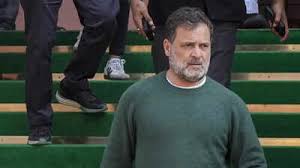
NEW DELHI: Leader of the opposition Rahul Gandhi accused the govt Wednesday of “completely surrendering” India’s core data, food and energy interests in the trade deal, in a sharp attack in Lok Sabha on PM Modi who, he alleged, had caved in to pressure due to the leverage that country has over him. Participating in the discussion on the Budget, Gandhi began his speech with mention of the concept of grip and chokehold players are taught in martial arts to floor rivals and then used the metaphor to target Modi in the US’s handling of him. Gandhi’s condemnation of the interim pact as a sellout of national interest was the theme of his speech. ‘Farmers left to mercy of mechanised US farms’ Rahul said the data of 140 crore Indians is the country’s most valuable asset, while the nation needs to secure its energy and food interests in these turbulent times. The LoP’s controversial references to a convicted child sex offender in the US, two Indian businessmen and Bharat Mata as he sought to corner govt was met with resistance from treasury benches and were expunged from records. He alleged that minister Hardeep Puri had introduced an Indian businessman to the child sex offender, and the files released by the US govt mention their names. The Chair asked him not to level the allegations. Rahul Gandhi’s condemnation of the interim trade pact as a sellout of national interest was the theme of his speech, hitting the BJP-led NDA govt on a plank which it has practically owned since coming to power in 2014. He alleged, “The most valuable asset (data) of India has been handed over. Our farmers have been left to the mercy of mechanised American farms. Our textiles have been wiped out. Our energy security has been handed over. We cannot buy oil from who we want to buy it from. This is a wholesale surrender.” Unlike Modi’s and NSA Doval’s assertion that it is not an era of war, Rahul said the world is in fact “moving into an era of war and instability” amid intensifying geo-political conflicts. Dollar’s supremacy is being challenged and world is moving away from the era of one superpower, he said. While the budget recognises these challenges, including the weaponisation of energy and finance, it offers no future pathways, he said, before turning to the agreement to hit out at govt. He alleged the deal has compromised security in all three critical things needed to run a modern country: data, food supply and energy. Courtesy : TOI Note: This news is originally published on https:/timesofindia.com/bha and is used purely for non-profit/non-commercial purposes, especially human rights
Bharat Bandh: Rahul Gandhi backs workers & farmers; takes ‘grip’ jibe at PM Modi
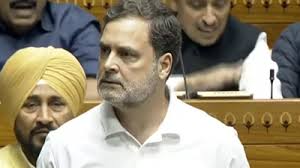
NEW DELHI: Congress leader Rahul Gandhi on Thursday backed nationwide protests by workers and farmers demanding protection of their rights. He flagged concerns over labour reforms, trade policies, and potential changes to the rural jobs programme MGNREGA. “Workers fear that the four labour codes will weaken their rights. Farmers are apprehensive that the trade agreement will harm their livelihoods. And weakening or scrapping MGNREGA could snatch away the last lifeline of villages. When decisions affecting their future were taken, their voices were ignored,” he said through a post on X. “Will Modiji listen now? Or is the “grip” on him too strong? I stand firmly with the workers and farmers on their issues and their struggle,” Rahul added. An all-India general strike called by ten Central Trade Unions (CTUs) and backed by the Samyukta Kisan Morcha (SKM) on Thursday is aimed at opposing a range of government policies, including the four labour codes, privatisation and contractualisation measures, the Electricity Amendment Bill 2025, changes to MGNREGA and the proposed Seed Bill. Large-scale participation from farmers, agricultural workers and industrial unions is expected at protest sites across the country, with power sector employees, PRTC staff and other worker organisations also set to join. In a statement, the SKM said the strike seeks the withdrawal of the four labour codes, the Electricity Bill 2025, the Seed Bill 2025 and the VB-G RAM G Act 2025, among other demands. It also called for the restoration of the old pension scheme and the implementation of minimum wages for all workers, including scheme workers. Communist Party of India (CPI) leader and All India Trade Union Congress (AITUC) working president Binoy Viswam expressed full support for the nationwide farmers’ strike, describing it as a movement to defend people’s basic rights. Apple farmers in Himachal Pradesh have also intensified preparations to join the nationwide farmers’ strike on February 12 and announced a march to Delhi, warning that recent import duty reductions under India-US and other free trade agreements could hurt the state’s apple-based economy. They expressed concern that cheaper imports could impact local growers, despite repeated assurances from union commerce and industry minister Piyush Goyal that the interests of Indian apple farmers will be safeguarded. While several trade unions and farmer organisations have decided to join the strike, the National Front of Indian Trade Unions (NFITU) said it would not participate, describing the protest as “politically motivated.” Courtesy : TOI Note: This news is originally published on https:/timesofindia.com/bha and is used purely for non-profit/non-commercial purposes, especially human rights