
One month in, CM Shivakumar’s government faces cabinet expansion test

Congress will be counting on the new government’s performance for the 2028 polls, but how those left out respond will also be crucial. Earlier this week, Chief Minister DK Shivakumar’s government completed one month in office. Although it is a short period to judge a government’s performance, the change of guard seems to have brought fresh energy to the administration, which looked jaded, especially in the last few months of Siddaramaiah’s tenure. After recovering from the initial shock of the portfolio allocation, with two senior ministers sulking, the CM has managed to keep the spotlight on his government rather than on the political uncertainty in his party. Unlike his predecessor, the CM has avoided open confrontation with the Union government, and has so far refrained from joining his party leaders in the state in aggressively criticising the Rashtriya Swayamsevak Sangh (RSS). However, it is just the beginning, and the Congress government has a long way to go. Maintaining the same tempo and cohesiveness in the government is a Herculean task, especially after the expansion of the cabinet. The government presently functions with just 13 ministers out of a 34-member-capacity cabinet. Of these, only two are new faces, and the rest were part of the previous cabinet. If the Congress leadership decides to give a majority of the remaining berths to new faces, the seniors hoping to return to the cabinet would be aggrieved. However, if most seniors are accommodated again, it would leave new aspirants disappointed. Either way, it’s a tricky situation. Congress will be counting on the new government’s performance for the 2028 polls, but how those left out respond will also be crucial. It would be interesting to see how the party strikes a balance between the loyalists of Shivakumar, Siddaramaiah, and AICC president Mallikarjun Kharge in the cabinet expansion. On the administrative front, key portfolios like agriculture and education do not have full-time ministers, with the portfolios vested with the CM. Several districts in the state are staring at a drought-like situation, and water levels in the reservoirs are low. The government has asked farmers to temporarily avoid cultivating crops relying on dam water. While the CM holds multiple meetings in the state capital, the ministers are hardly seen in action on the ground. If they fail to make amends, the government risks being branded as Bengaluru-centric. That apart, some of the decisions, like the tightening of guarantee schemes and the ambitious plan to develop Bidadi township on the outskirts of Bengaluru, need to be handled deftly. The Bidadi township issue should not be seen merely as a Congress against JDS/BJP issue, but concerns of all farmers must be taken into account, while also keeping in mind plans to develop townships to decongest Bengaluru. However, the state capital’s development cannot come at the cost of farmers, who depend solely on agricultural land for their livelihood. As for the flagship guarantee schemes, it is never a bad idea to fine-tune them. The exercise to weed out ineligible beneficiaries has started. The state government must be prudent with spending and ensure that the schemes benefit the most needy. At the same time, this should not merely become a cost-cutting exercise that amounts to the Congress government going back on its 2023 election promise. The departments handling the revision exercise should be sensitive not just to the letter, but also to the spirit of the government’s direction. Meanwhile, the CM has also announced the formation of guarantee committees with five members in each of the 7,000 panchayats and 4,000 wards. This will be in addition to the existing guarantee committees at state, district and taluk levels. The committees are tasked with the effective implementation of the schemes. On one hand, the government is tightening the schemes to avoid unnecessary expenditure, but at the same time, it is adding thousands of members to guarantee committees. What will their role be in each panchayat or ward when the benefits are directly reaching citizens, and officials are mandated to ensure that? It may be a good move to strengthen the party cadre at the grassroots, but at whose cost? Also, the CM’s announcement of forming 10,000 ‘Bharat Jodo’ youth associations in each panchayat and ward with a grant of Rs 10 lakh has faced flak from the BJP, which terms it as an attempt to put taxpayers’ money into Congress workers’ pockets. Although the government claims that guidelines would be issued for the formation of associations without political interference, it is anybody’s guess as to what extent they will actually be non-political. In the last 30 days in office, the new CM has given ample indication that he is a man in a hurry, unwilling to let go of any opportunity to put his stamp on the administration and consolidate his position within the party. Ramu Patil Courtesy : TNIE Note: This news is originally published on https:/thenewindianexpress.com/bha and is used purely for non-profit/non-commercial purposes, especially human rights
Why Congress Backed Vijay After the Election | Q&A with TNIE | Kaveree Bamzai | Praveen Chakravarty
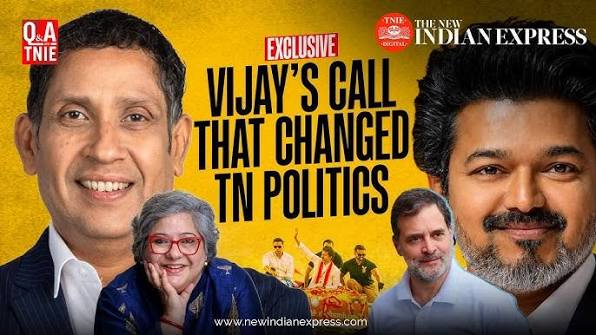
Did the Congress miss an opportunity by not aligning with Vijay before the Tamil Nadu Assembly elections? In this exclusive interview, Rajya Sabha MP Praveen Chakravarty opens up about the data that predicted Vijay’s rise, why Congress eventually decided to support him, and what the party learnt from the Tamil Nadu verdict. He also discusses: Why young voters rejected traditional politics Congress’ internal debates on the Vijay alliance Rahul Gandhi’s role after the election The changing aspirations of Gen Z voters Lessons for the Congress ahead of the 2029 General Election The future of Tamil Nadu politics Watch the full conversation for an in-depth analysis of one of the biggest political shifts in Tamil Nadu. Subscribe to The New Indian Express for more exclusive interviews and political analysis. Courtesy : TNIE Note: This news is originally published on https:/thenewindianexpress.com/bha and is used purely for non-profit/non-commercial purposes, especially human rights
NHRC issues second advisory focused on ten key areas to ensure welfare of transgenders

The National Human Rights Commission (NHRC) has issued a second advisory to Secretaries of 11 Ministries, the Office of the Registrar General and Census Commissioner and the Chief Secretaries of all the states and union territories to ensure the welfare of transgender persons. The Commission noted that encouraging responses have been received from all concerned authorities to its earlier advisory of September 2023 and the constructive engagement reflecting a shared commitment to this cause. Based on NHRC’s continued engagements, including field interactions, stakeholder consultations and reviews of implementation, the Commission has identified a range of persistent and emerging challenges affecting transgender persons. NHRC said that the advisory focuses on ten key areas for action to ensure the welfare of transgender persons. These include integrating gender diversity in national data systems, reviewing laws to ensure gender inclusivity, building an inclusive legal framework, right to property, right to education, healthcare and inclusivity at the workplace. Courtesy : NOA Note: This news is originally published on https:/newsonair.com/bha and is used purely for non-profit/non-commercial purposes, especially human rights
AMMA crisis deepens as Revathy, Padmapriya quit, cite ‘patriarchy and power politics’
WCC members resign from the Malayalam actors’ body, saying their demand for safer workplaces and accountability has gone unheard. KOCHI: The crisis within the Association of Malayalam Movie Artists (AMMA) deepened on Monday with actors Revathy and Padmapriya resigning from their primary membership in the organisation, saying it had increasingly become shaped by “patriarchy and power politics”. In a joint statement released on social media, the two actors said that for nearly a decade, their demand had remained unchanged – safer workplaces, dignity, accountability and equal treatment for every member. “The price of asking, for us, has been silence and distance. From colleagues, from friends, from spaces that once felt like home. Still, we stayed. For hope has a remarkable ability to survive disappointment,” they said. The duo further stated that resignations following the release of the Hema Committee report were “not an act of principle” but “an escape from accountability”. Revathy and Padmapriya are members of the Women in Cinema Collective (WCC), formed in 2017 to push for structural reforms in the Malayalam film industry after the 2017 actor assault case. “AMMA was meant to stand as a collective voice for all actors. But it has become increasingly shaped by patriarchy and power politics, weakening its founding ideals. Walking away for us now is not defeat. It is self-respect,” the statement said, adding that they would continue to work towards a more equitable film industry outside the organisation. Their resignations come at a time when AMMA is facing one of the biggest crises in its history. The executive committee headed by president Shwetha Menon resigned following the association’s annual general body meeting on June 21, where members voted to remove the committee over alleged irregularities and appointed an ad hoc committee headed by actor and MLA Ramesh Pisharody to oversee the organisation until fresh elections. However, Menon later asserted that she continued to be AMMA president and described the ad hoc committee as “illegitimate”. The standoff intensified after Pisharody stepped down from the ad hoc committee last week. The turmoil has been compounded by fresh allegations from actors, including Ansiba Hassan and Maala Parvathi, who accused Menon and her supporters of communal polarisation.Meanwhile, industry stalwarts Mammootty and Mohanlal have largely remained silent, refraining from publicly taking sides as the crisis continues to escalate. Courtesy : TNIE Note: This news is originally published on https:/thenewindianexpress.com/bha and is used purely for non-profit/non-commercial purposes, especially human rights
No pay parity for medical interns despite reminders to oversight commission

This is despite Health Ministry twice writing to the NMC to “examine” the issue of pay parity, a burning issue with medical students of both public and private colleges. NEW DELHI: The National Medical Commission (NMC) appears to be dilly-dallying on the issue of pay parity for all undergraduate medical interns, whether they are studying in government or private colleges, according to an RTI. This is despite the Union Health Ministry twice writing to the NMC, which regulates medical education in the country, to “examine” the issue of pay parity, a burning issue with medical students and raised multiple times by various medical associations. In February, the NMC accepted that there is no stipend parity and that an amendment is needed in accordance with the statutory process. However, in an RTI response, dated June 30, the NMC said, “As and when the regulations are revised or amended, the inputs will be sought from stakeholders.” The response was to RTI activist Dr KV Babu’s query on what communication has been shared from the Under-Graduate Medical Education Board (UGMEB), an autonomous board under the NMC, which regulates undergraduate medical education, to the Medical Education Policy Section (MEP) under the Union Health Ministry or by the NMC to the board. What is interesting is that the UGMEB, in its RTI reply, also said that its response to the Health Ministry’s letter to examine the issue was for “information for the input sought by the Ministry of Health and Family Welfare.” Speaking with this paper, Kerala-based Dr Babu said: “The issue of stipend parity for interns is pending with the government and the NMC for more than four years. The government clearly wrote to NMC in December last year to consider an amendment to regulations to bring stipend parity.” “Though UGMEB replied in February 2026 about the need for an amendment, NMC is yet to start the process, as per the RTI response. Hope the NMC will amend the regulations soon to bring stipend parity,” said Dr Babu, who has been pursuing the twin issue of non-payment of stipends to interns and pay parity. The Health Ministry had asked the NMC to examine amending the key provision of the Compulsory Rotating Medical Internship Regulations, 2021 (CRMI Regulations 2021), which states that “all interns shall be paid a stipend as fixed by the appropriate authority applicable to the institution/University or State.” This provision contrasts with the Post-Graduate Medical Education Regulation-2023, which makes no distinction between interns working in government or private medical colleges. The issue of the stipend is before the Supreme Court. The apex court had slammed the NMC, saying that it is “dragging its feet without any serious concern” on non-payment of stipend to interns and had urged it to “wake up from its slumber and take appropriate steps” in its October 28 order last year. Kavita Bajeli-Datt Courtesy : TNIE Note: This news is originally published on https:/thenewindianexpress.com/bha and is used purely for non-profit/non-commercial purposes, especially human rights
‘MSMEs being strangled’: Rahul Gandhi alleges transport rules hurting small bus, truck body-builders
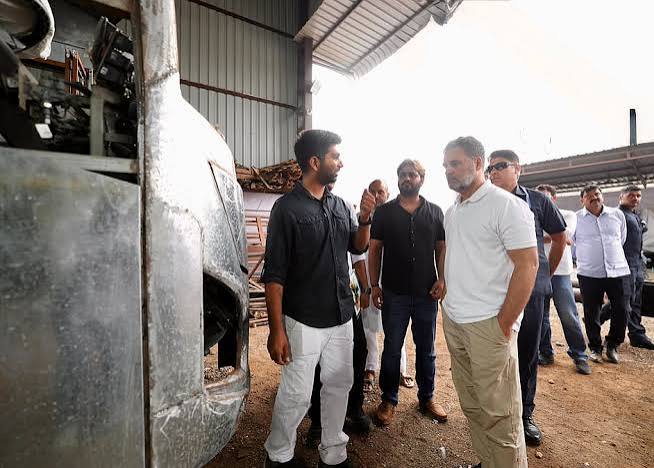
“Make in India” and “Vocal for Local” are merely slogans, and the Modi government’s policies cater only to big industrialists, he further alleged. Congress leader Rahul Gandhi on Monday accused the Centre of framing transport regulations that are crippling small bus and truck body-building workshops, alleging that micro, small and medium enterprises (MSMEs) are being “deliberately strangled” instead of being supported. The Leader of the Opposition in the Lok Sabha shared a video on social media of his recent visit to a bus and truck body-building workshop in Jaipur, where he interacted with artisans and manufacturers and heard their concerns. “Sheets of iron… welding sparks… the sound of hammers… amidst all this, artisans forge India’s future through their hard work and skill. In the local bus and truck body-building workshops of Jaipur, one witnesses an India that creates both employment and the nation’s momentum with its own hands,” Gandhi said in his post in Hindi along with the video. “Yet, regrettably, regulations framed within the Ministry of Transport in Delhi are stifling these small-scale industries across the country. The blame for bus fires caused by technical faults is being laid at the door of these artisans who merely construct the vehicle bodies,” the former Congress president said. MSMEs that ought to be supported are instead being “deliberately strangled”, Gandhi alleged. “Make in India” and “Vocal for Local” are merely slogans, and the Modi government’s policies cater only to big industrialists, he further alleged. If these factories shut down, it won’t just halt business as skills will be lost, jobs will vanish, and the burden of inflation on the common people will rise, Gandhi said. As always, it is the hardworking and skilled Indians who will keep paying the price, he added. The video shows Gandhi interacting with local truck and bus body builders, who outlined the challenges they face under the current regulatory framework. Gandhi assured them that he would raise the issue. The visit follows a meeting on March 18 in which Rahul Gandhi and Congress general secretary Priyanka Gandhi Vadra, along with a delegation of small truck and bus body builders from Rajasthan, met Union Road Transport Minister Nitin Gadkari to press for relief. Ahead of that meeting, the delegation had claimed that the government’s new standards and high licensing costs could force many small manufacturers to shut down, putting the livelihoods of millions of families at risk. Following the meeting, Priyanka Gandhi had told reporters, “The truck and bus body builders faced the problem that they have to incur significant expenses to obtain licenses, and the process is also extremely time-consuming. Gadkari has assured us that he will resolve their issues expeditiously.” However, in the video released on Monday, several truck and bus body builders told Rahul Gandhi that their grievances remained unresolved and alleged that the government was “favouring big companies”. Courtesy : TNIE Note: This news is originally published on https:/thenewindianexpress.com/bha and is used purely for non-profit/non-commercial purposes, especially human rights
Manjhi lashed out at Chirag, saying, “You took seats by lying; you gave us a rattle.” He advised his son, “Santosh… you should also speak up, what is visible sells.”

“Santosh, you should also speak up… nothing is achieved by keeping your mouth shut. What is visible sells. It is important to remain active in politics and put your point across to the public.” Union Minister Jitan Ram Manjhi made these remarks while addressing an event. Without naming Chirag Paswan, the national president of NDA ally LJP (R). Manjhi said, “You took all the seats you wanted by lying. What did you get? You were given a rattle. Some women who wear bangles remain silent, while others keep jingling. You too should jingle your bangles.” He also said, “There is very little discussion on Dalit issues in Parliament. Today, only MP Chandrashekhar Azad ‘Ravan’ strongly raises Dalit issues. I have also guided him in this direction in parliamentary politics.” Manjhi took a dig at Chirag Paswan – “Do you want to become a martyr by cutting your nails?” During the event, Jitan Ram Manjhi took a dig at Chirag Paswan without naming him. He said, “What kind of people are there who do anything for political gain? One man says, ‘No one can abolish the Constitution and reservation as long as I am here.’ Do you want to become a martyr by cutting your nails? I say that as long as Prime Minister Narendra Modi is here and Samrat Chaudhary is here, no one can harm the Constitution and reservation. Another man says, ‘Nothing can happen as long as we are here… Hey, who are you?” He alleged that in the name of Dalits and reservation, some people took more seats and even won elections, while his party did not get its due. For some, Samrat is a thorn in their eyes. Addressing the event, Jitan Ram Manjhi praised Samrat Chaudhary. He said, “There are many people in politics who consider Samrat Chaudhary a thorn in their eyes.” Manjhi also made several statements regarding Dalit issues, reservation, NDA politics, and the current political situation in Bihar. He said that for the real development of Dalits, a separate electoral system and equal education system are needed. Manjhi said, “Today the world has reached the moon, but the Dalit community is still stuck there. Until a separate electoral system and equal education system are implemented for Dalits, their real development is not possible.” Advice given to son Santosh Manjhi Referring to his son and HAM Party national president Santosh Kumar Suman, Jitan Ram Manjhi said that he should pay more attention to issue-based politics. He said that it is important to carry forward Prime Minister Narendra Modi’s politics and his development model. If the party works seriously in this direction, it can reach the top. Courtesy: Hindi News
Land mafia encroaches on Dalit land in Rae Bareli: Victims reach District Magistrate’s office seeking justice

In Tanghan village, under the Jagatpur police station area of Rae Bareli, land owned by Dalits is alleged to have been encroached by land mafia. After repeated complaints were not heard, the victims reached the District Magistrate’s office and pleaded for justice. Led by Deshraj Pasi, District President of the Pasi community, hundreds of victims marched from Vikas Bhawan to the District Magistrate’s office at 2:30 pm on Monday. The protesters held placards and shouted slogans against the government. The victims allege that land mafias have colluded with the Revenue Department to manipulate government records. They say that under the protection of the police force, powerful people are encroaching on Dalit land by constructing boundary walls. Will lay siege to Unchahar Tehsil One victim, Phoolan Devi, stated that she has submitted a complaint to the District Magistrate three times regarding this matter. However, each time she has received only assurances. The victims say they are constantly making rounds of the administration and local public representatives, but their grievances are not being heard. District President Deshraj Pasi has issued a stern warning in this regard. He said that if appropriate action is not taken soon and their land is not returned, they will surround the Unchahar tehsil. Pasi further said that if they do not get justice there, they will go to the state capital, Lucknow, and raise their voice at the Chief Minister’s office. Ashish Kumar Srivastava | Rae Bareli Courtesy: Hindi News
Allahabad High Court’s Important Directive: A QR Code-Based System Should Be Implemented to Prevent Fake Caste Certificates in Uttar Pradesh

To curb the circulation of fake caste certificates in Uttar Pradesh, the Allahabad High Court has given the Yogi government a crucial suggestion to implement a new system based on QR codes and software. Uttar Pradesh: Expressing serious concern over the increasing number of fake caste certificates, the Allahabad High Court has issued a crucial suggestion to the Uttar Pradesh government. The court believes that a software and QR code-based certification system should be implemented for Scheduled Castes (SC), Scheduled Tribes (ST), and Other Backward Classes (OBC). This new technology will directly combat fraud. The High Court clarified that this technology-based verification system will bring transparency to the entire process, eliminate arbitrary powers held by officials, and curb the issuance of fake caste certificates. The court also noted that adopting such innovative measures will facilitate proper audits and provide a reliable means of verifying the authenticity of issued certificates. This significant observation was made by a division bench of Justice Saumitra Dayal Singh and Justice Swarupama Chaturvedi while hearing a Public Interest Litigation (PIL). The PIL was filed by the UP Koli Kori Pratinidhi Sabha. The petition drew the court’s attention to a serious ground reality. The petitioner organization alleged that Scheduled Caste certificates were being issued to members of the “Koli” caste, even though this caste is not recognized in the Scheduled Caste list. This was happening simply because its pronunciation resembles that of the “Kori” caste, which is actually listed as a Scheduled Caste. The petition alleged that local officials were issuing certificates to the wrong people based solely on similar names or spellings, a direct violation of the President’s orders. No one appeared on behalf of the petitioner during the hearing. However, Additional Advocate General Manish Goyal presented his case on behalf of the state government. Given the gravity of the matter, the division bench strongly criticized the flaws in the current verification process. The court stated that the current system empowers lower-level officials with excessive privileges. Prima facie, it appears that modern technology is so capable that the state government can provide a robust and transparent software-based system for SCs, STs, and OBCs. This will eliminate the unnecessary and unchecked powers held by officials up to the tehsildar level, which often lead to the issuance of questionable or incorrect certificates. Following these strong and important observations by the High Court, Additional Advocate General Manish Goyal sought time from the court to obtain necessary instructions from the relevant officials. In its July 2 order, the division bench directed the matter to be listed for further hearing on July 23. Rajan Chaudhary Courtesy: Hindi News
CJP’s protest continues for the 16th day, hunger striker Sonam Wangchuk loses 6 kg.
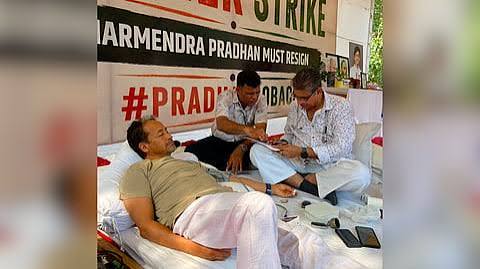
Students’ anger continues at Jantar Mantar over the NEET paper leak and exam malpractice. Climate activist Sonam Wangchuk’s indefinite hunger strike has added a new edge to the movement amid demands for the Education Minister’s resignation. New Delhi: The Cockroach Janata Party (CJP)’s protest at Delhi’s Jantar Mantar against the alleged exam malpractice and paper leak entered its 16th day on Sunday, July 5. Protesters continue to demand the resignation of Education Minister Dharmendra Pradhan and accountability of the government. Meanwhile, this was the eighth day of renowned climate activist Sonam Wangchuk’s indefinite hunger strike. Due to this rigorous fast, he has lost approximately 6 kg. According to a health bulletin issued by doctors, Wangchuk’s blood pressure while lying down was recorded at 112/70 mm Hg. Her heart rate remains at 72 beats per minute and her blood sugar level is 67 mg/dL. The medical report clearly states that her hydration is normal and she is mentally alert. However, her current weight has dropped to 60.95 kg, representing a loss of approximately six kg in seven days. The CJP has been demanding the resignation of the Education Minister. They allege that repeated exam irregularities and paper leaks have ruined the lives of countless students and their families. In this regard, CJP founder Abhijeet Dipke informed on the social media platform ‘X’ that on Sunday (July 5), the parents of NEET candidate Riya Kumari Thapa arrived at the protest site. The organization claims that Riya’s dreams were shattered due to the alleged paper leak, leading to her tragic death. Dipke explained that Riya’s father is a former soldier and joined the protest with the plea that no other family should suffer the pain that his family has endured. He urged the central government to ensure that such incidents do not recur in the future. In another post, the CJP clarified that it stands firmly with Thapa’s parents in this hour of grief and will continue to fight against the corrupt system that failed their daughter. The National Eligibility-cum-Entrance Test (NEET) for admission to medical colleges was held on May 3, but was cancelled amid serious allegations of paper leaks. A re-examination was subsequently held on June 21. On the other hand, the Samyukta Kisan Morcha (SKM) has already expressed its support for the CJP’s movement. The farmers’ organization is now sending a delegation to Jantar Mantar on July 7. Earlier, in its letter to the CJP, the SKM had stated that its delegation would visit the protest site on Sunday (July 6). The farmers’ body expressed solidarity with the agitating students and youth, stating that a transparent, fair, and credible examination system is every student’s fundamental right and that it is the government’s duty to ensure accountability. On a separate platform at the protest site, several members of the left-wing student organization, the All India Students Association (AISA), are also continuing their indefinite hunger strike. On Saturday (July 4), Danish Ali, joint secretary of the Jawaharlal Nehru University Students Union (JNUSU), had to be admitted to Ram Manohar Lohia Hospital. On the seventh day of the hunger strike, her blood sugar level dropped dangerously to 46 mg/dL. Meanwhile, Neha, Manish, Rishikesh, Deepak Kumar Verma, and Amin continue their indefinite fast at the protest site. The CJP’s protest, which began on June 20th over alleged irregularities in the country’s examination system, has already garnered widespread support from several prominent political leaders, social activists, and members of civil society. Rajan Chaudhary Courtesy: Hindi News