
Attack on Dalit Priest in Rajasthan, Conspiracy to Evict Him from Temple

The Khakhul Dev Temple in Barana was established by the Dalit community approximately 400 years ago. As long as the temple generated no income, no one objected. However, as donations began pouring into the temple, the Manuwadis became increasingly suspicious. Manuvadvisers attack Dalit priest Vishnu Kumar Balai in Barana village, Bhilwara district. Bhilwara. There are reports of an attack on Dalit priest Vishnu Kumar Balai in Barana village, Bhilwara district, Rajasthan. The Khakhul Dev Temple in Barana was established approximately 400 years ago by a Dalit (Balai) priest family. This family has served it for eight generations. As long as the temple generated no income, no one objected. But as the temple’s income improved the lives of the Dalit priest, with children attending English schools and a permanent house being built, attempts to seize the temple began. A fake trust was formed, a dispute was created, and the temple was placed under the Tehsildar’s custody. According to the FIR, Vishnu Kumar, who had come to perform puja on July 16, 2026, was subjected to casteist slurs. He was attacked with sticks and iron pipes, and an attempt was made to kill him. Police have registered a case under sections of the BNS and SC/ST (PoA) Acts. The incident was reported by Bhanwar Meghvanshi, a social activist and member of the Dalit Adivasi and Nomadic Rights Campaign (Dagar). Meanwhile, the Dalit Adivasi and Nomadic Rights Campaign (Dagar) has demanded that the National Commission for Scheduled Castes take suo motu cognizance and send an investigation team. The temple should either be returned to its traditional Dalit priest family or placed under the Devasthan Department until a court decision. Given the continued attacks, Vishnu Kumar should also be granted a weapons license for self-defense. Dagar has sent a letter to the National Commission for Scheduled Castes and the Director General of Police of Rajasthan, demanding the immediate arrest of all the accused, the victim’s family security, compensation, and legal redress, and an impartial investigation of the entire matter. Bhanwar Meghvanshi says, “But the biggest question is: when the temple is under government control, who gave the violent mob the freedom to take the law into their own hands? Why was the administration unable to protect the Dalit priest? Is the law only on paper?” Courtesy: Hindi News
Innocent girls were traded for 1.5 lakh rupees: Learn about the exploits of this human trafficking gang, which spanned from Uttar Pradesh to Rajasthan.
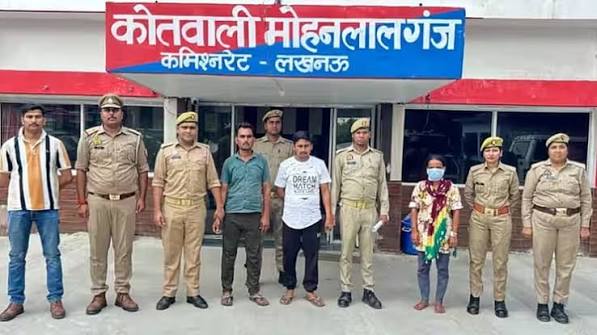
A human trafficking racket spanning Uttar Pradesh and Rajasthan has been busted. Innocent girls were traded for 1.5 lakh rupees in the name of marriage; 3 arrested. Uttar Pradesh: Police in the capital Lucknow have busted a major interstate child trafficking ring that sold innocent girls in Rajasthan under the guise of marriage. These girls were traded for up to 1.5 lakh rupees. Police have arrested three adults, including a woman, and a minor in this case. The search for the gang’s main leaders, based in Rajasthan, has been intensified. This horrific syndicate was exposed when Kamlesha, a resident of Ganiyar village in Mohanlalganj, filed a complaint with the police on May 12th. She reported that her two granddaughters, aged 16 and 12, had suddenly gone missing. The investigation revealed that the girls were kidnapped under the pretext of reuniting them with their estranged mother and providing them with a better life. Since the case involved minor girls, the police took immediate action and deployed four special teams in plain clothes. Footage from approximately 150 CCTV cameras was scanned during the investigation. Although the girls’ mobile phones were switched off, their location was traced to Rae Bareli using technical surveillance and ground intelligence. Acting swiftly, the police safely rescued both sisters on May 18th. The victims’ statements, recorded under the Indian Civil Defence Code, revealed a disturbing truth: the girls were being taken to Rajasthan for forced marriage and sold. Based on solid evidence, the police arrested the main suspects from Atrauli intersection on June 3rd. Those arrested include 25-year-old Anurag Yadav, 32-year-old Mohammad Akhtar, 23-year-old Priya Patel alias Sheela, and a 17-year-old juvenile. Additional DCP (South) Vasant Kumar Rallapalli stated that the investigation revealed several shocking revelations. This entire network had been active between Uttar Pradesh and Rajasthan since 2020. During interrogation, it was revealed that accused Priya Patel had contacted a woman named Sonam, who lived in Kota, Rajasthan. Priya, along with her live-in partner Anurag and associate Akhtar, began targeting orphans or girls from poor families whose families could not easily reach the police. This vicious gang lured girls by promising them jobs, travel, and a better life. In this latest case, the accused gained the girls’ trust and took them to Rae Bareli. There, they were dressed in new clothes and photographed. These photos were then sent via WhatsApp to Sonam and her husband, Bhupendra Chaudhary, in Rajasthan. Once the girls’ faces were “approved,” the deal was finalized. According to the police, the plan was to take the girls to Bambori in Kota district, where Priya was to receive ₹1.5 lakh per girl. Investigators have also uncovered important clues indicating that two sisters from Rae Bareli were previously sold through this network. Police have also seized two four-wheelers used to transport the girls from one district to another. According to Additional DCP Rallapalli, this is a highly organized gang, with pre-determined roles. Currently, the police are focused on arresting the masterminds, Sonam and Bhupendra Chaudhary, who are based in Rajasthan, and identifying other victims, for which raids are being conducted. Rajan Chaudhary Courtesy: Hindi News
UP police, searching for a Dalit son, woke a sleeping father; his body was found hours later; a murder case has been filed against six people, including a sub-inspector and a constable.

In Ballia, UP, police, searching for a son, detained a Dalit father. Following the suspicious death, a murder case has been filed against six people, including a sub-inspector, a constable, and the village head. Uttar Pradesh: A particularly tragic incident has come to light from Ballia district. Police arrived at the home of a 22-year-old man in search of him, but when they failed to find him, they detained his 44-year-old Dalit father. A few hours later, the laborer father died under suspicious circumstances. The deceased has been identified as Kamji Gond. The family alleges that the police severely beat and tortured Kamji to extract information about their son. A named FIR has been filed against two policemen, a village head, and three others for murder. The accused policemen have been suspended with immediate effect. However, the police have completely denied any allegations of custodial assault. Following the incident, the deceased’s family and villagers staged a massive protest. They alleged that the police assaulted Kamji, threw him unconscious in a field, and fled, where he later died in the hospital. Based on a complaint by Kamji’s son, Vishal, a murder case has been registered at the Revati police station against six people: Sub-Inspector Sachin Saroj, Constable Ankit Singh, Village Head Ashutosh Shankar Singh, and three local citizens. Ballia Superintendent of Police Omveer Singh stated that the accused inspector and constable have been suspended. SP Omveer Singh also stated that the SHO of Revati police station, Raj Kishore Singh, has been removed from his post and placed on the line. Given the seriousness of the matter, a magisterial inquiry has been ordered. No arrests have been made yet, and two of the accused belong to the Dalit community. The actual conflict began on July 7th. The deceased’s son, Vishal, had an argument with shopkeeper Suraj Kannaujiya over purchasing chicken at a shop near Khedan intersection in Gaighat village. The argument quickly escalated into a scuffle, which was later resolved with the intervention of local residents. Vishal claims that under pressure from the village head and others, the shopkeeper filed a complaint of assault against him. Based on this complaint, two policemen arrived at Vishal’s house at 1:20 pm on July 8th in search of Vishal. Vishal was not at home, so the policemen picked up his father, Kamji, who was sleeping there. The son alleges that the police took his father to a nearby brick kiln and brutally assaulted him to force him to reveal Vishal’s hiding place. According to family members, when Kamji fell unconscious due to the severe beating, the policemen abandoned him in a garden near the brick kiln and fled. Around 6 pm, locals found him unconscious and informed the family. He was immediately taken to a nearby hospital, where a team of doctors referred him to Varanasi. Kamji died while undergoing treatment at the Varanasi hospital. On the other hand, the police version is completely different. The police department states that Kamji began experiencing breathing difficulties during interrogation. According to officials, he was left in the custody of a neighbor at around 4 pm on July 8th, and that neighbor took him away. The police have denied the allegations of assault and abandonment. The police also clarified that the post-mortem report could not confirm the exact cause of Kamji’s death. Consequently, doctors have preserved the viscera for forensic examination, the report of which is currently awaited. Furthermore, the police also informed that the complainant, Vishal, already faces several serious criminal charges, including murder. Following this incident, the angry family refused to cremate the body, demanding strict action against the accused. After massive protests, when the police filed a murder case against the named accused, the family agreed to proceed with the funeral. Rajan Chaudhary Courtesy: Hindi News
Madras HC sternly remarked on the prohibition of temple processions in the Dalit-dominated North Street: Stopping religious processions in the name of caste amounts to untouchability!

High Court rebukes caste discrimination at temple festivals, orders Dindigul Collector to investigate within 12 weeks Madurai – In a landmark judgment, the Madurai Bench of the Madras High Court has held that any practice or custom that excludes any class of citizens on the basis of caste from any public religious festival cannot be constitutionally valid. The Court clarified that Article 17 of the Constitution completely abolishes untouchability and this prohibition is not subject to any custom, tradition, or social acceptance. The Bench headed by Justice L. Victoria Gauri issued these important directions while hearing a petition filed by Bakkiyaraj. Petitioner Devendra belongs to the Kula Vellalar community and alleges that during the annual festival of the Arulmighu Ayiram Aruval Kottai Karuppasamy Temple in Muthalapuram village, Nilakottai taluk, Dindigul district, a wooden casket decorated with silk cloth is prevented from entering North Street, which is dominated by his community. Why the procession is not taken to North Street? Petitioner Bakiyaraj Devendra, belonging to the Kula Vellalar community and a resident of Muthalapuram village’s North Street, filed a petition in the High Court, stating that the village deity is a public deity and is worshipped by people of all castes. Every year during the Thai month, a wooden casket decorated with silk cloth is taken out in a procession through the village streets. However, for the past several years, the respondents (Kumanesan, Raghupathi, Seeni, Satish, Kathinisan, and Kannan) have deliberately prevented the procession from entering North Street. The petitioner alleges that this restriction is based solely on caste grounds. The private respondents allege that the deity’s procession through North Road will be defiled and polluted. Furthermore, members of the Devendra Kula Vellalar community are not included in the temple administration, are prevented from offering offerings, and are excluded from making decisions related to the festival. The petitioner sought directions to officials, including the District Collector, Superintendent of Police, Revenue Divisional Officer, Tehsildar, and Police Inspector, to ensure the procession enters North Road and ensure a peaceful celebration by including some members of the Devendra Kula Vellalar community in the festival committee. Respondents stated that there is no discrimination based on caste in the village. Each community has its own temple and its own customs. The procession route has remained the same for centuries and has never been diverted through the petitioner’s community’s road. People from all communities can enter and worship at the temple, and there are no caste-based restrictions. Citing an earlier order, they argued that this petition attempts to reopen the same issue. The government stated that maintaining law and order was its priority and that all devotees, regardless of caste, would be allowed to worship and participate in religious activities at the temple. The court did not consider this matter merely a dispute over the route of a village procession. Rather, it was an issue of constitutional morality and social democracy. In its order, the court clearly stated: “The Constitution of India does not merely establish political democracy. It envisions a social democracy based on liberty, equality, and fraternity. The framers of the Constitution consciously recognized that caste discrimination had deprived a large section of Indian society of dignity and equal status for centuries. Therefore, the Constitution guaranteed equality before the law under Article 14, prohibited discrimination under Article 15, and abolished untouchability in all its forms under Article 17.” The court further stated that when members of a Scheduled Caste community are prevented from participating in a public religious festival or having equal access to a public temple, it is not merely a private dispute. “Such allegations strike at the very core of constitutional morality.” Interpreting Article 17, the Court wrote – “Article 17 abolishes untouchability and forbids its practice in any form. This constitutional prohibition is absolute. It is not subject to custom, usage, local tradition, or social acceptance. The Constitution does not merely prohibit physical segregation. Any disability imposed on a citizen on account of caste identity falls within the broad constitutional scope of Article 17, which it seeks to eradicate.” Regarding Article 25, the Court stated that religious freedom is subject to public order, morality, health, and other provisions of Part III. “No religious practice or customary usage can withstand constitutional scrutiny if it violates equality, dignity, or fraternity. Constitutional morality must always take precedence over social morality when the two conflict.” The Constitution does not recognize hierarchical participation in public religious life based on caste hierarchy. Faith cannot be divided street by street along caste lines. – Justice L. Victoria Gauri ‘Temple festivals are not just religious events, they are also social institutions’ Citing Article 51A(e), the court stated that temple festivals are not merely religious events. “It is also a social institution meant to unite people. If a festival becomes a means of exclusion, the very purpose of community worship is defeated.” The court, noting the petitioner’s allegations and the respondents’ denials, stated that disputed questions concerning historical routes, practices, and festival administration cannot be decided solely on the basis of affidavits in a writ petition. However, it also clarified: “When allegations of caste-based exclusion from a public religious festival are made, constitutional courts cannot simply relegate the petitioner to a civil forum. Constitutional courts cannot remain silent spectators to issues of equality, dignity, and fraternity.” These instructions were given to the District Collector The court assigned primary responsibility to the District Collector, stating: “The District Collector must remember that the issue is not merely about route management. It is linked to the constitutional promise of equal citizenship. The Constitution does not recognize hierarchical participation in public religious life based on caste hierarchy. Faith cannot be divided street by street along caste lines. Deities worshipped by the entire village belong to the entire village. Public religious institutions cannot become instruments for perpetuating social exclusion.” The court ordered a detailed investigation within 12 weeks, directing the Collector to convene a meeting of all stakeholders (petitioner community, private respondent, village elders, revenue,
Ramnarayan Baghel Murder Case | The family will receive an additional compensation of ₹8.25 lakh in the lynching case of a Dalit migrant worker in Kerala, but shortcomings in the police investigation have exacerbated the trouble!

A Dalit migrant worker from Chhattisgarh was murdered seven months ago by a mob after being branded a “Bangladeshi.” Thrissur – Ramnarayan Baghel’s family has received a major relief in their fight for justice. The district-level monitoring committee has made a historic decision to award them an additional ₹8.25 lakh in compensation, in addition to the previously approved amount. Earlier last year, the Kerala government had announced a grant of ₹30 lakh to Ramnarayan’s family. While the additional compensation decision will provide relief from financial hardship, the family is concerned by the court’s findings of flaws in the ongoing police investigation. During a recent press conference in Thrissur, Baghel’s family appealed to the Kerala government to ensure that the investigation into Ramnarayan’s alleged mass murder is not derailed, that the investigation be expedited, and that all culprits be brought to justice. The family stated that they were deeply saddened by the court’s finding of deficiencies in the police chargesheet, which was evidence of repeated lapses in the investigation. They stated that the court’s finding of deficiencies in the chargesheet was evidence of repeated lapses on the part of the police during the investigation, and that it was deeply concerning that the police had shown such negligence in such a serious case. The family demanded that the Kerala government and police conduct the investigation in a manner that ensures justice and that such a brutal ethnic massacre does not occur again in the state. They stated that the government should intervene to expedite the legal process and immediately appoint a special public prosecutor, as demanded by the family. The family also urged the police to address all deficiencies in the chargesheet already filed in court and submit a new, legally correct chargesheet as soon as possible. Addressing the media, Ramnarayan’s wife Lalita Baghel, his mother Shyamabai Baghel, brother Shashikant, Justice for Ramnarayan Baghel Action Council President K. Sivaraman, and convener Advocate K.S. Nisar, member M. Sulaiman Palakkad, and Advocate Nikhil Chandrasekaran, who is also the family’s lawyer, reiterated that ensuring a fair investigation and punishing the accused is essential not only for justice in Ramnarayan’s case but also to prevent such crimes in the future. The case was registered under Section 103(2) of the Indian Penal Code, the first in Kerala since the enactment of new criminal laws criminalizing mob lynching. A case was also registered under the Scheduled Castes and Scheduled Tribes (Prevention of Atrocities) Act. The Tragic Incident That Shamed Kerala It is noteworthy that on December 17, 2025, Ramnarayan Baghel, a 31-year-old Dalit migrant laborer from Karahi village in Sakti district, Chhattisgarh, was allegedly beaten to death by a mob in the Walayar area of Palakkad district, Kerala. Baghel had come to Kerala in search of employment and was suspected of theft in the Attapallam area of Walayar. The attackers called him “Bangladeshi” and began brutally beating him. According to the post-mortem report, he had over 40 serious injuries on his body, including repeated blows with sticks and batons on his head, face, chest, and back. Ethnic and Identity Groups Police arrested five people in connection with the case, including four BJP workers. Two more accused were later arrested. The case was registered under Section 103(2) of the Indian Penal Code, which criminalizes mob lynching, and is the first such case in Kerala. A case was also registered under the Scheduled Castes and Scheduled Tribes (Prevention of Atrocities) Act. Legal hurdles in providing compensation to migrants under the SC/ST Act The Action Council, which provides legal assistance to Ramnarayan Baghel’s family, welcomed the decision of the district-level monitoring committee to award the family an additional compensation of ₹8.25 lakh (approximately $8.25 million) in addition to the previously approved amount. The committee made this decision at its meeting on July 2nd after considering an application submitted by Ramnarayan’s mother through the Action Council. Discrimination and Identity Relationships According to the Action Council, this decision also removed a legal hurdle that typically faced individuals from outside Kerala receiving compensation under the SC/ST Act when they faced caste-based atrocities within the state. The Action Council called this decision a historic milestone in the fight for justice and demanded that this benefit be extended to all victims of caste atrocities in Kerala. The family stated that the government’s prompt approval of compensation in Ramnarayan’s case and the release of funds under the SC/ST Act should become the norm in all cases of atrocities against Dalits. They credited the Action Council’s continued intervention with prompting the government to take swift action. However, they stressed that compensation alone cannot erase injustice. They said this is the first case registered under Section 103(2) of the IPC, which criminalizes mob lynching, in Kerala since the implementation of new criminal laws. They urged the government to ensure that all the accused are punished to prevent such incidents from happening again. The Action Council also demanded that senior police officials investigate whether there were any lapses in the investigation and demanded that everyone involved in the crime be prosecuted and given the maximum punishment under the law. The family stated that they expect a fair, transparent, and professional investigation, leaving no room for allegations of negligence or bias on the part of the police. They stated that they would soon meet with Kerala Home Minister Ramesh Chennithala and other officials to present their demands and vowed to continue their struggle until justice is achieved. Initial allegations of delay, but later, the government bowed to public pressure It is noteworthy that initially, allegations of delay and procedural lapses in the investigation were raised in this case. The family stated that key legal provisions were implemented only after sustained public pressure, while the appointment of a special public prosecutor and other measures sought by the family also took time. Following protests and memorandums, the Kerala government implemented the mob-lynching provisions under the Indian Penal Code, began implementing the Supreme Court’s Tehseen S. Poonawala guidelines, and granted compensation to the
Neo-Nazi Who Claims to Be Transgender Sent to Women’s Prison in Germany Amid Mockery Concerns

The 55-year-old far-right activist failed to report to prison last August to serve a 1.5-year sentence for slander and incitement to hatred. They were placed in a women’s prison in Chemnitz, Saxony, despite suspicions of exploiting gender laws. Liebich legally changed gender while appealing the sentence, a move widely seen as mocking Germany’s self-determination act introduced under Olaf Scholz. A self-proclaimed transgender neo-Nazi has been transferred to a women’s prison in Germany amid accusations of exploiting the country’s gender self-identification laws. Marla-Svenja Liebich, born male and originally named “Sven” before legally registering as a woman, was extradited on Wednesday from the Czech Republic to a prison in Chemnitz, Saxony. The German far-right provocateur, who has been photographed at rallies wearing a Nazi-style uniform, had gone on the run last August after failing to report to serve a one-and-a-half-year jail sentence for slander and incitement to hatred. While appealing the 2023 conviction, the 55-year-old changed legal gender under a reform that eased the process. Liebich’s “transition” was widely seen as a deliberate mockery of the self-determination act, triggering intense debate over possible abuse of the law. The reforms, introduced by Olaf Scholz’s centrist coalition, simplified changing one’s name and gender on official documents. Appearing publicly in women’s clothing while sporting a moustache, Liebich claimed the change and request for a female prison were needed to avoid “discrimination” from male inmates. Sven Liebich was a prominent figure in Germany’s anti-vaccine movement during the Covid pandemic before adopting a woman’s name. Credit: Craig Stennett/Getty Images In 2022, Liebich disrupted an LGBTQ pride parade in Halle, labelling participants “parasites on society”, according to activists. A local prosecutor said Liebich was “co-operative” during extradition. Prison authorities are now deciding how to carry out the sentence. German officials previously confirmed the placement in a women’s prison was based on registered gender, not biological sex. Liebich has been a longstanding activist in eastern Germany’s right-wing extremist circles and is classified by Saxony’s intelligence services as a “Right-wing extremist” operating statewide and nationally. Photos show the activist at protests featuring black-clad marchers with red, white and black flags, wearing an armband reading “Sicherheits-Abteilung” (“security department”) — the same initials as the Nazi Brownshirts (SA). Former Chancellor Olaf Scholz had defended the gender reforms, stating: “We show respect to trans, intersex and non-binary people, without taking anything away from others. This is how we continue to drive the modernisation of our country. This includes recognising realities of life and making them possible by law.” The case has since drawn sharp criticism, prompting the new government under Chancellor Friedrich Merz to commit to reviewing the law. (inputs from The Telegraph) Courtesy : Outlook India Note: This news is originally published on https:/outlookindia.com/bha and is used purely for non-profit/non-commercial purposes, especially human rights
Parliament passes Transgender Persons Amendment Bill, 2026 with Rajya Sabha approving it today

Parliament has passed the Transgender Persons (Protection of Rights) Amendment Bill, 2026, with the Rajya Sabha approving it today. The bill was passed by the Lok Sabha yesterday by a voice vote amid an Opposition-led walkout. The bill seeks to redefine the category of transgender, removes the provision of self-perceived gender identity and excludes several socio-cultural identities as well as transmasculine individuals from its ambit. It also further defines transgender persons within a biological framework, based on intersex variations and differences in sexual development. Replying to the discussion on the Bill in the Rajya Sabha, Social Justice and Empowerment Minister Dr Virendra Kumar said the government is compassionate towards the well-being of the transgender community. He said the Bill has provisions to empower the transgenders and give them dignity. The Minister said that the NDA government has taken several initiatives to bring transgender people to the mainstream and stop discrimination against them. Starting the discussion in the Upper House, Congress MP Renuka Chowdhury said this bill dilutes the privacy of an individual provided under the Constitution. Opposing the Bill, Ms Chowdhury said self-identification cannot be taken away through bureaucratic certification. Criticizing the government, she said that the proposed bill undermines the fundamental rights and dignity of transgender persons. Calling such a move wrong and illegal, she argued that forcing transgender persons to provide their identity through official certificates is against the spirit of equality and dignity guaranteed by the constitution. She also questioned the government’s approach for not properly consulting with the transgender community before bringing the Bill. She also referred to the Supreme Court’s landmark NALSA judgement of 2014, which recognized the right of transgender persons to self-identify their gender. Ms Chowdhury said the proposed Bill violates the principles laid down in that judgement and fails to respect an already established legal framework. DMK MP Tiruchi Shiva also opposed the Bill, saying that even if the Bill is passed in Parliament with a majority, it will be struck down by the Supreme Court. He further added that the Bill violates Articles 14, 15, 19 and 21 of the Constitution and it deprives the community of the right to freedom, dignity and self-determination. Supporting the Bill, BJP MP Medha Vishram Kulkarni said, ” This Bill ensures justice, dignity, protection from criminalisation and legal safeguards for transgender persons. She also thanked Prime Minister Narendra Modi for bringing this bill with certain amendments in order to ensure that the benefits reach the deserving people in a proper manner. She said there is a need for a law that brings justice to real transgender individuals and punishes fake ones. Mrs Kulkarni said the benefits should be extended to those who are transgender by birth. She said that the amendment to extend punishment will bring down the rate of crime and forced identities. TMC’s Saket Gokhale said that 31% of Transgender people in India have attempted suicide because of the discrimination that they are facing. He alleged that now the government is going to start discriminating against them as though social discrimination were not enough. He called it unacceptable. Mr Gokhale expressed concern that gender is going to be decided by the Chief Medical Officer and a District Magistrate, and the bill does not prescribe any qualifications for the Chief Medical Officer. Sanjay Singh of AAP said the Bill is a big let-down for the transgender community. He accused the government of not doing anything for the community. RJD’s Manoj Kr Jha said that prejudices against transgender people should stop, and they should be able to live with dignity. He added that self-determination of gender should not be taken away. CPI(M)’s John Brittas said it is a black-letter day and the Bill is taking India a century back. He pleaded with the government to either withdraw the Bill or refer it to a Select Committee. Jaya Bachchan of the Samajwadi Party also questioned the government over the legislation. She sought to know what the urgency was in bringing the Bill, without examining it with the depth and care that it deserved. Courtesy : NOA Note: This news is originally published on https:/newsonair.com/bha and is used purely for non-profit/non-commercial purposes, especially human rights
Congress says they are in touch with DMK, AAP and other Opposition parties; BJP won’t secure two-thirds majority

Senior Congress leader says party is coordinating with all Opposition parties that voted against the delimitation Bill in April ahead of the Monsoon Session. The Congress is in touch with all Opposition parties that voted against the proposed Constitution amendment bill on delimitation earlier this year and is confident the government will not secure the two-thirds majority required to pass it if it is reintroduced during the Monsoon Session of Parliament, senior party leader Jairam Ramesh said on Thursday. Ramesh’s remarks come amid speculation that the Centre may bring back a revised Constitution amendment bill to operationalise the women’s reservation law through a fresh delimitation exercise. Speaking after a meeting of the Congress Parliamentary Strategy Group at Congress Parliamentary Party chairperson Sonia Gandhi’s residence, Ramesh said the party was coordinating with allies and other Opposition parties that had united to defeat the legislation in April. “We are in touch with all parties including the DMK who voted with us on the 17th April. We are in touch with all parties, which voted together collectively on the 17th. We are in touch with the DMK; we are in touch with the Aam Aadmi Party.” He said the Samajwadi Party had played a crucial role in defeating the government’s proposal. “We are in touch with the Samajwadi Party, and I can tell you that the top leadership of the Congress Party, which means the Congress president and the leader of the opposition in the Lok Sabha are in touch.” Ramesh said the Congress would continue to coordinate with these parties as they shared concerns over the proposed delimitation exercise and its potential implications. He alleged that the BJP’s approach to delimitation in Assam and Jammu and Kashmir had raised serious concerns and cautioned against believing speculative media reports about the government’s numbers in Parliament. “The reality is that they have a long way to go to secure a two-thirds majority in the Lok Sabha, and there is no scope for achieving it. Nevertheless, let me reiterate — such a two-thirds majority would be a tainted one.” Referring to the BJP’s 2024 Lok Sabha election campaign, Ramesh said the party had sought an overwhelming mandate but failed to achieve it. “They desired a two-thirds majority and raised the slogan of ‘crossing 400’ in the 2024 Lok Sabha elections; the public rejected them — they secured 240 seats — and now they are in pursuit of a two-thirds majority.” He described any attempt to secure such a majority after the elections as “an insult to the public mandate” and “an insult to the Constitution”. The Congress Parliamentary Strategy Group meeting, attended by party president Mallikarjun Kharge, Leader of Opposition in the Lok Sabha Rahul Gandhi and other senior leaders, finalised the party’s strategy for the Monsoon Session beginning July 20. Among those present were AICC general secretary K C Venugopal, P Chidambaram, K Suresh, Naseer Hussain, Manickam Tagore, Kumari Selja, Tariq Anwar, Shashi Tharoor, Manish Tewari and Ramesh. The Opposition INDIA bloc is scheduled to meet on July 20 to formulate a joint strategy for the session, while the Centre has convened an all-party meeting on July 19. The government is expected to introduce key legislation during the session, including the proposed Constitution amendment bill on delimitation and increasing the number of Lok Sabha seats, as well as another Constitution amendment bill seeking the removal of the prime minister, chief ministers and other ministers if they remain in custody for 30 consecutive days in serious criminal cases. Besides opposing the government’s legislative agenda, the Opposition plans to raise issues including the alleged NEET paper leak, the alleged embezzlement of donations at the Ram temple in Ayodhya, rising fuel prices and the proposed India-US trade deal during the session, which is scheduled to run from July 20 to August 13. COurtesy : TNIE Note: This news is originally published on https:/thenewindianexpress.com/bha and is used purely for non-profit/non-commercial purposes, especially human rights
Congress gets strategy in place for opposition
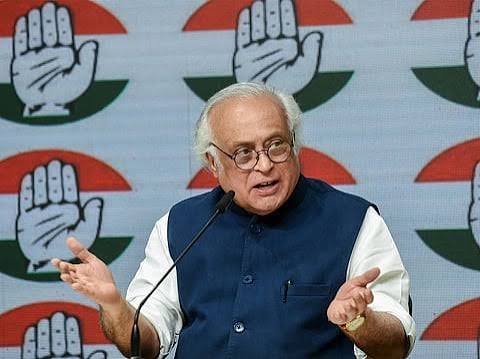
Addressing a press conference after the meeting, Congress general secretary Jairam Ramesh asserted that the BJP will not secure a two-thirds majority in the Lok Sabha. NEW DELHI: The Congress on Thursday said that it would oppose the constitutional amendment bills related to delimitation, dismissal of ministers and chief ministers, and other bills on FCRA and Higher Education, during the Monsoon session of Parliament beginning July 20. The decision was taken at the key strategic meeting, attended by senior Congress leaders, including party chief Mallikarjun Kharge, Sonia Gandhi, Leader of the Opposition in Lok Sabha Rahul Gandhi and others. Addressing a press conference after the meeting, Congress general secretary Jairam Ramesh asserted that the BJP will not secure a two-thirds majority in the Lok Sabha. “We have learnt that the Union Home Minister (Amit Shah) is making efforts to bring back the Delimitation Bill. The government failed to secure a two-thirds majority on 17th April, suffering a significant setback. It now wants to reintroduce the Bill.” This was discussed along with the Constitution amendment bill, which seeks to remove ministers from office for 30 days over serious offenses, he said. The home minister has “split parties” and is looking to manage a two-thirds majority by “cunningness,” which would be an insult to the Constitution, he said, adding that such a majority would be a “blot on democracy”. “LoP Rahul Gandhi and Congress president Mallikarjun are in touch with all parties that had supported us on April 16 and 17 in defeating the government’s delimitation bill,” he said. “The Congress Party has consistently maintained that it will strongly oppose the Delimitation Bill and will continue to do so. We will also make every effort to maintain the unity and solidarity of all Opposition parties,” he said. There was also some discussion on the ‘One Nation, One Election,’ on which a JPC has been constituted, Ramesh said. “We will also oppose the Viksit Bharat Shiksha Adhishthan Bill in its entirety. The Bill may be introduced during this session. There is also a possibility that the FCRA Amendment Bill will be introduced. We will oppose it as well. We had opposed it earlier, following which the government withdrew the Bill. However, we are now hearing that it may be brought back,” Ramesh said. The party will also corner the government on the alleged theft of donations from the Ram Mandir. Preetha Nair Courtesy : TNIE Note: This news is originally published on https:/thenewindianexpress.com/bha and is used purely for non-profit/non-commercial purposes, especially human rights
‘Cabinet expansion very soon’: Congress hints at Karnataka reshuffle after Rahul-DKS meeting
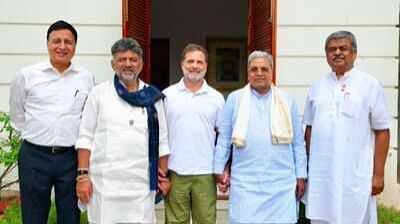
NEW DELHI: Congress general secretary Randeep Singh Surjewala on Thursday said the Karnataka cabinet expansion is expected to take place ‘very soon’, indicating that the exercise could be completed before the upcoming assembly session as consultations with the party leadership continue in Delhi. His remarks came after Karnataka chief minister DK Shivakumar, former CM Siddaramaiah, state Congress president BK Hariprasad and other senior leaders met Leader of Opposition Rahul Gandhi and Congress general secretary (organisation) KC Venugopal to discuss the long-pending cabinet expansion. Speaking to reporters, Surjewala said the discussions had only begun and it was too early to announce a timeline. “Today, CM DK Shivakumar, former CM and Congress Working Committee member Siddaramaiah, our PCC President BK Hariprasad, and many of our ministers and senior Congress leaders arrived in Delhi. DK Shivakumar and Siddaramaiah have met Rahul ji, and they have met with the General Secretary (Organisation), KC Venugopal. The discussions have just begun. I cannot give you a specific date right now; all I can say is that these are preliminary discussions. The Karnataka cabinet expansion will take place very soon,” he said. Surjewala said there are 20 vacancies in the cabinet and the post of Speaker is also lying vacant. “There are 20 vacancies in the cabinet, and the post of Speaker is also vacant. Let the consultations take place; anything can be said only after the discussions. The endeavour will be to fill as many vacancies as possible, or indeed all of them. Yes, I fully expect the cabinet formation to be completed before the Assembly session begins,” he added. Earlier in the day, Shivakumar shared details of the meeting on X. “Called on Leader of the Opposition Shri Rahul Gandhi in New Delhi today, along with AICC General Secretary in-charge of Karnataka Shri Randeep Singh Surjewala, former Chief Minister Shri Siddaramaiah, and KPCC President Shri BK Hariprasad. We remain committed to the welfare of our people and the continued development and progress of the state,” he posted. The Congress has been holding consultations on the cabinet expansion for several weeks. The exercise is expected to balance regional representation, caste equations and organisational priorities while filling 20 vacant ministerial berths. The expansion has gained significance ahead of the Karnataka assembly session beginning in August, with the party aiming to strengthen governance and prepare for upcoming local body elections. Nearly 50 aspirants are reportedly in the race for the available cabinet positions, making the final selection a politically sensitive exercise. Courtesy : TOI Note: This news is originally published on https:/timesofindia.com/bha and is used purely for non-profit/non-commercial purposes, especially human rights