
Stricter measures demanded against untouchability, caste discrimination

The Shoshan Mukti Manch today staged a massive protest outside the premises of Deputy Commissioner’s office against atrocities on the Dalit community, especially rising cases of rapes and murders. The manch demanded that the state government should opt stricter measures to stop untouchability, caste-based discrimination and oppression of Dalits as well as crime against them. Through the Deputy Commissioner, the manch submitted a memorandum to the Chief Minister demanding an end to social evils, while highlighting the issues and demands of the Dalit community. During the protest, Jagat Ram, state co-convener of the manch, alleged that the state was witnessing a significant rise in incidents of untouchability, caste-based discrimination, assaults on Scheduled Castes/Scheduled Tribes, rapes and murders over the past few months. He said in Rohru, a 12-year-old Dalit boy identified as Sikander, was subjected to such an extreme harassment that he was compelled to die by suicide. Also, in one of the schools in Rohru, a Dalit student was stripped naked by a teacher, and beaten and tortured with a stinging nettle. Similarly, in Kullu district’s Sainj Valley, a woman was brutally gang-raped and murdered, he said. During the Kullu Dussehra festival, a government officer was assaulted and humiliated, an incident that brought shame to the entire state, he said. “Cases of physical violence and rape of women by politically influential individuals and their families are on the rise. In Hamirpur, an attempt was made to rape a woman. She was attacked violently, leading to her death in the hospital,” he said. Jagat Ram further stated that the policies of liberalisation, privatisation and globalisation adopted by the state government were rapidly affecting both the nation and the state. “These policies are resulting in attacks on the rights of the common people and withdrawal of their essential facilities, creating widespread public anger. To divert attention from real issues and retain power, the ruling side is inciting divisions among people on the basis of caste and religion,” he claimed. Article_Author Tribune News Service Courtesy : The Tribune Note: This news is originally published on https:/thetribune.com/bha and is used purely for non-profit/non-commercial purposes, especially human rights
Transpersons in state fear exclusion from voters’ list
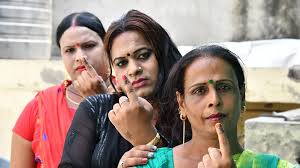
Chennai: Disowned by their family members, most transpersons are at risk of getting disenfrachised in the Special Intensive Revision (SIR) of voters list. According to the most recent voters list, there were 9,120 transgender voters in the state. “Transgenders got voting rights only in 2004 and many got their voter ID cards only after that. Hence, they won’t figure in 2002 and 2005 rolls. Moreover, most of the transpersons were disowned by their family and won’t have the details of voter ID cards of either of their parents. Without these details, our SIR forms will be rejected and we will be disenfrachised,” Priya Babu, a member of the Tamil Nadu Transgenders Welfare Board, told TOI. Priya Babu said they have planned to meet the chief electoral officer of Tamil Nadu, Archana Patnaik, to seek an exemption for transgender voters from SIR and to allow them to vote with their existing voter ID cards. “I voted in 2024 Lok Sabha election but with SIR I will lose my vote,” Priya Babu said. Aruna, founder and director of the South Indian Transgenders Federation, said most transpersons have moved out of their native places and therefore do not possess their own records or those of their family members. “Family members of one of my friends Dhanam had obtained a death certificate for her and amassed her properties. Under such circumstances, how will she have any document,” Aruna asked. “I have planned to file a writ petition against the ECI for SIR at the Madras HC. I will fight to ensure that none of the transpersons loses their voting right,” Aruna said. Courtesy : TOI Note: This news is originally published on https:/timesofindia.com/bha and is used purely for non-profit/non-commercial purposes, especially human rights
Transgender aspirant seeks BJP ticket for Nagpur civic body elections from Prabhag 23-D

Nagpur: With the Nagpur Municipal Corporation (NMC) elections nearing, political activity in Prabhag 23 has intensified after a transgender person, Rani Dhawle, expressed her desire to contest from seat D on a BJP ticket. Dhawle, who claimed to be leader of the transgender community in Nagpur city, said she has been a BJP worker for nearly 15-17 years. The seat matrix for Prabhag 23 has undergone a major reshuffle — A is reserved for SC, B for ST (woman), C for woman, and D is the only general seat. Earlier, in the 2017 polls, 23-C was a general category seat, from where BJP’s Narendra Borkar was elected. Following the reservation changes, senior BJP leader and three-time corporator Borkar has now shifted to the general seat D and plans to contest from the same prabhag. Borkar remains a strong organisational face for the party. The segment also has a history of multi-party representation, with NCP’s lone corporator Duneshwar Pethe previously elected from 23-D. Amid this churn, Rani Dhawle has decided to formally apply for the ticket. Speaking to TOI, Dhawle said she aspired to become Nagpur’s first transgender corporator and ensure rightful representation for the Kinnar Samaj. “Like in case of men and women, Kinnar Samaj too should also get justice,” she said, adding that her candidature was not just a personal ambition but a step toward securing dignity and space for the transgender community in mainstream politics. Dhawle said she has been consistently active in party work and hoped BJP would recognise her contribution. She gave example of Madhu Kinnar, India’s first transgender mayor from Raigadh Municipal Corporation in Chhattisgarh, as her inspiration. “Other states have shown the way. Nagpur should not remain behind. We should also get an opportunity to become Nagar Sevak,” said the 28-year-old Hiwri Nagar resident, who is a matriculate. With BJP yet to begin formal candidate interviews for the civic polls, which are likely to be held in early January, Dhawle’s entry has added a new social dimension to the contest in Prabhag 23-D. She plans to submit her form to BJP city president Dayashankar Tiwari on Monday. The final decision now rests with the party’s internal selection process. Courtesy : TOI Note: This news is originally published on https:/timesofindia.com/bha and is used purely for non-profit/non-commercial purposes, especially human rights
BJP MP alleges forced conversion racket targeting transgender community
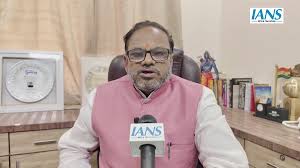
Amravati (Maharashtra), (PTI) BJP Rajya Sabha member Anil Bonde has alleged that a racket is operating in Maharashtra’s Amravati and Yavatmal districts to forcibly convert transgender individuals to Islam. Bonde told reporters here on Saturday that some transgender persons from Amravati approached him with a complaint of forced religious conversion, which has created an atmosphere of fear among the community. Some of the affected individuals reconverted to Hinduism through a ritual at the Kumbh Mela (held earlier this year at Prayagraj in Uttar Pradesh), he said. Bonde said he will inform Chief Minister Devendra Fadnavis about the issue and demanded immediate police action into the matter. PTI COR CLS GK This report is auto-generated from PTI news service. ThePrint holds no responsibility for its content. Courtesy : The Print Note: This news is originally published on https:/theprint.com/bha and is used purely for non-profit/non-commercial purposes, especially human rights
Will the India Alliance split in UP after the Bihar election results? Will Rahul and Akhilesh’s paths diverge in 2027?
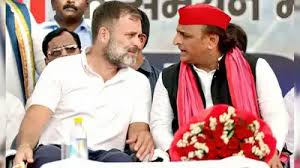
Following the poor performance of the India Alliance in Bihar, questions have arisen. Its impact could be felt in the 2027 UP elections. Discussions are already underway as to whether the India Alliance will break up. Lucknow: Following the landslide victory of the Bharatiya Janata Party (BJP)-led National Democratic Alliance (NDA) in the Bihar Assembly elections, speculation has begun about the future of the “India Alliance,” a group of opposition parties, in view of the 2027 UP Assembly elections. Prime Minister Narendra Modi, calling the Congress “Muslim League” and “Maoist,” has sparked a new debate by saying that “a split in the Congress will soon be seen.” Experts believe that this will spark a debate in UP, and that it will provide a new benchmark for both ruling and opposition party workers seeking future hope. The mental game has already begun. Samajwadi Party (SP) chief Akhilesh Yadav, who was quick to comment on the Bihar election results, called the BJP “not a party, but a fraud” and also acknowledged that there is much to learn from the BJP. Keshav Prasad Maurya took a jab at the opposition. Meanwhile, Uttar Pradesh Deputy Chief Minister Keshav Prasad Maurya, taking a jab at the opposition, said, “After Magadha, now Awadh,” suggesting that the BJP plans to portray the Bihar results as a good omen for Uttar Pradesh. The enthusiasm of NDA leaders in Uttar Pradesh is also at its peak regarding the Bihar election results. The Congress, which has found some new life in UP through its alliance with the SP for the 2024 Lok Sabha elections, is avoiding direct answers to questions about a grand alliance in 2027. Ajay Rai attacks Reacting to Modi’s statement about divisions within the Congress, UP Congress President Ajay Rai, Narendra Modi’s main rival in the Varanasi parliamentary constituency in the Lok Sabha elections, said he should first look at himself. What does he know about the Congress? But beyond claims and counterclaims, the question is being raised: what will be the relationship between the Samajwadi Party (SP) and the Congress, who together won 43 of the state’s 80 Lok Sabha seats in the 2024 Lok Sabha elections, in the 2027 Assembly elections? The fate will depend on the unity of both parties. The entire responsibility of opposition unity in Uttar Pradesh will depend on the unity of these two parties. Apparently, the SP and Congress are currently singing the tune of “all is well.” However, it is also a fact that after the poor results in the 2017 Assembly elections, the relationship between the Congress and the SP broke down, and the two boys (Rahul and Akhilesh) parted ways. Challenging the NDA will not be easy. Since the 2024 Lok Sabha election results, the unity of the Samajwadi Party (SP) and the Congress in Uttar Pradesh has created a new ground for possibilities for the 2027 Assembly elections. Since then, political pundits have begun to see the future of the opposition in the state in 2027. However, they now claim that the recent Bihar election results have sidelined the opposition parties’ Special Intensive Review (SIR) campaign and the issue of “vote theft,” making it difficult to challenge the NDA in Uttar Pradesh. They argue that the Bihar results have dealt a blow to the enthusiasm generated after the Lok Sabha elections. There is no such thing as a shock – Rajendra Chaudhary However, SP’s chief national spokesperson and former Uttar Pradesh government minister Rajendra Chaudhary said that there is no such thing as a shock; they will review the results to see what the reasons are. Chaudhary claimed that the All India Alliance will not be affected and the alliance will remain strong. The SP spokesperson said that they will learn lessons from the Bihar elections and the people of Uttar Pradesh are ready to deal with the rigging of the SIR by the BJP there. Bihar results have alerted us – SP spokesperson It should be noted that the SIR has been launched in Uttar Pradesh, and almost all political parties have alerted their workers to maintain transparency. SP spokesperson Chaudhary also stated that the Bihar results will make their workers more vigilant, more cautious, and work with greater vigor. He claimed that they are going to form a government in Uttar Pradesh in 2027 under the leadership of Akhilesh Yadav. They will perform even better in 2027, as the SP and the All India Alliance have become wary of the BJP’s potential conspiracies. Bhupendra Chaudhary claims victory in 2027 Meanwhile, Bharatiya Janata Party state president Bhupendra Singh Chaudhary attributed the NDA’s landslide victory in the Bihar assembly elections to the excellent development policies of Prime Minister Narendra Modi, including the Antyodaya and Garib Kalyan schemes, and claimed that the National Democratic Alliance will set a new record for victory in Uttar Pradesh in 2027. Edited by: Vivek Mishra About the Author Vivek Kumar Mishra is a Senior Digital Content Producer at Navbharat Times. He focuses on news in Uttar Pradesh and Uttarakhand. He also writes opinion pieces and political analysis. He was born in Barabanki and has worked in several cities across three states. He began his career in print media in 2013. Courtesy: Hindi News
Bihar Election Results 2025: Top 10 winners and losers

Bihar has delievered its verdict. It’s NDA ‘phir ek baar, with 200 paar’. They’re poised to break the 2010 record, when the NDA won 206 seats. The results have given both stunning victories and crushing setbacks. Here’s a look at the biggest winners and losers of Bihar’s high-stakes 2025 election. Bihar Election Results 2025 WINNERS Nitish Kumar Janata Dal (United) chief Nitish Kumar has once again emerged as the biggest winner of the Bihar elections 2025 as he managed to fight the 20 years of anti-incumbency and voter fatigue effectively. Despite nearly two decades in power, Nitish’s JD(U) made a clear gain this elections while leading in over 80 seats with the NDA tally of over 200 in the 243-member assembly. With this, Nitish has also blocked Tejashwi Yadav’s rise (again). Tejashwi had strong momentum in the last election with the RJD emerging as the largest single party and hoped for a full-term run this time. But the results show that the “youth vs experience” narrative has collapsed in Nitish’s favour. PM Modi The Bihar election results have once again proved that Prime Minister Narendra Modi it the GOAT with the NDA’s performance resting heavily on his personal popularity. Despite local anti-incumbency against Nitish Kumar, voters seems to have clearly distinguished state issues from PM Modi’s national leadership and voted in favour of “Modi ki guarantee”. His welfare schemes clearly created a strong beneficiary base that rallied behind the NDA. The results also halt any opposition momentum and reaffirm PM Modi’s unmatched vote-transferability, keeping the BJP firmly positioned for 2029. His BJP emerged as the single largest party by winning 89 seats. In a state defined by caste and shifting alliances, Bihar shows that PM Modi’s appeal still drives the coalition’s success. Chirag Paswan Chirag Paswan has emerged as one of the biggest gainers this Bihar election, marking a sharp turnaround from 2020 when his LJP won just one seat despite securing nearly 6% vote share. This time, his party has converted that scattered support into solid gains by winning 22 seats out of the 29 seats it was contesting. This result proves that Chirag’s personal appeal worked among Dalits and “yuva Biharis”. By distancing himself from the Nitish Kumar-led NDA earlier and then returning as a strengthened ally, he positioned himself as a rising force with independent bargaining power. His improved tally signals the consolidation of the Paswan vote and elevates him from a fringe disruptor in 2020 to a key power player in 2025. Women voters Women were the biggest winners of the Bihar elections, driving historic turnout and decisively shaping the verdict. For the first time, women outvoted men, 72% versus 63%, with many districts seeing a 10–20 point lead in female turnout. Their overwhelming participation tilted the mandate toward the NDA, boosted by welfare schemes like the Rs 10,000 Mukhyamantri Mahila Rozgar Yojana, which resonated with poorer and backward communities. Years of empowerment through panchayati raj reservations and Jeevika self-help groups strengthened mobilisation. Prioritising governance, safety and stability, women voters backed parties promising welfare and security, becoming the true kingmakers of Bihar 2025. Asaduddin Owaisi Owaisi’s AIMIM may not have won a large number of seats in the 2025 Bihar election, but politically, Owaisi walks away as a clear strategic winner. AIMIM was leading in five seats as counting was under way for the Bihar assembly polls, according to the Election Commission. The party, which has significant influence in the Seemanchal region that has a high Muslim population, is contesting 29 of the 243 seats in the assembly. Twenty-four of the seats it is contesting are in the Seemanchal region. His party once again proved its ability to shape tight contests in Muslim-heavy constituencies across Seemanchal, reaffirming his relevance in a state where every percentage point matters. Losers Tejashwi Yadav The Bihar election result marks a major setback for Tejashwi Yadav, who entered the race as the opposition’s CM face and the Mahagathbandhan’s only realistic challenger to the NDA. After leading RJD to 75 seats in 2020, making it the single largest party, Tejashwi was widely expected to build on that momentum in 2025. Instead, Tejashwi failed to convert the momentum and anti-incumbency wave against Nitish Kumar into actual votes. His party is on track to win 25 seats. This would be RJD’s second-worst showing in Bihar election after 2010 polls when theparty had won only 22 seats. This election was a test of whether Tejashwi could break out of RJD’s traditional Muslim–Yadav base and appeal to new generation of voters looking for governance-focused leadership. Despite energetic campaigning and a sharp message against Nitish, the party’s vote share did not see the substantial jump needed to tilt the state’s arithmetic. Most damaging for Tejashwi is the narrative loss. The 2020 result had established him as the emerging face of Bihar politics. This time, however, instead of expanding his political footprint, Tejashwi finds himself stalled and for a leader who hoped to become Bihar’s next CM, that makes him the biggest loser of this election. Rahul Gandhi The Bihar election has dealt a significant blow to Rahul Gandhi, whose Congress once again failed to make any significant gains in the state and was reduced to single digit. Despite efforts from Rahul Gandhi to revive the party’s fortunes in Bihar, which included a series of high-profile campaigns like the “vote chori” allegations against the Centre and the Election Commission, the Special Intensive Revision in Bihar, and the Voter Adhikar Yatra, Congress has failed to make a substantial impact. Although these issues were intended to galvanise voter support, they appear to have fallen flat in comparison to the local issues that resonate more strongly with Bihar’s electorate. In 2020, Congress had contested 70 seats as part of the Mahagathbandhan and won just 19, pulling down the alliance’s overall tally despite Tejashwi Yadav’s strong performance. This election offered an opportunity to correct that trajectory but Congress failed to improve its footprint, reinforcing the perception that it adds little electoral
A tale of three yatras: Why Rahul Gandhi, Tejashwi Yadav and Prashant Kishor failed – and BJP didn’t
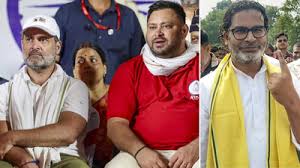
In the lead-up to Bihar’s assembly polls, three major marches: Rahul Gandhi’s Voter Adhikar Yatra, Tejashwi Yadav’s Bihar Adhikar Yatra and Prashant Kishor’s Jan Suraaj Padyatra were expected to energise the opposition and reshape the election narrative. All three drew large crowds and garnered a lot of attention. Yet, when the votes were counted, none of these grand yatras translated into electoral gains. The BJP-led NDA romped home with over 202 seats out of 243, consigning Congress and its allies to a crushing defeat. The INDIA bloc’s ambitious marches proved ineffective: Rahul Gandhi’s Voter Adhikar Yatra did not prove to be a trump card, and its message of “vote theft” remained largely irrelevant in Bihar politics. Likewise, Tejashwi Yadav’s tour failed to expand his party’s base, and Kishor’s two-year-long trek ended without a single Jan Suraaj victory. In short, symbolism could not substitute for organisation in Bihar’s rugged electoral terrain. Yatras: A time-honoured tool of Indian politics Pan-India “padayatra” has long been a favourite strategy for politicians seeking to connect with voters. And they are suddenly all the rage in politics, with leaders across parties taking to the road in dramatic, high-octane treks. Rahul Gandhi helped revive the trend with his Bharat Jodo Yatra in 2022–23, walking nearly 4,000km from Kanyakumari to Srinagar, followed by the far longer Bharat Jodo Nyay Yatra earlier this year. Hot on his heels came Tamil Nadu BJP chief K Annamalai, whose En Mann, En Makkal journey criss-crossed 10,000km and ended with a grand finale attended by the Prime Minister. TDP’s Nara Lokesh completed his own youth-focused Yuva Galam, insisting it was more about listening than winning. Such yatras can energise party cadres and highlight campaign themes. The yatras can be termed as “sanjivani” (life-giving) for parties, refreshing the organisation and giving campaigns a solid foundation. In Bihar, where rural networks and caste ties are crucial, parties often deploy yatras to visit far-flung villages and rural clusters. A well-timed yatra can build momentum by showing unity and giving voters a sense of participation. Yet this year, spectacle without substance was no match for the NDA’s disciplined strategy. Despite the grand fanfare of these three yatras, Bihar’s electorate delivered a very different verdict. Rahul Gandhi’s Voter Adhikar Yatra Rahul Gandhi’s Voter Adhikar Yatra (August–September) was hyped as a campaign to protect voter rights. Covering over 1,300 km across 25 districts and more than 100 constituencies, Rahul donned Bihar’s cultural symbols, the gamcha scarf, a cap and attacked alleged “vote chori” (vote stealing) and the state’s Special Intensive Revision of rolls. The march began with impressive crowds, especially in Sasaram, and projected Congress’s return to rural areas. However, from the very start, it was clear that public enthusiasm would not last. In the ensuing weeks, energy fell sharply. The yatra began with strong crowds, but as the campaign moved forward, the initial spark faded. Congress leaned heavily on the yatra’s symbolism but failed to build an effective ground organisation. Outside of a few big rallies, senior Congress leaders were largely absent, and booth-level mobilisation was weak. Rahul’s strategy focused obsessively on national issues like electoral rolls, which did not strike a chord with most Biharis. Ordinary voters were more concerned with jobs, inflation and local governance than allegations of “voter chori.” Rahul Gandhi and Tejashwi Yadav during Voter Adhikar Yatra Rahul’s campaign squandered precious time attacking the Election Commission, and the shift backfired. After rallying around national narratives, Congress’s messaging was drowned out by local realities it failed to read. By election day, Congress only won 6 seats out of 61 contested: a miserable 10% success rate. Rural crowds did not turn into rural votes. Internal alliance tensions didn’t help either: Rahul kept a distance after the Yatra and reappeared only weeks later, and the absence of sustained leadership further undermined Congress. Meanwhile, Bihar’s ruling BJP and JD(U) gleefully declared Rahul’s march a flop show. Their taunts echoed the ground reality: for all its high production values, the Voter Adhikar Yatra failed to translate into votes for Congress, leaving the party facing one of its worst-ever Bihar results. In short, Rahul’s narrative of “vote chori” and his focus on fighting SIR proved largely irrelevant to the Bihar electorate. His Yatra simply did not prove to be a trump card. Tejashwi Yadav’s Bihar Adhikar Yatra Tejashwi Yadav’s Bihar Adhikar Yatra was launched on September 16, almost immediately after Rahul’s tour. Setting out from Jehanabad, Tejashwi promised to challenge the Nitish Kumar government on unemployment, crime and local grievances. The yatra was partly pitched as filling gaps left by Rahul’s march; RJD officials openly said they covered districts left out of the Voter Adhikar Yatra. By highlighting issues in RJD strongholds: Jehanabad, Nalanda, Supaul, Saharsa and others. Tejashwi aimed to consolidate his party’s core vote and signal that the RJD was the main force in the INDIA bloc. He also used the trip to assert himself: earlier, he had declared he would contest all 243 seats, underlining his claim to be the alliance’s undisputed leader. In theory, Tejashwi’s focused effort should have solidified his social coalition and countered anti-incumbency. In practice, it barely made a dent outside his base. By election day, the RJD had outperformed Congress, but only marginally: the party was on course for about 25 seats, far below its 75 in 2020. Tejashwi failed to convert the momentum and anti-incumbency wave against Nitish Kumar into actual votes, leaving the RJD with its second-worst tally ever. The much-heralded yatra vision of reaching every village did little to overcome the RJD’s narrow caste profile. Most communities beyond the Muslim–Yadav base remained unconvinced, and even within the RJD, ticket distribution caused resentment. Seat-sharing disputes led to friendly fights where opposition partners split the anti-NDA vote. In the end, Tejashwi’s personal crusade could not overcome these structural flaws. The RJD held on to pockets of support but did not expand beyond its traditional base. The youth-versus-experience narrative he touted collapsed under the weight of Nitish Kumar’s intact governance credentials
‘Not the one to blackmail Congress’: DK Shivakumar slams leadership change speculation in Karnataka
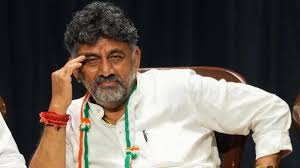
BENGALURU: Karnataka deputy chief minister D K Shivakumar has dimissed speculation that he was preparing to step down as the state Congress president, stressing that he remains a “disciplined soldier” of the party. His remarks came amid renewed chatter about a possible reshuffle in the Siddaramaiah cabinet following the chief minister’s meeting with Rahul Gandhi a day earlier, according to news agency PTI. Shivakumar said that any decision on cabinet changes is entirely up to Siddaramaiah and will be made only after consulting the party’s central leadership. He added that his visit to Delhi was mainly to invite Rahul Gandhi and Congress president Mallikarjun Kharge to the foundation stone ceremony for 100 new Congress office buildings in Karnataka. “There is a foundation-laying ceremony and several other events. Who will handle all of that? I have to do it. Why would I say I will resign (as state Congress president)? That situation hasn’t arisen yet,” he told reporters, rejecting the speculation circulating in political circles. Reaffirming his commitment to the party, he said, “I am dedicated to serving the party as a disciplined soldier, doing whatever tasks are assigned to me.” He also criticised the media for fuelling rumours, saying, “I am not the one to blackmail the Congress. I have built this party and worked tirelessly day and night for it. I will continue to do so in the future. Our party will return to power (in Karnataka) in 2028.” In addition to the office inauguration plans, Shivakumar is set to release his book Gandhi-Bharat, which revisits the historic Belagavi Congress session led by Mahatma Gandhi and the party’s centenary commemoration. Meanwhile, home minister G Parameshwara said the party was considering only a cabinet reshuffle and ruled out any change in leadership. Siddaramaiah, speaking in Delhi, maintained that there had been no discussion on a reshuffle and said his talks with national leaders were focused on the Bihar election results. Courtesy : TOI Note: This news is originally published on https:/timesofindia.com/bha and is used purely for non-profit/non-commercial purposes, especially human rights
TMC accuses BJP of being ‘anti-tribal anti-dalit’ alleges rise in crimes against STs
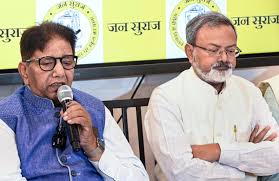
Kolkata, (PTI) Stepping up its attack on the BJP governments at the Centre and in states, the Trinamool Congress (TMC) on Saturday accused the party of being “anti-tribal” and “anti-Dalit”, alleging that crimes against Scheduled Tribes (STs) had risen sharply in saffron party-ruled states. In a post on its official X handle, the party claimed crimes against adivasis had shot up by a staggering 90 per cent from 6,827 cases in 2014 to 12,960 cases in 2023. “In just one year, between 2022 and 2023, crimes against STs skyrocketed by 28.8 per cent, with the crime rate surging from 9.6 to 12.4,” the party said. The party asked, “Where are Tribals the most unsafe? Not Bengal. But Manipur and Madhya Pradesh, both proudly governed by BJP,” alleging that BJP-ruled states accounted for the “worst atrocities” against tribal communities. “In Madhya Pradesh’s Sidhi, a BJP leader was caught on camera commiting atrocities on a tribal youth. In Bengal, BJP’s own LoP @SuvenduWB has proudly declared that respected Tribal leaders like Debnath Hansda and Birbaha Hansda are ‘infants’ who belong under his boots,” the TMC said in the post. “After this mountain of hate, humiliation and violence, how does the BJP dare to lecture Bengal?” the party asked, alleging that the double-engine government used adivasi lives as “political props”. In another post, the TMC accused BJP leaders like Amit Malviya of launching “an anti-Bengali campaign”, branding him as an outsider. “So now @BJP4India wants to decide who is ‘Bengali’ and who is not? Your UP-born @amitmalviya is the same man who insulted and questioned the Bengali language, claiming “there is, in fact, no language called Bengali”. Accusing Malviya of repeatedly painting Bengalis as infiltrators and Bangladeshis, the TMC described BJP as a party parachuting outsiders into Bengal politics and appointing outsiders like Bhupendra Yadav and Biplab Deb as “election in-charge”. “When it suits BJP, outsiders are leaders. When it doesn’t, even Bengalis are ousiders,” the post said. The TMC said Bengal does not need BJP’s certificate to decide who belongs here as “your hate-driven narrative won’t work here.” (This story has not been edited by THE WEEK and is auto-generated from PTI) Courtesy : The Week Note: This news is originally published on https:/theweek.com/bha and is used purely for non-profit/non-commercial purposes, especially human rights
Man gets 10yrs in jail for raping, holding Dalit girl captive for 45 Days
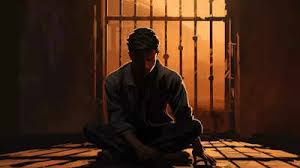
Agra: A 36-year-old man has been sentenced to 10 years of rigorous imprisonment for raping and holding a 15-year-old Dalit girl, a Class 9 student, captive for 45 days in Aligarh district in 2017. The court of additional district and sessions judge (Posco) Anil Kumar also imposed a fine of Rs 50,000 on the convict. Of this, Rs 25,000 has been directed to be given to the girl as compensation, special prosecution officer (SPO) Lalit Singh Pundir said on Saturday. The prosecution said the incident took place on Aug 16, 2017. The girl’s mother reported that her daughter had gone missing after leaving home to buy milk. She was abducted by two men who took her away in an e-rickshaw and handed her over to the convict, a daily-wage labourer from the girl’s locality. In her statement, the girl said, “The man offered her a cold drink that rendered her unconscious. She later woke up in a room in Ghaziabad, where she was held captive for one and a half months, repeatedly raped and beaten. The man also used casteist slurs and threatened to kill her if she reported the matter to the police. She eventually escaped one day when he was away at work”. The girl was taken for a medical examination and the man was sent to jail. A chargesheet was filed under IPC sections 376 (rape), 363 (kidnapping) and 366 (kidnapping or abducting a woman for illicit intercourse), along with relevant provisions of the Pocso Act and the SC/ST (Prevention of Atrocities) Act. The court found the evidence against the man compelling and convicted him on Friday. Two other accused were given a clean chit during the investigation, the SPO said. Courtesy : TOI Note: This news is originally published on https:/timesofindia.com/bha and is used purely for non-profit/non-commercial purposes, especially human rights