
Dalit Wedding Procession Attacked in Aligarh After Dispute Over Song, FIR Filed
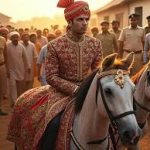
A Dalit wedding procession was allegedly attacked in Sunana village, Aligarh, after a dispute over a DJ song led to stone pelting and vandalism. A Dalit wedding procession was allegedly attacked in Sunana village of Aligarh on Tuesday night after a dispute broke out over a song played during the baraat. The incident led to stone pelting, vandalism and tension in the area under Jawan police station limits. According to police, the clash took place around 9.15 pm when the procession was passing through a locality of another community. Officials said a song perceived as caste-based and objectionable was played on the DJ system, which triggered objections from locals. The situation soon escalated into violence, with members of both sides allegedly attacking each other with sticks and stones. Videos of the clash later went viral on social media. Police Say Song Triggered Dispute Superintendent of Police City Mrigank Shekhar Pathak said a preliminary inquiry suggested that the conflict began after a participant in the procession played a provocative song through a mobile phone connected to the DJ system. “When a member of the baraat played a song intended to stir up caste-based feelings, it was objected to by members present there. Police reached the spot, pacified both sides and provided security to the procession,” Pathak said. He added that the baraat was safely escorted to the wedding venue and no injuries were officially reported. “Peace has been restored in the village. A case has been registered, and those involved are being identified for strict action,” he said. Sub Inspector Ghanshyam Singh, in his complaint, stated that when the procession entered the locality, an unknown baraati played an objectionable song. “People objected, and some unknown persons attacked each other, abused each other and used sticks. Nearby houses were also vandalised. The incident created panic and disturbed law and order,” he said. Police have seized video footage and the audio track for investigation. An FIR has been registered against unidentified persons under several sections of the Bharatiya Nyaya Sanhita, including rioting, voluntarily causing hurt, intentional insult to provoke breach of peace, criminal force and mischief, along with provisions of the Criminal Law Amendment Act. Family Alleges Targeted Attack However, family members of the bride have alleged that the procession was attacked without provocation. Anees Kumar, the bride’s brother, claimed that miscreants armed with sharp-edged weapons targeted the baraat. He said the wedding party could move forward only after police intervention. In another viral video, a participant in the procession accused members of the Thakur community of pelting stones at the Dalit wedding procession. He alleged that the attack reflected growing caste tensions. Political Reactions Chandra Shekhar Azad, chief of the Bhim Army, condemned the incident and termed it serious. He alleged that the procession was attacked with sticks and other weapons, and that casteist slurs were used. Police have deployed additional forces in the village to maintain law and order. Officials said the situation is currently peaceful, and efforts are ongoing to identify those involved in the clash. Courtesy : TOP Note: This news is originally published on https:/theobserverpost.com/bha and is used purely for non-profit/non-commercial purposes, especially human rights
Rahul Gandhi to visit Telangana on March 2, to address new DCC chiefs
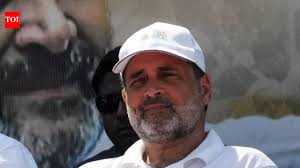
Hyderabad: Senior Congress leader Rahul Gandhi is likely to visit Hyderabad on March 2 as part of the party’s organisational push in the two Telugu states. As per the tentative schedule, the Leader of the Opposition in Lok Sabha will arrive at the Rajiv Gandhi International Airport at Shamshabad on Monday and proceed to Vikarabad to attend a training camp for the newly appointed District Congress Committee presidents. The DCC presidents from Telangana and Andhra Pradesh are undergoing a 10-day training programme. Rahul Gandhi will address them at the valedictory session of the programme and is expected to give a roadmap to the new DCC chiefs to further strengthen the party at the grassroots levels. During the visit, chief minister A Revanth Reddy is expected to discuss with him the upcoming election to the two Rajya Sabha seats in Telangana, the finalisation of candidates, and the development works being taken up by the govt in the run-up to Telangana Formation Day on June 2. Other political and organisational matters are also likely to be discussed. Meanwhile, sources have not ruled out the possibility of Rahul Gandhi visiting the state again in the second or third week of March to address a public meeting in Mulugu district. The Telangana Congress is planning to organise a public meeting as part of the AICC’s call for a nationwide protest against the G Ram G Act. Panchayat raj minister D Anasuya alias Seethakka represents the Mulugu Assembly constituency. The AICC has appointed her as a core member of its MNREGA Bachao Sangram committee. Also, the Mulugu district has a large number of people who are enrolled under MNREGA. Though Rahul Gandhi’s visit on March 2 was confirmed by his office, TPCC leaders said they have received only a tentative green signal about his participation in the proposed public rally in Mulugu. Courtesy:TOI Note: This news is originally published on https:/timesofindia.com/bha and is used purely for non-profit/non-commercial purposes, especially human rights
Rahul, Kharge to attend farmers’ conference in Sriganganagar proposed on March 9

Jaipur: The Rajasthan Congress would launch an agitation against the Centre’s trade deal with the United States with a farmers’ conference in Sriganganagar on March 9, Congress state president Govind Singh Dotasra announced Wednesday. Congress national president Mallikarjun Kharge and Leader of Opposition in the Lok Sabha Rahul Gandhi are scheduled to address the conference, which the party says will mark the beginning of a statewide campaign against the agreement. Dotasra alleged that Prime Minister Narendra Modi had accepted the trade deal “under pressure from the US” and claimed it would harm the interests of farmers, traders, industrialists, entrepreneurs, and handicraft artisans in Rajasthan. “The PM made a trade deal with the US, compromising the interests of the country’s farmers, which the party will oppose,” Dotasra said. “Congress workers are committed to taking every possible step and struggle to protect the interests of the country’s farmers and traders.” Dotasra said Congress workers would reach out to farmers and traders “affected by the American trade deal” and “expose the decision taken by the Centre against national interest”. Courtesy : TOI Note: This news is originally published on https:/timesofindia.com/bha and is used purely for non-profit/non-commercial purposes, especially human rights
On whose orders will you strike a deal with Israel, Rahul asks Modi
NEW DELHI: Congress MP Priyanka Gandhi Vadra on Wednesday expressed hope that PM Modi will raise the Gaza genocide and demand justice for Palestinians in his address to the Israeli Knesset. “India has stood for what is right throughout our history as an independent nation, we must continue to show the light of truth, peace and justice to the world,” she wrote on X. Congress neta Rahul Gandhi, referring to Epstein Files, poked fun at the PM that “at least once, you’ve already ‘danced and sung’ in Israel at Epstein’s behest – so this time, on whose orders will you strike a deal against the country’s interests?” With a colourful movie-like parody poster headlined ‘Jeffrey Ne Bana Di Jodi’ as the backdrop, Congress spokesman Pawan Khera cited email exchanges made public under Epstein Files to allege that the foundation of the India-Israel relationship post-2014 was laid down and shaped by convicted sex offender Jeffrey Epstein. “The foundation of India-Israel ties post-2014 was laid down by Jeffery Epstein… (former Israeli PM) Ehud Barak, Jeffery Epstein, Hardeep Puri…this is how our foreign policy was shaped,” he said. Courtesy : TOI Note: This news is originally published on https:/timesofindia.com/bha and is used purely for non-profit/non-commercial purposes, especially human rights
Kharge family has meted out injustice to Dalit leaders, says Chalavadi Narayanaswamy
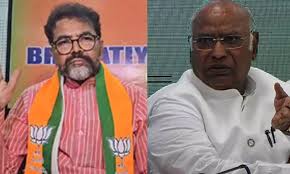
The Leader of Opposition in the Council says the Kharge family has deprived many Dalit leaders, including himself, of opportunities Leader of Opposition in the Legislative Council Chavaladi Narayanaswamy has said that the Kharge family has snatched away opportunities of many Dalit leaders, including himself. Speaking to presspersons in Dharwad on Tuesday, he took exception to Minister Priyank Kharge terming him an opportunist and said that the Kharge family has deprived him of opportunities he deserved after his four decades of service to the Congress. “Your (Priyank Kharge) father has been in politics for six decades and there is no example of him grooming a Dalit leader,” he quipped. Mr. Narayanaswamy also said that several Dalit leaders, including three-time legislators Prasad Abbayya, A. Narayanaswamy, P.M. Narendraswamy and Shivanna, have been sidelined in the Congress. “On other hand, Priyank Kharge, who has won three times, has been made a Minister on all three occasions,” he said. He also said that in Kalaburagi, the former Chief Minister N. Dharam Singh’s son has been politically suppressed by the Kharge family. Mr. Narayanaswamy also sought an answer from Priyank Kharge about allegations of them amassing wealth. The Hindu Bureau Courtesy : The Hindu Note: This news is originally published on https:/thehindu.com/bha and is used purely for non-profit/non-commercial purposes, especially human rights
Former JNUSU president files complaint over VC’s alleged remarks on Dalits
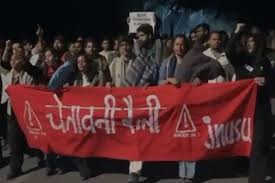
Dhananjay, former President of the Jawaharlal Nehru University Students Union (JNUSU) for 2023-24, has lodged a complaint with the National Commission for Scheduled Castes (NCSC) against JNU Vice Chancellor Santishree D. Pandit regarding allegedly hateful statements made on a public platform. The complaint asserts that the Vice Chancellor’s remarks fostered feelings of enmity, hatred, and ill will towards the Dalit community. The complaint contends that these remarks violate the Scheduled Castes and Scheduled Tribes (Prevention of Atrocities) Act, 1989, which was enacted to prevent atrocities and hate crimes against Scheduled Castes and Scheduled Tribes. The Act criminalises acts that insult, humiliate, or engender social hostility against these communities and includes provisions for immediate investigation and legal recourse to protect their rights and dignity. The petition seeks the NCSC’s immediate intervention for the registration of a case under the SC/ST (Prevention of Atrocities) Act, 1989, the initiation of an investigation by an independent committee, and disciplinary and legal action against the Vice Chancellor, including her removal from office. The complainant stressed that the Vice Chancellor has not issued an apology, reinforcing the view that the remarks were intentional and designed to encourage discrimination. On Sunday, Vice Chancellor Santishree D. Pandit defended her comments concerning Dalits and Blacks, stating that her remarks were taken out of context and misrepresented for “political purposes” by certain groups. Her statement followed protests by student organisations, including the JNUSU, demanding her resignation over comments made during a podcast published on February 16. In a written statement shared with ANI, the Vice Chancellor noted that “a large number of faculty” members expressed their “unwavering support” for her, accusing the JNUSU and the JNU Teachers’ Association (JNUTA) of undermining deliberative discourse on campus through selective framing. The controversy arose from Pandit’s remarks on the podcast while discussing the University Grants Commission’s proposed 2026 Equity (Anti-Discrimination) Regulations aimed at addressing caste-based discrimination in higher education. A clip circulating online records her stating that Dalits and Blacks “cannot progress by being permanently a victim or playing the victim card,” which sparked strong reactions from student groups. Courtesy : The News Mill Note: This news is originally published on https:/thenewsmill.com/bha and is used purely for non-profit/non-commercial purposes, especially human rights
Karnataka: Dalit couple worships at temple after Tehsildar’s intervention
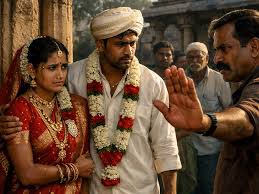
The Tehsildar warned that strict action will be taken if such atrocities occur in the taluk in the future. Tumakuru: A peace meeting was held regarding the incident of a newly married couple from the Dalit community being thrown out of a temple. Following the meeting, Turuvekere Tehsildar M.N. Kum E. Ahmed allowed the abused couple to enter the temple. A peace meeting was held in the village on Tuesday regarding the incident that occurred on February 19th in Goni Tumakuru village of Turuvekere taluk. The peace meeting was successful. Furthermore, Tehsildar Ahmed held the newly married couple’s hand and led them inside the Arasamma Devi temple, putting an end to the conflict between upper castes and Dalits. A Dalit newly married couple visited the village deity amidst police cordon. The Tehsildar warned that strict action will be taken if such atrocities occur in the taluk in the future. The Tehsildar stated that the government temple is not anyone’s property and everyone is allowed to enter the temple without restriction, which belongs to the Muzrai Department. He advised the villagers to maintain harmony among themselves. An awareness program is underway. Strict legal action will be taken against anyone found engaging in foolish rituals or illegal activities. Any kind of untouchability or caste-based abuse is a crime under the law. Everyone should be allowed to enter and exit the temple without restriction. If such incidents occur again in the future, strict action will be taken. We will set up a camp here. As part of the awareness campaign, the district administration will also perform a drama. Several officials, including the District Magistrate, will be present. Please cooperate with the villagers. Tehsildar Ahmed stated that some people have been arrested in connection with the incident, and the police are conducting further investigations. Taluk Panchayat Executive Officer Anantharaju, Conservation Sub-Inspector T. Murthy, Assistant Director of the Social Welfare Department Shivalingaiah, Assistant Engineer of the Public Works Department Kanmani, Panchayat Development Officer Suresh, Revenue Inspector Rangaswamy, Kasaba Hobli Revenue Inspector Jagadeesh, State Intelligence Department Rajkumar, Priest Nanje Gowda, Social Welfare Department employees Dhananjay and Kiran Kumar, Village Administrative Officer Mallick, and other villagers were present on the occasion. What was the matter: A newly married couple from the Dalit community in Goni Tumkur village alleged that they were not only prevented from entering the temple but also subjected to caste-based abuse. Based on a complaint from a person, a case has been registered at the Turuvekere police station under the SC/ST Atrocities Act. The victims stated in their complaint that as soon as they entered the temple, some people insulted them and threw them out. Courtesy: Hindi News
Social stigma and data gaps limit transgender enumeration in India, complicating the State’s policy design

In January 2026, the Karnataka government announced findings from a statewide survey on transgender persons. This is undeniably significant because the National Family Health Survey (2019-21) and the Periodic Labour Force Survey do not even enumerate transgender persons as a distinct demographic category, despite their recognition as a separate gender category by the Supreme Court of India. The recent Karnataka survey identified 10,365 transgender persons in the state, which is, however, only about half the population recorded in the 2011 National Census. It also significantly diverges from estimates produced by other datasets. Electoral data from the Karnataka assembly elections (2023) listed 4,927 registered transgender voters, while Election Commission figures from the 2024 Lok Sabha polls recorded 5,012 transgender electors. In contrast, community activists’ macro-estimates for 2024-25 place their population at over 200,000. A recent ethnographic study conducted as part of an ongoing project at the Institute of Social and Economic Change (ISEC), Bengaluru, finds an approximate estimate of more than 300,000 transgender people in Karnataka. Inconsistencies are visible in other state datasets as well. The statewide transgender survey conducted in Kerala (2014-15) estimated their population at over 25,000, which is an exponential divergence from the mere 3,902 persons recorded in the 2011 Census. These inconsistencies across surveys signal layered processes of undercounting, which deepens the statistical opacity surrounding transgender population in India. Thus, what is at stake is not merely demographic precision but persistent data inconsistency that shadows transgender realities in India. The questions that arise are: why do transgender populations appear differently across datasets? And why do the State and its enumeration regimes continue to find transgender populations difficult to count? Why do the numbers differ? The first explanation lies in methodology. Typically, population surveys rely on door-to-door enumeration, simultaneously mapping spatial coverage and demographic triangulation across documentation systems. In contrast, relying on community outreach and voluntary disclosure makes surveys contingent on network reach and willingness to self-identify. This introduces data distortions: those outside welfare databases, facing bureaucratic barriers in updating certificates, or geographically dispersed beyond outreach clusters risk exclusion. The dataset thus becomes vulnerable to network reach and assumptions of homogeneous identity assertion, rather than ground realities. The second explanation lies in definitional rigidity. Due to the Euro-American origin of the term ‘transgender’, many local non-binary identities do not neatly fit into this category. Therefore, who is counted as transgender varies across categories, welfare eligibility criteria, medical certification regimes, and community self-identification practices. Moreover, there are significant variations in terms of individuals who currently identify as transgender; those who transition into binary male or female identities after medical or social transition; andthose who occupy a liminal space within ritual and cultural frameworks. Thus, rigid definitional categories struggle to resolve who counts. In turn, it becomes a regulatory act to compress the very population into homogeneity, which it claims to represent. Third, stigma shapes participation. Uneven response rates, due to a wariness of being included in state databases, are widely acknowledged as a structural challenge in surveys that involve gender minorities. Disclosure can carry perceived risks, ranging from employment precarity and housing discrimination to heightened institutional scrutiny. For transgender community, where historical interactions with the State have been marked by surveillance, exclusion, or bureaucratic friction, willingness to self-identify within official data systems remains understandably uneven. Fourth, in states like Karnataka that experience a high rate of migration and mobility, demographic capture is bound to be complex, especially for transgender communities who often have limited access to structured labour markets. Consequently, they often inhabit circulatory geographies, moving between districts, informal economies, and seasonal labour networks. Thus, typical survey methods struggle to capture populations that are spatially fluid and temporally mobile. Finally, household rejection produces statistical erasure. A significant proportion of the transgender population lacks family acceptance. Expulsion from natal homes pushes them into alternative kinship structures unrecognised by typical survey methods, rendering them demographically invisible. These discrepancies are not technical errors. They emerge from structural conditions that make transgender lives difficult to enumerate within conventional demographic frameworks. It is also precisely what makes enumeration consequential to frameworks of recognition, resource allocation, and policy design. Beyond the statistics Counting matters because numbers produce policy legitimacy. Welfare boards require demographic baselines, reservations depend on quantification, and budget allocation follows population scale. Therefore, any survey of the socially and historically marginalised transgender communities must move beyond extraction towards collaboration. Such an enumeration requires partnership with community networks, involving experts, and most importantly, recognising the dynamic forms of transgender identity and a method that is informed by their realities. Without such shifts, surveys risk becoming instruments of symbolic inclusion rather than structural transformation. While the Karnataka survey signals administrative willingness to map the welfare needs of the marginalised and produce targeted interventions, which is welcome, it also reveals the epistemic limits of demographic knowledge itself in other Indian states. Transgender lives exceed the statistical frames designed to contain them. They move across everyday experiences of precarities, kinship reconfigurations, and identity transitions that resist bureaucratic fixity. Enumeration, in this context, becomes necessary, but often insufficient. There is already a lot of work in trans scholarship which argues that AI’s facial recognition software is a regulatory regime for trans people and how it perpetuates biases. The noted inadequacies in transgender enumeration undermine the sustainable formulation of economic, housing, and social policies for them, which are missing in most Indian states. But Karnataka and Kerala provide examples for other Indian states to follow, not only to make these populations inclusive but also to contain inconsistencies in their counting, as most states move to present their budgets. Swarupa Deb Kala S Sridhar (The writers are, respectively, a post-doctoral scholar and a professor at the Institute for Social and Economic Change) Disclaimer: The views expressed above are the author’s own. They do not necessarily reflect the views of DH. Courtesy : DH Note: This news is originally published on https:/deccanherald.com/bha and is used purely for non-profit/non-commercial purposes, especially human rights
Proud of ‘babbar shers’ of Youth Congress: Rahul on AI meet stir
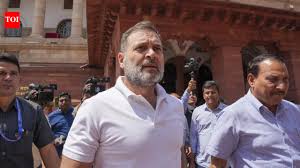
NEW DELHI: Breaking his silence on the protest at the AI Summit venue that has resulted in a police crackdown on members of Indian Youth Congress, Congress’ Rahul Gandhi Tuesday said he is proud of the “babbar shers” of Youth Congress who protested against the “compromised PM” in national interest. The remark came as Delhi Police arrested IYC members. Congress chief Mallikarjun Kharge condemned the arrests, while Rahul called them evidence of a dictatorial attitude and cowardice. “Congress strongly stands by the lion-hearted members of Youth Congress. Showing the mirror of truth to power is not a crime but a patriotic act,” he posted on X. Rahul said the IYC members were arrested for exposing truth about the deal with US. Kharge remarked, “Congress is never scared, Congress workers are not cowards. Modi is a coward. He is so paralysed by fear that he is unable to come to parliament to defend his govt’s policies.” Rahul has turned Cong into a joke: BJP Rahul Gandhi has reduced himself and Congress to a “running joke”, BJP said Tuesday, alleging that he exemplifies anarchic conduct, even as it rejected his reiteration of the “surrender” allegation against PM Modi over the trade agreement with the US. “The way he was spewing venom against PM Modi in MP today was not just indignified and undemocratic but also anarchic,” BJP MP Bansuri Swaraj told reporters and wondered if Rahul has become a “mouthpiece of anti-India forces”. “His statements reflect nothing but ignorance. He is behaving like an uninformed, immature and stubborn child,” she said. Courtesy : YOI Note: This news is originally published on https:/timesofindia.com/bha and is used purely for non-profit/non-commercial purposes, especially human rights
Rahul dares PM to scrap Indo-US trade deal
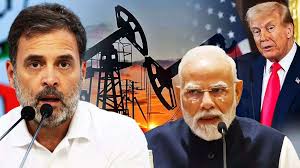
Bhopal: Congress leader Rahul Gandhi on Tuesday said the India-US interim trade deal was sealed under “pressure” and dared PM Narendra Modi to cancel the “anti-farmer” agreement in the wake of the US Supreme Court invalidating global tariffs. “This is not a deal, this is like an arrow struck right in the heart of the farmer,” he said. The PM is “acting under the pressure of President Donald Trump because of the Epstein files and to save industrialist Gautam adani against whom there is a criminal case pending in the US”, Rahul said in his address at Congress’s first ‘Kisan Maha Chaupal’ in Bhopal in Madhya Pradesh — India’s leading soyabean producing state. The chaupal is part of the party’s national outreach against the deal. Through the trade deal, the PM has compromised the interests of India’s agriculture, textile, data and import sectors, he alleged. The roadmap on the outreach was announced last week by Congress at a meeting where party president Mallikarjun Kharge and Rahul met leaders from J&K, Himachal Pradesh, Bihar, Rajasthan, Maharashtra and Madhya Pradesh. Congress has claimed that these states will be the “most adversely” affected by the trade deal. The next chaupal will be held in Yavatmal on March 7 before Parliament reconvenes on March 9 for the second part of the budget session. The third congregation is planned in Rajasthan’s Sriganganagar. Building on Rahul’s attack on the govt, Kharge accused Modi of being a “cowardly PM” and the trade deal as a “surrender” by the govt. In the backdrop of the arrests of Youth Congress members over their shirtless protests at the global AI summit in Delhi last week, Kharge went all all out to “congratulate” them “for standing firm and confronting Modi, and drawing attention to the situation of the youth in the face of challenges such as unemployment”. “When you (PM) pledged our pride at Trump’s feet (through the deal), that very day our honour was lost,” Kharge alleged. Courtesy : TOI Note: This news is originally published on https:/timesofindia.com/bha and is used purely for non-profit/non-commercial purposes, especially human rights