
What happens when Dalit Women lead Dalit movements?

A reflection from the first ever Dalit Literature Festival in Chicago It’s been a whirlwind of a Dalit History Month in April! I wrote several pieces for major publications, traveled to Chicago for the first ever (!) Dalit Literature Festival and then again to Syracuse to deliver a keynote at the South Asia’s Publics Symposium at Syracuse University. Many of you might also know that I’ve been involved with the efforts around the New York State Caste Bill, which is currently under consideration in state legislature and if passed could make New York the first state in the country to have caste protection laws in the books. So much has happened in the last few months and I can’t wait to update you all about it. But I want to start with the address for the panel on Gender and Caste, that I spoke in at the Dalit Literature Festival with Prof Shailaja Paik and Dr. Helen Chukka. Despite the provocation being on a slightly different subject, it was revealing that all three of us ended up addressing the same issue in our reflections — the state of Dalit women inside our own Dalit communities. Dr Paik — who I have written about on this Substack — talked about how Dalit women are often overlooked even within our own spaces, and ironically, how her work, which spans two decades became popular among Dalit communities only after she won the McArthur Foundation ‘Genius’ Grant. In my address, I wrote about the absence of Dalit women from leadership in movement spaces, barring a few prominent examples like Equality Labs’ Thenmozhi Soundarajan. This is also why I’m so thrilled to be among the leading voices on the New York Caste Bill, which is a Dalit femme led effort, introduced by firebrand Dalit lawyer, Swati Sawant and organized by community activists like Shalini (more on that soon). Me (left) with Swati Sawant and Pabitra Dash from Adhikaar at the AAARI CUNY Asian American Symposium on May 15 I’m grateful to my friend Pushkar Sharma from SACRED Chicago and Obed Manwatkar, along with the Midwest Ambedkarites, who organized this momentous gathering and invited me to participate in the festival. A special shoutout to Obed, who ensured that our voices were included as central to the celebration and who encouraged us as Dalit women, to speak our truth, even in the face of palpable discomfort. Here is the reflection in full: Dear friends, comrades and attendees at the first Dalit Literature Festival. I’m beyond honored to participate and be in conversation with Dr Shailaja Paik, Dr Helen Chukka and Kshitija Chavan, who is moderating today. Before we move ahead with the conversation, let me acknowledge the historic nature of this moment, where Dalit women and our voices are centered so assertively as part of this broader conversation of Dalit Literature. Dalit women have been historically marginalized not only within the larger Brahminical structures, within the Savarna feminist movement but also, and yes, there can be no better place to say it, even within mostly male-dominated Dalit spaces. Before we address the persistent focus on representation that become the precondition for a visible feminism in this neoliberal hellscape, I think it’s even more crucial for us to address the issue that is closer to all of us, both literally and figuratively. The presence and participation of Dalit women within Dalit spaces has no doubt increased over the last several years. The existence of this panel within this gathering is far from the only example. Yet, based on many experiences that I have both witnessed and undergone, it is safe to say that while Dalit women in movement spaces are encouraged, their leadership within our own communities is at best tolerated. The Dalit movement, as we know and understand it, takes shape in academia, as we are all gathered here to witness. But it also takes place on the streets, in community meetings, on social media and inside our homes. There have been countless instances where we find Dalit women expected to carry out the ‘consigned feminine’ roles of organizing events, cooking for gatherings, managing decorations but more or less excluded from rooms where decisions actually happen, and where their presence/our presence would challenge the gender dynamic that sadly still continues to take hold in our movement spaces. The panel on Caste and Gender at the Dalit Literature Festival in Chicago; Dr Shailaja Paik (left), Me, Dr Helen Chukka (center) and Dr Obed Manwatkar; April 18 Just a few weeks ago, the shocking story of Cesar Chavez, the pioneering movement leader of Latino Civil Rights and an enduring champion of farm workers broke in the New York Times. Chavez, whose work had elevated him to a godlike status within his communities, was accused of sexual abuse by several women and young children who had come in contact with him over the years, including by his closest aide and the co-founder of the United Farm Workers union he had founded, Dolores Huerta. The story which was published in the New York Times after five years of relentless investigative work highlights a chilling account of the ways in which Huerta and countless other women were silenced and ignored for years, just to preserve and maintain the legacy of what was then considered a fragile and deeply crucial movement. If you haven’t read that story, I would highly encourage you to do so. Not because there is a one-to-one parallel between that and what happens within our own movement spaces. But because it shows in incredibly clarifying detail, how marginalized women within movement spaces are devalued, ignored and forced maintain silence for quote, unquote the greater good. It forces us to question the deep discomfort we feel with contrarian ideas, especially when they are espoused and originated from women whose identities make them further marginalized in a group of already marginalized communities. And it makes us wonder about the instinctive knee-jerk reactions that we exhibit in respond to Dalit women
Dalits can’t be Tamil Nadu CM: VCK chief breaks silence over approach for top post
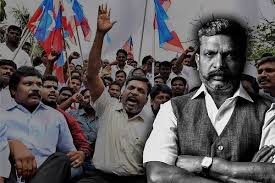
Viduthalai Chiruthaigal Katchi (VCK) chief Thol Thirumavalavan on Monday confirmed that “well-wishers and mediators” had approached him over the possibility of becoming Tamil Nadu Chief Minister, but said no formal discussions were ever held and no one officially sought his support for such a move. The remarks by the VCK leader come days after India Today reported that a rebel AIADMK leader had claimed the DMK proposed making Thirumavalavan the Chief Minister of Tamil Nadu, which would have made him the state’s first Dalit CM. Speaking after the floor test in the Tamil Nadu Assembly, rebel AIADMK leader C Ve Shanmugam had said the state got an “extremely rare chance” and an “unimaginable, impossible chance” for “someone from the Scheduled Caste community to become Chief Minister.” Responding to the controversy, Thirumavalavan said, “Well-wishers and mediators spoke but no one approached officially, forcing us to accept this decision and seeking support.” He added that certain mid-level leaders and supporters had questioned why a Dalit could not become Chief Minister. “Even my party general secretary put out a tweet but we said it is not right,” he said. Thirumavalavan also revealed that he was informed on the night of May 8 about comments surrounding the possibility of him becoming Chief Minister, but said he initially took it lightly. The VCK chief reiterated that his party had extended only outside and unconditional support to Tamilaga Vettri Kazhagam (TVK) for government formation. “I’ve said that we will not take part in the Cabinet while our party leaders are still wanting to,” he said. Reflecting on the broader social context, Thirumavalavan said Tamil Nadu, despite being described as a land of social justice and Periyar’s ideology, remained deeply affected by caste realities. “Tamil Nadu, even if you call it a social justice land or Periyar land, is caught in the grips of casteism. A Dalit cannot become a Chief Minister here that easily,” he said. Story by Pramod Madhav Courtesy : MSN Note: This news is originally published on https:/msn.com/bha and is used purely for non-profit/non-commercial purposes, especially human rights
Mahatma Gandhi and the Guruvayur struggle
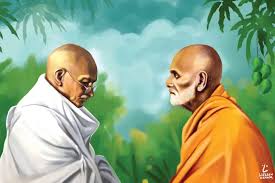
In this day and age when Guruvayur is a popular pilgrimage spot for people from all across India (and even Sri Lanka), it’s difficult to imagine that Dalits were not allowed into the Sree Krishna temple until June 1947. In 1936, the 24-year-old Maharaja Chithira Thirunal Balarama Varma passed the Travancore Temple Entry Proclamation decree, but this had no bearing on those who lived outside the princely state. Guruvayur was then in the Malabar district of the Madras province. The organised movement for Dalits, then called Untouchables, to enter the Guruvayur temple began with the 1931 Satyagraha led by K Kelappan and AK Gopalan, both Nairs. One of the biggest supporters of this non-violent movement was Mahatma Gandhi. In January 1933, the Manchester Guardian reported that Gandhi persuaded Kelappan to not fast, but said he himself would do so from the Yerawada Central Jail, if the upper castes remained adamant on denying Dalits entry to the temple. “Hinduism dies if untouchability lives, and untouchability has to die if Hinduism is to live,” Gandhi was quoted as saying by the United Press news agency. He said it would be “a living death” to witness the “degeneration” of the temple-entry movement, which he believed was “probably the biggest religious reform movement in India.” In the same period, C Rajagopalachari sent a cable to the Guardian where he said that the onus was on the British to implement legislation that banned discriminatory entry practices, as the temple was in the legal jurisdiction of British India. “Mr Rajagopalachari’s cable states that the Government is unwilling to permit the necessary bills to be introduced in the Legislature,” the Guardian said. “British authority is thus impeding the progress of social reform which Indian opinion demands,” the paper cited Rajagopalachari as saying. When Gandhi’s pleas from the Yerawada jail were falling on deaf ears, he proposed a makeshift compromise formula where the Guruvayur temple would allow entry to Dalits, and those who didn’t mind their presence, for a few hours a day. The idea was rejected by influential upper caste individuals, while the Zamorin (Samoothiri) of Calicut, the main patron of the temple, did not take a formal stand. “The Zamorin’s personal sympathies are believed to incline to the side of tradition, but on the question of temple entry, he has wisely taken up a neutral attitude and shelters himself behind the present state of the law, which makes it more than doubtful whether a temple trustee has any power to admit the untouchables into the precincts of a caste temple,” the Guardian added. The Mahatma’s activism towards social justice made him unpopular among a section of people in Kerala who wanted casteist practices to continue. A wire report from 1934 said Gandhi was given a “hostile reception” in Palghat (Palakkad). “Hundreds of Orthodox Hindus today greeted Gandhi’s arrival with black flags and cries of: ‘Go back, Gandhi. Your anti-religious propaganda is sowing the seeds of disunion and violence,’” the report said. The Palakkad protestors blocked Gandhi’s car by lying on the ground, and had to be removed by the police. Media reports of the time, however, seemed to suggest that a growing number of uppercaste Hindus supported Gandhi. The Guardian said “energy and enthusiasm” were on the Mahatma’s side. Guruvayur became a symbol of the movement for social justice in Kerala in that era. “Not that Guruvayur is a temple of extraordinary importance, but it is situated in the stronghold of orthodoxy and traditional Hinduism, the Malayali-speaking country (sic) on the southwest coast, where the pure castes are more more pure and the impure pollute at a longer range than in any other part of India,” the British paper said. The Travancore proclamation of 1936 did not lead to any similar changes in the Cochin state or the Malabar district. It would take another 11 years before Dalits in those parts of Kerala were legally allowed inside Hindu temples. Mahatma Gandhi was alive to witness these changes, but by that time, India was in the midst of the Partition and the communal violence and refugee crisis created by the division of the country. Gandhi’s 1933 statement about Hinduism and untouchability remains relevant all these decades later. It’s a shame that there are still temples in India that do not allow entry to Dalits, despite this being illegal. Caste discrimination in various other forms also lives on across the country- something the Mahatma would be deeply ashamed about. Ajay Kamalakaran Courtesy : ON manorama Note: This news is originally published on https:/onmanorama.com/bha and is used purely for non-profit/non-commercial purposes, especially human rights
“I’m sorry, you’re SC, we can’t hire you.” A young man in Haryana was fired from his job after being asked about his caste two hours after joining.

A Dalit youth in Panipat, Haryana, has leveled serious allegations against a private company. He claims he was fired from his HR position because of his caste. During the interview, the company owner and others abused him with caste-related slurs and pushed him. A complaint has been filed at Sector 13 and 17 police stations, and the police are investigating the matter. Panipat. A shocking incident has come to light in Panipat, Haryana, where a young man was fired because he belonged to the Dalit community. Rizul Kumar, a resident of Babarpur Mandi, said he was selected for the HR position after an interview at Ela Home Fashions Company on GT Road, Panipat. After his selection, Rizul was asked to meet the company’s General Manager. The youth went to the GM’s cabin to meet him. It is alleged that the General Manager asked about his caste instead of his qualifications. After providing his caste, Rizul returned home. About two hours later, the company official called Rijul and said, “I’m sorry, we can’t hire you. You belong to a Scheduled Caste. This isn’t covered by our policy.” Hearing this, the young man was shocked. The young man explained that when he went to the company with his sister to inquire about the reason for the dismissal, he and his sister were insulted with casteist slurs. The young man alleges that the company owner’s mother also used casteist slurs and pushed the two siblings out of the company. The victim went to Sector 13 and 17 police stations and filed a complaint against the company owner’s mother, the General Manager, and the HR for insulting him with casteist slurs. The station in-charge stated that the matter would be thoroughly investigated. The young man stated that his salary and all formalities had been completed. He alleged that the company promised to offer jobs based on caste. He said that he was stressed the entire night. The senior HR also made caste-related comments and even attempted to assault him. Reported by:Sumit Kumar Edited by:Vinod Kumar Katwal About the Author Vinod Kumar Katwal, a Season journalist with 14 years of experience across print and digital media. I have worked with some of India’s most respected news organizations, including Dainik Bhaskar, IANS, Punjab Kesari, and Amar Ujala. Currently serving as the Bureau Chief for Haryana and Himachal Pradesh, I lead and oversee comprehensive coverage across key regions, ensuring impactful, accurate, and timely reporting. With a strong command over political and crime reportage, I am passionate about in-depth storytelling, ground reporting, and delivering sharp, trustworthy journalism. Courtesy : Hindi News
Caste tensions flare up over temple entry in Kurnool
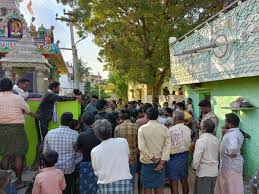
The incident once again highlighted the persistence of caste-based discrimination in rural areas despite constitutional guarantees of equality and social justice. KURNOOL: Tension prevailed in Juturu village of Patikonda mandal in Kurnool district after Dalits were allegedly prevented from entering a newly constructed Anjaneya Swamy temple by members of upper castes. Following complaints from affected families, police and revenue officials intervened to restore normalcy and ensure temple access for the Scheduled Caste community. Though the incident occurred on Saturday, it came to light on Monday after videos and messages related to the issue went viral on social media platforms. According to Patikonda DSP Venkataramaiah, the Revenue Divisional Officer and the DSP personally supervised the situation immediately after receiving information about the incident and arranged heavy police security at temple premises. Under tight police bandobast, Dalits entered the temple and offered special prayers in the presence of officials. The DSP said officials took adequate measures to prevent any untoward incidents and deployed a police picket in the village as a precautionary measure. The incident once again highlighted the persistence of caste-based discrimination in rural areas despite constitutional guarantees of equality and social justice. Courtesy : TNIE Note: This news is originally published on https:/thenewindianexpress.com/bha and is used purely for non-profit/non-commercial purposes, especially human rights
PHOTO ESSAY: A symbolic marriage ritual and beauty pageant brings India’s trans community together
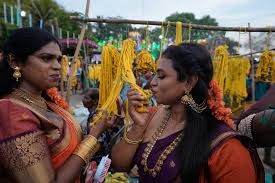
The Koovagam festival in Koovagam village, Tamil Nadu, India, is an annual gathering of transgender women to honor the Hindu deity Aravan, celebrate their identity and beauty, and find a sense of belonging. KOOVAGAM, India | Under stage lights, hundreds of transgender women adjusted their sarees, tucked flowers into their hair, and waited to be called onstage. One by one, they waved to cheering crowds and struck poses at one of India’s largest gatherings for the transgender community. Held each year in Koovagam village in southern India’s Tamil Nadu, the annual Koovagam festival brings faith and beauty together. By day, transgender women gather at a temple to honor a Hindu deity through rituals rooted in mythology and grief. By night, they celebrate glamour, identity, and joy as they take part in a vibrant beauty pageant. The festival centers on the Hindu legend of Aravan, a warrior from the Hindu epic Mahabharata who agreed to sacrifice himself before battle but wished to marry first. According to the story, the Hindu god Krishna transformed into a female form to wed Aravan. Many transgender women in India see the tale as a rare sacred recognition of gender fluidity, and each year reenact the marriage during the festival. The celebration, which drew hundreds of transgender women last month, has become both a sacred pilgrimage and a powerful expression of identity in a country where many transgender people still face discrimination, violence and exclusion. It also unfolded under a cloud of anxiety for the transgender community. Many attendees arrived amid growing concern over a controversial national bill that activists warn could erode hard-won rights for India’s transgender community by requiring medical-board approval for legal gender recognition. For many participants, the festival was deeply spiritual. Shanshi, who goes by just one name, has been attending the festival for five years and described Aravan as “God for all transgender people.” “When we gather here, it is for one reason — to worship Lord Aravan by getting married to him,” she said, after a Hindu priest tied a sacred thread around her neck, symbolically marrying her to the deity. Others spoke of violence and hardship beyond the festival grounds. Nazariya Kutty, 28, said she was forced out of her family home as a teenager and later survived domestic abuse and sexual assault in a marriage she hoped would bring stability. She rebuilt her life through delivery jobs before reopening her travel business. Now back at Koovagam with friends, she said the rituals give her strength. “I am waiting to be the bride of Lord Aravan,” Kutty said. “I have faith he will restore whatever I have lost.” Amid the festival’s spiritual fervor, the atmosphere remained celebratory. The village of Koovagam also transformed into a vibrant beauty pageant, where glamour and community took center stage. Backstage at this year’s beauty pageant, contestants in shimmering sarees shared mirrors and makeup brushes before stepping onto the stage as music echoed through the village. For 24-year-old Surya Kutty, winning the Miss Koovagam crown marked a personal turning point after years of returning to the festival with close friends. “This win has given me the confidence to participate in national and international events,” she said. Beyond the pageantry and rituals, many attendees described the gathering as a rare space of belonging for a community that continues to face barriers to jobs, housing and healthcare across India. Surya said the festival creates a rare sense of belonging. “Here we meet other transgender people and feel loved and cared by everyone,” she said. “These are special days meant exclusively for us.” Reported by SHEIKH SAALIQ Associated Press This is a documentary photo story curated by AP photo editors. Courtesy : Sentinel Note: This news is originally published on https:/sentinel.com/bha and is used purely for non-profit/non-commercial purposes, especially human rights
Ernakulam pins high hopes on UDF’s ‘power cabinet’
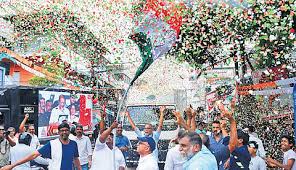
With CM from dist, a stronger voice in policy making is expected KOCHI: As Kerala steps into a new political era under Chief Minister V D Satheesan, expectations are running especially high in Ernakulam district, the state’s commercial hub that now enjoys unprecedented representation in the cabinet. From the long-pending Angamaly bypass, additional ring roads and stronger road-rail connectivity to the development of emerging urban centres like Muvattupuzha, residents and industry leaders are hoping the new government will finally fast-track projects that have remained on paper for years. With the chief minister himself representing the district, along with ministers Roji M John, Anoop Jacob and V E Abdul Gafoor, Ernakulam expects a stronger voice in policy making and infrastructure planning. The demand for improved connectivity has once again taken centre stage. Civic groups and planners argue that Kochi can no longer sustain rising traffic pressure without large-scale interventions including new bypasses, ring roads and alternative urban corridors connecting nearby towns. “The government should design a strategy to reduce pressure on the city. Along with the Sabari Rail project, a 50 to 60-metre-wide road should also be developed,” said V J Kurian, former managing director of Cochin International Airport Limited. “If such a high-speed corridor becomes a reality, it could significantly reduce congestion in the city. This will particularly benefit people travelling from Erumely,” he said. Kurian also stressed that development should not remain confined to Kochi.“There should be equal focus on developing cities like Muvattupuzha. After the airport, the Kochi Metro was the only major project Ernakulam received, and even that is yet to be fully completed,” he said. According to him, the long-pending Kundannoor-Angamaly bypass must figure among the government’s top priorities. Industry leaders, meanwhile, have highlighted the need to create a more business-friendly ecosystem in Kochi. Vinodini Sukumar, president of the Cochin Chamber of Commerce and Industry, said the government must focus on youth-centric initiatives and startup support. “Kochi has a large youth population and the government should introduce startup training programmes and youth-oriented initiatives,” she said. There is a growing trend of entrepreneurs starting ventures here but registering them outside Kerala because of the lack of a conducive business environment in the city, she added. D Dhanuraj, chairman of the Centre for Public Policy Research, stressed the need to improve urban living standards. “From water supply to roads and electricity, Kochi deserves focused attention as it hosts major institutions including Cochin Shipyard,” he said. Social activist Ranjith Thampi echoed similar concerns. “Infrastructure continues to be one of Ernakulam’s biggest concerns. The district needs more ring roads and better connectivity,” he said. “Now, with a minister from Angamaly in place, people are once again hoping the Angamaly bypass project will finally become a reality. There is also a growing demand for a second bridge connecting mainland Kochi and Bolgatty, which has long been a dream for many residents,” he added. What District wants Early completion of Angamaly bypass More ring roads and smoother connectivity Development of Muvattupuzha and eastern belt Better climate for startups and business Upgraded roads, water and transport infrastructure Abhirami Anil Courtesy : TNIE Note: This news is originally published on https:/thenewindianexpress.com/bha and is used purely for non-profit/non-commercial purposes, especially human rights
Stage overrun as massive crowd threatens to derail security protocol in Kerala
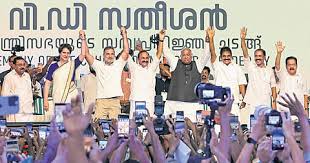
But for the Congress-led UDF, for whom the event marked a historic return to power after a decade, a restrained ceremony would have undermined the spirit of the occasion. THIRUVANANTHAPURAM: After the swearing-in ceremonies of the new governments in West Bengal and Tamil Nadu, all eyes were on whether Kerala too would opt for a flamboyant, festival-like spectacle or stick to the sombre tradition usually associated with such occasions in the state. When the protocol wing of the general administration department got in touch with Lok Bhavan, the latter preferred to follow convention – seating on the dais only for the governor, the ministers being sworn in and the chief secretary. But for the Congress-led UDF, for whom the event marked a historic return to power after a decade, a restrained ceremony would have undermined the spirit of the occasion. Late on Sunday, Chief Minister-designate V D Satheesan made a special request to Governor Rajendra Arlekar to permit additional dignitaries on the dais. “Though Satheesan initially preferred a simple ceremony, there was pressure from the AICC to ensure that Rahul Gandhi and other senior Congress leaders were accommodated on the stage,” said a source privy to the developments. “Since the governor did not want the new government’s tenure to begin on a sour note, he did not object to the chief minister’s request,” said a top official. The presence of nearly two dozen chairs in the front row and an almost equal number behind them offered an early indication of what was to come. However, matters soon spiralled beyond expectations. The swearing-in ceremony began nearly 15 minutes late after security personnel reportedly informed officials that the arrangements on the dais did not conform to the governor’s security protocol. Besides the dignitaries, members of their personal staff too remained standing behind the chairs, further crowding the stage. Governor Arlekar himself was seen navigating through nearly 60 people on the dais upon his arrival. “When the chief minister met the governor after the ceremony, he expressed regret over the way the arrangements had eventually unfolded. Even P K Kunhalikutty felt that the scale of the crowd frenzy had gone beyond expectations and resulted in a degree of chaos,” the official added. Sovi Vidyadharan Courtesy : TNIE Note: This news is originally published on https:/thenewindianexpress.com/bha and is used purely for non-profit/non-commercial purposes, especially human rights
Team Satheesan kicks off on a welfare note

Satheesan, who had sharply criticised the previous LDF government over its “poor handling” of the economy, also announced the cabinet’s decision to release a white paper on the state’s financial health. THIRUVANANTHAPURAM: Amid thunderous cheers from a teeming crowd and in the presence of a galaxy of VIPs, V D Satheesan was sworn in as Kerala’s 13th Chief Minister along with 20 cabinet colleagues at a glittering ceremony at Central Stadium, Thiruvananthapuram, on Monday. True to his word, Satheesan wasted no time after assuming office, rolling out two major poll promises: free travel for women on KSRTC buses from June 15 and the launch of India’s first dedicated government department for senior citizens. In a major relief for striking ASHA workers, the government also announced a Rs 3,000 hike in their monthly honorarium. Satheesan, who had sharply criticised the previous LDF government over its “poor handling” of the economy, also announced the cabinet’s decision to release a white paper on the state’s financial health. Addressing a packed press conference after his cabinet’s first meeting, a composed Satheesan said he was fully aware of the enormity of the task ahead and made it clear that his administration was determined to break from rigid precedents. While the finer details of the free transit scheme are being worked out, Satheesan said the new elderly welfare department would, within two months, prepare a comprehensive road map inspired by global models such as Japan’s to ensure senior citizens can live with dignity. The chief minister said the government’s goal was to build a system that would make Kerala proudly stand out as a truly civilised society. Signalling immediate relief for grassroots health and welfare workers, the cabinet approved a first-phase `3,000 hike in the honorarium of ASHA workers, raising their monthly pay from Rs 9,000 to Rs 12,000, with the promise of a second-stage increase later. Satheesan said a final decision on their retirement benefits would be taken within a month. The government also announced a Rs 1,000 salary hike for anganwadi workers, helpers and cooks, as well as pre-primary teachers and nannies. On the fiscal front, Satheesan said the government would publish a white paper, prepared with the support of economic experts, to give people a clear picture of the state’s financial health. SIT will probe ‘police excesses’ during Nava Kerala Sadas: CM The administration will also chart its next course after receiving a detailed report on the economic impact of the fuel price hike, while simultaneously reviewing monsoon preparedness. In a major political and administrative move, Satheesan announced the formation of a special investigation team (SIT) to probe the alleged police excesses against Congress workers during the Nava Kerala Sadas in 2023. Declaring, “We will not forget anything,” he insisted the move was not driven by political vendetta. Justifying the decision, the chief minister accused the previous regime of inaction, pointing out that a court in Alappuzha had ordered a reinvestigation of the case but no steps were taken. “The SIT will reinvestigate the case,” he said. In another clear departure from the previous administration, Satheesan assured greater access for the media to the state secretariat, saying the additional restrictions imposed by the former government would be reviewed. Portfolio row pushes govt into first crisis T’Puram: Hours after assuming office, the V D Satheesan government is facing its first major test as the chief minister and the Congress leadership have failed to arrive at a consensus over allocation of portfolios to certain ministers. 1st cabinet meeting Major decisions Free travel for women in KSRTC buses from June 15 Dedicated department for senior citizens; expert study to be initiated soon Rs 3,000 hike in monthly honorarium of ASHA workers; decision on retirement benefits in one month Rs 1,000 hike for anganwadi workers and helpers, noon-meal workers, pre-primary teachers and helpers Special Investigation Team to probe attacks during Nava Kerala Sadas in 2023 White paper to be published on financial status of treasury Decision to reduce fuel price hike burden will be taken after fiscal impact analysis To monitor monsoon preparedeness Assembly Session Special assembly session to held on May 21; MLAs to be sworn-in on the day Senior leader G Sudhakaran to be pro tem speaker Speaker’s election on May 22 Governor’s policy declaration on May 29 First session of 16th Kerala Assembly from May 29 Budget most likely on June 5 New appointments Advocate General: Adv Jaju Babu (Senior High Court lawyer) Director General of Prosecution: Adv T Asaf Ali Courtesy : TNIE Note: This news is originally published on https:/thenewindianexpress.com/bha and is used purely for non-profit/non-commercial purposes, especially human rights
Under pressure from youth booked for stalking and harassment, teen Dalit girl ends life in MP
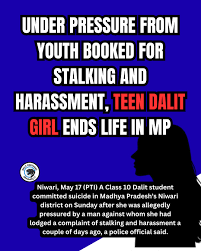
Niwari, A Class 10 Dalit student committed suicide in Madhya Pradesh’s Niwari district on Sunday after she was allegedly pressured by a man against whom she had lodged a complaint of stalking and harassment a couple of days ago, a police official said. The 16-year-old girl hanged herself in her house in Siyakhas village, around 18 km from the district headquarters, Prithvipur police station house officer (SHO) Jitendra Singh Gurjar told PTI. “She had earlier complained against Abhishek Yadav, a youth from the same village, after he allegedly caught hold of the girl with malicious intent when she was returning home from a temple with her sister-in-law two days ago,” he said. Following her complaint, Yadav and three others were booked under provisions of Scheduled Castes and Scheduled Tribes (Prevention of Atrocities) Act and Protection of Children from Sexual Offences (POCSO) Act, he said. “The accused allegedly pressured the girl’s family to withdraw the case. Possibly due to fear and pressure, she took the extreme step. Yadav has been arrested,” Gurjar said. This report is auto-generated from PTI news service. ThePrint holds no responsibility for its content. Courtesy : The Print Note: This news is originally published on https:/theprint.com/bha and is used purely for non-profit/non-commercial purposes, especially human rights