
‘The People’s Doctor’: This renowned doctor from Patna will reach your home; free treatment also available in Dalit settlements
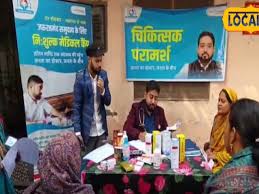
Dr. Dheeraj believes that doctors should go to the patients who cannot reach Patna or larger hospitals. His initiative is not only a new example for the healthcare system but also sends a message to society that treatment given with a spirit of service is true treatment. Vaishali: In today’s times, when medical treatment is becoming increasingly inaccessible to the common man, a unique initiative by a prominent doctor from Patna has forced everyone, from the healthcare department to the general public, to think. Dr. Dheeraj Kumar, a professor at PMCH and a renowned gastroenterologist, has put the concept of “Doctor at Your Doorstep” into practice by visiting Dalit and slum areas to provide free check-ups and distribute medicines to patients. In this era of expensive treatment and exorbitant fees, Dr. Dheeraj Kumar’s step has come as a great relief for thousands of needy people. While the fees of big doctors are usually in the thousands, Dr. Dheeraj has already created a stir in the healthcare system with his decisions. He proved that treatment can be affordable and accessible by offering OPD consultations for just Rs. 50 and X-ray facilities for Rs. 25 at his ‘InCure Clinic’ in Kankarbagh. Famous as the People’s Doctor Now, Dr. Dheeraj has gone a step further, moving out of air-conditioned rooms and large clinics to directly reach slums and Dalit settlements. In this regard, he, along with his medical team, reached Ward Number 31 in Yusufpur, Hajipur, where hundreds of patients were examined free of charge. Patients suffering from stomach problems, liver issues, gas, anemia, and other common ailments were not only given consultations but also provided with free medicines. Among the patients who come from far and wide for treatment, Dr. Dheeraj is now known as the “People’s Doctor.” Serving the poor and underprivileged is true religion. Dr. Dheeraj Kumar, who is educated in England, is a professor at PMCH and is also deeply involved in social causes. He says that becoming a doctor was his mother’s dream, and after fulfilling that dream, he considers serving the poor and underprivileged as his true religion. Edited by: Mohd Majid Courtesy: Hindi News
Raebareli: Patwari orchestrated a ‘horrific’ conspiracy, looted 38 lakhs from a Dalit man and seized his land; SP’s action creates a stir

Raebareli News: A shocking case of collusion between land mafia and government employees has come to light in Raebareli, Uttar Pradesh. Here, a patwari (revenue official) conspired with fraudsters to seize property worth crores of rupees from a mentally ill Dalit man. In this case, which has made headlines in UP news, Superintendent of Police (SP) Dr. Yashveer Singh’s zero-tolerance policy has shaken the criminals. The police have registered a case against five people, including the patwari, and have intensified efforts to arrest them. Land looted by instilling fear of a lawsuit This major fraud took place in Khor village (Amawan) under the Mill Area police station. The victim, Rajkumari, told the police that her husband, Ramprasad, is mentally unwell. Local land mafia took advantage of this. The accused threatened Ramprasad and his brother Guddu with an old lawsuit. The accused lured them to an office in Indira Nagar, Lucknow. There, on March 3, 2023, the fraudsters fraudulently got three agreements and two sale deeds registered in their favor in a single day. In this conspiracy, about 10 biswa of land was transferred to Raman Kumar and one bigha of land to Ramsajeevan. In addition, a fake agreement for one bigha of land was prepared in the name of Balkishun. 38 lakh rupees stolen from bank accounts The criminals not only seized the land but also looted the life savings of the victim’s Dalit family. The fraudsters took control of the mobile numbers and ATM cards of the victims, Ramprasad and his brother. The accused gradually transferred Rs 38.55 lakh from the accounts in the Bank of Baroda’s Malikmau branch to their own accounts. The investigation revealed that Rs 18.71 lakh was withdrawn from Ramprasad’s account and Rs 19.84 lakh from Guddu’s account. FIR filed against 5 people, including a revenue officer; police tighten the noose. The police department was thrown into a frenzy after this high-profile fraud came to light. City Circle Officer (CO City) Arun Kumar Nauhwar said that a case has been registered based on the complaint of the Dalit victim. The main mastermind of this conspiracy is Udit Narayan Srivastava, a resident of Kodwal. Bajrang, Ramlakhan Pasi, Manish Sonkar, and the local revenue officer Parmeshwardeen have also been named as accused. The Superintendent of Police has given clear instructions that no culprit will be spared. Police teams are conducting raids to arrest the accused. Poonam Sharma Courtesy: Hindi News
Dalit Sarpanch Abducted and Assaulted in Madhya Pradesh’s Morena
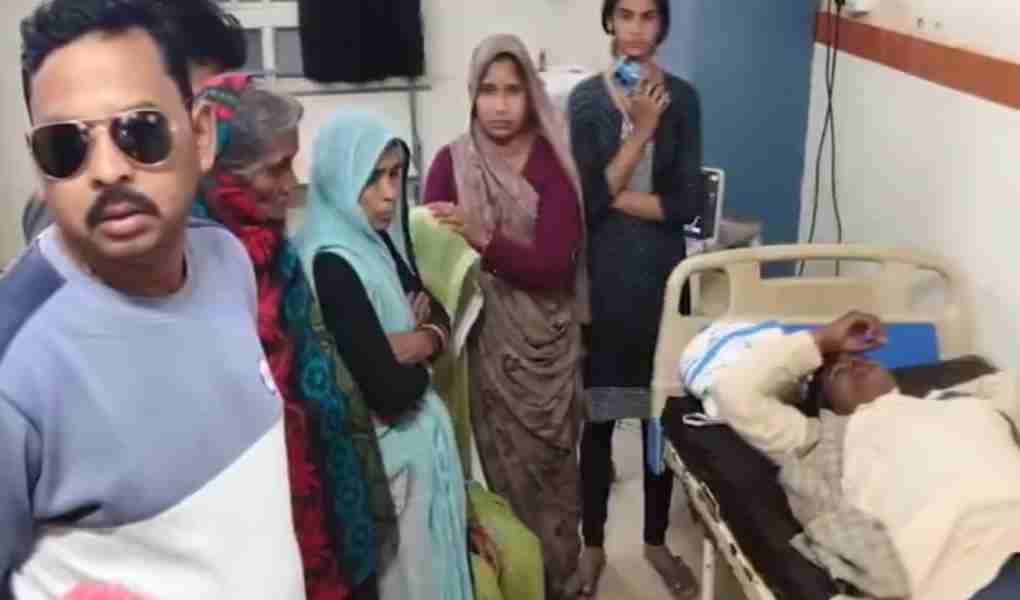
A Dalit sarpanch from Kelaras village in Morena district, Madhya Pradesh, was allegedly abducted from his home and beaten by a group of 20 to 25 individuals described as casteist elements on Saturday. The incident came to light through a viral video and social media post shared by Dalit activist and Azaad Samaj Party founder Sunil Astay, a former Bhim Army state in-charge. Astay described the abduction and assault as a serious and condemnable attack on the democratic system. A report aired on local channel Vistar News shows villagers and the sarpanch’s family gathered outside the local police station, demanding immediate action. According to the report, the assailants stormed the sarpanch’s residence, kidnapped him, and took him to a nearby village where he was allegedly beaten severely. They then returned him home, locked him inside, and fled before police could intervene. The sarpanch sustained serious injuries and is currently receiving medical treatment. The family suggested a possible financial dispute as a motive, though details remain unconfirmed. Activists have called on the police for strict and immediate action, highlighting a broader pattern of caste-based violence in the region. Astay also tagged key officials, including Madhya Pradesh Chief Minister Mohan Yadav and the Morena Superintendent of Police, holding them accountable for administrative inaction. He warned that when elected Dalit representatives are unsafe, the security of ordinary Dalit citizens is also at risk. Authorities have yet to release an official statement on the investigation. Courtesy : TOP Note: This news is originally published on https:/theobserverpost.com/bha and is used purely for non-profit/non-commercial purposes, especially human rights
Casteism in Himachal: ‘Mend your ways…’ Dalit leader openly threatened, the horrific truth of casteism in Devbhoomi comes to light
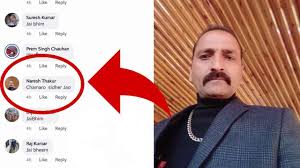
Himachal News: The recent incident has made it clear how deeply rooted casteism is in Himachal Pradesh. A prominent Dalit leader from the state, Ravi Kumar, was openly subjected to casteist abuses on social media. A man named Naresh Thakur fearlessly wrote on his post, “Chamars, mend your ways.” This comment is a direct caste-based attack. Surprisingly, such people have neither fear of the law nor of the Supreme Court’s orders. Serious questions are now being raised about the safety and equality of Dalits in Devbhoomi (the land of gods). Hatred in the name of reservation and tradition Our investigation has revealed strange justifications behind casteism in Himachal. Some people describe it as part of ‘Dev Sanskriti’ (divine culture) and tradition. Many others consider reservation to be the reason for the hatred. People openly write on social media that they practice casteism because of reservations. They claim that as long as reservations exist, discrimination will continue. Casteism is also justified in the name of protecting Dev Sanskriti. These people forget that the use of casteist slurs and discrimination is a serious crime. Serious questions about the role of the police The attitude of the Himachal Police in cases of Dalit oppression has consistently been under suspicion. In many serious cases, FIRs are registered only after immense pressure from Dalit groups. Whether it was the suspicious death of a child in Rohru or the rape of a Dalit woman in Kullu, the police action has been sluggish. The police also showed negligence in the Pallavi death case in Dharamshala. If the police had acted on Pallavi’s complaint two months earlier, her life might have been saved. Kullu incident: The husband himself was made the culprit The most frightening face of the police’s working style was seen in Sainj, Kullu. There, a Dalit woman was gang-raped and murdered. Her body was hung from a tree. Without a proper investigation, the police imprisoned the innocent husband of the deceased woman. He languished in jail for a month. Later, protests by women’s groups and a viral audio clip revealed the real killers. The police have not yet disclosed what happened to those real killers. This means that police officers don’t even consider it necessary to hold a press conference in such heinous cases. Blatant disregard of Supreme Court orders Former Supreme Court Chief Justice Gavai had clearly stated in his order that there is no provision for anticipatory bail under the SC-ST Act. The accused should be sent to jail immediately. Despite this, the police in Himachal Pradesh appear lenient towards the accused. In hundreds of cases, the accused have been given a free pass. Ravi Kumar has more than 200,000 followers on social media. If such a prominent figure can be subjected to casteist slurs, one can imagine the plight of ordinary Dalits. Now it remains to be seen whether the government suppresses this matter or delivers justice. Poonam Sharma Courtesy: Hindi News
New initiative in Tholla Fatehpur, Saharanpur: Dalit community panchayat bans the practice of ‘death feasts’
In Tholla Fatehpur village of Saharanpur, the Dalit community’s panchayat has taken a significant decision to end the practice of death feasts. Villagers believe that this practice… Read more Jagran Correspondent, Saharanpur. The Dalit community’s panchayat in Tholla Fatehpur village has decided to ban the practice of death feasts. People argue that this practice leads to people falling into debt. It also imposes an unnecessary financial burden during a time of grief. Former village head Deshraj said that the death feast is a harmful custom that should be abolished. Taking the initiative in this direction, Mangeram of the village decided not to hold a death feast after the death of his mother. His mother passed away on Saturday. After the last rites, he said that he would only perform the traditional turban-tying ceremony. Villagers believe that other villages should also decide to ban death feasts, as it puts an unnecessary financial burden on the deceased’s family. Many families have to take loans to follow this conservative tradition. In the panchayat, Som Singh Fauji, Gaje Singh Daroga, Shivlal, former head Dr. Ankit Arya, Rajesh, Dr. Sulekh, Nirdosh Kumar, Bhopal, Dr. Ramesh Chand, Sevaram, Anangpal, Yashpal, and many others supported this decision. EDITED BY: SAKSHI GUPTA Courtesy: Hindi News
YSRCP announces ‘Chalo Delhi’ programme over Dalit activist murder

Guntur: The YSR Congress Party (YSRCP) has announced plans for an intensified statewide and national-level agitation following the murder of Manda Salman. The party will soon launch a “Chalo Delhi” programme to press for justice and hold the ruling coalition accountable. YSRCP leaders asserted that the fight would continue until the guilty are punished and justice is served to the victim’s family. At a memorial meeting held in Pinnelli, YSRCP state leaders paid tribute to Salman and visited his family to express solidarity and assure continued support. Addressing the gathering, the leaders alleged that since assuming power, the coalition government has failed to protect Dalits and has instead allowed targeted attacks on YSRCP supporters, particularly in Palnadu district. They accused the ruling dispensation of resorting to violence and intimidation due to their inability to gain public support through development. Strongly criticising chief minister N Chandrababu Naidu, former legislator Kasu Mahesh Reddy alleged that Dalit lives hold no value in his political calculations and that systematic attacks were carried out to alienate Dalits from the party. He termed the attack on Dr BR Ambedkar’s statue as a shameful beginning to a series of assaults on Dalits and democratic voices. According to the leaders, the murder of Salman was a direct result of government negligence and police failure, with allegations that law enforcement acted in collusion with anti-social elements. Mahesh Reddy demanded an independent probe into the murder and said complaints would be lodged with the National Human Rights Commission and the National Commission for Scheduled Castes. He also insisted on strict action against police officials responsible for lapses in maintaining law and order. Several speakers highlighted that hundreds of families were forced to flee villages in Palnadu due to fear and intimidation, calling it a blot on governance. YSRCP leaders emphasised that the party would raise the issue both in parliament and at the national level, warning the coalition government that suppression and violence would only strengthen public opposition. They praised the restraint and maturity shown by Salman’s family, who appealed for peace in the village despite their immense loss, and said their appeal should be respected by restoring normalcy and ensuring safety. Prominent leaders, including Tirupati MP Maddila Gurumoorthy, former MPs, former ministers, former MLAs, and district-level party leaders, participated in the programme. Courtesy : TOI Note: This news is originally published on https:/timesofindia.com/bha and is used purely for non-profit/non-commercial purposes, especially human rights
Dakshayani Velayudhan: A Voice of Equality in India’s Constituent Assembly

Dakshayani Velayudhan was the only Dalit woman in India’s Constituent Assembly, who fearlessly fought caste injustice and inequality. Dakshayani Velayudhan: The Fearless Dalit Woman Who Shaped India’s Constitution and Demanded Equality On December 15, as India reflects on its long journey toward equality and justice, history invites us to remember a woman whose courage challenged centuries of silence. Her name is Dakshayani Velayudhan, the only Dalit woman to be a member of India’s Constituent Assembly — a voice that refused to be ignored at a defining moment in the nation’s birth. Born into a society rigidly divided by caste, Dakshayani Velayudhan grew up witnessing exclusion not as an abstract idea, but as lived reality. From restricted access to education to everyday discrimination, caste shaped every aspect of life. Yet she chose not to accept injustice as destiny. Breaking Barriers in a Divided Society Dakshayani Velayudhan was born in 1912 in what is now Kerala, at a time when Dalits were denied basic human dignity. Education itself was an act of rebellion. She pursued her studies against formidable odds and went on to become a teacher — a role that allowed her to empower others even before she entered national politics. Her personal journey reflected a broader struggle for dignity. In an era when Dalit voices were actively suppressed, Dakshayani chose to speak — not cautiously, but boldly. A Historic Role in the Constituent Assembly India’s Constituent Assembly was tasked with drafting the framework of a new nation. It was dominated by elite, upper-caste men. In this setting, Dakshayani Velayudhan stood alone as the only Dalit woman member. Her presence itself was historic, but it was her words that left a lasting impact. She questioned whether political freedom meant anything without social equality. She warned that a Constitution filled with ideals would fail if society continued to practice discrimination. While many spoke of unity in abstract terms, Dakshayani spoke of lived injustice — of humiliation, exclusion, and systemic inequality. Challenging Power Without Fear Dakshayani Velayudhan did not hesitate to challenge even the most powerful figures of her time. She criticized the idea of celebrating freedom while millions remained oppressed by caste. Her interventions were sharp, moral, and deeply principled. She famously argued that dignity is not charity — it is a right. To her, equality was not something to be granted gradually; it was fundamental to the idea of India itself. At a time when voices often trembled before authority, hers carried clarity and conviction. Equality Beyond the Constitution For Dakshayani, the Constitution was not meant to be a symbolic document. She believed it had to be a living promise — one that actively dismantled caste hierarchies and protected the most marginalized. She expressed skepticism toward excessive reliance on laws without social reform. True freedom, she believed, required transformation of attitudes, not just institutions. Her perspective added moral depth to constitutional debates and ensured that the concerns of Dalits and women were not erased from India’s foundational moment. A Legacy That Remains Overlooked Despite her historic role, Dakshayani Velayudhan remains largely absent from mainstream history narratives. Her contributions are often overshadowed, her courage under-acknowledged. Yet her ideas feel strikingly relevant today. As India continues to grapple with caste discrimination, gender inequality, and social justice, her words resonate with renewed urgency. She reminds us that progress is incomplete if it excludes the most vulnerable. Why Dakshayani Velayudhan Matters Today Dakshayani Velayudhan’s legacy is not confined to the past. It challenges present generations to question power, resist injustice, and demand accountability. She stood in halls dominated by privilege, carrying the hopes of millions who had never been heard. Alone, yet unshaken, she proved that one voice — grounded in truth — can confront an entire system. Remembering a Forgotten Architect of Equality Dakshayani Velayudhan was not just a member of the Constituent Assembly. She was a conscience within it. A reminder that freedom without equality is hollow. Remembering her is not merely an act of history — it is an act of responsibility. Because nations are not built only by laws and leaders, but by those brave enough to demand justice when silence feels safer. Her voice still calls out — to remember, to rise, and to resist injustice. Shivani Poli Courtesy : One World New Note: This news is originally published on https:/oneworldnews.com/bha and is used purely for non-profit/non-commercial purposes, especially human rights
Caste within caste: The dual reality of OBC politics

OBCs are both oppressed and, at times, oppressors. They suffer caste, but they also reproduce it. This duality must be named if we are to build a politics that is honest, transformative, and inclusive. Indian society rests on a graded hierarchy called caste, which Dr BR Ambedkar described as “an ascending scale of reverence and a descending scale of contempt.” This description captures the everyday reality of how respect and humiliation are distributed. From this recognition follows Ambedkar’s most urgent demand: the annihilation of caste. Ending caste is not only a moral aspiration but the central reform required to build genuine social democracy. Public understanding of caste has largely been shaped through a Dalit lens– a powerful and necessary perspective which exposes the brutality of untouchability and structural violence. Yet it is not enough to capture the full complexity of caste. What remains less examined is the position of those just above Dalits in this hierarchy: the thousands of communities grouped under the administrative category of Other Backwards Classes. Caste, in India, is often narrated as a binary of upper castes versus Dalits. This framing, while politically potent, erases the layered realities of OBCs. This vast and diverse category experiences exclusion even as some of its groups reproduce it. OBCs are not outside the caste– they are shaped by it, harmed by it, implicated in its reproduction, and, at times, perpetuate it. But their struggles cannot be dismissed simply because of this. Reducing them solely to perpetrators is to criticise without any nuanced understanding of the OBC problem. Their position in the caste order demands recognition of both the exclusions they face and the contradictions they embody. Graded inequality and the OBC experience Dr BR Ambedkar’s metaphor of caste as “graded inequality” is especially instructive here. OBCs, positioned on the middle rungs of this ladder, often internalise both ends of the spectrum. They seek validation from those above while distancing themselves from those below. This is not a moral failure but structural conditioning. It shows how caste works not only through institutions but also through desire, shame, and aspiration. The OBC experience is marked by constant negotiation between proximity and exclusion, between visibility and voicelessness. Their contradictions are not incidental; they are central to how caste reproduces itself across generations. Unlike Dalit and Adivasi communities, whose exclusion is marked by spatial segregation and cultural distinctiveness, the case of OBCs is more complex. As the sociologist TK Oommen notes, OBCs are above the ritual pollution line in the caste hierarchy. They are not excluded from village social life, nor do they possess a culturally distinct identity like Adivasis. They share language, religion, and many aspects of everyday life with dominant caste groups. Yet, despite this proximity, elite formation among OBCs has been slow. The size of their elite category remains disproportionately small compared to their numerical strength in the population. From occupation to intellectual absence This paradox of cultural inclusion and structural exclusion has shaped the trajectory of OBC aspirations. After independence, only a small section of OBC families who had the means encouraged their children to pursue professional fields such as engineering, medicine, and government services. These careers were seen as secure routes to mobility, respectability, and survival, though they remained accessible to only a limited percentage of the community. For many others, traditional caste-based occupations became economically unsustainable, forcing a transition into informal and precarious labour, undervalued, unprotected, and excluded from formal skill recognition. In this pursuit of material advancement, OBCs were largely absent from the philosophical and intellectual realms. Upper castes dominated the humanities and social sciences, while Dalit thinkers built powerful traditions of resistance and critique. OBCs, by contrast, did not cultivate a sustained presence in academic theory, research, or public thought. The pressure to prove worth to dominant-caste institutions and the state arose because OBC labour and knowledge were historically undervalued. With traditional occupations collapsing, technical success in engineering, medicine, and government services became the recognised pathway to dignity and survival. With little mentorship in critical disciplines and an internalised belief that philosophy and politics belonged to others, OBCs were steered away from intellectual spaces. The absence of a pan-India OBC intellectual movement is not apathy but the result of structural exclusion and lack of ideological space. Even among the few who entered the realm of thought, exclusion persisted. Kancha Ilaiah Shepherd, one of the most prominent OBC intellectuals, faced sustained hostility for naming caste, challenging Hindu orthodoxy, and asserting a Bahujan epistemology. His marginalisation is not only political, but also philosophical. It reflects the discomfort of dominant institutions with OBC thought that refuses to be servile, apologetic, or assimilated. Structural violence and everyday exclusion The absence of OBC voices in intellectual spaces is not just about ideas; it translates into lived silences. This silence is both imposed and internalised. OBC students in elite institutions often carry the burden of invisibility. They are rarely seen as theorists, seldom invited into spaces of reflection, and often discouraged from pursuing the humanities. Some endure this burden quietly. Others break under it. The suicides of OBC students are not isolated tragedies; they are structural indictments. They show how caste operates not only through denial of opportunity but also through denial of belonging. In most Hindu temples, the priesthood remains the monopoly of the upper castes. OBCs, despite being deeply embedded in the ritual and cultural life of villages, are denied access to sacred roles. Their labour sustains religious institutions, yet their bodies are kept outside the sanctum. Kancha Ilaiah Shepherd has long critiqued this Brahminical monopoly over spiritual life. Building on his insight, this exclusion can be understood as a form of spiritual apartheid — a system that denies OBCs dignity in the very spaces they help sustain. Even in marriage, caste boundaries remain rigid. Inter-caste marriages between OBCs and upper castes are rare and often resisted, revealing the deep social distance that persists despite constitutional equality. Political representation is equally fragmented. While OBCs hold electoral strength in
Caste-based violence in a Gujarat village: Dalit youth abused and beaten for refusing to lend his glasses

A man named Devshi Koli asked the youth for his glasses. When Solanki refused, Devshi made casteist remarks, leading to an argument. The three men together beat Solanki with punches and kicks and threatened to kill him. When villagers gathered, the accused fled on motorcycles. Patan – A case of caste-based violence has come to light in Piprala village of Santalpur taluka in Patan district of Gujarat, where a 26-year-old Dalit laborer, Tulsi Solanki, was attacked. Three men attacked him with sticks, fists, and kicks, hurled casteist abuses, and threatened to kill him after he refused to lend one of them his glasses. The incident took place on Tuesday evening around 7 pm near the Hanuman temple. Tulsi Solanki was standing near the Hanuman temple on Tuesday evening. At that time, a man named Devshi Koli asked him for his glasses. When Solanki refused, Devshi made casteist remarks, leading to an argument. About 30 minutes later, Devshi returned on a motorcycle with his accomplice Bhikhu Koli and started abusing and questioning Solanki again. Solanki’s parents, Vela and Demaben, also arrived at the spot and started protesting against the accused. Meanwhile, the third accused, Mandan Koli, arrived on another motorcycle with a stick. Mandan struck Solanki on his left shoulder with the stick, causing him to fall. Then Mandan hit him on the knee of his left leg. Bhikhu Koli pushed Solanki’s father to the ground. The three together beat Solanki with punches and kicks and threatened to kill him. When villagers gathered, the accused fled on motorcycles. Solanki sustained serious injuries in the attack. He was first taken to Santalpur Government Hospital, where after primary treatment, he was referred to Dharpur Hospital. His condition is reported to be stable, but the injuries are serious. The victim’s family filed a complaint at the Santalpur police station late Tuesday night. The police have registered a case against Devshi Koli, Bhikhu Koli, and Mandan Koli under various sections of the Bharatiya Nyaya Sanhita (BNS). In addition, relevant sections of the Scheduled Castes and Scheduled Tribes (Prevention of Atrocities) Act have also been applied. The Santalpur police have launched an investigation, but the accused have not yet been arrested. The police say they will apprehend the accused soon. Geetha Sunil Pillai Courtesy: Hindi News
Dalit Sarpanch Abducted and Assaulted in MP’s Morena: Activists Demand Immediate Action Under SC/ST Act
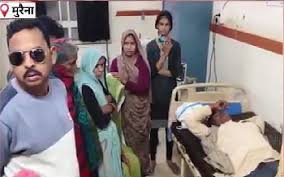
The incident came to light through a viral video and post shared by prominent Dalit activist and Azaad Samaj Party founder Sunil Astay, a former Bhim Army state in-charge in Madhya Pradesh. Morena- A Dalit sarpanch was allegedly abducted from his home in Kelaras village, Morena district, and subjected to a brutal beating by a group of 20-25 individuals described as “casteist elements.” The attack, which occurred earlier on Saturday, has been condemned as a direct assault on India’s constitutional framework, social justice, and democratic representation. The incident came to light through a viral video and post shared by prominent Dalit activist and Azaad Samaj Party founder Sunil Astay, a former Bhim Army state in-charge in Madhya Pradesh. In the post, Astay detailed the abduction and assault, emphasizing its gravity: “The abduction of the Dalit sarpanch from his home in Kelaras, Morena district, Madhya Pradesh, and the beating by casteist elements is extremely serious, condemnable, and a direct attack on the democratic system. This incident is not just against one individual but against the Constitution, social justice, and Dalit representation.” The accompanying video, aired on local channel Vistar News, shows on-the-ground reporting from the scene. It depicts the sarpanch’s family and villagers gathered outside the local police station, demanding swift intervention. According to the report, the assailants stormed the sarpanch’s residence in the Kelaras police station area, forcibly kidnapped him, and transported him to a nearby village where they allegedly thrashed him severely. The attackers then returned him to his home, locked him inside, and fled before police arrived. The sarpanch sustained serious injuries and is receiving treatment. The family has alleged possible motives linked to a financial dispute, though details remain unconfirmed. The clip urges police to take “strict and immediate action,” underscoring a pattern of unchecked caste-based violence in the region. Astay tagged key officials, including Madhya Pradesh Chief Minister Dr. Mohan Yadav, Morena Superintendent of Police, and the state government holding them accountable for administrative inaction. He warned: “When an elected Dalit public representative is not safe, the security of ordinary Dalit citizens automatically comes under question. The administration’s inaction and silence are emboldening criminals and reveal a complete failure in preventing caste violence.” Geetha Sunil Pillai Courtesy : The Mooknayak Note: This news is originally published on https:/themooknayak.com/bha and is used purely for non-profit/non-commercial purposes, especially human rights