
The Supreme Court has taken a major step in the new transgender law, immediately halting proceedings in four high courts.

The Supreme Court has immediately stayed the hearing of petitions challenging the new Transgender Persons (Persons) Act 2026 in four different high courts. Following the central government’s demand, all these cases are now likely to be heard in a single court to avoid any contradictory decisions. New Delhi: The Supreme Court has issued a significant order regarding the constitutional validity of the Transgender Persons (Protection of Rights) Amendment Act, 2026. On Monday, June 15, the apex court immediately stayed proceedings in four different high courts challenging the law. The central government had requested the transfer of all pending petitions in this matter to the Supreme Court to avoid conflicting decisions from different courts on the same law. A bench comprising Chief Justice (CJI) Surya Kant and Justice V. Mohana issued notice on the central government’s transfer petition and stayed the ongoing hearings in the Rajasthan, Delhi, Karnataka, and Kerala high courts. Solicitor General Tushar Mehta, representing the Government of India, informed the court that the Supreme Court is already hearing the case. Furthermore, several other High Courts are also challenging the constitutional validity of the 2026 amendment. Accepting this request, the Chief Justice stated that it would be better if all the cases were heard by either a single High Court or the Supreme Court itself delivered its final verdict. The court believed this would avoid scattered and divergent judicial opinions. The next hearing in the case will take place in July, when the court resumes regular work after its partial working period. Earlier, on May 27, the Central Government had expressed concern that hearings in different courts could lead to contradictory judgments on the validity of the law. Mr. Mehta clarified that the Supreme Court should convene these cases to avoid divergent opinions on the same act. During Monday’s hearing, Chandresh Jain, a petitioner from the Delhi High Court, also appeared before the Supreme Court. They argued that their petition comprehensively challenges the new law and establishes why the amendments are constitutionally unsound. The bench stated that if the cases are transferred to the Supreme Court, the court would be happy to seek Mr. Jain’s assistance in this matter. The petitioners’ main argument is that the 2026 amendment undermines the landmark 2014 NALSA judgment, which recognized the right to self-determination as a fundamental right. According to the petitioners, Section 3 of the 2026 Act eliminates the right to self-perceived gender identity and leaves gender determination to biology or state verification. On the other hand, the central government maintains its position. The government maintains that the amendment does not prohibit voluntary gender-affirming treatments. Its primary purpose is only to regulate procedures performed under coercion or pressure. Solicitor General Tushar Mehta also requested the court to transfer the petitions to the Supreme Court before a three-judge bench. He pointed out that the current challenge is primarily based on the 2014 NALSA decision, delivered by a two-judge bench. It may be difficult for high courts to take a view contrary to that decision. Just last month, the Supreme Court refused to stay the implementation of the new law on an interim basis. The court then remarked that the constitutional questions raised by it require detailed and in-depth examination. At that time, the Chief Justice also expressed a serious concern. He stated that in a country with a population of 1.4 billion, there could be a threat from individuals who may pretend to be transgender simply to benefit from reservations in government jobs or other welfare schemes. The Chief Justice questioned whether such fraud would not deprive those who are truly entitled to these benefits due to their physical or biological conditions. Rajan Chaudhary Courtesy: Hindi News
“My son’s killers will be destroyed”: Dalit youth killed in police custody cremated after 101 days

Following strict instructions from the Madras High Court, the funeral of a 26-year-old Dalit youth, a victim of police torture in Tamil Nadu, took place after 101 days. Family members wept inconsolably as they pleaded for justice. A 26-year-old Dalit youth, who died due to alleged police torture in Madurai, Tamil Nadu, was cremated on Wednesday after 101 days. Following strict instructions from the Madras High Court, the youth’s funeral took place at an electric crematorium in Madurai amid tight security. This entire incident raises serious questions about police accountability and human rights violations. The youth’s name was Akash. Following his death, the family refused to accept his body for more than three months. The family demanded the immediate arrest of all police officers involved in the alleged custodial murder. However, after court intervention, the funeral was finally completed amid protests and deep grief from the family. Aakash, a resident of Manamadurai in Sivaganga district, was arrested by local police on March 6 in connection with an assault case. Police claimed that Akash fractured his leg while trying to escape. On the other hand, Akash filed a statement before a judicial magistrate stating that the policemen brutally beat him and broke his leg. He subsequently succumbed to his injuries on March 8 while undergoing treatment at the Government Rajaji Hospital in Madurai. The post-mortem report released after Akash’s death shocked everyone, revealing approximately 28 injury marks on his body. This revelation sparked massive protests from Scheduled Caste welfare organizations and family members. Given the gravity of the case, the investigation was handed over to the CBI on March 9, and six police officers, including an inspector and a sub-inspector, were suspended. Taking suo motu cognizance of the matter, the Madras High Court on March 13 directed the CB-CID to register a case against the accused officers under murder and relevant sections of the SC/ST (Prevention of Atrocities) Act. Subsequently, the CB-CID interrogated 11 police officers, including Manamadurai DSP Raja and several other inspectors. Meanwhile, the victim’s father, Rajesh Kannan, approached the High Court, demanding compensation of ₹50 lakh and the arrest of 16 police officers involved in the incident. The family continued to protest near the old bus stand in Manamadurai to press for their demands. To end the dispute, the High Court ordered on June 15 that if the family did not accept the body by 5 pm that evening, the local administration would proceed with the funeral in a dignified manner. Following the family’s refusal to accept the body, the court assigned the responsibility of conducting the funeral to the Madurai District Collector, Corporation Commissioner, and hospital officials. When police and administrative officials arrived at the hospital mortuary on Wednesday morning to take the body, the family staged a fierce protest. Law enforcement officers briefly detained the protesting relatives in a police vehicle and then brought them to the crematorium to witness the final rites. The atmosphere at the crematorium became extremely somber when Akash’s mother burst into tears. She threw a handful of dirt at the policemen and cursed that those responsible for her son’s death would one day be completely destroyed. Rajan Chaudhary Courtesy: Hindi News
Andhra Pradesh Home Minister responds to the “kilograms of makeup” remark, saying she was targeted for being a woman and a Dalit.
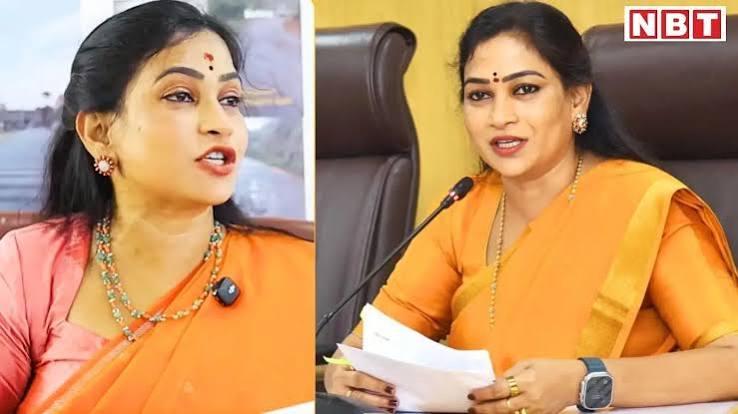
Vangalapudi Anitha Makeup Row: Andhra Pradesh Home Minister Anitha has broken her silence and issued a strong response to the comments made against her. She said that the comments were not only offensive but also a caste-based attack because she was a Dalit and a woman. Anitha is considered a confidante of Chief Minister Chandrababu Naidu. Andhra Pradesh Home Minister responds to the “kilograms of makeup” remark. Amaravati: Vangalapudi Anitha, who holds the responsibility of Home Minister in Chandrababu Naidu’s government in Andhra Pradesh, has responded to the “kilograms of makeup” remark. Andhra Home Minister Anitha said that she was targeted for being a woman and a Dalit. Gudivada Amarnath, a leader of the Jagan Mohan Reddy-led YSRCP party in Andhra Pradesh, had made the offensive remark. Amarnath had said that Home Minister Anitha wears kilograms of makeup. I was attacked in a casteist manner… A controversy has erupted in Andhra Pradesh after a Jagan Mohan Reddy party leader’s “kilograms of makeup” comment. The Deputy Chief Minister and the YSRCP have condemned the remark. Speaking at a public meeting on Wednesday, Amarnath reportedly claimed that TDP leader Anitha wears kilograms of makeup. Speaking to NDTV, Home Minister Anitha described the remark as more than just a personal insult, saying that what the YSRCP leader said about me on camera, at a public meeting, was not just an insult. It was a vile, casteist attack aimed at demeaning a woman and a Dalit woman holding a constitutional position. Home Minister Anitha demanded an apology. The remark has also drawn strong reactions from TDP leaders, who have criticized the YSRCP leader’s misogynistic and derogatory remarks. TDP leader Nara Lokesh also condemned the remark and accused the YSRCP of promoting a toxic political culture. He said that the shameful and anti-women comments against Vangalapudi Anitha Garu expose the true character of the YSRCP. Home Minister Anitha has been quoted as saying that targeting a woman and a Dalit leader is unacceptable and demanded an apology from the YSRCP. Comments on a woman’s appearance are an insult In response to this incident, TDP women leaders protested and pelted the Gudivada Amarnath flex banner with eggs and slippers, demanding an apology for the alleged remarks. Deputy Chief Minister and Janasena chief Pawan Kalyan also criticized the incident. He said that the comments made against Home Minister Anitha were objectionable. Commenting on a woman’s attire and appearance is an insult to every ordinary woman. Meanwhile, YSRCP leaders have rejected the allegations and accused the government of diverting public attention from law and order issues. Curated by: Achalendra Katiyar About the Author Achalendra Kumar Katiyar covers the events in western states for Navbharat Times Online based in Gujarat. He has over 17 years of experience in print, digital, and electronic media, as well as teaching. During this time, he has worked as a reporter and editor in states such as Uttar Pradesh, Delhi, and Haryana. Courtesy: Hindi News
TMC split row: Lok Sabha Speaker asks Abhishek Banerjee to present case on Friday
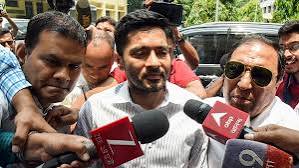
Parliamentary sources said the Speaker intends to hear both sides before making a decision, which will be based on the applicable laws and parliamentary rules. Lok Sabha Speaker Om Birla asked Trinamool Congress National General Secretary Abhishek Banerjee to appear before him on 19 June as he considers a request by a group of rebel MPs seeking recognition as a separate parliamentary faction. The move comes after 20 rebel Trinamool MPs claimed to have merged with the Nationalist Citizens Party of India and petitioned the Speaker for recognition as a distinct group in Parliament. The rebel MPs have already met Birla, while the faction led by Former West Bengal Chief Minister Mamata Banerjee had sought an appointment to present its position. Parliamentary sources said the Speaker intends to hear both sides before making a decision, which will be based on the applicable laws and parliamentary rules. In a letter to Birla, Abhishek Banerjee had argued that a valid merger under the anti-defection law would require both the merger of the political party and the backing of at least two-thirds of its legislators, contending that meeting only one of the conditions would not be sufficient. Sources had earlier told TNIE that a decision on the rebels MP’s plea is expected before Parliament’s Monsoon session, which is likely to begin in the third week of July. The Speaker’s decision will be guided by a written opinion from the Union law ministry, which is expected to seek the advice of a senior law officer before submitting its assessment, they added. Courtesy : TNIE Note: This news is originally published on https:/thenewindianexpress.com/bha and is used purely for non-profit/non-commercial purposes, especially human rights
India’s education system crushes children: Rahul Gandhi at Kota rally

KOTA: Congress leader Rahul Gandhi on Wednesday said India’s education system puts immense pressure on children and “crushes” them, while calling for collective efforts to ensure that no student feels the way many young aspirants do today. “This is not good for the country. I want all of us to work together to ensure that no student in this country ever feels what this girl felt,” Gandhi said while addressing the “Chhatron ki Goonj” Maha Rally in Kota. He said, “the event was not a political meeting but a platform to discuss the struggles faced by students.” “This is a meeting about you, about the young people who are struggling to get a future. This evening is about you, the challenges that you are dealing with every single day,” he added. Five students — three girls and two boys — were invited on stage after Gandhi’s opening remarks. The students, who are preparing for NEET, JEE and civil services examinations, spoke about their aspirations, challenges and the money spent on coaching. While interacting with students, Gandhi said the biggest weakness of India’s education system was that it failed to encourage children’s dreams and aspirations. Chhatron Ki Goonj in Kota “The biggest weakness of India’s education system: it does not nurture the dreams of our children. It does not respect the options and aspirations they truly want to pursue. After that, I began thinking more deeply about the education system. Several questions came to mind. One was why the public-sector education system had declined. Another was why private education had become so expensive,” he said. Recalling his Bharat Jodo Yatra from Kanyakumari to Kashmir, Gandhi said he met thousands of young people and noticed a pattern in their career choices. “Some time back, I walked from Kanyakumari to Kashmir, covering 4,000 kilometers. Along the way, I met lakhs of young people like you and had discussions with thousands of them. I would always ask them one simple question: ‘What do you want to become?’ Almost every time, I received the same five answers, engineer, doctor, lawyer, IAS officer, or joining the armed forces. There was never a sixth answer.” “This made me wonder why our education system, when young people are the future of the country, seems to offer them only five options. I asked this question many times and always received the same responses…The truth was that there was a big difference between their real aspirations and the five standard options they had mentioned,” Rahul added further. The Congress has projected the Kota rally as the beginning of a nationwide student convention series focused on issues including paper leaks, unemployment and education reforms. The BJP has criticised the outreach, alleging that such programmes could distract students preparing for competitive examinations. Kota, one of India’s biggest coaching hubs, has around 1.2 lakh students preparing for NEET and JEE exams across various institutes. The Congress said Gandhi’s national education campaign will focus on highlighting students’ concerns, seeking accountability and demanding the resignation of Education Minister Dharmendra Pradhan. The campaign will be carried forward by Congress units, including the National Students’ Union of India (NSUI) and Youth Congress, with conventions planned in Allahabad, Patna and Delhi, according to the party. Courtesy : TOI Note: This news is originally published on https:/timesofindia.com/bha and is used purely for non-profit/non-commercial purposes, especially human rights
UP: Encounter with two accused of gang-raping a Dalit woman; police shot one in the leg, arrested both.
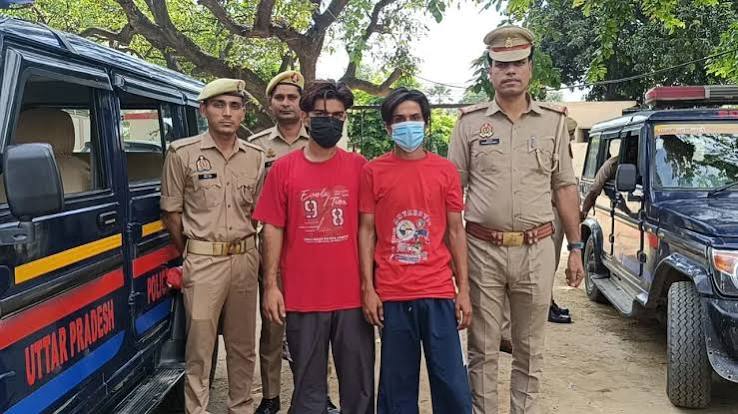
Police in Muzaffarnagar, UP, have taken major action and shot the accused in the leg of a gang-rape victim. Police have arrested two accused in this case. Muzaffarnagar: Police in Muzaffarnagar, UP, engaged in an encounter with the accused of gang-raping a Dalit woman. During this encounter, police shot one accused in the leg and arrested both. What is the whole matter? A joint team of Charthawal police station and the Special Operations Group (SOG) arrested two notorious criminals wanted in the gang-rape case of a Dalit woman after an encounter on Tuesday, June 16, 2026. One accused was injured in the police retaliation. Two illegal pistols, four live and one empty 315-bore cartridge were recovered from the arrested accused. It should be noted that on June 13th, in the Charthaval police station area of Muzaffarnagar, the plaintiff filed a complaint at the Charthaval police station, stating that the accused, Umar, son of As Mohammad, a resident of Dadhedu Khurd, along with his associates, drugged his daughter, rendering her unconscious. They then took her to the forest on a motorcycle and gang-raped her. Based on the victim’s complaint, the police registered a case and began searching for the accused. Under the direction of Senior Superintendent of Police Sanjay Kumar Verma, teams were formed under the supervision of Superintendent of Police City Amrit Jain and the leadership of Circle Officer Sadar Vinay Kumar Dwivedi. On June 16th, a team led by Station House Officer Satyanarayan Dahiya and Special Operations Group (SOG) in-charge Mohit was on patrol. Two suspects were spotted standing on the road leading to Dadhedu Khurd near the Dadhedu Bridge. Upon seeing the police, they opened fire and fled onto a dirt road. The police team surrounded them and warned them to surrender. The accused opened fire again. In retaliation, police fired controlled fire, in which Umar alias Salim, son of Aas Mohammad, age 25, was shot in the left leg. He was arrested while injured. The second accused, Maulana Abdullah, son of Matloob, resident of Bagowali, age 22, was apprehended during the combing operation. The injured Umar has been admitted to the hospital. A case has been registered against both accused. Umar already has a rape case registered against him. Police are taking further legal action in the matter. A statement from Senior Superintendent of Police, Muzaffarnagar, Sanjay Kumar Verma has also been released. Written By: Rituraj Tripathi (Report by Yogesh Tyagi) Courtesy: Hindi News
Telangana man booked for sexually exploiting Dalit domestic help

The elders offered her monetary compensation to “settle the matter” and “not approach the police. Hyderabad: A young man has been booked under the SC/ST (Prevention of Atrocities) Act for allegedly sexually exploiting a 20-year-old Dalit woman who worked as a domestic help in his house in Kosgi town of Narayanpet district, Telangana. The incident came to light when the accused, Sai Kiran, refused to marry her after she told him she was three months pregnant with her child and called her casteist names. The matter soon reached both families. The victim and her father reached out to the village elders. There, she stated that Sai Kiran allegedly promised to marry her. When she came to know about her pregnancy, she proposed marriage to him, which Kiran vehemently refused. Instead, the elders offered her monetary compensation to “settle the matter” and “not approach the police. The victim lodged a complaint with the Narayanpet Police and on Sunday night (June 14), Sai Kiran was booked. The woman has been sent for a medical examination. Sair Kiran’s family has a gold trade business. Courtesy : TSD Note: This news is originally published on https:/thesiasatdaily.com/bha and is used purely for non-profit/non-commercial purposes, especially human rights
Shivani, killed by her father at a police station for marrying a Dalit man

Controversy and outrage mount across the country over the latest femicide committed within the family. Fuelling the controversy is the fact that it occurred under the eyes of police officers who were supposed to protect the victim. Activists blame the killing on a mix of patriarchy, caste, and failure to enforce the law in Uttar Pradesh. Delhi – Patriarchy, the (sick) logic of caste, and a systematic failure to enforce the law and human rights in the heart of India are the main ingredients in the tragic and brutal death of Shivani Chauhan, a 19-year-old woman, killed by her own father inside a police station (pictured, police source). This is the latest episode of violence against a young woman in Uttar Pradesh, a state ruled by Prime Minister Narendra Modi’s ruling Bharatiya Janata Party (BJP), where minority and marginalised communities remain vulnerable even when they are supposed to be under state protection. The tragic murder of Shivani Chauhan – stabbed to death by her father, Satya Kumar Chauhan, while her mother held her down, at the Badausa police station in Banda District – highlights the persistent threat of honour killings. Such a practice is still widespread in the country, but this time, what shocked public opinion is the location where it occurred: inside a government facility, where the victim should have been under government protection, not in danger and defenceless. The young woman belonged to an Other Backward Class (OBC) community and had freely chosen to marry her neighbour, 20-year-old Lalit Verma, even without her parents’ approval. Since Verma was a Dalit, the marriage crossed rigid socio-religious caste boundaries, sparking strong opposition from the young woman’s family. Following the couple’s escape to Madhya Pradesh, Shivani’s family filed a kidnapping complaint against Verma. Uttar Pradesh police then tracked down the couple and took them to the Badausa police station for legal statements and a mandatory medical examination. During a formal counselling session at the police station, Shivani repeatedly maintained her initial position, declaring that she had married voluntarily and would remain with her husband. As tensions reached a fever pitch, Shivani’s mother, Ranno, reportedly pinned her arms from behind while her father, Satya Kumar Chauhan, 55, stabbed her with a knife he had hidden under his clothes. As a result of the attack, Shivani suffered multiple severe stab wounds to her abdomen and upper limbs and died hours later from her injuries as doctors at Banda Medical College desperately tried to save her life. The incident highlights the limitations of the state’s “counselling” system for cross-caste couples. Instead of prioritising physical safety, police routinely engage families to mediate, exposing vulnerable people to hostile environments and family contexts. The state’s failure to ensure a safe environment on the premises of a police station triggered widespread condemnation from the Indian public. Although her father has been arrested and faces charges of murder under Section 103 of the Indian Justice Code (BNS),[*] institutional responsibility remains unaddressed and a source of debate. Shivani Chauhan’s death, finally, highlights the reality that adult franchise and legal registration do not guarantee the safety of inter-caste couples. When the state fails to ensure security even in its own police stations, activist groups argue, the promise of constitutional freedom remains out of reach for vulnerable citizens. By Nirmala Carvalho Courtesy : Asia News Note: This news is originally published on https:/asianews.com/bha and is used purely for non-profit/non-commercial purposes, especially human rights
Dalit vegetable vendor assaulted for demanding repayment of a loan: Three accused booked under SC-ST Act in Greater Noida
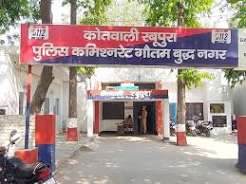
A Dalit vegetable vendor has been assaulted and subjected to casteist remarks in the Rabupura police station area of Greater Noida for demanding repayment of a loan of 150 rupees. Police have registered a case against three accused, including a woman, and have begun an investigation. According to police, Jawahar, a resident of Bhekanpur village, travels from village to village selling vegetables. On Tuesday, he went to Bhoira village to sell vegetables. He then asked Om Prakash, a resident of the village, for repayment of an old loan of 150 rupees. Om Prakash became angry at the demand and began abusing Jawahar. The victim alleges that the accused insulted him using casteist slurs. When he protested, Om Prakash called his family members, Maya and Meghraj. The three attacked Jawahar with sticks, leaving him seriously injured. Bystanders intervened and rescued him. It is alleged that while leaving, the accused also threatened to kill the victim if he returned to the village. The injured Jawahar has been admitted to the hospital for treatment, where he is undergoing treatment. On Tuesday, based on the victim’s complaint, Rabupura police registered a case against Omprakash, Maya, and Meghraj under relevant sections and the SC/ST Act. Police say the matter is being investigated and further action will be taken based on the investigation. Courtesy: Hindi News
RTIH inks pact with Dalit Philanthropy Foundation to empower women entrepreneurs

Ratan Tata Innovation Hub (RTIH), Vijayawada, signed a Memorandum of Understanding (MoU) with Dalit Philanthropy Foundation (DPF) at the NTR District Collectorate on Tuesday. According to a press release, the partnership aims to promote women entrepreneurship, inclusive innovation, livelihood development, and social enterprises, with a special focus on empowering marginalised and underserved communities. Through this collaboration, both organisations will work together to strengthen entrepreneurial ecosystems, facilitate capacity-building initiatives, provide mentorship opportunities, and support sustainable livelihood interventions. Dalit Philanthropy Foundation executive director Santosh Kumar Samal and Ratan Tata Innovation Hub CEO G. Krishnan exchanged the MoU. Speaking on the occasion, the representatives of both organisations emphasised the importance of collaborative efforts in creating equitable opportunities for aspiring entrepreneurs and fostering inclusive economic growth. The Hindu Bureau Courtesy : The Hindu Note: This news is originally published on https:/thehindu.com/bha and is used purely for non-profit/non-commercial purposes, especially human rights