
NCSC issues notice to Meerut DM-SSP in case of casteist remarks against Dalit women, calls for report within 15 days

The complaint stated that on August 6th, four youths from the Mohkampur and Shivpuram areas used casteist slurs and offensive language against women from the Scheduled Caste community while performing bike stunts on the highway. Meerut – The National Commission for Scheduled Castes (NCSC) has taken cognizance of a complaint regarding casteist and obscene/objectionable remarks against women from the Scheduled Caste community in the TP Nagar police station area and issued a notice to the District Magistrate and Senior Superintendent of Police of Meerut. The Commission has directed them to submit a detailed report of the action taken in the matter within 15 days. South Asians and Migrants This complaint was filed with the National Commission for Scheduled Castes by Mayank Verma, District Youth President, Anti-Corruption Foundation of India. The complaint stated that on August 6th, four youths from the Mohkampur and Shivpuram areas used casteist slurs and offensive language against women from the Scheduled Caste community while performing bike stunts on the highway. It was also mentioned that a video related to the incident had gone viral on social media. According to the complaint, FIR No. 0423/2026 was registered at TP Nagar Police Station, in which sections 196(1)(a) and 352 of the Indian Penal Code and Section 67 of the Information Technology Act were invoked, while sections of the SC/ST (Prevention of Atrocities) Act, 1989 were not invoked. The complainant also informed the Commission that a call recording of the Station House Officer’s conversation with Ravikant was available, in which it was stated that the SC/ST Act was not invoked in the case. The complaint sought inclusion of the viral video and call recording in the investigation and an inquiry into the role of the Station House Officer and the investigating officer. Through a notice, the National Commission for Scheduled Castes has sought a detailed report from the District Magistrate and SSP of Meerut, including the date of the incident, the crime number, details of the victim and accused, sections invoked in the FIR, the status of arrests, the charge sheet/final report, and action taken under the SC/ST (Prevention of Atrocities) Act. People and Society The Commission also stated that if the report is not received within the stipulated time, it may issue summons to the concerned officials to appear in person, exercising its powers under Article 338 of the Constitution. Courtesy: Hindi News
Dehradun: Dalit youth on ventilator, BJP leader charged with attempted murder; angry Valmiki community blocks Delhi-Haldwani highway
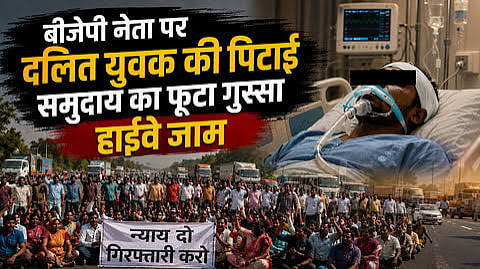
Following a fatal attack on a Dalit youth in Rudrapur, the Valmiki community staged a massive protest, blocking the highway and demanding the immediate arrest of the main accused, a BJP leader. New Delhi: The Valmiki community has erupted in anger following the fatal attack on a 20-year-old Dalit youth and his friends in Rudrapur. Hundreds of members of the community blocked the Delhi-Haldwani highway on Monday. The protesters were demanding the immediate arrest of BJP Mandal General Secretary Paras Chugh, accused in the case. The protest occurred hours after the arrest of Paras’ brother, Sunny Chugh, as the main accused, Paras, has not yet been taken into police custody. The incident occurred on the night of Friday, August 7th. A four-wheeler collided with a scooter near the Kashipur flyover, sparking a dispute that quickly escalated into a violent altercation. The victims allege that the Chugh brothers and their henchmen attacked them with sticks and iron rods, seriously injuring three people. The attackers are also accused of using casteist slurs during the assault. People and Society Abhishek Valmiki, the victim of this brutal attack, is in critical condition. He is battling for life on a ventilator in a private hospital in Bareilly, where doctors have given him little hope of survival. Police have registered a case against BJP leader Paras Chugh, his brother Sunny Chugh, and 10 unidentified individuals under Section 109 (attempt to murder) and other relevant sections of the Indian Penal Code (IPC). Before blocking the highway, protesters gathered at the Rudrapur Municipal Corporation premises, where they announced a complete boycott of sanitation work and raised slogans against the accused. Pooja Devi, the mother of the victim, Abhishek, who works as a sanitation worker in the Municipal Corporation, has raised serious questions about the administration’s functioning. As a widow, she said she expected justice from the mayor, but the police were avoiding arresting Paras Chugh because of his close ties to her. Despite an FIR being registered, the lack of arrest of the main accused has been growing, fueling anger among the Valmiki community. On Monday, police and administrative officials requested time until 2 p.m. to take action against the accused. Following this, CO Akhilesh Kumar Singh reached the Municipal Corporation and spoke with the protesters, but the discussions yielded no results. After much effort and heavy police deployment, the highway blockade was cleared in about 15 minutes. SP Uttam Singh Negi has officially confirmed the arrest of Sunny Chugh in the case. Earlier, Rudrapur in-charge CO Prashant Kumar had also announced the registration of a case. Meanwhile, Congress State Secretary Mohan Khera visited the Municipal Corporation and met with the victim’s family and assured them of full support, although the police detained him during the protest. Meanwhile, Rudrapur MLA Shiv Arora has clarified that the state government will not tolerate any kind of anarchy and that the law will take its course, regardless of who the accused are. Rajan Chaudhary Courtesy: Hindi News
Dalit youth beaten with belts in Jhansi, allegedly forced to drink urine from a pot; video goes viral
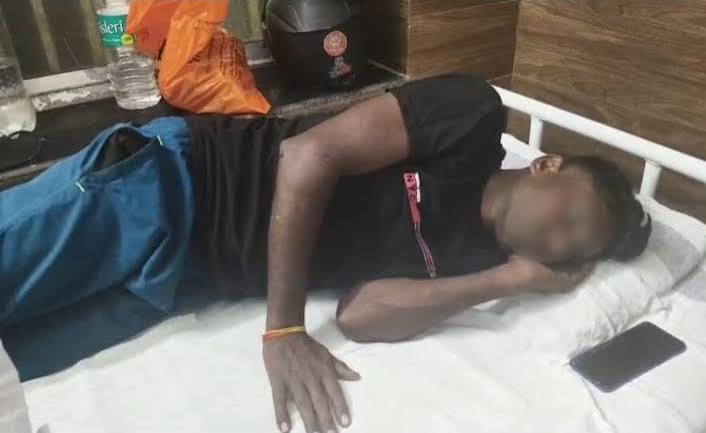
UP Crime: A shocking incident has come to light from Jhansi, Uttar Pradesh, where a Dalit youth was allegedly brutally beaten and forced to drink urine from a pot. The video of this incident is going viral on social media, sparking outrage. UP Crime: A video that shames humanity has surfaced from Jhansi district of Uttar Pradesh. A Dalit youth was allegedly brutally beaten and forced to drink urine from a pot. The video of the incident has also gone viral on social media. In the video, some people are seen assaulting and insulting the youth. The victim alleges that a group of bullies surrounded him and brutally beat him with belts. It is alleged that casteist and derogatory remarks were also hurled at him during the assault. After this, the accused subjected him to inhumane treatment, forced him to drink urine from a pot, and filmed the entire incident. Vikas and Aditya Thakur are fathers… In the viral video, some young men can allegedly be heard shouting slogans like, “Vikas and Aditya Thakur are fathers… Raising hands is a sin.” The video has sparked public outrage over the incident. However, independent verification of the viral video and official confirmation of the identities of all those seen in it will only be possible after an investigation. Victim blames the “Baba 302” gang The victim claims that more than a dozen powerful individuals operate a gang called “Baba 302.” According to him, the group’s objective is to instill terror and assault among people. The victim alleged that individuals associated with this alleged gang committed this crime against him. Questions about law and order raised after the video went viral After the video of the incident went viral on social media, questions have been raised about police action and law and order in the district. The biggest question is, if the allegations are true, why did the accused lack fear of the law? The alleged assault and inhumane treatment of the victim has raised serious questions about the safety of Dalits and the police’s control over the oppressors. People say that instilling fear of the law among criminals is the primary responsibility of the police and administration. Police investigation will reveal the full truth At present, the police investigation is crucial in this entire matter. The identity of the people seen in the video, the actual circumstances of the incident, and the veracity of the allegations made by the victim will only be clear after the investigation. If the allegations are found to be true, strict legal action must be taken against the culprits. Author: Tilak Kumar About the Author Tilak Kumar has been active in journalism for the past 14 years. He has extensive experience reporting in print and digital media. He has worked as a crime reporter for reputed news organizations such as Amar Ujala, Prabhat Khabar, Jan Sandesh Times, and Rashtriya Sahara. His areas of special interest and expertise are crime, politics, and hyperlocal journalism. During his field reporting, he has brought many important and impactful news stories to readers. His deep understanding of ground-level issues and fact-based reporting have been his hallmarks. He is currently associated with Prabhat Khabar’s digital team and continues to write and report on issues related to politics, crime, and public concerns in Uttar Pradesh. Courtesy: Hindi News
Dalit Women Allegedly Attacked for Entering Shiva Temple in Odisha, One Arrested
Tension was reported in Atimati village under Erasama police limits in Odisha after a group of Dalit women were allegedly stopped and assaulted when they tried to enter a Shiva temple to offer prayers during Shravan. The women alleged that some villagers prevented them from entering the temple, hurled casteist and abusive remarks at them, and threatened them with physical violence if they did not leave the premises. According to police, the incident took place on Monday when the women visited the local Shiva temple. Some villagers allegedly carrying sticks and lathis stopped them from entering, leading to an argument between the two groups. Dalit Woman Allegedly Attacked With Knife The situation reportedly escalated after the women refused to leave the temple premises. The villagers allegedly snatched their puja offerings and threw them on the ground. During the confrontation, one of the accused, identified as 40-year-old Satya Rout, allegedly attacked a 55-year-old Dalit woman with a knife, leaving her seriously injured. He is also accused of kicking and physically assaulting her. The injured woman later approached the Erasama police station and filed a complaint against eight people. Based on her complaint, police registered a case against all eight accused persons. Police Arrest One Person Erasama IIC Parthsarthi Beura confirmed that a case had been registered and said Rout had been arrested in connection with the alleged assault. He was subsequently produced before a court. Police are investigating the role of the other accused named in the complaint. “The involvement of the other accused persons would be verified during the investigation and appropriate action would be taken if they are found guilty,” Beura said. He added that the situation in the village was currently under control, but police personnel had been deployed to prevent any further escalation. “The situation is now normal, but police are maintaining strict vigil in the village to prevent any untoward incident,” he said. Courtesy : TOP Note: This news is originally published on https:/theobserverpost.com/bha and is used purely for non-profit/non-commercial purposes, especially human rights
BJP can’t tolerate BCs, Dalits’ growth: Minister Nagendra
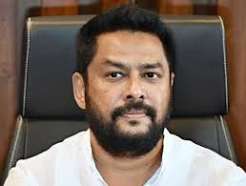
The world knows how the money was misappropriated. KOPPAL: Minister B Nagendra on Tuesday alleged that the BJP could not tolerate the growth of leaders from Backward Classes and the Dalit community. Addressing reporters at Munirabad near here, he said, “We are bringing back the money that was siphoned off from Karnataka Maharshi Valmiki Scheduled Tribes Development Corporation Limited. The world knows how the money was misappropriated. The case is before the court. I will come out clean in the alleged scam. Keep watching, my work as a minister will receive appreciation from people across the state.” “I will work under the guidance of the CM and the former CM,” he said. Reacting to some BJP leaders’ statements that they would not allow the Assembly to function till Nagendra is dropped from the cabinet, he said, “Their only aim is to suppress Dalits and BCs. We are ready to give them a fitting reply in the Assembly. Our chief minister has already responded to them. It is the Opposition’s job to corner us, and let them do so. All members of the Cabinet will respond. We are committed to our party’s ideology of taking people from all communities together.” “Whenever I travelled outside the state, I obtained permission. BJP leaders are unaware of it. I have not violated any rules. The court has granted a stay order in this case,” he said. Courtesy : TNIE Note: This news is originally published on https:/thenewindianexpress.com/bha and is used purely for non-profit/non-commercial purposes, especially human rights
‘Compromised PM sold India’s interest’: Rahul Gandhi as US court dismisses Adani case

Adani welcomed the court’s decision, saying he accepted it with ‘humility’ and ‘deep respect’ for the judicial process. Congress leader Rahul Gandhi on Wednesday slammed Prime Minister Narendra Modi after a US federal judge permanently dismissed criminal charges against Adani Group Chairman Gautam Adani and his nephew Sagar Adani, alleging that the decision came at a cost to India’s interests. “There is much more to this than meets the eye,” Gandhi said in a post on X, sharing a media report on the US Justice Department’s request to dismiss the charges. “A compromised PM was forced to sell India’s interest. India is paying a huge price,” he said. US District Judge Nicholas Garaufis of the Eastern District of New York approved the Justice Department’s request to dismiss charges against Gautam Adani, Sagar Adani and former Adani Green Energy CEO Vneet Jaain. The ruling removes a major legal overhang that had hung over the ports-to-energy conglomerate for nearly two years. In a 47-page order issued on August 10, Garaufis dismissed Counts Two, Three and Four of the indictment, covering securities-fraud conspiracy, wire-fraud conspiracy and securities fraud. The dismissals were with prejudice, meaning the charges cannot be refiled. The judge, however, reserved judgment on Count One, alleging violations of the Foreign Corrupt Practices Act, and Count Five, alleging conspiracy to obstruct justice. Both counts involve five India-based co-defendants who have not appeared before the US court. The Justice Department has until August 31 to meet the court’s requirements, while lawyers for the non-appearing defendants must confirm their clients’ consent by the same date. Garaufis made clear that the dismissal reflected prosecutorial discretion and did not amount to a finding on the merits of the allegations. “No one should mistake” the ruling for the court’s agreement with the government’s decision or an opinion on the merits, Garaufis wrote. No trial was held, witnesses were examined or evidence tested in court. The Adani Group has consistently denied the allegations, maintaining that it acted in accordance with applicable laws. In May, the Justice Department sought dismissal of the charges following an extensive review, citing jurisdictional and evidentiary challenges, the predominantly Indian nature of the alleged conduct, scrutiny by Indian authorities, the absence of identified investor losses and a shift in departmental priorities. The department also argued that the case, unsealed in the final weeks of the Biden administration, had little realistic prospect of reaching trial and appeared to be a politically motivated “name and shame” exercise. Adani welcomed the court’s decision, saying he accepted it with “humility” and “deep respect” for the judicial process. Courtesy : TNIE Note: This news is originally published on https:/thenewindianexpress.com/bha and is used purely for non-profit/non-commercial purposes, especially human rights
Jharkhand exam stir enters 19th day as students vow to intensify agitation

Students protesting under the JPSC-JSSC Reforms Manch have refused to call off the agitation despite assurances from the Hemant Soren government on reforms in the recruitment system. The agitation by job aspirants over alleged irregularities in Jharkhand’s recruitment examinations entered its 19th day on Wednesday, with protesting students vowing to intensify their stir until their demands are met. Students protesting under the JPSC-JSSC Reforms Manch have refused to call off the agitation despite assurances from the Hemant Soren government on reforms in the recruitment system. The protesters are demanding greater transparency in examinations conducted by the Jharkhand Public Service Commission (JPSC) and Jharkhand Staff Selection Commission (JSSC), cancellation of several tests and an independent probe by the CBI or a panel of retired high court judges from outside the state. Meanwhile, the Jharkhand Chhatra Nyay group has announced a one-day hunger strike and a ‘kali patti’ (black armband) protest against the police lathi-charge on students during their march towards the state assembly on Monday. Police used water cannons and tear gas to disperse the protesters. While students alleged that several demonstrators were injured, Ranchi Police said 14 of its personnel sustained injuries in the clashes. The police action triggered a political confrontation, with the BJP observing a statewide bandh on Tuesday. Roads were blocked, educational institutions remained shut and markets were closed in several districts, disrupting normal life. The BJP demanded an independent probe into the alleged examination irregularities and accused the JMM-led government of suppressing the voice of protesting youths. It also questioned the intentions of government officials who visited the dharna site around midnight. The ABVP separately staged a march towards the assembly on Tuesday, while the JPSC-JSSC Reforms Manch held a silent procession from Jaipal Singh Munda Stadium to Albert Ekka Chowk in Ranchi. Leaders of the outfit said the agitation would continue and that a fresh programme to intensify the protest would be announced soon. The prolonged agitation has also affected the health of protesters. Six demonstrators are on an indefinite hunger strike, with two admitted to Ranchi Sadar Hospital. Add as a preferred source on Google JLKM leader Devendra Nath Mahto, who has been fasting for about 10 days, remains in the emergency ward. Doctors said his condition was stable, though he has refused food despite repeated appeals. His blood pressure and blood sugar levels are being closely monitored. Another protester, Rahul Kranti from Palamu, began his fast at Jaipal Singh Munda Stadium on August 4 and was admitted to hospital on August 7 after his condition deteriorated. Doctors said his health parameters were currently normal. The sixth round of talks between the government and representatives of the protesting students on Sunday failed to break the deadlock, with both sides accusing each other of lacking seriousness. Chief Minister Hemant Soren has maintained that his government is committed to reforming the examination system and assured protesters that the 14th JPSC examination would be cancelled. He has also accused the BJP of turning the students’ agitation into a political platform. Courtesy : TNIE Note: This news is originally published on https:/thenewindianexpress.com/bha and is used purely for non-profit/non-commercial purposes, especially human rights
‘Portfolios within 24 hours’: Rahul, Kharge discuss Karnataka ministry allocation

NEW DELHI: Portfolios for ministers inducted in the recent Karnataka cabinet expansion will be allocated within the next 24 hours, news agency ANI reported citing sources. This came after a meeting between Congress leaders Rahul Gandhi, Mallikarjun Kharge, KC Venugopal and Randeep Surjewala on Tuesday. The Karnataka cabinet was expanded earlier this month with 20 new ministers inducted, taking the ministry to its full sanctioned strength of 34, including chief minister DK Shivakumar. The expansion came two months after Shivakumar took office and also saw the return of former ministers including B Nagendra, Laxman Savadi and Zameer Ahmed Khan. Gayathri Shanthegowda is the only woman among the new inductees. The expansion also triggered discontent among some Congress MLAs who were left out. Yashavantarayagouda V Patil and Belur Gopalakrishna resigned as MLAs ahead of the swearing-in after not finding a place in the Cabinet. Shivakumar urged disappointed legislators to remain patient, saying it was not possible to accommodate everyone at once and promising opportunities in the future. The Congress high command also approved new appointments to key legislative posts, including GS Patil as assembly Speaker and AS Ponnanna as deputy Speaker. Courtesy : TOI Note: This news is originally published on https:/timesofindia.com/bha and is used purely for non-profit/non-commercial purposes, especially human rights
‘Much more to this than meets the eye’: Rahul targets PM Modi after US court drops case against Adani
NEW DELHI: Congress leader Rahul Gandhi on Wednesday reacted sharply to Gautam Adani’s acquittal by a US court and targeted Prime Minister Narendra Modi over the development. In a post on X, the leader of opposition in Lok Sabha said, “There is much more to this than meets the eye. A compromised PM was forced to sell India’s interest. India is paying a huge price.” A US federal judge in New York on Monday dismissed the nearly two-year-old criminal case against Adani and the other accused. The US Department of Justice had sought dismissal of the charges, citing six “overlapping bases”, including that the case involved foreign conduct, India had not found “actionable misconduct”, no money had been lost on securities issued and there were “extraordinary proof problems”. The case, filed in November 2024, accused Adani, his nephew Sagar Adani and six others of conspiracy to bribe Indian government officials to secure a solar power contract. The Adani Group had denied the allegations and said its companies and executives had acted in accordance with applicable laws and regulatory requirements. Judge Nicholas Garaufis had earlier questioned the DOJ’s decision to drop the case and sought further explanation for the move. The DOJ had argued that the defendants were foreign nationals who had never appeared in the US and were unlikely to do so. Adani, meanwhile, welcomed the court’s decision, saying: “Throughout this challenging period, our faith in truth, fairness and the rule of law remained unwavering. My deepest gratitude to those who never lost faith in us, in the system and in India’s capacity for justice,” according to the supplied text. Courtesy : TOI Note: This news is originally published on https:/timesofindia.com/bha and is used purely for non-profit/non-commercial purposes, especially human rights
Before the Constitution: How ‘Scheduled Caste’ Was Born a Hindu Category — And Why the British Kept It That Way Part 1

Every argument about who is entitled to Scheduled Caste (SC) status in India today is, at bottom, an argument about history. Proponents of extending SC status to Dalit converts to Christianity and Islam often present the current religion-linked definition — Hindus, Sikhs, and Buddhists only — as a post-1950 anomaly, an accident of drafting that a more enlightened Republic ought to correct. The historical record says otherwise. The link between Scheduled Caste status and the Hindu social order was not invented by the Constituent Assembly in 1949. It was inherited, fully formed, from more than two decades of colonial administrative and political practice — practice that itself confronted, and rejected, the demand to extend caste-based protections to Christian and Muslim converts. This first article in the series traces that history. Untouchability as an Administrative Fact, Not a Legal Category Before “Scheduled Caste” existed as a term, the colonial state grappled with the reality of untouchability as a sociological fact peculiar to Hindu society. The 1881 census and subsequent decennial enumerations recorded a large population subjected to social disabilities on account of birth communities barred from temples, wells, schools, and public roads, and confined hereditarily to degrading occupations. British ethnographers and administrators, working through successive census operations, consistently identified this system of graded exclusion as an internal feature of Hindu social organisation, rooted in notions of ritual pollution that had no doctrinal counterpart in Islam or Christianity, notwithstanding that both faiths had, by then, acquired converts from the same untouchable communities. This is the crucial starting point often erased from public memory: the British did not invent the idea that untouchability was a Hindu phenomenon. They found it that way, documented it that way, and built their entire administrative response around that understanding. The Simon Commission and the Depressed Classes The Indian Statutory Commission of 1927 — the Simon Commission — was among the first bodies to give the phrase “Depressed Classes” (the pre-Independence term for what became Scheduled Castes) an administrative shape. Its enquiries, like the census operations before it, confirmed that the disabilities in question attached to caste communities within Hindu society. The Commission’s engagement with the question set the template that later instruments would follow: identify the castes suffering ritual and social disability, and confine protective measures to the community that generated and sustained that disability in the first place. The Communal Award of 1932: The First Legal Separation of Converts from Depressed Class The decisive administrative moment came in 1932. Prime Minister Ramsay MacDonald’s Communal Award, framed to allocate separate electorates among India’s communities, drew a sharp and deliberate line: it treated “Indian Christians” as a distinct political and electoral minority, wholly separate from the Depressed Classes. A Dalit who had converted to Christianity was, under the Award, an Indian Christian for electoral purposes, not a member of the Depressed Classes. Such a person could neither vote in, nor contest, the seats specifically reserved for the Depressed Classes. This was not an oversight. The British administration, dealing daily with the realities of caste, religion, and colonial governance, took the considered position that conversion to an Abrahamic faith changed a person’s political and social classification. It dissolved, for electoral law, the individual’s identity as a member of the Depressed Classes. The Poona Pact of the same year, the settlement between Gandhi and Ambedkar that replaced separate electorates with reserved seats within the general electorate, likewise operated within this same framework: the reserved seats were for the Depressed Classes as a Hindu social category, not for a religion-neutral class of the economically disadvantaged. The Government of India Act, 1935 and the 1936 Order Three years later, the Government of India Act, 1935 authorised the Governor-General to specify, by order, which castes, races, or tribes would be treated as Scheduled Castes for representation and administration. Acting under this power, the colonial government issued the Government of India (Scheduled Castes) Order, 1936, the instrument that coined the very term “Scheduled Castes.” The 1936 Order restricted the definition strictly to persons professing the Hindu religion. Indian Christians of Dalit origin were explicitly and knowingly excluded. It is worth pausing on the significance of this. The post-Independence Constitution (Scheduled Castes) Order, 1950, the instrument at the centre of today’s controversy, did not invent the religion criterion. It inherited it, almost verbatim, from an instrument that had already been in continuous administrative use for over a decade. When Dr Ambedkar and the framers of India’s Constitution came to address the question of Scheduled Castes in 1949, they were not writing on a blank slate. They were ratifying and, in the case of Sikhs and later Buddhists, cautiously extending a classification that colonial administrators, working from census data and ground-level observation rather than any ideological programme, had already settled a generation earlier. Early Representations for Inclusion — and Their Rejection The demand to bring Christian Dalits within the ambit of Depressed Classes protections is not a new one; it is, in fact, older than Independence itself. Christian organisations in South India — where a substantial proportion of Dalit conversions to Christianity had occurred through nineteenth and early twentieth-century missionary activity — periodically pressed the colonial government to recognise continuing caste-based disadvantage among converts and extend the same statutory protections available to Hindu Depressed Classes. These representations were considered and were not accepted. The colonial state’s position — later inherited without significant modification by the Constituent Assembly, as the second article in this series will show — was that the disability in question was untouchability, a phenomenon rooted in the Hindu social order, and that the act of conversion to a faith which formally repudiated caste distinctions was itself evidence that the convert had exited the social system generating the disability. The state did not deny that Christian converts of Dalit origin might continue to face economic hardship or informal social prejudice. It declined, however, to treat that hardship as equivalent to the specific, ritualised, birth-imposed disability of untouchability for which the Depressed Classes framework