
Vote ‘chori’ row: BJP steps up attack on Congress; claims Pawan Khera has 2 voter ID cards
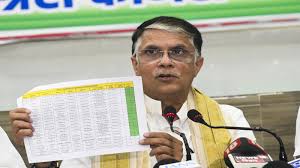
NEW DELHI: Bharatiya Janata Party on Tuesday accused Congress leader Pawan Khera of holding two voter ID cards as Rahul Gandhi sharpened his attack against the Centre with his “vote chori” claim during the recently concluded “voter Adhikar Yatra” in poll-bound Bihar. In a social media post, BJP IT cell head Amit Malviya urged the Election Commission to investigate whether Khera voted multiple times. “It has now emerged that Pawan Khera, Congress spokesperson—who never misses a chance to flaunt his proximity to the Gandhis—holds two active EPIC numbers (in Jangpura and New Delhi Assembly constituencies, falling under East Delhi and New Delhi Lok Sabha seats respectively),” Malviya said. — amitmalviya (@amitmalviya) “It is now for the Election Commission to investigate how Pawan Khera holds two active EPIC numbers, and whether he voted multiple times—a clear violation of electoral laws,” he added. Malviya also accused Khera of holding a “malicious” press conference in Bihar to mislead voters during the INDIA bloc’s recently concluded “Voter Adhikar Yatra.” “As if the criminality of holding multiple votes isn’t enough, Pawan Khera is holding malicious press conferences in Bihar to mislead voters, create dissonance, and undermine India’s robust electoral process,” he said. Earlier, the BJP had dug up the 1980 poll roll and said that Sonia Gandhi’s name appeared on the voter list three years before she became an Indian citizen. “Sonia Gandhi’s tryst with India’s voters’ list is riddled with glaring violations of electoral law. This perhaps explains Rahul Gandhi’s fondness for regularising ineligible and illegal voters, and his opposition to the SIR,” Malviya had said. This comes a day after Rahul Gandhi concluded INDIA bloc’s 1,300-km “Voter Adhikar Yatra” in Bihar. Speaking at the concluding event in Patna on Monday, the Congress leader targeted Prime Minister Narendra Modi, saying he would not be able to “show his face to people after we bring the hydrogen bomb of vote chori.” “I want to tell the BJP people. Have you heard of anything bigger than an atom bomb? It is a hydrogen bomb. BJP people, be ready, a hydrogen bomb is coming. People are soon going to find out the reality of vote chori,” he said. “In the coming time, I am guaranteeing you that after the hydrogen bomb (comes), Narendra Modi ji will not be able to show his face to the country,” he added. Earlier, Rahul said the Congress had analysed the Mahadevapura electoral rolls over six months and found that out of 1,00,250 alleged bogus voters, 40,009 had “fake and invalid addresses” and 10,452 were “bulk voters” registered at common addresses. Examples included entries with “0” in the address field, non-existent locations, and addresses that could not be verified. The opposition has also been protesting against the special intensive revision of the electoral roll, alleging that the EC’s exercise is aimed at “disenfranchising voters” in Bihar ahead of the assembly elections due later this year. Courtesy : TOI Note: This news is originally published on https:/timesofindia.com/bha and is used purely for non-profit/non-commercial purposes, especially human rights.
Revisiting Periyar: Dialogues on caste, socialism and Dravidian identity
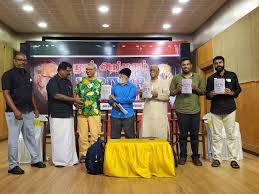
S. V. Rajadurai and Vidya Bhushan Rawat’s joint effort in bringing out a book on the most original iconoclast of South Asia, Periyar E. V. Ramasamy, titled Periyar: Caste, Nation and Socialism, published by People’s Literature Publication, Mumbai, is now available on Amazon and Flipkart. This volume presents an innovative method of documenting the pioneering contributions of a leader like Periyar, and it reflects the scholarship of Rajadurai, who has played a pivotal role in popularizing Periyar in English. What makes the book distinct is its dialogic structure, inspired by Paulo Freire’s conversational method, in which Rajadurai responds to Rawat’s carefully crafted questions across 14 chapters, covering a wide range of themes from Periyar’s conception of Dravidanadu to his engagements with Ambedkar, Buddhism, caste annihilation, Pakistan, the Constituent Assembly debates, and several lesser-known episodes of his North Indian tours and Bombay conferences organized largely by RPI and Ambedkarite groups. The book records Periyar’s nuanced positions, including his candid defense against accusations from certain Dalit activists, his contentious relations with leaders like Rajagopalachari and Kamaraj, and his interactions with communists and Dalit dissenters. A significant addition lies in three appended chapters that reveal aspects of Rajadurai’s own life and mission, unavailable elsewhere. Particularly notable is the exploration of Ambedkar’s Annihilation of Caste, a text Periyar translated into Tamil and serialized in Kudi Arasu. Rajadurai details Periyar’s solidarity with Ambedkar’s anti-Brahminical struggles, his acknowledgment of the Round Table Conferences, and his critiques of Gandhi. Beyond his reputation as an atheist and iconoclast, the book underscores Periyar’s deep engagement with Buddhism—his participation in conferences in Ceylon, his organization of meetings in Erode, and his collaborations with Ambedkar and RPI workers. Such narratives enrich our understanding of Periyar as a comprehensive humanist and reformer, later recognized by UNESCO. The chapters also revisit Periyar’s fraught relations with the Justice Party, the Congress, and the subsequent formation of the Self-Respect Movement, with Rajadurai illustrating how leaders like Anna, Karunanidhi, and Veeramani shaped and sustained the Dravidian movement under his influence. Rawat’s probing questions bring depth to these narratives, particularly in relation to controversies such as Kilvenmani and Meenakshipuram, Dalit massacres during and after Periyar’s time, and the persistence of caste violence in Tamil Nadu today. Interestingly, the chapter on land reforms is a mere page and a half, exposing the movement’s inadequacies in addressing Dalit economic deprivation. Rajadurai highlights that Tamil Nadu still has the highest proportion of landless Dalits in the South—around 73 percent—making caste clashes largely agrarian conflicts between landowners and landless Dalits. The persistence of feudal mindsets even within sections of the Dravidian leadership underscores this unresolved tension. Rajadurai’s reflections also reveal his disillusionment with the left parties, whose entrenchment in Brahminical frameworks undermined radical reform agendas. The Naxalite strategy of violent elimination of class enemies, which briefly influenced Rajadurai, also failed to transform the socio-economic realities of Tamil Nadu. Nevertheless, the Periyar project’s enduring impact lay in its challenge to the Arya-Brahmin conspiracy and its mobilization of Dravidian identity against structural oppression. While Dalit critics have faulted Periyar for not addressing their specific grievances more robustly, Rajadurai argues that Periyar consistently stood with the oppressed, though the sheer scale and internal contradictions of the movement inevitably gave rise to disputes. The socialist dimension of Periyar’s thought is another strength of this book. His writings in Kudi Arasu (Republic), Puratchi (Revolution), and Viduthalai (Freedom) reflect his belief in socialism, which he defined as samadharma, a direct refutation of Manudharma. For Periyar, socialism meant equality through proportional representation and the self-respect of all individuals. He translated the Communist Manifesto into Tamil and emphasized that caste inequality was rooted in agrarian structures. His clashes with Gandhi, his leadership in the Vaikom Satyagraha, his repeated imprisonments for temple-entry struggles, and his advocacy of women’s liberation and family planning in the 1930s demonstrate his radicalism in both social and economic spheres. Periyar’s fight for caste-based reservations, especially his leadership in pressuring Nehru’s government to amend the Constitution in 1951 to restore backward class rights after the Supreme Court struck them down, is also recounted in detail. Ambedkar, as Law Minister, supported this amendment. Rajadurai also recalls events like the Meenakshipuram conversions, countered by Hindutva forces with political money power, and shows how Periyar’s tactical support for conversions provided Dalits temporary relief from caste oppression. Ultimately, Periyar’s samadharma envisioned a Dravidian country rooted in equality and dignity for all. The book’s wider contribution is to spark fresh debate on the relevance of Periyar in contemporary India. It interrogates the limitations of the Dravidian movement, both in addressing class inequities and in broadening its scope beyond Tamil Nadu. The narrowing of the Dravidian identity, despite its historical linkages to the Indus and Harappan civilizations, has weakened its ideological reach. Rajadurai and Rawat argue that intellectual collectives must re-examine non-Brahmin movements, critically evaluate source material often mediated by Brahmin translators, and expand the study of caste and class annihilation in light of Periyar and Ambedkar’s visions. Periyar: Caste, Nation and Socialism thus provides a compelling foundation to continue the agenda of liberating India’s oppressed classes from Brahminical and capitalist exploitation. It offers an honest appraisal of Periyar’s achievements and limitations while urging new approaches to strengthen the unfinished tasks of social and economic justice. By Prof. K. S. Chalam* Courtesy : Counterview Note: This news is originally published on https:/counterview.com/bha and is used purely for non-profit/non-commercial purposes, especially human rights.
Dalit youth murdered in Hardoi: Beaten with kicks and sticks during irrigation, dispute over playing music in the temple 4 months ago
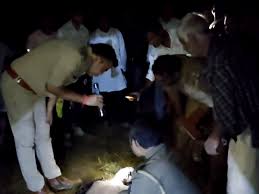
A Dalit youth was murdered in Zaidipur village of Madhoganj police station area of Hardoi. The deceased has been identified as 22-year-old Rohit. He was a Rozgar Sevak and the only brother of four sisters. On Sunday evening, Rohit was irrigating the paddy crop in his field. During this time some people attacked him. The accused beat him with kicks and sticks. Then strangled him to death. According to the villagers, Rohit had a dispute with some people three-four months ago over playing music in the temple. He was attacked even then. He went into coma in this attack. He had to be admitted in Lucknow for 15 days. A case of attempt to murder was registered in this matter. On receiving information about the incident, police station in-charge and CO Bilgram Ravi Prakash reached the spot. The deceased’s father Balakram has accused five youths of the village. The police have detained two suspects and started questioning them. The body has been sent for post-mortem. The villagers allege that the police did not take any action after the last attack. This boosted the morale of the accused and they attacked again. There is an atmosphere of tension in the village. Faizi Khan Courtesy: Hindi News
Rajgarh: Case of rape of Dalit woman comes to light
Rajgarh: A 26-year-old Dalit woman living in village Mana of Kurawar police station area has accused a youth from Barodia Talab of raping her several times in a period of one and a half months on the pretext of marriage and threatening to kill her by beating her when she protested. On Monday, the police registered a case against the accused who fled from the spot under various sections including SCST Act and started the search. According to the police, the 26-year-old Dalit woman resident of village Mana told that Arjun son of Govind Khati, resident of village Barodia Talab, raped her several times between 11 June and 27 July on the pretext of marriage. Now he is refusing to marry, he beat her when she protested and threatened to kill her. The police registered a case against the accused who fled from the spot under sections 69, 115(2), 351(3) BNS, SCST Act and started the search. Courtesy : Hindi News
BIM yet to reinstate Dalit assistant professor, likely to appeal Madras HC order
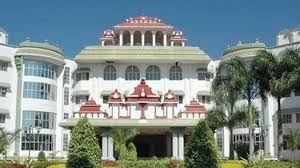
The director of the institution said they are exploring options to appeal against the order in Supreme Court within the stipulated period of 90 days. TIRUCHY: An assistant professor, who is from a Scheduled Caste community, has sought the intervention of state higher education department stating the Bharathidasan Institute of Management (BIM) has not reinstated him despite an order issued by the Madurai Bench of the Madras High Court on August 4. The director of the institution said they are exploring options to appeal against the order in Supreme Court within the stipulated period of 90 days. Dr CNS Ramnath Babu, an alumnus, joined the BIM in April 2021 as assistant professor in marketing department. On completion of probation period, he was terminated by the director Asit K Barma in July 2023 without issuing notice. Dr Babu challenged it in the Madurai Bench of Madras High Court, which stayed the termination and later quashed it in November 2023. BIM obtained a stay that prolonged the dispute until August 2025, when a division bench dismissed the appeal and upheld his reinstatement. The judges held that while probationers could be discharged for poor performance, punitive or stigmatic termination required an inquiry. On August 24, Boiler Plant police booked Asit K Barma under the SC/ST Act. “Since July 2023, I am in this legal battle, just to prove I am an able teacher and scholar. Every day is a struggle to uphold my self-respect without earning,” he told TNIE. Dr Babu, who earlier headed the SC/ST Committee at BIM, alleged that reservation norm is not followed in the institution in faculty recruitment. “I am not looking for another job because this fight is for justice and dignity. I want what I rightfully deserve,” he said. When contacted, Barma said the institution respects the high court but had the right to move SC within 90 days. “Reservation norms are not applicable in faculty recruitment or promotions in our institution. We follow merit-based selection as per our rules. At the same time, we are exploring legal remedies,” Barma said. Legal experts say unless BIM obtains a stay from the apex court, the HC order is binding, and non-compliance could invite contempt action. Higher Education MinisterGovi Chezhian assured that the department would examine the matter and take action. Courtesy : TNIE Note: This news is originally published on https:/thenewindianexpress.com/bha and is used purely for non-profit/non-commercial purposes, especially human rights.
Case of Dalit students being beaten: 5 students were made to stand like a rooster for chanting Jai Bhim, complaint lodged with SP
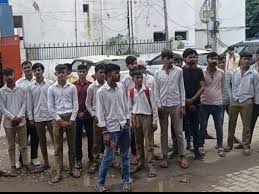
A case of beating of Scheduled Caste students has come to light in the Intermediate College located in Dhanaura Silvernagar of Binauli in Baghpat district. The students have complained to the SP office. The incident is of 26th August. Some students raised slogans of ‘Jai Shri Ram’ in the prayer meeting. During this, the Scheduled Caste students raised the slogan of ‘Jai Bhim’. After this, the PTI and two teachers took five students to a room. Two teachers held the hands of the students. The third teacher beat them with a stick. The students were also made to stand like a rooster. Threatened to be expelled from school The students allege that the principal used casteist words. They were threatened to be expelled from the school. The aggrieved students complained to the Binauli police station. The police did not take any action. After this, the students reached the SP office on Friday. Additional SP Narendra Pratap Singh said that the Binauli police station in-charge has been instructed to investigate. DIOS Raghavendra Singh said that he has not received any complaint yet. On receipt of complaint, a thorough investigation will be conducted and action will be taken as per rules. Ashish Courtesy : Hindi News
8-year-old Dalit boy beaten, hung upside down in Rajasthan for touching water pot; mother, grandmother attacked
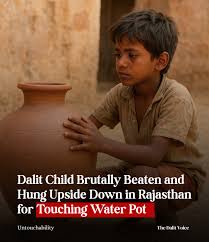
A man was arrested and two others were detained after an eight-year-old Dalit boy was brutally assaulted and hung upside down from a tree in Rajasthan’s Barmer district for allegedly touching a water pot. His mother and grandmother were also attacked when they tried to stop the assault. According to the boy’s mother, Puri Devi, the incident took place in Bhakharpura village on Friday. She told Hindustan Times that her son was playing nearby when two men, identified as Narnaram Prajapat and Demaram Prajapat, asked him to clean a bathroom and collect garbage. After completing the work, the minor requested water and touched their pot, which allegedly triggered the violence. The accused reportedly dragged the child to Narnaram’s house, where they hung him upside down from a tree and continued beating him. The assault reportedly ended only when a relative of the boy began recording the incident on his phone. Soon after, the accused allegedly barged into Puri Devi’s home and attacked her and her mother-in-law. “Prima facie investigation and medical examination confirm the boy was brutally beaten and hung upside down. However, the allegation that touching a water pot led to the assault is still under investigation,” Circle Officer Sukhram Bishnoi told the newspaper. He added that an FIR was registered on August 30 against the three men — Narnaram, Demaram, and Ruparam Prajapat, all residents of Bhakharpura. Police have charged the accused under Section 115(2) (voluntarily causing hurt), Section 127(2) (wrongful confinement), and Section 137(2) (kidnapping) of the Bharatiya Nyaya Sanhita (BNS), along with relevant provisions of the Scheduled Caste and Scheduled Tribe (Prevention of Atrocities) Act, 1989. Courtesy : Maktoob Media Note: This news is originally published on https:/maktoobmedia.com/bha and is used purely for non-profit/non-commercial purposes, especially human rights.
RPF team assaulted by eunuchs, transgenders at Deoria station; 2 held, others absconding
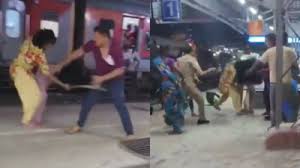
LUCKNOW: A Railway Protection Force (RPF) team was allegedly assaulted late Sunday night by a group of 6–7 individuals, including eunuchs and transgenders, at Deoria railway station in Uttar Pradesh. The incident took place around 10 pm on platform number one and was caught on video, later shared widely on social media. According to SHO Aash Mohammad of RPF Deoria, the team had intervened after receiving a passenger complaint of harassment and extortion by some transgender persons. The group allegedly turned violent, attacking the officers on duty. Two individuals, identified as Chanda and Sahil, were arrested, while others remain absconding. The Government Railway Police (GRP) Deoria registered an FIR under Bharatiya Nyaya Sanhita Sections 191(2) (rioting with deadly weapons), 115(2) (causing hurt), 121(1) (attacking public servants), 132 (assault to obstruct duty), 308 (attempted culpable homicide), 324 (mischief), and 352 (provoking unrest through intentional insults). Courtesy : TOI Note: This news is originally published on https:/timesofindia.com/bha and is used purely for non-profit/non-commercial purposes, especially human rights.
Two Virginia school districts sue US Education Department over transgender policies
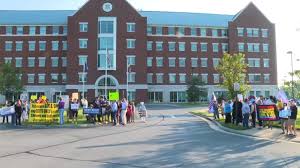
In a bold legal move that could shape the national debate on transgender rights in schools, two Virginia school districts, Arlington and Fairfax counties, filed lawsuits against the U.S. Department of Education on Friday, seeking to block the federal agency from freezing millions in funding over policies that allow students to use bathrooms and other facilities consistent with their gender identity. The lawsuits come after the Education Department said such policies violate federal law prohibiting sex-based discrimination. The department had urged the districts, along with three others in the D.C. suburbs, to rescind their policies or risk losing access to crucial federal dollars. Both districts refused, arguing that their policies comply with the law and provide a safe, welcoming environment for all students, according to The Washington Post. The stakes for students are high “Students are punished when federal funding, primarily used to provide free breakfast and lunch for over 8,000 students or counseling and education for special needs students, is ripped away,” Arlington Public Schools Superintendent Francisco Durán said in a statement, according to The Washington Post. “We strongly disagree with the U.S. DOE’s assertion that our policy violates Title IX.” Education Secretary Linda McMahon responded sharply on social media, writing on X, “It’s disturbing that these Virginia school division leaders are fighting harder to keep boys in girls sports and bathrooms than they are to improve outcomes for students. The Trump Administration will proudly stand for commonsense and protect our young girls.” Investigations and complaints The federal agency began investigating the five Northern Virginia districts, including Alexandria, Loudoun, and Prince William counties—after a complaint by America First Legal, a conservative group founded by White House Deputy Chief of Staff Stephen Miller. The complaint alleged that districts were providing “greater rights to students whose ‘gender identity’ does not match their biological sex than it does to students whose ‘gender identity’ matches their biological sex,” according to The Washington Post. While no federal funds have yet been withheld, officials warn that the “high-risk” designation imposed by the Education Department could jeopardize up to $167 million for Fairfax, the state’s largest district, and $23 million for Arlington. The funding supports programs ranging from counseling and academics to free and reduced meals for students. Legal battleground: Title IX Legal experts say the fight centers on the interpretation of Title IX, the landmark federal law that bars discrimination based on sex in federally funded schools. Courts have split on whether the law protects transgender students, though LGBTQ+ advocates argue that failing to do so constitutes sex-based discrimination. The 4th Circuit Court ruling in Grimm v. Gloucester County School Board is often cited in support of policies allowing transgender students to access facilities that match their gender identity, The Washington Post reports. Trump administration pressures districts Under the Trump administration, the U.S. Department of Education has repeatedly pressed districts to rescind such policies, framing them as examples of “gender ideology” that threaten the rights of girls. Some districts nationwide, including Maine, California, and Denver, have resisted, leading to ongoing litigation, according to The Washington Post. Northern Virginia districts stand firm In Northern Virginia, where liberal districts serve roughly a third of the state’s public school students, local officials have doubled down on policies they say comply with both state and federal law. Revoking them, the school boards argue, would put them in legal jeopardy. “We have a responsibility to ensure that every child has the support needed to achieve their full, unique, and limitless potential,” the Fairfax County School Board said in a statement reported by The Washington Post. “We will not abide attempts to pit one group of students against another.” Supreme Court looming The Supreme Court is expected to hear a case involving transgender athletes in federally funded schools this fall, a decision that could ultimately determine the fate of policies like those in Northern Virginia. For now, the legal battle underscores the tension between federal authority, local control, and the rights of transgender students — a fight playing out in school hallways, courtrooms, and public debate alike. Courtesy : TOI Note: This news is originally published on https:/timesofindia.com/bha and is used purely for non-profit/non-commercial purposes, especially human rights.
Kerala Assembly polls will decide India’s future, says Revanth
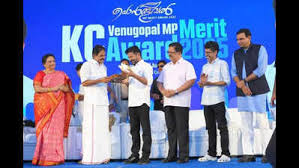
Hyderabad: Chief minister A Revanth Reddy on Sunday urged the youth to fight for their rights and resolve to make Rahul Gandhi the Prime Minister of India in 2029. Speaking at the MP Merit Awards – 2025 in Alappuzha, Kerala, he said the BJP was snatching away the rights of the youth, and the Congress is fighting to safeguard the Constitutional rights. “Youth are our brand ambassadors. I strongly believe in their power, and their fight for the future will definitely bring a change in the country”. Stating that the 2026 Assembly elections in Kerala will decide India’s future in 2029, the chief minister said that Congress does not have money, power and media support. “The 2029 Lok Sabha elections will be a battle between two political forces, and the youth should play a crucial role in safeguarding the country’s democratic spirit,” he said. During the 2024 Lok Sabha elections, the chief minister recalled that he had urged Rahul Gandhi and Priyanka Gandhi to contest from Telangana. “They chose to fight elections from Kerala and considered the state as their ‘Karmabhumi’. We are organising a big movement against vote theft in the country. Everyone should join the fight to protect the voting rights of every Indian and to protect the Constitution,” he said. The CM emphasised that the age limit to contest in Assembly elections should be reduced to 21 years. “When 21-year-old IAS officers are running the districts efficiently, why shouldn’t the 21-year-old youth contest as MLAs. We need to amend the Constitution in this direction,” the CM said. He highlighted the Telangana govt’s initiatives to strengthen the state economy under TelanganaRising- 2047. The govt has targeted to achieve a $3 trillion economy by 2047 and $1 trillion economy by 2035.Congratulating AICC general secretary KC Venugopal for taking up such a good programme of distributing merit scholarships to the talented students, Revanth said the Telangana govt has filled 11,055 teaching posts in just 55 days to strengthen the education sector and build Young India Residential Schools in 100 Assembly constituencies. The MP Merit Awards instituted by Venugopal are special for the country. Kerala always stood at the top in providing education, and its commitment to achieve 100% literacy is a testament. The chief minister said the adult education programme implemented in Kerala is a role model for all states. Courtesy : TOI Note: This news is originally published on https:/timesofindia.com/bha and is used purely for non-profit/non-commercial purposes, especially human rights.