
From Mallikarjun Kharge’s lawn, 250 opposition MPs ‘impeach’ CEC Gyanesh Kumar
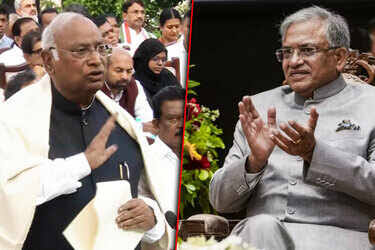
NEW DELHI: With Rahul Gandhi terming “public impeachment” and Sunday’s Ramlila Maidan rally a “dangerous political weapon” targeting Modi-Shah-Gyanesh, the INDIA bloc, in a symbolic move, Saturday passed a “resolution” to “impeach” CEC Gyanesh Kumar accusing it of colluding with the ruling BJP to compromise national election management. It also sought that Kumar be “tried for treason”. Six “charges” of “premeditated attack on poll process” – as part of “criminal conspiracy” of BJP, PM Modi and Union minister Amit Shah – span questionable handling of poll rolls, “manipulated” SIR to delete 14 crore voters, illegal changes to Form 6 to block new voters, deletion of voters through software. CEC Kumar has also been accused of ignoring the two ECs in decision making. The “public impeachment” held in the lawns of the residence of Congress chief Mallikarjun Kharge involved around 250 MPs from opposition. The venue was designed with Parliament chamber like decor, with former Speaker Meira Kumar in the high chair. LoP Rajya Sabha Kharge tabled the resolution while Rahul concluded the debate, before Meira Kumar put the resolution to vote that was passed by a voice vote. The slogan ‘vote chor gaddi chhod’ ended the assembly after three hours of debate. Setting the tone, Kharge said Modi has hatched conspiracies to retain power, which include engineering defections, splitting parties, electoral bonds, misuse of agencies, while adding the 2023 “immunity law” for the CEC is another such instrument. Underlining the need for “public impeachment”, Kharge said RS and LS rejected the opposition notices for removal of Kumar. Rahul said 15% of 2024 voters have been deleted by SIR, which means the LS polls were illegal. “I can comfortably say Kumar will not survive as CEC. We have enough proof. If BJP keeps him after we reveal what we know, then the BJP game would be clear,” he argued. Harendra Malik of SP said SIR has sought to target “PDA voters” of his party ahead of UP polls. Sagarika Ghose of TMC said 2026 Bengal polls were stolen after 29 lakh voters “vanished” under “Vanish Kumar’s SIR”. John Brittas (CPM), in a searing warning, said India should not be the Germany of 1930s, a parallel also drawn by Mamata TMC’s Mahua Moitra. Those who spoke were Mehbooba Mufti (PDP), Arvind Sawant (Shiv Sena), Abhay Sinha (RJD), NK Premachandran (RSP), Sandosh Kumar (CPI), Rajeev Rai (SP), Durai Vaiko (MDMK), Kapil Sibal, Jose Mani (KCM), Devarajan (FB), ET Muhammed Basheer (IUML), Sudama Prasad (CPI-ML), Nasir Aslam (NC), Thol Thirumavalavan (VCK), Baidyanath Ram (JMM). Civil society luminaries like Yogendra Yadav, Nikhil Dey, Sharukh Alam advocate, Anjali Bharadwaj, Noor Shridhar provided incisive arguments and data to put the EC in the dock. Neha Bora of AISA and NSUI volunteer Ritu Barala also spoke. Courtesy : TOI Note: This news is originally published on https:/timesofindia.com/bha and is used purely for non-profit/non-commercial purposes, especially human rights
India’s opposition set to hold mega rally seeking election chief’s resignation
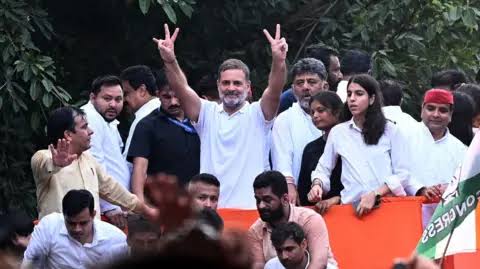
Tens of thousands of people are expected to gather in the Indian capital, Delhi, for a mega opposition rally, seeking the resignation of chief election commissioner and electoral reforms. The rally, called by the main opposition Congress party, will begin around noon at the famous Ramlila Maidan grounds, with leaders claiming a million people could attend. Several top leaders of the Congress-led INDIA alliance have said they would attend and the influential Gen Z-led pressure group Cockroach Janta Party (CJP) has also pledged support. The rally comes amid growing criticism of a voter-list revision exercise that has removed 130 million names from the draft rolls across India. The Election Commission of India (ECI) says the exercise is aimed at updating the voters’ list by purging names of people who have died or moved away from their registered addresses. But opposition parties allege that the exercise – known as the Special Intensive Revision (SIR) – could benefit Prime Minister Narendra Modi’s Bharatiya Janata Party (BJP) by removing eligible voters from the rolls. They accuse the Chief Election Commissioner (CEC) and the BJP of “vote chori (theft)”. Both the BJP and the ECI have denied the allegations. The controversy intensified in September when The Indian Express newspaper in its investigation reported that the CEC, Gyanesh Kumar, made key decisions related to the exercise without the agreement of the two other election commissioners, who had raised objections on more than a dozen occasions. NurPhoto via Getty Images Protesters form human chains while holding placards and Indian national flags demanding the resignation of Chief Election Commissioner Gyanesh Kumar over alleged irregularities in voter rolls and the scrapping of the Special Intensive Revision (SIR) of electoral rolls in Hyderabad, India, on October 24, 2026NurPhoto via Getty Images Protests have been going on for weeks seeking CEC Kumar’s resignation and electoral reforms The Election Commission said differences of opinion were normal in any institution and did not affect its functioning. But concerns over the revision process have continued, with the opposition parties, the CJP and student groups organising a number of protests in Delhi and other Indian cities. Last month, Congress MP and leader of the opposition Rahul Gandhi led tens of thousands of protesters in a march from Connaught Place in central Delhi to the Supreme Court, seeking the CEC’s resignation. “The march was just the trailer,” a party leader told the BBC, adding that “Sunday’s rally will be several times bigger than that”. Ahead of the rally, Gandhi said their protest was against “the demolition of Indian democracy”, adding that “all the opposition parties and everybody who wants to come, political or non-political, is welcome”. “There is huge anger, huge emotional pain because millions are being disenfranchised,” he said. “We are all standing together because we are defending the Constitution. We are defending the idea of India. We are defending the vote, which is the expression of all Indians.” Getty Images Protesters gather around a bus carrying Leader of the Opposition Rahul Gandhi during a demonstration on October 12, 2026 in New DelhiGetty Images Thousands gathered for the last Congress rally in Delhi on 12 October Delhi police have given permission to hold Sunday’s rally, but it comes with several conditions. Media reports say the rally must end by 5pm, CCTV cameras must be installed at the venue and no marches will be allowed outside the designated protest site. The planned mega rally has also divided opinion among traders in Chandni Chowk, one of Delhi’s oldest and busiest markets, located less than a kilometre from Ramlila Maidan. Earlier this week, a group of traders said the protest could hurt business during the festive season, coming just a week before Diwali. But a rival group of traders said they supported Gandhi’s rally and criticised the BJP for taking out a march through the market on Thursday, saying that disrupted the festive season more. Rekha Gupta/X Bharatiya Janata Party (BJP) National President Nitin Nabin (centre L) with Delhi Chief Minister Rekha Gupta (centre R) take part in a “Save Democracy, Remove Anarchy” protest march in New Delhi on October 28, 2026.Rekha Gupta/X Leaders of the ruling BJP party also carried out a march in Chandni Chowk market on Thursday Authorities have deployed thousands of police and paramilitary personnel across the city, including the roads leading up to Ramlila Grounds, Sunday’s protest venue. The opposition, which has been preparing for the rally for days now, has accused the government of trying to stop people from travelling to Delhi to take part in the protest. Rahul Gandhi has appealed to people to turn up in large numbers. “Don’t worry about the police, don’t worry about lathis [batons] – the BJP will not have the guts to try any of their antics,” he wrote on X. His comments come amid growing concerns about the policing of recent protests in the capital. On 10 October, thousands of security personnel were deployed and large parts of the city were shut down to thwart protests called by the CJP against CEC Gyanesh Kumar. All of the top CJP leaders were detained and many demonstrators were beaten and dragged through the streets to break up their protests. BBC reporters covering demonstrations saw police dragging away protesters and using batons on some of them. The CJP has publicly backed the INDIA bloc rally, but it is unclear whether its senior leaders will attend. Geeta Pandey and Nikita Yadav Courtesy : BBC Note: This news is originally published on https:/bbc.com/bha and is used purely for non-profit/non-commercial purposes, especially human rights
India Alliance Rally: Traders fear losses of ₹12,000 crore or gains of ₹50 crore? Rahul Gandhi has made a big move!
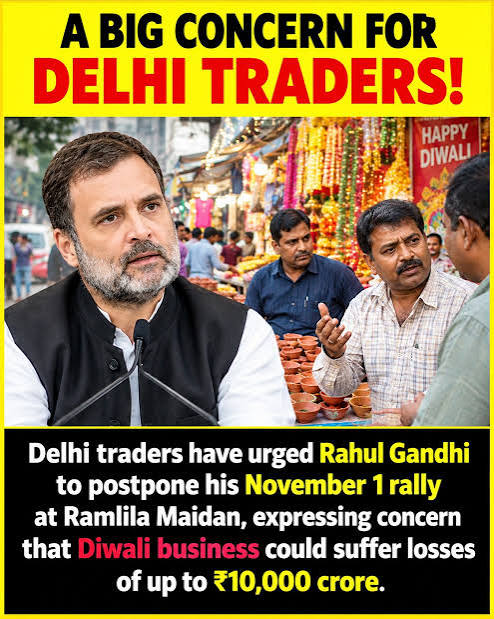
Congress Protest in Delhi: Traders fear losses due to Rahul Gandhi’s rally at Delhi’s Ramlila Maidan. According to trade organizations, business could be affected by up to ₹12,000 crore. However, markets are also expecting business worth up to ₹50 crore due to Rahul Gandhi’s appeal. Will the opposition rally benefit or harm Delhi’s traders? New Delhi: A major rally by the Congress and India Alliance is scheduled to be held today, November 1, 2026, at Delhi’s Ramlila Maidan. Congress and opposition parties have organized this protest against alleged irregularities in the voter list and Chief Election Commissioner Gyanesh Kumar. Rahul Gandhi, Congress President Mallikarjun Kharge, and leaders from several opposition parties are expected to attend the rally. The opposition alliance has claimed that around 1 million people will attend the rally. Meanwhile, Delhi’s business organizations and the BJP have raised questions about the impact of this rally on business. Meanwhile, Rahul Gandhi has also posted a business-related post on Instagram. He appealed to the millions of people attending the rally, “It’s the festival season. It’s the time of Diwali, Chhath, and Bhai Dooj. I want the millions of people coming to Delhi from outside to help the local businesses. Protest, march, rally, and do some shopping as well—it will benefit the businesses.” Some estimates suggest that people coming to Delhi from other states for rallies or other purposes often buy something. If Rahul Gandhi’s appeal works, Delhi’s businesses could benefit significantly from this rally. What are the businesses worried about? This rally, scheduled to be held at Ramlila Maidan, is expected to impact business in approximately 20 major markets in the capital. Business organizations claim that this could impact business worth between ₹10,000 and ₹12,000 crore per day. According to the Chamber of Trade and Industry (CTI), the rally is expected to disrupt business in major markets like Chandni Chowk, Sadar Bazaar, Chawri Bazaar, Khari Baoli, Connaught Place, and Daryaganj. These markets typically see a large crowd of customers during Diwali. Traffic jams, road closures, and police restrictions could make it difficult for customers to reach the shops. 1 million people expected to gather According to trade organizations, approximately 1 million people are expected to attend the rally. Additionally, 15,000 to 20,000 vehicles are expected. The large number of people and vehicles could cause heavy traffic jams in central Delhi. This could impact the movement of goods and services. Markets to remain open on Sundays Generally, major markets in Delhi, such as Sadar Bazaar, Chawri Bazaar, and Chandni Chowk, are closed on Sundays. Since it’s Diwali season, most shops in the markets are expected to remain open on Sundays. Because of this, it’s been said that the rally will impact business on Sunday. However, most big businesses keep their shops closed on Sundays. Benefits or losses from the rally? While the Congress rally is said to cause losses to businesses, another aspect also emerges. Whenever someone comes to Delhi from another state, they usually buy something. Since 1 million people are expected to attend the rally, if Rahul Gandhi’s appeal impacts the rally’s attendees, businesses could see substantial profits. Assuming an average person spends ₹500 on shopping, food, and drinks, then 1 million people will spend approximately ₹50 crore. This means that this amount will go into the pockets of Delhi’s businesses. How accurate is the claim of a loss of ₹12,000 crore? Business organizations claim that the rally could impact business by up to ₹12,000 crore. This figure could be significantly lower on Sunday. Major markets in Delhi typically see higher business volumes from Monday to Saturday. Sundays are closed, which reduces business. Therefore, traders can benefit from the purchases made by rally-goers during Sunday’s market hours. This means the rally will not significantly impact business due to the Sunday market closure. A chance for significant shopping in many places As festivals like Diwali, Bhai Dooj, and Chhath are approaching, and the cold has also arrived in a significant way, rally-goers may be interested in purchasing festival-related items, warm clothing, shoes, cosmetics, and makeup items. The wedding season is also about to begin, which could lead to increased business for these businesses. Curated by: Rajesh Bharti About the Author Rajesh Bharti is an Assistant News Editor at Navbharat Times (Digital). He joined Navbharat Times, the digital wing of the Times of India Group, in July 2024. Rajesh Bharti works on the Business Desk at NBT Digital. Courtesy: Hindi News
Document change regime developed following NALSA ‘grossly discriminatory’ against ‘biological females’: PIL
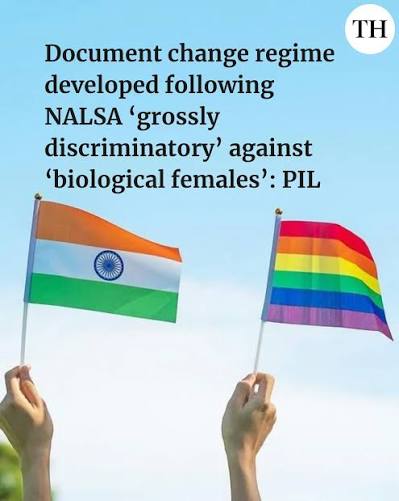
The India chapter of the UK-based trust seeks to overrule the NALSA judgment that laid down that legal recognition of gender identity was part of the Constitutional right to dignity and freedom UK-based Women’s Declaration International has challenged parts of the Transgender Persons (Protection of Rights) Act, 2026 and also the operating procedures of UIDAI, which are meant to enable an update to the name and gender of persons on their Aadhaar cards. (Image used for representational purpose only) UK-based Women’s Declaration International has challenged parts of the Transgender Persons (Protection of Rights) Act, 2026 and also the operating procedures of UIDAI, which are meant to enable an update to the name and gender of persons on their Aadhaar cards. (Image used for representational purpose only) | Photo Credit: Getty Images A Public Interest Litigation (PIL) in the Supreme Court has argued that the regulatory regime developed in India on the back of the landmark 2014 National Legal Services Authority (NALSA) judgement that recognised transgender identity is “grossly discriminatory” against “biological females”. The PIL filed by the India chapter of UK-based Women’s Declaration International (WDI) argued that the document change regime also “dilutes” the rights, protections, and entitlements meant for “biological females,” and further impinges on the right to freedom of speech and expression by compelling all citizens to “express belief in gender identities”. A decade after NALSA, trans students still await inclusion on Indian campuses The trust, which describes itself as a “feminist, non-partisan, all-volunteer and all-female organisation advocating for the rights, dignity, safety, and freedom of women”, is seeking to overrule key portions of the NALSA judgement, specifically, the portion that ruled that legal recognition of gender identity constituted a part of the right to dignity and freedom guaranteed by the Constitution of India. In addition, the WDI has challenged parts of the Transgender Persons (Protection of Rights) Act, 2026, which provides the statutory framework for recognising gender identity and enables gender-diverse people to obtain gender certificates. The petitioners have also challenged the standard operating procedures of the UIDAI, which are meant to enable an update to the name and gender of persons on their Aadhaar cards. Government tables Bill to redefine ‘transgender person’, remove ‘self-perceived’ identity A Bench led by Chief Justice of India Surya Kant on Wednesday (October 28, 2026) issued notices to the Union Ministries of Social Justice and Empowerment, Law, and Health and Family Welfare on the PIL. The WDI has argued that while people have a right to “believe in gender identities and hold and express these internal experiences”, the regulatory regime that has developed in India through the years since the 2014 judgement has legally recognised gender identity by “overwriting the sex marker in official documents with the person’s professed internal experience”. It added that this change in “sex marker” has been allowed to propagate into other identity documents like Aadhaar, Voter ID, passports, and birth certificates, which has “come at the cost of women’s rights to equality, dignity and freedom”. Identity certificates for transgenders Transgender identity certificate will be treated as valid documentation for PAN: Centre to Supreme Court Change in transgender law cannot take away rights already given, Supreme Court tells Centre SIR: Why transgender persons fear exclusion from voter rolls In the petition, the WDI has cited instances of the State Election Commission in Kerala, in 2025, allowing two people the NGO identifies as “biological males self-identifying as female” to contest Panchayat elections on seats reserved for women; one “biological male” in Kerala being allowed to participate in the women’s category of Judo, a contact sport, and winning a State-level championship; one “biological male” in Tamil Nadu being appointed as a “female” nursing assistant at a government hospital; and one “biological male” being admitted to the National Cadet Corps Girls Division, “despite concerns regarding shared accommodation and intimate facilities”. WDI India’s petition echoes arguments on gender identity and its recognition in the West, particularly in the United States of America, and in the United Kingdom, where the first half of this decade has seen multiple court decisions ruling that women-only spaces are meant to be reserved for people based on their sex and not their gender identity, and that language like “man”, “woman”, and “sex” in statutory provisions is meant to protect the rights and entitlements available by virtue of “biological sex”. U.K. top court’s definition of woman further polarises debate on gender The WDI’s petition has cited the landmark U.K. Supreme Court ruling in For Women Scotland Ltd v. The Scottish Ministers (2025)and the U.S. Supreme Court’s 2026 decisions reserving women’s sports for “biological females” to make its case. Notably, while WDI India has argued that the same regulatory regime that has allowed “biological males” to change their identity documents based on their self-identification of gender and threatened spaces, protections, rights, and entitlements meant for “biological females”, has also stripped “biological females” of these spaces, protections, rights, and entitlements by allowing them to change their identity documents to “male”. What are the changes being proposed to Transgender Persons (Protection of Rights) Act, 2019 | Explained Further, this petition’s arguments before the Supreme Court come at a time when India is on its way to giving effect to the 106th Constitutional Amendment, which provides for reserving 33% of Lok Sabha and State Assemblies for women. This is also coming at the heels of the Union Government amending the Transgender Persons (Protection of Rights) Act earlier this year to redefine “transgender” persons based purely on physiological characteristics and removing a provision guaranteeing the right to “self-perceived gender identity”. And even as the 2026 amendments to the trans rights law remain under challenge before the Supreme Court, WDI India has argued that the “constitutional issues” it has raised in its petition are not fully resolved by the 2026 amendments. Abhinay Lakshman Courtesy : The Hindu Note: This news is originally published on https:/thehindu.com/bha and is used purely for non-profit/non-commercial purposes, especially human rights
Opinion | Dalit Vote In Uttar Pradesh: From BSP Monopoly To A Three-Way Fight
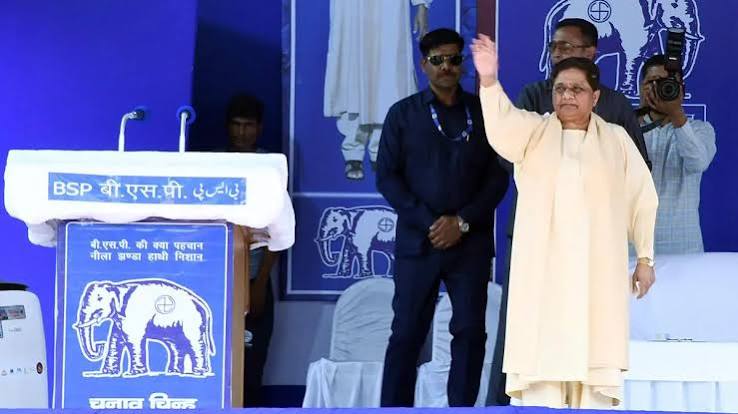
As the 2027 election approaches, Dalits, who make up about one in five voters, could decide who governs India’s most populous state. Uttar Pradesh’s politics has long run on caste arithmetic, and no bloc has been more consequential or more contested in recent years than the Dalits. Scheduled Castes (SCs) account for about 21% of the state’s population. For decades, they were seen as the private preserve of Mayawati’s Bahujan Samaj Party (BSP). That is no longer true. Ahead of the 2027 assembly election, the BJP, the Samajwadi Party (SP)-Congress alliance, and newer outfits like Azad Samaj Party are all courting Dalit voters, and their outcome could shape the next government. A vote that reaches far The Dalit population is not evenly spread. Kaushambi, Sitapur, Hardoi, Rae Bareli, and Unnao districts each have SC populations above 30%. At the other end, Shamli, Baghpat, Moradabad, Bareilly, and Balrampur districts sit between 11% and 13%. Eight assembly seats have an SC population above 40%, while 144 seats have less than 10%. It matters most in the 122 seats where SCs make up 20-30% of the population. Across 148 of the state’s 403 seats, the Dalit share exceeds the state average, and these are the seats where the community can most influence the result. Latest and Breaking News on NDTV Two communities, not one The Dalit electorate is not monolithic. Jatavs, about 12% of voters, are the BSP’s traditional core. Non-Jatav SCs, about 9%, are a more fragmented group, and the BSP was never as dominant among them. Its support there ran between 44% and 54% through 2017. Jatavs stayed loyal for two decades. BSP support in the community ranged from 60% to 87%, and it held firm even in 2022, when the party won a single seat. The break came only in 2024, when the BSP’s Jatav share fell to 44%. Non-Jatavs moved first The non-Jatavs left first. The BJP’s share among them jumped from 7% to 33% in 2017, a gain of 26 points, and reached 40% in 2022. This “non-Jatav SC consolidation” was central to the party’s 2017 sweep. The BJP exploited the differences between the two Dalit groups and built a coalition of upper castes, non-Yadav OBCs, and non-Jatav SCs that accounted for roughly 60% of the population. Meanwhile, the BSP’s non-Jatav support fell to 27% in 2022 and 15% in 2024. The BJP’s Jatav numbers stayed in single digits until 2017, then rose to 20% in 2022 and 24% in 2024. 2024: the reversal The 2024 general election broke the pattern. Non-Jatav SC support for the SP and its ally, the Congress, together constituents of the “INDIA bloc”, rose from 23% in 2022 to 56%. The BJP’s share among non-Jatavs dropped from 40% to 29%. The presence of the Congress in the alliance helped, as did the campaign warning that the Constitution and reservations were in danger. Latest and Breaking News on NDTV Jatavs moved too. Their support for the SP+ nearly tripled from 9% to 25%, matching the BJP among the community for the first time. The BSP’s lost votes did not go to one place. Non-Jatavs went mostly to the SP+, while Jatavs split between the SP+ and the BJP. The loss of the non-Jatav bloc cost the BJP a crucial 9% support gained by the SP+. Projected onto assembly segments, the SP+ led in about 225 seats and the BJP+ in 174, against a simple majority mark of 202 largely on account of this movement. The seat-level story The shifts show up clearly in the 148 seats with above-average Dalit populations: 2012: The SP dominated with 91 seats, the BSP had 34 and the BJP just 8. 2017: The BJP won 118 of the 148, and the SP fell to 14. 2022: The BJP held 93, the SP recovered to 43 and the BSP won none. 2024 (assembly segments): The SP+ led in about 94 segments, a gain of 51, while the BJP led in 44, a loss of 49. The BSP has gone from 34 seats in these constituencies to zero. Even where its base is most concentrated, it is no longer the force it was, and it may not even play spoiler. A weakened Mayawati, a growing challenger The BSP’s decline has hurt the party’s standing beyond arithmetic. Mayawati is seen as less active and less forceful than in her prime, and the “B-team of the BJP” label has stuck to her, feeding the perception that the BSP splits opposition votes to the ruling party’s benefit. New players are trying to fill the space. Chandrashekhar Azad “Ravan” of the Azad Samaj Party (ASP) is gaining some traction among Dalit youth, having won the Nagina Lok Sabha seat, though his party’s reach is still limited. Aakash Anand, Mayawati’s nephew, who was reappointed as national coordinator on October 5, just 25 days after being expelled on September 10, is trying to revive the BSP vote base. The parties’ strategies Each major party is tailoring its pitch. The SP is planning to field SC candidates even in general, unreserved seats. The tactic worked in 2024, when the party won Faizabad (Ayodhya) with a Dalit candidate. It is also reportedly adopting blue, the colour associated with Dalit identity and Ambedkarite politics, for the dress of its student wing, the Samajwadi Chhatra Sabha. The BJP faces a more delicate task. It hopes to win back non-Jatavs through welfare schemes and to attract Jatavs through political representation. Having built its rise on non-Jatav support, it cannot afford to lose that base for good. The BSP is attempting to revive its SC votebank through Aakash, who is decently popular amongst youth and is Mayawati’s counter to Ravan. He addressed his first post-reinstatement public rally in Bulandshahr on October 28, pledging his loyalty to Mayawati and urging workers to prepare for the elections. Who benefits from the BSP’s fall? The BSP’s decline has so far helped the SP more than the BJP, in both 2022 and 2024. That matters for
JNU PhD Admissions: CPI(M) MP Flags Shortfall in Seats for Dalit, Adivasi and Disabled Students
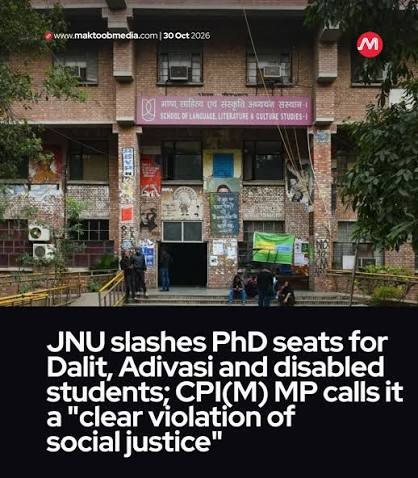
CPI(M) Lok Sabha MP K Radhakrishnan has written to Union Education Minister Pralhad Joshi seeking urgent intervention over an alleged shortfall in reserved seats for Scheduled Caste (SC), Scheduled Tribe (ST) and Persons with Benchmark Disabilities (PwBD) candidates in Jawaharlal Nehru University’s (JNU) PhD admissions for the 2026-27 academic year. In a letter dated October 29, Radhakrishnan, who represents Alathur in Kerala, alleged that the university had drastically reduced the number of seats allocated to these categories in its PhD admission prospectus. According to the letter, JNU has allocated 38 seats to ST candidates against the 53 required under the 7.5% reservation quota out of 711 seats. SC candidates have been allocated 103 seats against the 107 required under the 15% quota. The shortfall is also evident in the PwBD category. Against the 5% reservation requirement of 36 seats, the university has allocated only 17, according to the MP. Radhakrishnan said the prospectus therefore fell short by a total of 38 seats across the three categories: 15 for ST candidates, four for SC candidates and 19 for PwBD candidates. “This denial of constitutional representation in one of India’s premier higher education institutions is a clear violation of social justice and equity,” he wrote, adding that such practices deprived marginalised students of higher academic opportunities. Indiatravel guide He urged the education minister to direct the JNU administration to withdraw the prospectus, correct the seat allocation and restore the reserved seats without delay. Students Protest Alleged Reservation Shortfall The MP’s intervention comes amid an ongoing protest at JNU over the PhD admission process. The Birsa Ambedkar Phule Students’ Association (BAPSA) has been holding an indefinite sit-in at the university’s T-Point since October 24, alleging irregularities in the allocation of reserved seats. The organisation claims that 15 ST seats and four SC seats have been left unfilled and has demanded that they be re-notified. BAPSA has also questioned the exclusion of candidates from the June 2025 UGC-NET cycle, which it says was initially included in the list of eligible cycles but later left out without prior notice. The organisation has further alleged that the administration agreed to form a committee to examine the reservation issue but proceeded to notify the PhD viva voce process without resolving the matter. JNUSU councillor Komal Devi said the university had issued an admission notice halting admissions under the NET category, while JRF-category admissions were scheduled to begin on October 30. She said the protest would continue until the 15 ST and four SC seats were re-notified, and warned that students would oppose the viva voce process if their demands were not addressed. BAPSA has also called for the implementation of reservation in the interview process, the publication of category-wise seat allocations across departments and centres, and the implementation of recommendations made by various university committees. The organisation has released figures alleging that JNU failed to meet reservation requirements across SC, ST, OBC and PwBD categories over the past decade. These figures have not been independently verified. Radhakrishnan is a member of the Parliamentary Standing Committee on Home Affairs and the Consultative Committee for the Ministry of Social Justice and Empowerment. Courtesy : TOP Note: This news is originally published on https:/theobserverpost.com/bha and is used purely for non-profit/non-commercial purposes, especially human rights
Telangana Dalit youth dies by suicide after alleging harassment by police, government hospital doctor
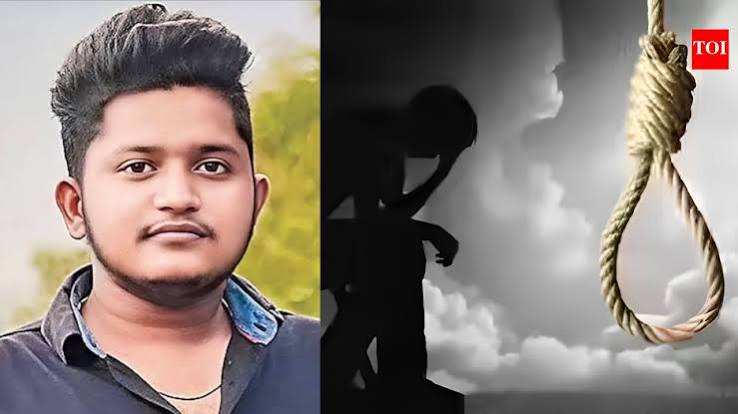
Police claimed there was no truth to the allegation that the deceased was beaten up at the police station, saying video proof was available in this connection Hyderabad: A Dalit youth allegedly died by suicide in Adilabad, Telangana, accusing police and hospital staff of insulting him after he went seeking medical treatment for a scorpion bite, with the police refuting his claim that they beat him up. According to police, Kamble Rahul (27), who was bitten by a scorpion on the evening of August 28, went to the state-run RIMS hospital in Adilabad for treatment, where he started filming a video alleging negligence. This led to an argument with a doctor who called the police. Police took him to a station and handed him over to his father. Later, he died by suicide at his residence by hanging himself, police said on Friday. In a purported suicide note, he alleged that the doctor rebuked him and police beat him up, they said. A case was registered regarding the incident and began an investigation, Police said. Police also claimed there was no truth to the allegation that the deceased was beaten up at the police station, saying video proof was available in this connection. Protesting the incident, Dalit organisations staged a dharna at the hospital on Thursday demanding justice for the deceased’s family. The opposition BJP and BRS demanded justice for the family, including payment of ex gratia. Observing that Rahul was the family’s breadwinner, BJP MLA Payal Shankar demanded a time-bound inquiry into the incident and a job for a family member. He found fault with hospital staff complaining to the police against Rahul and the police for allegedly harassing him. Courtesy : The Pioneer Note: This news is originally published on https:/thepioneer.com/bha and is used purely for non-profit/non-commercial purposes, especially human rights
Koyyala Ruth becomes India’s first Dalit transgender doctor; Dr. Ambedkar becomes an inspiration
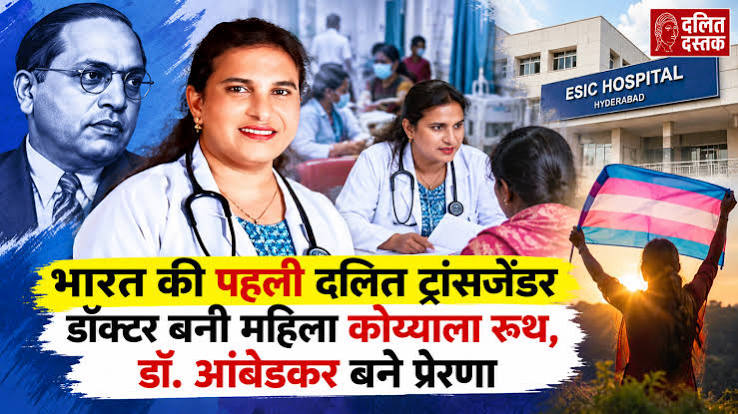
Ruth says that Dr. Ambedkar advocated for the dignity of every human being, not just men and women. As a Dalit transgender woman, Ruth was deeply inspired by Babasaheb Ambedkar’s struggle against caste discrimination and his zeal for education. On one hand, the dream of becoming a doctor, on the other, a long battle for her identity and dignity. But fighting this battle, 31-year-old Dr. Koyyala Ruth John Paul has made history. Ruth is one of the first Dalit transgender women in India to earn an MD degree in Emergency Medicine. She has since treated patients at the ESIC Hospital in Hyderabad. Now, her dream is to become a doctor and treat people in a government hospital. The story begins in Khammam, Telangana. Ruth, the daughter of a mother who became a daily wage laborer after her father died of a heart attack in 2006, would have lost her courage if any other child had been in Ruth’s place. But Ruth learned to fight, and in this fight, Babasaheb Dr. Ambedkar became her inspiration. Her mother raised her three children in extremely difficult circumstances. Despite these difficult circumstances, Ruth continued her studies, passed her 10th and 12th grade exams with good marks, and dreamed of becoming a doctor. In Nikhila Henry’s report published in the Indian Express, Ruth says that Dr. Bhimrao Ambedkar’s thoughts and struggle have had a profound influence on her life. She says that Dr. Ambedkar always advocated for basic human dignity. He spoke of respect for every human being, not just men or women. As a Dalit transgender woman, Ruth was deeply inspired by Babasaheb Ambedkar’s struggle against caste discrimination and his zeal for education. But the greatest of all challenges was accepting her gender identity. For Ruth, this struggle began from childhood. She enrolled in medical school with the female gender she was assigned at birth. However, in her third year of medical college, she revealed her transgender identity to her family. According to Ruth, her family couldn’t accept this truth. She was beaten and thrown out of the house. At that time, she faced extremely difficult circumstances for livelihood. She had the option of begging or sex work, paths often forced upon the transgender community. But Ruth didn’t give up. During this difficult time, she met Hyderabad-based transgender activists Rachana Mudraboyina and Vaijayanti Vasantha Mogli, who helped Ruth. They recognized her talent and gave her a chance to progress. Thanks to this support, she completed her MBBS from a medical college in Hyderabad in 2019. And as often happens, after Ruth’s success, her family has also accepted her. But the struggle continued. The path to further education after MBBS was not easy. Ruth appeared for and passed the NEET-PG exam three times between 2021 and 2023. While she was allowed to register as a SC transwoman in the application form, she was included in the female category during counseling. Ruth appealed to the Telangana High Court in 2021, demanding recognition as a transgender woman from a Scheduled Caste. In 2022, the National Medical Commission (NMC) wrote to her, stating that there was no precedent for including her under the transgender category in counseling. Therefore, her case was separate. The legal battle in this matter continues. Meanwhile, in 2023, the Telangana High Court issued an interim order allowing her admission to the medical program, but under the female category. Ruth argues that as a Dalit transgender woman, the Constitution entitles her to reservations under both the Scheduled Caste and transgender categories. However, the NMC places her among female candidates. Despite this, Ruth continued her studies and finally passed the MD exam on October 9th. However, Ruth’s exam was still pending. Even after completing her MBBS, Ruth faced difficulties finding a job as a doctor. For a while, she worked as a temporary doctor at the Mitra Transgender Clinic. However, she finally secured a position as a doctor at the ESIC Hospital in Hyderabad. Getting an MD degree is a major achievement for Dr. Ruth. But her dream doesn’t end there. She wants to work in a government hospital to provide better treatment not only to members of her community but also to those in need who cannot afford private hospitals. Ruth continues to pursue this dream. Dr. Ruth’s story isn’t just about earning a medical degree. It’s also about the struggle for caste-based discrimination, gender identity, education, and respect. A story that demonstrates that despite difficult circumstances and discrimination, when a great leader like Dr. Ambedkar is considered a role model, paths can be forged through education and determination. Dr. Pooja Rai Dr. Pooja Rai is a teacher by profession. She has a keen interest in women’s issues and humanitarian news. Her books, “Aadhi Aabadi Ka Dard” and “Sapno Ke Pankh” (Faces of Dreams), were very popular. Courtesy: Hindi News
India’s poverty will be down from 14.2% to 12.1% in 2 years: World Bank
NEW DELHI: World Bank has said that poverty in India, defined at $4.2 a day, will decline from 14.2% in 2026 to 12.1% by 2028. Between 2011 and 2023, it is estimated that the share of the population living below $4.2 a day declined from 57.7% to 16.1%, lifting an estimated 496 million people out of poverty. It said that extreme poverty ($3 a day) declined from 27.1% to 2.6% during this period. “This progress was mainly driven by strong consumption growth; rising employment, especially among women; and expanded social transfers, including food subsidies. As poverty declined, it became increasingly concentrated among households with lower education, fewer assets, limited access to stable employment, and higher dependency ratios. Wage disparities, however, remain pronounced, as median earnings among the top 10% of workers were about 13 times those of the bottom 10% in 2023,” World Bank said in its latest Poverty & Equity brief. Finance minister Nirmala Sitharaman cheered the decline in poverty in the country, pointing out that the report recognised India’s progress as a country with one of the fastest poverty declines in the world. “Under the leadership of PM Narendra Modi, govt’s sustained policy efforts are yielding tangible results, strengthening the foundations for inclusive growth and greater economic opportunity. This is the reason why NDA govt wins people’s trust and mandate of our citizens. We remain committed to building on this progress through productive employment, stronger household incomes and effective delivery of public services, so that aspirations of our people are met,” she posted on X. World Bank also noted that between 2017 and 2023, employment increased by about 134 million people, nearly twice the growth of the working-age population, with major gains driven by rural women entering paid work and raising the number of earners in households. “Labour market conditions continue to be broadly resilient, with labour force participation and employment rates stable between Q1 FY 2026 and Q1 FY 2027. However, youth unemployment rose from 14.6% to 15.9% between the two quarters, particularly among rural young women. Moreover, real earnings remained broadly unchanged with employment growth concentrated in relatively low-productivity activities,” it said. Courtesy : TOI Note: This news is originally published on https:/timesofindia.com/bha and is used purely for non-profit/non-commercial purposes, especially human rights
BJP mock Parliament cruel joke on democracy: Congress
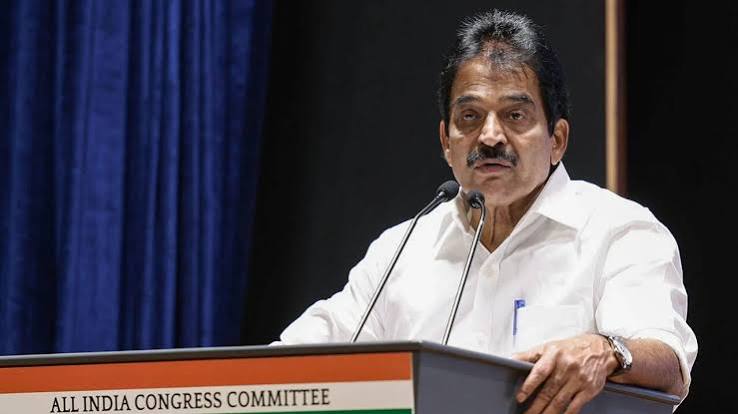
NEW DELHI: Congress Friday mocked the “BJP-sponsored mock parliament” in the capital as a “cruel joke”, even as opposition was forced to postpone its “public impeachment” of CEC Gyanesh Kumar to Saturday because of bad weather. Congress general secretary KC Venugopal claimed “BJP-sponsored outfits” held a ‘mock parliament’ Friday after BJP has made a “mockery” of Parliament for the last 12 years. “First treat Parliament as rubber-stamp to steamroll bills and silence opposition and now run a ‘mock parliament’ to make a cruel joke of democracy,” he said, referring to a ‘mock parliament’ on ‘democracy vs anarchy’ at NDMC Convention Centre. Amid rain and flanked by INDIA bloc members, Congress MP Rahul Gandhi Friday invited all to attend the Nov 1 “Chalo Dilli” rally at Ramlila Maidan. Courtesy : TOI Note: This news is originally published on https:/timesofindia.com/bha and is used purely for non-profit/non-commercial purposes, especially human rights