
Nandyal MP assures TDP support towards Dalits, Christians

Byreddy Shabari says she will bring the legitimate demands of Dalits and Christians to the notice of Chief Minister N. Chandrababu Naidu and get them resolved during a rally in Nandyal Nandyal MP Byreddy Shabari claimed that protection and justice for Dalits and Christians are ensured only under Telugu Desam Party (TDP) rule. She assured that she would bring the legitimate demands of Dalits and Christians to the notice of Chief Minister N. Chandrababu Naidu and get them resolved during the State-level ‘Dalit and Christian Garjana’ rally held in Nandyal on Saturday. Ms. Shabari said that the founder of TDP and former Chief Minister, late Nandamuri Taraka Rama Rao, strove to eradicate untouchability and provided Dalits with permanent housing and agricultural land. Ms. Shabari emphasised that the credit for establishing the SC Commission to safeguard the interests of Dalits belongs solely to TDP government. “Both in united Andhra Pradesh and after the State’s bifurcation, Mr. Naidu has been working with unwavering dedication towards the upliftment of Dalits and Christians,” the MP said. Meanwhile, Ms. Shabari participated in the consecration ceremonies of the flagstaffs and idols at Sri Abhayanjaneya Swamy temples in Murvakonda and Nehru Nagar. The events took place in Nehru Nagar village of Pagidyala mandal within Nandikotkur constituency in Nandyal district, where she also inaugurated cement roads constructed at a cost of ₹25 lakhs. Speaking on the occasion, she expressed happiness over the cement roads, check dams, and water tanks that were constructed during her father, Byreddy Rajasekhara Reddy’s tenure as an MLA, continue to benefit the people to this day. She asserted that comprehensive development is possible only through the leadership of Mr Naidu. The Hindu Bureau Courtesy : The Hindu Note: This news is originally published on https:/thehindu.com/bha and is used purely for non-profit/non-commercial purposes, especially human rights
Thol Thirumavalavan: Champion of Dalit liberation and kingmaker of Tamil Nadu politics
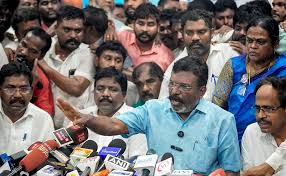
From forensic scientist to the political king maker, the VCK founder’s journey reflects a lifelong commitment to Dalit emancipation and Tamil identity In the aftermath of the 2026 Tamil Nadu Assembly elections, Thol Thirumavalavan and the Viduthalai Chiruthaigal Katchi (VCK) emerged as a pivotal force in government formation. Recognizing the importance of upholding the people’s mandate and preventing a constitutional crisis, Thirumavalavan announced VCK’s decision to extend unconditional support to Vijay’s Tamilaga Vettri Kazhagam (TVK), which had fallen short of a simple majority. Demonstrating strategic foresight, he coordinated closely with allied Left parties to ensure a long-term vision for the state while maintaining VCK’s continued association with the DMK-led Secular Progressive Alliance. By placing the public interest above short-term political calculations, Thirumavalavan positioned his party as a kingmaker, ensuring that the mandate of the electorate was respected. With the support of VCK’s two MLAs, along with backing from the IUML and other allies, TVK crossed the 118-seat threshold, securing the numbers necessary to form a stable government. Thirumavalavan emphasized that his party’s intervention was aimed at preventing President’s rule and safeguarding democratic norms, reflecting his enduring commitment to both Dalit empowerment and broader state governance. Thol Thirumavalavan, born Tholkappiyan Thirumavalavan on August 17, 1962, in Anganur, Tamil Nadu, is a scholar, social reformer, and one of the most prominent Dalit leaders in India. He is the founder and president of the Viduthalai Chiruthaigal Katchi (VCK) and currently serves as a Member of Parliament representing the Chidambaram constituency. Known for his unflinching advocacy for social justice, Thirumavalavan has been a pivotal figure in Tamil Nadu politics for over three decades. Thirumavalavan completed his early schooling in his hometown before earning a Bachelor’s degree in Chemistry from Presidency College, Chennai, followed by a Master’s in Criminology in 1988. He initially worked as a Scientific Assistant in the Government Forensic Science Department until 1999. Later, he pursued law at Madras Law College and earned a Ph.D. from Manonmanium Sundaranar University in 2019, focusing on the religious conversion of Meenakshipuram Dalits. His political journey began in 1982 when he joined the Dalit Panthers Iyyakam (DPI) in Tamil Nadu, inspired by the Dalit Panthers of India and the Black Panther Party in the United States. Mentored by A. Malaichamy, he coordinated student protests for Eelam Tamils and organized campaigns for Dalit rights. Following Malaichamy’s death in 1989, Thirumavalavan became the state organizer of DPI, later renaming the organization Viduthalai Chiruthaigal. Influenced by the ethnic conflict in Sri Lanka and the Tamil identity struggle, the organization formally became the Viduthalai Chiruthaigal Katchi (VCK) in 1990, marking its transition into a political party. Thirumavalavan initially avoided electoral politics, focusing on raising awareness about caste discrimination. However, in 1999, he resigned from his government position to contest his first Lok Sabha elections from Perambalur in alliance with the Tamil Maanila Congress, securing over 2.25 lakh votes despite losing. In 2001, he won his first Assembly seat from Mangaloree constituency (later dissolved), and in 2009, he was elected to the Lok Sabha from Chidambaram with a victory margin of over 1 lakh votes. Since then, he has contested multiple elections, winning significant victories and establishing VCK as a recognized state party with the permanent election symbol of a “Pot.” Under Thirumavalavan’s leadership, VCK has become a powerful political force in Tamil Nadu, forming alliances with both major Dravidian parties and unexpected partners such as the Pattali Makkal Katchi (PMK), reflecting a pragmatic approach to electoral politics. His slogans and speeches, such as the 1996 call to “Refuse to be subdued, Transgress, Rise vehemently, Retaliate,” have inspired generations of Dalit youth to challenge systemic oppression and assert their rights. Ideologically, Thirumavalavan draws from a rich tapestry of thinkers and movements. He combines Ambedkarite principles of social justice and Dalit empowerment, Periyar’s rationalist and anti-caste philosophy, and Marxist critiques of capitalism, while also embracing the revolutionary activism of the Black Panthers. VCK’s core principles include the abolition of the caste system, opposition to social exclusion, protection of Tamil culture and language, advocacy for women’s liberation, and support for the working class. His influences range from Gautama Buddha and Dr. B.R. Ambedkar to Thanthai Periyar and Velupillai Prabhakaran. Beyond politics, Thirumavalavan has engaged in cultural and social initiatives. He has acted in Tamil films like Anputhozhi and Kalagam, HE HAS authored several books and launched the VCK’s television channel, Velicham TV, in 2016. He has promoted Tamil naming conventions to eliminate caste and religious identifiers and spearheaded environmental projects, including planting 1 lakh palm seeds across Tamil Nadu in 2018. Thirumavalavan’s career has not been without controversy. He has faced criticism for remarks on Manusmriti, Hindu deities, differently-abled persons, and LGBTQ+ issues. Legal cases have been filed against him, ranging from alleged incitement during public speeches to bus-burning incidents in 1999, although he has often successfully contested these charges in court. He has also been accused by former associates of receiving funds from Christian missionary organizations, a claim he has consistently denied. Despite such controversies, Thirumavalavan’s commitment to Dalit emancipation and social reform remains unwavering. Thirumavalavan has received multiple awards for his social and political contributions, including the Icon of Social Liberation Award (2025), the Quaid-e-Milleth Award for probity in public life (2019), and recognition as one of the best-performing MPs (2024). VCK under his leadership also honors social activists through awards such as the Ambedkar Sudar Award and Periyar Oli Award. As a lifelong bachelor, Thirumavalavan has dedicated his life to the upliftment of marginalized communities, blending scholarship, activism, and political strategy. From grassroots organizing to becoming a kingmaker in state politics, he has shaped Tamil Nadu’s political landscape while consistently advocating for equality, justice, and Tamil identity. Courtesy : TNIE Note: This news is originally published on https:/thenewindianexpress.com/bha and is used purely for non-profit/non-commercial purposes, especially human rights
Tension in UP Village After Dalit Women Object to Maharana Pratap Jayanti Procession Route

Tension briefly prevailed in Maheshpura village on Saturday after members of the Dalit community, especially women, allegedly objected to a procession being taken out on the occasion of Maharana Pratap Jayanti and blocked its route. According to police officials, the disagreement took place over the path of the procession, leading to a standoff between two groups in the village. Police said the situation was later brought under control after talks between both sides and a written agreement reached in the presence of authorities. Police deny reports of violent clash Superintendent of Police (City) Manush Pareek said reports claiming that a violent clash had taken place were “completely misleading.” He said, “A disagreement had arisen between two groups regarding the procession route, but the matter was resolved peacefully through dialogue.” After receiving information about the dispute, Station House Officer Satish Kumar reached the village along with a heavy police force. Officials said the protesting women and villagers initially refused to allow the procession to move forward, leading to heightened tension in the area. Police first tried to convince both sides at the spot. However, as the disagreement continued, representatives from both groups were later called to the police station for discussions. Agreement reached after negotiations According to police, prolonged negotiations were held between both parties before a written compromise was reached around 1 pm. SP Pareek said the agreement was achieved “in an atmosphere of mutual coordination and harmony.” Following the settlement, the procession resumed around 5 pm on its scheduled route and concluded peacefully by around 7 pm. Situation under control Police said the situation in the village remains peaceful and under control. Additional security personnel were deployed during the procession to prevent any untoward incident. Authorities have not reported any injuries or arrests in connection with the dispute. Courtesy : TOP Note: This news is originally published on https:/theobserverpost.com/bha and is used purely for non-profit/non-commercial purposes, especially human rights
High command yet to decide on Kerala CM amid intense factional campaigns

Poster wars, public demonstrations and hectic consultations in Delhi intensify as Congress leadership moves closer to announcing Kerala’s next chief minister The suspense over Kerala’s next Chief Minister persisted on Saturday as Congress leaders held an extended round of discussions in New Delhi, but no final decision emerged from the meeting. Sources said senior leader Rahul Gandhi reprimanded the leaders over the public show of factionalism, warning that the unrest was tarnishing the party’s massive electoral mandate. The chief ministerial deadlock remained unresolved even after top leaders held nearly three hours of discussions with the frontrunners. According to sources, Rahul Gandhi was unhappy that the lobbying for the top post had begun almost immediately after the election results, saying the leaders could not wait even a few days for the high command’s decision. He also urged the leaders to rein in workers and end internal divisions. AICC general secretary and Congress state in-charge Deepa Dasmunshi told reporters that deliberations on the leadership issue were still ongoing. She confirmed that all Congress MLAs had signed a one-line resolution authorising the high command to take the final call on who will lead the new United Democratic Front (UDF) government in Kerala. Deepa Dasmunshi said the ultimate decision will be made by Congress president Mallikarjun Kharge and senior leader Rahul Gandhi. The crucial discussions in Delhi are reportedly nearing it’s end after intense lobbying, public campaigns and internal consultations within the Congress-led United Democratic Front (UDF) following its sweeping Assembly election victory. The high-level meeting, which commenced at 4 pm at the residence of Congress president Mallikarjun Kharge, is being attended by senior leaders Rahul Gandhi, V D Satheesan, K C Venugopal, Ramesh Chennithala and KPCC chief Sunny Joseph. AICC observers Mukul Wasnik and Ajay Maken, who submitted their report to Kharge on Friday after consulting MLAs and alliance partners, are also participating in the deliberations. The leadership question has triggered visible factional mobilisation across Kerala, with supporters of senior Congress leaders V D Satheesan, K C Venugopal and Ramesh Chennithala openly campaigning for their respective leaders through posters, flex boards, road shows and demonstrations. Senior Congress leader K Muraleedharan on Saturday indicated that the decision-making process in New Delhi had entered its final phase. “The information from Delhi is that discussions on the chief ministerial candidate will be completed within 24 hours,” Muraleedharan told reporters in Thiruvananthapuram. However, he cautioned that public displays of support alone would not determine the leadership issue. “Flex boards and demonstrations cannot decide who becomes Chief Minister. I conveyed the sentiments of the people from my constituency to the party leadership,” he said, adding that seniority was not the only criterion and that the opinions of coalition partners and MLAs would also be taken into account. The Congress-led UDF registered a decisive victory in the Assembly elections, winning 102 of the 140 seats, while the Left Democratic Front (LDF) was reduced to 35 seats and the BJP secured three constituencies. Following the victory, the Congress Legislature Party had passed a resolution authorising the All India Congress Committee (AICC) leadership to decide the next leader of the legislature party, effectively handing the final call to the party high command. The focus has now shifted entirely to New Delhi, where senior Kerala Congress leaders, including Satheesan, Chennithala and KPCC president Sunny Joseph, arrived on Friday night for consultations with the central leadership. Sunny Joseph said a key meeting involving the top contenders would be held at Congress president Mallikarjun Kharge’s residence and expressed hope that a consensus would emerge quickly. “We expect a quick decision. The matter has been completely left to the AICC leadership,” he said. At the same time, Joseph appealed to party workers to refrain from public demonstrations and poster campaigns over the Chief Ministerial issue. The political atmosphere within the Congress has become increasingly tense over the past few days, with supporters of different factions openly projecting their preferred candidates. Posters backing Chennithala appeared in Idukki, while flex boards supporting Venugopal surfaced in Thiruvananthapuram soon after the UDF’s landslide victory. Supporters of Satheesan also organised marches and demonstrations demanding that the Leader of Opposition be elevated as Chief Minister. The growing factional activity has drawn criticism from several senior Congress leaders. Veteran leader P J Kurien condemned incidents involving the destruction of flex boards and attempts to pressure the party leadership through public campaigns. “Everyone has the right to express opinions. But destroying flex boards and pouring black oil on them is wrong. A Chief Minister cannot be decided through pressure tactics,” he said. Congress MLA T Siddique also expressed concern over public attacks against senior leaders and urged workers to maintain party discipline. “Leaders who dedicated their lives to public activity should not be humiliated in public. This is not Congress culture,” Siddique said. He nevertheless expressed confidence that the Congress high command would resolve all differences through a unanimous decision. Congress MP Rajmohan Unnithan further intensified the debate on Saturday after strongly criticising the destruction of a flex board featuring K C Venugopal and late Congress stalwart Oommen Chandy. Calling such actions “divisive tactics,” Unnithan said all three leaders — Satheesan, Venugopal and Chennithala — were legitimate contenders for the Chief Minister’s post and that supporters were free to campaign for them within the limits of party discipline. “People who destroyed the flexboard of Venugopal, which also carried Oommen Chandy’s image, cannot be seen as part of Congress,” he said. Unnithan also defended the Indian Union Muslim League’s right to comment on the leadership issue after remarks by Congress MLA Mathew Kuzhalnadan suggesting that the IUML should not interfere in Congress internal affairs. The Kasaragod MP argued that all UDF constituents, including the IUML, Kerala Congress and Revolutionary Socialist Party, had a stake in the formation of the next government and were entitled to express their opinions. “In fact, all the minority and religious groups who helped the UDF win are eligible to express their views on the matter,” he said. He
Vijay to take oath as Tamil Nadu CM on Sunday 10 am as VCK, IUML extend support
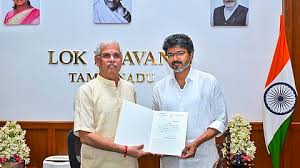
The Governor has directed the newly appointed Chief Minister to prove his majority in the Tamil Nadu Assembly by seeking a confidence vote on or before May 13 Ending the five-day-long suspense over government formation in Tamil Nadu, the VCK on Saturday declared unconditional support to the Vijay-led TVK, enabling the actor-politician to stake claim to form the government with a clear majority in the Assembly. Following the announcement, TVK founder-chief Vijay met Governor Rajendra Vishwanath Arlekar at Lok Bhavan in Chennai and formally staked claim to form the new government. The swearing-in ceremony for the Council of Ministers, to be led by Vijay, is scheduled to take place in Chennai at 10 AM on Sunday. The Leader of Opposition in Lok Sabha, Rahul Gandhi, is likely to attend the swearing-in The Governor has directed the newly appointed Chief Minister to prove his majority in the Tamil Nadu Assembly by seeking a confidence vote on or before May 13, according to Lok Bhavan sources. This was the fourth time Vijay met the Governor since the election results, but unlike the previous occasions, he now enjoys majority support in the 234-member Tamil Nadu Assembly. Soon after the VCK extended support to TVK, another DMK ally, the Indian Union Muslim League (IUML), also announced its backing for Vijay. The IUML has two MLAs. With the support of the VCK and IUML, the numbers in favour of TVK rose to 120 — two above the simple majority mark of 118 in the Assembly. Earlier in the evening, TVK leader Adhav Arujuna confirmed the development and announced that the VCK had formally decided to support the party. VCK legislature party leader Vanni Arasu also submitted a letter to the Governor declaring the party’s support to TVK. “Victory,” Arujuna said, while thanking the Congress, Left parties and VCK chief Thol Thirumavalavan for backing TVK, and expressed confidence that Vijay would soon become the Chief Minister of Tamil Nadu. Sources in the VCK said the party would, for now, extend outside support to the TVK-led government. Before finalising its decision, the VCK had reportedly considered placing several conditions before extending support, including the continuation of welfare schemes introduced during the previous DMK regime. Tamil Nadu Governor Rajendra Vishwanath Arlekar hands over the letter of appointment to TVK chief C Joseph Vijay as the new state Chief Minister, at the Lok Bhavan, in Chennai, Saturday, May 9, 2026. The party had also prioritised the continuation of two commissions — one constituted to recommend legislation against honour killings and another examining reservation in promotions for government employees. Sources further indicated that internal discussions within the VCK also explored the possibility of seeking a share in power, including ministerial positions and even a proposal projecting Thirumavalavan for the Chief Minister’s post with the backing of both the DMK and AIADMK, sources privy to the meeting told TNIE. It is this proposal that prompted Thirumavalavan to visit DMK president MK Stalin at his Cenotaph Road residence for a consultation. Stalin was reportedly receptive to the idea, but raised questions about future electoral politics, including in which alliance VCK plans to contest the next elections if both Dravidian majors backed Thirumavalavan for the top post. The same proposal was also taken to AIADMK general secretary Edappadi K Palaniswami. Sources close to EPS, however, said he outrightly rejected it, noting it would damage his core vote bank. On Saturday morning, EPS posted in a social media platform X, extending his greetings to the party set to form a new government. Vijay’s Tamilaga Vettri Kazhagam (TVK), which emerged as the single largest party with 108 seats in a stunning electoral debut, was denied permission to form the government by the Governor, who was insisting that proof of majority should be provided before a floor test in the Assembly. The party earlier obtained support from the Congress, which won five seats in the Assembly elections as part of the DMK-led alliance. On Thursday, Left parties extended support to Vijay, upping the prospects for the TVK to form the government. The Viduthalai Chiruthaigal Katchi (VCK), a long-time ally of the Left parties, also followed suit but did not send any letter of support, thereby prompting the Governor to call off the swearing-in ceremony scheduled on Saturday. Thirumavalavan had already announced that his party’s decision would align with the decision of the Left parties. Tamil Nadu Governor Rajendra Vishwanath Arlekar hands over the letter of appointment to TVK chief C Joseph Vijay as the new state Chief Minister, at the Lok Bhavan, in Chennai, Saturday, May 9, 2026. Horse-trading allegations against TVK Meanwhile, the AMMK, a constituent of the NDA alliance, on Saturday loged a complaint with the Guindy police alleging TVK chief Vijay used a “forged” support letter by its MLA to stake claim for government formation. According to Guindy police, the petition was filed by AMMK General Secretary T T V Dhinakaran. However, no First Information Report (FIR) has been registered in the matter as of Saturday morning. Speaking to reporters, Dhinakaran accused the TVK of submitting a forged photocopy of a letter to the Governor, falsely claiming the support of AMMK’s lone MLA-elect from Mannargudi, S Kamaraj. “The TVK, which claims to be a ‘pure force,’ has indulged in forgery and horse-trading,” Dhinakaran stated. Meanwhile, the TVK has dismissed the allegations as “false news,” releasing a counter-video purportedly showing MLA Kamaraj signing the support letter voluntarily. Courtesy : TNIE Note: This news is originally published on https:/thenewindianexpress.com/bha and is used purely for non-profit/non-commercial purposes, especially human rights
Rahul Gandhi slams Bihar police action on teacher aspirants, targets BJP over unemployment
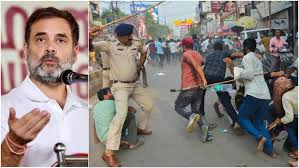
He said the incident reflected the government’s indifference towards the concerns of unemployed youth. Rahul Gandhi on Saturday accused the BJP-led government of failing to address rising unemployment among young people and condemned the police action against protesting teacher aspirants in Bihar. The Congress leader alleged that the Bihar Police used force against candidates who were peacefully demonstrating over employment-related demands in Patna. He said the incident reflected the government’s indifference towards the concerns of unemployed youth. In a post on X, the Congress leader wrote, “Yesterday in Patna, teacher aspirants who were peacefully protesting for their right to employment were brutally beaten by the Bihar Police–again. BJP’s response to unemployed youth: Lathis. Unemployment is the biggest disease in India today, and its most devastating impact is falling on the youth of Bihar and Uttar Pradesh.” Gandhi added that the Congress party stands with the unemployed youth. “Millions of youth, armed with degrees and skills in hand, are wandering from door to door. But the BJP government neither cares for them nor for you. When youth take to the streets to demand their rights, they are not given jobs in their hands–instead, lathis are rained down on their backs. India’s youth are fed up with the BJP’s lies–they will no longer stay silent. And the Congress stands with them at every turn,” the post read. Meanwhile, on Thursday, the Bihar government witnessed a major cabinet expansion as 32 ministers, including senior leaders and first-time entrants, were inducted into the Council of Ministers at a grand ceremony held at Gandhi Maidan in Patna. The expansion comes after the Bharatiya Janata Party (BJP)-led National Democratic Alliance (NDA) formed the government in Bihar, with Chief Minister Samrat Choudhary strengthening the administrative structure following a decisive electoral mandate. As part of the expansion, leaders from the BJP (15), Janata Dal (United) (13), Lok Janshakti Party (Ram Vilas) (2), Hindustani Awam Morcha (Secular) (1) and Rashtriya Lok Morcha (1) were inducted into the Council of Ministers. Courtesy : TNIE Note: This news is originally published on https:/thenewindianexpress.com/bha and is used purely for non-profit/non-commercial purposes, especially human rights
Tamil Nadu saw 67% rise in atrocities against Dalits under DMK rule

Tamil Nadu’s 67.9% increase in cases against Scheduled Castes (SC) and Scheduled Tribes (ST) is the highest in India, surpassing Madhya Pradesh (55.3%) and Odisha (42.9%). Tamil Nadu recorded a 67 per cent rise in atrocities against Dalits between 2019 and 2023, the highest increase in the country,according to a report by the National Campaign on Dalit Human Rights (NCDHR). This data has gained significant attention following the DMK’s defeat in the 2026 Assembly elections, suggesting that the state’s failure to address caste violence contributed to voter dissatisfaction despite the party’s “social justice” rhetoric. Tamil Nadu’s 67.9% increase in cases against Scheduled Castes (SC) and Scheduled Tribes (ST) is the highest in India, surpassing Madhya Pradesh (55.3%) and Odisha (42.9%). According to NCRB data, murders of Dalits rose by 40.4 per cent, increasing from 52 to 73 cases, while incidents of grievous hurt surged by 240 per cent and cases of criminal intimidation witnessed a sharp 584.8 per cent rise, climbing from 46 to 315 cases. Total rape cases rose by 36.1%. While the rape of adult Dalit women dropped by 14%, the rape of Dalit girls increased by 73.2% (from 56 to 97 cases). Assaults with “intent to outrage modesty” grew by 289.5%. The report highlights a breakdown in the justice system. In 2023, the conviction rate for these crimes was a mere 12.2%, while the acquittal rate stood at 87.8%. Additionally, the case pendency rate is 87.7%, exacerbated by a shortage of exclusive special courts; Tamil Nadu currently has only 20. The state government has also been criticized for administrative negligence. The state-level vigilance and monitoring committee, chaired by the Chief Minister, is legally required to meet twice a year. However, it met only once annually between 2021 and 2023, and failed to meet at all in 2024. Prison Statistics India (PSI) indicates a disproportionate targeting of Dalits under preventive detention. In 2021, SC individuals made up 37% of detainees in Tamil Nadu, accounting for 84.5% of all SC detainees across India. By 2023, this figure rose to 42.2%, despite Dalits making up only 20% of the state’s population. The sharp rise in atrocities against Dalits in Tamil Nadu has drawn particular attention because the Dravida Munnetra Kazhagam (DMK) has historically positioned itself as a champion of “social justice,” anti-caste politics, and the upliftment of backward classes, Dalits, and minorities through the broader Dravidian movement. Notably, the debate around caste violence and the DMK’s “social justice” claims intensified following the 2026 Tamil Nadu Legislative Assembly election, in which the Dravida Munnetra Kazhagam (DMK) suffered a major defeat. Tamilaga Vettri Kazhagam (TVK), led by actor-turned-politician Vijay, emerged as the single largest party with 108 seats, while the DMK was reduced to 59 seats. The All India Anna Dravida Munnetra Kazhagam (AIADMK) secured 47 seats. Courtesy : Maktoob Media Note: This news is originally published on https:/maktoobmedia.com/bha and is used purely for non-profit/non-commercial purposes, especially human rights
What is Dalit joy? It’s a threat to savarnas
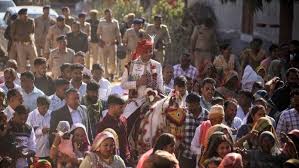
In ‘Dalit Women and the Fullness of Life’, Christina Dhanuja dismantles the stereotypes that freeze Dalit women as victims or icons of resilience. Caste minds have constructed worlds and cultivated cultures that are inherently anti-joy and actively anti-Dalit. This is our crooked room. And this is precisely why even the most mellowed expressions of joy from Dalits are threatening to those around us. Like in 2018, Mahesh Rathod, a 13-year-old Dalit boy from Vithalapur 8 in Ahmedabad, Gujarat, was beaten up for having a Darbar-like etiquette. Meaning, Mahesh was wearing jeans, a shirt, a thick gold chain around his neck, and Rajwadi Mojaris. In 2015, Sagar Shejwal, a twenty-three-year-old Dalit man from Shirdi in Maharashtra, was beaten to death by seven men belonging to the Maratha and OBC communities for having an Ambedkar song as a ringtone on his phone. In 2019, Jitendra in Kot, Uttarakhand was beaten up and killed for sitting on a chair and eating at a wedding in the presence of upper castes. The same year, four wedding processions of Dalits were attacked in a single week in Gujarat. A moustache. A dance. Riding a horse. An unbuttoned shirt. Leather shoes. Simple things and small joys that lead to thrashing, beating, stabbing, humiliation and death. This is what caste is. It emboldens joy-killing monsters that sit at the top of the pyramid, obese from eating the joys of Dalits. Urban savarnas are no different. They may not kill you, but they too cause damage. When I noticed that my hair was so thick, my friend piped, ‘That’s ’cause you’re nicely eating mutton and chicken.’ When I texted another about a new gadget I had bought, he replied, ‘All you rich, privileged people.’ When I announced that I had got a new job, a colleague said, ‘That’s because I didn’t apply for it.’ Prick that bubble. Dull that shine. Kill that moment. Savarnas believe in the impossibility of Dalit joy—and if and when it happens, they are convinced of their right to rob it. To discover joy as Dalit thus means that we first deconstruct this ridiculous inadequacy we have been rationed. We have to take apart their lies not just with rage, but with jeer. Call it silly. Call it absurd. See how foolish it is to treat joy as an individualistic pursuit that is sheathed, hidden within the self, from the self. See how wearisome it is to restrict something so available. See how fabricated it all sounds. Mediocre, even. I don’t want this warped notion of joy. I want no part in this laboriousness. I’d rather relish fruits like Vijeta Kumar’s father. I could go on morning walks with my mother, listening to little birds heralding the dawn. I could eat mutton curry andgaré at my mother-in-law’s. I could sit on a rocky beach and let the thick, salty air wash over me. Joy should be free to take. Still, I suspect that learning new ways of pursuing, sustaining, and savouring joy takes practice. Every time something beautiful happens, however small or big, my mind has no idea what to do with it. Instead of revelling in it, it searches for something that could go wrong. My mind believes it’s protecting me from unnecessary hurt, but in so doing, it has (almost) rid me of the ability to be in the moment. To relish, to enjoy, to experience. Dr Brené Brown calls it foreboding joy—an experience of joy immediately followed by worry or dread. It’s a form of self-protection against vulnerability, she says. I used to admire Brown’s work, but I now find her a tad too simplistic in the way white American worldviews generally are. Indeed, while‘foreboding joy’ as a term makes sense, its explanation does not. It is not without reason that Dalits fear joy. For Mahesh, Suman, and Delta, appearing joyful can literally get them killed. And it exposes the rest of us to ridicule, hurt and ‘lessons’. In this sense, joy is not an easy thing to embrace. Joy seems lethal. Joy seems unnecessary. So, what does Brown even mean when she says, ‘In moments of joyfulness, we try to beat vulnerability to the punch’? That, ‘when we lose our tolerance to be vulnerable, joy becomes foreboding’? Disappointingly enough—but not surprisingly—a number of South Asian influencers and brown therapists also resonate with Brown’s dare-to-be-vulnerable rhetoric. Perhaps they would advise Dalits to embrace vulnerability in order to realise joy. Here’s the thing though: Dalits’ foreboding isn’t because they are scared of vulnerability. They are already systemically vulnerable and have even been told that they have a victim mindset if and when they speak of it. So, how is a performance of vulnerability, in the way Brown is advocating for—which is to ‘daringly’ show the world how soft and gooey we all are—going to work? How will it lead to joy? If anything, the opposite happens. Caste minds respond with disgust, name-calling and more exploitation. A Dalit’s vulnerability is a reminder of their evil. Vulnerability is not our magic potion. Recognition is. Reconstruction is. Our foreboding joy is our minds grappling with the real cost of what joy demands of us—the history and the reality of our joy being robbed and the usual trauma that follows it. It is a warning, a writing on the wall that has been passed down through generations. Perhaps we must ignore the likes of Brown and stop calling our minds and bodies chicken-hearted. Perhaps we must see them as intelligent beings that are understandably tempered in their enthusiasm. Perhaps we must empathize with the fear that bubbles from within. Perhaps only by validating it can we and our communities truly pursue joy. This is why resilience and resistance feel more authentic than vulnerability. Indeed, a foreshadowing of what could happen and the fear that it will all fall apart is entirely reasonable, but it is also true that we are our ancestors’ wildest dreams. Our fore-parents fought hard for our joy. Not in one grand
From Gharana Gurus to Pandemic Flatmates, Trans Motherhood in India Has Always Made a Place for Itself

From hijra gharanas to pandemic flatshares, trans women across India have long built matriarchal families the law refuses to name. With the 2026 amendment threatening chosen family autonomy, three trans women speak about what motherhood really means. Meena* was twelve when she fled a small town with nothing and no one. She found factory work in the city and, slowly, found herself, first through cross-dressing, then through conversation, then through the gradual understanding that some friendships, deepened over years, become something for which no adequate word exists. “Achanak se ek maa ban gayi thi,” she says: I had suddenly become a mother. She had not planned it. The role arrived quietly, like an understanding reached between two people who had each been looking, without knowing it, for the same thing. For RudraniChettri, trans rights activist, actor and model, who also starred in Vikas Khanna’s directed The Last Colour, whose themes almost run parallel to this story on chosen families, and one of the most visible figures of India’s trans movement, motherhood arrived in much the same way. “I never really saw myself as a trans mother,” Chettri told Local Samosa. “I was simply there for people who needed love, care, and support. Over time, these relationships naturally evolved on their own.” Her closest bond is with a non-binary person who is son, sister, brother, mother, and father to her all at once, a bond that goes “beyond labels and traditional definitions of relationships.” For trans women across India, this is what family looks like: not given, but built, through accumulated time and the willingness to stay. The hijra gharana system is among the oldest surviving kinship structures in South Asia. Rooted in a guru-chela lineage, in which a guru takes on chelas, who may in turn take poti-chelas, it has for centuries provided trans women with shelter, sustenance, social standing, and belonging, functioning as a matriarchal institution documented by scholars including Gayatri Reddy and Serena Nanda. But structure is not always warmth, and not every guru becomes a mother. Meena, who spent time within a gharana, recalls the hierarchy as legible but cold. “Guru aayi hai toh boss aayi hai,” she says, when the guru arrived, it felt like a boss, not a mother. What she had been given was a household; what she had been searching for was intimacy. Over time she found it elsewhere, in a friendship that slowly became something more. “Hum ek doosre ki life mein rehte the,” she says: we lived inside each other’s lives. Meena is careful not to dismiss what the gharana gave her: a roof, company, someone who would come in illness. But the chosen family she has since built is held together by something the old system rarely offered, what she calls “mamtapan”, the quality of genuine, tender care. Rudrani Chettri puts the figure plainly: more than ninety, perhaps ninety-five, per cent of India’s trans community is sustained not by biological family but by chosen family. Family rejection remains one of the most consistent and damaging experiences of trans life in India, beginning in childhood and persisting through every significant life transition. The chosen family is not a romantic alternative to the biological one. It is the infrastructure of survival. For 34-year-old Delhi-based trans woman and community organiser Sana*, chosen family emerged not through a traditional gharana but through shared precarity. During the pandemic, she began informally housing younger trans and queer people who had been pushed out of hostels, denied rental accommodation, or cut off financially by their families while in college. What began as temporary shelter slowly became permanence. “At first it was just, ‘Stay here till things get better,’” she says. “Then suddenly we were cooking together, fighting over groceries, helping each other through breakups and hormone appointments. One day someone introduced me as their mother and I realised the relationship had already become real before we named it.” “None of us planned this structure,” Sana says. “But when the world keeps telling you that you do not belong anywhere, even small acts of staying become family.” Chettri is precise: “For many of us, building a chosen family was never the first choice, it became necessary because the first priority was choosing ourselves, choosing our truth, and surviving as who we are.” For transmasculine people, she notes, the situation has historically been far bleaker, without comparable support structures, they remain significantly more isolated. Indian law has not caught up with the families trans people have already built. The Transgender Persons (Protection of Rights) Act, 2019 made no provision for trans persons seeking to adopt and did not address chosen family bonds in any meaningful way. CARA, India’s central adoption authority, has issued no guidance for trans-led families, leaving prospective trans parents in a legal grey zone navigated through bureaucratic discretion and, more often than not, refusal. The NALSA vs. Union of India judgment of 2014 affirmed transgender personhood but left family law untouched. For trans mothers and their chosen children, the legal relationship remains, in most cases, invisible. Sana has encountered that invisibility in ordinary bureaucratic situations, rental agreements, hospital paperwork, emergency contacts. “There is no column for the people who actually take care of you,” she says. “When one of the kids was hospitalised, I was the person speaking to doctors, arranging money, staying awake all night. But legally I was nobody.” The contradiction, she says, is exhausting: “The state keeps asking us to prove relationships that we are already living every day.” The Transgender Persons (Protection of Rights) Amendment Bill, 2025, signed into law in early 2026, sharpened these contradictions considerably. The legislation drew sustained criticism for expanding the role of biological families and state-run rehabilitation centres in matters of trans welfare, provisions that activists read as mechanisms for family-sanctioned confinement dressed in the language of protection. It retained requirements around institutional certification of gender identity, eroding the self-identification principle established by NALSA, while continuing to offer no recognition to chosen family bonds. Chettri names
Karnataka High Court directs continuation of hormone replacement therapy on two transgenders

The petitioners challenged the validity of the Transgender Persons (Protection of Rights) Amendment Act, 2026, and claimed that despite being midway through treatment, the attending doctors are unwilling to continue the prescribed course of therapy. Bengaluru: The High Court of Karnataka has directed the doctors of a private hospital in Bengaluru to continue with hormone replacement therapy (HRT) upon two transgenders as per the existing medical protocol. The petitioners challenged the validity of the Transgender Persons (Protection of Rights) Amendment Act, 2026, and claimed that despite being midway through treatment, the attending doctors are unwilling to continue the prescribed course of therapy. “The concerned doctors and medical authorities shall facilitate continuation of such treatment without interruption. The continuation of treatment shall, however, be subject to the outcome of the present writ petition and any orders that may be passed by the Supreme Court, including in any transfer proceedings initiated by the Union of India,” Justice Sachin Shankar Magadum stated in the interim order passed on Thursday. The petitioners submitted that they are transgender persons identifying as women and are aggrieved by the consequences flowing from the amended definition of “transgender person” under Section 2(k) of the 2026 Amendment Act. The petitioners claimed that they have been undergoing hormone replacement therapy (HRT) in a hospital since November 11, 2023, and have also been issued Transgender Identity Cards. They contend that denial of treatment midway, infringes their fundamental rights guaranteed under Articles 14, 15, 16, 19, and 21 of the Constitution of India. They also relied on an interim order passed by the Kerala High Court in an analogous matter, where similarly placed persons were permitted to continue the therapy and appropriate directions were issued to facilitate uninterrupted treatment. The Additional Solicitor General, appearing for the Union government, submitted that no material is placed on record to demonstrate that the authorities have initiated or proposed coercive action restraining such treatment. It was further submitted that the issue relating to the validity of the amendment is presently sub judice and before the Supreme Court. The Union government is contemplating filing an application seeking transfer of all similar petitions pending before various high courts, the court was informed. Justice Magadum noted that the medical records produced by the petitioners, prima facie, indicate that both have been undergoing the therapy since November 11, 2023. “At this stage, it cannot be disputed that abrupt discontinuation of such ongoing medical treatment may have adverse and detrimental consequences on their physical and mental well-being. It is also not in dispute that the issues raised in the present petition, including the challenge to the amended statutory provision, are engaging the attention of the Supreme Court and are likely to be authoritatively settled. In the facts and circumstances of the case, this court is of the considered view that, pending adjudication of the larger issues, limited interim protection is required to be extended to the petitioners to ensure that ongoing medical treatment is not disrupted,” the court said. Ambarish B Courtesy : DH Note: This news is originally published on https:/deccanherald.com/bha and is used purely for non-profit/non-commercial purposes, especially human rights