
Ram temple donations case: All eight accused sent to 14-day judicial custody
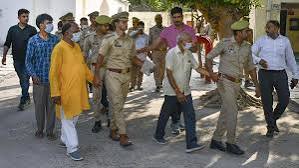
The accused were produced before Special Judge, Anti-Corruption Court, Rajat Verma, through video conferencing from the district jail, after the expiry of their three-day judicial custody. LUCKNOW: All eight accused arrested in connection with the alleged embezzlement of donation funds at Ram temple were, on Monday, remanded to 14-day judicial custody by a local court, case officials said. The accused were produced before Special Judge, Anti-Corruption Court, Rajat Verma, through video conferencing from the district jail, after the expiry of their three-day judicial custody, Special Prosecution Officer Umesh Dubey said. Dubey said that the district police did not apply for the custody of the accused. The eight accused — Ram Shankar Yadav alias Tinnu, Anukalp Mishra, Avinash Shukla, Karunesh Pandey, Manish Yadav, Lavkush Mishra, Ram Shankar Mishra and Subhash Srivastava—earlier been remanded to three days’ judicial custody till Monday by a special remand magistrate. The case has been posted for next hearing on July 13. Namita Bajpai Courtesy : TNIE Note: This news is originally published on https:/thenewindianexpress.com/bha and is used purely for non-profit/non-commercial purposes, especially human rights
Dalit vote at centre of UP parties’ organisational overhaul ahead of 2027 polls
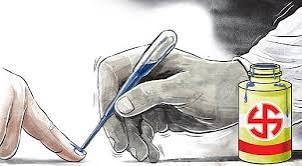
Congress, BJP, SP and BSP are reshaping their leadership structures as the battle for Scheduled Caste voters intensifies ahead of the Assembly election. As Uttar Pradesh heads towards the 2027 Assembly elections, political parties have begun fighting the first battle long before campaigning begins—through organisational restructuring. While the Congress has appointed Dalit leader R.P. Gautam as its Uttar Pradesh in-charge, the BJP has carried out a sweeping overhaul of its state unit by replacing all six regional presidents and appointing a new caste-balanced leadership team. The Samajwadi Party continues expanding its PDA network, while the Bahujan Samaj Party (BSP) has reshuffled its organisational hierarchy under Mayawati. Together, the moves underscore how every major party is recalibrating its leadership to reflect Uttar Pradesh’s intricate caste and regional equations in a state where Dalit votes could prove decisive in determining power. Why Is the 2027 UP Election More Than an Electoral Contest—A Battle for Dalit Votes? The renewed emphasis on Dalit representation follows the political message delivered by the 2024 Lok Sabha elections. The BJP’s tally in Uttar Pradesh fell from 62 seats in 2019 to 33, while the Samajwadi Party emerged as the largest party in the state with 37 seats and the Congress won six, giving the INDIA bloc a significant boost. More importantly, the BJP’s dominance in Scheduled Caste-reserved constituencies weakened as it won only eight of the state’s 17 reserved Lok Sabha seats, down from 14 in 2019. Equally significant was the BSP’s electoral setback, with Mayawati’s party once again failing to open its account in Uttar Pradesh, repeating its 2014 performance. Once the undisputed political voice of Dalits, the BSP has seen its support fragment over the past decade, with sections of Jatav voters remaining with the party while many non-Jatav Dalits shifted towards the BJP and, more recently, the SP-led INDIA alliance. The BSP’s electoral decline has intensified competition for Dalit votes, encouraging every major party to aggressively target both Jatav and non-Jatav Scheduled Castes ahead of the 2027 Assembly elections. With Scheduled Castes constituting nearly 21 per cent of Uttar Pradesh’s population and influencing electoral outcomes in well over 150 Assembly constituencies, organisational appointments have become almost as politically significant as candidate selection. Every major party is now attempting to balance caste identity, regional representation and social influence within its organisational structure. Congress Bets on a Dalit Face The latest move has come from the Congress, which appointed senior Dalit leader R.P. Gautam as its Uttar Pradesh in-charge, replacing Avinash Pande. Gautam, regarded as an experienced organisational hand, is expected to spearhead the party’s preparations for the 2027 Assembly elections while strengthening its outreach among Scheduled Castes. The appointment is widely seen as an acknowledgement that Dalit politics in Uttar Pradesh has entered a new phase following the BSP’s decline. By placing a Dalit leader in charge of its largest electoral battleground, the Congress hopes to complement its alliance strategy with the Samajwadi Party while simultaneously rebuilding its independent organisational base. BJP’s Organisational Reset If the Congress has sought to send a political message by appointing R.P. Gautam, the BJP has responded with one of its most extensive organisational overhauls in recent years. Following its disappointing performance in the 2024 Lok Sabha elections, the BJP replaced all six regional presidents of its Uttar Pradesh unit while appointing 19 vice-presidents, eight general secretaries and several new office-bearers, carefully balancing caste representation and regional aspirations. The six regional chiefs themselves reflect the BJP’s social engineering strategy. Nawab Singh Nagar (Gujjar) has been appointed for western Uttar Pradesh, Puran Lal Lodhi (Lodhi OBC) for Braj, Ram Kishore Sahu (Sahu OBC) for Kanpur-Bundelkhand, Avadhesh Dwivedi (Brahmin) for Awadh, Ashok Chaurasia (OBC) for Kashi and Vinod Rai (Bhumihar) for Gorakhpur. The revamped organisation accommodates leaders representing Dalit, OBC, upper-caste and regional communities, reflecting the BJP’s effort to broaden its social coalition after the 2024 setback. The organisational restructuring complements the BJP’s representation in government through ministers such as Baby Rani Maurya, Asim Arun, Dinesh Khatik and Gulab Devi, while continuing targeted outreach among non-Jatav Dalit communities including Pasi, Valmiki, Kori and Khatik through welfare schemes, social outreach programmes and grassroots mobilisation. SP Strengthens PDA Coalition The Samajwadi Party, meanwhile, continues to reorganise its structure around Akhilesh Yadav’s PDA (Pichhda, Dalit, Alpsankhyak) formula. The party has consciously increased the representation of Dalits and Extremely Backward Classes in district organisations, frontal units and candidate selection while expanding beyond its traditional Muslim-Yadav support base. The strategy paid dividends in the 2024 Lok Sabha elections, when the SP won seven of Uttar Pradesh’s 17 Scheduled Caste-reserved parliamentary constituencies. Since then, the party has consistently appointed office-bearers from backward and Dalit communities while making caste census, reservation and social justice central themes of its campaign for 2027. BSP Seeks to Reclaim Dalit Base Although the BSP suffered another major setback by failing to win a Lok Sabha seat in Uttar Pradesh in 2024, political observers believe writing off the party would be premature. The BSP still retains a committed cadre, strong booth-level organisation in several districts and an emotional connect among a sizeable section of its traditional Jatav support base. Recognising the need for organisational revival, BSP chief Mayawati has repeatedly reshuffled state office-bearers, zonal coordinators and district presidents while restoring her nephew Akash Anand as the party’s national coordinator. The BSP continues to strengthen its booth-level network by appointing coordinators from different Scheduled Caste sub-groups and OBC communities across western, central and eastern Uttar Pradesh. Unlike the BJP’s welfare-centric politics or the SP’s PDA narrative, the BSP continues to rely on Ambedkarite ideology and the legacy of Kanshi Ram and Mayawati. The party hopes to retain its loyal Jatav vote while reconnecting with non-Jatav Dalits who shifted towards rival parties over the last decade. The emergence of Nagina MP Chandrashekhar Azad as an independent Dalit voice has further diversified Dalit politics in Uttar Pradesh, particularly among younger voters, adding another layer to the competition for the community’s support. Even if the BSP does
Congress claims SBI had sought removal of officials posted at Ram Temple’s donation counting centre three months ago

Congress leader Pawan Khera said the donation theft, for which eight people have been arrested so far by the Uttar Pradesh police, was only a glimpse, and more such cases were yet to come. The Congress on Monday targeted Prime Minister Narendra Modi and Uttar Pradesh Chief Minister Yogi Adityanath over the alleged irregularities in the handling of donations and offerings made by devotees at the Ram Temple in Ayodhya. Speaking to reporters in Raipur, Pawan Khera, Chairman (Media and Publicity Department), AICC, claimed that the State Bank of India had recommended the removal of officials posted at the temple’s donation counting centre three months ago, and sought to know who were protecting them. He said the alleged donation theft at the Ram Temple, for which eight people have been arrested so far by the Uttar Pradesh police, was only a glimpse, and more such cases were yet to come. “Ayodhya ki loot jhanki hai, Kashi-Mathura abhi baaki hai (the alleged loot in Ayodhya was only a glimpse, Kashi and Mathura were yet to come),” he said. Khera said the UP CM should be asked whether bulldozer action will be taken against the RSS or the Prime Minister’s Office (PMO) over the embezzlement of funds at the temple. “The RSS and PMO were directly looking after the Ram Mandir administration. Ask Adityanath, if there has been wrongdoing there, will bulldozers be sent to RSS chief Mohan Bhagwat’s residence or to PMO? Just ask him this question and he will have no answer,” he said. Khera claimed the State Bank of India (SBI) three months ago recommended the removal of officials posted at the donation counting centre at the shrine. “SBI had recommended three months ago that those posted at the counting centre be removed. Who has been protecting them? Nagpur or Delhi?” the Congress leader asked. In reply to a question, he said the United States was “insulting India every day” while Prime Minister Narendra Modi was maintaining silence. “Modi ji should give us a list of those he is afraid of and those he is not,” he quipped. On the reported move by the new BJP government in West Bengal to bring a bill on Uniform Civil Code (UCC), Khera alleged such issues were being raised to divert people’s attention from the Ram Mandir donation theft case. “The purpose (of UCC bill) is only to change the headlines and divert attention from what is happening in the name of Lord Ram in Ayodhya,” he claimed. Khera was in Raipur to address the last day of a ten-day training camp of the Chhattisgarh Congress organised for district unit presidents in the Abhanpur area. Courtesy : TNIE Note: This news is originally published on https:/thenewindianexpress.com/bha and is used purely for non-profit/non-commercial purposes, especially human rights
BJP backs Nitin Nabin’s ‘foreign mindset’ jibe at Congress, intensifies attack on Rahul Gandhi

Party spokesperson Shehzad Poonawalla alleges Congress works at the behest of foreign powers to undermine India, labels it the “Italian National Congress” and “Islamabad National Congress” The BJP on Monday threw its weight behind party president Nitin Nabin’s remarks targeting the Congress, accusing the opposition of having a “foreign mindset” and alleging that it works at the behest of foreign powers to weaken and divide India. The controversy stems from Nabin’s speech at a public meeting in Hyderabad on Sunday, where he claimed that the Congress leadership’s mindset was “Italian rather than Indian” and asserted that a government guided by such thinking would never get an opportunity to govern the country. Echoing those remarks, BJP national spokesperson Shehzad Poonawalla alleged that the Congress no longer deserved to be called the “Indian National Congress”, but should instead be described as the “Italian National Congress” or the “Islamabad National Congress”. “Nitin Nabin ji is absolutely right. The Congress family’s bodies are here, but their mindset is abroad. With that foreign mindset, they constantly divide and undermine India at the behest of foreign powers,” Poonawalla said in a video statement. Stepping up his attack on Congress leader Rahul Gandhi, Poonawalla alleged that Gandhi routinely criticises India’s economy, democracy and sovereignty during his visits abroad. “Isn’t it true that Rahul Gandhi is abroad even now, perhaps planning some conspiracy against India? He goes to foreign soil and abuses India’s economy, democracy and sovereignty. He goes abroad and says Operation Sindoor did not happen. He attacks our armed forces and says they were beaten. Even the Supreme Court chastised him, saying no Indian speaks like this,” he alleged. Poonawalla further accused Gandhi of attempting to divide the country on caste lines and undermining India’s institutions. “He says he wants to fight the Indian state and divides India on caste lines. It is very clear that the agenda is to take George Soros’ money and contract to divide and attack India and its institutions. He attacked the AI Summit, attacked India’s self-reliant vaccines, defence preparedness and armed forces. In opposing the BJP, he is attacking India and the Indian state itself,” he claimed. Reiterating the BJP’s criticism, Poonawalla alleged that the Congress was functioning against the country’s interests. “That is why it is not the Indian National Congress; it is the anti-India Italian National Congress or the Islamabad National Congress,” he said. Courtesy : TNIE Note: This news is originally published on https:/thenewindianexpress.com/bha and is used purely for non-profit/non-commercial purposes, especially human rights
Mallikarjun Kharge takes oath as Rajya Sabha member after re-election
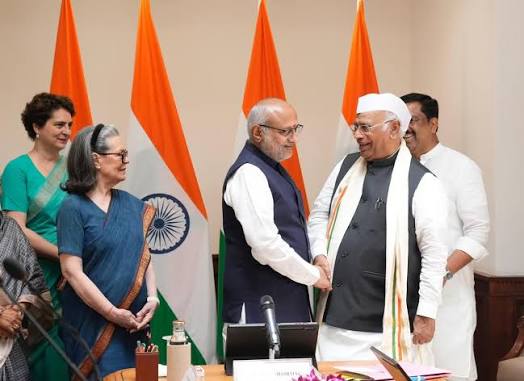
Vice President C P Radhakrishnan administers oath in Parliament House; Congress leaders Sonia Gandhi and Priyanka Gandhi Vadra attend ceremony Congress president Mallikarjun Kharge was on Monday sworn in as a member of the Rajya Sabha after being re-elected to the Upper House. The oath of office was administered to Kharge by Rajya Sabha Chairman and Vice President C P Radhakrishnan in his chamber at Parliament House. He took the oath in Hindi and was seen holding a copy of the Constitution during the ceremony. Vice President Radhakrishnan congratulated Kharge and said the Upper House would benefit from his long parliamentary experience. Following the oath-taking, Kharge said he would continue to raise the concerns, aspirations and voices of the people with sincerity and conviction, while also holding the government accountable. He reiterated that these responsibilities would remain central to his role in Parliament. Senior Congress leaders, including Congress Parliamentary Party chairperson Sonia Gandhi and Wayanad MP Priyanka Gandhi Vadra, were present during the ceremony. Union ministers J P Nadda, Kiren Rijiju, Arjun Ram Meghwal, and Rajya Sabha Deputy Chairman Harivansh also attended the occasion. In a post on social media platform X, the Vice President’s office confirmed that Kharge had taken oath as a re-elected member of the Council of States from Karnataka, sharing photographs of the ceremony. Kharge also posted on X expressing gratitude for the opportunity to continue serving as Leader of the Opposition in the Rajya Sabha, calling it a matter of “immense pride and responsibility.” He thanked Vice President Radhakrishnan and Deputy Chairman Harivansh for their support, as well as Congress leadership including Sonia Gandhi and Rahul Gandhi, along with party colleagues and workers for their continued backing. He also expressed appreciation to leaders across parties, particularly INDIA bloc members, and said he looked forward to stronger coordination during the upcoming Monsoon Session of Parliament to ensure greater accountability from the government. Apart from Kharge, BJP leader Tarun Chugh, and six other new members including Jitendra Meghjibhai Kanzariya and Mansingh Meraman Parmar (Gujarat), M Nagaraja (Karnataka), Rajendra Hiralal Jain (Maharashtra), Adhikarimayum Sharda Devi (Manipur) and Alka Singh (Rajasthan), also took oath. Rajya Sabha Deputy Chairman Harivansh, Leader of the House J P Nadda, Parliamentary Affairs Minister Kiren Rijiju and Law Minister Arjun Ram Meghwal were present at the oath-taking, both inside the chairman’s chamber as well as in the House. Kharge took oath in Hindi while holding a copy of the Constitution in his hand. VP Radhakrishnan congratulated and welcome the new members into the House. Courtesy : TNIE Note: This news is originally published on https:/thenewindianexpress.com/bha and is used purely for non-profit/non-commercial purposes, especially human rights
‘Missing’ posters targeting Rahul Gandhi surface in Delhi, BJP calls him ‘Leader of Paryatan’
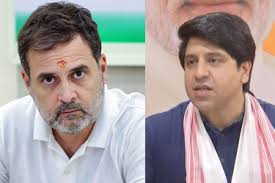
NEW DELHI: The BJP on Saturday intensified its attack on Congress leader Rahul Gandhi over his reported foreign visits, with “missing” posters surfacing across parts of Delhi and party spokesperson Shehzad Poonawalla dubbing the Leader of Opposition the “Leader of Paryatan.” The posters, put up in several parts of the national capital, described Rahul Gandhi as “missing”, prompting a fresh political attack from the BJP. Reacting to the development, BJP national spokesperson Shehzad Poonawalla took a swipe at the Congress MP in a post on X, referring to him as “Gumshuda Lapata MIA Rahul Baba” and “Leader of Paryatan.” In another post on X, Poonawalla contrasted Prime Minister Narendra Modi’s work record with Rahul Gandhi’s reported foreign visits. “Prime Minister Modi has been in work mode. He has spent almost 9,000 days as Chief Minister and Prime Minister without taking a holiday. Rahul Gandhi has vacation mode. He spends crores on holidays every year. Rahul is the Leader of Paryatan,” Poonawalla said. In a video message on Friday, Poonawalla alleged that Rahul Gandhi frequently remains away during key political and parlimentary occasions. “Rahul Gandhi should rename LoP as ‘Leader of Paryatan and Partying’ because that’s what he always does. On one hand, Prime Minister Modi has become the longest-serving elected Prime Minister of the country and, during the last 9,000 days as Chief Minister and Prime Minister, has not taken a single day off. This is work mode and seva mode,” he said. “On the other hand, Rahul Gandhi is constantly on vacation. Every time the party and the country need him, he goes on foreign tours. He does not put people first, Parliament first or even the party first; he puts tourism first,” Poonawalla alleged. He further claimed that Gandhi had undertaken several foreign trips and questioned the funding of those visits. “Rahul Gandhi has spent crores on his vacations but has not provided any account of how this money is spent on foreign tours and travels. Once again, Rahul Gandhi has gone abroad. He will be missing when Parliament, the party and the people need him,” Poonawalla alleged. Courtesy : TOI Note: This news is originally published on https:/timesofindia.com/bha and is used purely for non-profit/non-commercial purposes, especially human rights
57 years after Stonewall, why equality, inclusivity still a battle for India’s queer community
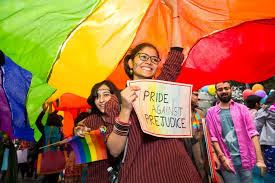
On June 28,1969, police raided New York’s Stonewall Inn, detaining many transgender persons and drag performers and subjecting others to humiliating searches and questions. The resistance that followed is known as the Stonewall Riots and June continues to be celebrated as Pride Month to commemorate the incident. For many in India, Pride is not a parade, but the hope of a life lived without discrimination and humiliation. At 1.20 a.m. on June 28, 1969, a Saturday, four police officers in plainclothes, accompanied by two uniformed patrolmen, walked up to the double doors of a small bar in New York’s Greenwich Village. “Police. We’re taking the place,” one of them announced. The bar was called the Stonewall Inn, a clandestine ‘gay’ bar. Patrons were lined up, their identity papers examined, and those whose appearance did not conform to what the police believed men and women should look like were singled out. Many transgender persons and drag performers were detained. Others were subjected to humiliating searches and questioning. Raids like these on places identified as queer hubs were routine back then. But that night was different. The people inside Stonewall Inn refused to quietly submit. The crowd outside swelled. Resistance replaced fear. The Stonewall Riots became the defining moment of the modern LGBTQIA+ rights movement. Fifty-seven years later in India, during Pride Month (celebrated in June to commemorate the 1969 riots), Stonewall feels less like history and more like a warning. A conversation beyond survival Imagine a 20-year-old transgender student growing up in Harda, Hapur or Hazaribagh. She has never attended a Pride parade. There is no queer community centre in her town. No support group she can walk into after college. No café where she can simply exist without being stared at. She worries less about rainbow flags than about whether her college will recognise her identity, whether a landlord will rent her a room, whether a hospital will treat her with dignity, and whether the law sees her as the person she knows herself to be. For years, it seemed that India was slowly moving in that direction. In National Legal Services Authority v. Union of India (2014), popularly known as the NALSA judgment, the Supreme Court recognised that gender identity lies at the heart of dignity, equality and personal autonomy and affirmed the principle of selfidentification. Four years later, in Navtej Singh Johar v. Union of India (2018), the Court decriminalised consensual same-sex relationships by reading down Section 377 of the Indian Penal Code (which had criminalised ‘carnal intercourse against the order of nature’), declaring that constitutional morality must prevail over social prejudice. More recently, in Supriyo @ Supriya Chakraborty v. Union of India (2023), while the Supreme Court declined to recognize marriage equality, it unequivocally acknowledged the dignity and equal citizenship of queer persons. Taken together, these decisions did not solve every problem, but they changed the direction of travel. They told queer Indians that the Constitution saw them not as criminals or outcasts, but as equal citizens. The conversation, slowly but surely, was beginning to move beyond survival. The questions were changing. Could queer couples marry? Could they adopt children? Would health insurance recognise their partners? Would workplaces guarantee equal opportunities? Could a partner make medical decisions during an emergency? Would families eventually choose acceptance over silence? These are the questions of people imagining a future. Fresh anxieties That is why the present moment has generated so much anxiety. The Transgender Persons (Protection of Rights) Amendment Act, 2026, which is presently under challenge before the Supreme Court, has reignited concerns among many transgender persons and rights advocates that the constitutional principle of self-identification recognised in NALSA could be substantially diluted. Whether those concerns ultimately withstand constitutional scrutiny will be for the Court to determine. But the very fact that the debate has returned to who gets to define a person’s identity has left many wondering whether hard-won gains are becoming fragile. History never repeats itself exactly. Yet it often asks remarkably similar questions. In 1969, people gathered outside the Stonewall Inn because they refused to accept that the State could decide who they were. In 2026, transgender Indians are once again asking who has the authority to define their identity. The context is different. The question remains hauntingly familiar. For queer Indians living in Delhi, Mumbai or Bengaluru, community spaces, support networks and affirming workplaces, while still limited, at least exist. But what does Pride mean to someone living in a small town? Where does that young student from Harda go? There are no community spaces like the Stonewall Inn. There may be no counsellor trained in gender identity, no local support group, no understanding within the family and no legal aid organisation nearby. Every decision, whether to come out, seek healthcare or simply exist openly, carries consequences that extend far beyond personal identity. It may determine whether someone can continue their education, keep a roof over their head or remain financially secure. Even today, queer persons in India continue to face barriers that extend well beyond legal recognition. Marriage equality remains unavailable. Adoption rights remain uncertain for same-sex couples. Many struggle to access affirming healthcare. Workplace discrimination persists. Police harassment and social stigma continue to be reported. For countless young people, the fear of rejection by their own families remains the greatest obstacle of all. Equality and inclusion This is precisely why the debate cannot stop at self-identification. The next chapter of LGBTQIA+ rights in India should be about enabling ordinary lives. The right to marry the person one loves. The right to build a family. Equal opportunities in education and employment. Access to healthcare without humiliation. Insurance, inheritance, pensions and legal recognition that treat queer families with the same dignity as everyone else. These are not extraordinary demands. They are the ordinary incidents of citizenship. Across the world, many democracies have already begun answering these questions. South Africa constitutionally prohibits discrimination on the basis of sexual orientation and has recognised same-sex marriage for nearly
Parliament Passes Transgender Persons (Protection of Rights) Amendment Bill, 2026 After Rajya Sabha Nod
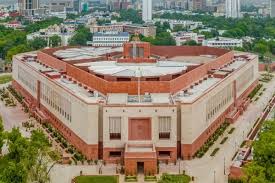
Parliament Passes Transgender Persons (Protection of Rights) Amendment Bill, 2026 After Rajya Sabha Nod Parliament has passed the Transgender Persons (Protection of Rights) Amendment Bill, 2026, with the Rajya Sabha approving it yesterday. Earlier, the bill was passed by the Lok Sabha on tuesday by a voice vote amid an Opposition-led walkout. The bill seeks to redefine the category of transgender, removes the provision of self-perceived gender identity and excludes several socio-cultural identities as well as transmasculine individuals from its ambit. Replying to the discussion on the Bill in the Rajya Sabha, Social Justice and Empowerment Minister Dr Virendra Kumar said, the government is compassionate towards the well-being of the transgender community. He said, the Bill has provisions to empower the transgenders and give them dignity. The Minister said, NDA government has taken several initiatives to bring transgender people to the mainstream and stop discrimination against them. Courtesy : News ON AIR Note: This news is originally published on https:/newsonair.com/bha and is used purely for non-profit/non-commercial purposes, especially human rights
Independent probe sought for custodial death of Dalit woman in AP

Mala Gangamma died on May 31 after suffering torture in the hands of the Special Investigation Team (SIT) constituted to probe the disappearance of her son, Veerendra, in November 2024. Andhra Pradesh: Human Rights Forum (HRF) and the Indian Federation of Trade Unions (IFTU) have demanded an independent enquiry over the alleged custodial death of a 40-year-old Dalit woman in Andhra Pradesh’s Kurnool district in May this year. Mala Gangamma died on May 31 after suffering torture in the hands of the Special Investigation Team (SIT) constituted to probe the disappearance of her son, Veerendra, in November 2024. The Dalit woman had approached the Andhra Pradesh High Court seeking justice. The SIT was made on the directions of the court. It was headed by then Guntur Additional Superintendent of Police (ASP) K Supraja. According to HRF and IFTU, Gangamma was allegedly tortured and forcefully confessed that she and her partner, Malla Durgayya, murdered her son, as he reportedly opposed their relationship. HRF and IFTU stated that the couple were subjected to third-degree torture, leading to Gangamma’s death, while Durgayya continues to battle for his life at the Kurnool Government Hospital. They questioned why Gangamma’s burial was conducted in the presence of 20 to 30 police personnel, and why Durgayya’s relatives were disallowed from meeting him in the hospital. Apart from an independent, impartial examination, the organisations have demanded a fresh post-mortem examination of Gangamma’s body, and the registration of criminal cases, including murder charges and relevant provisions of the Scheduled Castes and Scheduled Tribes (Prevention of Atrocities) Act, against police personnel found responsible. Courtesy : TSD Note: This news is originally published on https:/thesiasatdaily.com/bha and is used purely for non-profit/non-commercial purposes, especially human rights
Janseva Dal to contest 403 assembly seats: In Aligarh, the party stated, “We no longer want votes, but equal rights to power.”

The Janseva Dal in Aligarh has announced its intention to contest all 403 seats in Uttar Pradesh ahead of the upcoming assembly elections. The party held a public meeting at Jupiter Lodge on ITI Road on Sunday evening, June 28, 2026, targeting mainstream political parties. Party National President Vinesh Thakur (Karpoori) alleged that while the votes of the most backward, most Dalit, and working-class castes form governments, they do not receive equal rights to power and respect. Vinesh Thakur stated that since independence, the Nai, Sen, Savita, Pal, Baghel, Prajapati, Kashyap, Nishad, Mallah, Saini, Kushwaha, Kori, Khatik, Valmiki, Dhobi, Tailor, and other working-class communities have been considered merely vote banks. He explained that promises are made during elections, but these communities have consistently been neglected in ticket distribution, government positions, and political participation. The National President of the Jan Seva Dal announced that his party is preparing to contest all 403 assembly seats in Uttar Pradesh. He clarified that candidates will be fielded from among the marginalized communities. Vinesh Thakur emphasized that this community will no longer be dependent on the mercy of any party, but will gain a share of power based on its political strength. Speakers at the meeting also mentioned Karpoori Thakur’s model of social justice. They questioned the governments’ intentions in not implementing the backward and extremely backward classifications. A state-wide public awareness campaign was also announced on this occasion. The program was chaired by District President Ramnaresh Singh, who reiterated his commitment to strengthening the organization down to the booth level. A large number of workers and officials from various social organizations attended the public meeting. The Jan Seva Dal also raised slogans like “Hand-made artisans will form the government” and “It’s not a caste, it’s a community; all the most backward are together,” reflecting their political warning. Naresh Pratap Singh | Kol Courtesy: Hindi News