
Dalit woman assaulted and robbed in Rae Bareli: Violent men beat a woman for building a field fence, snatched gold jewelry from a woman who came to her rescue; case filed
A Dalit woman was assaulted and robbed in Maharajganj, Rae Bareli. Following the orders of the SC/ST Court, police have filed a case against four individuals. The incident occurred at 2 p.m. on July 13th. Siyavati was building a fence in her field on the Mahua Kheda Gunawar border. Neighboring farmer Chhote Lal Singh, his son Shrikrishna Singh, grandson Rakesh Singh, and granddaughter Saroj Kumari arrived armed with sticks and iron rods. The accused hurled casteist slurs at Siyavati and began assaulting her. When Ashma, who was at a nearby poultry farm, came to her rescue, the accused struck her on the head with an iron rod. Ashma fell unconscious. During this, Saroj took the gold necklace, earrings, and bracelets from the unconscious Ashma’s neck. The victim complained to the Maharajganj police and the Superintendent of Police. When no action was taken, she appealed to the SC/ST Court on July 22nd. On the court’s orders, the Kotwali police registered a case and began investigation. Police Inspector Jagdish Yadav stated that a case has been filed against the four accused under relevant sections. Anand Kumar Singh Courtesy: Hindi News
Dalit woman attacked in field: Five women attacked with sharp weapons in Prayagraj, case filed a month later
A case of assault on a Dalit woman has come to light in Mauaima, Prayagraj. Rekha Devi, a resident of Sisai Sipha village, was working in her field on August 17th when five women, including Komal and Nanhi Devi, arrived with sharp weapons. The accused women attacked Rekha Devi. Passersby heard the victim’s cries and rescued her. The accused hurled casteist slurs at her and threatened to kill her before fleeing the scene. The victim immediately called 112. The police summoned her to the police station and asked her to return in two days after a medical examination. Rekha Devi continued to visit the police station for a month. When no action was taken, she contacted the DCP, Ganganagar. On the DCP’s orders, a case was registered on September 16th. Shyam Babu Gupta Courtesy: Hindi News
Dalit woman demands compensation from Kerala govt over ‘mental torture’ at police station
Thiruvananthapuram, Sep 15 (PTI) A Dalit woman who recently suffered “mental harassment” at a police station over an alleged fake theft case approached the state Human Rights Commission on Monday to demand compensation from the state government. The woman, R Bindhu, demanded compensation when Commission chairperson Justice Alexander Thomas considered the case during the sitting. In view of the demand of the victim, the panel decided to name the state home secretary and state and district police chiefs as official respondents and the two accused police personnel in the case as contesting respondents. The Commission asked them to examine Bindhu’s request and submit a written response in this regard, an official statement said here. Bindhu, a domestic help, recently made serious allegations against the police, citing a theft case registered against her that was later proven to be false. She had alleged that she had to suffer acute mental torture and harassment in the custody of police in Peroorkada station here in April after the owner of the house, where she was working, lodged a complaint that she had stolen their gold chain. The woman’s claims of being detained overnight at the police station without food or sleep and being asked to drink toilet water by police personnel recently sparked widespread outrage. The accused police personnel had been suspended from service following an internal inquiry. Meanwhile, Bindhu, on Monday, joined as a peon in a private school in Vithura, as the management offered the job after knowing about the incident through the media. (This story has not been edited by THE WEEK and is auto-generated from PTI) Courtesy : The Week Note: This news is originally published on https:/theweek.com/bha and is used purely for non-profit/non-commercial purposes, especially human rights
Dalit Woman in UP Harassed, Forced to Clean Road by Councillors, Approaches SP
In Mainpuri district of Uttar Pradesh, a Dalit woman named Uma Devi has approached the Superintendent of Police after facing harassment and threats from two local councillors. Uma Devi, a resident of ward number four in Kishni town, earns her livelihood by rearing goats and buffaloes. According to her complaint, on September 4, 2025, her husband was grazing their goats when the animals dirtied the culvert near the councillors’ houses. This reportedly angered councillors Amit Kumar and Ravi Pal, who began abusing her husband and demanded that he clean the road. Uma Devi said the men threatened to kill her family if they did not obey. Fearing for her safety, she cleaned the public road herself. The incident was caught on CCTV. She also alleged that when she went to the local police station to file a complaint, her grievances were ignored. “The accused are pressuring me every day to compromise. They threaten to kill us if we don’t end the matter,” Uma Devi told reporters after submitting her complaint to the SP. Taking note of the case, the Superintendent of Police has directed the Kishni police station to investigate and assured Uma Devi of justice. He said strict action would be taken against those responsible. Courtesy : TOP Note: This news is originally published on https:/theobserverpost.com/bha and is used purely for non-profit/non-commercial purposes, especially human rights
Dalit Youth, Mother Assaulted in Ghaziabad, Tensions Boil Into Village Clash
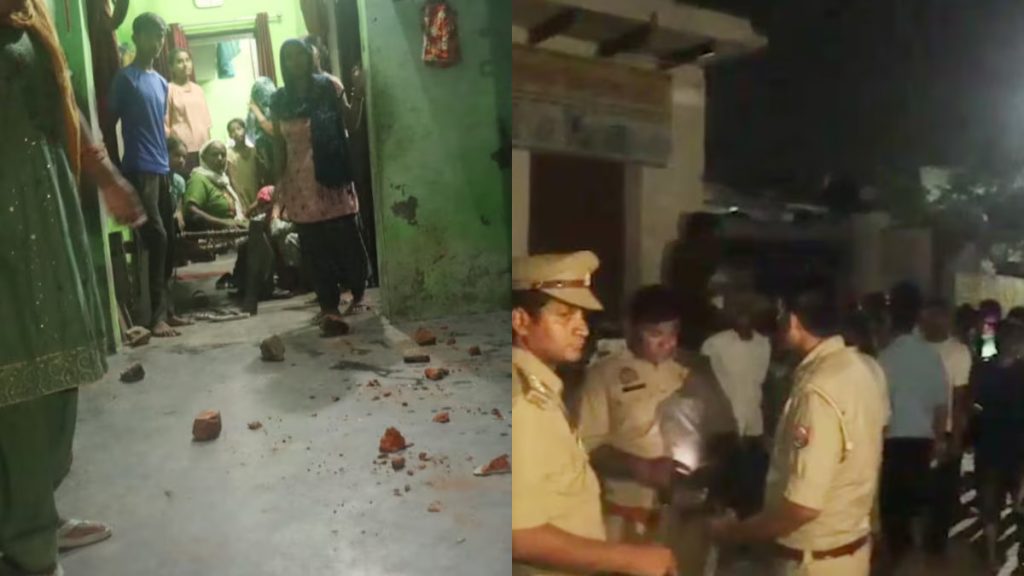
Fresh caste violence has erupted in Ghaziabad’s Masauta village, where Dalit and Rajput communities clashed on Sunday evening. Heavy stone-pelting broke out between the two sides, forcing police to rush additional forces to the area. The Provincial Armed Constabulary (PAC) has been deployed to maintain order, while several police teams remain stationed in the village. According to police, the tension began after a Dalit youth’s bike collided with a car carrying Rajput men on Saturday. The car occupants allegedly slapped the youth, sparking anger. Later, when the boy and his mother went to complain, they were allegedly beaten. This escalated into a larger confrontation between the two groups. “Stone pelting was reported around 8 pm. Our teams reached the spot quickly and managed to bring the situation under control,” said Acting Assistant Police Commissioner of Mussoorie, Amit Saxena. He added that CCTV footage from the village is being scanned to identify all those involved. Police have detained at least six people so far, and a case has been filed under multiple sections, including the SC/ST (Prevention of Atrocities) Act. Officials confirmed that Bhim Army leaders also reached the village, which further heightened tensions. Despite a heavy police presence, locals remain fearful of renewed violence. “We don’t feel safe. The situation is still tense, and we hope the authorities take strict action,” a villager who requested anonymity told media. Courtesy : TOP Note: This news is originally published on https:/theobserverpost.com/bha and is used purely for non-profit/non-commercial purposes, especially human rights
54 Rajputs tied and brutally attacked:Women gangraped, victims buried alive; Congress never regained Bihar Chief Ministership after the massacre

In the second episode of Dainik Bhaskar’s election series ‘Massacre’, today is the story of the Dalelchak Baghaura massacre, after which the Congress, which ruled Bihar for 40 years, could never make its CM again… One night of May 29, 1987. Location – Aurangabad district of Bihar. The same Aurangabad where the country’s only west-facing Sun Temple is located. A crowd of about 500 people was advancing, chanting the slogan ‘MCC Zindabad’. They had guns, axes, sickles, and cans of kerosene oil in their hands. After a while, everyone stopped at one place. They talked for a bit. Then half of them started moving towards Baghaura village and the other half towards Dalelchak. Both villages are one kilometer apart. Here, the Rajputs had dominance. Gaya Singh of Baghaura was the head clerk in the forest department. He had the only concrete house in the village. He had built it with passion. The eyes would stop at the gateway from afar. Around 8 PM, suddenly some noise was heard. When he opened the door and looked, a crowd of 200-300 people was standing in front. Gaya Singh hastily closed the door. They hadn’t even taken two steps when the crowd pushed and broke the door. First, the men of the house were dragged out and lined up. Meanwhile, two boys tried to escape unnoticed, but the attackers fired shots. Both fell right there. The attacker went near them. Their breaths hadn’t completely stopped yet. He struck a machete on the neck. Then, wiping his sweat, he said- ‘What are you looking at… go and bring their women.’ 20-25 attackers entered and started throwing women and children outside. Everyone was screaming- ‘Don’t kill us. Let us go. We beg you.’ One attacker spoke up- ‘#&#$% these people show a lot of arrogance. They make our women work. Dishonor their women in front of them. Only then will the revenge be complete.’ The attackers pounced on the women and girls. They tore their clothes. They began to rape them. After a while, a middle-aged man spoke up- ‘Enough. Now kill them all.’ The attackers dragged the women into the veranda. They placed their necks on the cot and pressed hard. One attacker picked up an axe and one by one beheaded the five women. Blood spread all over the veranda. The attacker said- ‘Dispose of them all.’ 8-10 people started digging a pit in front of the house with shovels. In a short time, the pit was ready. The attackers put the women’s bodies in the pit and filled it with soil. ‘Now tie these #@$%*& and take them to the banyan tree. The villagers should also see what happens when they clash with us.’ Hearing this, the attackers tied the hands and feet of Gaya Singh and his family members. They dragged them to the banyan tree. There was a large banyan tree at the beginning of the village. 30 May 1987, Dalelchak Baghaura village. Rajputs were killed by tying them to this banyan tree. Source: Library 30 May 1987, Dalelchak Baghaura village. Rajputs were killed by tying them to this banyan tree. Source: Library By now, there was chaos in the village. The attackers were dragging women, men, and children from Rajput families one by one to the banyan tree. Many people were jumping from the roofs and running towards the fields. The attackers were continuously firing. Some people were killed on the spot. A 40-year-old man was returning home with a tractor. Seeing the attackers, he screamed, ‘Oh uncle, we are not Rajputs. We work at their house. We are Harijans, Harijans.’ #$%@#$ Lying… saying this, a middle-aged man struck him on the back with an axe. Two attackers tied him to the seat of the tractor. Then they poured a can of kerosene oil on the tractor and set it on fire. Within minutes, the driver died in agony. Meanwhile, in the nearby village of Dalelchak, Kamla Kunwar had just returned from her in-laws’ house a few hours earlier. Her father was preparing for a feast. Guests had already arrived. Suddenly, the dogs started barking. Kamla said to her sister Lalita- ‘Go and see who is outside?’ Lalita peeked and saw hundreds of armed men advancing towards the village. She screamed- ‘Papa, Mummy, everyone run, the Naxalites have come.’ Both sisters, their parents, and other relatives started running towards the fields. Just then, the people next door stopped them. They said- ‘You people are not in any danger. Just hide in the house.’ Within minutes, the crowd stormed into the village. They entered the Rajputs’ houses and started a massacre. Kamla and Lalita hid in a pile of hay behind the house. The rest of the family and relatives were caught. A two-year-old child was sleeping on the bed. He started crying upon seeing the crowd. The attacker shouted – ‘Kill this bastard first.’ As soon as he heard this, a middle-aged man picked up the child and threw him on the threshold. His head split open. The attacker grabbed the child by the hair and lifted him. Another struck the child’s neck with an axe. The child’s head remained in the attacker’s hand, and the body fell to the ground. 30 May 1987, the children of the Dalelchak Baghaura massacre whose entire families were killed in the massacre. Source: Library 30 May 1987, the children of the Dalelchak Baghaura massacre whose entire families were killed in the massacre. Source: Library One pointed towards the women and said, ‘Violate their honor and finish them off.’ The attackers did just that. After raping, they beheaded the women and girls. Kamla’s father could not bear to see this. He charged at the attackers, cursing them, but they caught him. Two attackers held his legs and two held his arms. A 20-year-old boy struck him in the stomach with an axe. He screamed. Then the attacker shoved the butt of a gun into his mouth. Within minutes, he was writhing in
Opinion: We must talk about Savarna women’s complicity in caste violence

Dominant caste women are not a monolithic entity. Their engagement with caste may not be uniform. Some might be victims of it. Some are complicit in it. Some resist only the misogyny. But true liberation is possible only if they dismantle both caste and patriarchy. There appears to be a marked shift in the caste discourse after the brutal murder of Kavin Selvaganesh, a 27-year-old Dalit IT professional. Onus was placed on Subhashini, and suspicions were raised about her culpability. Her video, defending her parents’ innocence, garnered severe criticism. And she was chastised for her appeals to “drop” the issue, whitewashing the crime and failing to take a stance against the perpetrators. Many also questioned the Dravida Munnetra Kazhagam-led (DMK) state government’s ineffectual anti-caste politics and its general apathy towards Dalits. People shared their anxieties regarding the increase in violent caste pride among intermediate castes. On July 27, Kavin was brutally hacked to death in Tirunelveli for his relationship with Subhashini, a woman from the dominant Maravar caste. Kavin was an IT employee based in Chennai and was killed in broad daylight at KTC Nagar in Tirunelveli. Both victim and perpetrator The criticism of Subhashini deviated from how public narratives largely frame dominant caste women as victims of so-called honour killings. The murders of Dalit individuals who are in intercaste relationships are often referred to as ‘honour’ killings. The caste-supremacist view dictates that such relationships are a threat to the maanam (honour) of dominant communities. In a caste-punitive society, murder is wielded as a means to keep intercaste relationships in check and uphold caste endogamy. In many caste killings, the loss of life has been that of a Dalit man, either hacked to death in broad daylight like Shankar in 2016 or found dead on deserted railway tracks like Ilavarasan in 2013. Each of them was punished for being in love with dominant caste women. In 2016, V Shankar, a Dalit man, and his wife Kowsalya, who belongs to the Kallar caste, were brutally attacked in Tiruppur district. While Shankar succumbed to his injuries on the spot, Kowsalya survived despite her wounds. Kowsalya held firm and testified against her family, seeking justice for her husband. Events after the 2013 caste killing of Dalit youth Illavarasan in Dharmapuri district played out differently. Following the suicide of her father, Divya, Illavarasan’s partner, returned home to her mother. Divya is from the Vanniyar community. She succumbed to the pressures of a caste society a few days before Ilavarasan’s death. Kowsalya is now a fierce anti-caste activist, while Divya leads a quiet life, staying out of the limelight. However, both women were considered victims. The reason why Subhashini was held accountable by social media users is the changing perspectives of women’s roles in Tamil caste society. Dominant caste women are no longer regarded solely as victims but as active benefactors of the system. Several critiques even flipped the derogatory narrative of naadaga kaadhal (fake love), using it to describe how Subhashini cost Kavin his life. The term naadaga kaadhal was first used by the Pattali Makkal Katchi (PMK), a Vanniyar-majority party, to falsely accuse Dalit men of ‘luring’ dominant caste women. Vanniyars are categorised as Most Backward Class (MBC). There is no denying that caste, like patriarchy, oppresses all women. Both systems rob women of their autonomy, agency and personhood and fundamentally treat them as mere birthing vessels meant to further male and caste lineage. The practice of endogamous monogamy was institutionalised in order to ensure the idea of ‘purity’ in bloodlines. As a result, a woman’s freedom was curbed, and restrictions were placed to control who she can love and marry. Despite the knowledge that both patriarchy and casteism thrive on women’s subjugation, dominant caste women’s critique and opposition have been uneven. While women from all quarters put up a fierce fight to dismantle patriarchy, the struggle against casteism is largely led by Dalit women. Many dominant caste women content themselves with tepid criticisms. This is because the hierarchical and gradational nature of caste offers them considerable privilege. A privileged caste position provides women with social and cultural capital that their gender identity does not. Caste privilege helps them navigate patriarchal hurdles and even reap some extra benefits along the way. Challenging portrayals of Savarana women in cinema Mari Selvaraj’s portrayal of dominant caste women in his films offers insightful examples of how such caste privilege works. In director Mari Selvaraj’s Maamannan (2023), Rathnavel’s (Fahadh Faasil) wife Jyothi (Raveena Ravi) is docile and subservient. She, quite literally, has a silent presence in the film, as she has no dialogues. Despite being confined to her house for the most part, she ultimately bags a seat at the Legislative Assembly, clearly a fruit of her dominant caste status. One can argue that she stands in the election only at her husband’s bidding and is a puppet in his hands, calling attention to her oppression as a woman. Nevertheless, it is undeniable that her path to power is relatively easier and not as arduous as that of the film’s eponymous Dalit protagonist (Vadivelu). His life and dignity and that of his family’s are perpetually at stake. A reading like this might go against the grain of what the director believes in and wants to convey. Mari, in many of his interviews, maintains the conviction that women are hapless victims and that their victimisation by patriarchy is worse than the caste marginalisation faced by a man. Regardless of his position, due to the realistic tenor of his films, the caste privilege of dominant caste women is apparent in the upper hand they have over Dalit men. Take, for instance, Jo (Anandhi) from Pariyerum Perumal (2018). When the dominant caste Jo falls in love with Pariyan (Kathir), she has the freedom and space to be honest about her feelings and express them boldly. On the other hand, Pariyan, a first-generation Dalit law student, is attacked multiple times to force upon him the realisation that he is forbidden
4 years’ jail for AAP MLA in Dalit woman assault case

TARN TARAN: A court in Punjab’s Tarn Taran district sentenced Manjinder Singh Lalpura, AAP MLA from Khadoor Sahib, to four years in prison in a 12-year-old case of assault and molestation of a Dalit woman. On Wednesday, the court had convicted 11 people, including six policemen, in the case. Pronouncing the sentence on Friday, additional sessions judge Prem Kumar awarded four-year jail term to Lalpura and six others, while three accused were sentenced to one-year imprisonment each. One of the accused, Harvinder Singh, currently lodged in Delhi’s Tihar Jail, did not appear in the court and his sentencing is scheduled on Sept 16. Another accused, Paramjit Singh, died during the trial. “The court also imposed a fine of Rs 50,000 on each of the accused and directed that compensation be paid to the victim as per the law,” the survivor’s lawyer, Amit Dhawan, said. Following the pronouncement of the sentence, the MLA was taken into custody and sent to jail. On Sept 4, 2013, a taxi driver and a few other men assaulted and molested a 19-year-old woman when she and her family members were attending a wedding. A police team that arrived at the scene also assaulted the woman. Courtesy : TOI Note: This news is originally published on https:/timesofindia.com/bha and is used purely for non-profit/non-commercial purposes, especially human rights
UP Dalit woman accuses 5, including ex-Army solider of harassment

At one instance, the former soldier drag the woman into a field with the intention of raping. When she screamed for help, he ran away. A Dalit woman hailing from the Valmiki community in Aligarh’s Kotwali area of Uttar Pradesh has accused five individuals, including a retired Army soldier, of assault, molestation and death threats. In her complaint, she stated that her family is constantly pressured to leave the village. According to the Dalit woman, her mother-in-law had purchased a plot and built a house. However, a few members from the upper caste tried to construct a passage by placing shutters near her gate, even though an alternative route was available. The woman accused the retired Army soldier, Yogendra Singh, of repeated harassment and attempted rape. “He has beaten me and molested me several times. He often peeps into my house without shame. On March 8, when I went to cut fodder in the forest, he tried to drag me into a field with the intention of raping me. I screamed, and nearby farmers rushed to help. He fled, threatening to kill me,” her complaint said. He currently serves in the Provincial Armed Constabulary (PAC) in Agra. When her husband tried to oppose the harassment, Singh and his son Dushyant barged into her house with a pistol and threatened to kill him. A case has been registered under the SC/ST Act against Yogendra Singh, Dushyant Singh, Anita, Aarti, and Shivcharan. Posted by Veena Nair Courtesy : TSD Note: This news is originally published on https:/thesiasatdaily.com/bha and is used purely for non-profit/non-commercial purposes, especially human rights.
Police cooked up theft case to frame dalit woman, finds crime branch
Thiruvananthapuram: Amidst mounting outrage over police excesses in the state, the crime branch’s findings in the Peroorkada false theft case — in which dalit domestic worker Bindu R was falsely accused of stealing a gold chain from her employer’s house and detained at the police station for nearly 20 hours in April — could further dent the already “battered” image of the force. The crime branch’s report in the case suggests that Peroorkada police had deliberately constructed the theft narrative to implicate Bindu and justify her arrest and detention. It is reliably learnt that Pathanamthitta crime branch DSP K A Vidyadharan, who took over the investigation following a state human rights commission order that an officer of DSP rank from outside the district should look into the incident, concluded in his report that no theft had taken place at the residence of complainant and Bindu’s employer Omana Daniel. According to the report, the “stolen” gold chain was recovered from inside the complainant’s own residence. The complainant, who reportedly suffers from memory loss, had misplaced the ornament inside the house, but police maintained that it was recovered from a garbage heap outside the premises. The report is also learnt to have recommended action against then Peroorkada station house officer R Sivakumar, who has been transferred, and Omana. Bindu had alleged that she was subjected to inhuman treatment, including denial of food and drinking water, during her detention. She also said officers had coerced her into confessing to the theft by threatening to implicate her two minor daughters and husband. Her plight had sparked outrage, with rights activists alleging a caste bias. Sub-inspector S G Prasad and ASI Prasannan were earlier suspended from service for the incident. Courtesy : TOI Note: This news is originally published on https:/timesofindia.com/bha and is used purely for non-profit/non-commercial purposes, especially human rights.