
Ram temple donations case: All eight accused sent to 14-day judicial custody
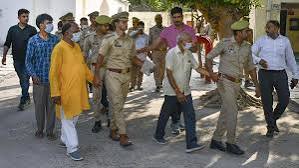
The accused were produced before Special Judge, Anti-Corruption Court, Rajat Verma, through video conferencing from the district jail, after the expiry of their three-day judicial custody. LUCKNOW: All eight accused arrested in connection with the alleged embezzlement of donation funds at Ram temple were, on Monday, remanded to 14-day judicial custody by a local court, case officials said. The accused were produced before Special Judge, Anti-Corruption Court, Rajat Verma, through video conferencing from the district jail, after the expiry of their three-day judicial custody, Special Prosecution Officer Umesh Dubey said. Dubey said that the district police did not apply for the custody of the accused. The eight accused — Ram Shankar Yadav alias Tinnu, Anukalp Mishra, Avinash Shukla, Karunesh Pandey, Manish Yadav, Lavkush Mishra, Ram Shankar Mishra and Subhash Srivastava—earlier been remanded to three days’ judicial custody till Monday by a special remand magistrate. The case has been posted for next hearing on July 13. Namita Bajpai Courtesy : TNIE Note: This news is originally published on https:/thenewindianexpress.com/bha and is used purely for non-profit/non-commercial purposes, especially human rights
Dalit vote at centre of UP parties’ organisational overhaul ahead of 2027 polls
Congress, BJP, SP and BSP are reshaping their leadership structures as the battle for Scheduled Caste voters intensifies ahead of the Assembly election. As Uttar Pradesh heads towards the 2027 Assembly elections, political parties have begun fighting the first battle long before campaigning begins—through organisational restructuring. While the Congress has appointed Dalit leader R.P. Gautam as its Uttar Pradesh in-charge, the BJP has carried out a sweeping overhaul of its state unit by replacing all six regional presidents and appointing a new caste-balanced leadership team. The Samajwadi Party continues expanding its PDA network, while the Bahujan Samaj Party (BSP) has reshuffled its organisational hierarchy under Mayawati. Together, the moves underscore how every major party is recalibrating its leadership to reflect Uttar Pradesh’s intricate caste and regional equations in a state where Dalit votes could prove decisive in determining power. Why Is the 2027 UP Election More Than an Electoral Contest—A Battle for Dalit Votes? The renewed emphasis on Dalit representation follows the political message delivered by the 2024 Lok Sabha elections. The BJP’s tally in Uttar Pradesh fell from 62 seats in 2019 to 33, while the Samajwadi Party emerged as the largest party in the state with 37 seats and the Congress won six, giving the INDIA bloc a significant boost. More importantly, the BJP’s dominance in Scheduled Caste-reserved constituencies weakened as it won only eight of the state’s 17 reserved Lok Sabha seats, down from 14 in 2019. Equally significant was the BSP’s electoral setback, with Mayawati’s party once again failing to open its account in Uttar Pradesh, repeating its 2014 performance. Once the undisputed political voice of Dalits, the BSP has seen its support fragment over the past decade, with sections of Jatav voters remaining with the party while many non-Jatav Dalits shifted towards the BJP and, more recently, the SP-led INDIA alliance. The BSP’s electoral decline has intensified competition for Dalit votes, encouraging every major party to aggressively target both Jatav and non-Jatav Scheduled Castes ahead of the 2027 Assembly elections. With Scheduled Castes constituting nearly 21 per cent of Uttar Pradesh’s population and influencing electoral outcomes in well over 150 Assembly constituencies, organisational appointments have become almost as politically significant as candidate selection. Every major party is now attempting to balance caste identity, regional representation and social influence within its organisational structure. Congress Bets on a Dalit Face The latest move has come from the Congress, which appointed senior Dalit leader R.P. Gautam as its Uttar Pradesh in-charge, replacing Avinash Pande. Gautam, regarded as an experienced organisational hand, is expected to spearhead the party’s preparations for the 2027 Assembly elections while strengthening its outreach among Scheduled Castes. The appointment is widely seen as an acknowledgement that Dalit politics in Uttar Pradesh has entered a new phase following the BSP’s decline. By placing a Dalit leader in charge of its largest electoral battleground, the Congress hopes to complement its alliance strategy with the Samajwadi Party while simultaneously rebuilding its independent organisational base. BJP’s Organisational Reset If the Congress has sought to send a political message by appointing R.P. Gautam, the BJP has responded with one of its most extensive organisational overhauls in recent years. Following its disappointing performance in the 2024 Lok Sabha elections, the BJP replaced all six regional presidents of its Uttar Pradesh unit while appointing 19 vice-presidents, eight general secretaries and several new office-bearers, carefully balancing caste representation and regional aspirations. The six regional chiefs themselves reflect the BJP’s social engineering strategy. Nawab Singh Nagar (Gujjar) has been appointed for western Uttar Pradesh, Puran Lal Lodhi (Lodhi OBC) for Braj, Ram Kishore Sahu (Sahu OBC) for Kanpur-Bundelkhand, Avadhesh Dwivedi (Brahmin) for Awadh, Ashok Chaurasia (OBC) for Kashi and Vinod Rai (Bhumihar) for Gorakhpur. The revamped organisation accommodates leaders representing Dalit, OBC, upper-caste and regional communities, reflecting the BJP’s effort to broaden its social coalition after the 2024 setback. The organisational restructuring complements the BJP’s representation in government through ministers such as Baby Rani Maurya, Asim Arun, Dinesh Khatik and Gulab Devi, while continuing targeted outreach among non-Jatav Dalit communities including Pasi, Valmiki, Kori and Khatik through welfare schemes, social outreach programmes and grassroots mobilisation. SP Strengthens PDA Coalition The Samajwadi Party, meanwhile, continues to reorganise its structure around Akhilesh Yadav’s PDA (Pichhda, Dalit, Alpsankhyak) formula. The party has consciously increased the representation of Dalits and Extremely Backward Classes in district organisations, frontal units and candidate selection while expanding beyond its traditional Muslim-Yadav support base. The strategy paid dividends in the 2024 Lok Sabha elections, when the SP won seven of Uttar Pradesh’s 17 Scheduled Caste-reserved parliamentary constituencies. Since then, the party has consistently appointed office-bearers from backward and Dalit communities while making caste census, reservation and social justice central themes of its campaign for 2027. BSP Seeks to Reclaim Dalit Base Although the BSP suffered another major setback by failing to win a Lok Sabha seat in Uttar Pradesh in 2024, political observers believe writing off the party would be premature. The BSP still retains a committed cadre, strong booth-level organisation in several districts and an emotional connect among a sizeable section of its traditional Jatav support base. Recognising the need for organisational revival, BSP chief Mayawati has repeatedly reshuffled state office-bearers, zonal coordinators and district presidents while restoring her nephew Akash Anand as the party’s national coordinator. The BSP continues to strengthen its booth-level network by appointing coordinators from different Scheduled Caste sub-groups and OBC communities across western, central and eastern Uttar Pradesh. Unlike the BJP’s welfare-centric politics or the SP’s PDA narrative, the BSP continues to rely on Ambedkarite ideology and the legacy of Kanshi Ram and Mayawati. The party hopes to retain its loyal Jatav vote while reconnecting with non-Jatav Dalits who shifted towards rival parties over the last decade. The emergence of Nagina MP Chandrashekhar Azad as an independent Dalit voice has further diversified Dalit politics in Uttar Pradesh, particularly among younger voters, adding another layer to the competition for the community’s support. Even if the BSP does
Congress claims SBI had sought removal of officials posted at Ram Temple’s donation counting centre three months ago

Congress leader Pawan Khera said the donation theft, for which eight people have been arrested so far by the Uttar Pradesh police, was only a glimpse, and more such cases were yet to come. The Congress on Monday targeted Prime Minister Narendra Modi and Uttar Pradesh Chief Minister Yogi Adityanath over the alleged irregularities in the handling of donations and offerings made by devotees at the Ram Temple in Ayodhya. Speaking to reporters in Raipur, Pawan Khera, Chairman (Media and Publicity Department), AICC, claimed that the State Bank of India had recommended the removal of officials posted at the temple’s donation counting centre three months ago, and sought to know who were protecting them. He said the alleged donation theft at the Ram Temple, for which eight people have been arrested so far by the Uttar Pradesh police, was only a glimpse, and more such cases were yet to come. “Ayodhya ki loot jhanki hai, Kashi-Mathura abhi baaki hai (the alleged loot in Ayodhya was only a glimpse, Kashi and Mathura were yet to come),” he said. Khera said the UP CM should be asked whether bulldozer action will be taken against the RSS or the Prime Minister’s Office (PMO) over the embezzlement of funds at the temple. “The RSS and PMO were directly looking after the Ram Mandir administration. Ask Adityanath, if there has been wrongdoing there, will bulldozers be sent to RSS chief Mohan Bhagwat’s residence or to PMO? Just ask him this question and he will have no answer,” he said. Khera claimed the State Bank of India (SBI) three months ago recommended the removal of officials posted at the donation counting centre at the shrine. “SBI had recommended three months ago that those posted at the counting centre be removed. Who has been protecting them? Nagpur or Delhi?” the Congress leader asked. In reply to a question, he said the United States was “insulting India every day” while Prime Minister Narendra Modi was maintaining silence. “Modi ji should give us a list of those he is afraid of and those he is not,” he quipped. On the reported move by the new BJP government in West Bengal to bring a bill on Uniform Civil Code (UCC), Khera alleged such issues were being raised to divert people’s attention from the Ram Mandir donation theft case. “The purpose (of UCC bill) is only to change the headlines and divert attention from what is happening in the name of Lord Ram in Ayodhya,” he claimed. Khera was in Raipur to address the last day of a ten-day training camp of the Chhattisgarh Congress organised for district unit presidents in the Abhanpur area. Courtesy : TNIE Note: This news is originally published on https:/thenewindianexpress.com/bha and is used purely for non-profit/non-commercial purposes, especially human rights
Independent probe sought for custodial death of Dalit woman in AP

Mala Gangamma died on May 31 after suffering torture in the hands of the Special Investigation Team (SIT) constituted to probe the disappearance of her son, Veerendra, in November 2024. Andhra Pradesh: Human Rights Forum (HRF) and the Indian Federation of Trade Unions (IFTU) have demanded an independent enquiry over the alleged custodial death of a 40-year-old Dalit woman in Andhra Pradesh’s Kurnool district in May this year. Mala Gangamma died on May 31 after suffering torture in the hands of the Special Investigation Team (SIT) constituted to probe the disappearance of her son, Veerendra, in November 2024. The Dalit woman had approached the Andhra Pradesh High Court seeking justice. The SIT was made on the directions of the court. It was headed by then Guntur Additional Superintendent of Police (ASP) K Supraja. According to HRF and IFTU, Gangamma was allegedly tortured and forcefully confessed that she and her partner, Malla Durgayya, murdered her son, as he reportedly opposed their relationship. HRF and IFTU stated that the couple were subjected to third-degree torture, leading to Gangamma’s death, while Durgayya continues to battle for his life at the Kurnool Government Hospital. They questioned why Gangamma’s burial was conducted in the presence of 20 to 30 police personnel, and why Durgayya’s relatives were disallowed from meeting him in the hospital. Apart from an independent, impartial examination, the organisations have demanded a fresh post-mortem examination of Gangamma’s body, and the registration of criminal cases, including murder charges and relevant provisions of the Scheduled Castes and Scheduled Tribes (Prevention of Atrocities) Act, against police personnel found responsible. Courtesy : TSD Note: This news is originally published on https:/thesiasatdaily.com/bha and is used purely for non-profit/non-commercial purposes, especially human rights
Janseva Dal to contest 403 assembly seats: In Aligarh, the party stated, “We no longer want votes, but equal rights to power.”

The Janseva Dal in Aligarh has announced its intention to contest all 403 seats in Uttar Pradesh ahead of the upcoming assembly elections. The party held a public meeting at Jupiter Lodge on ITI Road on Sunday evening, June 28, 2026, targeting mainstream political parties. Party National President Vinesh Thakur (Karpoori) alleged that while the votes of the most backward, most Dalit, and working-class castes form governments, they do not receive equal rights to power and respect. Vinesh Thakur stated that since independence, the Nai, Sen, Savita, Pal, Baghel, Prajapati, Kashyap, Nishad, Mallah, Saini, Kushwaha, Kori, Khatik, Valmiki, Dhobi, Tailor, and other working-class communities have been considered merely vote banks. He explained that promises are made during elections, but these communities have consistently been neglected in ticket distribution, government positions, and political participation. The National President of the Jan Seva Dal announced that his party is preparing to contest all 403 assembly seats in Uttar Pradesh. He clarified that candidates will be fielded from among the marginalized communities. Vinesh Thakur emphasized that this community will no longer be dependent on the mercy of any party, but will gain a share of power based on its political strength. Speakers at the meeting also mentioned Karpoori Thakur’s model of social justice. They questioned the governments’ intentions in not implementing the backward and extremely backward classifications. A state-wide public awareness campaign was also announced on this occasion. The program was chaired by District President Ramnaresh Singh, who reiterated his commitment to strengthening the organization down to the booth level. A large number of workers and officials from various social organizations attended the public meeting. The Jan Seva Dal also raised slogans like “Hand-made artisans will form the government” and “It’s not a caste, it’s a community; all the most backward are together,” reflecting their political warning. Naresh Pratap Singh | Kol Courtesy: Hindi News
Dalit girl raped in Ballia, youth arrested
Ballia: Under the direction of Superintendent of Police Omveer Singh, the Revati police station has achieved success in the ongoing campaign against crime and criminals. On June 24th, based on the complaint of the plaintiff, the police registered a case under the rape, POCSO Act, and SC/ST Act. Station House Officer Anupam Jaiswal, along with Constables Shailesh Kumar and Karan Yadav, were on duty in the area. Meanwhile, Kanak Soni alias Makhan Soni, son of Surendra Soni (resident of Revati Ward No. 3, Town Police Station, Revati, Ballia), accused under sections 65(1), 351(3) IPC, 3(2)V, 3(2)VA of the SC/ST Act, and 3(2) of the POCSO Act, was arrested near the crossing near Khedan Square. Courtesy: Hindi News
SPECIAL | Rahul Gandhi weighs bigger role for Charanjit Singh Channi as Punjab Congress eyes Dalit, Sikh and Hindu vote balance ahead of 2027
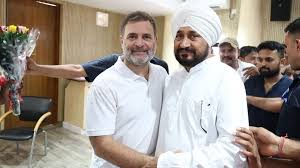
Sources familiar with the deliberations said the leadership, under Rahul Gandhi, is examining a formula that combines social representation with organisational stability. The Congress high command is learnt to be considering one of its biggest organisational exercises in Punjab since the 2022 Assembly election, with discussions indicating that former Chief Minister and Jalandhar MP Charanjit Singh Channi could be entrusted with a larger role in the state unit as part of a broader strategy to rebuild the party before the 2027 polls. According to party sources, the proposed restructuring goes far beyond a routine leadership change. The exercise is understood to be aimed at creating a carefully balanced organisational structure that gives representation to Punjab’s three most significant electoral segments, Dalits, Jat Sikhs and urban Hindu voters, while ensuring that senior leaders continue to remain politically relevant within the organisation. Sources familiar with the deliberations said the leadership, under Rahul Gandhi, is examining a formula that combines social representation with organisational stability. Alongside the appointment of a new state leadership, key election-related responsibilities, including campaign management, coordination, manifesto preparation and organisational planning, are also expected to be distributed among experienced leaders in an effort to minimise factionalism ahead of the Assembly election. Dalit vote bank at the centre of Congress calculations Political observers believe the reported move is primarily driven by Punjab’s unique social composition. Punjab has the highest proportion of the Scheduled Caste population among all Indian states, with Dalits accounting for nearly 32 per cent of the state’s population. The community plays a decisive role not only in the 34 Assembly constituencies reserved for Scheduled Castes, but also influences electoral outcomes in dozens of general seats across Doaba, Malwa and parts of Majha. Within the Congress, Channi is regarded as the party’s most recognisable Dalit Sikh leader. His tenure as Punjab’s first Dalit Chief Minister and his victory from the Jalandhar Lok Sabha constituency in the 2024 parliamentary election have strengthened perceptions within the party that he continues to enjoy considerable political acceptability among sections of Dalit voters. Party strategists are believed to feel that projecting a strong Dalit face at the organisational level could help the Congress regain a section of the traditional support base that has shifted towards rival political parties over the past several years. Balancing the Jat Sikh leadership is equally important Even as the Congress attempts to consolidate Dalit voters, the party is understood to be equally cautious about maintaining its influence among Punjab’s politically dominant Jat Sikh community. Although Jat Sikhs constitute an estimated 20 to 22 per cent of Punjab’s population, they continue to exercise significant political influence across rural constituencies, particularly in the Malwa region, which sends the largest number of MLAs to the Assembly. Party insiders believe any organisational restructuring that overlooks this influential community could create fresh internal challenges. Consequently, discussions are said to include assigning major organisational and election-management responsibilities to senior Jat Sikh leaders, allowing them to continue playing a central role in shaping the party’s campaign strategy while maintaining social equilibrium within the organisation. Urban Hindu voters also part of the strategy Another important element of the reported formula is the urban Hindu electorate. According to the 2011 Census, Hindus account for nearly 38.5 per cent of Punjab’s population. However, political strategists generally estimate that the decisive urban Hindu voting bloc constitutes around 25 to 26 per cent of the electorate and significantly influences election results in cities such as Ludhiana, Amritsar, Jalandhar, Patiala, Pathankot and several municipal centres. Congress leaders are believed to be exploring ways to ensure adequate organisational representation for leaders who enjoy influence in urban constituencies, thereby broadening the party’s appeal beyond its traditional rural support base. Lessons from the 2022 defeat The reported restructuring also reflects the Congress leadership’s assessment of the mistakes made during the 2022 Punjab Assembly election. The party had projected Channi as its chief ministerial face only a few months before polling. However, persistent factionalism, competing leadership centres, and organisational disunity overshadowed the campaign, reducing the Congress to 18 seats in the 117-member Assembly, while the Aam Aadmi Party secured a landslide victory. Many within the party now believe that social representation alone cannot deliver electoral success unless it is backed by organisational unity, clearly defined responsibilities and coordinated campaigning. 2024 Lok Sabha performance revives confidence The Congress’s improved performance in the 2024 Lok Sabha election, in which it won seven of Punjab’s 13 parliamentary seats, has reportedly prompted the central leadership to accelerate organisational restructuring well before the next Assembly polls. Party leaders are believed to view the parliamentary results as evidence that the Congress continues to retain substantial support in Punjab despite its defeat in the previous Assembly election. The leadership now appears keen to convert that momentum into a stronger organisational framework capable of sustaining a statewide campaign. Social engineering before 2027 Political analysts believe Congress is attempting to build a broader electoral coalition rather than relying on any single community. The reported strategy seeks to combine the electoral strength of Punjab’s nearly 32 per cent Dalit population, the politically influential 20-22 per cent Jat Sikh community, and the decisive urban Hindu electorate that plays a crucial role in several Assembly constituencies. If implemented successfully, such a leadership structure could allow the party to simultaneously target multiple voter segments while reducing internal friction among senior leaders. Unlike previous organisational changes that largely focused on individual appointments, the latest exercise appears to be centred on building a leadership model designed around Punjab’s electoral arithmetic and social realities. Although speculation over the proposed changes has intensified, Congress has not made any official announcement regarding the restructuring. The final shape of the Punjab unit is expected to emerge only after the party leadership completes its internal consultations. With less than a year and a half left before political activity gathers full momentum for the 2027 Assembly election, the decisions taken by the Congress in the coming weeks could play a significant role in determining whether
ASP Appointed To Probe Deaths Of Dalit Youths

The police appealed to Dalit organisations, including those led by Mandakrishna Madiga, to call off their proposed protest in view of the ongoing inquiry Maidakur DSP S. Rajendra Prasad on Sunday said an IPS officer had been appointed to inquire into the deaths of two Dalit youths, who were found dead in a canal at Brahmamgari Matham on February 5, 2026. Addressing a press conference in Maidakur, the DSP said the incident had sparked suspicion among Dalit organisations, which alleged foul play and claimed justice had not been delivered. The organisations had also proposed a ‘Chalo Kadapa’ protest to press their demands Responding to their demand for a higher-level inquiry, Kadapa SP Nachiket Vishwanath appointed Proddatur ASP Vibhu Krishna as the inquiry officer. The DSP said Dalit leaders had also raised doubts over whether the FIR had been registered in accordance with legal procedures. He added that a video recorded by a witness who accompanied the deceased had been sent to the Forensic Science Laboratory (FSL) for analysis. Meanwhile, the police appealed to Dalit organisations, including those led by Mandakrishna Madiga, to call off their proposed protest in view of the ongoing inquiry. 2 engg students drown at beach Two first-year engineering students drowned at Bhavanapadu beach in Srikakulam district on Sunday after being caught in strong sea currents. The victims were identified as S. Yeshwanth, 18, and G. Agastima, 18. According to reports, they were part of a group of students from a private engineering college who had visited the beach. While bathing, the two were swept into deep waters by strong currents and drowned. Agriculture minister K. Atchennaidu expressed shock over the incident and conveyed his condolences to the bereaved families. Describing the tragedy as heartbreaking, he directed officials to extend all possible assistance and ensure necessary support to the families of the deceased. 32 fall ill after eating roadside snacks Thirty-two persons were admitted to the Primary Health Centre at Dugguduru in Kajuluru mandal after they allegedly suffered food poisoning from eating snacks purchased from roadside vendors. Officials said the victims consumed the snacks on Friday evening and began reporting to the hospital from Saturday. More patients were admitted on Sunday, while some were discharged after treatment. Officials said around 60 others were reportedly undergoing treatment at private hospitals. Medical and health department officials rushed to the village and treated the affected persons. Kakinada district medical and health officer D.N. Naick visited the hospital and reviewed the condition of the patients. He said the patients were recovering. Courtesy : Deccan Chronicle Note: This news is originally published on https:/deccanchronicle.com/bha and is used purely for non-profit/non-commercial purposes, especially human rights
Two-day Dalit writers’ conference concludes in Jaipur

Jaipur: A two-day state-level Dalit Writers’ Conference, jointly organised by Pranjal Sahitya Akademi, Jaipur, and Rajasthan Sahitya Akademi, Udaipur, concluded Sunday at the Mata Ramabai Auditorium of the Dr Ambedkar Memorial Welfare Society. The conference featured poetry recitals by writers from across Rajasthan, who presented works centred on the vision of an egalitarian society. Courtesy : TOI Note: This news is originally published on https:/timesofindia.com/bha and is used purely for non-profit/non-commercial purposes, especially human rights
Maharashtra postpones TET 2026 on eve of exam after suspected paper leak; CM orders SIT probe

The breach came to light early on Saturday, when police acted on confidential intelligence regarding individuals possessing unauthorised information about the examination papers. The Maharashtra Teacher Eligibility Test (TET) 2026, scheduled to be conducted on Sunday, has been postponed after a leaked question paper was found during a raid in Thane’s Bhiwandi, just a day before the exam. As the development which affected around six lakh candidates followed the national scandal caused by the last month’s leak of the NEET-UG paper, Opposition leaders trained their guns on the BJP-led government, saying it was busy breaking political parties instead of ensuring foolproof examinations. Chief Minister Devendra Fadnavis ordered the constitution of a Special Investigation Team headed by Thane Joint Commissioner of Police Panjabrao Ugale to probe the paper leak, sources said. Fadnavis spoke to School Education Minister Dada Bhuse and state Director General of Police Sadanand Date and asked them to take strict action against the culprits, they added. The exam was scheduled to be conducted at 1,028 centres across the state on Sunday. The authority said that will be conducted in 37 places and 1028 exam centres across Maharashtra. In an official statement issued on Saturday, the Maharashtra State Examination Council said the test has been postponed to maintain the “transparency and the integrity” of the examination process. “The rescheduled examination date will be declared in the next two to three days,” said Priya Shinde, deputy commissioner of Maharashtra State Examination Council. The breach came to light when the Bhiwandi police, acting on a tip-off, conducted a raid at the Diamond Hotel in Bhiwandi in the early hours of Saturday. During the raid, the police found the leaked question papers of the exam in the possession of some individuals. Officials from the Maharashtra State Examination Council were immediately summoned to verify the material. Upon close inspection, it was confirmed that several questions in the possession of the suspects matched the actual question paper drafted for the June 2026 TET. Subsequently, the authorities announced the cancellation of the exam and a criminal case was registered at the Bhiwandi Police Station. Three people have been arrested so far in connection with the incident. The suspects were nabbed from the Sahar airport in Mumbai and police are investigating how they got the exam papers, along with their money transactions. Last year also a similar incident was reported from Kolhapur where the TET question paper was allegedly leaked. Slamming the repeated irregularities in examinations, Maharashtra Congress president Harshvardhan Sapkal on Saturday alleged that the BJP-led state government was busy in poaching MLAs and MPs instead of prioritising the future of the youth. He also stated that the Congress will launch a massive protest if the perpetrators are not brought to justice. “If the BJP government fails to take strict actions and find out the source of the leak, then the Congress party will come out on the streets. They (BJP government) cannot even conduct an exam in a proper manner. The BJP is playing with the future of the students,” Sapkal said. Sudhir Suryawanshi Courtesy : TNIE Note: This news is originally published on https:/thenewindianexpress.com/bha and is used purely for non-profit/non-commercial purposes, especially human rights