
Tension in UP Village After Dalit Women Object to Maharana Pratap Jayanti Procession Route

Tension briefly prevailed in Maheshpura village on Saturday after members of the Dalit community, especially women, allegedly objected to a procession being taken out on the occasion of Maharana Pratap Jayanti and blocked its route. According to police officials, the disagreement took place over the path of the procession, leading to a standoff between two groups in the village. Police said the situation was later brought under control after talks between both sides and a written agreement reached in the presence of authorities. Police deny reports of violent clash Superintendent of Police (City) Manush Pareek said reports claiming that a violent clash had taken place were “completely misleading.” He said, “A disagreement had arisen between two groups regarding the procession route, but the matter was resolved peacefully through dialogue.” After receiving information about the dispute, Station House Officer Satish Kumar reached the village along with a heavy police force. Officials said the protesting women and villagers initially refused to allow the procession to move forward, leading to heightened tension in the area. Police first tried to convince both sides at the spot. However, as the disagreement continued, representatives from both groups were later called to the police station for discussions. Agreement reached after negotiations According to police, prolonged negotiations were held between both parties before a written compromise was reached around 1 pm. SP Pareek said the agreement was achieved “in an atmosphere of mutual coordination and harmony.” Following the settlement, the procession resumed around 5 pm on its scheduled route and concluded peacefully by around 7 pm. Situation under control Police said the situation in the village remains peaceful and under control. Additional security personnel were deployed during the procession to prevent any untoward incident. Authorities have not reported any injuries or arrests in connection with the dispute. Courtesy : TOP Note: This news is originally published on https:/theobserverpost.com/bha and is used purely for non-profit/non-commercial purposes, especially human rights
High command yet to decide on Kerala CM amid intense factional campaigns

Poster wars, public demonstrations and hectic consultations in Delhi intensify as Congress leadership moves closer to announcing Kerala’s next chief minister The suspense over Kerala’s next Chief Minister persisted on Saturday as Congress leaders held an extended round of discussions in New Delhi, but no final decision emerged from the meeting. Sources said senior leader Rahul Gandhi reprimanded the leaders over the public show of factionalism, warning that the unrest was tarnishing the party’s massive electoral mandate. The chief ministerial deadlock remained unresolved even after top leaders held nearly three hours of discussions with the frontrunners. According to sources, Rahul Gandhi was unhappy that the lobbying for the top post had begun almost immediately after the election results, saying the leaders could not wait even a few days for the high command’s decision. He also urged the leaders to rein in workers and end internal divisions. AICC general secretary and Congress state in-charge Deepa Dasmunshi told reporters that deliberations on the leadership issue were still ongoing. She confirmed that all Congress MLAs had signed a one-line resolution authorising the high command to take the final call on who will lead the new United Democratic Front (UDF) government in Kerala. Deepa Dasmunshi said the ultimate decision will be made by Congress president Mallikarjun Kharge and senior leader Rahul Gandhi. The crucial discussions in Delhi are reportedly nearing it’s end after intense lobbying, public campaigns and internal consultations within the Congress-led United Democratic Front (UDF) following its sweeping Assembly election victory. The high-level meeting, which commenced at 4 pm at the residence of Congress president Mallikarjun Kharge, is being attended by senior leaders Rahul Gandhi, V D Satheesan, K C Venugopal, Ramesh Chennithala and KPCC chief Sunny Joseph. AICC observers Mukul Wasnik and Ajay Maken, who submitted their report to Kharge on Friday after consulting MLAs and alliance partners, are also participating in the deliberations. The leadership question has triggered visible factional mobilisation across Kerala, with supporters of senior Congress leaders V D Satheesan, K C Venugopal and Ramesh Chennithala openly campaigning for their respective leaders through posters, flex boards, road shows and demonstrations. Senior Congress leader K Muraleedharan on Saturday indicated that the decision-making process in New Delhi had entered its final phase. “The information from Delhi is that discussions on the chief ministerial candidate will be completed within 24 hours,” Muraleedharan told reporters in Thiruvananthapuram. However, he cautioned that public displays of support alone would not determine the leadership issue. “Flex boards and demonstrations cannot decide who becomes Chief Minister. I conveyed the sentiments of the people from my constituency to the party leadership,” he said, adding that seniority was not the only criterion and that the opinions of coalition partners and MLAs would also be taken into account. The Congress-led UDF registered a decisive victory in the Assembly elections, winning 102 of the 140 seats, while the Left Democratic Front (LDF) was reduced to 35 seats and the BJP secured three constituencies. Following the victory, the Congress Legislature Party had passed a resolution authorising the All India Congress Committee (AICC) leadership to decide the next leader of the legislature party, effectively handing the final call to the party high command. The focus has now shifted entirely to New Delhi, where senior Kerala Congress leaders, including Satheesan, Chennithala and KPCC president Sunny Joseph, arrived on Friday night for consultations with the central leadership. Sunny Joseph said a key meeting involving the top contenders would be held at Congress president Mallikarjun Kharge’s residence and expressed hope that a consensus would emerge quickly. “We expect a quick decision. The matter has been completely left to the AICC leadership,” he said. At the same time, Joseph appealed to party workers to refrain from public demonstrations and poster campaigns over the Chief Ministerial issue. The political atmosphere within the Congress has become increasingly tense over the past few days, with supporters of different factions openly projecting their preferred candidates. Posters backing Chennithala appeared in Idukki, while flex boards supporting Venugopal surfaced in Thiruvananthapuram soon after the UDF’s landslide victory. Supporters of Satheesan also organised marches and demonstrations demanding that the Leader of Opposition be elevated as Chief Minister. The growing factional activity has drawn criticism from several senior Congress leaders. Veteran leader P J Kurien condemned incidents involving the destruction of flex boards and attempts to pressure the party leadership through public campaigns. “Everyone has the right to express opinions. But destroying flex boards and pouring black oil on them is wrong. A Chief Minister cannot be decided through pressure tactics,” he said. Congress MLA T Siddique also expressed concern over public attacks against senior leaders and urged workers to maintain party discipline. “Leaders who dedicated their lives to public activity should not be humiliated in public. This is not Congress culture,” Siddique said. He nevertheless expressed confidence that the Congress high command would resolve all differences through a unanimous decision. Congress MP Rajmohan Unnithan further intensified the debate on Saturday after strongly criticising the destruction of a flex board featuring K C Venugopal and late Congress stalwart Oommen Chandy. Calling such actions “divisive tactics,” Unnithan said all three leaders — Satheesan, Venugopal and Chennithala — were legitimate contenders for the Chief Minister’s post and that supporters were free to campaign for them within the limits of party discipline. “People who destroyed the flexboard of Venugopal, which also carried Oommen Chandy’s image, cannot be seen as part of Congress,” he said. Unnithan also defended the Indian Union Muslim League’s right to comment on the leadership issue after remarks by Congress MLA Mathew Kuzhalnadan suggesting that the IUML should not interfere in Congress internal affairs. The Kasaragod MP argued that all UDF constituents, including the IUML, Kerala Congress and Revolutionary Socialist Party, had a stake in the formation of the next government and were entitled to express their opinions. “In fact, all the minority and religious groups who helped the UDF win are eligible to express their views on the matter,” he said. He
Vijay to take oath as Tamil Nadu CM on Sunday 10 am as VCK, IUML extend support
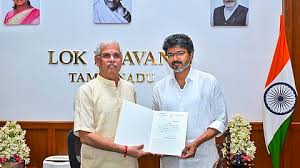
The Governor has directed the newly appointed Chief Minister to prove his majority in the Tamil Nadu Assembly by seeking a confidence vote on or before May 13 Ending the five-day-long suspense over government formation in Tamil Nadu, the VCK on Saturday declared unconditional support to the Vijay-led TVK, enabling the actor-politician to stake claim to form the government with a clear majority in the Assembly. Following the announcement, TVK founder-chief Vijay met Governor Rajendra Vishwanath Arlekar at Lok Bhavan in Chennai and formally staked claim to form the new government. The swearing-in ceremony for the Council of Ministers, to be led by Vijay, is scheduled to take place in Chennai at 10 AM on Sunday. The Leader of Opposition in Lok Sabha, Rahul Gandhi, is likely to attend the swearing-in The Governor has directed the newly appointed Chief Minister to prove his majority in the Tamil Nadu Assembly by seeking a confidence vote on or before May 13, according to Lok Bhavan sources. This was the fourth time Vijay met the Governor since the election results, but unlike the previous occasions, he now enjoys majority support in the 234-member Tamil Nadu Assembly. Soon after the VCK extended support to TVK, another DMK ally, the Indian Union Muslim League (IUML), also announced its backing for Vijay. The IUML has two MLAs. With the support of the VCK and IUML, the numbers in favour of TVK rose to 120 — two above the simple majority mark of 118 in the Assembly. Earlier in the evening, TVK leader Adhav Arujuna confirmed the development and announced that the VCK had formally decided to support the party. VCK legislature party leader Vanni Arasu also submitted a letter to the Governor declaring the party’s support to TVK. “Victory,” Arujuna said, while thanking the Congress, Left parties and VCK chief Thol Thirumavalavan for backing TVK, and expressed confidence that Vijay would soon become the Chief Minister of Tamil Nadu. Sources in the VCK said the party would, for now, extend outside support to the TVK-led government. Before finalising its decision, the VCK had reportedly considered placing several conditions before extending support, including the continuation of welfare schemes introduced during the previous DMK regime. Tamil Nadu Governor Rajendra Vishwanath Arlekar hands over the letter of appointment to TVK chief C Joseph Vijay as the new state Chief Minister, at the Lok Bhavan, in Chennai, Saturday, May 9, 2026. The party had also prioritised the continuation of two commissions — one constituted to recommend legislation against honour killings and another examining reservation in promotions for government employees. Sources further indicated that internal discussions within the VCK also explored the possibility of seeking a share in power, including ministerial positions and even a proposal projecting Thirumavalavan for the Chief Minister’s post with the backing of both the DMK and AIADMK, sources privy to the meeting told TNIE. It is this proposal that prompted Thirumavalavan to visit DMK president MK Stalin at his Cenotaph Road residence for a consultation. Stalin was reportedly receptive to the idea, but raised questions about future electoral politics, including in which alliance VCK plans to contest the next elections if both Dravidian majors backed Thirumavalavan for the top post. The same proposal was also taken to AIADMK general secretary Edappadi K Palaniswami. Sources close to EPS, however, said he outrightly rejected it, noting it would damage his core vote bank. On Saturday morning, EPS posted in a social media platform X, extending his greetings to the party set to form a new government. Vijay’s Tamilaga Vettri Kazhagam (TVK), which emerged as the single largest party with 108 seats in a stunning electoral debut, was denied permission to form the government by the Governor, who was insisting that proof of majority should be provided before a floor test in the Assembly. The party earlier obtained support from the Congress, which won five seats in the Assembly elections as part of the DMK-led alliance. On Thursday, Left parties extended support to Vijay, upping the prospects for the TVK to form the government. The Viduthalai Chiruthaigal Katchi (VCK), a long-time ally of the Left parties, also followed suit but did not send any letter of support, thereby prompting the Governor to call off the swearing-in ceremony scheduled on Saturday. Thirumavalavan had already announced that his party’s decision would align with the decision of the Left parties. Tamil Nadu Governor Rajendra Vishwanath Arlekar hands over the letter of appointment to TVK chief C Joseph Vijay as the new state Chief Minister, at the Lok Bhavan, in Chennai, Saturday, May 9, 2026. Horse-trading allegations against TVK Meanwhile, the AMMK, a constituent of the NDA alliance, on Saturday loged a complaint with the Guindy police alleging TVK chief Vijay used a “forged” support letter by its MLA to stake claim for government formation. According to Guindy police, the petition was filed by AMMK General Secretary T T V Dhinakaran. However, no First Information Report (FIR) has been registered in the matter as of Saturday morning. Speaking to reporters, Dhinakaran accused the TVK of submitting a forged photocopy of a letter to the Governor, falsely claiming the support of AMMK’s lone MLA-elect from Mannargudi, S Kamaraj. “The TVK, which claims to be a ‘pure force,’ has indulged in forgery and horse-trading,” Dhinakaran stated. Meanwhile, the TVK has dismissed the allegations as “false news,” releasing a counter-video purportedly showing MLA Kamaraj signing the support letter voluntarily. Courtesy : TNIE Note: This news is originally published on https:/thenewindianexpress.com/bha and is used purely for non-profit/non-commercial purposes, especially human rights
Tamil Nadu saw 67% rise in atrocities against Dalits under DMK rule

Tamil Nadu’s 67.9% increase in cases against Scheduled Castes (SC) and Scheduled Tribes (ST) is the highest in India, surpassing Madhya Pradesh (55.3%) and Odisha (42.9%). Tamil Nadu recorded a 67 per cent rise in atrocities against Dalits between 2019 and 2023, the highest increase in the country,according to a report by the National Campaign on Dalit Human Rights (NCDHR). This data has gained significant attention following the DMK’s defeat in the 2026 Assembly elections, suggesting that the state’s failure to address caste violence contributed to voter dissatisfaction despite the party’s “social justice” rhetoric. Tamil Nadu’s 67.9% increase in cases against Scheduled Castes (SC) and Scheduled Tribes (ST) is the highest in India, surpassing Madhya Pradesh (55.3%) and Odisha (42.9%). According to NCRB data, murders of Dalits rose by 40.4 per cent, increasing from 52 to 73 cases, while incidents of grievous hurt surged by 240 per cent and cases of criminal intimidation witnessed a sharp 584.8 per cent rise, climbing from 46 to 315 cases. Total rape cases rose by 36.1%. While the rape of adult Dalit women dropped by 14%, the rape of Dalit girls increased by 73.2% (from 56 to 97 cases). Assaults with “intent to outrage modesty” grew by 289.5%. The report highlights a breakdown in the justice system. In 2023, the conviction rate for these crimes was a mere 12.2%, while the acquittal rate stood at 87.8%. Additionally, the case pendency rate is 87.7%, exacerbated by a shortage of exclusive special courts; Tamil Nadu currently has only 20. The state government has also been criticized for administrative negligence. The state-level vigilance and monitoring committee, chaired by the Chief Minister, is legally required to meet twice a year. However, it met only once annually between 2021 and 2023, and failed to meet at all in 2024. Prison Statistics India (PSI) indicates a disproportionate targeting of Dalits under preventive detention. In 2021, SC individuals made up 37% of detainees in Tamil Nadu, accounting for 84.5% of all SC detainees across India. By 2023, this figure rose to 42.2%, despite Dalits making up only 20% of the state’s population. The sharp rise in atrocities against Dalits in Tamil Nadu has drawn particular attention because the Dravida Munnetra Kazhagam (DMK) has historically positioned itself as a champion of “social justice,” anti-caste politics, and the upliftment of backward classes, Dalits, and minorities through the broader Dravidian movement. Notably, the debate around caste violence and the DMK’s “social justice” claims intensified following the 2026 Tamil Nadu Legislative Assembly election, in which the Dravida Munnetra Kazhagam (DMK) suffered a major defeat. Tamilaga Vettri Kazhagam (TVK), led by actor-turned-politician Vijay, emerged as the single largest party with 108 seats, while the DMK was reduced to 59 seats. The All India Anna Dravida Munnetra Kazhagam (AIADMK) secured 47 seats. Courtesy : Maktoob Media Note: This news is originally published on https:/maktoobmedia.com/bha and is used purely for non-profit/non-commercial purposes, especially human rights
Karnataka High Court directs continuation of hormone replacement therapy on two transgenders

The petitioners challenged the validity of the Transgender Persons (Protection of Rights) Amendment Act, 2026, and claimed that despite being midway through treatment, the attending doctors are unwilling to continue the prescribed course of therapy. Bengaluru: The High Court of Karnataka has directed the doctors of a private hospital in Bengaluru to continue with hormone replacement therapy (HRT) upon two transgenders as per the existing medical protocol. The petitioners challenged the validity of the Transgender Persons (Protection of Rights) Amendment Act, 2026, and claimed that despite being midway through treatment, the attending doctors are unwilling to continue the prescribed course of therapy. “The concerned doctors and medical authorities shall facilitate continuation of such treatment without interruption. The continuation of treatment shall, however, be subject to the outcome of the present writ petition and any orders that may be passed by the Supreme Court, including in any transfer proceedings initiated by the Union of India,” Justice Sachin Shankar Magadum stated in the interim order passed on Thursday. The petitioners submitted that they are transgender persons identifying as women and are aggrieved by the consequences flowing from the amended definition of “transgender person” under Section 2(k) of the 2026 Amendment Act. The petitioners claimed that they have been undergoing hormone replacement therapy (HRT) in a hospital since November 11, 2023, and have also been issued Transgender Identity Cards. They contend that denial of treatment midway, infringes their fundamental rights guaranteed under Articles 14, 15, 16, 19, and 21 of the Constitution of India. They also relied on an interim order passed by the Kerala High Court in an analogous matter, where similarly placed persons were permitted to continue the therapy and appropriate directions were issued to facilitate uninterrupted treatment. The Additional Solicitor General, appearing for the Union government, submitted that no material is placed on record to demonstrate that the authorities have initiated or proposed coercive action restraining such treatment. It was further submitted that the issue relating to the validity of the amendment is presently sub judice and before the Supreme Court. The Union government is contemplating filing an application seeking transfer of all similar petitions pending before various high courts, the court was informed. Justice Magadum noted that the medical records produced by the petitioners, prima facie, indicate that both have been undergoing the therapy since November 11, 2023. “At this stage, it cannot be disputed that abrupt discontinuation of such ongoing medical treatment may have adverse and detrimental consequences on their physical and mental well-being. It is also not in dispute that the issues raised in the present petition, including the challenge to the amended statutory provision, are engaging the attention of the Supreme Court and are likely to be authoritatively settled. In the facts and circumstances of the case, this court is of the considered view that, pending adjudication of the larger issues, limited interim protection is required to be extended to the petitioners to ensure that ongoing medical treatment is not disrupted,” the court said. Ambarish B Courtesy : DH Note: This news is originally published on https:/deccanherald.com/bha and is used purely for non-profit/non-commercial purposes, especially human rights
Protests, flex wars and online battles mark Kerala Congress CM race
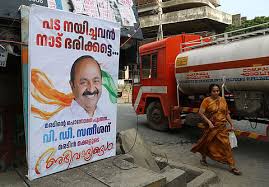
Supporters also marched from Martyrs’ Column to the Secretariat in Thiruvananthapuram carrying Satheesan’s placards. KOCHI: The delay by Congress in naming the next chief minister even four days after the UDF swept the Kerala assembly election has triggered an unprecedented show of strength by supporters of senior leaders V D Satheesan, K C Venugopal and Ramesh Chennithala across the state. From Kozhikode to Thiruvananthapuram and Kottayam to Ernakulam, Congress workers have taken out rallies, erected giant boards and flooded social media demanding that their preferred leader be elevated to the top post. Large demonstrations backing Satheesan were organised at Muthalakulam, Koyilandy, Kuttiady and Vadakara in Kozhikode, where supporters installed towering cut-outs portraying him as ‘kingmaker’ and ‘Bahubali’. Similar marches were organised in Malappuram under the banner “Mathethara Keralam VD-ku Oppam”, while a rally titled “Secular Keralam with Satheesan” was held at Pampady. Supporters also marched from Martyrs’ Column to the Secretariat in Thiruvananthapuram carrying Satheesan’s placards. In some places, posters of Venugopal were reportedly torn down and replaced with Satheesan’s banners. Congress workers in Ernakulam and Kalamassery also witnessed flex-board rivalry. Meanwhile, the Congress leadership in Idukki cracked down on pro-Satheesan demonstrations. The DCC removed four office-bearers who led a march demanding Satheesan be made the CM. . Interestingly, while grassroots leaders, including booth and mandalam committee presidents, have openly joined rallies, most senior leaders have refrained from participation. Several seniors across factions are understood to be backing Venugopal internally, arguing that the CM should be selected through organisational consensus rather than public pressure. The battle has shifted online, too. Under a social media post by senior leader Rahul Gandhi thanking Kerala voters, Satheesan’s supporters urged the high command not to appoint Venugopal, arguing that choosing a sitting MP would trigger unnecessary by-elections. However, another Congress supporter countered online: “Any leader, no matter how big, who imagines that they can blackmail the party by sending fans and supporters to the streets, is mistaken. The party must take decisions within its own organisational framework and discipline.” Another widely shared post defending Venugopal questioned why so many MLAs continued to support him despite Satheesan’s strong media backing, arguing that party workers value leaders who quietly strengthen the organisation rather than build personality cults. Though relatively subdued, supporters of Chennithala too entered the online contest, circulating posters calling him the “People’s Chief Minister”, adding another layer to the Congress succession battle now spilling from party corridors onto Kerala’s streets and social media feeds. Courtesy : TNIE Note: This news is originally published on https:/thenewindianexpress.com/bha and is used purely for non-profit/non-commercial purposes, especially human rights
Rahul Gandhi, Congress top brass to attend Vijay’s swearing-in as Tamil Nadu CM

The development comes as Vijay appears set to assume office after securing crucial support from several political parties, including the Congress and its five MLAs, enabling TVK to cross the majority mark in the 234-member Assembly Senior Congress leaders, including Leader of Opposition in the Lok Sabha Rahul Gandhi, are expected to attend the swearing-in ceremony of TVK chief C Joseph Vijay as the next Chief Minister of Tamil Nadu, according to Congress sources. The development comes as actor-turned-politician Vijay appears set to assume office after securing crucial support from several political parties, including the Congress and its five MLAs, enabling TVK to cross the majority mark in the 234-member Assembly, party leaders and sources said on Friday. The move follows Vijay’s meeting with Tamil Nadu Governor Rajendra Vishwanath Arlekar at Lok Bhavan, where he formally staked claim to form the government after consolidating support from multiple parties in the wake of the fractured mandate delivered in the recently concluded Assembly elections. TVK leader and Tamil Nadu CM designate Joseph Vijay Vijay moves closer to forming Tamil Nadu government as Left parties extend support; VCK decision awaited TVK had emerged as the single-largest party with 108 seats, but remained short of the majority mark of 118 required to form the government on its own. The Congress later formally announced its support to TVK and Vijay in forming the next government in the state, effectively ending its alliance with the Dravida Munnetra Kazhagam (DMK) in favour of backing the new political formation. Congress had contested the elections as part of the DMK-led alliance before extending support to TVK. With the backing of the Congress, the Communist Party of India, the Communist Party of India (Marxist) and the Viduthalai Chiruthaigal Katchi (VCK), Vijay’s party has crossed the majority threshold in the Assembly. The CPI, CPI(M) and VCK, which won two seats each, extended support to TVK, taking the alliance tally beyond the halfway mark along with the Congress’ five MLAs. In an official letter, the CPI(M) conveyed its support to TVK for the formation of the government in the state, while the CPI extended “conditional support” to the Vijay-led party in favour of “stable, secular and democratic governance for the people of Tamil Nadu.” Courtesy : TNIE Note: This news is originally published on https:/thenewindianexpress.com/bha and is used purely for non-profit/non-commercial purposes, especially human rights
UoH student fined for assaulting Dalit student, ASA protests inadequate action
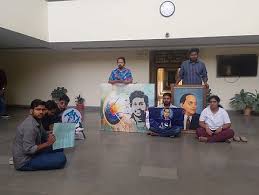
The Ambedkar Students’ Association is on strike against the University of Hyderabad administration, alleging institutional bias and inadequate action in a case of an alleged caste atrocity over a Dalit student, where a mere fine Rs 5,000 was imposed. Protests at the University of Hyderabad (UoH) entered their third day on Thursday, May 7, with students led by the Ambedkar Students’ Association (ASA) launching an indefinite relay hunger strike. The students are demanding the release of a fact-finding committee report into the alleged assault and casteist abuse of a Dalit student. According to the ASA, a Dalit student, Anuj Kumar, was allegedly assaulted and subjected to casteist slurs by fellow student Suryavardhan Singh Bablu following a personal dispute on December 11, 2025. After sustained student protests demanding official action, the university constituted a fact-finding committee. On May 4, Anuj was orally informed that the accused had been fined Rs 5,000, directed to issue a private apology through the Office of Anti-Discrimination, and barred from taking admission to any future course at UoH. Both students are second-year MA students. The ASA has strongly opposed the recommendations, calling them a “mockery of justice” and evidence of “institutional bias”. The student body argued that Dalit students had previously been fined ₹10,000 for minor infractions such as washing bikes near hostels, while an alleged caste assault had attracted only a ₹5,000 penalty. “The administration is effectively signalling that caste atrocities can be settled with a small fine,” the ASA said in a statement. “We demand justice and will not accept this cheap valuation of our lives and dignity.” Anuj Kumar, a second-year MA Sociology student, and his roommate Vinod were allegedly assaulted by Suryavardhan Singh Bablu, a second-year MA History student and former president of the All India Other Backward Castes Students’ Association (AIOBCSA). “He called me, ‘Dalit saale tum log naali ke keede hote ho. Tum jaison ko main apne ghutne ke niche rakhta hoon,’” Anuj told TNM. He alleged that the abuse took place in front of around seven people and that he was beaten with a thick wooden stick. The ASA had earlier protested over the issue in February and has continued to accuse the university administration of displaying “continued institutional bias” in handling the case. “After the protest, the administration addressed my complaint and formed a fact-finding committee,” Anuj said. According to him, the committee, headed by SC/ST liaison officers, submitted its report to the Vice Chancellor and Registrar, but the findings were never shared with him. Anuj alleged that despite assurances from university authorities that the matter would be resolved by April 30, he received no official communication until he emailed the Registrar on May 4. He said the Registrar directed him to meet P. Thukaram, a member of the Equal Opportunity Cell, who verbally informed him of the disciplinary action against the accused. The ASA criticised the administration for not releasing the fact-finding committee report or issuing the recommendations in writing. “They have not released the fact-finding committee report. They have only verbally communicated the recommendations of the anti-discrimination cell,” ASA president Dayanidhi told TNM. In a press release, the ASA described the recommendations as an “insult to the dignity of Dalits” that “exposes the deep-rooted Manuvadi mindset prevailing in the university”. The student body also pointed out that the university website routinely uploads details of disciplinary cases and recommendations, but claimed that Anuj’s case had not been uploaded or formally communicated. “I’m not satisfied with the verdict. I am the victim in this case,” Anuj said, adding that he wants the fact-finding report released so he can appeal the decision. “We want the university to acknowledge this as a caste atrocity. We also want the fact-finding committee report and recommendations to be made public,” Dayanidhi said. When TNM contacted university Registrar Devesh Nigam, he said the administration had acted in accordance with the committee’s recommendations. Written by:Syed Shahid Edited by:Azeefa Fathima Courtesy : TNM Note: This news is originally published on https:/thenewsminute.com/bha and is used purely for non-profit/non-commercial purposes, especially human rights
SC panel orders removal of encroachments on Dalit lands, graveyards

Andhra Pradesh State Commission for Scheduled Castes member Ravada Seetharam on Friday directed Revenue Department officials to clear encroachments on lands and graveyards belonging to Dalit communities in Cheepurupalli, Garividi, Rajam, Santakavti and other parts of Rajam constituency. He held a high-level meeting on Thursday in Rajam with Cheepurupalli Revenue Divisional Officer Sudha Rani and tahsildars of eight mandals of the district. He told the revenue officials that he had received 45 complaints from villagers of various places, and directed them to ensure justice to the petitioners after verification of the veracity in the complaints. Mr. Seetharam further directed the Rajam municipal authorities to allocate 22% works to societies belonging to the Scheduled Castes. He said that a consolidated report of the field visits and review meetings would be submitted to K. S. Jawahar, chairperson of the Commission for further follow up action on the subjects related to Scheduled Castes. The Hindu Bureau, K Srinivasa Rao Courtesy : The Hindu Note: This news is originally published on https:/thehindu.com/bha and is used purely for non-profit/non-commercial purposes, especially human rights
Tamil Nadu: A massive 67% increase in violence against Dalits, a huge gap between government claims and ground reality
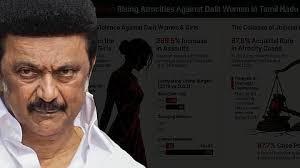
A shocking 67% increase in crimes against Dalits in Tamil Nadu: NCRB and NCDHR reports expose the state’s claims of ‘social justice’. New Delhi: The 2026 Tamil Nadu Assembly election results have created a major stir in the state’s politics. The DMK’s defeat and the TVK’s rapid rise have sparked numerous discussions. While anti-incumbency and political strategies are being blamed for this defeat, the ongoing violence against Dalits and the government’s lackadaisical response to it also point to a serious crisis. The DMK has long touted Tamil Nadu as a model of governance for social justice. However, data from the National Crime Records Bureau (NCRB) and the National Campaign on Dalit Human Rights (NCDHR) tell a different story. A deeper analysis of these reports reveals a massive 67 percent increase in atrocities against Dalits and tribals in the state. It’s noteworthy that both the AIADMK and the DMK were in power during this period. According to the NCDHR report “Five Years of Caste-Based Atrocity,” Tamil Nadu saw a 67.9 percent increase in crimes against Dalits between 2019 and 2023, the highest in the country. Madhya Pradesh, with 55.3 percent and Odisha, with 42.9 percent, came in second and third. These figures demonstrate a wide gap between the language of social justice and the real lives of Dalits in the state. The NCRB 2023 data paints an even more alarming picture. Cases of murder of Dalits saw a 40.4 percent increase, from 52 in 2019 to 73 in 2023. Cases of grievous hurt have increased by 240 percent, while criminal intimidation cases have seen a staggering 584.8 percent jump. These figures prove that whenever Dalits raise their voices for their rights, the caste system attempts to suppress them through violence. Crimes against Dalit women and girls have also seen an alarming increase. The total number of rape cases increased from 97 in 2019 to 132 in 2023, a 36.1 percent increase. In particular, atrocities against Dalit girls have increased by 73.2 percent. These are not just individual crimes; rape is often used as a weapon of caste oppression. Attacks intended to outrage the dignity of women have also seen a 289.5 percent increase. The failure of the justice system is also exacerbating this situation. In 2023, the conviction rate for Dalit atrocity cases was only 12.2 percent, while the acquittal rate was high at 87.8 percent. The pendency rate is also 87.7 percent, primarily due to the lack of special courts. Tamil Nadu has only 20 special courts for speedy trials, which is woefully inadequate for the caseload. According to law, the State-Level Vigilance and Monitoring Committee, chaired by the Chief Minister, must meet twice a year. However, these meetings have been ignored in Tamil Nadu since 2021. Only one meeting each was held in 2021, 2022, and 2023, while none was held in 2024. This reflects not an administrative lapse but the government’s priorities and attitude towards marginalized communities. Dalits are also being targeted in cases of violence in police custody. According to the 2021 Prison Statistics, 37 percent of those detained in the state were Dalits. Tamil Nadu alone accounts for 84.5 percent of India’s total Scheduled Caste prisoners. By 2023, this number was projected to rise to 42.2 percent, while Dalits constitute only around 20 percent of the state’s total population. The DMK’s electoral defeat is partly a result of growing discontent among Dalits over hollow slogans of social justice and the perceived insecurity of the state. On the other hand, the rise of the TVK is a result of cinematic influence and the search for an alternative among young people. However, celebrity culture or anti-incumbency alone cannot provide justice to marginalized communities. The TVK’s silence on issues like the recent honor killing of Dalit tech professional Kavin Selvaganesh has also raised questions. It will be important to see whether new political forces will engage in mere symbolic politics or work to ensure real protection and justice for victims by strictly enforcing the SC/ST (Prevention of Atrocities) Act. Rajan Chaudhary Courtesy: Hindi News