
Kerala CM VD Satheesan again uses full name in MLA oath amid row over ‘Menon’ surname

At his oath-taking ceremony on Monday, Satheesan had used his complete name, triggering criticism from sections of social media and some Congress leaders. Kerala Chief Minister V D Satheesan on Thursday took oath as an MLA of the 16th State Legislative Assembly, once again reading out his full name, Vadasseri Damodara Menon Satheesan, days after drawing criticism for using the caste surname ‘Menon’ during his swearing-in as chief minister. At his oath-taking ceremony on Monday, Satheesan had used his complete name, triggering criticism from sections of social media and some Congress leaders. Defending his decision at a press conference on Wednesday, Satheesan said he had merely mentioned his father’s name and saw nothing wrong in doing so on such an occasion. “Why is it wrong if I mention my father’s name. Shouldn’t I remember him,” Satheesan had asked while speaking to reporters after a Cabinet meeting here. He had also said that he wanted to mention his mother’s name too, but there was no scope for that. The controversy surfaced after social media users compared his recent oath as chief minister with the one he took as a legislator in 2021, when he had identified himself simply as “V D Satheesan”. On Thursday, while taking oath again as an MLA, Satheesan repeated his full name Courtesy : TNIE Note: This news is originally published on https:/thenewindianexpress.com/bha and is used purely for non-profit/non-commercial purposes, especially human rights
Ernakulam pins high hopes on UDF’s ‘power cabinet’
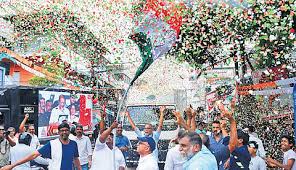
With CM from dist, a stronger voice in policy making is expected KOCHI: As Kerala steps into a new political era under Chief Minister V D Satheesan, expectations are running especially high in Ernakulam district, the state’s commercial hub that now enjoys unprecedented representation in the cabinet. From the long-pending Angamaly bypass, additional ring roads and stronger road-rail connectivity to the development of emerging urban centres like Muvattupuzha, residents and industry leaders are hoping the new government will finally fast-track projects that have remained on paper for years. With the chief minister himself representing the district, along with ministers Roji M John, Anoop Jacob and V E Abdul Gafoor, Ernakulam expects a stronger voice in policy making and infrastructure planning. The demand for improved connectivity has once again taken centre stage. Civic groups and planners argue that Kochi can no longer sustain rising traffic pressure without large-scale interventions including new bypasses, ring roads and alternative urban corridors connecting nearby towns. “The government should design a strategy to reduce pressure on the city. Along with the Sabari Rail project, a 50 to 60-metre-wide road should also be developed,” said V J Kurian, former managing director of Cochin International Airport Limited. “If such a high-speed corridor becomes a reality, it could significantly reduce congestion in the city. This will particularly benefit people travelling from Erumely,” he said. Kurian also stressed that development should not remain confined to Kochi.“There should be equal focus on developing cities like Muvattupuzha. After the airport, the Kochi Metro was the only major project Ernakulam received, and even that is yet to be fully completed,” he said. According to him, the long-pending Kundannoor-Angamaly bypass must figure among the government’s top priorities. Industry leaders, meanwhile, have highlighted the need to create a more business-friendly ecosystem in Kochi. Vinodini Sukumar, president of the Cochin Chamber of Commerce and Industry, said the government must focus on youth-centric initiatives and startup support. “Kochi has a large youth population and the government should introduce startup training programmes and youth-oriented initiatives,” she said. There is a growing trend of entrepreneurs starting ventures here but registering them outside Kerala because of the lack of a conducive business environment in the city, she added. D Dhanuraj, chairman of the Centre for Public Policy Research, stressed the need to improve urban living standards. “From water supply to roads and electricity, Kochi deserves focused attention as it hosts major institutions including Cochin Shipyard,” he said. Social activist Ranjith Thampi echoed similar concerns. “Infrastructure continues to be one of Ernakulam’s biggest concerns. The district needs more ring roads and better connectivity,” he said. “Now, with a minister from Angamaly in place, people are once again hoping the Angamaly bypass project will finally become a reality. There is also a growing demand for a second bridge connecting mainland Kochi and Bolgatty, which has long been a dream for many residents,” he added. What District wants Early completion of Angamaly bypass More ring roads and smoother connectivity Development of Muvattupuzha and eastern belt Better climate for startups and business Upgraded roads, water and transport infrastructure Abhirami Anil Courtesy : TNIE Note: This news is originally published on https:/thenewindianexpress.com/bha and is used purely for non-profit/non-commercial purposes, especially human rights
Stage overrun as massive crowd threatens to derail security protocol in Kerala
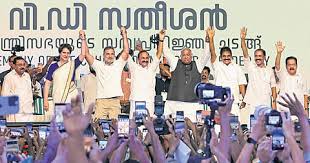
But for the Congress-led UDF, for whom the event marked a historic return to power after a decade, a restrained ceremony would have undermined the spirit of the occasion. THIRUVANANTHAPURAM: After the swearing-in ceremonies of the new governments in West Bengal and Tamil Nadu, all eyes were on whether Kerala too would opt for a flamboyant, festival-like spectacle or stick to the sombre tradition usually associated with such occasions in the state. When the protocol wing of the general administration department got in touch with Lok Bhavan, the latter preferred to follow convention – seating on the dais only for the governor, the ministers being sworn in and the chief secretary. But for the Congress-led UDF, for whom the event marked a historic return to power after a decade, a restrained ceremony would have undermined the spirit of the occasion. Late on Sunday, Chief Minister-designate V D Satheesan made a special request to Governor Rajendra Arlekar to permit additional dignitaries on the dais. “Though Satheesan initially preferred a simple ceremony, there was pressure from the AICC to ensure that Rahul Gandhi and other senior Congress leaders were accommodated on the stage,” said a source privy to the developments. “Since the governor did not want the new government’s tenure to begin on a sour note, he did not object to the chief minister’s request,” said a top official. The presence of nearly two dozen chairs in the front row and an almost equal number behind them offered an early indication of what was to come. However, matters soon spiralled beyond expectations. The swearing-in ceremony began nearly 15 minutes late after security personnel reportedly informed officials that the arrangements on the dais did not conform to the governor’s security protocol. Besides the dignitaries, members of their personal staff too remained standing behind the chairs, further crowding the stage. Governor Arlekar himself was seen navigating through nearly 60 people on the dais upon his arrival. “When the chief minister met the governor after the ceremony, he expressed regret over the way the arrangements had eventually unfolded. Even P K Kunhalikutty felt that the scale of the crowd frenzy had gone beyond expectations and resulted in a degree of chaos,” the official added. Sovi Vidyadharan Courtesy : TNIE Note: This news is originally published on https:/thenewindianexpress.com/bha and is used purely for non-profit/non-commercial purposes, especially human rights
Team Satheesan kicks off on a welfare note

Satheesan, who had sharply criticised the previous LDF government over its “poor handling” of the economy, also announced the cabinet’s decision to release a white paper on the state’s financial health. THIRUVANANTHAPURAM: Amid thunderous cheers from a teeming crowd and in the presence of a galaxy of VIPs, V D Satheesan was sworn in as Kerala’s 13th Chief Minister along with 20 cabinet colleagues at a glittering ceremony at Central Stadium, Thiruvananthapuram, on Monday. True to his word, Satheesan wasted no time after assuming office, rolling out two major poll promises: free travel for women on KSRTC buses from June 15 and the launch of India’s first dedicated government department for senior citizens. In a major relief for striking ASHA workers, the government also announced a Rs 3,000 hike in their monthly honorarium. Satheesan, who had sharply criticised the previous LDF government over its “poor handling” of the economy, also announced the cabinet’s decision to release a white paper on the state’s financial health. Addressing a packed press conference after his cabinet’s first meeting, a composed Satheesan said he was fully aware of the enormity of the task ahead and made it clear that his administration was determined to break from rigid precedents. While the finer details of the free transit scheme are being worked out, Satheesan said the new elderly welfare department would, within two months, prepare a comprehensive road map inspired by global models such as Japan’s to ensure senior citizens can live with dignity. The chief minister said the government’s goal was to build a system that would make Kerala proudly stand out as a truly civilised society. Signalling immediate relief for grassroots health and welfare workers, the cabinet approved a first-phase `3,000 hike in the honorarium of ASHA workers, raising their monthly pay from Rs 9,000 to Rs 12,000, with the promise of a second-stage increase later. Satheesan said a final decision on their retirement benefits would be taken within a month. The government also announced a Rs 1,000 salary hike for anganwadi workers, helpers and cooks, as well as pre-primary teachers and nannies. On the fiscal front, Satheesan said the government would publish a white paper, prepared with the support of economic experts, to give people a clear picture of the state’s financial health. SIT will probe ‘police excesses’ during Nava Kerala Sadas: CM The administration will also chart its next course after receiving a detailed report on the economic impact of the fuel price hike, while simultaneously reviewing monsoon preparedness. In a major political and administrative move, Satheesan announced the formation of a special investigation team (SIT) to probe the alleged police excesses against Congress workers during the Nava Kerala Sadas in 2023. Declaring, “We will not forget anything,” he insisted the move was not driven by political vendetta. Justifying the decision, the chief minister accused the previous regime of inaction, pointing out that a court in Alappuzha had ordered a reinvestigation of the case but no steps were taken. “The SIT will reinvestigate the case,” he said. In another clear departure from the previous administration, Satheesan assured greater access for the media to the state secretariat, saying the additional restrictions imposed by the former government would be reviewed. Portfolio row pushes govt into first crisis T’Puram: Hours after assuming office, the V D Satheesan government is facing its first major test as the chief minister and the Congress leadership have failed to arrive at a consensus over allocation of portfolios to certain ministers. 1st cabinet meeting Major decisions Free travel for women in KSRTC buses from June 15 Dedicated department for senior citizens; expert study to be initiated soon Rs 3,000 hike in monthly honorarium of ASHA workers; decision on retirement benefits in one month Rs 1,000 hike for anganwadi workers and helpers, noon-meal workers, pre-primary teachers and helpers Special Investigation Team to probe attacks during Nava Kerala Sadas in 2023 White paper to be published on financial status of treasury Decision to reduce fuel price hike burden will be taken after fiscal impact analysis To monitor monsoon preparedeness Assembly Session Special assembly session to held on May 21; MLAs to be sworn-in on the day Senior leader G Sudhakaran to be pro tem speaker Speaker’s election on May 22 Governor’s policy declaration on May 29 First session of 16th Kerala Assembly from May 29 Budget most likely on June 5 New appointments Advocate General: Adv Jaju Babu (Senior High Court lawyer) Director General of Prosecution: Adv T Asaf Ali Courtesy : TNIE Note: This news is originally published on https:/thenewindianexpress.com/bha and is used purely for non-profit/non-commercial purposes, especially human rights
UDF returns to power after 10 years; thousands gather for swearing-in in Thiruvananthapuram
Congress president Mallikarjuna Kharge and senior party leaders Rahul Gandhi and Priyanka Gandhi Vadra were scheduled to attend the swearing-in ceremony. THIRUVANANTHAPURAM: The Kerala capital turned into a sea of white on Monday as thousands of UDF workers and supporters from across the state gathered for the oath-taking ceremony of the Congress-led government, which returned to power after a decade-long Left rule with a thumping victory in the Assembly polls. The pavilion set up at the Central Stadium for the swearing-in ceremony was packed with UDF workers and supporters wearing white khadi shirts and mundu, waving flags of alliance partners and raising slogans in support of the coalition. The crowd, including children, braved the humid weather to attend the event. Many others who could not enter the venue gathered around the stadium in large numbers. Many people told reporters that they had waited 10 years to see their alliance return to power and said it would be a great government. “When a UDF government comes back to power after 10 years, it will energise every Congress worker,” they said and shouted — “team UDF and UDF zindabad”. Supporters also danced to the beats of drums played inside and outside the pavilion, celebrating the alliance’s return to power. From 8 am onwards, party leaders, MLA-elects and MPs arrived at the venue one after another. Congress president Mallikarjuna Kharge and senior party leaders Rahul Gandhi and Priyanka Gandhi Vadra were scheduled to attend the swearing-in ceremony. Tight security arrangements were put in place across the state capital ahead of the high-profile event. Special traffic arrangements were also made in view of the large number of VIPs and UDF supporters arriving in the city. Traffic and parking regulations remained in effect from 7 am to 4 pm. The Assembly elections to the 140-member House were held on April 9, and the results were declared on May 4. The Congress-led UDF won 102 seats, while the LDF secured 35 seats and the BJP won three. The MLAs are scheduled to take oath on May 21, followed by the election of the Assembly Speaker on May 22. The Governor’s policy address is scheduled for May 29, and the state budget is likely to be presented by June 5. Courtesy : TNIE Note: This news is originally published on https:/thenewindianexpress.com/bha and is used purely for non-profit/non-commercial purposes, especially human rights
V D Satheesan takes oath as Kerala Chief Minister with 20-member Cabinet as UDF returns to power after a decade

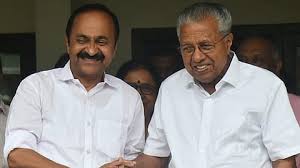
Congress-led alliance assumes power in Kerala after sweeping Assembly poll victory over the LDF; Rahul Gandhi, Kharge and top leaders attend swearing-in ceremony. A decade after being pushed to the opposition benches, the Congress-led United Democratic Front (UDF) stormed back to power in Kerala on Monday, with VD Satheesan taking oath as the state’s 13th Chief Minister at a high-voltage ceremony in Thiruvananthapuram. In a packed Central Stadium drenched in Congress flags, drumbeats and chants of “UDF zindabad”, Governor Rajendra Vishwanath Arlekar administered the oath of office and secrecy to Satheesan and his 20-member Cabinet, formally ending the CPI(M)-led LDF’s 10-year rule in the state. Thousands of UDF workers and supporters from across Kerala flooded the capital city from early morning, turning the venue and surrounding roads into a sea of white khadi shirts and mundu. As Satheesan rose to take oath in the name of God, the crowd erupted in celebration, marking what many Congress workers described as the party’s biggest political comeback in years. The 61-year-old Paravur MLA, credited with rebuilding the Congress organisation and scripting the UDF’s emphatic electoral victory, assumes office after leading the alliance to a stunning 102-seat triumph in the 140-member Assembly. The LDF was reduced to 35 seats, while the BJP won three. The swearing-in ceremony doubled as a show of strength for the Congress nationally, with party president Mallikarjun Kharge, Rahul Gandhi and Priyanka Gandhi Vadra occupying the front row. Karnataka Chief Minister Siddaramaiah, Telangana Chief Minister A. Revanth Reddy, Himachal Pradesh Chief Minister Sukhvinder Singh Sukhu and Karnataka Deputy Chief Minister D.K. Shivakumar were among the senior Congress leaders who attended the event. Former Chief Minister Pinarayi Vijayan, now set to become the Leader of Opposition, was also present along with Left leaders and BJP representatives, including state president Rajeev Chandrasekhar. Satheesan’s ministry signals both continuity and generational transition. Fourteen of the 21 ministers, including the Chief Minister himself, are first-timers in executive office, a rare reshaping of Kerala’s political establishment. Senior Congress leader Ramesh Chennithala, who was widely seen as a contender for the chief ministership, took oath as the third member of the Cabinet and is expected to handle the powerful Home portfolio. K. Muraleedharan, A.P. Anil Kumar and KPCC president Sunny Joseph are among the senior Congress faces in the ministry. The IUML, the second-largest constituent in the UDF, secured five Cabinet berths with P.K. Kunhalikutty emerging as the coalition’s second most powerful figure politically. RSP leader Shibu Baby John, Kerala Congress (Joseph) leader Mons Joseph, Kerala Congress (Jacob) leader Anoop Jacob and CMP leader C.P. John also joined the ministry. The Cabinet includes two women ministers , Bindhu Krishna and K.A. Thulasi, while Scheduled Caste representation has increased to two with Thulasi and A.P. Anil Kumar becoming ministers. Among the new-generation faces in the ministry are P.C. Vishnunadh, Roji M. John, T. Siddique, M. Liju and O.J. Janeesh from the Congress, besides IUML leaders N. Shamsudheen, K.M. Shaji, P.K. Basheer and V.E. Abdul Gafoor. The mood outside the stadium resembled a festival. Supporters danced to percussion performances, waved giant party flags and burst into slogans as ministers took oath one after another. Security was tightened across the capital with heavy police deployment and traffic restrictions in place throughout the day. For the Congress in Kerala, the day marked more than just a change of government. It signalled the return of the UDF after two consecutive defeats, the rise of Satheesan from Opposition leader to Chief Minister, and the beginning of what the party hopes will be a long-awaited political reset in the state. Courtesy : TNIE Note: This news is originally published on https:/thenewindianexpress.com/bha and is used purely for non-profit/non-commercial purposes, especially human rights
Southern CMs Vijay, Revanth, Sidda likely to join Satheesan’s swearing-in in show of opposition unity

The presence of these leaders is being viewed as politically significant, particularly in the context of the growing coordination among non-BJP parties in the southern region and the Congress party’s efforts to strengthen its influence across the South. The swearing-in ceremony of Keralam Chief Minister-designate V. D. Satheesan on Monday is set to acquire a wider political dimension with the expected participation of chief ministers from neighbouring southern states, reflecting both regional solidarity and the evolving political equations in South India after the recent Assembly elections. Chief ministers from Tamil Nadu, Karnataka and Telangana have been invited to attend the oath-taking ceremony scheduled to be held at the Central Stadium in Thiruvananthapuram. The presence of these leaders is being viewed as politically significant, particularly in the context of the growing coordination among non-BJP parties in the southern region and the Congress party’s efforts to strengthen its influence across the South. The invitation extended to Tamil Nadu Chief Minister C. Joseph Vijay has attracted considerable attention. Vijay, who recently assumed office after the Tamil Nadu Assembly election, shares a politically important equation with the Congress leadership, which had supported his government formation efforts in the state. His expected participation in the Keralam ceremony is being seen as a continuation of the emerging political engagement between regional parties and the Congress in southern India. Karnataka Chief Minister Siddaramaiah and Telangana Chief Minister A. Revanth Reddy are also expected to attend the event, lending support to the new United Democratic Front government in Keralam. Both Karnataka and Telangana are currently governed by the Congress, and their participation is likely to reinforce the party’s attempts to project a united southern political front. Senior Congress leaders, including Rahul Gandhi and Priyanka Gandhi Vadra, are also expected to be present at the ceremony, adding to the national political visibility of the event. Political observers believe the swearing-in ceremony could become more than a routine constitutional event, as it is likely to serve as a platform for opposition leaders from the South to signal greater cooperation on national and regional issues. The participation of chief ministers from neighbouring states also underlines Keralam’s continuing importance in the broader opposition landscape ahead of future political alignments at the national level. Preparations for the ceremony are underway in Thiruvananthapuram, where thousands of party workers, supporters and leaders from across the country are expected to gather for the formal inauguration of the new government. Security arrangements have been intensified in the state capital in anticipation of the arrival of senior political leaders and large public participation. Satheesan, who led the UDF to a decisive electoral victory in Kerala, is expected to take oath along with members of his cabinet at the ceremony. The event is likely to mark the beginning of a politically significant phase for the Congress-led alliance in Kerala, while also highlighting the party’s broader attempts to consolidate its presence across southern India through coordination with regional allies and friendly state governments. Courtesy : TNIE Note: This news is originally published on https:/thenewindianexpress.com/bha and is used purely for non-profit/non-commercial purposes, especially human rights
Thiruvananthapuram gears up for swearing-in of Congress govt
The cabinet will later hold its first meeting and submit its recommendation to the governor for convening the assembly. THIRUVANANTHAPURAM: Preparations are in full swing at the Central Stadium in Thiruvananthapuram for the swearing-in ceremony of the UDF government scheduled for Monday morning. A massive stage with seating capacity for around 10,000 people is being set up at the venue. It is expected that nearly one lakh people might attend the ceremony. To enable the public to watch the oath-taking ceremony live from 10am on Monday, video walls are being installed around the stadium premises. In addition to that, LED screens will also be set up at various parts of the city, including Nishagandhi Auditorium premises. Entry for the public will be regulated through passes. Following the ceremony, the ministers will proceed to Raj Bhavan for a reception hosted by the governor. The cabinet will later hold its first meeting and submit its recommendation to the governor for convening the assembly. Senior Congress leaders, including Mallikarjun Kharge, Rahul Gandhi and Priyanka Gandhi are expected to attend the event. Chief ministers from neighbouring states have also been invited. The schedule announced for the new government includes the cabinet swearing-in on Monday, oath-taking of MLAs on May 21, speaker election on May 22, governor’s policy address on May 29 and presentation of the state budget on June 5. Courtesy : TNIE Note: This news is originally published on https:/thenewindianexpress.com/bha and is used purely for non-profit/non-commercial purposes, especially human rights
Kerala High Court Upholds Reproductive Autonomy of Transgender Man by Allowing Egg Cryopreservation
In a significant development concerning transgender rights and reproductive autonomy in India, the Kerala High Court recently permitted a transgender man to cryopreserve his eggs by allowing him to approach an Assisted Reproductive Technology (ART) bank of his choice. The order was passed in the case titled Hari Devageeth v. Union of India by Justice Sobha Annamma Eapen on May 15, 2026. The Court directed that the ART bank concerned should take steps to retrieve the petitioner’s oocytes and cryopreserve them for future reproductive use. The decision came in a writ petition filed by a transgender man who challenged the refusal of a private hospital to permit egg cryopreservation on the ground that transgender persons fall outside the statutory framework established under the Assisted Reproductive Technology (Regulation) Act, 2021. The case raised important constitutional and legal questions concerning the reproductive rights of transgender persons, the scope of healthcare protections under Article 21 of the Constitution, and the interpretation of statutory provisions regulating assisted reproductive technologies in India. While granting relief to the petitioner, the High Court also left open the constitutional challenge to Section 21(g) of the ART Act, which restricts ART services to women between the ages of 21 and 50 years and men between 21 and 55 years. The petitioner before the Court was a person assigned female at birth who identified as a man. According to the pleadings, the petitioner had undergone breast removal surgery as part of gender affirmation procedures but had not yet undergone complete sex reassignment surgery, including hysterectomy or removal of ovaries. Before proceeding further with gender-affirming procedures, the petitioner sought to preserve his reproductive potential by cryopreserving his eggs. However, KIMS Hospital allegedly refused permission for the procedure, citing restrictions under the ART Act and the absence of a legal framework expressly recognising transgender persons within assisted reproductive services. This refusal prompted the petitioner to approach the High Court seeking constitutional protection of reproductive choice and healthcare access. The litigation quickly evolved into a broader debate regarding the rights of transgender persons to parenthood, reproductive healthcare, and equal treatment under Indian law. It also highlighted gaps within existing legislation governing ART services, surrogacy, and adoption, all of which largely continue to operate on binary gender assumptions. The matter attracted significant attention because it brought into focus the intersection between gender identity, medical autonomy, constitutional dignity, and reproductive justice. Senior Advocate Anand Grover appeared on behalf of the petitioner and argued that denial of cryopreservation violated the petitioner’s fundamental rights. The Union Government opposed the plea, contending that existing statutory frameworks consciously excluded transgender persons from availing such services. Although the High Court’s detailed judgment is awaited, the operative order permitting cryopreservation has already emerged as an important judicial intervention in the evolving jurisprudence surrounding transgender rights in India. Arguments of the Parties: The petitioner argued that the refusal to permit egg cryopreservation amounted to a direct infringement of his constitutional right to reproductive autonomy and healthcare. It was submitted that although the petitioner identified as a man, he had been assigned female at birth and retained reproductive organs capable of producing oocytes. Therefore, prior to undergoing further gender-affirming surgical procedures, he wished to preserve his eggs for possible future reproduction. The petitioner clarified that he had not undergone complete sex reassignment surgery and had only undergone breast removal surgery. Since the uterus and ovaries remained intact, it was argued that the petitioner retained the biological capacity to reproduce. Counsel submitted that transgender men are capable of experiencing pregnancy and reproduction, and therefore, denying them access to fertility preservation services solely because of gender identity would be discriminatory and unconstitutional. A central argument advanced by the petitioner was that reproductive choice forms an essential component of personal liberty protected under Article 21 of the Constitution. The plea asserted that the right to make decisions regarding reproduction, parenthood, and fertility preservation is inseparably connected with bodily autonomy, dignity, and privacy. The petitioner contended that denial of cryopreservation effectively deprived him of the possibility of biological parenthood in the future. Once gender-affirming procedures such as hysterectomy or removal of ovaries are performed, the ability to retrieve oocytes would permanently cease. Therefore, refusal to permit cryopreservation would cause irreversible harm to the petitioner’s reproductive future. The petitioner also relied upon the protections available under the Transgender Persons (Protection of Rights) Act, 2019 and the accompanying Rules of 2020. It was argued that the statutory framework expressly prohibits discrimination against transgender persons in matters relating to healthcare access. Consequently, exclusion from ART services merely because the petitioner was a transgender man amounted to unlawful discrimination prohibited by statute and constitutional principles of equality. Another important submission made on behalf of the petitioner was that the ART Act did not contain any explicit prohibition against cryopreservation of eggs by transgender persons. According to the petitioner, while the legislation regulates eligibility for assisted reproductive procedures, it does not impose an absolute bar on fertility preservation. Therefore, the authorities could not rely upon legislative silence to deny healthcare access. Senior Advocate Anand Grover argued that reproductive rights must be interpreted in a gender-inclusive manner consistent with constitutional morality and the recognition of transgender identity affirmed by the Supreme Court of India in landmark transgender rights jurisprudence. It was submitted that constitutional protections cannot be denied merely because statutory frameworks have failed to evolve alongside contemporary understandings of gender identity and reproductive health. The Union Government opposed the plea and defended the existing legislative framework governing assisted reproductive technology and surrogacy in India. The Centre argued that the ART Act specifically permits assisted reproductive procedures only for a “commissioning couple” or a single woman. Under the statutory definition, a commissioning couple refers strictly to a legally married man and woman. According to the Government, transgender persons and single men were intentionally excluded from the categories of persons eligible to avail ART services. Since cryopreservation of oocytes forms part of ART services regulated under the statute, the petitioner could not claim
KC Venugopal will remain in the game with ‘powerplay’, say his supporters

There is palpable discontent within the Venugopal camp over the manner in which he was, according to his supporters, “disgracefully” elbowed out by the Congress high command. THIRUVANANTHAPURAM: Till Thursday, for some, Congress organisational general secretary K C Venugopal was the ‘kingmaker’. A powerful ‘Goliath’. But all that changed as the political landscape around him shifted dramatically in a matter of hours. Within party circles, the mighty Goliath appeared to fall before ‘David’ — V D Satheesan. And, with the tables now turned, the question being asked is: What next for the once-invincible and trusted lieutenant of Rahul Gandhi? Venugopal’s name was among the first to emerge for the post of chief minister after the UDF’s sweeping victory in Kerala. His political rise — from KSU state president in 1988, Youth Congress state president, MLA, MP, state minister, Union minister, and finally to the Congress’s second most powerful organisational post — had long been regarded as enviable. Consequently, he has as many detractors as admirers, with many now privately rejoicing his fall. Meanwhile, there is palpable discontent within the Venugopal camp over the manner in which he was, according to his supporters, “disgracefully” elbowed out by the Congress high command. “The high command should have asked him to stay away from the race if it had decided that Satheesan would be the chief minister,” said an associate of Venugopal. “Venugopal has played the role of kingmaker in several states while selecting chief ministers. However, in his own state, he could not even announce the next chief minister. The high command could have avoided such a humiliation.” Notably, it was Venugopal who played a major role in making Satheesan the leader of the opposition in 2021, even though Ramesh Chennithala enjoyed majority support in the Congress legislative party at that time. Subsequently, however, the Venugopal camp got rattled as Satheesan began asserting control over the organisation. As a counter, Venugopal first tightened his grip over the Youth Congress by appointing loyalists. Then, during the KPCC reorganisation, his faction secured near-complete control over the organisation. This was reflected in the distribution of Assembly election tickets, helping him secure the support of more than 40 MLAs for his chief ministerial ambitions. Meanwhile, the Venugopal camp dismissed murmurs that the Satheesan faction had begun influencing these MLAs. Leaders close to Venugopal indicated that, as long as he enjoys the trust of Rahul and remains the AICC organisational general secretary, he would continue to play a major role in the state Congress in the coming days. “In politics, power dictates everything. A Congress chief minister cannot move forward without relying on the AICC leadership. That dependence begins with cabinet formation,” said a veteran Congress leader. K S Sreejith Courtesy : TNIE Note: This news is originally published on https:/thenewindianexpress.com/bha and is used purely for non-profit/non-commercial purposes, especially human rights