
The missing contest: Why 2026 elections are not about PM Modi and Rahul Gandhi

As nearly 17.4 crore voters prepare to cast their ballots across Assam, Kerala, Tamil Nadu, West Bengal, and Puducherry in the coming weeks, the familiar contours of electioneering are visible — Prime Minister Narendra Modi’s high-decibel rallies and Rahul Gandhi’s ideological messaging in the poll-bound states. Yet, the election discussion remains far from the two national leaders. The 2026 assembly election battles are decisively centred on regional leadership, local welfare models and state-specific political equations, rather than on a PM Modi vs Rahul Gandhi binary. The power test of regional satraps In the upcoming elections, the spotlight is firmly on Mamata Banerjee in West Bengal and MK Stalin in Tamil Nadu. At the same time, contests in Kerala and Assam, featuring Pinarayi Vijayan and Himanta Biswa Sarma, are expected to be equally intense. Though these battles are unfolding in different political arenas with distinct players, they are tied together by a common theme: it’s do-or-die for regional leaders. For the BJP, these elections represent an opportunity to expand its footprint in states that have traditionally resisted it. However, for regional parties the stakes are significantly higher. This time, the elections are not just about retaining power, but will also decide their influence within the INDIA bloc at the national level. Mamata Banerjee In West Bengal, the contest is once again centred on Mamata Banerjee’s entrenched political base, including strong support from Muslim voters, who make up roughly a third of the electorate, alongside backing from other sections. For Mamata Banerjee, Bengal is not just a state – it is her core political identity and power base. The TMC has little presence outside Bengal. Losing here would mean losing national relevance overnight. After years of resisting the BJP’s rise, another strong challenge tests whether her grip remains intact or is beginning to loosen. A reduced mandate, even if not a loss, weakens Mamata’s stature within the opposition space as well. The BJP, while firmly established as the principal challenger, continues to grapple with converting its earlier gains into a decisive advantage. MK Stalin For MK Stalin and his Dravida Munnetra Kazhagam (DMK), the 2026 Tamil Nadu election is not a routine electoral test — it’s a decisive moment that will define both political longevity and legacy. Having come to power in 2021 with a strong mandate, Stalin now faces the weight of governance. This election is less about promises and more about performance. Welfare delivery, administrative control, and economic management will be closely scrutinised. Even a reduced majority could signal early signs of voter fatigue, altering the perception of DMK’s dominance. The stakes are amplified by Tamil Nadu’s political history of alternating regimes. A second consecutive victory would allow DMK to break its own jinx of now coming to power consecutively. For DMK, it’s not just about winning election this time, but to also perform with high strike rate to keep an upper hand over Congress in the alliance. Edappadi K Palaniswami Complicating matters further for Stalin is Edappadi K Palaniswami. and the All India Anna Dravida Munnetra Kazhagam (AIADMK) that remain a key challenger. But for EPS, the election is about being relevant. Since the death of J Jayalalithaa, the AIADMK has struggled to retain its earlier dominance. EPS has gradually consolidated control within the party, but this election is his first full-scale test as the undisputed face of the organisation, especially when his arch-rival O Panneerselvam has joined hands with MK Stalin. A strong performance would validate his leadership and re-establish AIADMK as a credible alternative to the ruling DMK. A weak showing, however, could reopen internal fault lines and leadership questions. regional leaders2 Seeman For Seeman and the Naam Tamilar Katchi (NTK), this election is not about immediate power but about breaking the ceiling of relevance. Over the past few elections, NTK has carved out a distinct political identity rooted in Tamil nationalism. However, this support has largely remained a vote share without seats. In the 2021 elections, the NTK got 6.6% vote share, more than the BJP and the Congress. The central question this time is whether that support can finally translate into seats. For Seeman, the stakes are deeply personal and political. His appeal as a mobiliser, especially among sections of youth and first-time voters, has kept NTK visible. But repeated failure to win seats risks creating a perception of the party as a permanent outsider, strong on rhetoric but weak on electoral conversion. Pinarayi Vijayan For Pinarayi Vijayan and the Communist Party of India (Marxist)-led Left Democratic Front, the 2026 Kerala election is a defining test of durability rather than emergence. Vijayan made history in 2021 by breaking Kerala’s long-standing pattern of alternating governments, securing a rare consecutive term for the Left. That victory raised the stakes for 2026. A third straight win would not only cement his leadership but also mark an unprecedented political shift in a state known for its cyclical mandates. This election is also a referendum on governance. Vijayan’s tenure has been marked by an emphasis on welfare delivery, infrastructure, and crisis management, but it has also faced criticism over issues ranging from financial stress to allegations of administrative overreach. With anti-incumbency likely to accumulate over two consecutive terms, the margin for error is significantly narrower. Beyond Kerala, the outcome carries symbolic weight. Vijayan is one of the most prominent Left leaders in the country and a victory would reinforce the relevance of Left politics in India’s current political scenario. A defeat, on the other hand, means the end of the Left governance in India, ironically on the eve of Karl Marx’s birthday. N Rangasamy For N Rangasamy and the All India NR Congress (AINRC), the 2026 Puducherry election is about political survival and relevance in a tightly contested Union Territory. Rangasamy, often seen as Puducherry’s most recognisable regional face, has built his appeal on a governance-first image and personal credibility. However, leading a relatively smaller regional outfit, his political space is inherently fragile. A strong mandate would reaffirm his
Congress Targets Rajasthan Govt Over Ajmer Dalit Rape Case
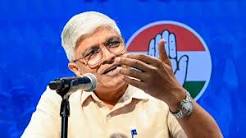
New Delhi: The Congress on Saturday launched a sharp attack on the Rajasthan government, alleging that those accused in the gang rape of a 15-year-old Dalit girl in Ajmer are being shielded and that the victim’s family has been left without adequate protection. The party also flagged what it described as a broader rise in atrocities against Dalits in BJP-ruled states. Speaking at a press conference, Rajendra Pal Gautam said the handling of the case reflects serious lapses by the police. He stated that the incident occurred in July 2024 but came to light only after the minor became pregnant. A Zero FIR was initially registered in New Delhi and later transferred to Ajmer. Despite the victim recording her statement before a magistrate under Section 164 of the CrPC, Gautam alleged that no arrests were made for nearly eight months. He said that out of the three accused, only one has been arrested so far, while the other two were briefly detained under preventive provisions and subsequently released. Gautam further alleged that on March 16, just ahead of a scheduled court hearing, the victim’s family was attacked with axes after they refused to agree to a compromise. He added that a counter-FIR was filed against the family, though it was later closed. Raising legal concerns, Gautam pointed to alleged violations of the Scheduled Castes and Scheduled Tribes (Prevention of Atrocities) Act. He said the authorities failed to provide protection to the victim as mandated under Section 15(A) and did not take action against officials responsible for negligence under Section 4. He demanded immediate security for the victim and her family, adequate compensation, and strict legal action, including the arrest of police officials found to have violated the law. Highlighting a wider trend, Gautam cited data claiming that 76 percent of reported atrocities against Dalits are concentrated in five BJP-ruled states. He said Uttar Pradesh, Madhya Pradesh and Rajasthan account for the highest number of such cases, followed by Bihar and Maharashtra, and argued that the figures point to a systemic issue requiring urgent attention. The Congress also referred to related political developments, noting that Rahul Gandhi has written to the Prime Minister seeking withdrawal of cases linked to the 2018 protests held to protect the SC/ST Act. Gautam said this reflects the party’s continued focus on safeguarding the rights of marginalised communities. He also announced that Rahul Gandhi will flag off a “Run for Ambedkar, Run for Constitution” marathon in Delhi on April 12 to mark the birth anniversary of B. R. Ambedkar, calling on people to participate in large numbers. The Congress maintained that the Ajmer case underscores the need for accountability, stronger enforcement of laws, and timely justice for victims, warning that failure to act decisively would further erode public trust in the system. By Purna Singh Courtesy : THI Note: This news is originally published on https:/thehansindia.com/bha and is used purely for non-profit/non-commercial purposes, especially human rights
Identity vs dignity: Virudhunagar Dalits to boycott TN polls over caste-based village name

Because of the village name – “Paraicheri” – residents say they are forced into a position of humiliation even at workplaces. Synopsis: Over 60 Dalit families in North Achamthavilthan, Virudhunagar, face daily humiliation as their locality is officially recorded as “Paraiyar Cheri.” Despite petitions for 15 years, the caste-marked name persists in voter lists, Aadhaar, and bank records. Frustrated by inaction, residents have resolved to boycott the 2026 Assembly elections, demanding dignity through a permanent name change. “Hey Suryakala, come here” — this is how Kannan (name changed), a 30-year-old man, calls out to Suryakala, who is over 60 years old, without even a trace of respect. Ironically, Kannan studied in school with Suryakala’s daughter. Not just Suryakala — over 60 families from North Achamthavilthan village in Srivilliputhur taluk of Virudhunagar district have been facing such disrespect and humiliation for years, solely because they belong to the Dalit community. What is more troubling is that not only the general public, but even government records refer to their locality as “Paraicheri,” explicitly marking their caste identity. The residents say that wherever they go, this name subjects them to humiliation and caste-based discrimination. For over 15 years, they have submitted petitions—from local Tahsildar to the Chief Minister—requesting a change in the village name. But as no action has been taken so far and the indignity continues, the residents of North Achamthavilthanhave now announced that they will boycott the 2026 Assembly elections. Village carrying burden of caste humiliation North Achamthavilthan is located in Achamthavilthan revenue village under Achamthavilthan panchayat in Srivilliputhur taluk of Virudhunagar district. While multiple intermediate communities live across the broader village, over 60 families belonging to the Dalit Paraiyar community reside in the northern part. Because of this, the area has come to be referred to as “Paraicheri” — not just by neighboring villagers but also in official records. This name appears in documents such as voter lists, bank records, Aadhaar, and PAN cards. However, in land patta records, the village is still officially recorded as Achamthavilthan. Thus, while some government documents mention Achamthavilthan, others continue to use “Paraicheri.” A Abi, a native of this village who is currently pursuing a PhD in Chennai, shared how this caste-based naming has affected her since childhood. “I did all my schooling in and around my village. We had to go to a neighboring village for school, where students from other communities also studied. They would mock us by calling out our village name, and even write it on classroom desks to ridicule us,” she said. She added that upon hearing the name of their village, some students from certain intermediate castes would even avoid speaking to them. “Not just students, even today, elders from those communities expect us to address even their children with respect, using ‘vaanga, poonga.’ But they, from children to adults, never extend the same respect to us,” she said. Even though Suryakala is over 60, she, and others from her community, are still addressed disrespectfully by people from intermediate castes in the same village, often being called by name without basic courtesy. Abi noted that while the intensity of such behaviour may have reduced over the past decade, it still continues. 15-year-long struggle Because of the village name, residents say they are forced into a position of humiliation even at workplaces. SV Kumar, a resident, has been leading the fight to change the name for over 15 years. “When children go to school, they hesitate to even say the name of our village. Even when we go to work, if someone asks where we are from, we say Achamthavilthan. But those who know will immediately correct it and say ‘No, they are from Paraicheri.’ At that moment, we feel deeply humiliated. We lose the sense of being free individuals and are pushed into a mindset of inferiority, as if we are slaves to others,” he said. Despite years of suffering, residents continue to fight for change. While in manual processes at local offices they manage to get the name recorded as North Achamthavilthan, digital government services like Aadhaar and tax records still reflect “Paraicheri.” “In some cases, during Aadhaar enrolment or updates, we insist and get the name corrected. But many people who cannot argue are left at the mercy of e-service operators, who continue to enter ‘Paraicheri,’” Kumar said. He added that even when opening bank accounts, despite submitting the name as North Achamthavilthan, officials, often local and from other communities, override it and record “Paraicheri.” Even the Election Commission’s voter list continues to carry the caste-based name. This is despite residents submitting forms with the correct name during the recent Special Intensive Revision. “We have submitted petitions to everyone, from the Tahsildar to the Chief Minister. There is no one we haven’t approached. Yet nothing has changed,” Kumar said. Over the past decade, resolutions demanding the name change have been repeatedly passed in the gram sabha. Petitions have been sent at every level. Seeking accountability, Kumar even filed RTI queries with the district collector’s office. According to the RTI response, in March 2023, the Srivilliputhur revenue divisional officer recommended changing the name from “Paraicheri” to North Achamthavilthan and forwarded it to the Virudhunagar district collector. In July 2025, the collector forwarded the recommendation to the Commissionerate of Revenue Administration and Disaster Management in Chennai. However, Kumar says the RTI reply revealed that the request is currently pending at that department. “Our village has central government employees, award-winning teachers, and highly educated graduates. Yet, wherever we go, we are humiliated because of our village name,” said Abi. “No matter how far we progress, the moment we say our village name, people’s perception of us changes. We feel like we are not free individuals. Changing the name will give us the dignity of being equal citizens of this country. It will free the next generation from the humiliation we have endured for years,” Kumar said. “When people hear our village name, some look at us with ridicule,
Kerala govt led by an invisible force, its policies not Leftist: Rahul

Alappuzha/Idukki: Congress leader Rahul Gandhi on Saturday sharply hit out at LDF stating that Left didn’t remain in the front’s name and nothing would remain after the elections. In his speech in Alappuzha, the opposition leader in Lok Sabha criticised chief minister for describing the brutal assault on Alappuzha candidate A D Thomas by his security personnel, as a ‘rescue operation’. Thomas had earlier shown a black flag at CM. With G Sudhakaran, an independent supported by UDF in Ambalappuzha, being present on stage, Gandhi said, “A senior leader, who was part of LDF is sitting with us today. His change of mind was not sudden; it was due to fundamental changes in LDF. It is not opportunism. When one travels with a party for a long time, one absorbs many things from it. He quit because he saw things happening contrary to its principles.” “We have been fighting LDF for years. Earlier, they had some ideologies, which is why they were called Left. The current govt’s policies are not leftist and it is led by an invisible force. It is communal and doesn’t accept the Constitution. It spreads hatred among people,” Gandhi alleged. “The connection between CPM and RSS-BJP is now visible to people. Most Left leaders are aware of it. There are two types of Left leaders: the opportunistic and power-hungry and they aren’t troubled by RSS-BJP connection. The second group consists of those who believed in and worked for Left ideologies for years. They feel betrayed and are uneasy,” he said. “When someone is in power for a long time, there is deep confusion. It happens to small leaders too. In a democracy, people provide leaders the opportunity to use power. However, at some point, some leaders feel that all power belongs to them. Those who recognise that power belongs to people will respect and acknowledge them. Such leaders will see all sections of people as their partners and speak to them,” said Gandhi. “Those who believe power comes from themselves will become intolerant and disconnected from people. This has happened to both Prime Minister and Chief minister here. People will recognise all these. Elections are just a formality for that,” he added. “When five or six women MPs stood up in Parliament, Prime Minister thought it was an attack on him. The brutal assault on those who showed a black flag to CM was due to the same mindset. CM didn’t think it was just their dissent. These incidents reveal two people intoxicated by power,” he said. “Why do those in power become disconnected from people? Kerala ranks first in drug issues. Farmers are in debt. In the coir sector, 1.3 lakh people are unemployed. Minorities are being attacked. Two nuns were attacked in Chhattisgarh. Churches were attacked in Manipur. The CM here stands with the attackers,” said Gandhi. He said UDF govt would implement the seawall promise unfulfilled by LDF govt, provide a support price of Rs 35 for rice and implement special projects in the coir and cashew sectors. Gandhi introduced UDF-supported candidates in Alappuzha district: Sudhakaran, M Liju, Thomas, Reji Cherian and K R Rajendraprasad to the audience. DCC president B Babu Prasad presided over the meeting. KPCC vice-president A A Shukoor, Muslim League district president A M Naseer and UDF Alappuzha assembly constituency committee chairman R Unnikrishnan also spoke. Gandhi and AICC general secretary K C Venugopal greeted the crowd. Before leaving the stage, Neerkunnam-native Amanil Kumar presented Gandhi a Neymeen (fish). As he was leaving, the crowd surrounded Gandhi, eager to shake hands and present him kanikonna flowers. Slams Modi for calling Trump ‘sir’ Speaking at an election campaign meeting in Kattappana, Gandhi criticized Prime Minister Narendra Modi for addressing US President Donald Trump as ‘sir’. He alleged that the PM was under Trump’s control. “If Trump asks Modi to jump, he would jump and if asked to lie down, he would comply,” said Gandhi. Even if instructed to act in Israel’s favour, Modi would follow it without question, he said. He said addressing Trump as ‘sir’ was highly inappropriate and reflected a colonial mindset, as if India was still under British rule. “India is an independent nation and a Prime Minister should never address anyone as ‘sir’, nor act on instructions from a foreign leader,” he said. Gandhi alleged that whenever Trump called, Modi responded what he should do. “When Modi calls, Kerala CM responds in a similar manner,” he said. He accused PM of weakening India’s energy security and harming small businesses and the agricultural sector through trade agreements with the US. He also made corruption allegations against Kerala CM and his family. Courtesy : TOI Note: This news is originally published on https:/timesofindia.com/bha and is used purely for non-profit/non-commercial purposes, especially human rights
Puducherry will be granted statehood when Rahul Gandhi becomes PM, Mallikarjun Kharge says
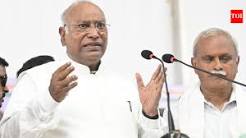
PUDUCHERRY: Congress president Mallikarjun Kharge on Saturday promised that if the INDIA block forms the govt, it will provide free groceries worth ₹2,500 every month and secure full statehood for the Union territory. Addressing a public meeting organised by the Puducherry Pradesh Congress Committee (PPCC) on Saturday in Puducherry, Kharge promised that the long-standing demand of statehood would be granted once the leader of the opposition of the Lok Sabha, Rahul Gandhi, becomes the prime minister. This will end the interference of the lieutenant governor in elected government, he said. The party promised free and complete education from primary school to research levels. Furthermore, the party promised a monthly scholarship of Rs 2,000 to students in both govt and private colleges. The party would provide a subsidy for gold for the thali (mangalsutra) to support families amidst rising costs of gold, he said. He labelled the NDA regime a “30% commission govt,” alleging that corruption had stalled all meaningful development in the state. He accused NDA of looting temple land and public assets worth several crores of rupees. He further alleged that Prime Minister Narendra Modi’s “zero tolerance” for corruption was a facade, while major infrastructure like ports and airports were being handed over to private players. Kharge slammed the govt for opening more than 450 restaurants and bars in five years while failing to provide clean drinking water. He questioned whether NDA intended to turn Puducherry into a liquor-driven economy, citing plans for six new liquor factories despite a drinking water crisis. He said the double-engine govt was responsible for the rampant drug menace and the collapse of law and order. Kharge reminded the people that the infrastructure Puducherry enjoys today, including major hospitals like Jipmer and Indira Gandhi govt medical college, was established under the Congress regime. He accused the BJP of simply “pasting stickers” on existing Congress schemes and claiming them as new. “This election is a fight between neglect and responsibility, between a puppet govt and a strong Congress administration,” Kharge concluded, urging voters to oust the “corrupt” regime. Courtesy : TOI Note: This news is originally published on https:/timesofindia.com/bha and is used purely for non-profit/non-commercial purposes, especially human rights
‘No one is going to fall for their rhetoric…’ Rajbhar hits back at Akhilesh’s statement
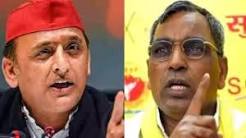
Om Prakash Rajbhar, hitting back at Akhilesh Yadav’s statement, has asserted that the Dalit and Backward Classes will no longer be swayed by the Samajwadi Party (SP). Rajbhar hits back at Akhilesh Yadav’s statement. Dalits and Backward Classes will not fall for the SP’s rhetoric. SP accused of abolishing Dalit reservation and instigating riots. State Bureau, Lucknow. Om Prakash Rajbhar—President of the Suheldev Bharatiya Samaj Party (SBSP) and a cabinet minister—has hit back at the statement made by SP President Akhilesh Yadav on Friday, declaring that the Dalit and Backward Classes have now seen through his strategy of misleading the public. “No one is going to fall for their rhetoric,” he asserted. Rajbhar stated that this is the very same SP that worked to abolish reservation for Dalits in promotions. He noted that while BSP Chief Mayawati had established districts and universities named after prominent Dalit icons, it was the SP that subsequently worked to change those names. During the SP’s rule, riots were a frequent occurrence, and Dalits often lost their lives in the ensuing violence. SP goons, he alleged, used to encroach upon and seize land belonging to Dalits. He further remarked that whenever the SP forms a government, a single specific caste comes to dominate the administration; even the Muslims—who play a pivotal role in bringing the party to power—are subsequently sidelined. Rajbhar acknowledged that the SP had benefited in the recent Lok Sabha elections from false propaganda claiming that the Constitution was under threat of being abolished; however, he asserted that Dalits and Backward Classes will no longer fall for their deceptive ploys. BY HEMANT KUMAR SRIVASTAVA | EDITED BY: AYSHA SHEIKH Courtesy: Hindi News
Can Dalit voters become game-changers in 2027 UP polls?:SP banks on Constitution; Congress leans on Jagjivan Ram’s legacy

Two recent political statements have made it clear that Dalit voters—who constitute around 21% of Uttar Pradesh’s population—could play a decisive role in the 2027 Assembly elections. “Mayawati only used Dalits and later abandoned them. Even today, Dalits and weaker sections remain marginalized,” said Ajay Rai on April 2. “We will celebrate Ambedkar Jayanti at the village level and discuss the threats facing the Constitution,” said Akhilesh Yadav on April 3. These remarks indicate that both the Samajwadi Party (SP) and Congress are actively trying to consolidate Dalit voters ahead of the elections. Congress revives Jagjivan Ram’s legacy Jagjivan Ram, India’s first Dalit Deputy Prime Minister, played a crucial role in the 1971 India-Pakistan war that led to the creation of Bangladesh. As Agriculture Minister, he also contributed to the Green Revolution. His rise to the top echelons of power sent a strong message that Dalits could play a decisive role in mainstream politics. Although Jagjivan Ram hailed from Bihar, Congress used his legacy for decades to maintain a strong hold over Dalit voters in Uttar Pradesh. Read in this report… Samajwadi Party cheif Akhilesh Yadav said on Friday in Lucknow that the constitution will be discussed in every village. Samajwadi Party cheif Akhilesh Yadav said on Friday in Lucknow that the constitution will be discussed in every village. Congress outreach through Meira Kumar To reinforce this connection, Congress is organizing a seminar in Lucknow on the eve of Jagjivan Ram’s birth anniversary (April 4). The party has invited his daughter Meira Kumar and Dalit thinker and Delhi University professor Ratan Lal as key speakers. Through this, Congress aims to send a message that Dalit interests are best protected under its leadership. Party workers have also been instructed to spend more time in Dalit localities and engage directly with their concerns. Why Dalit votes matter Senior journalist Ratan Mani Lal explains that Dalits constitute around 20–21% of UP’s population. There are 84 Assembly seats reserved for Scheduled Castes, and nearly 120 constituencies where Dalit voters exceed one lakh. Since Mayawati weakened after 2012, there has been no single dominant Dalit leader to unify the community. In 2014, a significant section of Dalit voters supported Narendra Modi, contributing to the BJP’s sweeping victories. However, voting trends suggest that such support typically lasts about a decade before voters begin exploring alternatives. Dalit vote shifts and Political competition After a BSP rally on October 9, 2025, there were indications that Dalit voters were returning to Mayawati. This prompted SP and Congress to intensify efforts to prevent a consolidation of Dalit votes in BSP’s favor. Their strategy showed partial success in the 2024 Lok Sabha elections, where the alliance secured around 43% of the vote in UP, with significant support from Dalit voters. They now aim to replicate this in the 2027 Assembly polls. Election data reflects changing trends In the 2022 Assembly elections, Congress contested 399 seats independently but won only two, with a vote share of 2.33%. However, in the 2024 Lok Sabha elections, the party won six seats and increased its vote share to 9.46%. The Samajwadi Party also saw a 2% increase in vote share compared to 2022. Percentage of Major Dalit Sub-Castes Sub-Caste % in Dalit Population % in Total UP Population (Approx.) Area of Influence Jatav/Chamar 54.2% 11.3% Strong in Western and Eastern UP Pasi 15.8% 3.2% Influence in Awadh and Purvanchal Dhobi 5.9% 1.2% Central and Eastern UP Kori 5.5% 1.1% Bundelkhand and Awadh Valmiki 3.2% 0.7% More in urban areas Khatik 2.2% 0.5% Small but active Search for a new Dalit leadership Senior journalist Sharat Pradhan notes that Dalits once saw Jagjivan Ram’s image reflected in Mayawati. However, as her influence declined post-2012, dissatisfaction grew among Dalit voters. This has led to the emergence of new leaders like Chandrashekhar Azad. Congress, traditionally seen as the “old home” of Dalits, regained some traction in 2024, aided by Rahul Gandhi’s campaign centered on the narrative that the Constitution is under threat. This messaging also benefited SP, helping consolidate Dalit support for the opposition alliance. Dalit sub-castes and Voting patterns Dalits make up about 20.7% of UP’s population (around 41.4 million people) and are divided into 66 sub-castes. Six major sub-castes account for 87% of the Dalit population The remaining 60 sub-castes are smaller and fragmented Among them, the Jatav community is the most influential and forms the core vote base of BSP. Non-Jatav Dalits—including Pasi, Kori, Dhobi, Khatik, and Balmiki communities—are more divided. The BJP successfully consolidated these groups between 2017 and 2024. However, in the 2024 Lok Sabha elections, a section of non-Jatav voters shifted towards the opposition alliance, contributing to its strong performance with 43 seats. Santosh Singh, Uttar Pradesh Courtesy : Bhaskar English Note: This news is originally published on https:/bhaskarenglish.com/bha and is used purely for non-profit/non-commercial purposes, especially human rights
Rahul Gandhi enjoys ‘appam and omelette’ with UDF leaders ahead of Kerala Assembly polls

NEW DELHI: Congress MP and Leader of Opposition Rahul Gandhi on Friday shared a video on social media showing him having snacks with United Democratic Front (UDF) leaders in Kerala ahead of the 2026 assembly elections. In the video, Gandhi is seen enjoying local delicacies like Appam, Puttu and omelette while engaging with UDF leaders on the ground realities of the upcoming polls. In a post on X, he wrote: “In between bites of Appam, Puttu and omelette the UDF leaders and I had a very interesting conversation on the ground realities of the Keralam election. It’s evident that Keralam deserves change – an overhaul of the education system, real opportunities for youth and a government that supports its people in sickness and old age. UDF is renewed hope for the people of Keralam – our team is strong, united and ready to lead.” The ruling Left Democratic Front (LDF) is expected to face a stiff challenge from the opposition United Democratic Front (UDF) led by the Indian National Congress. Meanwhile, the Bharatiya Janata Party (BJP)-led National Democratic Alliance (NDA) is also trying to expand its footprint in the state, aiming to turn the contest into a three-way fight. The 2026 Kerala Legislative Assembly elections will be held in a single phase on April 9, as announced by the Election Commission of India on March 15. The counting of votes is scheduled for May 4, while the tenure of the current assembly is set to end on May 23. Courtesy : TOI Note: This news is originally published on https:/timesofindia.com/bha and is used purely for non-profit/non-commercial purposes, especially human rights
85% candidates finalised, 15% pending: Congress to seal Tamil Nadu list at CEC meet today
NEW DELHI: The Indian National Congress is set to finalise its candidates for the upcoming Tamil Nadu Assembly elections at a Central Election Committee (CEC) meeting in Delhi, with 85 per cent of names already decided, according to state unit chief K Selvaperunthagai. Selvaperunthagai said discussions involving senior leaders, including Mallikarjun Kharge and Rahul Gandhi, have largely concluded, with only a small portion of seats left to be finalised. “All India Congress President Mallikarjun Kharge, Opposition leader Rahul Gandhi and senior leaders discussed the candidates. 85% have been decided, 15% are pending. Today we are going to decide,” he said. The Congress will contest 28 constituencies as part of the alliance led by the Dravida Munnetra Kazhagam, which heads the Secular Progressive Alliance (SPA). The DMK has retained the lion’s share, deciding to contest 164 of the 234 seats, while allocating the remaining 70 seats to its partners. Apart from Congress, key allies include the Communist Party of India (CPI) and Communist Party of India (Marxist) (CPI-M) with five seats each, Viduthalai Chiruthaigal Katchi (VCK) with eight seats, and Marumalarchi Dravida Munnetra Kazhagam (MDMK) with four seats. Other alliance partners include the Desiya Murpokku Dravida Kazhagam (DMDK) with 10 seats and the Indian Union Muslim League (IUML) with two seats, along with smaller regional players. Tamil Nadu chief minister and DMK president M K Stalin has already unveiled candidates for several key constituencies. Stalin will contest from Kolathur, while Deputy chief minister Udhayanidhi Stalin has been fielded from Chepauk-Thiruvallikeni. Other prominent candidates include Mahesh from Kanyakumari, Appavu from Radhapuram, Vahab from Palayamkottai, Kalaikathiravan from Tenkasi, and KKSSR Ramachandran from Aruppukottai. Additional names include Velu from Mylapore and Ma Subramanian from Saidapet. The main contest in the state is expected between the DMK-led SPA and the NDA led by the All India Anna Dravida Munnetra Kazhagam, which includes the BJP and PMK. A recent survey by polling agency Lok Poll projected a strong performance for the DMK alliance, estimating 181 to 189 seats with a vote share of 40.1 per cent. The AIADMK-led alliance was projected to secure 38 to 42 seats. Tamil Nadu will go to polls in a single phase on April 23, with counting scheduled for May 4. The last date for filing nominations is April 6, scrutiny will take place on April 7, and candidates can withdraw nominations until April 9. With candidate lists nearing completion and alliances finalised, political parties are entering the final phase of preparations for what is expected to be a closely watched electoral contest in the state. Courtesy : TOI Note: This news is originally published on https:/timesofindia.com/bha and is used purely for non-profit/non-commercial purposes, especially human rights
AIADMK functionary arrested for assaulting dalits
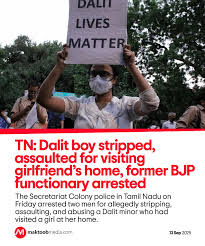
Trichy: An AIADMK functionary was arrested for allegedly assaulting a group of dalit youths campaigning for a DMK candidate in Mannachanallur constituency and was later released on bail following a protest by his supporters on Thursday. The complainant, S Rahul, 26, of Mahalikudi near Samayapuram, along with two others, was campaigning near Maniyampatti on Tuesday in support of DMK candidate S Kathiravan when the incident occurred. Police said a group of AIADMK cadres led by P Kumar, 47, confronted them, allegedly abused them using casteist slurs, threatened them and assaulted them. Rahul sustained injuries in the attack. Based on the complaint, Pulivalam police registered a case under relevant sections of the Bharatiya Nyaya Sanhita for assault, abuse and criminal intimidation, along with provisions of the SC/ST (Prevention of Atrocities) Act, and arrested Kumar on Wednesday. Following the arrest, AIADMK workers and locals staged a road blockade on the Trichy–Thuraiyur State Highway near Peramangalam on Thursday, demanding his release. Traffic was disrupted for about an hour before police intervened and pacified the protesters. Kumar was later released on bail. Courtesy : TOI Note: This news is originally published on https:/timesofindia.com/bha and is used purely for non-profit/non-commercial purposes, especially human rights