
Rahul visits MCF in Rae Bareli

Lucknow: Local MP and leader of opposition, Rahul Gandhi, visited the Modern Coach Factory in Rae Bareli on Tuesday alongside Amethi MP Kishori Lal Sharma. MCF General Manager Prashant Kumar Mishra and other senior officials welcomed them and provided detailed information about the factory’s operations and products. During his visit, Gandhi examined various railway coaches and wheels produced at the facility. The inspection included different types of coaches such as Sleeper, AC 3-Tier Economy, AC Pantry Car, Non-AC Chair Car, Tejas, Rajdhani, Bharat Gaurav and Vande Bharat (prototype shell items) trains. He expressed contentment with the manufacturing process and coach quality. The officials demonstrated the features of General (Deen Dayalu) and Sleeper coaches, which are commonly used by the public. They showcased various passenger comfort enhancements, including improved seats and berths, sliding window doors, mobile charging points, cushioned luggage racks that double as additional seating, FRP panels, and modular toilets. Lucknow: Local MP and leader of opposition, Rahul Gandhi, visited the Modern Coach Factory in Rae Bareli on Tuesday alongside Amethi MP Kishori Lal Sharma. MCF General Manager Prashant Kumar Mishra and other senior officials welcomed them and provided detailed information about the factory’s operations and products. During his visit, Gandhi examined various railway coaches and wheels produced at the facility. The inspection included different types of coaches such as Sleeper, AC 3-Tier Economy, AC Pantry Car, Non-AC Chair Car, Tejas, Rajdhani, Bharat Gaurav and Vande Bharat (prototype shell items) trains. He expressed contentment with the manufacturing process and coach quality. The officials demonstrated the features of General (Deen Dayalu) and Sleeper coaches, which are commonly used by the public. They showcased various passenger comfort enhancements, including improved seats and berths, sliding window doors, mobile charging points, cushioned luggage racks that double as additional seating, FRP panels, and modular toilets. Courtesy : TOI Note: This news is originally published on https://timesofindia.com and is for use by the non-military/non-commercial community, especially those in the human rights sector.
After Singer Neha Singh Rathore, FIR Against Dr. Medusa Over Posts on Pahalgam Attack

Both the FIRs, against folk singer Neha Singh Rathore and Dr. Medusa, have been lodged under multiple charges including “endangering the sovereignty, unity and integrity of India”. New Delhi: The Uttar Pradesh police have registered an FIR against folk singer Neha Singh Rathore under multiple charges including “endangering the sovereignty, unity and integrity of India”. Shortly after, another FIR has been registered by the UP police against activist and professor Madri Kakoti, better known as Dr. Medusa, under the same charges. In Rathore’s case, the complainant referred to the Pahalgam terror attack and the killing of 26 people and has alleged that Rathore’s posts were objectionable and could adversely affect the national integrity, reported Press Trust of India. “In this situation, singer and poetess Neha Singh Rathore, using her Twitter (now X) handle @nehafolksinger made some objectionable posts that can adversely affect the national integrity and made repeated efforts to incite one community against another based on religion,” the complainant, Abhay Pratap Singh said in his complaint. Thereafter, an FIR was registered at Lucknow’s Hazratganj police station. “The statements by Neha Singh Rathore against India are going viral in Pakistan and people in Pakistan are praising Neha Singh Rathore. The Pakistani media is using all the statements of Neha Singh Rathore against India and our enemy country is raising question marks against Bharat. At such a time of crisis, the constant statements of Neha Singh Rathore against India are taking away the honour of entire poet community and country,” says the FIR in the case. In some of the posts mentioned in the FIR, Rathore questions that who will benefit from the Pahalgam attack and also asks if there was some prior inkling of a terrorist attack. ‘By lodging FIR against me, government wants to divert attention from real issues’ Rathore, in response to the FIR, said that the government has taken action against her to divert attention from real issues. “What has the government done in response to the Pahalgam attack? An FIR against me? By lodging an FIR against me, the government wants to divert attention from real issues. Is this too difficult to understand? If you have the strength, go get the heads of the terrorists. There is no need to blame me for your failures. Just as each vote is important in a democracy, each question is also important. The government has a problem with me asking questions and that is why wants to stop me from asking questions,” said Rathore in a video statement on X. FIR against Dr. Medusa Soon after Rathore’s case, another FIR came to light, registered against another popular face on social media, Madri Kakoti or Dr. Medusa, who is known for her satirical content and is often critical of the government. An Assitant Professor at Lucknow University, Kakoti had recently posted a video on the Pahalgam attack went viral, especially in Pakistan. In the video, she talks about the lack of unity in India on religious grounds and demands safety for Kashmiris across the country. In Hindi, she says given how divided the country is on religious and other lines, it will “not take even a second to incite riots”. Calling for the protection of the Kashmiri people living outside Kashmir, she called for demanding justice, not revenge. The FIR was registered at Lucknow’s Hasanganj police station. The complainant alleged that Kakoti’s recent posts would disrupt peace and harmony in the country. Both Rathore and Kakoti have been booked under various sub-sections of Sections 196 (promoting enmity between different groups on ground of religion, race, place of birth, residence, language, etc., and doing acts prejudicial to maintenance of harmony), 197 (imputations, assertions prejudicial to national integration) 353 (statements conducing to public mischief), 302 (uttering words, etc., with deliberate intent to wound religious feelings of any person) and 152 (acts endangering sovereignty unity and integrity of India) of the BNS, as well as Section 69a of the Information Technology Act. Courtesy: The Wire Note: This news is originally published on https://thewire.in and is for use by the non-military/non-commercial community, especially those in the human rights sector.
Underfunded, Overburdened, and Unjust: The national verdict from the India Justice Report 2025
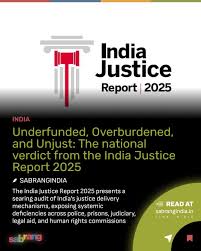
The India Justice Report 2025 presents a searing audit of India’s justice delivery mechanisms, exposing systemic deficiencies across police, prisons, judiciary, legal aid, and human rights commissions In a country where justice is often delayed — and too frequently denied — the India Justice Report 2025 lays bare a stark reality: India’s justice delivery systems are chronically under-resourced, deeply unequal, and dangerously out of step with constitutional promises. Based on the government’s own data, the report captures a nation grappling with persistent vacancies, overwhelmed courts, overcrowded prisons, undertrained police forces, and a legal aid system retreating from the communities that need it most. While isolated sparks of progress flicker — from increased digital infrastructure to a growing number of women in the judiciary — the overwhelming picture is one of inertia and systemic neglect. The findings are a clarion call: without urgent and systemic reform, the promise of justice for all risks becoming a hollow dream. The IJR 2025 delivers a sobering yet illuminating portrait of the state of justice delivery across the country. Drawing from government data across police, judiciary, prisons, legal aid, and human rights commissions, it presents a powerful call to action. Despite pockets of progress, the national picture remains dominated by chronic capacity deficits, deep systemic inequalities, and a sluggish pace of reform. A System Under Strain: Deficits and gaps Across the pillars of justice, major structural weaknesses persist. Police forces nationwide allocate a mere 1.25% of their budget to training, a clear indicator that human capital development remains a low priority. Alarmingly, no state or union territory meets its own reserved quotas for women in the police, exposing deep gender disparities at the very frontline of law enforcement. The forensic science ecosystem, crucial to modern crime detection and fair trials, is also buckling. Half the sanctioned forensic staff positions across the country remain vacant, paralysing investigations and exacerbating delays. In prisons, conditions continue to deteriorate: 176 prisons report occupancy rates of 200% or more, while over 20% of undertrial prisoners have been incarcerated for one to three years without conviction — an indictment of both police investigation and judicial functioning. Judicial backlogs have reached staggering heights, with over five crore cases pending across court levels, reflecting a crippling burden on the system. Meanwhile, the promise of judicial dynamism is undermined by the fact that only 4% of cases are initiated suo motu — a marker of proactive judicial intervention — leaving citizens heavily dependent on individual litigation to seek redress. In the realm of legal aid, there has been a disheartening drop in the number of paralegal volunteers since 2019, and access to basic legal advice in rural and marginalised communities remains worryingly thin. The crisis extends to prisoner welfare too. For a prison population exceeding 5.7 lakh, the country boasts just 25 sanctioned psychologists or psychiatrists, with 25 states and UTs sanctioning none at all. The absence of mental health support in overcrowded, violent environments exacerbates the cycles of trauma and criminality that prisons are supposed to break. Green Shoots: Signs of progress Yet, amidst these dismal findings, rays of hope shine through. A steady expansion of digital infrastructure and gender diversity points towards meaningful, if limited, gains. By 2025: 83% of police stations have at least one CCTV camera, a critical tool for ensuring transparency and accountability in custodial settings. 78% of police stations now have women’s helpdesks, offering marginal improvements in gender-sensitive policing. 86% of prisons are equipped with at least one video-conferencing facility, easing prisoner access to courts without physical transfers. The share of women judges in the district judiciary has climbed to 38%, a vital step towards a more representative bench. Notably, six states now meet the recommended benchmark of one woman medical officer for every 300 women inmates in prisons, addressing a long-standing neglect of gender-sensitive prison health services. High courts have managed to maintain case clearance rates exceeding 100% annually since 2017, a promising trend suggesting some resilience even under extreme workload pressures. Data based on the national findings: Who Leads, Who Lags: Rankings across states Large and mid-sized states (Map 1) Karnataka retains the top position among 18 large states, with a composite score of 6.78/10. Andhra Pradesh makes a remarkable jump to second place (6.32), up from fifth earlier. Telangana ranks third (6.15), showing consistent progress since 2019. Kerala and Tamil Nadu complete the top five. At the bottom: Bihar, Rajasthan, Jharkhand, Uttarakhand, Uttar Pradesh, and West Bengal occupy the lowest ranks. West Bengal drops to the bottom (18thplace), swapping places with Uttar Pradesh. Small states (Map 2) Sikkim remains the top-ranked small state (5.20/10). Himachal Pradesh and Arunachal Pradesh follow closely. Meghalaya, Mizoram, and Goa slide to the bottom ranks among the seven small states. Scorecards of Change: Who improved? (Figure 1: Improvement scorecard) The report measured whether states had improved between the 2022 and 2025 editions across 68 indicators. Top improvers among large states: Bihar improved on 47 out of 68 indicators — the highest improvement rate. Chhattisgarh, Odisha, Rajasthan, and Karnataka also showed strong positive shifts (around 40 indicators each). Among small states: Himachal Pradesh and Sikkim were the most consistent improvers. Uttarakhand, Haryana, and Madhya Pradesh showed moderate improvements, while states like Maharashtra, Gujarat, and Tamil Nadu showed worrying stagnation or decline. Diversity and Representation: Still a distant goal? Diversity rankings (Figure 2) Karnataka is the only large state to meet SC, ST, and OBC quotas in both police and judiciary. Caste-based diversity in judicial appointments is poor across most states, despite constitutional mandates. Women’s representation (Figure 3–5) Five states — Andhra Pradesh, Bihar, Chandigarh, Ladakh, and Tamil Nadu — are moving steadily towards achieving 33% women’s representation in police. District judiciary has seen a steady rise in women judges, now at 38%, but High Courts and Supreme Court continue to show male domination. Projections suggest that even at the current pace, it will take decades for full gender parity. Human Resources: Vacancies and gaps (Figure 7–9) Judge-to-population ratios remain poor
Echoes of Hate: Online anti-Muslim hate spreads against Muslim businesses and workers after Pahalgam attack
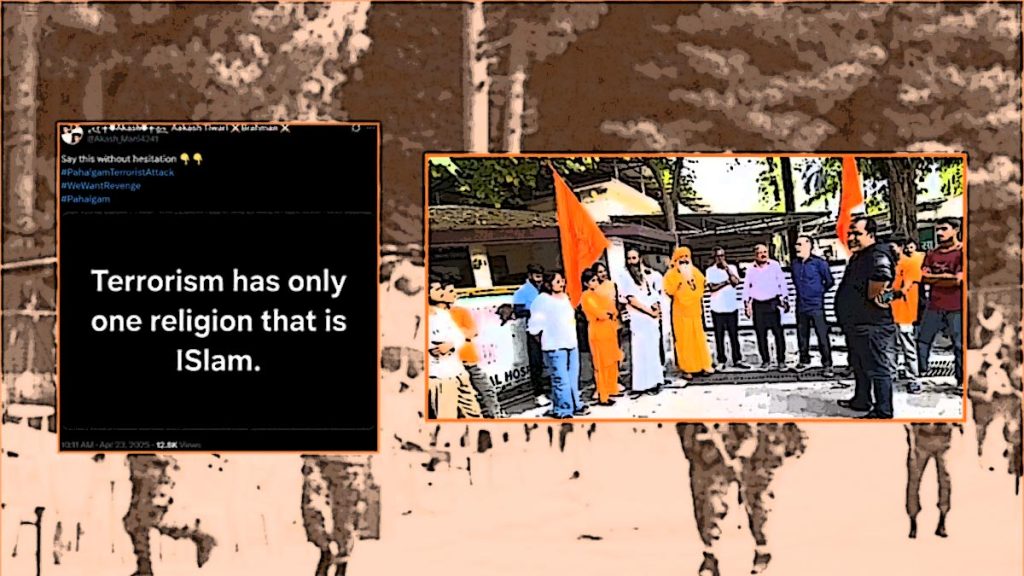
Following the Pahalgam attack, a wave of anti-Muslim incidents reported across the country, from online targeting of Muslim businesses to harassment of shopkeepers and vendors, communal rumours spread like wildfire, igniting fear and fracturing the nation’s social fabric, this is the dangerous consequence of unchecked online hate manifesting in real-world violence In the digital aftermath of the Pahalgam terror attack, a disturbing trend of online hate has taken root, demonstrating a clear object: the economic and social marginalisation of the Muslim community. The meaning behind this digital onslaught is the propagation of collective guilt and the dehumanisation of Muslims, falsely associating an entire religious group with an act of terror committed by individuals. This manifests through the widespread circulation of readymade templates and scripted messages on social media platforms, specifically targeting businesses owned by Muslims and explicitly calling for their economic boycott. The effect of this orchestrated online hate campaign is multi-faceted and deeply damaging. Socially, it fosters an environment of fear and distrust, further polarising communities and entrenching existing prejudices. The constant barrage of hateful content online normalises discrimination and can incite real-world violence and ostracisation. This digital propaganda effectively weaponises social media, turning it into a platform for disseminating prejudice and enacting a form of collective punishment due to stereotypes. In Dombivli, protesters called for economic boycott of Muslim vendors While a protest was organised in Dombivli city of Thane district ostensibly to condemn the Pahalgam terror attack, disturbing elements within the gathering have surfaced, raising serious concerns about the underlying motivations and potential for communal incitement. A video from the event reveals a man addressing the assembled crowd, and instead of solely focusing on denouncing terrorism, he openly called for the economic boycott of non-Hindus within the area. This inflammatory rhetoric specifically targeted the livelihoods of fruit sellers and local vendors, effectively painting an entire community with the brush of suspicion and demanding their economic marginalisation. This shift in focus from condemning a specific act of violence to targeting an entire religious demographic for economic strangulation is deeply alarming. It highlights how events intended to express national solidarity and condemnation of terrorism can be hijacked by individuals seeking to propagate divisive agendas and incite discriminatory practices against minority communities, turning grief and anger into tools for economic coercion and social exclusion within the local sphere of Dombivali. The insidious nature of online hate lies in its ability to spread rapidly and anonymously, leaving a lasting scar on the social fabric and hindering any prospects of reconciliation and understanding. Nine BJP workers booked for ‘abusing, assaulting’ Muslim hawkers in Dadar Similarly, Mumbai police have registered a case against nine BJP workers, including Akshata Tendulkar, president of Mahim Assembly, for allegedly abusing and assaulting Muslim hawkers in the Dadar market area, following a complaint filed by hawker Saurabh Mishra. The case is being handled by the Shivaji Park police. The Indian Express reported that the incident happened on Thursday evening. Tendulkar and his eight associates reached Dadar market area opposite Rangoli store and allegedly asked hawkers if they were Muslims, the complaint read. Mishra added that they assaulted one of the Muslim workers who work under him. “They asked my worker Sofiyan Shahid Ali his name and then abused and assaulted him. When Ali ran away from the place, they chased him and again assaulted him,” Mishra said In a separate account, Tendulkar, speaking to a news channel, defended the group’s actions by asserting they were pressing for police intervention against alleged Bangladeshi nationals using forged Indian documents. He claimed that their repeated complaints about illegal immigrants selling produce in the area had been consistently ignored by law enforcement. “We had requested police to take action against those Bangladeshi nationals who have created fake Indian documents and were selling fruits and vegetables as hawkers. We and local residents were angry over the matter. Local residents were asking us what the BMC and police are doing? On Thursday we had gone on a round to check where all Muslim people works and what (solution) can be done” Tendulkar said, reported the Indian Express. DCP Zone 5 Ganesh Gawde stated that the Shivaji Park police station has registered a case against the nine accused under sections 189(2), 191(2), 115(2), 351(2), and 352 of the Bharatiya Nyaya Sanhita, as well as sections 37(1) and 135 of the MP Act. He confirmed that the investigation into the matter is currently underway BJP’s national spokesperson, Shehzad Poonawalla, offered a similar narrative, using the same platform to urge a different kind of boycott. He took to X, stating, “Dear Hindus Jaat ke naam pe batoge, Toh Dharm ke naam pe katoge Telling you this as an Indian Muslim, Jo tumhe jaati me baante – take a pledge to boycott such people forever #PahalgamTerroristAttack.” Muslim worker removed from temple job by right-wing group In a disturbing manifestation of the heightened communal tensions, a Muslim youth named Shahid reportedly faced the abrupt termination of his employment at a temple. The sole reason cited for his dismissal was his religious identity, with the tragic incident in Pahalgam being used as a pretext. Shahid’s case starkly illustrates the insidious reach of communal prejudice, where an individual’s established work within a place of worship became irrelevant in the face of generalised suspicion directed towards an entire community. A user while sharing the video of incident, wrote o X that “Hindus are no longer in a mood to tolerate. After #PahalgamTerrorAttack, an economic boycott has begun, removing them from business and labour roles. Finally, Hindus are uniting” Indore doctor refused to treat a Muslim patient in response to the Pahalgam attack The ripple effects of the Pahalgam terror attack tragically extended into the realm of healthcare, as evidenced by a deeply concerning incident in Madhya Pradesh’s Indore. Dr. Neha Arora Verma, a medical professional, reportedly refused to treat a Muslim patient, explicitly citing the terror attack as the reason for her denial. The doctor went so far as to
Rahul Gandhi to visit Kanpur to meet Dwivedis
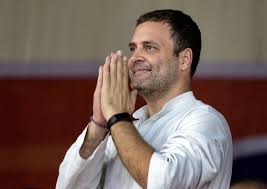
Kanpur: Rahul Gandhi will visit the family of Shubham Dwivedi, who was killed in the Pahalgam terror attack, at their home in Hathipur to offer his condolences. He will travel from Rae Bareli to Kanpur, arriving at Chakeri Airport around 4:15pm on a special flight. At the airport, he will meet with Congress party leaders. He is expected to reach Shubham’s home around 5pm and will stay until approximately 5:30pm, after which he will fly to Delhi. The Congress district president said, “He will visit Shubham’s house to offer condolences and pay tribute.” After his arrival at Chakeri Airport, Rahul Gandhi will be accompanied by local Congress leaders in a convoy to Hathipur village. During his brief stay, Gandhi will meet with the grieving family members and listen to their concerns regarding compensation and govt assistance.tnn Courtesy : TOI Note: This news has been originally published on https://timesofindia.com/state/madhya- and has been used purely for non-profit/non-commercial purposes, especially human rights.
Pahalgam attack: Cong tells its members to refrain from commenting on sensitive issues
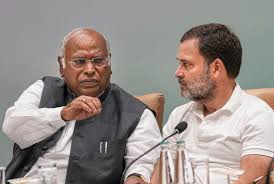
New Delhi: Amid BJP stepping up its attack on some senior Congress members for allegedly questioning the need for war with Pakistan and challenging the accounts of the Pahalgam terror victims that terrorists targeted non-Muslims, the opposition party on Monday distanced itself from the controversial utterances which have given the governing party a handle to beat it with. “Some Congress leaders have been speaking to the media. They speak for themselves and do not reflect Congress’s views,” Congress general secretary Jairam Ramesh said in a statement. The statement came amid mounting attacks from BJP over remarks by Congress members, including Mani Shankar Aiyar, Shashi Tharoor, Karnataka CM Siddaramaiah and his cabinet colleague R B Timmapur, Maharashtra leader Vijay Wadettiwar, J&K Congress president Tariq Hameed Karra and former Union minister Saifuddin Soz. “There should be absolutely no doubt whatsoever at this most sensitive of times that the CWC (Congress Working Committee) resolution, the views expressed by party president Mallikarjun Kharge and Rahul Gandhi and the views of authorised AICC office-bearers alone represent the position of Congress,” Ramesh said, sending out a clear message to party members to refrain from commenting on the sensitive terror attack issue. He said after the CWC passed the resolution, both Kharge and Rahul on the same day attended the all-party meeting and put forward the party’s views. The CWC resolution said, “Cowardly and calculated act of terror, masterminded by Pakistan, is a direct assault on the values of our Republic.” The CWC also flagged intelligence and security failure and called for a comprehensive analysis into the lapses that enabled such the attack. Congress cautioned that the deliberate targeting of Hindus was aimed at inflaming passions as well as accused BJP of exploiting the tragedy to sow seeds of discord. Both Kharge and Gandhi had expressed support for the govt on whatever action it takes on the matter. Aiyar, during a book release event on Saturday, wondered whether the terror attack was a result of “unresolved questions of the Partition”. On Monday, Wadettiwar stirred a controversy as he was quoted as reportedly saying, “The govt should take responsibility for the Pahalgam attack. They (govt) are saying that terrorists killed people after asking them (about their religion). Do terrorists have time for all this.” Siddaramaiah, who found himself caught in the crosshairs for allegedly saying that India does not need a war with Pakistan to avenge the attack, on Sunday accused BJP and the media of misquoting him with a “sinister spin”. Timmapur doubted the veracity of the statements of wives and kin of victims of the terror attack that terrorists had marked non-Muslims out before shooting them dead. Interestingly, Tharoor stirred a controversy with his comments in which he reportedly said there was some failure but no country can ever have a “foolproof, 100% intelligence”. This statement came under attack from Congress leader Udit Raj. “When the BJP govt itself admitted security lapse, then brother Tharoor ji how did you become their lawyer and (are) giving (them a) clean chit?” Raj asked on X. “According to you Congress should guarantee foolproof intelligence to BJP and nothing should be asked of BJP,” he said. Asked about Raj’s remarks, Tharoor said everyone knows that he is not a BJP spokesperson and is, in fact, no one’s spokesperson. “I speak for myself,” he said as reported by news agency PTI. “I believe the person who said this is a former BJP MP, so you can ask him, he is better qualified to understand who speaks for BJP,” Tharoor said. Raj was with BJP before switching to Congress. Courtesy : TOI Note: This news has been originally published on https://timesofindia.com/state/madhya- and has been used purely for non-profit/non-commercial purposes, especially human rights.
‘India must show we stand together’: Rahul urges PM Modi to call special session
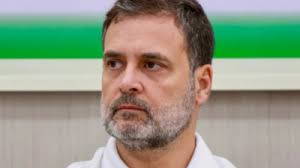
Leader of opposition in the Lok Sabha, Rahul Gandhi, has written to Prime Minister Narendra Modi, requesting that a special session of both Houses of parliament be convened at the earliest following the Pahalgam terror attack. “The terrorist attack in Pahalgam has outraged every Indian. At this critical time, India must show that we will always stand together against terrorism,” Rahul Gandhi said in his letter, which he also shared on social media platform X. He added that Parliament must show the people’s unity and determination in the face of terrorism. “We request that such a special session be convened at the earliest,” Rahul wrote. — RahulGandhi (@RahulGandhi) Earlier Congress president and leader of the opposition in the Rajya Sabha, Mallikarjun Kharge, also wrote to Prime Minister Modi with a similar request. The Congress party has been criticising the government after the Pahalgam attack. At a rally in Rajasthan, Kharge accused PM Modi of skipping the all-party meeting on the issue and said the BJP was trying to divide the country at a time when unity was needed. The terror attack, which took place last Tuesday at the Baisaran meadow in Pahalgam, killed 26 people. It is one of the deadliest attacks in the Kashmir Valley since the Pulwama bombing in 2019, where 40 CRPF personnel lost their lives. Courtesy : TOI Note: This news has been originally published on https://timesofindia.com/state/madhya- and has been used purely for non-profit/non-commercial purposes, especially human rights.
Omar Abdullah has met terrorists, Digvijay Singh’s brother’s statement intensifies politics, said- Rahul Gandhi should take my resignation

MP Politics: There is anger across the country after the Pahalgam terrorist attack. Meanwhile, a senior Congress leader claimed that Omar Abdullah is also involved in this terrorist attack. Former CM and Rajya Sabha MP Digvijay Singh’s brother Laxman Singh even said that if Rahul Gandhi wants, he can take my resignation. Laxman Singh made serious allegations against Omar Abdullah Congress leader said that the CM is in cahoots with terrorists Congress considered Laxman Singh’s statement as indiscipline Bhopal: Former Madhya Pradesh CM Digvijay Singh’s brother Laxman Singh is considered a ‘loudmouth’ leader. But his frank words often make a lot of headlines, so people also start liking him. Another statement of his is in discussion these days. Senior leader Laxman Singh has launched a scathing attack on his party over the Pahalgam terror attack. He has also made serious allegations against Jammu and Kashmir CM Omar Abdullah. This time the Congress party has distanced itself from the statement of former MP Laxman Singh, who gave a statement against the party guidelines. Opposition to his statement has started within the party itself. The party has considered Laxman Singh’s statement as indiscipline. Also, there is talk of taking action against Laxman Singh for indiscipline in the next two days. Gave statement against the party Let us tell you that a candle march was taken out to pay tribute to the dead in the Pahalgam terror attack in Jammu and Kashmir. A meeting was also organized. Addressing this tribute meeting, Laxman Singh, who was hurt by the attack, targeted the CM of Jammu and Kashmir. He also raised questions on Congress leader Rahul Gandhi. He said about Rahul Gandhi that he should give statements on such issues after thinking carefully. He also talked about withdrawing support from the Omar Abdullah government. Laxman Singh has called Omar Abdullah a supporter of terrorists. Rahul Gandhi also targeted Along with Rahul Gandhi, Laxman Singh also targeted Robert Vadra on his statement. Robert Vadra had said that Muslims are not allowed to offer namaz on the road, so terrorists have attacked. On this statement, he said that how long will we bear this childishness, dissolve the government of Kashmir. Taking a dig at Rahul, he said that he is the leader of the opposition, he should speak thoughtfully. Such incidents happen due to their naivety. If Rahul Gandhi wants, he can resign Lakshman Singh has warned the Congress party. He said that if the party wants to expel me, expel me now. I don’t care. If Rahul Gandhi wants, he can resign because for me the country and the countrymen come first. Let us tell you that Laxman Singh has lost the 2023 assembly elections from Chachauda in Guna district to Priyanka Meena of BJP. He has been an MLA from here earlier. This statement was in discussion In December 2023, one of his statements came into discussion. Then he had given a statement about Congress leader Rahul Gandhi that Rahul Gandhi is not a big leader, he is only an MP. Then he told the media that you people should not highlight Rahul Gandhi so much and neither should we. He is just an MP and is like our other MPs. No one becomes a big leader by birth, one becomes by deeds. Do not consider Rahul Gandhi to be such a big leader, I do not believe so. About the author Sanjay Chaturvedi I work for Madhya Pradesh-Chhattisgarh in Navbharat Times Digital. I have joined Navbharat Times from Asianet News Network in journalism. After starting work from Indore city, now Bhopal is my workplace. Courtesy : Edited by Sanjay Chaturvedi | Reported by Deepak Kumar Rai, Hindi News
Bharat Summit: Global leaders back gender justice, condemn Pahalgam terror attack
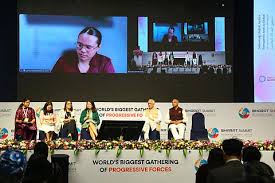
At the Bharat Summit organised by the Congress party in Hyderabad, global policymakers and activists discussed social justice and inclusive growth — and joined a candlelight rally to condemn the Pahalgam attack. The two-day ‘Bharat Summit’ organised by the Congress party in Hyderabad on Friday, April 26 was attended by delegates from around 100 countries including international political leaders, policymakers, and others working toward social justice and inclusive governance in technology and other sectors. At the event, the delegates also condemned the Pahalgam terror attack and expressed solidarity with India. The convention opened with a panel discussion on ‘Gender Justice and a Feminist Future’ where Sweden’s former Minister for Foreign Affairs Ann Linde spoke about challenges in Europe, such as structural disincentives for working women. She called for tax reforms to promote gender equality and emphasised the need for universal access to childcare. “If families cannot combine work and parenting, gender equality will remain out of reach,” she said. Senior Congress leader Salman Khurshid also advocated for tax incentives to increase women’s participation in the workforce. Undram Chinbat, a Member of Parliament from Mongolia, highlighted her country’s emphasis on STEM education for girls and climate-resilient training for rural women affected by desertification. She underscored the need for gender justice in climate policy frameworks. Rabia Abdallah, a senior leader from Tanzania’s Chama Cha Mapinduzi (CCM) party, and other speakers stressed the importance of women’s leadership in political structures to ensure sustained justice. The session also featured Monica Fein, a Socialist Party politician from Argentina, and Maria Alejandra Panay, Minister for Women Affairs from the Republic of Panama. It was moderated by Maharashtra Congress MP Praniti Sushilkumar Shinde. Other key sessions at the summit included discussions on countering disinformation, youth politics, and international relations. At a panel titled ‘Facts vs Fiction: Countering Disinformation’, Miapetra Kumpula-Natri, a former Member of the European Union Parliament, spoke on the EU’s policies for digital literacy, media regulation, and public education. “What is illegal offline must be illegal online,” she said, urging audiences to scrutinise how information is sourced and spread. After the sessions, the delegates joined Telangana Chief Minister A Revanth Reddy in a candlelight rally to condemn the terror attack in Jammu and Kashmir’s Pahalgam. A statement issued on behalf of the delegates read: “We express our solidarity with the people of India and unequivocally condemn the terror attack in the strongest possible terms. Such acts of brutality against peaceful citizens have no place in society and are a direct assault on the constitutional values of unity, peace, and harmony.” Courtesy: The News Minute Note: This news is originally published on https://www.thenewsminute.com and is for use by the non-military/non-commercial community, especially those in the human rights sector.
‘Felt trapped & isolated’: Rahul Gandhi on why he led Bharat Jodo Yatra
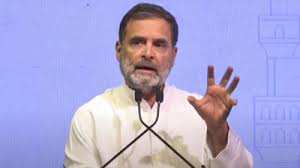
‘Felt trapped & isolated’: Rahul Gandhi on why he led Bharat Jodo Yatra’Felt trapped & isolated’: Rahul Gandhi on why he led Bharat Jodo Yatra NEW DELHI: Congress leader Rahul Gandhi on Saturday said he led his political Bharat Jodo Yatra as his party was “not allowed” to operate the way they wanted and that it felt “completely trapped and isolated”. Addressing the Bharat Summit in Hyderabad, the leader of opposition in the Lok Sabha said that “all avenues were compromised, the media and the general atmosphere”. “Some years ago, we in the Congress party felt completely trapped and isolated. This new politics, aggressive politics, where the Opposition is not talked to, but the idea is to crush the Opposition, we found that all our avenues were compromised, the media, the general atmosphere, did not allow us to operate the way we wanted, so we reached back into history, and decided to walk from Kanyakumari to Kashmir,” Rahul Gandhi was quoted as saying by news agency ANI. The Congress leader said democratic politics has changed over the past 10 years and that the tools that worked back then wouldn’t anymore. He said “new type of politicians need to be constructed”. “As we all know, democratic politics has fundamentally changed across the globe, the rules that would apply a decade ago, simply don’t apply anymore. When I speak to younger member of party, the tools that worked 10 years ago, simply do not work anymore. They cannot face the concentration of capital, modern media, modern social media, so in a sense, the old politician is dead, and a new type of politicians need to be constructed. That is the challenge in front of us,” Rahul Gandhi said. He further said that “we should think about education, regaining democratic space, healthcare, each one of us has a particular view about that”. Rahul Gandhi’s Bharat Jodo Yatra was a 4,000 kilometer march from Kanyakumari to Kashmir, launched in September 2022. Organised by the Congress party, the yatra aimed to connect with people across India, addressing issues like unemployment, inflation, and social harmony. It marked a major political outreach effort for Rahul Gandhi. Courtesy : TOI Note: This news is originally published on https://timesofindia.com and is used purely for non-profit/non-commercial purposes, especially human rights.