
Muslim Girl Marries Dalit Boy in Haryana, Now Seeks Protection, Says MLA Maman Khan is Threatening Her
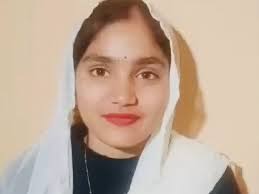
A Muslim girl in Haryana’s Nuh district has married a Dalit boy. Now she has released a video appealing for security. Nuh: The controversy surrounding an inter-caste marriage in a village in the Firozpur Jhirka area is deepening. The girl, Najrana, has alleged that after her inter-caste marriage, which she entered into of her own free will, the boy’s family was subjected to social boycott and forced to leave the village. In her statement, Najrana said that she married Mohit with her full consent and desire and that she is happy and safe with her husband. She clarified that she is of legal age and her statements have been recorded in court. The girl alleged that her family members presented a fake birth certificate in court, even though she is an adult. Family Forced to Leave Village Najrana says that because Mohit belongs to the Dalit community, some people in the village and allegedly MLA Maman Khan socially boycotted Mohit’s family, due to which the family had to leave the village of Patla Shahpuri. Regarding the matter, the SHO of City Police Station Firozpur Jhirka said that the girl is an adult and her statements have been recorded in court. He said that a case was registered on the complaint of the girl’s family members, but during the investigation, the girl stated that she had a court marriage and is living under police protection. Najrana has demanded that the administration provide security to Mohit and his family and resettle them safely in the village. Clarifying the allegations made by her family, the girl said that she did not bring any gold or silver with her, only her essential documents and Aadhaar card. Girl Says: MLA Maman Khan is My Relative A video of the girl, Najrana, has surfaced on social media. In this video of about one and a half minutes, the girl says that her name is Najrana, her father’s name is Junaid, and she is from Firozpur Jhirka. I want to marry Mohit, I am happy with him, and I want to live with him. I have come with Mohit of my own free will, and there is no pressure on me from Mohit or his family. In the video, the young woman, Najrana, also says that MLA Maman Khan is related to my family because he is my grandfather’s aunt’s son. My family, in collusion with Maman Khan, presented a false birth certificate in court. This certificate is completely false; I am of legal age. The young woman also alleges in the video that MLA Maman Khan is threatening and intimidating my husband Mohit’s family and trying to force them out of the village because Mohit belongs to the Dalit community. Due to the threats from MLA Maman Khan, Mohit’s family has left the village. SDM Laxmi Narayan said the entire matter is being monitored. To investigate these allegations, Tehsildar Ravi Kumar reached Padla village and spoke to the villagers. During the investigation, the women and people of the Hindu community in the village clearly stated that there is no atmosphere of social boycott or pressure in the village. According to the villagers, the young man, his father, and uncle left the village on their own in January without informing anyone, while peace prevails in the village and there is no dispute. SDM Ferozepur Jhirka, Laxmi Narayan, said that the entire matter is being monitored and necessary steps will be taken to maintain law and order. No case of migration from the village was observed. Curated by: Rahul Mahajan About the Author Rahul Mahajan is a Principal Digital Content Producer at Navbharat Times Online. He has 12 years of experience in the field of journalism. He has worked with organizations like ETV and News18 (Digital) in his journalistic career. Hindi News
Report finds Adivasi, Muslim, and Dalit communities targeted through politically driven violence in Telangana
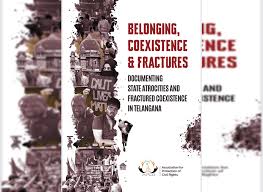
A fact-finding report released by the Association for Protection of Civil Rights (APCR) has concluded that recent incidents of communal violence and social tension across Telangana are not isolated events but part of a broader pattern of politically driven polarisation, institutional bias, and administrative failure, particularly affecting Adivasi, Muslim, Dalit, and other marginalised communities. Titled “Belonging, Coexistence & Fractures: Documenting State Atrocities and Fractured Coexistence in Telangana”, the report is based on field visits, survivor testimonies, interviews with local residents and activists, and an analysis of official records across multiple districts, including Hyderabad, Medchal–Malkajgiri, Narayanpet, Medak, Nizamabad, Nirmal, Adilabad, and Bhainsa. According to the report’s executive summary, many flashpoints in Telangana began as local disputes over land, religious practice, noise, interpersonal conflicts, or administrative decisions, but were subsequently escalated into communal confrontations through organised political mobilisation, misinformation campaigns, and provocative public actions. The report attributes a central role in this escalation to right-wing organisations and affiliated local networks, particularly during politically sensitive periods such as elections. A key outcome of the report is its finding that state institutions, especially the police and district administrations, have frequently failed to act impartially. In several cases documented by APCR, members of Muslim and other minority communities faced delayed police responses, excessive force, false criminal cases, custodial violence, or pressure to withdraw complaints. Oversight bodies such as the SC/ST Commission and the National Human Rights Commission were described as largely inaccessible or ineffective at the ground level, contributing to what the report terms a “climate of impunity.” The report also highlights how communal narratives are being used to divert attention from structural issues such as land alienation, unemployment, erosion of public services, and unequal access to welfare schemes. It notes that Adivasi, Dalit, and Muslim communities, despite sharing similar economic vulnerabilities, are increasingly positioned against one another through identity-based mobilisation, weakening possibilities for collective resistance. Importantly, APCR’s findings do not portray Telangana as uniformly divided. The report documents several instances where communities have resisted polarisation, continued everyday coexistence, and intervened to prevent violence. Civil society groups, women, and youth initiatives are identified as playing a critical role in supporting survivors and de-escalating tensions in the absence of effective state intervention. Concluding its assessment, the report states that communal violence in Telangana is neither inevitable nor driven primarily by grassroots hostility. Instead, it argues that such violence is increasingly “manufactured and sustained” through political strategies that benefit from social division. APCR said the report is intended to serve as a starting point for further public scrutiny, institutional accountability, and policy intervention aimed at safeguarding coexistence, dignity, and constitutional rights in Telangana. Speaking to Maktoob, Nadeem Khan, national secretary of APCR, said, “Our findings show that communal violence in Telangana is not spontaneous or inevitable. In most cases, local disputes are deliberately escalated through political mobilisation, misinformation, and selective state action.” He added, “What we repeatedly observed on the ground was the manufacture of communal flashpoints—small, resolvable issues being transformed into large-scale tensions through organised intervention by right-wing groups.” He further said, attributing this to the report, “Adivasi, Muslim, Dalit, and other marginalised communities are being pitted against one another, despite sharing the same vulnerabilities—land insecurity, unemployment, and weak access to welfare,” and that “instead of acting as neutral protectors, state institutions often became part of the problem. Delayed responses, biased policing, and false cases against victims were recurring patterns across districts.” “Communal violence in Telangana today is better understood as a political strategy than a social reality. Division benefits those in power, while ordinary people bear the cost,” Khan told Maktoob. The report calls for independent investigations into cases of custodial deaths and alleged fake encounters, accountability for hate speech and inflammatory mobilisation, protection of land and housing rights, and reforms to ensure equal treatment of all communities by law enforcement and administrative authorities. Ghazala Ahmad Courtesy : Maktoob Media Note: This news is originally published on https:/maktoobmedia.com/bha and is used purely for non-profit/non-commercial purposes, especially human rights
Is meeting Rahul Gandhi difficult, or is it just a rumor? Are Muslim leaders really being ignored in the Congress party? Find out.
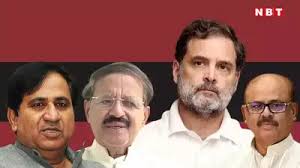
Congress MP Tariq Anwar from Katihar, Bihar, has advised Muslim leaders to communicate with the high command regarding allegations of their neglect. This statement comes after former leader Shakeel Ahmed called Rahul Gandhi a “coward” and Rashid Alvi alleged difficulty in meeting Rahul and neglect of Muslim leaders. Is meeting Rahul Gandhi difficult, or is it just a rumor? Patna: Congress MP Tariq Anwar has appealed to the party’s Muslim leaders that if they feel that Muslim leaders are being neglected, they should discuss the matter with the party’s top leadership. This statement comes at a time when former Congress leader Shakeel Ahmed targeted Rahul Gandhi, calling him an insecure and cowardly leader. Following this, senior Congress leader Rashid Alvi said that Muslim leaders are being neglected in the party and that Rahul Gandhi does not have time to meet Muslim leaders. Meeting Rahul Gandhi is not that easy. Congress MP Tariq Anwar defends Rahul Responding to these statements, Congress MP Tariq Anwar from Katihar, Bihar, said in New Delhi that these are their personal feelings. If there is any such complaint, he has been a senior leader and also a Member of Parliament from the Congress, and he should talk to the Congress leadership about all these matters. If they feel that collective leadership is not being promoted, then this should be discussed. Regarding Congress MP Manickam Tagore’s statement, Tariq Anwar said that if there is such discontent within the party, then why is it there, and it should be properly resolved. The Congress party is a national party, and it is essential for democracy that the Congress party remains strong, improves itself, and works to protect democracy in the country in the future. It should work to save democracy in the country in the coming times. Shakeel Ahmed had called Rahul a ‘coward’ In fact, former Union Minister and senior leader Shakeel Ahmed launched a scathing attack on Rahul Gandhi, calling him a “coward and insecure” leader. Ahmed, a three-time MLA and two-time MP, alleged that Rahul Gandhi feels uncomfortable around senior and popular leaders, which is why he only promotes sycophantic and inexperienced young people. Calling Rahul a dictator and undemocratic, Ahmed said that he does not listen to the advice of senior colleagues. He mocked Rahul’s working style, reminding him that this very attitude led to him losing his family’s traditional seat of Amethi. According to Ahmed, who left the Congress after the 2025 elections, Rahul Gandhi feels insecure in the presence of any prominent personality, which is harming the party’s internal democracy. Meanwhile, on the statement of Congress leader Karti Chidambaram, Congress MP Tariq Anwar from Katihar, Bihar, said that there must be some basis for what Karti said. I don’t deny this, although there is still a debate going on about whether holding simultaneous elections would be right or not. Our constitution grants rights to the states, and any step that harms or weakens those rights will not be acceptable to everyone. Rashid Alvi, who raised questions, U-turns Congress leader Rashid Alvi had said that limited access to the top leadership has created a communication gap in the party. Congress workers also complain that it is no longer easy to meet the Congress high command. There is no platform in the party where issues can be discussed. If people want to express their concerns, where do they go? Not everyone is a member of the Congress Working Committee. He said that Muslim leaders are leaving the party not out of greed for power, but because of the neglect of Muslim leadership. If the neglect of Muslim leadership continues in this way, leaders like Asaduddin Owaisi will continue to become powerful forces in the country. However, Rashid Alvi, who said all this, is now praising Rahul, saying that the country needs Rahul Gandhi. Input – IANS Edited by: Sunil Pandey About the author Sunil Pandey is a Senior Journalist at Navbharat Times Bihar-Jharkhand. He has experience in all three mediums: print, TV, and digital. He has 20 years of experience in politics, sports, business, and ground reporting. He started his career with the prestigious fortnightly magazines Maya and Lokayat. Courtesy: Hindi News
Congress brought in laws against Muslims and Dalits, Owaisi reveals why Khalid and Imam were denied bail
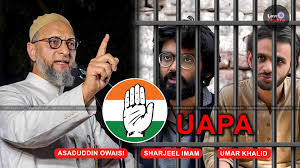
Asaduddin Owaisi Statement: Owaisi said that the then Home Minister P Chidambaram had introduced the UAPA. He was the only person to oppose it in Parliament. Today, this law is not… Asaduddin Owaisi News: All India Majlis-e-Ittehadul Muslimeen (AIMIM) chief Asaduddin Owaisi has blamed the Congress for Umar Khalid and Sharjeel Imam not getting bail. He said that the stringent UAPA under which Umar Khalid and Sharjeel Imam have been booked was implemented during the Congress government’s tenure. The Hyderabad MP was speaking at a public meeting in the Chandni Chowk area under Amravati, Maharashtra, ahead of the municipal elections. Owaisi said that those who talk about secularism during elections are actually enemies of Muslims, Dalits, and tribals, as they use political secularism to get votes. He said that Khalid and Imam were denied bail by the Supreme Court in the 2020 Delhi riots conspiracy case based on Section 15A of the Unlawful Activities (Prevention) Act. Chidambaram had introduced the UAPA During this time, Asaduddin Owaisi also said that the then Home Minister P Chidambaram (during the Congress government) had introduced the UAPA. He (Owaisi) was the only person to oppose it in Parliament. I was the first to say that the police would use this law against Muslims, tribals, Dalits, and intellectuals who understand and oppose the government’s policies. You can see what has happened today. These two young men could not get bail because of the definition of terrorism in that law. Supported the amendment to UAPA in 2019 Owaisi said that Khalid and Imam have been languishing in jail for 5 years. Meanwhile, 85-year-old Stan Swamy, an accused in the Elgar Parishad case, died in jail due to this very law. He said that when the UAPA was amended in 2019, the Congress party had supported the BJP government, which is now ruining the lives of innocent people. This week, the Supreme Court rejected the bail applications of activists Umar Khalid and Sharjeel Imam in the 2020 Delhi riots conspiracy case, but granted bail to five others, citing their level of involvement. By Ranjan Kumar Courtesy: Hindi News
Muslims, Xians, dalits and BCs live in fear in India: Stalin
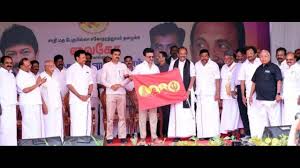
Trichy: Chief minister M K Stalin said Tamil Nadu should unite to prevent drug addiction and the much worse communal addiction from entering the state. Flagging off MDMK general secretary Vaiko’s ‘Equality March’ in Trichy on Friday, chief minister M K Stalin said caste and religious conflicts, along with drug abuse, have emerged as a major problem in the country. The march also aims to create awareness against drug abuse. “Even those holding responsible positions, including Union ministers, make hate speeches and instigate communal clashes,” Stalin said. “For their personal ideology, they are engaging in activities that undermine country’s unity and peace,” he added. Stalin said that a situation has emerged where Muslims, Christians, adidravidars and backward communities are living in fear. “Recent Christmas celebrations saw violence in many parts of the country. Did such a situation exist in India a few years back?” he asked. Stalin said the days when different communities came together and lived joyfully have become a thing of past. He said divisive forces were at work, turning people against one another. “Instead of using spirituality (aanmeegam) to teach love (anbu), some groups use it to create conflict (vambu),” he said. On drug abuse, Stalin said the state and union govts should work together to prevent drugs from entering the country and getting trafficked into states. “Drug trafficking must be dealt with coordinated efforts between state and union govts,” he said. TN govt was extending required support to the union and other state govts to tackle drug abuse, he added. He also urged the film industry not to glorify drugs in movies. “Film industry should create their works with responsibility. Glorifying drugs will destroy an entire generation,” Stalin said. MDMK chief Vaiko said that DMK would return to power with a thumping majority in the upcoming election. Functionaries from VCK, CPI, CPM, IUML, MNM, MMK, and DK participated. VCK chief Thol Thirumavalavan in a veiled attack at TVK and NTK said that entities supporting ‘sanatana forces’ wearing the masks of Dravidam and Tamil nationalism are engaging in divisive politics. “We must stand united to defeat such proxies. Dravidam is not against Tamil. It is because of Dravidam, Tamil is still alive in the state,” he said. Courtesy : TOI Note: This news is originally published on https:/timesofindia.com/bha and is used purely for non-profit/non-commercial purposes, especially human rights
Thackeray brothers need Marathi vote consolidation, sizable Muslim and Dalit votes to win BMC polls
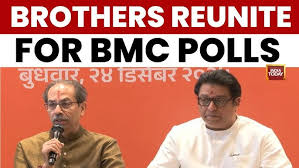
In the BMC polls scheduled on January 15 of next year, Congress has refused to be part of the Thackeray brother alliance, over differences in decent space and number of seats. MUMBAI: If Uddhav Thackeray and Raj Thackeray eye to win the Asia’s largest civic body (Brihanmumbai Municipal Corporation) polls, the leaders have to repeat Shiv Sena (UBT)’s 2024 Lok Sabha performance. It will help them to win as many as 113 seats out of 227 in the BMC polls. However, Shiv Sena (UBT) had won the three seats out of six Lok Sabha seats while it lost one seat, by 34 votes in Mumbai. Congress’s vote base — Muslim and Dalit — and Sharad Pawar’s supporters from the western Maharashtra region who stay in Mumbai, helped to secure several seats. MVA was successful in restricting the BJP and Deputy Chief Minister Eknath Shinde’s Shiv Sena to one seat each only in the financial capital. In the BMC polls scheduled on January 15 of next year, Congress has refused to be part of the Thackeray brother alliance, over differences in decent space and number of seats. Also, Raj Thackeray’s stand against North India is considered problematic for Congress’s North Indian voters. However, the silver lining for Uddhav Thackeray is, Raj Thackeray-led MNS has a seven per cent vote share in Mumbai, which will help them both to fill the gap caused by Shinde-led Shiv Sena and Congress, but that is not enough at all, as there is still a gap of six per cent. Thackerays has to go an extra mile by addressing as many rallies as possible, galvanising the ground network and utilising funds. Only then ther is a possiblity, that they will be able to swing the verdict in their favour. Despite Thackeray’s alliance, the BJP is unfazed and is comfortable on the ground as it has 27 per cent vote share in Mumbai, and even DCM Eknath Shinde will pull in at least five per cent vote share. Most likely, the BJP and Shiv Sena will march towards a historic win in this closely contested BMC election. Shinde led Shiv Sena has won the six state assembly seats in Mumbai, while BJP had won 15, and DCM Ajit Pawar led NCP has won one seat; therefore, arithmetically, BJP and Shiv Sena are unperturbed. The split in Maha Vikas Aghadi has boosted the confidence of the BJP and its Gujarati, Marwari and North Indian vote bank in Mumbai remains unaffected. However, the opposition are getting divided into multiple forces. Meanwhile, if Muslim and Dalit votes get divided among the Thackerays, Congress, NCP SP, Samajwadi Party, MIM, then it will be difficult to repeat the Lok Sabha’s template again in BMC polls. Sudhir Suryawanshi Courtesy : TNIE Note: This news is originally published on https:/thenewindianexpress.com/bha and is used purely for non-profit/non-commercial purposes, especially human rights
BMC Elections 2026: Congress Expands Base With VBA Tie-Up, Aims To Consolidate Dalit & Minority Votes
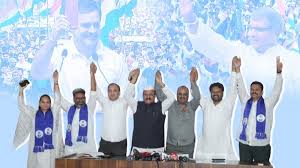
Congress and the Prakash Ambedkar-led Vanchit Bahujan Aghadi (VBA) have formed a surprising alliance for the Mumbai BMC elections, ending 25 years of rivalry. Congress will contest 150 seats, VBA 62, and Rashtriya Samaj Paksha 9-12. The alliance aims to consolidate Dalit, minority, and north Indian votes, posing a challenge to Sena-MNS and BJP ahead of 2029 polls. Mumbai: Burying political animosity of the past 25 years, Congress on Sunday sprung a surprise by joining hands with the Prakash Ambedkar-led Vanchit Bahujan Aghadi (VBA) for BMC elections. Under the arrangement, Congress will contest 150 seats, while VBA will field candidates in 62 wards, leaving 9-12 seats for Rashtriya Samaj Paksha led by Mahadeo Jankar. The alliance was announced by Maharashtra Pradesh Congress Committee (MPCC) president Harshwardhan Sapkal, along with VBA state vice-president Dhairyavardhan Pundkar. Mumbai Congress chief Varsha Gaikwad was absent, reportedly due to her engagement in a screening committee meeting to finalise candidates. The coming together of the Congress and the Vanchit Bahujan Aghadi (VBA) has once again proved that anything and everything is possible when it comes to politics. If we look back into recent electoral history, we will remember that not once but twice the VBA gnawed into the Congress vote base. During the 2014 Lok Sabha and state Assembly elections, the VBA in alliance with the All India Majlis-e-Ittehadul Muslimeen (AIMIM), contributed to the defeat of Congress’ several candidates. In the 2019 elections again, it significantly dented the Congress-NCP alliance’s chances of returning to power on its own. According to Congress leaders, the VBA ensured the defeat of at least 25 candidates from the Congress and the NCP. The party attracted a substantial share of Dalit votes, which traditionally belonged to the grand old party. The VBA is said to have polled 41 lakh votes in the 2024 Lok Sabha elections and 24 lakh votes in the Assembly elections held the same year. Its candidates finished second in 10 constituencies and third in several others. In the 2024 Assembly elections, the VBA impacted nearly 20 seats where the Maha Vikas Aghadi (MVA) lost to the Mahayuti by margins of less than 10,000 votes. Similarly, in the Lok Sabha elections held last year, the MVA lost a few seats due to the presence of VBA candidates in constituencies such as Akola, Buldhana, Hatkanangle and Mumbai North West. The emerging understanding between the Congress and the VBA is being seen as a precursor to a possible alliance ahead of the 2029 elections, according to a party leader. “The Congress cannot remain dependent on the Shiv Sena (UBT), especially as it may continue its alliance with the Raj Thackeray-led MNS, which is against our ideology,” the leader said. The Congress is also keen on expanding its base in Vidarbha, a region that has traditionally been a party bastion. Even in the recent municipal council elections, the party secured its maximum number of seats from Vidarbha. With upcoming elections to municipal corporations and Zilla Parishads, the alliance with the VBA could prove advantageous, the leader added. On the other hand, a Congress-VBA alliance is likely to pose challenges for the Sena (UBT)-MNS combine as it could attract a large share of Dalit votes along with support from north Indian voters and minorities. “North Indians and minorities do not vote for the MNS and this could significantly affect the Thackeray brothers,” the leader said. For the BJP and the Shinde Sena, the alliance may create problems in a few constituencies. However, by denting the Thackeray vote bank, it could also indirectly benefit the Mahayuti. The BJP primarily relies on Gujarati and north Indian voters and requires substantial support from Marathi voters across communities. For the Shinde Sena, the Congress-VBA candidates could come to its aid – provided they draw votes away from the Thackeray faction. Ravikiran Deshmukh Courtesy : TFPJ Note: This news is originally published on https:/thefreepressjournal.com/bha and is used purely for non-profit/non-commercial purposes, especially human rights
Jamia students back Dalit Professor suspended over exam question on atrocities against Muslims
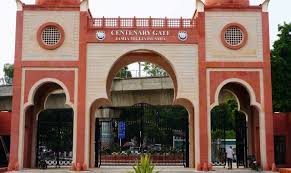
Students of the Department of Social Work at Jamia Millia Islamia have issued a strong statement expressing solidarity with Prof. Virendra Balaji Shahare, who was suspended by the university administration over an end-of-semester examination question asking students to “discuss the atrocities against Muslim minorities in India,” calling the action an “erosion of academic freedom and intellectual autonomy, and an impermissible narrowing of scholarly discourse.” In their statement, the students asserted that the professor had committed “no wrongdoing” and maintained that the question cited as the basis for complaints was fully aligned with the prescribed syllabus. They said the syllabus explicitly mandates critical engagement with issues such as marginalisation, discrimination, violence, and structural injustice, and added that a copy of the syllabus was attached to their statement to substantiate the claim. “Penalising an academic for facilitating critical engagement undermines the very foundation of social science education,” the students said. The students argued that Jamia formally offers courses in Dalit and Minority Studies, Social Inclusion, Human Rights, and Social Justice, disciplines that are premised on critical inquiry and structural analysis. In this context, they said, the action against Prof. Shahare represents an erosion of academic freedom and intellectual autonomy, and an impermissible narrowing of scholarly discourse. The statement strongly criticised the university’s invocation of Statute 37(1) to suspend the professor, calling it “arbitrary, excessive, and legally untenable.” According to the students, the statute allows suspension only in exceptional circumstances involving prima facie evidence of grave misconduct, and solely as a temporary measure pending inquiry. They maintained that setting an examination question approved through institutional mechanisms does not amount to misconduct, negligence, or “unbecoming conduct” under the statute. Highlighting that examination papers undergo multiple levels of moderation and approval, the students questioned why only Prof. Shahare had been singled out. “No questions have been raised against moderation committees, departmental vetting processes, or the Controller of Examinations, who bears statutory responsibility for the conduct of examinations,” the statement said. The students also raised concerns about caste-based discrimination, noting that Prof. Shahare is a Dalit academic, stating, “The suspension reflects a disturbing pattern where individuals from marginalised communities bear the brunt of punitive action, while systemic accountability is evaded,” they alleged. The students described the reported mention of filing a police FIR against the professor as a “dangerous and unjust escalation,” warning that it could set a precedent for criminalising pedagogy. “Academic disagreements or public discomfort cannot and must not be converted into criminal liability,” the statement said. The students demanded immediate and permanent revocation of Prof. Shahare’s suspension, withdrawal of any legal action, a public apology from the university, assurances against scapegoating faculty from marginalised communities, and a reaffirmation of Jamia’s commitment to academic freedom and constitutional values. “We stand with our professor. We reject this injustice. And we will continue to speak until it is corrected,” they asserted. Similarly, students of the Department of Political Science at Jamia Millia Islamia condemned the suspension and demanded its immediate revocation, stating that “institutions of higher learning must address internal disagreements through transparent, proportionate, and procedurally fair mechanisms.” The students warned that such action affects not only the faculty member concerned but also the academic environment and students’ right to a free and critical learning space, adding that dialogue, not punitive measures, must remain the guiding principle of university governance. Virendra Balaji Shahare, was the paper setter for the BA (Hons) Social Work Semester-I examination titled Social Problems in India for the academic session 2025–26. The suspension comes after Prof. Shahare included a question asking students to “discuss the atrocities against Muslim minorities in India” in the examination paper he set, sparking outrage among students, fellow teachers, and rights groups/ The university stated that it had received several complaints from various sources regarding the content of the question paper. In its order dated December 23, 2025, the university stated that the competent authority had taken a “serious view” of what it described as the professor’s negligence and carelessness. Acting on the instructions of the competent authority, Jamia said Prof. Shahare had been placed under suspension pending further orders. The Jamia Millia Islamia unit of the Fraternity Movement has demanded the revocation of the teacher’s suspension, calling it a move to defend academic freedom. The order further stated that a police FIR would be filed “as per rules” in connection with the matter. Invoking Statute 37(1) of the Statutes of the University, the Vice-Chancellor ordered disciplinary action, stating that the alleged negligence amounted to an act “unbecoming” of a faculty member. Earlier, several student organisations, including AIDSO, AIMSU, AIRSO, AISA, DISSC, MSF, the Fraternity Movement, SFI, and SIO, in a joint statement condemned the suspension, stating that the examination question asking students to “discuss the atrocities against Muslim minorities in India” was clearly syllabus-based and academically legitimate. They called the university’s decision to suspend him and file a police FIR an unprecedented, disproportionate, and dangerous attack on academic autonomy, democratic functioning, and Jamia’s historical legacy of critical inquiry. They also demanded the immediate revocation of the suspension and withdrawal of all punitive proceedings. Courtesy : Maktoob Media Note: This news is originally published on https:/maktoobmedia.com/bha and is used purely for non-profit/non-commercial purposes, especially human rights
Delhi Dalit OBC minorities body members wear Ambedkar masks pledge to save Constitution
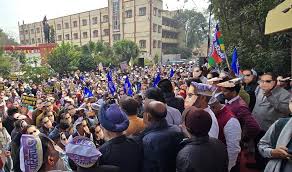
New Delhi, A large number of members of the Confederation of Dalit, OBC, Minorities and Adivasi Organisations (DOMA Parisangh) gathered at the Ambedkar Bhawan here, taking a pledge to save the Constitution of India in front of Ambedkar’s statue by wearing masks with his face on them. Earlier, the DOMS Parisangh was scheduled to hold a rally at Ramlila Maidan, but following a BJP leader’s complaint, the NOC by the police was denied. DOMS Parisangh chairman and Congress leader Udit Raj said that, being disciplined and law-abiding citizens, they changed the original program from Ramlila ground to Ambedkar Bhawan, as thousands of people attended. Campaigning and mobilising the team members had been underway since July, and the cancellation was announced, yet some people still reached the Ramlila Maidan and were mistreated by the police, Udit Raj alleged. He said people arrived peacefully at the Ambedkar Bhawan to take the pledge amid heavy police deployments, which prevented them from marching. Addressing the gathering, Udit Raj said that saving the Constitution and democracy is no longer within the power of political parties alone, as all constitutional institutions have become weak, and a few individuals cannot protect them through struggle. A mass movement is the only option to save the Constitution, he said. (This story has not been edited by THE WEEK and is auto-generated from PTI) Courtesy : The Week Note: This news is originally published on https:/theweek.com/bha and is used purely for non-profit/non-commercial purposes, especially human rights
Dalits, minorities targeted for deletions: VCK chief Thol Thirumavalavan on SIR
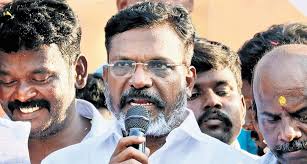
Addressing reporters at the party’s headquarters, he claimed that several constituencies with significant Dalit and minority populations are witnessing “unnatural” levels of voter-list deletions. CHENNAI: Viduthalai Chiruthaigal Katchi (VCK) president Thol Thirumavalavan on Tuesday alleged large-scale irregularities in the ongoing Special Intensive Revision (SIR) of electoral rolls and urged the Election Commission of India (ECI) to immediately intervene to ensure free and fair elections in Tamil Nadu. Addressing reporters at the party’s headquarters in Chennai, he claimed that several constituencies with significant Dalit and minority populations are witnessing “unnatural” levels of voter-list deletions. He said the pattern appears “targeted and deliberate” and warned that such actions could “distort the democratic rights” of marginalised communities. Thirumavalavan alleged that political forces “aligned with the BJP” are attempting to influence the revision process by filing mass objections and facilitating relocation of voters from other states into select constituencies. “These are coordinated attempts to alter voter demographics ahead of the 2026 polls,” he said. The VCK leader also criticised the ECI for what he described as “a lack of adequate monitoring” at the field level. He urged the ECI to deploy special observers, verify deletion requests and publish constituency-wise data on additions and removals to maintain transparency. Stating that TN had always maintained a “high standard of electoral integrity”, he said any deviation would undermine public confidence. He further announced that VCK would submit a detailed memorandum to the chief electoral officer highlighting specific irregularities. Calling for united action, Thirumavalavan appealed to all INDIA bloc parties to remain vigilant and protect the voting rights of all citizens. He further announced a protest against the ongoing SIR, calling to stop the exercise immediately on November 24 in Chennai. Courtesy : TNIE Note: This news is originally published on https:/thenewindianexpress.com/bha and is used purely for non-profit/non-commercial purposes, especially human rights