
80% of Pakistan is gay: Karachi transgender activist Hina Baloch’s viral claim

Pakistani transgender activist Hina Baloch claimed in a viral video that “80% of Pakistanis are gay,” calling it an “open secret” hidden by social and religious pressures. How do cultural pressures affect LGBTQ+ visibility in Pakistan? What basis does Hina Baloch use for her 80% claim? How do cultural pressures affect LGBTQ+ visibility in Pakistan? Why do Indian trans activists oppose the 2026 bill? A viral video featuring Pakistani transgender activist Hina Baloch has triggered widespread debate after she claimed that “80% of Pakistan is gay and the remaining 20% are bisexual,” arguing that sexuality in the country is largely hidden due to social pressure, religion, and family honour. In an interview with Queer Global YouTube Channel, Baloch describes what she calls an “open secret” in Pakistani society. “I believe that more than half of Pakistan is quite gay actually. They don’t want to just say it out loud, but I guess 80% of Pakistan is gay and the remaining 20% are bisexuals, so I don’t think that anybody is straight in Pakistan in terms of their sexuality,” she says. She adds that people often deny or conceal their sexual orientation, citing cultural and religious factors. “They will deny it, they will bring religion into it, they will bring culture into it, but this is an open secret. Nobody’s straight in Pakistan,” Baloch says, while recounting her own perceptions growing up. Reflecting on her personal experiences, Baloch says her concerns were less about sexuality and more about gender expression. “What I was worried about was how to apply lipstick and not get lots of shit from the family for that. How do I get to dress feminine, wear jewellery and not get the beatings?” she says. Baloch also speaks about the structural challenges faced by the khawaja sira community in Pakistan, noting that many are pushed into limited and often exploitative livelihoods such as begging, dancing, or sex work. Rejecting these constraints, she became actively involved in organising for gender and minority rights. She went on to co-found Sindh Moorat March and participated in Pakistan’s Aurat March, positioning herself as a vocal advocate for transgender and minority rights. Baloch has previously said she faced violent retaliation after raising a Pride flag at a protest and survived kidnapping and abuse by law enforcement, experiences that ultimately forced her to leave Pakistan. She later secured a scholarship to SOAS, University of London, and sought refugee status in the United Kingdom. Written By: Akshat Trivedi Courtesy : India Today Note: This news is originally published on https:/indiatoday.com/bha and is used purely for non-profit/non-commercial purposes, especially human rights
Nepal to issue formal apology to Dalits within 15 days

KATHMANDU: Nepal’s new govt said it would issue a “formal state apology” to Dalits and other historically excluded communities within 15 days under prime minister Balendra Shah’s 100-point reform agenda, in what activists described as a historic acknowledgment of generations of caste-based discrimination, exclusion and denial of opportunity. The proposed apology is to be accompanied by measures on social justice, inclusive restoration and historical reconciliation. The agenda said: “We will formally acknowledge the injustice, discrimination and deprivation of opportunities inflicted on Dalits and historically marginalised communities by the state, society and policy structures, and prepare the basis for social justice, inclusive restoration and historical reconciliation.” It added that a reform-oriented programme would be announced too. The promise has drawn attention in a country where Dalits make up about 13-14% of the population but continue to face entrenched exclusion despite constitutional guarantees and laws against caste-based discrimination and untouchability. Activists said nearly 42% of Dalits lived below the poverty line, literacy remained below the national average, and representation in key institutions stayed disproportionately low. For many, the issue remained deeply personal. Saraswati Nepali, president of the Dalit Society Development Forum in Baitadi, recalled that as a child she was not allowed to drink from the same water jar as her classmates and had to walk home for water because she was Dalit. “The state’s official apology will be like a balm for our wounds,” she said. “But for it to heal entirely, govt must effectively ensure all our guaranteed rights. That would give us justice and ensure our dignity.” Dalit activist Hira Lal Bishwakarma welcomed the announcement, but said its meaning would depend on implementation. “The current decision is honourable, but there is fear that it will only be lip service like in the past,” he said. “After announcing such programmes, policies, budgets, and structures are needed. Without them, it is good to show such announcements externally, but the Dalit community does not get justice.” Amrita Ban, 23, a Gen Z activist, told TOI the move had raised expectations among young voters. “A state apology to a community that has faced discrimination for generations is historic and a positive beginning. I strongly welcome the decision…I am hopeful it will also bring concrete measures to end discrimination at its roots.” Rakshya Bam, 26, said, “If govt backs this with budgets, enforcement and accountability, it could mark a significant shift in Nepal’s response to caste injustice. Without that, the apology could become a powerful acknowledgment of the past, but fall short of changing the present.” Courtesy : TOI Note: This news is originally published on https:/timesofindia.com/bha and is used purely for non-profit/non-commercial purposes, especially human rights
Newly Formed Nepal Government to Apologise to Dalits for Decades of Discrimination

Balendra Shah announced that Nepal’s government will formally apologise to Dalit communities for historical discrimination within 15 days. The move, part of a 100-point reform agenda, aims to address caste-based injustice and promote equality, though its impact will depend on effective implementation. The newly formed government of Nepal has decided to issue a formal apology to Dalit and historically marginalised communities for decades of discrimination and exclusion. Prime Minister Balendra Shah, popularly known as Balen Shah, took oath on March 27 and made the announcement as part of a 100-point Governance Reform Agenda approved in the Cabinet’s first meeting. Government to Acknowledge Historical Injustice According to the official plan, the state will recognise the injustices faced by Dalits due to long-standing social practices and state policies. “The government will formally apologise on behalf of the state within 15 days and announce programmes focused on justice, equality, and socio-economic upliftment,” the agenda states. This move is being seen as one of the most significant steps by any Nepali government to address caste-based discrimination. Deep Roots of Caste Discrimination Nepal has a long history of caste hierarchy linked to the traditional Hindu social order. The Muluki Ain of 1854 had legally enforced caste divisions and treated Dalits as “untouchables.” Although untouchability was abolished in 1963 and equality was guaranteed in later constitutions, discrimination continues in practice. Dalits, who make up around 13% of the population, still face barriers in education, jobs, and access to public resources. Reports by global organisations have repeatedly highlighted these inequalities. Balen Shah’s Rise to Power Shah became Nepal’s 47th Prime Minister after being appointed by President Ram Chandra Paudel. His rise reflects a shift in public mood, especially among younger voters demanding change. His leadership comes after major protests in 2025, led largely by young people, against corruption and poor governance. The protests resulted in the fall of the previous government and fresh elections. A former rapper and engineer, Shah is considered one of the youngest leaders to hold the post and represents a new political wave in the country. 100-Point Reform Plan Focuses on Governance and Justice The government’s 100-point agenda includes reforms in administration, anti-corruption measures, digital governance, economic policy, and public services. The inclusion of an apology to Dalits highlights the government’s focus on social justice along with governance reforms. Dalit leaders and activists have welcomed the decision. Many, however, stressed that the real impact will depend on how effectively the promised reforms are implemented. Next Steps and Expectations The government has set a 15-day deadline to issue the formal apology and announce detailed programmes for upliftment and inclusion. Observers say the move could mark a new phase in Nepal’s efforts to build a more equal and inclusive society. Courtesy : TOP Note: This news is originally published on https:/theobserverpost.com/bha and is used purely for non-profit/non-commercial purposes, especially human rights
‘Conflict has reached our backyard’: Rahul Gandhi targets Centre after Iranian warship sunk in Indian Ocean

NEW DELHI: Leader of opposition Rahul Gandhi on Thursday targeted the Centre after a US submarine sank an Iranian warship, IRIS Dena, warning that the conflict in West Asia poses serious risks for India’s energy security. In a post on X, Rahul Gandhi said the world was entering a turbulent phase and accused Prime Minister Narendra Modi of saying “nothing”. “The world has entered a volatile phase. Stormy seas lie ahead. India’s oil supplies are under threat, with more than 40% of our imports transiting the Strait of Hormuz. The situation is even worse for LPG and LNG,” Rahul Gandhi wrote. Rahul also referred to the sinking of the Iranian frigate IRIS Dena, which had recently taken part in the Indian Navy’s Milan naval exercise before heading back through the Indian Ocean. “The conflict has reached our backyard, with an Iranian warship sunk in the Indian Ocean. Yet the Prime Minister has said nothing,” he said. Calling for stronger leadership in the face of growing geopolitical tensions, Rahul said the country needed a firm and steady response. “At a moment like this, we need a steady hand at the wheel,” he wrote. “Instead, India has a compromised PM who has surrendered our strategic autonomy,” Rahul said. The remarks came after the US Navy sank the Iranian Moudge-class frigate IRIS Dena in the Indian Ocean earlier this week using a Mark-48 torpedo launched from a submarine, an attack that reportedly killed dozens of sailors. Iran has strongly condemned the strike, calling it an “atrocity at sea” and warning that the United States would “bitterly regret” the precedent set by attacking the vessel. Iranian officials also pointed out that the frigate had recently visited India as part of naval engagements linked to the Milan exercise. The incident comes amid a rapidly widening conflict in West Asia, with missiles, drones and rockets being exchanged across Iran, Israel and other parts of the region. Courtesy : TOI Note: This news is originally published on https:/timesofindia.com/bha and is used purely for non-profit/non-commercial purposes, especially human rights
‘India must be morally clear’: Rahul Gandhi urges PM Modi to ‘speak up’ on Iran crisis

NEW DELHI: Congress leader Rahul Gandhi on Tuesday urged Prime Minister Narendra Modi-led government to take a clear and moral stand amid escalating hostilities between the United States, Israel and Iran. In a post on X, Rahul said the region was being pushed “toward wider conflict” and warned that millions, including nearly a crore Indians, faced uncertainty due to the deteriorating security situation. “Escalating hostilities between the United States, Israel and Iran are pushing a fragile region toward wider conflict. Crores of people, including nearly a crore Indians, face uncertainty,” Rahul said. “While security concerns are real, attacks that violate sovereignty will only worsen the crisis. The unilateral attacks on Iran, as well as Iran’s attacks on other Middle Eastern nations, must be condemned. Violence begets violence – dialogue and restraint remain the only path to peace,” he added. Rahul said India’s foreign policy traditions demand clarity during periods of global instability. “India must be morally clear. We should have the courage to speak plainly in defence of international law and human lives. Our foreign policy is rooted in sovereignty and the peaceful resolution of disputes — and it must remain consistent,” he said. In a pointed remark aimed at Prime Minister Narendra Modi, Rahul Gandhi questioned the government’s position on recent developments. “PM Modi must speak up. Does he support the assassination of a head of state as a way to define the world order? Silence now diminishes India’s standing in the world,” he added. Meanwhile, the ministry of external affairs (MEA) said on Tuesday that limited flight operations have resumed from Dubai amid continued airspace disruptions in the region. US and Israel conducted airstrikes across multiple Iranian cities on February 28, targeting military command centres, air-defence systems, missile sites, and key regime infrastructure. These strikes resulted in the death of Iranian Supreme Leader Ayatollah Khamenei and four senior military and security officials, with large explosions reported in Tehran and other major cities. Courtesy : TOI Note: This news is originally published on https:/timesofindia.com/bha and is used purely for non-profit/non-commercial purposes, especially human rights
Who was Jesse Strang? 18-year-old named in Canada school shooting that left 10 dead, dozens injured

Canadian authorities are investigating a deadly shooting that killed 10 at Tumbler Ridge Secondary School after reports named 18-year-old Jesse Strang as the suspected gunman.Two Canadian news outlets, Western Standard and Juno News, reported that Strang was also transgender. The outlets said they received the name from a close family member. The Royal Canadian Mounted Police (RCMP) has not officially confirmed the suspect’s identity. The shooting happened on Tuesday at about 1:20 pm local time in Tumbler Ridge, a small town in northeastern British Columbia, about 1,100 kilometers north of Vancouver. Police responded to reports of an active shooter at the school. A public safety alert was sent out telling residents to stay indoors. According to the RCMP, ten people were killed, including the gunman. More than two dozen others were injured. Police said they believe the shooter died from a self-inflicted gunshot wound inside the school. Investigators also found additional victims at a nearby home that they believe is connected to the case. RCMP Superintendent Ken Floyd told reporters that investigators believe they know who the shooter was. However, police are not releasing the name at this time. Floyd said the decision was made out of respect for the victims’ families and to protect the investigation. Police have also said they do not yet know the motive. They are still working to determine how the victims were connected to the suspect. The shelter-in-place order was lifted later that evening after police said there was no longer a threat to the public. Students and staff who remained inside the school were safely evacuated. Tumbler Ridge has a population of about 2,400 people. Authorities said both the elementary and secondary schools will stay closed for the rest of the week. Counseling and support services are being offered to students, staff, and families. Canadian Prime Minister Mark Carney and British Columbia Premier David Eby released statements expressing sorrow and offering condolences to the families of those killed. Courtesy : TOI Note: This news is originally published on https:/timesofindia.com/bha and is used purely for non-profit/non-commercial purposes, especially human rights
12 Bangladeshi Transgender Nationals Living Illegally Detained in Mumbai, Deportation Process Initiated

The Anti-Terrorism Cell (ATC) of Versova Police has detained 12 Bangladeshi transgender nationals who were found to be . The Anti-Terrorism Cell (ATC) of Versova Police has detained 12 Bangladeshi transgender nationals who were found to be residing illegally in India. The action was carried out on February 4 and 5, 2026, at multiple locations in Andheri West and Malvani, According to police officials, the first operation was conducted in the early hours of February 4 at around 3:30 am at the premises of Shakrullah Shah Baba Dargah on JP Road, Versova. During routine bandobast duty, police personnel noticed nine transgender individuals conversing in the Bangladeshi dialect. On questioning, all of them admitted to being Bangladeshi nationals and revealed that they had entered India illegally without any valid documents or permission. The second operation took place on February 5 at around 1:30 pm in the Old Madha area of Andheri West, including Hanuman Mandir Lane and a nearby residential complex. Three more Bangladeshi transgender nationals were detained from the spot. During investigation, Bangladeshi mobile numbers, birth certificates and other digital evidence were recovered from their possession, confirming their nationality. Police investigations further revealed that all the detained individuals were using mobile applications to remain in contact with associates in Bangladesh. Action has been initiated against them under the Foreigners Act, and the process to deport them from India has begun. Regional Registration Office (FRRO), and the concerned Deputy Commissioner of Police. The entire operation was carried out under the leadership of Senior Police Inspector Dipshikha Bhagyashree Avhad Ware, under the guidance of the Additional Commissioner of Police and the Deputy Commissioner of Police, Zone-09. Police officials stated that such strict action against foreign nationals residing illegally in India will continue in the future. By vishal.singh Courtesy : Lokmat Times Note: This news is originally published on https:/lokmattimes.com/bha and is used purely for non-profit/non-commercial purposes, especially human rights
Indo-US trade deal a death knell for farmers: Congress

Jandiala Guru: Congress leaders on Friday sounded alarm bells over the Indo-US trade deal, saying it will sound the death knell for the country’s farmers as the US agricultural products will flood Indian markets. They also alleged that Prime Minister Narendra Modi surrendered under pressure from the US President Donald Trump and was forced to accept these conditions, which were against the country’s interests. Addressing the ‘MGNREGA Bachao Sangram’ rally here on Friday, the Congress leaders resolved that, in the way PM Modi was forced to withdraw the three controversial “black” agricultural laws, the same way he will be forced to restore the MGNREGA by the Congress. Bhupesh promised that, in case the BJP govt does not restore the MGNREGA, the Congress govt, which will be formed in Punjab in 2027, will make special provisions for the poor labourers so that they are not affected by its withdrawal. Similarly, he said, once the Congress govt is formed at the Centre in 2029 with Rahul Gandhi as the PM, the MGNREGA will be restored in its original form. Referring to the Indo-US trade deal, he said it was the sign of a weak PM who completely surrendered before Trump. He said, under Modi, the country was seen as weak as it was being arm-twisted by the US and the Chinese. Speaking on the occasion, the Punjab Congress President Amarinder Singh Raja Warring blamed both the central and the state govt for the failure to implement the MGNREGA scheme in Punjab. He said that while Modi scrapped the scheme now, chief minister Mann already failed as Punjab was providing negligible work under this scheme. Warring also lashed out at the BJP and its leaders for trying to distort the conversation between Rahul Gandhi and Ravneet Singh Bittu. Giving details of the conversation, he said he was very much present on the occasion when Rahul addressed Bittu as his “traitor friend”. He condemned the BJP for trying to give communal colour to the issue and accuse Rahul of insulting the Sikhs. He pointed out it was Bittu himself who said it so many times that he started wearing a turban at the behest of Rahul Gandhi only. Moreover, he added, Rahul Gandhi had so much faith and respect for the Sikh religion that he performed seva at Darbar Sahib round the clock. “Can such a person really insult Sikhs?” he asked. Courtesy : TOI Note: This news is originally published on https:/timesofindia.com/bha and is used purely for non-profit/non-commercial purposes, especially human rights
US SC likely to uphold state bans on transgender athletes in women’s sports
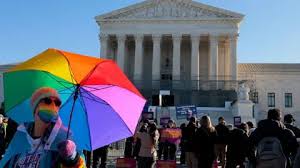
The justices are evaluating claims of sex discrimination lodged by transgender people versus the need for fair competition for women and girls, the main argument made by the states The Supreme Court on Tuesday appeared ready to deal another setback to transgender people and uphold state laws barring transgender girls and women from playing on school athletic teams. The court’s conservative majority, which has repeatedly ruled against transgender Americans in the past year, signaled during more than three hours of arguments it would rule the state bans don’t violate either the Constitution or the federal law known as Title IX, which prohibits sex discrimination in education. More than two dozen Republican-led states have adopted bans on female transgender athletes. Lower courts had ruled for the transgender athletes who challenged laws in Idaho and West Virginia. The legal fight is playing out against the backdrop of a broad effort by President Donald Trump to target transgender Americans, beginning on the first day of his second term and including the ouster of transgender people from the military and declaring that gender is immutable and determined at birth. The justices are evaluating claims of sex discrimination lodged by transgender people versus the need for fair competition for women and girls, the main argument made by the states. Justice Brett Kavanaugh, who coached his daughters in girls basketball, seemed concerned about a ruling that might undo the effects of Title IX, which has produced dramatic growth in girls and women’s sports. Kavanaugh called Title IX an amazing and inspiring success. Some girls and women might lose a medal in a competition with transgender athletes, which Kavanaugh called a harm we can’t sweep aside. The three liberal justices seemed focused on trying to marshal a court majority in support of a narrow ruling that would allow the individual transgender athletes involved in the cases to prevail. A ruling for West Virginia and Idaho would effectively apply to the other two dozen Republican-led states with similar laws. But the justices soon might be asked to decide about the laws in an additional roughly two dozen states, led by Democrats, that allow transgender athletes to compete on the teams that match their gender identity. The outcome also could influence separate legal efforts by the Trump administration and others seeking to bar transgender athletes in states that have continued to allow them to compete. The transgender athletes’ cases In the Idaho case, Lindsay Hecox, 25, sued over the state’s first-in-the-nation ban for the chance to try out for the women’s track and cross-country teams at Boise State University in Idaho. She didn’t make either squad because she was too slow, her lawyer, Kathleen Hartnett, told the court Tuesday, but she competed in club-level soccer and running. Becky Pepper-Jackson, a 15-year-old high school sophomore, was in the courtroom Tuesday. She has been taking puberty-blocking medication, has publicly identified as a girl since age 8 and has been issued a West Virginia birth certificate recognizing her as female. She is the only transgender person who has sought to compete in girls sports in West Virginia. Pepper-Jackson has progressed from a back-of-the-pack cross-country runner in middle school to a statewide third-place finish in the discus in just her first year of high school. Prominent women in sports have weighed in on both sides. Tennis champion Martina Navratilova, swimmers Summer Sanders and Donna de Varona and beach volleyball player Kerri Walsh-Jennings are supporting the state bans. Soccer stars Megan Rapinoe and Becky Sauerbrunn and basketball players Sue Bird and Breanna Stewart back the transgender athletes. In 2020, the Supreme Court ruled LGBTQ people are protected by a landmark federal civil rights law that prohibits sex discrimination in the workplace, finding that sex plays an unmistakable role in employers’ decisions to punish transgender people for traits and behavior they otherwise tolerate. But last year, the six conservative justices declined to apply the same sort of analysis when they upheld state bans on gender-affirming care for transgender minors. Chief Justice John Roberts signaled Tuesday he sees differences between the 2020 case, in which he supported the claims of discrimination, and the current dispute. The states supporting the prohibitions on transgender athletes argue there is no reason to extend the ruling barring workplace discrimination to Title IX. Idaho’s law, state Solicitor General Alan Hurst, said, is necessary for fair competition because, where sports are concerned, men and women are obviously not the same. Lawyers for Pepper-Jackson argue that such distinctions generally make sense, but that their client has none of those advantages because of the unique circumstances of her early transition. In Hecox’s case, her lawyers want the court to dismiss the case because she has forsworn trying to play on women’s teams. NCAA president Charlie Baker told Congress in 2024 that he was aware of only 10 transgender athletes out of more than a half-million students on college teams. But despite the small numbers, the issue has taken on outsize importance. Baker’s NCAA and the US Olympic and Paralympic Committees banned transgender women from women’s sports after Trump, a Republican, signed an executive order aimed at barring their participation. About 2.1 million adults, or 0.8 per cent, and 724,000 people age 13 to 17, or 3.3 per cent, identify as transgender in the US, according to the Williams Institute at the UCLA School of Law. A decision is expected by early summer. (Only the headline and picture of this report may have been reworked by the Business Standard staff; the rest of the content is auto-generated from a syndicated feed.) AP Washington Courtesy : Business Standard Note: This news is originally published on https:/businessstandard.com/bha and is used purely for non-profit/non-commercial purposes, especially human rights
Indian Tourist Beaten By Transgender Group In Pattaya After Payment Row, Video Viral

After Raj was injured, a formal complaint was filed, prompting legal action. However, Jasuja has not yet made any public statement regarding the matter. An Indian tourist was assaulted by a group of transgender women in Thailand’s Pattaya following an alleged dispute over payment for sexual services, according to local reports. The incident took place in the early hours of December 27 and was captured on camera. Pulled Out of Car, Beaten in Public The victim, identified as 52-year-old Raj Jasuja, was reportedly dragged out of his car and beaten after he refused to pay the agreed amount. The assault occurred on a public road, with footage of the incident later circulating online. Victim Hospitalised With Injuries Jasuja sustained injuries to his face and head during the attack and was subsequently admitted to hospital for treatment. Details regarding the extent of his injuries were not immediately available. Attacks On Indians On The Rise Lately, attacks on Indian tourists have been on the rise in Pattaya. Pongpol Boonchid, a 19 year-old told police that the quarrel escalated when the two began chasing each other and a physical attack ensued. After Raj was injured, a formal complaint was filed, prompting legal action. However, Jasuja has not yet made any public statement regarding the matter. Several such disputes have been occurring between Indian tourists and transwomen sex workers in Pattaya in recent months. Previously, in September an Indian man was attacked, and in October three transwomen were also accused of assaulting two Indians and fleeing with nearly 24,000 baht in cash. By Sagarika Chakraborty About the author Sagarika Chakraborty Sagarika Chakraborty is a Senior Copy Editor at ABP Live English, where she handles business coverage and key developments in general news, while also actively chasing breaking stories. With a foundation in advertising, she transitioned into journalism to craft in-depth stories and explainers on the economy, real estate, and personal finance. She also engages in interviews and podcasts, bringing out expert insights. Courtesy : abp live Note: This news is originally published on https:/abplive.com/bha and is used purely for non-profit/non-commercial purposes, especially human rights