
IIT Mandi Janmashtami Poster Controversy: Inquiry Committee Says No Intent to Target Community, Students Will Now Be Counseled
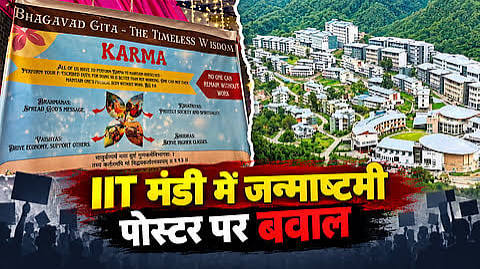
The inquiry committee also concluded in its report that the provisions of the Scheduled Castes and Scheduled Tribes (Prevention of Atrocities) Act, 1989, are not applicable in this case. Mandi – The three-member inquiry committee formed to investigate the controversial caste-based poster displayed during a Janmashtami event at the Indian Institute of Technology (IIT) Mandi has recommended counseling and sensitization training instead of disciplinary action against the students involved. The committee also stated that it found no evidence of an intent to target, insult, or offend any individual or community. The inquiry committee also concluded in its report that the provisions of the Scheduled Castes and Scheduled Tribes (Prevention of Atrocities) Act, 1989, are not applicable in this case. Following the controversy, IIT Mandi will now formulate clear rules and guidelines for student events held on campus and establish a system to monitor such events. What was the entire controversy? The controversy began with a poster displayed during a student-led Janmashtami event held on September 4th at the IIT Mandi campus. The poster was titled “Bhagavad Gita – The Timeless Wisdom.” After photos and videos of the poster surfaced on social media, it sparked strong reactions. The poster divided society into four groups: Brahmins, Kshatriyas, Vaishyas, and Shudras, assigning distinct roles to them. The poster stated that Brahmins spread God’s message, Kshatriyas protect society, Vaishyas support others by running the economy, and Shudras serve the upper castes. The poster also referenced a verse from the Bhagavad Gita, which describes the four divisions of human society based on the three gunas of nature and their corresponding actions. The poster’s description of the role of Shudras as “serving the upper classes” drew the most objection, and it was considered to promote caste hierarchy. After photos and videos of the poster circulated on social media, questions arose about the role of the IIT Mandi administration. Many people expressed concerns about caste discrimination, social equality, and the dignity of students in educational institutions. Amid the controversy, IIT Mandi clarified that the event was not officially organized by the institute and that the poster was neither approved nor endorsed by the institute. Following this, on September 6, IIT Mandi Director Professor Laxmikant Behera formed a three-member inquiry committee. What did the inquiry committee find? Now that the investigation is complete, the committee has revealed several important facts related to the matter. According to the committee, the event was not organized by IIT Mandi. No officially recognized student organization of the institute was involved. No IIT Mandi funds were used for the event. The expenses were met through voluntary contributions. The controversial poster was neither viewed, approved, nor endorsed by any authority at the institute. The content of the poster reflected a student’s personal interpretation and did not represent the views or official stance of IIT Mandi. The committee found no evidence of intent to target, insult, or offend any individual or community. The student who displayed the poster was also identified during the investigation. The inquiry committee did not recommend direct disciplinary action against the students concerned. Instead, it recommended counseling and sensitivity training. According to a senior IIT faculty member, the committee found that students need to be sensitized on such issues and therefore considered counseling and sensitization appropriate steps. The committee also pointed out a significant shortcoming at the institute level. The committee found that the IIT Mandi campus lacks a clear and defined process for organizing such events. The committee considered this an institutional shortcoming that needs to be addressed on a priority basis. Based on this recommendation, IIT Mandi will now formulate rules and guidelines for organizing student events on campus and establish a mechanism to monitor such events. A key part of the inquiry report is that the committee found the provisions of the SC/ST (Prevention of Atrocities) Act, 1989, were not applicable in the case. The report stated that the investigation found no evidence of intent to target, insult, or offend any individual or community, and that the committee concluded that the provisions of the SC/ST Act were not applicable in this case. However, upon the poster controversy, the institute director himself acknowledged that the poster had offended members of the community and expressed regret. The institute expressed regret and sympathy to those affected and stated its commitment to equality, social justice, and a discrimination-free campus. Six members from IIT Mandi’s Reservation Cell assisted the committee in the investigation process. This allowed the committee to incorporate institutional representation related to reservation and social justice issues into the investigation. Based on the available facts and information received from relevant stakeholders, the committee concluded that the event was not an official event of the institute and that the controversial poster was not sanctioned or approved by any institute official. What’s next? Following the committee’s recommendations, IIT Mandi now has two courses of action. First, the students who displayed the controversial poster will be counseled and provided sensitivity training. Second, the institute will develop clear rules, permission procedures, and monitoring mechanisms for future student events on campus. Thus, the findings of the investigation focus more on sensitivity and institutional reform than disciplinary action against students. Overall, IIT Mandi’s investigation found the controversial poster to be at odds with the institute’s official position. Furthermore, the institute acknowledged that the poster offended community members. Counseling and sensitivity training for the concerned students, along with the development of new regulations and monitoring mechanisms for student events on campus, will now proceed. Geetha Sunil Pillai Courtesy: Hindi News
Kangra News: Nandrul Panchayat sets a congratulatory amount for transgender people

Kangra. In the Nandrul Panchayat of Kangra Development Block, transgender people will no longer be allowed to act arbitrarily and forcibly extort money in the name of congratulatory gifts. To end the hassles and disputes faced by transgender people, the Panchayat has set a maximum limit for the congratulatory amount. No transgender person will be able to demand more than the prescribed amount. A formal resolution was passed in this regard at the Gram Sabha meeting of Nandrul Gram Panchayat. Panchayat head Sanjeev Kumar and secretary stated that under the new system, the congratulatory amount has been fixed at ₹1,100 for BPL families and ₹2,100 for other general families. They clarified that if any capable or wealthy individual wishes to voluntarily donate more than the prescribed amount, the Panchayat will have no objection. Panchayat representatives have warned that if members of the transgender community refuse to adhere to this established arrangement or enter homes and display indecent language and unwanted behavior, the Panchayat will be forced to take strict legal action through the police and administration. Furthermore, the Gram Sabha meeting also discussed in detail the outline of upcoming development work in the Panchayat. Courtesy: Hindi News
Transcending Barriers: Maya Thakur’s Advocacy for Transgender Reforms in India

Activist Maya Thakur urges Chief Minister Sukhvinder Singh Sukhu to implement systemic reforms in criminal and labor laws to support the transgender community in India. Highlighting discrimination in jobs and education, Thakur calls for overseas job opportunities and European partnership initiatives to provide a safer environment for transgender individuals. In a passionate plea for reform, transgender activist Maya Thakur has addressed a letter to Himachal Pradesh Chief Minister Sukhvinder Singh Sukhu. She seeks systemic changes in criminal and labor laws to end discrimination against the transgender community. Thakur highlighted enduring biases in education and employment, drawing attention to the difficulty transgender individuals face in finding jobs and housing, especially in North India . Praising recent initiatives for overseas job placements, Thakur suggested collaborations with European countries to secure inclusive employment opportunities, citing Germany and Norway as models for safety and inclusivity. Courtesy : Devdiscourse Note: This news is originally published on https:/devdiscourse.com/bha and is used purely for non-profit/non-commercial purposes, especially human rights
Transgender Advocate Speaks Out: Systemic Reforms Needed for Inclusion

Activist Maya Thakur calls for systemic reforms in India’s criminal and labor laws to address discrimination against transgender people. She urges Chief Minister Sukhvinder Singh Sukhu to facilitate overseas job opportunities, highlighting ongoing challenges in employment and housing for transgender individuals, particularly in North India. Activist Maya Thakur has urged Chief Minister Sukhvinder Singh Sukhu to implement systemic reforms addressing challenges faced by India’s transgender community. In her letter, Thakur called for changes in criminal and labor laws to combat discrimination. Thakur, known as an ‘election icon’ for Solan, pointed out difficulties transgender people encounter in securing jobs and housing, particularly in North India. She highlighted the Himachal government’s efforts to facilitate overseas employment for youth and suggested similar opportunities for transgender individuals. Citing examples from European countries, Thakur proposed partnerships to recruit transgender persons for jobs abroad. She stressed the need for legal reforms, like stricter overtime provisions and anti-corruption measures, to improve living conditions for transgender individuals in the region. Courtesy : Devdiscourse Note: This news is originally published on https:/devdiscourse.com/bha and is used purely for non-profit/non-commercial purposes, especially human rights
Trans icon Maya Thakur writes to Himachal CM to facilitate overseas jobs for community

Shimla, Expressing concern over challenges faced by the transgender community in India, activist Maya Thakur has written a letter to Chief Minister Sukhvinder Singh Sukhu, seeking ‘systemic reforms’ in criminal and labour laws. Thakur, a transgender woman who was designated ‘election icon’ for the state poll body in Solan, told PTI on Friday that discrimination in education and jobs against the community remains a major issue in India, and urged the CM to facilitate overseas job opportunities for transgender people. Appreciating the recent initiative of the Himachal government facilitating overseas jobs for youths in Dubai and Saudi Arabia, Thakur — who herself has been seeking employment opportunities — pointed out that “even today, it is nearly impossible for a transgender person to find a decent job or even a room on rent, especially in North India, due to deep-rooted discrimination”. Last year, the Himachal Pradesh State Electronics Development Corporation was officially authorised by the Ministry of External Affairs to facilitate securing overseas jobs and organise recruitment drives for international positions like bike-borne delivery riders in the UAE. Citing examples of European countries like Germany and Norway, which have more inclusive laws and a safe environment for transgender persons, Thakur suggested initiating partnerships with European nations specifically for the recruitment of transgender persons from Himachal, adding that overseas employment in these nations will provide safety to the community. “There are transgender people who wish to study, become teachers, lawyers, join the police and excel in other spheres of life, but when we apply for jobs, the response that we usually get is — will tell you if there is any scheme for you.” “I was born a male but identify myself as a woman. My identity is a transgender woman, we are unisex, not eunuchs,” says Thakur, who hails from Kothi village in Kunihar area of Solan district. Thakur’s proposal, Himachal Pradesh Systemic Reforms Initiative (HPSRI), calls for amendments in criminal laws, saying that the fear of law has disappeared, and workers are being exploited Thakur, who previously worked for an NGO in Delhi and has been actively looking for jobs, has also pushed for a stringent ‘overtime law’ to compensate for extra work, instead of ad hoc payments ranging between Rs 100 and Rs 200. Other suggestions made by Thakur include Gulf-style law enforcement, which advocates the death penalty for rape as a deterrent, zero tolerance towards corruption, and speedy disposal of corruption cases. Thakur also suggested hiring European engineers for technical skill development, sending Himachali students to Europe and inviting European experts for “on-site training”. “Himachal ko ab purani neetiyon ki nahi, balki bade badlav ki zarurat hai (Himachal now needs change and not the old policies),” Thakur, who herself has been trying to seek jobs, said. PTI BPL KSI KSI This report is auto-generated from PTI news service. ThePrint holds no responsibility for its content. Courtesy : The Print Note: This news is originally published on https:/theprint.com/bha and is used purely for non-profit/non-commercial purposes, especially human rights
Lost in translation: When Kinnaur became ‘transgender’ in Himachal Class 6 textbook

The Hindi text is translated into English using some AI tool, which appears to have mistaken ‘Kinnaur’ for ‘Kinnar’ and changed it to ‘transgender’ The Himachal Pradesh Board of School Education has landed in an awkward situation due to the careless use of Artificial Intelligence (AI). In a Class 6 book, ‘Folk Culture of Himachal and Yoga’, district Kinnaur has been mentioned as ‘transgender’ in the English version. However, the Hindi version mentions the correct name. Apparently, the Hindi text was translated into English using some AI tool, which appears to have mistaken ‘Kinnaur’ for ‘Kinnar’ and changed it to ‘transgender’. The state government has introduced English as a medium of instruction in the government schools, and the Hindi version was translated into English. “It’s alright to use AI for translations but one should at least have seen the final text. AI is helpful but it can lead to embarrassing errors, as seen in this case,” said a teacher. Meanwhile, the education board has decided to issue a corrigendum stating that the word ‘transgender’ in the book should be read as ‘Kinnaur’. “We have noticed the error, and a corrigendum will be issued in a few days,” said Board secretary Vishal Sharma. The error will be corrected when the book is reprinted for the next academic session. Article_Author Subhash Rajta Courtesy : The Tribune Note: This news is originally published on https:/thetribune.com/bha and is used purely for non-profit/non-commercial purposes, especially human rights
Himachal Congress to conduct training programmes for all office-bearers to strengthen organisation

The Himachal Pradesh Congress Committee (HPCC) President, Vinay Kumar, announced on May 1 that the party will organise training programmes for office-bearers at all levels across the state to enhance organisational capacity and deepen workers’ understanding of its ideology and policies. He explained that the initiative will focus on equipping party workers with modern communication strategies, including effective use of social media and public outreach methods to better connect with people. Vinay Kumar stated that the state unit will fully implement the directions and ideas shared by Leader of Opposition Rahul Gandhi during a recent training programme for district presidents. Describing the effort as a “historic step,” he emphasised that the programme is more than a formal exercise; it is a substantial move to strengthen the party at the grassroots level, injecting fresh energy, enthusiasm, and renewed commitment among workers. He noted that the appointment of district presidents as part of the organisational restructuring has provided new direction to the Congress in Himachal Pradesh, reinforcing the organisational framework and boosting workers’ confidence in the leadership. Vinay Kumar also thanked party office-bearers, organisers, and workers for successfully conducting the extensive training programme involving district presidents from Himachal Pradesh, Punjab, and Jammu and Kashmir, citing it as a reflection of the party’s discipline and commitment. Highlighting the significance of direct engagement, he said Rahul Gandhi’s interaction with district presidents conveyed a clear message that grassroots workers are valued and have growth opportunities within the party based on merit and dedication. He added that the training emphasised strengthening direct communication with the public, understanding their issues, and effectively mobilising them to build stronger mass movements. According to him, the guidance provided by the central leadership will form the basis of the organisation’s work in the coming years. Calling the initiative a “milestone,” Vinay Kumar said it will play a crucial role in making the Congress more organised, resilient, and responsive to public concerns. He also pointed out that such a comprehensive training programme is the first of its kind organised in Himachal Pradesh. Expressing confidence, he stated that under Rahul Gandhi’s guidance, the Congress will progress with renewed energy and continue to assert its presence on issues affecting the public. Courtesy : The News Mill Note: This news is originally published on https:/thenewsmill.com/bha and is used purely for non-profit/non-commercial purposes, especially human rights
Congress leaders pay tribute to Mahatma Gandhi, protest changes to MGNREGA
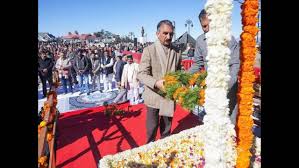
Shimla: Chief minister Sukhvinder Singh Sukhu, along with Congress leaders, paid floral tributes to the father of the nation, Mahatma Gandhi, on his death anniversary, observed as Martyrs’ Day, at the historic Ridge in Shimla on Friday. Following the tribute, the Congress leaders observed a two-hour fast from 11 am to 1 pm to protest against “renaming and dilution of the Mahatma Gandhi National Rural Employment Guarantee Act (MGNREGA)” by the BJP-led Union govt. Addressing mediapersons, the CM alleged that the central govt not only altered the name of MGNREGA but also weakened the core objectives of the scheme. He said thw MGNREGA was earlier a strong pillar of rural employment, particularly benefiting youth and women, but opportunities under the scheme are now being steadily reduced. Sukhu highlighted that village pradhans earlier had the authority to undertake development works such as road construction under MGNREGA, which ensured employment close to people’s homes. He added that during the Covid-19 pandemic, the scheme played a vital role in providing employment to a large number of people. However, he expressed concern that the powers of panchayat pradhans are now curtailed. The CM added that for nearly two decades, MGNREGA guaranteed employment and also provided unemployment allowance when work was not made available. He said the two-hour fast was a symbolic protest against the systematic dismantling of the scheme. He also pointed out that while the central govt earlier bore 100% of the expenditure, it now shifted to a 90:10 funding pattern, which could adversely affect states like Himachal Pradesh. Responding to a question, Sukhu said he raised concerns over the proposed reduction in import duty on apples from New Zealand with Union minister Piyush Goyal, cautioning that it could severely impact apple growers in Himachal Pradesh. Courtesy : TOI Note: This news is originally published on https:/timesofindia.com/bha and is used purely for non-profit/non-commercial purposes, especially human rights
Casteism in Himachal: ‘Mend your ways…’ Dalit leader openly threatened, the horrific truth of casteism in Devbhoomi comes to light
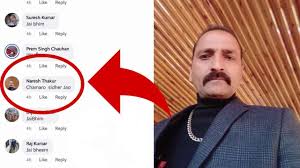
Himachal News: The recent incident has made it clear how deeply rooted casteism is in Himachal Pradesh. A prominent Dalit leader from the state, Ravi Kumar, was openly subjected to casteist abuses on social media. A man named Naresh Thakur fearlessly wrote on his post, “Chamars, mend your ways.” This comment is a direct caste-based attack. Surprisingly, such people have neither fear of the law nor of the Supreme Court’s orders. Serious questions are now being raised about the safety and equality of Dalits in Devbhoomi (the land of gods). Hatred in the name of reservation and tradition Our investigation has revealed strange justifications behind casteism in Himachal. Some people describe it as part of ‘Dev Sanskriti’ (divine culture) and tradition. Many others consider reservation to be the reason for the hatred. People openly write on social media that they practice casteism because of reservations. They claim that as long as reservations exist, discrimination will continue. Casteism is also justified in the name of protecting Dev Sanskriti. These people forget that the use of casteist slurs and discrimination is a serious crime. Serious questions about the role of the police The attitude of the Himachal Police in cases of Dalit oppression has consistently been under suspicion. In many serious cases, FIRs are registered only after immense pressure from Dalit groups. Whether it was the suspicious death of a child in Rohru or the rape of a Dalit woman in Kullu, the police action has been sluggish. The police also showed negligence in the Pallavi death case in Dharamshala. If the police had acted on Pallavi’s complaint two months earlier, her life might have been saved. Kullu incident: The husband himself was made the culprit The most frightening face of the police’s working style was seen in Sainj, Kullu. There, a Dalit woman was gang-raped and murdered. Her body was hung from a tree. Without a proper investigation, the police imprisoned the innocent husband of the deceased woman. He languished in jail for a month. Later, protests by women’s groups and a viral audio clip revealed the real killers. The police have not yet disclosed what happened to those real killers. This means that police officers don’t even consider it necessary to hold a press conference in such heinous cases. Blatant disregard of Supreme Court orders Former Supreme Court Chief Justice Gavai had clearly stated in his order that there is no provision for anticipatory bail under the SC-ST Act. The accused should be sent to jail immediately. Despite this, the police in Himachal Pradesh appear lenient towards the accused. In hundreds of cases, the accused have been given a free pass. Ravi Kumar has more than 200,000 followers on social media. If such a prominent figure can be subjected to casteist slurs, one can imagine the plight of ordinary Dalits. Now it remains to be seen whether the government suppresses this matter or delivers justice. Poonam Sharma Courtesy: Hindi News
Casteism in Himachal: Thakur girl marries Dalit man, faces ostracism from her own family; read the heartbreaking truth

Himachal News: A living example of how deeply rooted casteism still is in society has come to light. A young woman from a general category (Thakur) family married a man from a Scheduled Caste (SC) community, and she became a victim of taunts and discrimination from her own relatives and society. The woman shared her pain on social media, describing how her parents fully supported her, but after their death, all limits of discrimination were crossed. This story exposes the double standards of a society that prioritizes caste over humanity. Court marriage performed with the Constitution as witness In her post, the woman stated that she and her husband had a court marriage with the Indian Constitution as their witness. This is an inter-caste marriage. The woman belongs to a Thakur family from the general category, while her husband comes from the SC community. After the marriage, some relatives and villagers protested. They tried to instigate the woman’s parents, saying that their daughter had brought shame to the family. However, the woman’s parents and brother and sister-in-law ignored these remarks and strongly supported their daughter’s decision. The real struggle began after the parents’ death The victim said that as long as her parents were alive, no one dared to say anything in front of them. Her parents said that there was no greater happiness than their daughter finding a life partner of her choice. But after the death of her parents, the attitude of relatives and acquaintances completely changed. Those who used to speak respectfully before now started practicing untouchability and discrimination. The woman said that fed up with this behavior, she has distanced herself from her relatives. Even childhood friends and landlords discriminated against her The poison of casteism is not only spread among illiterate people but also among educated people. The woman shared a shocking incident. Her childhood friend, who had grown up with her, also started practicing untouchability towards her children. Moreover, she was asked about her caste when she was looking for rented accommodation in Rampur and Shimla. A landlady even prevented the children from putting up charts on the walls and discriminated against them. This incident shows how deeply ingrained caste-based mentality is, even in cities. A strong reply to the trolls After sharing her story on social media, a woman from Sirmaur (Rekha Sharma) tried to troll the young woman. The troll alleged that she had eloped from college and had dishonored her father. The young woman gave a strong reply, stating that she had married legally, not eloped. She clarified that she had never tarnished her family’s honor. She is very happy with her husband, who cherishes her and her children. The young woman clarified that her fight is not against the general category, but against the ‘Manuvadi’ ideology that spreads hatred in society. Poonam Sharma Courtesy: Hindi News