
Modi Playing the Dalit Caste Card to Push Rahul Gandhi Out of the Ring and Don the Mantle of Dalit Messiah
The Supreme Court’s decision to stay the recent University Grants Commission (UGC) regulation on the ground that it adopted a non-inclusive definition of caste-based discrimination and excluded certain categories from institutional protection is certainly not a setback for Narendra Modi. Instead, it could significantly elevate his stature in the eyes of Dalits and the poor. Politically, the most important observation made by the bench of Chief Justice Surya Kant and Justice Joymalya Bagchi—“If we don’t intervene, it will lead to dangerous consequences, divide society, and have grave impact”—will have far-reaching implications. The court also observed that by limiting the scope of “caste-based discrimination” only to SC, ST, and OBC categories, the UGC had effectively denied institutional protection and grievance redressal to individuals belonging to the “general” or non-reserved categories who may also face harassment or bias based on caste identity. However, this order also raises a crucial question: why did the court not take suo motu cognisance when hundreds of SC, ST, and OBC students in IITs and IIMs allegedly died by suicide due to discrimination? With the epithet “Hindu Hridaya Samrat” losing relevance amid the mushrooming of multiple claimants, Narendra Modi appears to have chosen a new path in saffron politics—to don the crown of a Dalit Messiah. For the first time in his eleven-year rule as Prime Minister, Modi has made a politically astute move by antagonising traditional upper-caste supporters through measures perceived as protective of Dalits and marginalised students. Modi refused to heed the advice of friends and well-wishers to retrace his steps, despite being aware of the consequences. Some protesters even targeted his caste identity, claiming that “the Teli is out to destroy our future” (Modi belongs to the Teli community, an OBC group). Yet Modi appears unmoved. He seems confident that upper-caste voters will not desert the BJP despite their anger over the new rules. With the 2029 Lok Sabha election in view, winning over Dalits and EBCs appears to be at the top of his priority list. Shivam Singh, one of the founders of the Savarna Sena (Forward Caste Army), stated that protests would be withdrawn if the government assured that general-category students would not be affected. Data shows that complaints related to caste discrimination in universities were around 173 in 2016–17 but rose to over 350 in the 2023–24 academic year, indicating a significant increase. Even memories of 1990, when upper-caste youth launched violent protests against the implementation of the Mandal Commission report, do not seem to deter Modi. During that agitation, over 150 people attempted suicide, with at least 63 succumbing to their injuries. The protest, which began after Prime Minister V.P. Singh announced the implementation of the Mandal Report, turned violent as many students resorted to self-immolation. Rajeev Goswami’s attempt became the symbolic face of the agitation. The compulsion to identify with Dalits and the proletariat has become so acute for Modi’s political survival that he has sought to reinvent himself as a modern Dalit Messiah. This shift also reflects the rise of hardline Hindutva leaders such as Yogi Adityanath within the BJP ecosystem, many of whom are associated with the “Hindu Hridaya Samrat” image. Modi, unwilling to be overshadowed by any rival within the saffron camp, appears determined to chart an independent path by aligning himself with Dalits and EBCs. Recent political developments have significantly strengthened Rahul Gandhi’s appeal among Dalits. What was once a peripheral issue has become a central ideological plank of his leadership as Leader of the Opposition. Although the Congress had historically lost Dalit trust in the 1990s, Rahul Gandhi has attempted to reclaim this space by linking social justice with the demand for a caste census—what he calls an “X-ray of the country.” He is increasingly perceived by Dalits and EBCs as a potential liberator. By placing the caste census at the centre of his political narrative, Rahul Gandhi has moved beyond tokenism. He aims to demonstrate the underrepresentation of Dalits, Adivasis, and OBCs in corporate, media, and academic institutions. He has targeted what he calls BJP’s “Manuvaad” and accused the government of weakening constitutional protections for marginalised communities. His claim that 95 per cent of upper-caste bureaucrats decide the fate of Dalits and the poor has found resonance among these communities. With Rahul Gandhi aggressively shaping the Dalit narrative, Modi appears left with little option but to reposition himself. Yet he faces competition not only from regional leaders but also from the BJP’s own targeted outreach strategies. After V.P. Singh, no national leader could fully capture the imagination of Dalits as a Mandal Messiah, although regional leaders like Mulayam Singh Yadav, Lalu Prasad Yadav, Ram Vilas Paswan, and Nitish Kumar emerged as protagonists of Mandal politics. Over time, however, they came to be seen largely as caste leaders rather than representatives of collective Dalit empowerment. Experts and liberals fear the emergence of violent protests similar to those witnessed after the Mandal Commission’s implementation in 1990. Upper-caste students in Bihar and Uttar Pradesh have already taken to the streets against the UGC’s Promotion of Equity in Higher Education Institutions Regulations, 2026. Sit-in protests have been organised across universities, with demonstrators claiming that the rules would lead to caste conflict and disrupt social harmony on campuses. Critics argue that the rules are one-sided and lack safeguards against false complaints. They question the effectiveness of “Equity Squads” and the potential for increased conflict. The regulations require every university and college to establish an Equal Opportunity Centre and an Equity Committee, with representation from SC, ST, and OBC communities. Institutions must address complaints within 24 hours, failing which they risk severe penalties. The 2026 regulations mark a legally binding step towards safer and more equitable campuses, aiming to curb the sharp rise in reported caste-based discrimination cases between 2019 and 2024. Yet a crucial question remains: why did the Modi government choose this moment and this mechanism to introduce such rules? In 2022, the Supreme Court had directed the UGC to formulate accessibility guidelines for students with
Karnataka leadership tussle: Dalits plan rally for CM Siddaramaiah; wait for Home Minister’s approval
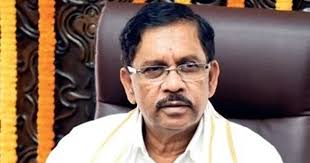
Being a member of the Siddaramaiah camp, Parameshwara feels the former would continue as CM and that is the reason he is hesitating to back the Dalit rally, sources said. BENGALURU: With the leadership tussle between Chief Minister Siddaramaiah and DCM DK Shivakumar unlikely to die down till the intervention of LoP in Lok Sabha Rahul Gandhi, a section of Dalits is planning a rally to push for a CM from their community. Several Dalit leaders are exerting pressure on Home Minister Dr G Parameshwara, the prominent Dalit face in Karnataka, to give the go ahead for the rally in Old Mysuru Region. A group, led by Venkataramanaswamy, also known as Papu, from Chamarajanagar, met him in Tumakuru on Sunday and sought his dates for the event. However, Parameshwara advised them to wait for some more time. Being a member of the Siddaramaiah camp, Parameshwara feels the former would continue as CM and that is the reason he is hesitating to back the Dalit rally, sources said. Parameshwara, a loyalist of the Nehru-Gandhi family and an aide of AICC president Mallikarjun Kharge, is not ready to go against them, they added. He met Kharge, but what transpired between them was not known even as he termed their meeting a courtesy call. “Since Parameshwara is a staunch Congress loyalist, he should be made CM if Siddaramaiah has to step down,” said DSS leader Mavalli Shankar, adding that a Dalit rally will be organised soon to give this demand a push. “The top post has been elusive for Dalits since Independence as many senior leaders missed the bus. It should not be the case this time,” he said. Meanwhile, AHINDA organisations have started preparations to hold rallies across the state, including in Mysuru and Hubballi, to back Siddaramaiah to continue in the top post. A rally has also been planned in central Karnataka, either in Haveri or Davanagere, sources said. Have faith my party will decide my future: DKS Amid the change in leadership tussle in the Congress government, Deputy Chief Minister DK Shivakumar said he has faith in the party and it will decide his future as well. Shivakumar said more than outsiders, some people from his own community are criticising him out of jealousy. “They are stabbing me in the back. All this is natural in politics. One should not lose peace . We must remain honest,’’ he said. Shivakumar also said when Union minister and JDS leader HD Kumaraswamy was chief minister, he had worked honestly. “Yet, Kumaraswamy accused me of stabbing him in the back. I do not need anyone’s certificate. It is enough if I satisfy my conscience,’’ he said. Devaraj B Hirehalli Courtesy : TNIE Note: This news is originally published on https:/thenewindianexpress.com/bha and is used purely for non-profit/non-commercial purposes, especially human rights
5 injured after gang opens fire at Dalit family:Dispute over cow grazing led to attack in Morena village; elderly man seen pleading with folded hands
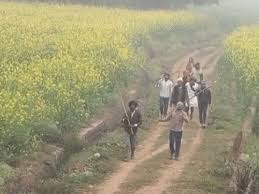
In Rajaram Ka Pura village of the Jaura development block in Morena, influential villagers allegedly opened fire and assaulted a Dalit family after the family refused to let their cows graze in the field or allow the removal of bajra stalks. The attackers are accused of firing indiscriminately and then beating the family with sticks. Injured admitted to the hospital Five members of the family are injured in the incident and have been admitted to Jaura Hospital. The victim’s family has also accused the police of delaying in registering the report. The incident occurred on the first day of the new year, i.e., Thursday at 3 PM. The video surfaced on Friday morning. According to the victim, Maharaj Jatav, the cows of influential villagers Banwari Gurjar and his associates were grazing in his field. When the family protested, they also took away the bajra stalks. Due to this, the dispute escalated, and the influential people threatened to take revenge. Fired 8-10 rounds, beaten with sticks It is alleged that Banwari Gurjar, along with his 10-12 companions, reached the house of a Dalit family. First, 8 to 10 rounds were fired, after which the family was attacked with sticks and batons. In the video, youths are also seen holding sticks and batons. Ramesh Jatav, Maharaj Jatav, Bahadur Jatav, Mahadevi Jatav, and Simla Jatav were injured in the assault. During the dispute, an elderly member of the family even folded his hands and apologized to the bullies, but despite this, the accused did not stop the assault. Police accused of delaying FIR After the incident, the injured family members reached the Jaura police station. It is alleged that their complaint was not registered immediately. The FIR was registered late at night. A case has been registered against Banwari Gurjar, Vishram Gurjar, Damodar Gurjar, Bunty Gurjar, and Veera Gurjar in the matter. Jaura SDOP Nitin Baghel said, The dispute was over a cow and fodder. The investigation revealed that there was first an altercation with a youth from the Gurjar family, after which there was a physical fight between both parties. An FIR has been registered based on the video and available evidence. The investigation of the case is ongoing. Courtesy : Bhaskar English Note: This news is originally published on https:/bhaskarenglish.com/bha and is used purely for non-profit/non-commercial purposes, especially human rights
Untouchable Goa by Dadu Mandrekar (1997) – A Review by Sampurna Dutta

Dadu Mandrekar’s Untouchable Goa (published in Marathi in 1997), rendered into English through Nikhil Baisane’s (published by Panther’s Paw Publication in 2025) layered and attentive translation, is a powerful sociological archive that exposes caste in a region often reduced to the postcard image of beaches and heritage-rich towns. Across eighteen essays that traverse the maharwadas of Goa’s villages, Mandrekar—writer, journalist, and Ambedkarite activist—constructs a counter-map of the state, highlighting some of its most invisibilised spaces. I approach Untouchable Goa through three interlinked pillars: the maharwadas as infrastructures of caste, death as a mechanism of Brahminical control, and superstition as a material and moral economy. Mandrekar maps the state’s maharwadas—Dalit settlements pushed to the village outskirts, often bordering forests or water bodies that swell dangerously during the monsoon, and typically beyond the reach of the state’s infrastructural gaze. He renders each dwelling an index of economic neglect and a site of endurance. Government housing schemes surface as 1,200–2,000-rupee grants intended to fund entire homes in contexts where installing a functional toilet alone might cost 10,000. In a rare instance, they appear as a failed experiment in socialist “uniformity”. Units are childishly conceived to erase caste boundaries. They are crumbling and ill-maintained, yet statistically “complete.” A passage from this chapter describes a tap installed in a tattered village; a lone functioning emblem of “development”- capturing this paradox with devastating precision. These homes, like their inhabitants, are barely built to survive, let alone live. Subsidies exist largely as bureaucratic data points, disbursed without provisions for repair or maintenance. The Dalits who inhabit maharwadas do not own the land it stands on, nor the land where they will one day be buried—an unbroken circle of dispossession that renders their bodies “owned” by Brahminism in living labour and in death. In the chapter “365 Devchaar”, Mandrekar visits a maharwada in Dhargal, where an old man narrates what begins as ancestral history but gradually reveals itself as myth. He speaks of devchaars, betaals, and a god who, aided by a man, banishes Vetal from his throne. When the protagonist, Pavne, receives water from a Mahar, he loses his caste. Pavne is rewarded with land for banishing Vetal, which, according to local lore, explains why some Mahars in Dhargal still nominally possess land. Mandrekar reads these mythic residues not as distortions of history but as evidence of how ownership itself is shaped by caste memory. He situates the story within a reality where, even when bahujans legally own land, they must still seek permission from the original Brahmin proprietors to build on it—a spiritual and social contract that lays bare the feudal motivations of Brahminism. If home marks the beginning of Mandrekar’s sociological map, death forms its moral and material core. In the second chapter, “Desecrating the Dead,” he examines a grotesque ritual of exhumation in which lower-caste men are bound to dig up graves and participate as drum-beaters in the procession. These bodies are then dismembered and paraded through the night before being discarded. Mandrekar analyses this hideous practice not as a cultural aberration, but as violence enforced through faith. The Brahminical logic of untouchability, Mandrekar observes, seeps even into mahar households. Among Dalits themselves, contact with a menstruating woman demands purification through gomutra, tulsi water, bathing, and changing clothes—rituals that are unmistakably Brahminical in form. The burden of humiliation trails bahujan women intimately. When menstruating or pregnant women die, their corpses are buried without ceremony, often in unmarked places, their faces turned groundwards to prevent them from returning as “vengeful spirits.” Mandrekar intuits an economic ‘fear’ behind this superstition: these rituals are meant to guard family wealth from women who, in death, might return to claim property once denied to them in life. Mandrekar expands the idea of ritual as a sociological archive, tracing the “traditions of death” where the humiliation and economic dispossession of Dalits are most visceral. He refuses to dismiss superstition as quaint or irrational, instead locating its persistence in material and political realities. Mandrekar observes that mahar traditions (whether deities or celebrations) are modest, symbolic, and exposed to the elements, much like Dalits themselves. But over time, these have been displaced by Brahminical practices such as angat yene and devdevski. Dalits must now spend heavily during Hindu festivals, sinking into cycles of never-ending debt. “They barely pay off one before another comes,” Mandrekar notes, showing that belief itself becomes a form of bondage. Superstition, Mandrekar shows, is also a survival strategy shaped by precarity. Dalits participate out of belief but also fear of persecution by upper-caste men and the consequences of stepping outside caste-bound occupations such as bamboo work, cleaning, or leatherwork. Mandrekar notes that their modest homes are sometimes targeted for demolition under the rhetoric of modernisation, mirroring the contemporary demolition of Muslim neighbourhoods across India. Untouchable Goa is a vital ethnographic companion to recent scholarship on caste in Goa by Parag Parabo (2023), Kaustubh Naik (2017), and Jason K. Fernandes (2020). Parabo’s 2023 work, which distinguishes between the Old and New Conquests, analyses the latter as being aligned with Brahminical consolidation following a period of colonial Christian influence—a process that Mandrekar charts through his fieldwork. While Portuguese colonisation itself remains largely absent in Mandrekar’s account, his ethnography provides a rich archive that complements studies of Goan temple politics, landholdings under colonial regimes, and the intersection of Christianity and Brahminism in defining the asprushya or untouchable, as explored by Parabo and Fernandes. Mandrekar specifically documents the everyday realities of home, ritual, and death in post-independence Goa, when Brahminical consolidation became increasingly visible. Untouchable Goa transforms accounts of caste abuse into evidence, offering a necessary corrective to Goa’s sanitised public image and an essential resource for students of the political economy of caste in the region. The Deras: Culture, Diversity and Politics by Santosh K. Singh (2025): A Review by Neha Sharma Courtesy : Doing Sociology Note: This news is originally published on https:/doingsociology.com/bha and is used purely for non-profit/non-commercial purposes, especially human rights