
A Dalit girl was raped inside her home: Incident in the Holagarh area of Prayagraj; sister beaten for protesting.

A case of rape of a Dalit girl has come to light in the Holagarh police station area of Prayagraj. It is alleged that a young man entered her home on Sunday morning and raped her. When her elder sister came to rescue her, the accused assaulted her with casteist slurs, threatened to kill her, and fled. The victim’s elder sister has filed a complaint at the police station. She stated that their parents have passed away, and the two sisters live in a mud house as laborers. On Sunday morning, while the younger sister was busy with household chores, a young man from the village entered their home. It is alleged that the young man forcibly raped her. Hearing the noise, the elder sister arrived at the scene and attempted to apprehend the accused. Upon hearing this, the accused abused her, used casteist slurs, and beat her to the ground. While fleeing, the accused threatened to kill both sisters if they told anyone about the incident. The frightened victim reported the matter to the police. Holagarh Police Station in-charge Virendra Kumar Mishra stated that he had received a complaint and the police were investigating the matter seriously. Amar Singh | Soraon Courtesy: Hindi News
Thol Thirumavalavan’s VCK: The Dalit Political Party That Emerged As Kingmaker In Tamil Nadu
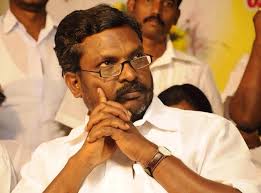
(As Tamilaga Vettri Kazhagam (TVK), the single largest party in Tamil Nadu Assembly election 2026, scrambles to find numbers to stake claim to form the government, it is Thol Thirumavalavan’s Viduthalai Chiruthaigal Katchi (VCK) that has emerged as the kingmaker. So far, the TVK has managed to earn the support letters from the Congress, the Communist Party of India (CPI) and Communist Party of India (Marxist) – CPI(M). Even with the support of three parties, the TVK remains short of a seat.Politics But there is speculation that the TVK is eyeing a plum post, including the Deputy chief minister post. Not just this, TVK also hopes that Thirumalavalan should be fielded from the Tiruchirapalli East constituency in the event of TVK founder Vijay vacating it. People also ask AI powered insights from this story .5 QUESTIONS1What is the Viduthalai Chiruthaigal Katchi (VCK)?⌵ The Viduthalai Chiruthaigal Katchi (VCK) is a Dalit political party in Tamil Nadu founded in 1982. It is dedicated to the liberation of the working class, advocating for the annihilation of caste, social justice, and secularism. 2How did VCK become a kingmaker in Tamil Nadu?⌵ VCK emerged as a kingmaker in Tamil Nadu when the Tamilaga Vettri Kazhagam (TVK), the single largest party after the 2026 Assembly election, needed support to form the government. VCK’s two seats were crucial for TVK to reach the majority mark. 3What are VCK’s political goals?⌵ VCK strives to bring Dalits and the marginalized into the political mainstream. The party aims to unite all people to transform society through social empowerment and political authority. 4What is the history of VCK’s electoral participation?⌵ VCK first entered the electoral arena in September 1999, contesting in the Chidambaram Parliamentary constituency. R Thirumavalavan was elected to the Tamil Nadu Legislative Assembly from the Mangalore constituency in 2001. 5What role did VCK play in the 2026 Tamil Nadu government formation?⌵ VCK discussed a share in power, including key posts like the Deputy Chief Minister’s post for Thol Thirumavalavan, with TVK. The party’s support was essential for TVK to form the government. Vijay, who won from two constituencies, has to vacate one and is likely to retain Perambur in Chennai. A source, quoted by PTI, said the VCK discussed a share in power, including two or three key posts for the VCK at the virtual meeting chaired by Thirumavalavan on Friday evening. It deliberated on seeking deputy chief minister’s post for Thirumavalavan and a Cabinet post for its newly elected members. The party won two seats in the April 23 Assembly election. Justifying the demands, VCK deputy general secretary Vanni Arasu told reporters that the party’s stance on a share in power reflected the people’s feelings. As the VCK now emerges as the kingmaker in the Tamil Nadu politics, here is everything you need to know about the party. According to the Viduthalai Chiruthaigal Katchi website, the party is dedicated to the“liberation of the working class.”It says,“Our movement is built on the unwavering pillars of Annihilation of Caste, Social Justice, and Secularism.” “We strive to bring Dalits and the marginalized into the heart of the political mainstream, uniting all people to transform society through true Social Empowerment and political authority,” it says. Formerly known as Dalit Panthers Iyyakkam, the party was founded in 1982 by M Malalchami aiming to protect Dalits from caste-based violence. In September 1999, VCK entered the electoral arena for the first time. Contesting in the Chidambaram Parliamentary constituency in alliance with TMC (Moopanar), Thiru R. Thirumavalavan (Thol) secured a remarkable 2,25,768 votes. In 2001, R Thirumavalavan was elected to the Tamil Nadu Legislative Assembly from the Mangalore constituency. In 2006, VCK joined the AIADMK alliance to contest the Assembly General Elections. In 2013, the party expanded and launched the movement in Andhra Pradesh under ‘Vimuktha Chiruthalu’. It also has an official channel ‘Velicham TV’. Courtesy : MenaFN Note: This news is originally published on https:/menafn.com/bha and is used purely for non-profit/non-commercial purposes, especially human rights
Two-thirds of the BJP’s first government in Bengal is comprised of Dalits, tribals, and backward classes: Only two of the six ministers, including the Chief Minister, are upper castes, as the party strikes a balance in social relations.

The BJP’s first government in West Bengal has prominently featured Dalits, tribals, and backward classes, with only two of the six ministers being upper castes. KOLKATA: On May 9, 2026, a historic Bharatiya Janata Party government was formed in West Bengal. Suvendu Adhikari was sworn in as the state’s first BJP Chief Minister. Five other cabinet ministers were sworn in alongside him. The BJP has carefully attempted to strike social balance based on caste and region in its first cabinet in Bengal. The party won 207 seats in the 2026 assembly elections, ending the 15-year rule of the Trinamool Congress (TMC). Today, it formed a new government, with Chief Minister Suvendu Adhikari and five ministers sworn in. The new cabinet is prominently representing ethnic and social groups. Key faces in the cabinet and their social alignment Suvendu Adhikari (Chief Minister): Suvendu comes from the Bengali Brahmin community. The party projected Adhikari, who joined the BJP from the TMC, as a “giant killer.” His appointment to the Chief Minister’s post will strengthen the party in coastal Bengal. A longtime TMC strategist, Suvendu will also be responsible for eliminating Mamata Banerjee’s remaining strength. Dilip Ghosh: Dilip Ghosh, who has been sworn in as a minister in the Suvendu Adhikari government, is the former state president of the party and has been elected as an MLA from Kharagpur. He is considered the OBC face of the BJP in Bengal. His role will be crucial in appeasing the party’s long-time workers and Hindutva base. Agnimitra Paul: Agnimitra Paul was elected as an MLA from Asansol South. She represents the Kayastha community, which holds a significant position in Bengal politics. Additionally, Agnimitra, as a female face, is part of the BJP’s strategy to expand its reach to women voters. Ashok Kirtania: Elected MLA from the Bongaon North Assembly constituency, Ashok Kirtania belongs to the Dalit Matua community. The Matua vote bank has been a major strength for the BJP in the North 24 Parganas and Nadia regions of Bengal. The Matua community’s vote is decisive in approximately 24 seats in West Bengal, directly influencing election results. Khudiram Tudu: Khudiram Tudu, a Scheduled Tribe (Santhal) member, was elected MLA from Ranibandh in Bankura district. Tribal voters play a decisive role in the Jhargram-Jangalmahal region of Bengal. The BJP has secured a strong electoral lead in this region. Khudiram Tudu has been appointed minister to further strengthen the BJP’s hold on the tribal community and Jangalmahal. He took oath as minister today wearing traditional tribal attire. Nisith Pramanik: Former Union Minister of State, Nisith Pramanik, was elected MLA from Mathabhanga this time and was appointed a minister today. He is considered a prominent leader of the Rajbanshi community in North Bengal. The Rajbanshi caste is the largest Scheduled Caste community in Bengal. Nisith Pramanik has been appointed a minister to strengthen the BJP in North Bengal along with the Rajbanshi community. What is the BJP’s strategy? In West Bengal, the BJP has long worked on polarizing Hindu votes and social alignment. In contrast to the TMC’s Muslim-centric politics, the BJP attempted to bring together groups such as the upper castes (Brahmins and Kayasthas), OBCs, Dalits (Matuas), tribals, and Rajbanshis, and achieved significant electoral success. In the BJP’s first cabinet, representation was given to South Bengal, North Bengal, and Jangalmahal to maintain regional balance. For social inclusion, Brahmins, Kayasthas, OBCs, Matuas, tribals, and Rajbanshis received representation. Women were also represented through Agnimitra Paul. Political analysts believe this cabinet represents a reflection of social arithmetic. While retaining long-standing organizational leaders, the party is also prioritizing new faces and the backward, Dalit, and tribal communities. The Suvendu Adhikari government now has to focus on issues such as development, law and order, and the CAA-NRC. It remains to be seen how sustainable this caste-regional balance will be and how it will manage Bengal’s traditional cultural diversity. However, this is just a first step. Further changes will become clearer in the full cabinet expansion. Mukesh Srivastava Courtesy: Hindi News
Chaos at wedding! Dalit bride removed from horse in Udaipur, protest march again on horse
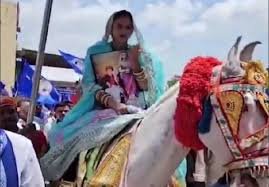
Udaipur Mare Bride Removal Controversy: The case of Dalit bride Pooja Meghwal being removed from a horse during her wedding in Hariyau village of Udaipur is gaining momentum. The family alleges that some people, protesting, forced the bride to dismount and even assaulted her. Following the incident, the Dalit community and various organizations protested in Udaipur. During the protest, Pooja Meghwal arrived again riding a horse. The protesters demanded a fair investigation and strict action against the accused. The police have registered a case and arrested four accused so far. Udaipur. A wedding in Hariyau village of Udaipur district, Rajasthan, sparked controversy and protest when the incident of removing a Dalit bride from a horse came to light. The joy of the bride Pooja Meghwal’s wedding quickly turned into tension, and now the matter has spread beyond the village and become a topic of discussion across the state. Following the incident, anger grew among the Dalit community and various organizations, leading to protests in Udaipur. It is reported that on April 29, in Hariau village, under the Dabok police station area, Pooja Meghwal rode a horse during her wedding ceremony. Some villagers objected and allegedly forced her to dismount. The family alleges that they were assaulted for protesting. The incident left the bride and her family traumatized. This is not a family issue, but a social issue. Pooja Meghwal alleged that she was treated disrespectfully on a special occasion like her wedding. She says this is not just a family issue, but a social issue. Following the incident, tension prevailed in the village, and the matter gradually spread on social media. Many people reacted to the incident and expressed concern about such incidents. BSP and Dalit community protested against the incident. On Thursday, members of the Bahujan Samaj Party and the Dalit community marched to the Udaipur District Collectorate to protest the incident. Notably, Pooja Meghwal again joined the protest, riding a mare. The protesters raised slogans against the administration and submitted a memorandum to the Governor, demanding a fair investigation. Only four people have been arrested. Protesters allege that nearly a dozen people, including women, were involved in the incident, but only four have been arrested so far. They also questioned the impartiality of the investigation and demanded that a different officer handle the case. Bhim Army state president Jitendra Hatwal said that if strict action is not taken against the accused, a major protest will be held in Jaipur. Meanwhile, Rajasthan Police stated that a case has been registered at the Dabok police station and the investigation is ongoing. Police have arrested four accused so far. The administration is closely monitoring the situation to ensure peace and order in the area. Edited by: Deep Ranjan About the Author Deep Ranjan Singh has been working in media since 2016. He has worked for Hindustan, Dainik Bhaskar, ETV Bharat, and Dailyhunt. He has been working for News18 Hindi since 2022. Courtesy : Hindi News
Nandyal MP assures TDP support towards Dalits, Christians

Byreddy Shabari says she will bring the legitimate demands of Dalits and Christians to the notice of Chief Minister N. Chandrababu Naidu and get them resolved during a rally in Nandyal Nandyal MP Byreddy Shabari claimed that protection and justice for Dalits and Christians are ensured only under Telugu Desam Party (TDP) rule. She assured that she would bring the legitimate demands of Dalits and Christians to the notice of Chief Minister N. Chandrababu Naidu and get them resolved during the State-level ‘Dalit and Christian Garjana’ rally held in Nandyal on Saturday. Ms. Shabari said that the founder of TDP and former Chief Minister, late Nandamuri Taraka Rama Rao, strove to eradicate untouchability and provided Dalits with permanent housing and agricultural land. Ms. Shabari emphasised that the credit for establishing the SC Commission to safeguard the interests of Dalits belongs solely to TDP government. “Both in united Andhra Pradesh and after the State’s bifurcation, Mr. Naidu has been working with unwavering dedication towards the upliftment of Dalits and Christians,” the MP said. Meanwhile, Ms. Shabari participated in the consecration ceremonies of the flagstaffs and idols at Sri Abhayanjaneya Swamy temples in Murvakonda and Nehru Nagar. The events took place in Nehru Nagar village of Pagidyala mandal within Nandikotkur constituency in Nandyal district, where she also inaugurated cement roads constructed at a cost of ₹25 lakhs. Speaking on the occasion, she expressed happiness over the cement roads, check dams, and water tanks that were constructed during her father, Byreddy Rajasekhara Reddy’s tenure as an MLA, continue to benefit the people to this day. She asserted that comprehensive development is possible only through the leadership of Mr Naidu. The Hindu Bureau Courtesy : The Hindu Note: This news is originally published on https:/thehindu.com/bha and is used purely for non-profit/non-commercial purposes, especially human rights
Thol Thirumavalavan: Champion of Dalit liberation and kingmaker of Tamil Nadu politics
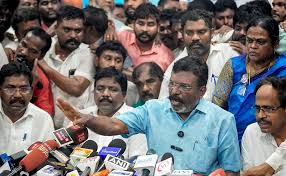
From forensic scientist to the political king maker, the VCK founder’s journey reflects a lifelong commitment to Dalit emancipation and Tamil identity In the aftermath of the 2026 Tamil Nadu Assembly elections, Thol Thirumavalavan and the Viduthalai Chiruthaigal Katchi (VCK) emerged as a pivotal force in government formation. Recognizing the importance of upholding the people’s mandate and preventing a constitutional crisis, Thirumavalavan announced VCK’s decision to extend unconditional support to Vijay’s Tamilaga Vettri Kazhagam (TVK), which had fallen short of a simple majority. Demonstrating strategic foresight, he coordinated closely with allied Left parties to ensure a long-term vision for the state while maintaining VCK’s continued association with the DMK-led Secular Progressive Alliance. By placing the public interest above short-term political calculations, Thirumavalavan positioned his party as a kingmaker, ensuring that the mandate of the electorate was respected. With the support of VCK’s two MLAs, along with backing from the IUML and other allies, TVK crossed the 118-seat threshold, securing the numbers necessary to form a stable government. Thirumavalavan emphasized that his party’s intervention was aimed at preventing President’s rule and safeguarding democratic norms, reflecting his enduring commitment to both Dalit empowerment and broader state governance. Thol Thirumavalavan, born Tholkappiyan Thirumavalavan on August 17, 1962, in Anganur, Tamil Nadu, is a scholar, social reformer, and one of the most prominent Dalit leaders in India. He is the founder and president of the Viduthalai Chiruthaigal Katchi (VCK) and currently serves as a Member of Parliament representing the Chidambaram constituency. Known for his unflinching advocacy for social justice, Thirumavalavan has been a pivotal figure in Tamil Nadu politics for over three decades. Thirumavalavan completed his early schooling in his hometown before earning a Bachelor’s degree in Chemistry from Presidency College, Chennai, followed by a Master’s in Criminology in 1988. He initially worked as a Scientific Assistant in the Government Forensic Science Department until 1999. Later, he pursued law at Madras Law College and earned a Ph.D. from Manonmanium Sundaranar University in 2019, focusing on the religious conversion of Meenakshipuram Dalits. His political journey began in 1982 when he joined the Dalit Panthers Iyyakam (DPI) in Tamil Nadu, inspired by the Dalit Panthers of India and the Black Panther Party in the United States. Mentored by A. Malaichamy, he coordinated student protests for Eelam Tamils and organized campaigns for Dalit rights. Following Malaichamy’s death in 1989, Thirumavalavan became the state organizer of DPI, later renaming the organization Viduthalai Chiruthaigal. Influenced by the ethnic conflict in Sri Lanka and the Tamil identity struggle, the organization formally became the Viduthalai Chiruthaigal Katchi (VCK) in 1990, marking its transition into a political party. Thirumavalavan initially avoided electoral politics, focusing on raising awareness about caste discrimination. However, in 1999, he resigned from his government position to contest his first Lok Sabha elections from Perambalur in alliance with the Tamil Maanila Congress, securing over 2.25 lakh votes despite losing. In 2001, he won his first Assembly seat from Mangaloree constituency (later dissolved), and in 2009, he was elected to the Lok Sabha from Chidambaram with a victory margin of over 1 lakh votes. Since then, he has contested multiple elections, winning significant victories and establishing VCK as a recognized state party with the permanent election symbol of a “Pot.” Under Thirumavalavan’s leadership, VCK has become a powerful political force in Tamil Nadu, forming alliances with both major Dravidian parties and unexpected partners such as the Pattali Makkal Katchi (PMK), reflecting a pragmatic approach to electoral politics. His slogans and speeches, such as the 1996 call to “Refuse to be subdued, Transgress, Rise vehemently, Retaliate,” have inspired generations of Dalit youth to challenge systemic oppression and assert their rights. Ideologically, Thirumavalavan draws from a rich tapestry of thinkers and movements. He combines Ambedkarite principles of social justice and Dalit empowerment, Periyar’s rationalist and anti-caste philosophy, and Marxist critiques of capitalism, while also embracing the revolutionary activism of the Black Panthers. VCK’s core principles include the abolition of the caste system, opposition to social exclusion, protection of Tamil culture and language, advocacy for women’s liberation, and support for the working class. His influences range from Gautama Buddha and Dr. B.R. Ambedkar to Thanthai Periyar and Velupillai Prabhakaran. Beyond politics, Thirumavalavan has engaged in cultural and social initiatives. He has acted in Tamil films like Anputhozhi and Kalagam, HE HAS authored several books and launched the VCK’s television channel, Velicham TV, in 2016. He has promoted Tamil naming conventions to eliminate caste and religious identifiers and spearheaded environmental projects, including planting 1 lakh palm seeds across Tamil Nadu in 2018. Thirumavalavan’s career has not been without controversy. He has faced criticism for remarks on Manusmriti, Hindu deities, differently-abled persons, and LGBTQ+ issues. Legal cases have been filed against him, ranging from alleged incitement during public speeches to bus-burning incidents in 1999, although he has often successfully contested these charges in court. He has also been accused by former associates of receiving funds from Christian missionary organizations, a claim he has consistently denied. Despite such controversies, Thirumavalavan’s commitment to Dalit emancipation and social reform remains unwavering. Thirumavalavan has received multiple awards for his social and political contributions, including the Icon of Social Liberation Award (2025), the Quaid-e-Milleth Award for probity in public life (2019), and recognition as one of the best-performing MPs (2024). VCK under his leadership also honors social activists through awards such as the Ambedkar Sudar Award and Periyar Oli Award. As a lifelong bachelor, Thirumavalavan has dedicated his life to the upliftment of marginalized communities, blending scholarship, activism, and political strategy. From grassroots organizing to becoming a kingmaker in state politics, he has shaped Tamil Nadu’s political landscape while consistently advocating for equality, justice, and Tamil identity. Courtesy : TNIE Note: This news is originally published on https:/thenewindianexpress.com/bha and is used purely for non-profit/non-commercial purposes, especially human rights
Tension in UP Village After Dalit Women Object to Maharana Pratap Jayanti Procession Route

Tension briefly prevailed in Maheshpura village on Saturday after members of the Dalit community, especially women, allegedly objected to a procession being taken out on the occasion of Maharana Pratap Jayanti and blocked its route. According to police officials, the disagreement took place over the path of the procession, leading to a standoff between two groups in the village. Police said the situation was later brought under control after talks between both sides and a written agreement reached in the presence of authorities. Police deny reports of violent clash Superintendent of Police (City) Manush Pareek said reports claiming that a violent clash had taken place were “completely misleading.” He said, “A disagreement had arisen between two groups regarding the procession route, but the matter was resolved peacefully through dialogue.” After receiving information about the dispute, Station House Officer Satish Kumar reached the village along with a heavy police force. Officials said the protesting women and villagers initially refused to allow the procession to move forward, leading to heightened tension in the area. Police first tried to convince both sides at the spot. However, as the disagreement continued, representatives from both groups were later called to the police station for discussions. Agreement reached after negotiations According to police, prolonged negotiations were held between both parties before a written compromise was reached around 1 pm. SP Pareek said the agreement was achieved “in an atmosphere of mutual coordination and harmony.” Following the settlement, the procession resumed around 5 pm on its scheduled route and concluded peacefully by around 7 pm. Situation under control Police said the situation in the village remains peaceful and under control. Additional security personnel were deployed during the procession to prevent any untoward incident. Authorities have not reported any injuries or arrests in connection with the dispute. Courtesy : TOP Note: This news is originally published on https:/theobserverpost.com/bha and is used purely for non-profit/non-commercial purposes, especially human rights
Tamil Nadu saw 67% rise in atrocities against Dalits under DMK rule

Tamil Nadu’s 67.9% increase in cases against Scheduled Castes (SC) and Scheduled Tribes (ST) is the highest in India, surpassing Madhya Pradesh (55.3%) and Odisha (42.9%). Tamil Nadu recorded a 67 per cent rise in atrocities against Dalits between 2019 and 2023, the highest increase in the country,according to a report by the National Campaign on Dalit Human Rights (NCDHR). This data has gained significant attention following the DMK’s defeat in the 2026 Assembly elections, suggesting that the state’s failure to address caste violence contributed to voter dissatisfaction despite the party’s “social justice” rhetoric. Tamil Nadu’s 67.9% increase in cases against Scheduled Castes (SC) and Scheduled Tribes (ST) is the highest in India, surpassing Madhya Pradesh (55.3%) and Odisha (42.9%). According to NCRB data, murders of Dalits rose by 40.4 per cent, increasing from 52 to 73 cases, while incidents of grievous hurt surged by 240 per cent and cases of criminal intimidation witnessed a sharp 584.8 per cent rise, climbing from 46 to 315 cases. Total rape cases rose by 36.1%. While the rape of adult Dalit women dropped by 14%, the rape of Dalit girls increased by 73.2% (from 56 to 97 cases). Assaults with “intent to outrage modesty” grew by 289.5%. The report highlights a breakdown in the justice system. In 2023, the conviction rate for these crimes was a mere 12.2%, while the acquittal rate stood at 87.8%. Additionally, the case pendency rate is 87.7%, exacerbated by a shortage of exclusive special courts; Tamil Nadu currently has only 20. The state government has also been criticized for administrative negligence. The state-level vigilance and monitoring committee, chaired by the Chief Minister, is legally required to meet twice a year. However, it met only once annually between 2021 and 2023, and failed to meet at all in 2024. Prison Statistics India (PSI) indicates a disproportionate targeting of Dalits under preventive detention. In 2021, SC individuals made up 37% of detainees in Tamil Nadu, accounting for 84.5% of all SC detainees across India. By 2023, this figure rose to 42.2%, despite Dalits making up only 20% of the state’s population. The sharp rise in atrocities against Dalits in Tamil Nadu has drawn particular attention because the Dravida Munnetra Kazhagam (DMK) has historically positioned itself as a champion of “social justice,” anti-caste politics, and the upliftment of backward classes, Dalits, and minorities through the broader Dravidian movement. Notably, the debate around caste violence and the DMK’s “social justice” claims intensified following the 2026 Tamil Nadu Legislative Assembly election, in which the Dravida Munnetra Kazhagam (DMK) suffered a major defeat. Tamilaga Vettri Kazhagam (TVK), led by actor-turned-politician Vijay, emerged as the single largest party with 108 seats, while the DMK was reduced to 59 seats. The All India Anna Dravida Munnetra Kazhagam (AIADMK) secured 47 seats. Courtesy : Maktoob Media Note: This news is originally published on https:/maktoobmedia.com/bha and is used purely for non-profit/non-commercial purposes, especially human rights
What is Dalit joy? It’s a threat to savarnas
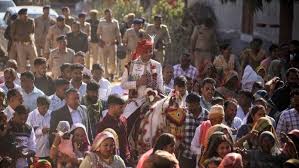
In ‘Dalit Women and the Fullness of Life’, Christina Dhanuja dismantles the stereotypes that freeze Dalit women as victims or icons of resilience. Caste minds have constructed worlds and cultivated cultures that are inherently anti-joy and actively anti-Dalit. This is our crooked room. And this is precisely why even the most mellowed expressions of joy from Dalits are threatening to those around us. Like in 2018, Mahesh Rathod, a 13-year-old Dalit boy from Vithalapur 8 in Ahmedabad, Gujarat, was beaten up for having a Darbar-like etiquette. Meaning, Mahesh was wearing jeans, a shirt, a thick gold chain around his neck, and Rajwadi Mojaris. In 2015, Sagar Shejwal, a twenty-three-year-old Dalit man from Shirdi in Maharashtra, was beaten to death by seven men belonging to the Maratha and OBC communities for having an Ambedkar song as a ringtone on his phone. In 2019, Jitendra in Kot, Uttarakhand was beaten up and killed for sitting on a chair and eating at a wedding in the presence of upper castes. The same year, four wedding processions of Dalits were attacked in a single week in Gujarat. A moustache. A dance. Riding a horse. An unbuttoned shirt. Leather shoes. Simple things and small joys that lead to thrashing, beating, stabbing, humiliation and death. This is what caste is. It emboldens joy-killing monsters that sit at the top of the pyramid, obese from eating the joys of Dalits. Urban savarnas are no different. They may not kill you, but they too cause damage. When I noticed that my hair was so thick, my friend piped, ‘That’s ’cause you’re nicely eating mutton and chicken.’ When I texted another about a new gadget I had bought, he replied, ‘All you rich, privileged people.’ When I announced that I had got a new job, a colleague said, ‘That’s because I didn’t apply for it.’ Prick that bubble. Dull that shine. Kill that moment. Savarnas believe in the impossibility of Dalit joy—and if and when it happens, they are convinced of their right to rob it. To discover joy as Dalit thus means that we first deconstruct this ridiculous inadequacy we have been rationed. We have to take apart their lies not just with rage, but with jeer. Call it silly. Call it absurd. See how foolish it is to treat joy as an individualistic pursuit that is sheathed, hidden within the self, from the self. See how wearisome it is to restrict something so available. See how fabricated it all sounds. Mediocre, even. I don’t want this warped notion of joy. I want no part in this laboriousness. I’d rather relish fruits like Vijeta Kumar’s father. I could go on morning walks with my mother, listening to little birds heralding the dawn. I could eat mutton curry andgaré at my mother-in-law’s. I could sit on a rocky beach and let the thick, salty air wash over me. Joy should be free to take. Still, I suspect that learning new ways of pursuing, sustaining, and savouring joy takes practice. Every time something beautiful happens, however small or big, my mind has no idea what to do with it. Instead of revelling in it, it searches for something that could go wrong. My mind believes it’s protecting me from unnecessary hurt, but in so doing, it has (almost) rid me of the ability to be in the moment. To relish, to enjoy, to experience. Dr Brené Brown calls it foreboding joy—an experience of joy immediately followed by worry or dread. It’s a form of self-protection against vulnerability, she says. I used to admire Brown’s work, but I now find her a tad too simplistic in the way white American worldviews generally are. Indeed, while‘foreboding joy’ as a term makes sense, its explanation does not. It is not without reason that Dalits fear joy. For Mahesh, Suman, and Delta, appearing joyful can literally get them killed. And it exposes the rest of us to ridicule, hurt and ‘lessons’. In this sense, joy is not an easy thing to embrace. Joy seems lethal. Joy seems unnecessary. So, what does Brown even mean when she says, ‘In moments of joyfulness, we try to beat vulnerability to the punch’? That, ‘when we lose our tolerance to be vulnerable, joy becomes foreboding’? Disappointingly enough—but not surprisingly—a number of South Asian influencers and brown therapists also resonate with Brown’s dare-to-be-vulnerable rhetoric. Perhaps they would advise Dalits to embrace vulnerability in order to realise joy. Here’s the thing though: Dalits’ foreboding isn’t because they are scared of vulnerability. They are already systemically vulnerable and have even been told that they have a victim mindset if and when they speak of it. So, how is a performance of vulnerability, in the way Brown is advocating for—which is to ‘daringly’ show the world how soft and gooey we all are—going to work? How will it lead to joy? If anything, the opposite happens. Caste minds respond with disgust, name-calling and more exploitation. A Dalit’s vulnerability is a reminder of their evil. Vulnerability is not our magic potion. Recognition is. Reconstruction is. Our foreboding joy is our minds grappling with the real cost of what joy demands of us—the history and the reality of our joy being robbed and the usual trauma that follows it. It is a warning, a writing on the wall that has been passed down through generations. Perhaps we must ignore the likes of Brown and stop calling our minds and bodies chicken-hearted. Perhaps we must see them as intelligent beings that are understandably tempered in their enthusiasm. Perhaps we must empathize with the fear that bubbles from within. Perhaps only by validating it can we and our communities truly pursue joy. This is why resilience and resistance feel more authentic than vulnerability. Indeed, a foreshadowing of what could happen and the fear that it will all fall apart is entirely reasonable, but it is also true that we are our ancestors’ wildest dreams. Our fore-parents fought hard for our joy. Not in one grand
UoH student fined for assaulting Dalit student, ASA protests inadequate action
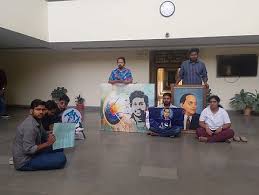
The Ambedkar Students’ Association is on strike against the University of Hyderabad administration, alleging institutional bias and inadequate action in a case of an alleged caste atrocity over a Dalit student, where a mere fine Rs 5,000 was imposed. Protests at the University of Hyderabad (UoH) entered their third day on Thursday, May 7, with students led by the Ambedkar Students’ Association (ASA) launching an indefinite relay hunger strike. The students are demanding the release of a fact-finding committee report into the alleged assault and casteist abuse of a Dalit student. According to the ASA, a Dalit student, Anuj Kumar, was allegedly assaulted and subjected to casteist slurs by fellow student Suryavardhan Singh Bablu following a personal dispute on December 11, 2025. After sustained student protests demanding official action, the university constituted a fact-finding committee. On May 4, Anuj was orally informed that the accused had been fined Rs 5,000, directed to issue a private apology through the Office of Anti-Discrimination, and barred from taking admission to any future course at UoH. Both students are second-year MA students. The ASA has strongly opposed the recommendations, calling them a “mockery of justice” and evidence of “institutional bias”. The student body argued that Dalit students had previously been fined ₹10,000 for minor infractions such as washing bikes near hostels, while an alleged caste assault had attracted only a ₹5,000 penalty. “The administration is effectively signalling that caste atrocities can be settled with a small fine,” the ASA said in a statement. “We demand justice and will not accept this cheap valuation of our lives and dignity.” Anuj Kumar, a second-year MA Sociology student, and his roommate Vinod were allegedly assaulted by Suryavardhan Singh Bablu, a second-year MA History student and former president of the All India Other Backward Castes Students’ Association (AIOBCSA). “He called me, ‘Dalit saale tum log naali ke keede hote ho. Tum jaison ko main apne ghutne ke niche rakhta hoon,’” Anuj told TNM. He alleged that the abuse took place in front of around seven people and that he was beaten with a thick wooden stick. The ASA had earlier protested over the issue in February and has continued to accuse the university administration of displaying “continued institutional bias” in handling the case. “After the protest, the administration addressed my complaint and formed a fact-finding committee,” Anuj said. According to him, the committee, headed by SC/ST liaison officers, submitted its report to the Vice Chancellor and Registrar, but the findings were never shared with him. Anuj alleged that despite assurances from university authorities that the matter would be resolved by April 30, he received no official communication until he emailed the Registrar on May 4. He said the Registrar directed him to meet P. Thukaram, a member of the Equal Opportunity Cell, who verbally informed him of the disciplinary action against the accused. The ASA criticised the administration for not releasing the fact-finding committee report or issuing the recommendations in writing. “They have not released the fact-finding committee report. They have only verbally communicated the recommendations of the anti-discrimination cell,” ASA president Dayanidhi told TNM. In a press release, the ASA described the recommendations as an “insult to the dignity of Dalits” that “exposes the deep-rooted Manuvadi mindset prevailing in the university”. The student body also pointed out that the university website routinely uploads details of disciplinary cases and recommendations, but claimed that Anuj’s case had not been uploaded or formally communicated. “I’m not satisfied with the verdict. I am the victim in this case,” Anuj said, adding that he wants the fact-finding report released so he can appeal the decision. “We want the university to acknowledge this as a caste atrocity. We also want the fact-finding committee report and recommendations to be made public,” Dayanidhi said. When TNM contacted university Registrar Devesh Nigam, he said the administration had acted in accordance with the committee’s recommendations. Written by:Syed Shahid Edited by:Azeefa Fathima Courtesy : TNM Note: This news is originally published on https:/thenewsminute.com/bha and is used purely for non-profit/non-commercial purposes, especially human rights