
Cow vigilantes beat Dalit man and force him to eat dung
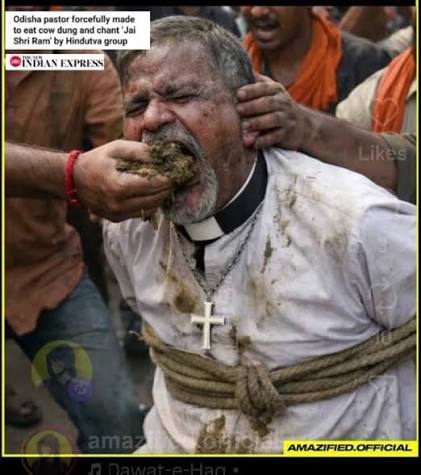
Six men face charges after allegedly assaulting Dalit cattle buyer in front of his young son, using caste slurs and accusing him of selling bull to Muslim butcher NEW DELHI, India (MNTV) — Police in western India have filed a case against six suspected Hindu cow vigilantes accused of assaulting a Dalit man and forcing cow dung into his mouth after accusing him of planning to sell a bull to a Muslim butcher. The attack allegedly occurred May 23 in Jalna district in Maharashtra state but came to wider attention months later after a video of the assault circulated on social media, prompting the victim to approach police on Aug. 21. Parameshwar Suhas Hiwale told police he was returning from a weekly cattle market in Deulgaon Raja with his 11-year-old son and an acquaintance, Narayan Maroti Kamble, after purchasing a bull when their vehicle was stopped in the Kanhaiyanagar area. The men who stopped them claimed affiliation with the Hindu extremist Bajrang Dal and cow-protection groups, according to Hiwale’s complaint. They accused Hiwale of intending to sell the animal to a Muslim butcher. He denied the accusation and produced documents showing that he had purchased the bull at the cattle market. The confrontation then allegedly took a casteist turn. Hiwale said the men demanded to know his caste before abusing him with caste-based slurs and assaulting him. He alleged that his attackers then forcibly stuffed cow dung into his mouth. The men also allegedly attempted to force dung into the mouth of Hiwale’s 11-year-old son, but Hiwale resisted. Kamble, who was traveling with them, was also allegedly abused and beaten, while their vehicle was damaged. Hiwale belongs to India’s Dalit community, historically placed at the bottom of the Hindu caste hierarchy and subjected for centuries to discrimination and practices once associated with “untouchability.” The alleged attackers recorded at least part of the assault and threatened Hiwale and his family with serious consequences if they went to police, according to his complaint. Hiwale said those threats prevented him from immediately reporting the attack. He eventually approached Jalna Tehsil police after learning that footage of the incident had appeared on Instagram. Police registered a case against six identified men under provisions of India’s criminal code covering offenses including wrongful restraint, voluntarily causing hurt and unlawful assembly. They also invoked the Scheduled Castes and Scheduled Tribes (Prevention of Atrocities) Act, a law intended to prosecute caste-based violence, intimidation and humiliation targeting members of historically marginalized communities. Police Inspector Santosh Sable confirmed that a case had been registered, while Additional Superintendent of Police Vikram Sali said the investigation was being handled by a senior divisional police officer. Courtesy : Muslim Network TV Note: This news is originally published on https:/muslimnetworktv.com/bha and is used purely for non-profit/non-commercial purposes, especially human rights
DMK and TVK spar in House over atrocities against Dalits
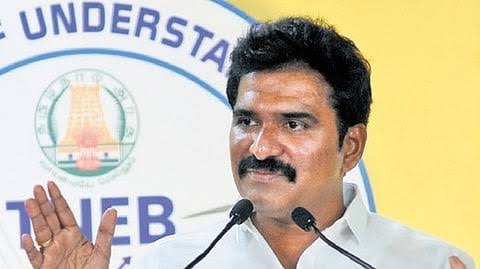
Further, Velu said the figures showed that the previous government had maintained law and order and ensured that cases were registered. CHENNAI: Tempers flared in the Assembly on Friday during a heated exchange between DMK floor leader E V Velu and Minister C T R Nirmal Kumar over atrocities against Dalits during the previous DMK government. Former minister Velu dismissed as “incorrect” the statement made by PWD Minister Aadhav Arjuna a day before in the Assembly that Tamil Nadu witnessed the highest number of atrocities against Dalits in the country over the past five years. Citing National Crime Records Bureau (NCRB) data, Velu said Uttar Pradesh had recorded the highest number of cases against people belonging to the Scheduled Caste communities, followed by Rajasthan, Madhya Pradesh, Bihar, and Maharashtra. He said Uttar Pradesh recorded around 71,000 such cases in five years, while Tamil Nadu had recorded 8,110 cases. Tamil Nadu stood 10th in cases registered under the SC category and 15th in cases involving Scheduled Tribes, he said. Further, Velu said the figures showed that the previous government had maintained law and order and ensured that cases were registered. However, Nirmal Kumar rejected the claim and alleged that many cases against Dalits were not registered during the previous DMK regime. He further cited an incident in Ramanathapuram, in which a minister had allegedly assaulted a Dalit tahsildar. Nirmal Kumar claimed that the minister’s portfolio was changed after protests, but no case was registered against him. He said that if all cases had been registered during the previous regime, Tamil Nadu would have topped the NCRB list. Courtesy : TNIE Note: This news is originally published on https:/thenewindianexpress.com/bha and is used purely for non-profit/non-commercial purposes, especially human rights
TN government school HM booked for abetment after dalit girl ends life

The HM passed a casteist remark during admission interview, ordered her out of premises MADURAI: The Caste-Hindu headmistress of a government higher secondary school was booked under abetment charges on Friday, after a 16-year-old Dalit girl died by suicide on August 25 allegedly after she ordered her out of the school for telling her mother not to keep her hands folded during an admission interview. Police identified the deceased student as P Nisanthi (16) of Ambedkar Nagar, Usilampatti. A case of suicide was registered on August 25, but altered to abetment of suicide and the HM Vimala’s name was included. Nisanthi’s uncle, P Sangili (52), a share-auto driver, said the incident took place on August 24 when Nisanthi went to the school with her mother, P Thavamani, seeking admission. Vimala inquired about the girl with her previous school. During the conversation, Thavamani was listening with folded hands, but Nisanthi tapped them down. The headmistress questioned the action, refused to admit her, allegedly passed a casteist remark, and ordered them to leave the premises. The next day, Nisanthi died by suicide. “Nisanthi was upset over the incident, which triggered her to end her life. She refused to eat and cried a lot the previous night. It happened to our child in this era and it should not happen again in society. We want action against the headmistress,” he said. Police said there was no CCTV inside the room and only the girl’s arrival and departure could be seen in the footage recorded outside. “The exact conversation between them was not clear, but the incident prompted her to end her life. Whether SC/ST Act will be invoked will be decided after the inquiry by Usilampatti DSP. As of now, the case has been converted into one of abetment of suicide,” a police source said. A school education official who held an inquiry with the headmistress stated that she denied the charges and claimed she had spoken casually without any casteist motive. A report has been submitted to the district collector. Further action against her will be decided in line with the police investigation. Nisanthi completed Class 10 at a government school in Thottappanayakanur before joining the first group at a government school in Poochipatti. However, she did not attend that school as she wanted to pursue nursing group. Later, the family approached a government-aided school in Usilampatti, where they were asked to pay `5,000. Unable to afford the amount, they approached the Government Model Higher Secondary School for admission. (To overcome suicidal thoughts, contact TN Health Department helpline 104 and Sneha’s helpline 044-24640050) Courtesy : TNIE Note: This news is originally published on https:/thenewindianexpress.com/bha and is used purely for non-profit/non-commercial purposes, especially human rights
After the Common Man, the Convenient Bahujan: CJP Fails the Litmus Test of Representation

Yogendra Yadav sees in CJP a new Bahujan politics. But a caste mix is not automatically a Bahujan distribution of power. The real test is whether communities historically excluded from power exercise authority across the organisation. After the Common Man, the Convenient Bahujan: CJP Fails the Litmus Test of Representation Cockroach Janta Party (CJP) founder Abhijeet Dipke, left, with team member Ratna Singh, centre, on August 5, 2026. Photo: PTI, via CJP Yogendra Yadav’s account of the July 20 protest at Jantar Mantar is fine political writing. It encapsulates the core of a youth mobilisation that broke through governmental fear and media silence. Nevertheless, its most ambitious claim is that this movement – led by Dalit activist Abhijeet Dipke and inspired by Sonam Wangchuk – could inaugurate a new phase of social-justice politics. “Instead of demanding its share in the nation,” Yadav writes, “Bahujan politics can now define what the nation is.” Can it, though? Or has the liberal intelligentsia simply found its next common man? The first real litmus test of CJP’s potential was not Jantar Mantar, but during a moment that occurred almost two weeks after it declared its national leadership team. According to CJP, its National Working Committee “ratified” the list of eleven leaders. It would appear from the publicly identifiable composition of CJP’s leadership that it is caste heterogeneous. However, it is disproportionately weighted towards upper-caste and regionally dominant caste groups, including Jats and Reddys. In any case, a caste mix is not automatically a Bahujan distribution of power. The relevant test is whether communities historically excluded from power exercise authority across the organisation. Representation is not merely the identity visible at the apex; it is the distribution of power throughout the institution. In the same vein, protests can tell us who is angry, but it is organisations and their composition that tells us who will get to exercise power. The CJP has yet to explain either the social rationale for this organisation or the process by which it was constituted. The importance of a Dalit convenor is undeniable, but that alone does not make it a Bahujan movement either. Representation does not lie in faces at the top; it lies in power structures below. Further, if the CJP derives its politics from the constitution, social justice cannot wait for the moment when it takes up the question with the state. It must begin at home – with who leads and holds power and whose concerns form its agenda. An organisation that cannot practice social justice in the first institution it has created cannot credibly promise to deliver it elsewhere. Yadav, especially, needs to understand this. He was part of the anti-corruption movement and was one of the founding members of the Aam Aadmi Party (AAP), which promised to transcend ordinary politics through the idea of the common man, with a discourse about corruption, education and service delivery that quietly excluded caste, class and social relations from its agenda. The similarities go beyond political ideology: six out of twelve members of CJP’s core team belong to AAP’s political world, either because they worked with the party or publicly supported it. The question that should have been asked of AAP then is the one that matters as CJP takes shape now: who, precisely, was the common man? The answer lies not in the social composition of AAP’s voters, but in the leadership it chose when it had real discretion – its national executive, Cabinet portfolios and Rajya Sabha nominations. The caste imbalance is visible without much excavation. Even after winning Punjab, where Scheduled Castes constitute nearly a third of the population, AAP sent no Dalit to the Rajya Sabha. Its 2022 nominations favoured party insiders, professionals and business figures; no Dalit, Adivasi or OBC candidate made the list. The language of the common man was addressed to lower-caste and marginalised citizens, while institutional power remained concentrated among upper-caste and socially privileged groups. Then there is Rajendra Pal Gautam, who held the position of Minister of Social Justice and Empowerment in AAP governments (2015-2022). He opposed the health department’s notification which excluded mohalla clinic contract workers from reservation policy in 2022. Months later, his presence at an event where Ambedkar’s twenty-two vows were recited was fabricated into a controversy. Being pressured by the BJP and due to the electoral sensitivity of AAP, he resigned. In private, he was questioned for supporting reservation and publicly sacrificed for being an Ambedkarite. It shows the yawning gap between symbolic and substantive representation: a Dalit minister represents inclusiveness; an assertive Dalit minister becomes a liability. The education model of AAP remains fascinating for the Indian liberal community – better classrooms, better exam results, all in the rhetoric of administrative efficiency rather than transformations of social relations. CJP seems to be joining the same league. Paper leaks and recruitment delays are real issues and readily become the agenda of “Indian youth”. Caste discrimination and the deaths of Scheduled Caste and Scheduled Tribe students inside these institutions remain, as ever, a sectional footnote. The Ministry of Education, say reports, recorded 122 student suicides in centrally-funded higher education institutions between 2014 and 2021, 24 of which were of Scheduled Caste scholars, three pf Scheduled Tribes and 41 from the Other Backwards Classes (OBC). Death is only the most brutal end of a longer exclusion. India still has no continuous, caste-wise registry tracking these deaths, dropouts and complaints – and that is not oversight but evasion of accountability. Across 21 IIMs with 1,880 sanctioned faculty posts, government data count only 62 Scheduled Caste, 16 Scheduled Tribe and 109 OBC teachers. The bureaucratic verdict “not found suitable” has refused to die: a parliamentary committee condemned its continued use against Scheduled Caste and Scheduled Tribe academics as recently as in 2025. An education movement that speaks only of paper leaks and examinations, silent on who teaches and who survives inside these institutions, is not confronting India’s educational crisis. It is choosing the part of the crisis liberal
Cong Using Tribal Students’ Stir to ‘Relaunch’ Rahul Gandhi: Bawankule
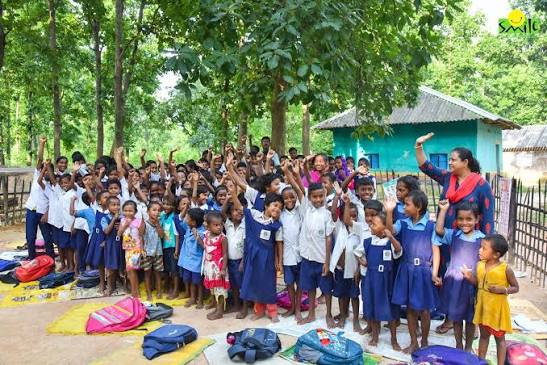
Nagpur: Revenue minister Chandrashekhar Bawankule on Friday accused Congress of attempting to use an agitation by tribal students as a political launchpad for leader of opposition in Lok Sabha Rahul Gandhi in Maharashtra. He alleged that Congress was keeping the protest alive for political reasons even as the govt has given assurances to students over their demands. Gandhi, during his “Chhatron Ki Goonj” interaction in Pune on Aug 22, publicly backed the tribal students’ agitation in Maharashtra. In a letter written to CM Devendra Fadnavis, he raised several of their demands. “The state govt has discussed the issues of students and is ready to engage with them repeatedly, if necessary. But why insist on continuing the agitation when the issues are moving towards resolution?” he said. The minister alleged that Congress was seeking to sustain the agitation until Gandhi’s next tour of Maharashtra, using the students to build a political narrative around their demands. “Maharashtra would not accept tribal students being drawn into such an exercise,” he said. As per Bawankule, political parties should not use educational concerns as a vehicle for political mobilisation. He said the immediate priority should be resolving issues affecting students rather than extending an agitation for partisan purposes. “This is like playing with the future of tribal students,” he said. The Nagpur and Amravati district guardian minister maintained that the administration had already moved beyond assurances by taking decisions on the demands raised by the students. He also sought to draw a political contrast between the govt’s approach and that of Congress. “The administration led by chief minister Devendra Fadnavis was working to expand facilities and educational opportunities for tribal students. Their academic future should remain at the centre of the issue,” he said, adding, “Congress appears more worried about saving the political careers of its leaders than those of students.” Bawankule urged Congress to engage with the govt directly if it wanted to pursue unresolved issues concerning the tribal community. Rather than turning students into participants in a political confrontation, he said, the party should help create conditions for negotiations and resolution. Courtesy : TOI Note: This news is originally published on https:/timesofindia.com/bha and is used purely for non-profit/non-commercial purposes, especially human rights
From India to America: How Caste Discrimination Followed the Diaspora

Jana Eid explores how the Indian diaspora brought caste discrimination to the U.S. and highlights the growing legal and social movement to outlaw it. Caste and caste discrimination are no longer limited to India. The system has followed the Indian diaspora across the globe, including to the United States. Today, Indian Americans represent one of the largest and fastest-growing immigrant communities in the country; in 2022, the U.S. Census Bureau recorded more than 6.5 million people of South Asian descent residing in the U.S. Many Dalits who moved to America to escape persecution found that the very system that caused them to leave was also embedded within various domestic institutions, primarily the workforce. Equality Labs, a South Asian civil rights organization, released a report in 2018 titled Caste in the United States, revealing that 67% of Dalit respondents felt they were treated unfairly at an American workplace due to their caste. Approximately 12,000 Dalits responded to the survey, with 41% stating they experienced discrimination in education and 25% reporting they had been physically assaulted in the U.S. because of their caste. While respondents hailed from an extensive range of fields, the tech industry has garnered the most public outcry. Major technology employers, including Cisco Systems, Inc. in Silicon Valley and Google, have come under scrutiny for enabling discrimination by higher-caste employees who predominantly occupy senior-level, higher-paying positions. In July 2020, the California Civil Rights Department filed a lawsuit against Cisco and two of its managers for discriminating against an engineer on the basis of his Dalit identity, denying him both a raise and promotional opportunities. The engineer worked on a team composed entirely of higher-caste employees who had immigrated to the U.S. from India. The Washington Post reported that after the Cisco lawsuit was announced, Equality Labs received roughly 260 complaints from workers in the tech industry concerning caste bias. The executive director of Equality Labs, Thenmozhi Soundararajan, told The Washington Post that complaints detailed “caste-based slurs and jokes, bullying, discriminatory hiring practices, bias in peer reviews, and sexual harassment.” A member of Google’s Alphabet Workers Union (AWU), speaking under a pseudonym due to fear of workplace retaliation, noted that “companies like Alphabet employ a large number of workers of South Asian origin … via contracting, which strongly intersects with caste” (“In These Times: Meet the Activist Coalition That Outlawed Caste Discrimination in Seattle”). She highlighted how lower-caste individuals are particularly vulnerable to losing their immigration status (as many are on work visas) and to being doxxed or harassed online. AWU is urging Google to add an explicit ban on caste discrimination to its U.S. code of conduct, matching its policy in India, given that there are currently no U.S. federal employment laws that explicitly ban caste discrimination. To date, several jurisdictions and institutions have succeeded in banning caste discrimination, including the Seattle City Council and various universities. In February 2023, Seattle became the first American city to explicitly outlaw caste discrimination. The Seattle City Council voted 6,1 to approve an ordinance adding caste to its municipal anti-discrimination laws, officially banning caste-related discrimination and harassment in employment, public accommodations, and housing. Several years prior, in November 2019, Brandeis University updated its non-discrimination policy to include caste, becoming the first higher education institution to do so. A number of universities followed suit over the next several years, including Colby College, California State University, Brown University, and Rutgers University. Different arguments have been made in favor of addressing caste under existing protected class categories. The New Jersey State Bar Foundation defines a protected class as “a person or group of people who are legally protected from discrimination or harm if they possess certain characteristics.” In terms of caste, the most notable established categories are religion and race. California’s Civil Rights Department has argued that the Hindu caste system falls under the protected class of religion. However, this argument rests on the false premise that caste is practiced exclusively by Hindus; in reality, caste cuts across religious boundaries and is frequently observed among Christians, Muslims, and Sikhs as a deeply ingrained sociocultural practice. While caste is historically rooted in the Hindu varna framework, it cannot be comprehensively regulated through religion alone because of its persistent presence across multiple religious communities. The case for interpreting caste discrimination as a form of racial discrimination involves a rich historical precedent, intersecting with the fight against anti-Black racism in the United States. The caste-race analogy has been drawn repeatedly throughout American history because caste is fundamentally a hierarchical system of social stratification. The Chambers Etymological Dictionary of the English Language (1872) defined caste as “a breed or race; one of the classes into which society in India is divided; a tribe or class of society.” To demonstrate that slavery and segregation ran counter to the core principles of American democracy, abolitionists such as Thomas Dalton, Frederick Douglass, William Lloyd Garrison, and Harriet Beecher Stowe routinely equated the treatment of Black Americans to the caste system of South Asia. The author of an 1833 article in The Abolitionist asserted that members of “the African race are essentially a degraded caste, of inferior rank and condition in society.” Charles Sumner, an American lawyer and U.S. senator, drew a similar comparison: “In India, Brahmins and Sudras, from generation to generation, were kept apart. If a Sudra presumed to sit upon a Brahmin’s carpet his punishment was banishment. With similar inhumanity here, the black child, who goes to sit on the same benches with the white child, is banished, not from the country, but from the school. In both cases it is the triumph of Caste. But the offense is greater with us, because, unlike the Hindoos, we acknowledge that men are born equal” (Brown and Thorat 956). Furthermore, in August 1866, the Republican Party circulated bulletins clarifying that the Fourteenth Amendment, which guarantees U.S. citizenship to everyone born in the country, was created in part to prohibit caste, and class-based discrimination. While the historical connection between race and caste
AAP names Dalit face Garhi as in charge of Channi’s former seat
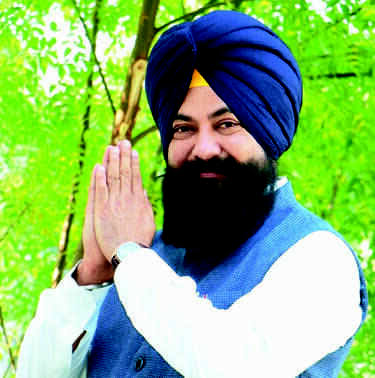
Patiala: The Aam Aadmi Party has appointed Punjab State Scheduled Castes Commission chairperson Jasvir Singh Garhi as its halqa in charge of the SC-reserved Chamkaur Sahib constituency, triggering speculation over a possible candidate change before the 2027 assembly elections. The seat is held by AAP MLA Dr Charanjit Singh, who defeated the then CM, Charanjit Singh Channi, by more than 7,900 votes in 2022. Channi had won the seat in 2007, 2012 and 2017. Party insiders said appointing an outsider as halqa in charge in a constituency represented by a sitting MLA had often preceded a candidate change. Garhi, a prominent Dalit leader with a grassroots network built during his years in the Bahujan Samaj Party (BSP), will now oversee party activities in the constituency. AAP functionaries described the move as a routine organisational exercise to energise workers. Political observers, however, see it as a possible recalibration of the party’s field leadership in a constituency with a substantial Dalit electorate. The appointment assumes significance given Garhi’s political background. A former govt veterinary inspector, he quit service in 2019 and headed the BSP’s Punjab unit for nearly five years. BSP expelled him in Nov 2024 on charges of indiscipline. He joined AAP on Jan 1, 2025, in the presence of CM Bhagwant Mann and became SC commission chairperson two months later. As commission chairperson, Garhi has taken on several Congress and BJP functionaries. He summoned Punjab Congress chief Amrinder Singh Raja Warring over remarks about late former Union minister Buta Singh and sought a written response. He also summoned leader of opposition Partap Singh Bajwa twice, including over alleged casteist remarks against Punjab minister Harbhajan Singh ETO. Garhi also summoned Congress-turned-BJP leader Ravneet Singh Bittu over alleged casteist remarks during a civic poll-related dispute in Dhuri. He rejected Sangrur police’s initial report as unsatisfactory despite Bittu issuing a public apology. MLA Dr Charanjit Singh and AAP media in-charge Baltej Pannu could not be contacted for comment. Courtesy : TOI Note: This news is originally published on https:/timesofindia.com/bha and is used purely for non-profit/non-commercial purposes, especially human rights
Dalit girl taps down mom’s folded hands, faces HM’s ire; found dead next day
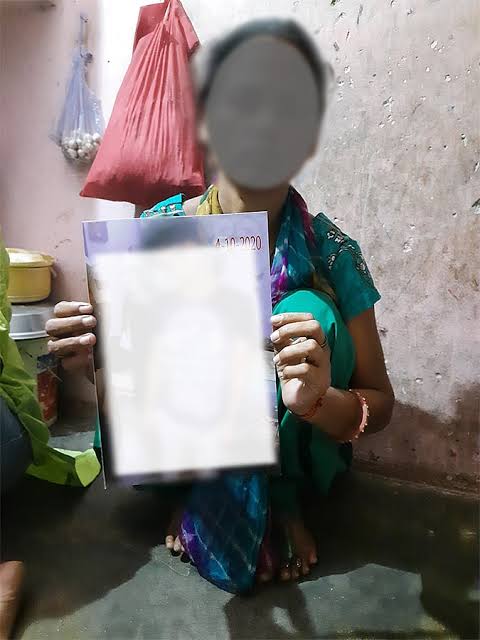
Madurai:: A 16-year-old dalit girl from Madurai was found hanging at her home on Aug 25, a day after a headmistress ordered her out of school for tapping down her mother’s folded hands while she was seeking admission there. Her mother P Thavamani told police that her daughter P Nijanthi was deeply distressed after Vimala, headmistress of Government Model Higher Secondary School in Usilampatti, who belongs to a dominant caste, rebuked her over the gesture. Thavamani, from Ambedkar Nagar, said Nijanthi completed Class X at Thottappanayakkanur before joining a nearby govt school in Poochipatti. She attended the first group there for 20 days but discontinued because she wanted to pursue the nursing group. She remained home for a month. Later, Thavamani took her to TELC Girls’ Higher Secondary School in Usilampatti, where they submitted an admission form. According to the police FIR, the school sought Rs5,000, which Thavamani could not pay immediately. So, they approached Government Model Higher Secondary School in Usilampatti. Its headmistress questioned Nijanthi and telephoned her former headmaster. Speaking over a loudspeaker, the former headmaster described her as disciplined and good at studies. As Thavamani listened with her hands folded, Nijanthi tapped them down. The model school headmistress allegedly questioned the teenager over her action. She accused her of arrogance and claimed such behaviour may have led to her leaving the earlier school, the FIR said. “She made a casteist remark, asking, ‘Why can’t people like you keep your hands folded?’ She then berated the child and ordered her out. The humiliation left her distressed,” said Selvam, a relative of the girl. Nijanthi ran from the campus and walked five kilometres towards Nallamalpatti. Her mother located her and brought her home by autorickshaw. Thavamani said her daughter skipped dinner and remained distressed. Returning from work around 5.30 pm the next day, she found the bedroom locked. A neighbour broke open the door, and Nijanthi was found dead. “She cried throughout the night after the humiliation. Police are refusing to invoke SC/ST Act and appear to be protecting the headmaster, who belongs to the Kallar community,” Selvam said. Courtesy : TOI Note: This news is originally published on https:/timesofindia.com/bha and is used purely for non-profit/non-commercial purposes, especially human rights
Caste-Based Attack on Dalit Youth in Moradabad: Hit on Head with Sharp Weapon for Watching DJ, Case Filed Against Five
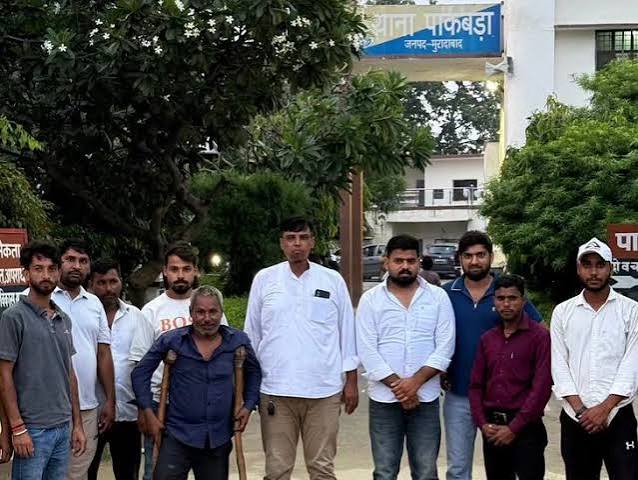
In Sabjipur village, under the Pakbara police station area of Moradabad, a Dalit youth was attacked with a sharp weapon while being hurled caste-based insults. The youth, who had returned from work in Kerala, suffered serious head injuries. Based on the victim’s complaint, police have registered a case against five accused under serious sections and the SC/ST Act. The victim, Ajit Kumar, son of Balram, stated in his complaint to the police that he returned home from Kerala on August 17, 2026, at around 8 p.m. After returning home, he went to a mechanic to pick up his bike, which had been given for service. While returning home, a DJ was playing on the road. Ajit parked his bike to watch the DJ. It is alleged that some boys came from behind the DJ and surrounded him shortly after. According to the victim, the accused used casteist slurs and abused him, saying, “You are a Chamar and a Bhimta, you believe in Bhima, what business do you have here?” They then surrounded him and attacked him with a sharp-edged weapon on his head, causing serious injuries. The accused also said, “Son of a Chamar, what can you do?” In the complaint, the victim named the accused who assaulted him as Bablu, son of Sher Singh, Akash, son of Ramavatar, Akash, son of Prakash, Chandrasen, son of Karan Singh, and Jain, son of Netrapal. Based on Ajit Kumar’s complaint, the Pakbara police station in-charge has registered a case under the SC/ST Act and relevant sections and has begun an investigation. Police say they will investigate the matter and take strict legal action against the culprits. Shrikant Sharma | Moradabad Courtesy: Hindi News
TVK, DMK MLAs trade barbs over social justice

The minister also cited a reported 67% increase in atrocities against SCs in TN between 2019 and 2023, claiming it was the highest in the country. CHENNAI: The Assembly on Thursday witnessed fiery exchanges between members of the ruling coalition and the DMK over Dalit empowerment. PWD Minister Aadhav Arjuna, responding to DMK’s claims of championing Dalits and minorities, questioned its alliance with the BJP between 1994 and 2003. He asked why the DMK did not withdraw support for the BJP after the 2002 Gujarat riots. The minister also cited a reported 67% increase in atrocities against SCs in TN between 2019 and 2023, claiming it was the highest in the country. Referring to CAG observations on SC and ST welfare funds remaining unspent, he said, “BR Ambedkar’s vision was to give authority to Dalits, not stop with providing them houses and water.” Rejecting the criticism, DMK MLA KN Nehru said it was common for governments to leave around 6%-7% of funds unspent and for such amounts to be flagged in CAG reports. He added that the same could happen to the present government “if it lasts for a year”, triggering protests from TVK members. Speaker JCD Prabakar intervened and said the people’s mandate was for five years. DMK MLA Govi Chezhiaan then accused Arjuna of trying to create an impression that the party had done nothing for Dalits. He credited Karunanidhi with introducing concrete houses for Dalits and bringing legislation to enable people from all communities to become temple priests. Arjuna questioned whether the scheme to appoint temple priests had been implemented for the entire five years of DMK rule. Former HR&CE minister PK Sekar Babu said the DMK government had issued appointment orders for 32 people, but the process was halted following a case in the Supreme Court. Arjuna then accused the DMK of taking credit for schemes it could not implement fully. Aadhav also questioned why the DMK had not conducted a caste survey. DMK MLAs responded that the Supreme Court had not permitted the state to conduct one. School Education minister A Rajmohan accused the DMK of portraying Dalit rights as achievements granted by the party rather than rights secured through the Constitution. He also referred to RS Bharathi’s controversial remark that Dalits becoming judges were “alms” granted by the Dravidian movement. DMK members objected to the reference, pointing out that Bharathi had already been reprimanded by the party. Joining the debate, Social Justice Minister Vanni Arasu questioned why the DMK had not shared power with the VCK when the latter had four MLAs supporting the DMK in the previous Assembly. Drawing a parallel with VCK’s representation in the TVK-led government, he said the DMK could not accept a VCK leader becoming a minister. He also took exception to the DMK’s description of the TVK government as a “sofa model government”, saying the remark could be compared to dominant caste people mocking Dalits for wearing good clothes or buying a car. Responding to statements that Dravidian parties had fielded Dalit candidates in general seats, Arasu said the move appeared to have been driven by “pity rather than principle”. ‘Assembly not a forum for political fights’ Chennai: The Assembly is a legislative forum meant to discuss people’s issues, not a battleground for political fighting, DMDK MLA Premalatha Vijayakant said on Thursday, urging the Speaker to given an opportunity for all MLAs to speak. She also singled out Aadhav Arjuna, saying his interventions were prolonging debates. ENS Courtesy : TNIE Note: This news is originally published on https:/thenewindianexpress.com/bha and is used purely for non-profit/non-commercial purposes, especially human rights