
Tamil Nadu: Dalits forced to prostrate at the feet of a 90-year-old man who went to bury him at a crematorium; a case has been filed.
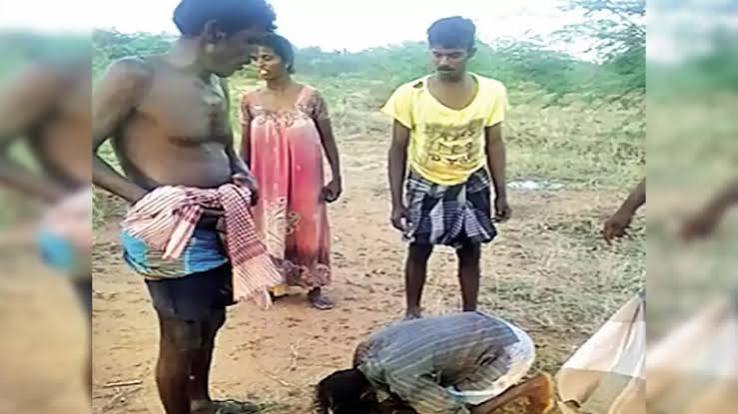
Caste dispute erupts in Erode, Tamil Nadu, over a public crematorium. Dalits prostrated themselves at the feet of powerful men after being threatened with a job ban. Tamil Nadu: A highly inhumane and shameful case of caste discrimination has emerged from Erode district. A massive controversy erupted over the cremation of a 90-year-old man in Perumbali village, located in the Madathupalayam Panchayat near Perundurai. Amidst the protests over the use of the public crematorium, two Scheduled Caste (SC) members were allegedly forced to prostrate themselves at the feet of members of the Backward Class (BC). Over 100 Scheduled Caste residents reside in Perumbali village. These villagers have long faced difficulties burying the bodies of their loved ones at the local crematorium. Due to strong opposition from the dominant castes, they were often forced to carry the bodies to Thingalur, about five kilometers away. However, after a recent survey, the Tehsildar of Perundurai declared this cremation ground public for all communities. On October 5th, Chenni, a 90-year-old Scheduled Caste man, died due to age-related ailments. When members of his community took his body to the public cremation ground for burial, they faced strong opposition from members of the backward castes, which soon escalated into a heated argument. According to the district police, the funeral was conducted under tight security from the Revenue Department and the police. During the altercation between the two communities, the Scheduled Caste members were allegedly threatened and warned not to approach the dominant caste members for any work in the future. Immediately after this threat of not giving them work, two members of the Scheduled Caste community were forced to grab the feet of the members of the BC community. The police have now taken strict legal action regarding this incident. A case has been registered at the Thingalur police station on the night of October 8, 2026 (Thursday) based on a complaint filed by the Perundurai Revenue Inspector. Two individuals have been charged under stringent sections of the Scheduled Castes and Scheduled Tribes (Prevention of Atrocities) Act in connection with this inhumane act, and the police are conducting a thorough investigation. A video of the incident is rapidly going viral on social media, clearly showing the public humiliation of members of the Dalit community. The video has sparked widespread public outrage and demands for immediate, strict action against the culprits. Iswaran, State Coordinator for the Western Region of the Bahujan Samaj Party (BSP), has strongly condemned the incident. He alleged that preventing people from using public crematoriums is a direct violation of the rights of SC community members. He described the threat of denial of work as the most brutal form of caste-based oppression. Iswaran said that taking advantage of the economic helplessness and helplessness of Dalits and forcing them to bow down at the feet of other communities is a highly condemnable act. The BSP leader also raised serious questions about the role of the police and revenue department officials present at the scene. He demanded strict action against those who opposed the funeral, as well as those officials who completely failed to prevent this insult. Rajan Chaudhary Courtesy: Hindi News
Rashtriya Janshakti Samaj Party threatens hunger strike: One-day sit-in in Ayodhya, demands action in cases of Dalit victims
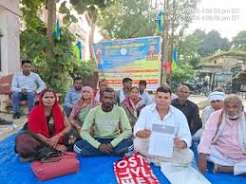
The Rashtriya Janshakti Samaj Party (Uttar Pradesh) held a day-long sit-in at Tikonia Park in Ayodhya on October 9, 2026. Led by State Vice President Anil Kumar Rawat, a memorandum addressed to the Governor was submitted to the District Magistrate, Ayodhya. The memorandum demanded legal action in pending cases of Dalit victims. The party warned that if the demands are not met by October 14, 2026, its workers will begin an indefinite sit-in, fast-unto-death, and hunger strike from October 15. The party’s main demands: A case be registered for the Dalit victim, Meenawati (Anil Rawat’s wife), in the September 27, 2026 incident. A charge sheet be filed and the accused arrested in Kotwali Nagar FIR No. 702/2025. A high-ranking officer should investigate FIR No. 391/2026 against the Bikapur SDM Peshkar, and the victim’s family should be provided with protection. The accused named in FIR No. 424/2025, dated December 2025, including Ashish, Shivakant, Vindu, and Shrikant, should be arrested. The false FIR No. 425/2025 filed against Anil Kumar Rawat and others should be withdrawn. Prabhakar Nath Chaurasia | Civil Lines (Atal Nagar), Ayodhya Courtesy: Hindi News
TM Investigation | Hopes dashed: No consultation with NCSC, so how was the path to becoming pilots blocked for Dalit students?
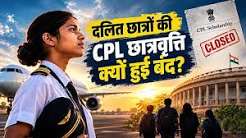
After a detailed BANAE report, Rahul Gandhi demanded the restoration of scholarships from the Social Justice Minister. New Delhi. Major decisions are often recorded in very short lines in government files. The story of the end of the Commercial Pilot License (CPL) scholarship for Scheduled Caste (SC) students is also contained in one such line in documents obtained by TM. The minutes of a meeting of the Steering Committee of the Top Class Scholarship Scheme, held on July 7, 2023, state that there was a “broad consensus” that the CPL course should be removed from the scheme due to the very high fees and lack of employment certainty for the beneficiary students. This policy decision concerning the Scheduled Caste community was made without consulting the National Commission for Scheduled Castes, which not only violates constitutional provisions but has also deprived 200 deserving Dalit students, who perhaps dreamed of becoming pilots, of their dream careers over the past four years. More than three years after that Steering Committee meeting, this decision is now at the center of political debate. On September 26th, Rahul Gandhi, Leader of the Opposition in the Lok Sabha, wrote a letter to Dr. Virendra Kumar, Union Minister of Social Justice and Empowerment. He demanded that the CPL scholarship be immediately reinstated and all pending cases from 2023 be approved. This letter was not written suddenly; it was represented by a Mumbai-based organization. On September 11th, the Dr. Babasaheb Ambedkar National Association of Engineers (BANAE), based in Andheri (Mumbai), sent a detailed letter to Rahul Gandhi. The organization’s national president, Nagsen Sonare, requested Rahul Gandhi to personally raise the issue with the Minister of Social Justice, citing it as “most urgent/on top priority.” BANAE clearly stated that this was not merely a scholarship complaint, but rather a question of adherence to constitutional safeguards in major policy decisions affecting Scheduled Castes. Fifteen days later, Rahul Gandhi wrote his letter to the Minister, enclosing BANAE’s full representation. In his letter, Gandhi wrote, “Young Dalits across the country dream of looking up to the sky and flying. For years, government scholarships made these dreams come true. These dreams have been shattered since 2023-24. In 2023-24, the CPL course was removed from the “Top Class Scholarship Scheme” for SC students. The Ministry states that eligible students can apply under the Post-Matric Scholarship for SC Students.” Rahul Gandhi says that the scheme’s guidelines do not include any provision for CPL training, and therefore “the path to the cockpit has been closed for most Dalit youth.” The issue arose after a complaint by a Bahujan activist from Uttar Pradesh. Dwarika Prasad, a retired general manager of the Oil and Natural Gas Corporation Limited (ONGC), is the complainant in this entire episode, whose letter brought the matter to the National Commission for Scheduled Castes (NCSC). Through three years of tireless efforts, Dwarika Prasad collected documents through the Right to Information Act and uncovered the reasons behind the closure of this ambitious scheme. Dwarika Prasad, a resident of Mathura district, wrote a letter to the NCSC Chairman, stating that the free scholarship and fee for CPL courses for SC students had been in place for over four decades, but the Ministry of Social Justice had arbitrarily discontinued it. Dwarika Prasad explains that hundreds of poor Scheduled Caste students had benefited from this scheme. They alleged that this decision was taken in violation of Article 338(9) because it appeared that the Ministry had not consulted the Commission before making this major policy decision. They requested the Commission to take up the matter with the Ministry. On January 19, 2026, the Commission’s Under Secretary, K.J. Bhatt, sent a letter to the Secretary, Department of Social Justice, under file number ESDW/IP/UP/2024/259953, based on this complaint. Dwarika Prasad’s representation was attached to it for “appropriate action,” and a copy of the letter was also provided to him. This same Commission letter was later referenced in both BANAE’s representation and Rahul Gandhi’s letter. More than seven months after the Commission’s letter, no effective solution has been found. When CPL was part of the Post-Matric Scholarship To understand what changed, we need to look back. The Centrally Sponsored Post Matric Scholarship Scheme (PMS-2010), which came into effect on July 1, 2010, clearly states CPL as a Group I course, the same category as medical, engineering, and management courses. The CPL course also included training for a commercial helicopter pilot license and multi-engine rating on aircraft like the A-320. Fifty CPL awards were set aside for the entire country each year. State governments and union territories would scrutinize applications and submit the names of eligible candidates to the ministry, which would approve up to 50 awards nationwide on a first-come, first-served basis. Selected students received a maintenance allowance at Group I rates: ₹1,200 per month for hostel residents and ₹550 per month for day scholars. Flight charges were also covered, in addition to all mandatory fees. The same document also stipulated that scholarships would not be awarded for private pilot license and aircraft maintenance engineer courses. Thus, CPL was not an exception, but rather included in the scholarship-eligible courses. Speaking to The Mooknayak, BANAE President Nagsen Sonare says that the CPL scholarship was not a new concession. It was an established facility, recognized by the government as a specialized professional education. Sonare also cited the 2005-06 Union Budget, in which the then Finance Minister announced in Parliament that all three existing scholarship schemes for SC/ST students – pre-matric, post-matric, and merit-based – would continue. In the same speech, he proposed a new window of larger scholarships for SC/ST students enrolled in select institutions of excellence. This later became the “Top Class Education for SC Students” scheme, which came into effect in June 2007. Sonare says that in 2018, CPL was removed from the original Post Matric Scholarship framework, but the government did not discontinue it at that time. The benefit was transferred to the Top Class Education Scheme. The scheme’s guidelines, effective
Karnataka High Court: Acquittal of 26 accused in 17-year-old case of desecration of Baba Saheb’s portrait and SC/ST atrocities upheld
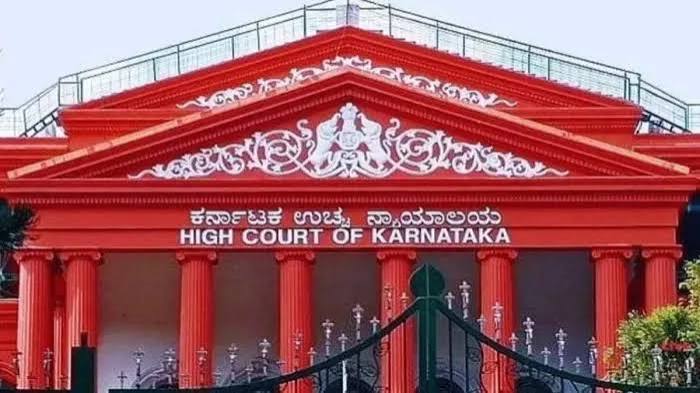
On behalf of the state, public prosecutor K. Nageshwarappa argued that the acquittal was “illegal, invalid, and contrary to the law, evidence, and material on record.” According to him, the lower court failed to properly evaluate the witnesses’ testimony, leading to a miscarriage of justice. Bengaluru: The Karnataka High Court on October 1 dismissed the state government’s appeal against the acquittal verdict delivered by the Chamarajanagar Special Court. The case relates to a 2009 incident in Bommanahalli village in Gundlupet taluk, in which a portrait of Dr. B.R. Ambedkar and a community hall signboard were vandalized, and members of the Scheduled Castes were assaulted and subjected to casteist abuse. A single bench of Justice G. Basavaraj delivered the verdict while hearing the case. The appeal was filed by the state government through the Terakanambi police. According to the prosecution, on June 6, 2009, at around 7 p.m., 29 accused persons formed an unlawful assembly in Bommanahalli village. They were armed with deadly weapons and had gathered with the common intention of rioting. They were alleged to have toppled the signboard of a “community hall” and a portrait of Dr. Ambedkar. According to the prosecution, this act was committed in public with the intention of outraging the sentiments and insulting the Scheduled Caste community. The accused were charged under sections 143, 147, 148, 341, 323, 324, 506, 427, and 295(A) of the Indian Penal Code and sections 3(1)(x) and (xi) of the Scheduled Castes and Scheduled Tribes (Prevention of Atrocities) Act, 1989. After the charge sheet was filed, the court took cognizance and issued summons. All the accused appeared and were granted bail. However: Accused No. 2 failed to appear in court despite a non-bailable warrant, and a separate Special Case No. 51/2010 was filed against him. Accused No. 25 died and the case against him was abated. The trial court framed charges and read them out to the accused in their own language. The accused pleaded not guilty and expressed their willingness to face trial. The prosecution presented a total of 13 witnesses, 21 documents (Ex. P1 to P21), and 25 material objects. In their statements recorded under Section 313 of the Code of Criminal Procedure, the accused completely denied all evidence against them but offered no defense. After a hearing, the trial court acquitted Accused Nos. 1, 3 to 12, 14 to 24, and 26 to 29. The State’s arguments in the appeal The State’s Public Prosecutor, K. Nageshwarappa argued that the acquittal was “illegal, invalid, and contrary to the law, evidence, and material on record.” According to him, the trial court failed to properly evaluate the witnesses’ testimony, leading to a miscarriage of justice. He stated that there were seven injured witnesses, and there was no reason to disbelieve them. These witnesses clearly stated that the accused attacked with hands, sticks, and sickles, causing injuries all over their bodies. He also stated that caste-based abuses were hurled and stones were thrown to break the community hall signboard bearing the image and name of Dr. B.R. Ambedkar. The public prosecutor also argued that atrocities against Dalits are punishable under a special law that serves a social purpose, and therefore, the trial court should not have insisted on a harsh interpretation of the law. Advocate Manjunath N.D., representing the accused, stated that the trial court correctly evaluated the evidence in accordance with the law and facts, and there was no basis for interfering with the verdict. He sought dismissal of the appeal. In its order, the High Court cited paragraph 30 of the lower court’s judgment. It states that the complainant is injured, the other witnesses are his son, wife, and his elder brother’s wife, while four separate witnesses belong to the same community. All eyewitnesses admitted that the scene was dark and there was no electricity in the village since 6:45 p.m. that day. The lower court remarked, “None of the eyewitnesses explained how they saw the incident and in what light.” The court also noted that there were several significant contradictions in the evidence, which cast doubt on the occurrence of the incident. In conclusion, the lower court held that “the benefit of the doubt should accrue to the accused” and the prosecution failed to prove the accused’s guilt beyond a reasonable doubt, therefore, all 10 issues were answered in the negative. The High Court, after re-examining the entire material on record, refused to interfere with the lower court’s findings. Justice G. Basavaraj said in his order, “After re-evaluating, reconsidering, and re-examining the evidence, I do not find any legal or factual error committed by the lower court.” The court thereby dismissed the appeal. Geetha Sunil Pillai Courtesy: Hindi News
Dalit Youth Allegedly Beaten at Home in MP’s Katni After Scooter Collision Dispute
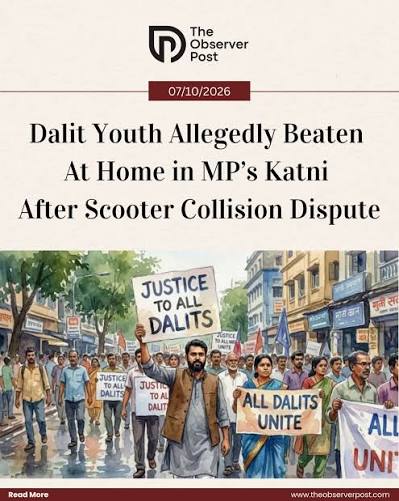
A minor dispute following a scooter collision in Madhya Pradesh’s Katni district allegedly escalated into an assault on a Dalit youth, with a video of the incident surfacing on social media. LearnHindi The incident took place in Matwara village under the Sleemanabad police station area. The victim, identified as Arvind, has alleged that some people first assaulted him in the local market and later followed him to his house, where he was dragged into the courtyard and beaten with kicks and sticks. The family has also alleged that Arvind’s clothes were torn during the assault and that he was stripped. Dispute Started After Scooter Collision According to Arvind’s family, the incident began on September 29 after a minor collision involving a scooter. The family alleged that Arvind was beaten by some people in the market following the dispute. They then allegedly went to his house and dragged him into the courtyard, where they assaulted him with kicks, punches and sticks. A video that surfaced on Monday night purportedly shows several people beating a young man while women inside the house try to intervene and protect him. Mother Allegedly Assaulted While Trying to Save Son Arvind’s mother alleged that she was also beaten and misbehaved with when she tried to intervene and save her son. The family said women present at the house attempted to stop the assault. Parts of the incident were reportedly captured on video. The allegations are being investigated by the police. Family Alleges Delay in FIR The victim’s family alleged that they approached the Sleemanabad police station after the incident but that their complaint was not immediately registered as an FIR. The family later submitted a written complaint to Katni Superintendent of Police Abhinav Vishwakarma on October 1, seeking action against those allegedly involved in the assault. FIR Registered After SP’s Intervention Police said an FIR was subsequently registered at the Sleemanabad police station following the SP’s intervention. The case has been registered under Sections 331(2), 296(b), 115(2), 351(3) and 3(5) of the Bharatiya Nyaya Sanhita. Police are examining the complaint and the video to identify all those allegedly involved in the assault. Family Seeks Arrest and Security The victim’s family has alleged that the named accused have not been arrested despite the FIR being registered. They have sought their immediate arrest and protection, claiming that the family continues to face threats. Police said efforts are underway to identify and arrest the accused. Sleemanabad police station in-charge Vijay Vishwakarma said a case had been registered and that the accused were being identified on the basis of the complaint and the video. He said the named accused and others found to be involved would be arrested and legal action would follow. Courtesy : TOP Note: This news is originally published on https:/theobserverpost.com/bha and is used purely for non-profit/non-commercial purposes, especially human rights
Dalit family attacked for protesting abusive language during thirteenth day ceremony: Woman hit with brick after entering home; case filed against accused Rinku Singh
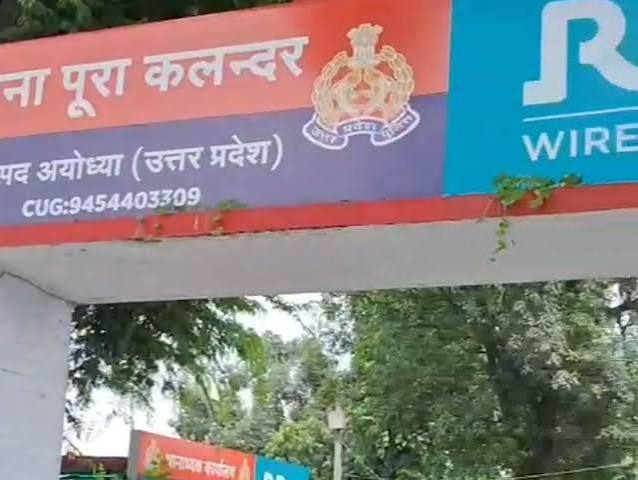
A Dalit family was attacked in Dadera village, under the Purakalandar police station area. The victim, Ramkumar, has filed a complaint against Rinku Singh, a resident of the village. According to Ramkumar, his wife’s thirteenth day ceremony was held on October 3, 2026. The accused, Rinku Singh, abused the family. When they protested, he used obscene language. Villagers intervened and sent him home. It is alleged that at around 6 a.m. on October 6, Rinku Singh entered Ramkumar’s elder brother’s house and assaulted him. He hit Ramkumar’s sister-in-law (Manoj’s wife) on the head with a brick, seriously injuring her. Following the complaint of the family, who had been receiving threats for three days, Purakalandar police have registered a case and handed over the investigation to police officer Ashutosh Tiwari. In this regard, the Pura Qalandar police station stated that a preliminary report has been filed regarding the incident, and the investigation is ongoing. Further action will be taken as directed by the Deputy Superintendent of Police. Brijesh Chandra Pandey | Pura Bazaar (Ayodhya), Ayodhya Courtesy: Hindi News
‘Age can’t outweigh crime’s gravity’: Court gives 24yo man life term for Dalit’s murder
Agra: An SC/ST court in Aligarh sentenced a 24-year-old man to life imprisonment for murdering a Dalit labourer in Nov 2021, observing that while his young age and family circumstances merited consideration, they “could not outweigh the gravity of an offence” that had ended the victim’s life and left his family, including two minor children, struggling. While pronouncing the judgment, special judge Pratibha Saxena said, “Sentencing cannot be a mechanical exercise and has to balance the gravity and manner of the crime, its impact on the victim and society, against the accused’s age, family circumstances, criminal history and prospects of rehabilitation.” According to case records, Sher Singh, a labourer, left home for work on Nov 7, 2021, but did not return. The next morning, his family was informed that his body had been found at a plot near a railway line. His brother, Munna Lal, found a plastic noose around his neck, gutka and pouches stuffed in his mouth, and injury marks around his eyes. The court noted that the murder was “particularly grave” as the victim was not merely assaulted but beaten and dragged along a road before his body was dumped in an open plot. ADGC Chaman Prakash said the postmortem revealed multiple ante-mortem injuries, including a fractured skull bone, blood clots in the brain and fractured ribs. The medical opinion attributed the death to coma and shock caused by the injuries. The court record also cited CCTV footage as an important piece of documentary evidence. Seeking leniency, the defence submitted that Manish, a resident of Barola Jafrabad, was unmarried, poor and had only his mother to support. The prosecution opposed leniency, citing the brutality of the crime and the impact of Singh’s death on his children, including a daughter. Courtesy : TOI Note: This news is originally published on https:/timesofindia.com/bha and is used purely for non-profit/non-commercial purposes, especially human rights
UP: 15-Year-Old Dalit Girl Allegedly Raped by Two Men After Being Taken to Empty House
A 15-year-old Dalit girl studying in Class 9 was allegedly gang-raped by two men in a village under the Kotwali police station area. The incident reportedly took place around 10 am on Wednesday. ExploreDiversity According to the complaint filed by the girl’s father, police registered an FIR against the two accused and detained them for questioning. Girl Allegedly Taken to Empty House The girl, a resident of the village, studies in Class 9 at a school in a nearby village. On Wednesday morning, she was returning home after giving water to cattle at a cattle shed. Police said she allegedly met Gaurav Khadgवंshi and Jaspal Khadgवंshi on the way. The two allegedly took her to Gaurav’s house, where his family members were away in the fields. According to the complaint, Jaspal allegedly raped the girl while Gaurav held her hands. The complaint also alleges that Gaurav bolted the room from inside. The girl reportedly raised an alarm, following which several villagers gathered at the house and rescued her. Accused Detained, Investigation Underway Police detained both accused and began questioning them. The girl has been sent for a medical examination as part of the investigation. CO Pankaj Kumar Tyagi said an FIR had been registered against the accused and that the matter was being investigated. Members of the girl’s family and community expressed anger over the alleged sexual assault. Police said further action would be taken based on the investigation and medical examination. Courtesy : TOP Note: This news is originally published on https:/theobserverpost.com/bha and is used purely for non-profit/non-commercial purposes, especially human rights
For quota baiters, a lesson from salons as Dalit youths challenge caste barriers
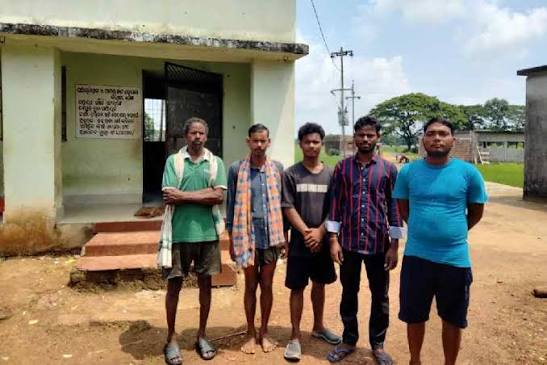
Youths in Puri district invoke the SC/ST Act after salons deny them haircuts, activists say education and reservation have helped them assert their rights In May, a group of determined Dalit youths from Jorakani Bhoi Sahi under Sauria grampanchayat in Puri district decided to assert themselves by demanding haircuts in salons that had traditionally served only the upper castes. The youths’ effort failed and set off a legal battle against the practice of untouchability, which continues even 76 years after India adopted a Constitution that guarantees equality, freedom, and justice for all. The incident stood out at a time when affluent sections have launched a campaign demanding dilution of caste-based reservation and the Scheduled Castes and Scheduled Tribes (Prevention of Atrocities) Act. There are six salons in nearby Ghoradia market run by barbers, largely OBCs. Traditionally, barbers have held the ceremonial lamp in front of wooden palanquins carrying idols from temples in processions through villages. Bhagyarathi Kandi, 26, a graduate who ekes out a living by giving tuitions, said all the shops denied them entry. “They (the barbers) said they serve the God in the temple and their caste would be diluted if they cut our hair. They said God would be annoyed too,” Bhagyarathi said. The Dalit youths filed an FIR at the Delang police station under the SC/ST Act and named the salon owners. People of the dominant Brahmin and Khandayat castes have supported the barbers’ stand to deny entry to Dalits, Bhagyarathi said. “The upper caste people met the police and demanded no action against the barbers. They said cutting the hair of Dalits means the barbers will no longer enjoy their social status and will not be able to render their services at religious events. We continue to face this untouchability,” Bhagyarathi said. Nandu Kandi, 30, said the fight would continue till the salons opened their doors to Dalits. “The boycott of Dalits is not restricted to salons. We are not allowed to attend any village festival. We celebrate our own festivities,” Nandu said, pointing to the Mangala Temple set up by Dalits. “The Brahmin priest does not come to our temple. One family from our caste is a Vaishnav Gosain (Dalit priest). He performs the rituals at the temple. On Holi or Diwali, we celebrate ourselves,” Nandu said. Rights activist Akshya Behera said the Dalits of Jorakani gathered courage to fight because many youths among them are now educated. “If we are able to fight the Savarnas (upper caste), it is because of reservation that helped us get educated. There are five/six graduates in the 25 Dalit families. They are aware of their rights and duties. The barbers, with the support of the Brahmins and Khandayats (a landed warrior caste), had never allowed entry to Dalits. But now this cannot be continued,” Behera said. He criticised the campaign to abolish caste-based reservation and the SC/ST Act. “The police are sitting on the FIR. They are not giving it any importance although the case has been filed under the SC/ST Act. The law is not enough. It must be implemented properly. Those who are demanding abolition of caste-based reservation and the scrapping of the SC/ST Act should visit Ghoradia and see how untouchability and atrocities are going on against Dalits,” Behera said. Basant Kumar Mohanty Courtesy : The Telegraph Note: This news is originally published on https:/thetelegraph.com/bha and is used purely for non-profit/non-commercial purposes, especially human rights
Andhra: Legal clinic hears Dalit atrocity victims
The clinic was presided over by DSS National Convener Jhansi Geddam and attended by 30 women victims of murder, rape, cheating, POCSO and other cases. VIJAYAWADA: Dalit Sthree Sakthi (DSS) conducted a Legal Clinic on Tuesday to hear grievances of women victims of caste atrocities, with government officials participating as jury members. The clinic was presided over by DSS National Convener Jhansi Geddam and attended by 30 women victims of murder, rape, cheating, POCSO and other cases. The jury comprised Director of Prosecutions Byra Koteswara Rao, SC Corporation Director Maridayya, psychologists Rama Devi and Praveena, Women and Child Welfare Department officer Ruksana, Bhoomika representative Anupama, and DBS representative Chitti Babu. The victims narrated their agony in accessing justice, pressure for compromise from the accused, and non-receipt of compensation. State Coordinator Jabali briefed the jury on the present status and follow-up of each case. Responding to the victims, jury members counselled them to remain resilient, and stand up for justice. Byra Koteswara Rao said the government has provided various schemes for the betterment of victims and advised them to properly utilise them. He assured all help from the prosecution side and said victims can opt for a Special Public Prosecutor as per law. Jhansi Geddam said the SCs and STs Act is a special law meant to provide total protection to victims but is not being properly implemented. She said compensation and rehabilitation is a right and not charity. She pointed out that delay in prosecution and trial is causing a lot of agony as victims are being threatened and pressured for compromise. State and district coordinators Devi, Prasanna, Sowjanya and Praveen coordinated the clinic. High Court advocate Priyanka explained cases pending in the High Court. Courtesy : TNIE Note: This news is originally published on https:/thenewindianexpress.com/bha and is used purely for non-profit/non-commercial purposes, especially human rights