
Centre seeks transfer to SC petitions filed in HCs against Transgender Persons (Protection of Rights) Amendment Act, 2026
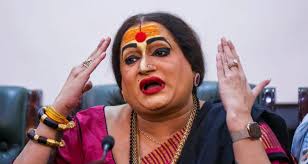
The SC had asked respondents to file replies after senior counsel AM Singhvi pointed out that the amendment took away transgender persons’ fundamental right to self-determination of gender “There are more than one High Court. There may be divergent views,” Solicitor General Tushar Mehta cautioned. File Photo The Centre on Wednesday sought transfer to the Supreme Court multiple petitions pending in various high courts challenging the Transgender Persons (Protection of Rights) Amendment Act, 2026 which introduced certain contentious changes in the legal framework governing the recognition, rights and protection of transgender persons. “We have filed transfer petitions to transfer the challenge to Transgender Amendment Act here in this court. Can the transfer petition be listed on Friday? If notice also goes, we can ask high courts to wait,” Solicitor General Tushar Mehta told a Bench of Chief Justice of India Surya Kant and Justice Joymalya Bagchi. “Sometimes, we can have an advantage of high courts’ views also,” the CJI said, noting that parallel proceedings before high courts could be beneficial to it. On May 4, the Supreme Court had issued notices to Centre, states and union territories on petitions challenging the validity of the Transgender Persons (Protection of Rights) Amendment Act, 2026. It had asked the respondents to file their replies after senior counsel AM Singhvi pointed out that the amendment took away transgender persons’ fundamental right to self-determination of gender. The petitioners contended that transgender persons receiving hormonal therapy would face problems due to the amendment. He, however, didn’t press for stay of the amendment as it had not been notified. Passed by Parliament in March this year during the Budget Session, the law amended the Transgender Persons (Protection of Rights) Act, 2019 and redefined who qualified as a “transgender person”. It also strengthened penal provisions to address serious offences such as forced identity and bodily harm. President Droupadi Murmu had given her assent to the ‘Transgender Persons (Protection of Rights) Amendment Act, 2026’ on March 30, 2026 Petitioners transgender persons Laxmi Narayan Tripathi, Zainab Patel and others – who have have challenged the validity of the amendment—alleged that it caused “irreparable constitutional injury” to the fundamental rights of transgender persons guaranteed under Articles 14 (right to equality), 15 (right to non-discrimination), 19 (right to freedom of speech and expression) and 21 (right to life and liberty) of the Constitution. Tripathi is the Acharya Mahamandaleshwar of the Kinnar Akhara, a Bharatanatyam dancer, author and social activist, Patel is the Director (Inclusion & Diversity) at KPMG India, and a Member of the National Council for Transgender Persons (Western Region). They wondered if the State, through legislation, could define who a person was by substituting biological or socio-medical classifications for a person’s lived and self-perceived identity. The PIL alleged that the amendment dismantled the principle of self-identification of gender recognised as a fundamental right by the Supreme Court in the landmark verdict in National Legal Services Authority (NALSA) versus Union of India (2014). Referring to the provision requiring the District Magistrate to issue a certificate of identity for a transgender person only after examining the recommendation of a medical board, the petitioners said it violated transgender persons’ right to privacy. “Parliament has, by the stroke of a legislative pen, repealed the statutory right that this Court held to be a fundamental right under Article 21. The impugned deletion does not even require elaborate constitutional analysis to expose its unconstitutionality: a provision that directly codifies a right declared fundamental by this Court cannot be omitted by ordinary legislation without violating Article 21 and the doctrine of non-retrogression of fundamental rights,” they submitted. The amendment has been criticised by LGBTQIA+ groups on the ground that they were not consulted before the introduction of the Bill. National Council of Transgender Persons (NCTP) members Kalki Subramanium and Rituparna Neog had resigned in protest. Former Delhi High Court judge Asha Menon who headed a committee set up by the Supreme Court to examine transgender rights has asked the Centre to withdraw the Bill. Article_Author Satya Prakash Courtesy : The Tribune Note: This news is originally published on https:/thetribune.com/bha and is used purely for non-profit/non-commercial purposes, especially human rights
Supreme Court backs 28 per cent GST levy on online gaming

According to the apex court, the GST demands raised by the tax department from these gaming companies under the law cannot be struck down solely by challenging the rules framed under the legislation In a major blow to the online gaming industry, the Supreme Court on Wednesday upheld the government’s retrospective levy of 28% Goods and Services Tax (GST) on these firms, thereby validating tax demands running into nearly Rs 2.5 lakh crore. With this verdict, the tax liability on the gaming platforms is likely to go up significantly, as the firms batted for GST to be applicable only on gross gaming revenue (GGR)—the commission retained by the platform — at 18%, instead of the entire pooled stake amount at 28%. As per the verdict of the court, online gaming platforms involving monetary stakes cannot be treated merely as intermediaries or facilitators, as they qualify as betting and gambling under the GST framework and thus cannot escape taxation. The court also gave the verdict in favour of the tax department validating Rule 31A of the Central GST Rules, which permits taxation on the full face value of bets placed, rather than just the platform fee or commission earned by gaming companies. “This decision is retroactive, meaning it could have an impact for the period even before 2023, when the law was amended. As a result, the gaming industry now faces substantial challenges, including significant past tax liabilities along with interest and penalty and the prospect of paying GST at 40% from September 2025. One will also need to consider the impact on other laws, which govern betting and gambling activities, which are prohibited in many states,” said Nitin Vijaivergia, Partner, Price Waterhouse & Co LLP. Industry executives and tax experts warned that the ruling could reshape India’s online gaming ecosystem, triggering consolidation and forcing firms to overhaul business models. Sivakumar Ramjee, executive director-indirect tax at Nangia Global said: “With reported tax exposure across the sector estimated at over Rs 1 lakh crore, this is no longer merely a litigation issue, it is a balance-sheet event.” Major gaming firms such as Gameskraft, Dream11, Mobile Premier League, Games24x7 and Delta Corp are likely face immediate pressure from ongoing tax disputes, higher compliance costs and investor scrutiny. For instance, the GST Intelligence Wing has served a show cause notice (SCN) of Rs 21,000 crore on Bengaluru-based online gaming company Gameskraft Technology last year. The court also made broader constitutional observations affirming the powers of states to regulate or prohibit online gaming activities in public interest, a signal that could encourage tighter state-level restrictions on real-money gaming platforms. Sudipta Bhattacharjee, partner at Khaitan & Co, said the GST ruling flowed from the court’s parallel judgment upholding state laws restricting online money gaming in Tamil Nadu, Karnataka and Kerala. However, Bhattacharjee cautioned that recovery of such massive tax dues may prove difficult because many gaming firms have already shut operations or pivoted to other businesses after regulatory tightening. He said: “It would be ideal if the government invokes its powers under Section 11A of the CGST Act to grant exemption and regularize the generally prevalent GST position adopted by everyone in this sector till September 2023.” Pushpita Dey Courtesy : TNIE Note: This news is originally published on https:/thenewindianexpress.com/bha and is used purely for non-profit/non-commercial purposes, especially human rights
Centre fears ‘divergence of views’ among High Courts on new transgender law; asks SC to transfer cases to itself
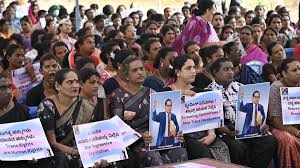
“We will see,” Chief Justice Kant said in response The Centre urged the Supreme Court on Wednesday (May 27, 2026) to transfer petitions challenging the constitutionality of the Transgender Persons (Protection of Rights) Amendment Act, 2026 from about four different High Courts to the apex court. Appearing before a Bench headed by Chief Justice of India Surya Kant, Solicitor General Tishar Mehta said the High Court are returning to work from summer recess in the first week of June. SC flags ‘risk’ of misuse in transgender self-identification debate The Supreme Court is already seized of several petitions challenging the 2026 Act, but it is is only partially working during June. Mr. Mehta, appearing for the Union government, said the High Courts may pre-empt the apex court by separately taking up the petitions before them and pass order. Mr. Mehta said the apex court should shift the cases pending in these High Courts to itself in order to avoid “divergent views” on the same Act. The top law officer urged the Chief Justice to list the Union government’s plea for transferring these petitions to itself on May 29. “We will see,” Chief Justice Kant said in response. The petitions in the apex court have criticised the controversial 2026 law of removing the right to self-identity. The 2026 Act requires a government-appointed medical board’s favourable recommendation for a District Magistrate to certify someone as a transgender person. NHRC asks Centre to review changes to trans law, ‘revisit’ community concerns on self-identification The petitioners, including activists like Laxminarayan Tripathi and others, said the Act disregarded transgender identity as an “authentic human identity, freely chosen”. They have argued that the requirement for a medical certification for gender recognition violated the rights of transgender persons and amounts to “medical gatekeeping” by the State. The government had countered that the intention of the Act was to ensure that deserving people from the community get benefits. He said forcible sex change was criminalised. The Transgender Persons Amendment Bill and the question of identity The petitioners highlighted that the Act had abruptly stopped ongoing sex-change therapies and treatment, leaving many in the community in dire straits. The petitions have argued that the 2026 amendments pull the carpet from under the 2014 NALSA judgment that declared that the right to self-identity was a fundamental right. It had held that identity was determined by the person, and not by biology, birth assignment or through State verification. Section 3 of the 2026 Act has omitted the right to self-perceived gender identity. The Hindu Bureau Courtesy : The Hindu Note: This news is originally published on https:/thehindu.com/bha and is used purely for non-profit/non-commercial purposes, especially human rights
2007 history will be repeated in 2027: Mayawati blows the election bugle, hints at a Dalit-Brahmin alliance

Mayawati’s new strategy to win the 2027 UP Assembly elections, vigorously preparing to return to power using the 2007 ‘social engineering’ formula (Dalit-Brahmin alliance). Uttar Pradesh: Bahujan Samaj Party chief Mayawati has sounded the election bugle for the 2027 Uttar Pradesh Assembly elections, hinting at a strong comeback. Recalling the party’s historic 2007 victory on Sunday, she declared that if BSP workers strengthen their grassroots mobilization and reconnect with the “Sarva Samaj,” the same political model can easily be replicated in 2027. In a clear political message specifically focused on Brahmins and Dalits, the BSP supremo asked her party leaders to remind the public of the 2007 experiment with social alliances. She said that people should be told that during the BSP’s rule, every section of society that felt neglected, insecure, and humiliated, including Brahmins, Dalits, the poor, and backward communities, received power and full respect. Addressing an important meeting of BSP state officials in Lucknow, Mayawati comprehensively reviewed booth-level preparations, candidate selection, and organizational expansion. During the meeting, she sharply attacked opposition parties on issues of inflation, unemployment, law and order, and misleading and divisive politics. In her statement, Mayawati emphasized that the people of Uttar Pradesh must once again fully trust the BSP, just as they did in 2007. She recalled that during that period, the Brahmin community, the weaker sections, and people from all sections of society were rescued from an environment of neglect and insecurity and given full respect and dignity, both in the party and the government, through proper participation. She instructed BSP leaders to reassure the public that, like in 2007, people from all communities can once again unite. Particularly, Brahmins, the marginalized, and the weaker sections can unite to form a government that guarantees respect, better law and order, and a firm guarantee of constitutional rights. The former Chief Minister made serious allegations against her rival parties of resorting to caste and communal polarization before the elections. She clarified that these parties have completely failed to provide good governance to the public after coming to power. She claimed that inflation, unemployment, and increasing oppression and neglect of the weak and marginalized sections of society have caused widespread public disillusionment. Without directly naming the BJP, Mayawati said that current governments are more focused on rhetoric, image management, and divisive politics than on public welfare. She also strongly instructed her workers to be vigilant against attempts to influence voters through emotional and caste-based narratives during the elections. BSP insiders also believe that Mayawati’s strong focus on Brahmins is a significant signal. It’s worth noting that in 2007, the party’s “social engineering” formula helped it reach the pinnacle of power by mobilizing Dalit and Brahmin support. At that time, the BSP won 206 seats and formed a government in Uttar Pradesh with an absolute majority. The Bahujan Samaj Party has struggled significantly on the electoral front in recent years. This new strategy clearly indicates a serious effort to rebuild that broad social alliance before the 2027 elections. Mayawati also emphasized early selection of candidates, strengthening booth management, and expanding the party organization at every level. She stated that the upcoming elections will prove to be both challenging and decisive for the future of Uttar Pradesh politics. Senior BSP officials, district coordinators, and key assembly constituency-level leaders from across the state attended this important party meeting. Rajan Chaudhary Courtesy: Hindi News
Congress workers protest in Hapur: Express outrage over gang rape of Dalit girl in Mahoba, submit memorandum to SDM

Congress party workers staged a protest in Hapur on Monday to protest the alleged gang rape of a Dalit girl in Mahoba district. The workers reached the District Magistrate’s office and submitted a memorandum addressed to the Governor to SDM Sakshi Sharma. Congress District President Rakesh Tyagi stated in the memorandum that a Dalit girl returning from NEET coaching in Mahoba was abducted by miscreants. It is alleged that she was held in Prayagraj for 15 days, drugged, and gang-raped. He also alleged that when State Congress President Ajay Rai visited the victim’s family, the administration did not allow him in. Targeting the BJP government, he said that rape cases against women and girls are continuously increasing in the state. He accused the government of inaction on this issue. City President Irfan Ahmed demanded that the victim’s family be given a compensation of ₹50 lakh and that punitive action be taken against the culprits as soon as possible. He also stated that visiting the victim’s family is not a crime. Present during the meeting were former MLA Gajraj Singh, PCC member and former Dhaulana Assembly candidate Pandit Arvind Sharma, senior Congress leader Dr. VC Sharma, former councilor Aijaz Ahmed, former SC-ST District President Naresh Bhati, City President Pilkhua Rajneesh Tyagi, District Vice President Ravindra Gurjar, District Vice President Mursaleen Chaudhary, District Vice President Lal Bahadur, District President of the Ideology Department Seema Sharma, District President of the Law and Human Rights Department Advocate Raghuveer Singh, State Vice President of the Outreach Committee Kuldeep Atreya, SC-ST State Secretary Vinod Jatav, SC-ST State Secretary Rashmi Chaudhary, District General Secretary Gaurav Garg, District General Secretary Yashpal Dhilor, District General Secretary Kapil Sharma, City President of the OBC Cell Afzal Aadhati, Garh Block President Bijendra Tyagi, Simbhaoli Block President Nafees Khan, Sachin Goyal, Ramlal Arya, and many other activists. Danish, Hapur Courtesy: Hindi News
Vijay’s cabinet and the transformation of social justice politics in Tamil Nadu

By choosing institutional inclusion over mere rhetoric, the TVK-led coalition government breaks the six-decade DMK-AIADMK duopoly to structurally redefine representation and social justice politics in Tamil Nadu The formation of the new Tamil Nadu government under the leadership of C Joseph Vijay marks a significant moment in the political history of the State. For nearly six decades, Tamil Nadu’s political landscape was dominated by the alternating rule of the Dravida Munnetra Kazhagam (DMK) and the All India Anna Dravida Munnetra Kazhagam (AIADMK). Both parties consistently projected themselves as inheritors of the Dravidian movement and champions of social justice. Yet, despite the ideological centrality of equality, anti-caste politics, and representation in Tamil Nadu’s political discourse, the structure of political power often remained limited in its inclusiveness. The emergence of the Tamilaga Vettri Kazhagam (TVK)-led coalition government, therefore, represents more than an electoral transition. It signals an attempt to redefine the grammar of governance through broader social representation, coalition-based participation, and the redistribution of institutional power to historically marginalised communities. A Historic Moment in Dalit Representation : One of the most remarkable aspects of Vijay’s cabinet is the unprecedented representation accorded to Dalit communities. For the first time in Tamil Nadu’s history, the cabinet includes eight ministers from Dalit communities in a 35-member Tamil Nadu Cabinet. This development acquires even greater significance when placed within a historical context. Successive governments led by both the DMK and the AIADMK often projected themselves as defenders of social justice, yet Dalit representation within the cabinet rarely crossed symbolic limits. Even in the outgoing DMK government, the number of Dalit ministers reportedly rose to four only after cabinet reshuffles. By contrast, the present cabinet has elevated Dalit representation to an unprecedented level, not merely numerically but institutionally. Dalit ministers have been entrusted with portfolios that influence education, ideology, social policy, and long-term governance. This shift matters because representation in democratic systems is not only about visibility; it is fundamentally about access to decision-making power. Political theorists of social justice have long argued that meaningful democracy requires historically excluded communities to participate in shaping institutions, rather than merely appearing within them symbolically. In this sense, Vijay’s cabinet marks a transition from token representation toward participatory representation. Education and the Politics of Historical Repair : Among the most symbolically significant appointments in the cabinet are those of Rajmohan and P Viswanathan, leaders from Dalit communities who have been entrusted with the School Education and Higher Education portfolios, respectively. The importance of these appointments cannot be overstated. For centuries, oppressed communities in India were systematically denied access to education, literacy, and intellectual authority under the caste hierarchy. Education functioned not merely as a site of learning, but as a mechanism through which social power was monopolised. The allocation of education ministries to leaders from historically oppressed communities, therefore, carries profound political meaning. It represents a reversal of historical exclusion and a form of democratic correction. These appointments symbolise a structural shift in governance: those who understand the lived experience of exclusion are now responsible for shaping educational policy and institutional access for future generations. Such representation extends beyond electoral arithmetic; it touches the moral foundations of social justice itself. The move also reflects a broader understanding of social justice, one that seeks not merely redistribution of welfare, but redistribution of institutional authority. Women’s Representation and Gender Inclusion : Another major milestone in the new cabinet is the inclusion of four women ministers, the highest number in Tamil Nadu’s history. While four women in a cabinet of thirty-five cannot yet be described as adequate gender parity, the development nevertheless marks an important beginning. Tamil Nadu’s political system has historically witnessed strong women leaders at the top, yet women’s broader participation within executive governance has often remained limited. The inclusion of four women ministers, therefore, represents an institutional acknowledgement that political representation must expand beyond caste inclusion alone. Social Justice also means to address intersections of caste, gender, class, and minority identity. In this respect, the present cabinet attempts to broaden the social composition of governance and establish a precedent that future governments may be compelled to follow. Minority Representation and Inclusive Governance : The cabinet has also ensured representation for religious minorities, reinforcing the coalition’s attempt to present itself as secular and socially inclusive. The induction of representatives from religious minorities group reflects an effort to incorporate minority voices into governance rather than keeping them confined to electoral alliances alone. This approach becomes particularly significant in an era where majoritarian politics increasingly shape national political discourse. By incorporating minorities within executive governance, the coalition signals that democratic legitimacy depends on participation across social and religious communities. Such inclusion also strengthens the idea that secularism is not merely a constitutional principle but an administrative practice. Coalition Politics and the Redistribution of Power : Perhaps the most transformative feature of the present government is its embrace of coalition politics and power-sharing. For decades, Tamil Nadu politics operated through centralised party structures dominated by a single political formation. Alliance partners often remained electorally useful but politically peripheral. While coalition parties contributed to electoral victories, they were rarely given substantial participation in governance. The present government departs from that model. For the first time in fifty-nine years, the Indian National Congress has become part of the Tamil Nadu government through direct power-sharing. This is historically significant not merely because Congress ministers are included, but because it marks the return of coalition governance in a state long characterised by dominant-party politics. The inclusion of alliance partners within the cabinet reflects a broader democratic principle: political support must translate into institutional participation. This development also exposes a long-standing criticism directed at earlier Dravidian governments, namely, that while they relied on coalition arithmetic electorally, they seldom shared governance meaningfully with alliance partners. Vijay’s approach appears to challenge that tradition by institutionalising coalition participation rather than limiting alliances to electoral arrangements. The Significance of VCK’s Inclusion : The inclusion of the Viduthalai Chiruthaigal Katchi (VCK) in the
Karnataka power tussle: Siddaramaiah agrees to quit

Siddaramaiah seeks Governor’s appointment at 2 pm on Thursday, calls CLP meeting the following day; no clarity yet on successor though Deputy CM Shivakumar is the front-runner. NEW DELHI/BENGALURU: Karnataka Chief Minister Siddaramaiah late on Tuesday night agreed to step down, confirmed sources privy to the marathon meetings held earlier in the day in New Delhi. Although Deputy Chief Minister D K Shivakumar is the front-runner for the CM’s post, no decision has been taken on who would succeed him nor on when Siddaramaiah would tender his resignation as chief minister. But sources said Siddaramaiah has sought time to meet Governor Thawar Chand Gehlot at Lok Bhavan on May 28 at 2 pm, and called for the Congress Legislature Party the following day. AICC General Secretary K C Venugopal and AICC General Secretary in-charge of Karnataka, Randeep Singh Surjewala, are scheduled to arrive in Bengaluru on Wednesday. Sources informed this newspaper that senior Congress leader Rahul Gandhi asked Siddaramaiah to step down to resolve the prolonged tussle between him and Shivakumar. They said the CM agreed after a late evening huddle with MLAs supporting him. Shivakumar had been insisting that the high command hand over the CM’s post to him, based on an agreement of sharing two-and-a-half years that he is said to have struck with Siddaramaiah after the party came to power in the 2023 Assembly polls. The half-way mark arrived in November last year, but Siddaramaiah refused to yield. Siddaramaiah and Shivakumar were summoned to Delhi on Monday, where Rahul is said to have told the CM that the party wanted the transition to take place smoothly. However, Siddaramaiah sought time to respond to the high command’s suggestion that he move to the Rajya Sabha to play a “larger role” at the national level, according to sources. After marathon meetings — from 11.35 am to 6 pm — a visibly upset Siddaramaiah huddled with his coterie of cabinet colleagues at Karnataka Energy Minister K J George’s New Delhi residence and conveyed the message of the high command to them. He agreed to step down after this meeting, sources said. No wonder, Shivakumar and his supporters looked upbeat. Siddaramaiah was carrying a letter of support by 100 party MLAs (Congress has 134 of 224 seats in the assembly) to convince the high command about his support. Sources said he will hold a meeting with all these MLAs at George’s Bengaluru residence on Wednesday. The day saw a series of meetings attended by Rahul, AICC president Mallikarjun Kharge, Venugopal and Surjewala. Siddaramaiah and Shivakumar were consulted separately at the party headquarters. Following the discussions, Rahul and Venugopal are said to have briefed senior leader Sonia Gandhi on the meetings, before having a closed-door meeting with Siddaramaiah where he offered the latter a larger role at the national level, while asking him to step down as CM. For the record, Venugopal dismissed all talk on change in leadership as mere speculation. Asked if there was any discussion on leadership change, Siddaramaiah, too, said “No”. On a possible cabinet reshuffle, the CM said, “It did not come up for discussion.” If not DKS: Who’s in race “The Congress high command could go in for a complete makeover of the party in the state and appoint a young, dynamic leader with a clean image to lead the party in the 2028 assembly elections,” sources said Byre Gowda: Chart topper The name of Revenue Minister Krishna Byre Gowda is on the top, besides Minister for Large & Medium Industries and Infrastructure Development MB Patil. Both have a clean image and are known for their good work Preetha Nair, Bala Chauhan, Naushad Bijapur, Devaraj B Hirehalli Courtesy : TNIE Note: This news is originally published on https:/thenewindianexpress.com/bha and is used purely for non-profit/non-commercial purposes, especially human rights
Daughter’s wedding procession stopped, wedding held in police presence: Some villagers accused of bullying and abusive language, police filed a complaint

A case of stopping a daughter’s wedding procession and disrupting the wedding has come to light in Hoshiyapur village, in the Patti Kotwali area. The victim, Gayatri Devi, has filed a complaint with the police, accusing some villagers of bullying, abusive language, and stealing cash and other items. The wedding took place in the presence of Dial 112 police. According to Gayatri Devi, wife of Suresh Kumar, a resident of Hoshiyapur, her daughter’s wedding procession was arriving at her doorstep on Monday night. It is alleged that at around 1 a.m., some villagers stopped the DJ and the wedding party on the way. They did not allow the procession to reach the house. When the victims protested, the accused began abusing and disrupting the wedding ceremony. When the situation escalated, Dial 112 police were immediately informed. The police arrived at the scene as soon as they received the information. Somehow, the marriage rituals were completed and the wedding vows were solemnized in the presence of the police. The woman also alleged that some people stole cash and other items during the incident. On Tuesday, the victim reached the Patti police station and submitted a petition demanding action against the accused. Based on the complaint, the police have begun investigating the case. Police station in-charge Anandpal Singh stated that the case is being investigated based on the victim’s complaint. Shivakant Pandey | Belkharnath Dham (Pratapgarh), Pratapgarh Courtesy: Hindi News
This Rajasthan MP’s heart melted at the plight of tribals, expressing his pain in his post!

Bharat Adivasi Party MP Rajkumar Roat also targeted CM Bhajanlal Sharma’s visit, prompting a BJP cabinet minister to retort, “What did Roat do for the region during his tenure as MLA and MP?” New Delhi – Rajkumar Roat, MP from Banswara-Dungarpur, Rajasthan, has once again raised questions about the current system by writing an emotional post about the ground reality of the country’s tribals. Citing a shocking video shared on social media, MP Roat wrote that when he raises the plight of 140-150 million tribals in Parliament, many people ask him, “What era are you talking about? Now the country is going to become a world leader.” “The pain of being deprived of forests and land” In his post, Roat clarified that tribals only want to see paper claims in the name of development, while their existence is actually under threat on the ground. Describing the plight of women from tribal areas of Madhya Pradesh and Gujarat, Rath wrote, “This picture is from our own country, India. This is the same India where leaders talk about ‘tap in every home and water in every tap’ and where respect for women is loudly spoken about.” He said that women are forced to risk their lives to extract water from deep wells 2-3 kilometers away from their homes. The MP further wrote, “Despite these adverse circumstances, the tribal people of this country do not expect much from the government. They simply want their forests and land not to be taken away in the name of development. Development for tribal people has occurred only on paper, while the situation on the ground remains the same. In the eyes of governments, development is defined as allocating land to industrialists for mining, setting up factories, and exploiting resources in tribal areas. Meanwhile, tribal people who talk about good education, health facilities, protecting forests and land, and implementing tribal culture, history, and constitutional rights are considered anti-development or anti-national. Currently, TV channels and street billboards portray the country’s development model, but the ground reality is completely opposite. Break free from false dreams and see, understand, and experience the struggles of tribal, Dalit, and poor people living in remote areas of the country.” Roat accused governments of exploiting tribals by granting land to industrialists for mining, while those who advocate for education, health, and constitutional rights are labeled anti-development. It is noteworthy that prior to this post, Roat had sharply criticized Chief Minister Bhajanlal Sharma’s recent visit to Banswara. Roat alleged that the Chief Minister’s Dungarpur-Banswara visit proved to be a mere drama. The public was not even allowed entry into the night Chaupal. People waited for hours outside the administrative wall. The Chaupal was only for those who already had everything. The elected MLA of Chaurasi sought time through the Collector and CMO, but he was denied that. When even a public representative is avoided, who will listen to the tribal farmer who walked miles? Those whose lands were submerged and displaced by the Mahi-Kadana Dam have not received irrigation water to date, and now they are planning to divert the Mahi-Anas water 700 kilometers from the Scheduled Area. This criticism immediately sparked a political firestorm. Tribal Area Development Minister Babulal Kharari hit back at Roat, saying, “Rajkumar Roat’s political ground is slipping, so he is making baseless statements to the public. He was an MLA for five years and is now an MP, but what has he done for the development of the region? He should answer to the public.” Geetha Sunil Pillai Courtesy: Hindi News
A massive tribal crowd gathered in Delhi, demanding the removal of converts from the ST list.
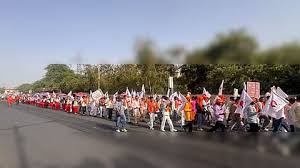
A grand conference of millions of tribals was held in Delhi, with a strong demand being raised to exclude converts from the ST quota. New Delhi: A massive gathering of millions of tribals from across the country was witnessed in the national capital, Delhi. The occasion was the “Tribal Cultural Confluence,” where, along with a unique glimpse of indigenous culture, a major demand was also raised. During this, a call was raised to exclude from the Scheduled Tribe (ST) category those who have abandoned their original faith and adopted another religion. This grand event was organized by the “Tribal Security Forum,” affiliated with the Rashtriya Swayamsevak Sangh (RSS). This historic event was held to commemorate the 150th birth anniversary of the great tribal leader Birsa Munda. Representatives from more than 550 tribal groups from various states participated in this massive gathering near Delhi Gate. People wore their traditional costumes and presented captivating cultural performances, conveying a sense of connection to their roots. Along with this, important issues related to tribal identity, constitutional rights, and the protection of indigenous customs were also highlighted through marches and public demonstrations. The most prominent demand during this conference was for an amendment to Article 342 of the Constitution. The protesters stated that the ST status of those who have abandoned traditional tribal beliefs and converted to other religions should be revoked with immediate effect. The protesters argued that such converts are taking double advantage of the system. They are taking full advantage of the benefits provided to minority communities as well as the reservations meant for Scheduled Tribes. Several speakers addressing the gathering expressed deep concern. They stated that conversions are gradually leading to the erosion of tribal traditions, customs, and cultural identity. To address this, they called for an immediate review of the existing constitutional framework governing ST status. The organizers and thousands of participants unanimously clarified that their demand was not aimed at any particular religion. Its sole purpose was to protect their indigenous heritage, community rights, and culture. Overall, the event was a unique confluence of cultural celebration and a strong political message. Tribal groups from across the country united to deliver a strong and clear message demanding policy changes related to their identity and constitutional protection. Rajan Chaudhary Courtesy: Hindi News