
Dhampur: Two accused arrested and charged after altercation with woman

Dhampur police have arrested and charged two young men in connection with the assault of a Dalit youth. The incident occurred after an alleged altercation with a woman. The incident occurred near Chak Sahajani village in Dhampur, where a Dalit youth was assaulted by three or four unidentified youths. Vivek Kumar, son of Pramod Kumar, a resident of Nangli Ladan village in the police station area, filed a police complaint. Vivek told police that he works as a mechanic at a local business. He had frequent disputes with a woman, Sonu, and her family at the same business. This dispute occurred on Wednesday. According to police, two young men living in the neighborhood, along with their friends, assaulted Vivek at the instigation of Sonu’s family. Inspector Ravindra Pratap Singh stated that the arrested accused have been identified as Adnan from Bamnoli and Ali from Delhi Bhatpura. They were accompanied by two other unidentified individuals. Police have arrested Adnan and Ali and issued a challan against them. Based on Vivek’s complaint, police have also named Sonu, wife of Manish. Shahbaz Anwar | Dhampur Alaihpur (Dhampur), Bijnor Courtesy: Hindi News
An unflinching portrait of Dalit life | Review of Chandu Maheria’s Homes without Windows
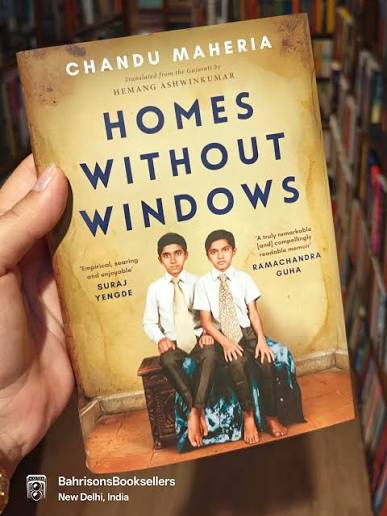
Translated by Hemang Ashwinkumar, Maheria’s book offers an intimate account of caste, poverty, and survival in urban Gujarat but is undermined by an embellished translation Monsoon arrived in Gujarat just as I finished reading Homes without Windows, a collection of 11 autobiographical essays by Dalit activist Chandu Maheria, translated by Hemang Ashwinkumar. Originally written in the Gujarati and published in non-literary magazines, these essays are now available in English. “Today, when I utter stuff like I don’t like monsoon or the prospect of getting wet in rain, my audience gasps, their eyebrows raised in mock surprise. How could someone, who has spent most of his life’s monsoons in just two pairs of mostly wet clothes, still like to get soaked is a question beyond them…,” writes Maheria in one of the essays. For him, the monsoon evokes memories of hellish public toilets, the scramble to cover the house with a sheet of cheap tarpaulin, rainwater flooding homes and streets, and his mother praying to Varun, the god of rain. In the chawls of Rajpur, where Maheria spent most of his life, there was little time to marvel at the beauty of a rainbow. A life of deprivation When you enter Ahmedabad, the commercial capital of Gujarat, from the eastern side, a dense web of chawls lines both sides of the main road, inhabited mostly by Muslims, Dalits, Christians, and poor communities. Maheria takes us into the heart of this labyrinth. He introduces us to its seasons and festivals, its sorrows and moments of happiness despite scarcity and untouchability, its schools, toilets, and hospitals, and the enduring presence of B.R. Ambedkar and M.K. Gandhi in the lives of its people. Maheria’s childhood was marked by extreme food deprivation. His father, a textile mill worker, was the sole breadwinner of a family of nine. During Maheria’s early school years, the children received a glass of milk every day before classes, but little else. Maheria writes about those dark days with disarming honesty. There were times when a relative who delivered tiffin boxes would stop by their home at the end of his rounds and let the family eat the leftovers from the boxes. At the end of the chapter, Maheria expresses his gratitude for the reservation policy, which enabled him and his siblings to pursue education and secure jobs and escape those years of hardship. In another chapter, he writes, “As if the question of filling the bottomless pits of hunger was not vexed enough, the daily dilemma of emptying our bowels had made our lives, both personal and social, embarrassing and miserable.” Their dingy dwelling, Abu Kasai’s chawl, did not have a single public toilet of its own, forcing its residents to use the filthy toilets in the neighbouring Hiralal’s chawl. Decades later, a large, modern, and well-maintained public toilet stands there, yet it remains beyond the reach of the daily-wage poor and the unemployed because it costs one rupee per visit. As a result, it is seldom used by the local residents, who have wryly come to call it ‘The Mayor’s Bungalow’. Maheria, a noted scholar of Dalit life in Gujarat, has important points to make in the ever-contentious debate on Gandhi and Ambedkar. Unlike many of his Dalit friends, he admires Gandhi. He writes, “Gandhi might have been anything — call him whatever names — but one thing he was certainly not was anti-Dalit.” Maheria loved wearing Khadi despite his mother’s opposition; his father too was anti-Gandhi. Yet Maheria affectionately refers to Gandhi as “That Fellow, Gandhido.” When Maheria was just two years away from retirement, he received a promotion along with a transfer to a town called Dhoraji in the Saurashtra region. There the author says he repeatedly encountered the question, “Tame keva? (What caste are you?)”, which he had never been asked in urban Gujarat. While much of his writing focuses on Dalit life in urban Gujarat, his two-year stay in this dusty town offers a glimpse into caste discrimination and the ways in which Dalits and Muslims are excluded from the broader development agenda. It also shows how these communities are pushed into segregated ghettos on the outskirts of so-called developing towns. Losing the writer’s voice Having read the original Gujarati essays alongside their English translations, I have a few observations about Ashwinkumar’s translation. A translator’s foremost responsibility is to preserve the original author’s voice and tonal quality. Maheria’s language is simple and he rarely uses ornamental expressions; his economy of words is almost Gandhian. In many places, however, the English translation departs from this restraint by adding flourishes. In the chapter on Diwali, for instance, the translation reads: “Ramanbhai worked tirelessly…treating the wall as a wide canvas, painting it in broad strokes. Thanks to his speed and finesse, the whole drawing room, the biggest room in the house, would be taken care of by the afternoon.” In the original Gujarati, this is a single sentence. The added phrases do not align with Maheria’s sparse style. Moreover, the sentence is factually inaccurate: in the original, there is no drawing room; it refers instead to a small, single thatched room in a chawl. The use of the words “drawing room” creates a misleading impression. A translator should remain faithful to the original text and avoid such liberties. Despite these concerns, Homes Without Windows remains an important and deeply affecting work. Maheria’s essays offer an intimate, lived account of caste, poverty, and survival in urban Gujarat. What stays with the reader is the dignity and wit with which he recounts them. Maheria’s voice continues to insist on being heard. Mehul Devkala The reviewer is a Gujarati poet, writer, and award-winning filmmaker. Courtesy : The Hindu Note: This news is originally published on https:/thehindu.com/bha and is used purely for non-profit/non-commercial purposes, especially human rights
“PM has caused the most damage to the future of the youth,” Rahul Gandhi counters PM Modi’s statement on the paper leak.
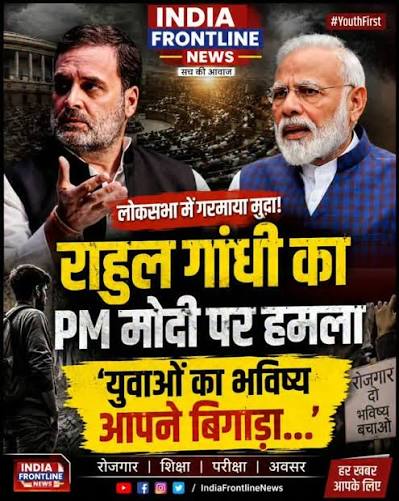
Rahul Gandhi, responding to Prime Minister Narendra Modi’s statement on the student protests, accused the government of weakening the education system. He also accused the PM of harming the future of students. New Delhi: Prime Minister Narendra Modi gave his first public response to the ongoing student protests at Jantar Mantar and the paper leak issue by writing on X. He stated on X that the welfare and future of the youth are his top priority. He also called for the establishment of fast-track courts for paper leak cases and strict punishment for the culprits. Rahul Gandhi sharply responded to Prime Minister Narendra Modi’s statement via the social media platform X. Rahul Gandhi, responding on X, directly attacked the government. He stated that the Prime Minister and his government have caused the most damage to the future of the youth. He alleged that the government allowed the education system to weaken and protected those responsible for this. Rahul Gandhi’s response to the PM’s statement Rahul Gandhi wrote, “You have caused the greatest harm to the future of our youth. You not only allowed the complete takeover and destruction of our education system, but also encouraged it. You protected everyone responsible for it.” Reiterates Students’ Three Demands Rahul Gandhi said that the students’ demands are clear. He reiterated three demands: Union Education Minister Dharmendra Pradhan should be removed from his post. An apology should be issued to the students. Action should be taken against those who committed violence against students. What did PM Modi say? Prime Minister Modi wrote on X that the interests and future of the youth are of paramount importance. He said that fast-track courts will be set up to expedite the hearing of paper leak cases. The concerned officials have been instructed to take necessary action and those who tamper with the future of the youth will not be spared. Curated by: Tina About the Author Tina works as a consultant at Navbharat Times Online and is in the process of establishing her identity in the world of digital journalism. Currently, she actively covers national, crime, jungle news, good news, and local news. Additionally, she works with NBT’s social media team to deliver impactful and reliable content to users on digital platforms. Courtesy: Hindi News
Attack on Dalit youth in Jaunpur: Case filed against 4 under various sections including SC/ST Act

An attack on Dalit youth has been reported in the Sarpataha police station area of Jaunpur. A case has been filed against four named accused under various sections including the SC/ST Act in this attack, which occurred near the Mirzapur-Rudhauli culvert due to an old rivalry. Police have begun investigating the matter. Saurabh, son of Ramesh, a resident of Sawayan village, stated in his complaint to the police that Kuldeep, Kishan, Aman, and Deepchand Yadav attacked him on the evening of July 18th. Saurabh’s head was fractured in the attack, which involved punches, kicks, and injuries. Rakesh suffered serious leg injuries and was also strangled. The victims also alleged that the attackers used casteist slurs and threatened to kill him. The incident was reported to police on 112. Police arrived at the scene as soon as they received the information, but by then all the accused had fled. Police recovered a motorcycle from the scene. Station Head Ramasray Rai stated that based on the victim’s complaint, a case has been registered against four accused under various sections of the SC/ST Act and other sections. Further legal action is being taken in the matter. Ashutosh Dubey | Suithakalan Courtesy: Hindi News
Administration Removes Illegal Encroachment in Sahajanwa Chandbari: Dalit Leaseholders Regain Rights to Their Allotted Land After 30 Years
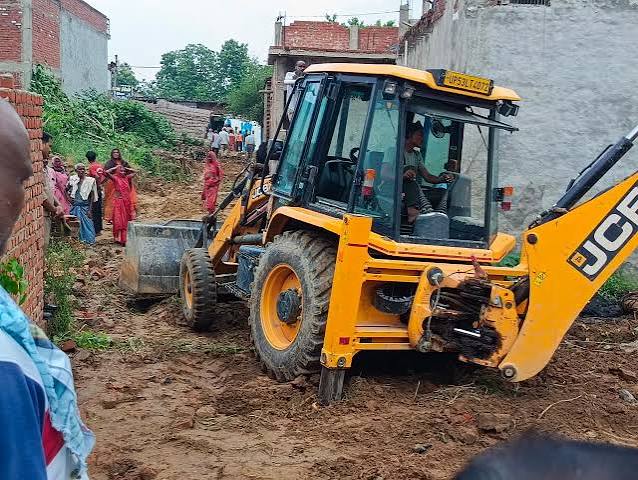
On Tuesday, the administration took major action in Chandbari Gram Panchayat, located in the Pali Block of Sahajanwa Tehsil in Gorakhpur district. A team from the Revenue Department removed years-old illegal encroachments from government land in Naveen Pariti. This action restored rights to Dalit leaseholders who had been waiting for their land for 30 years. The matter began with a complaint from Village Head Pradeep Srivastava. He submitted a written complaint to officials at the Sampoorna Samadhan Diwas. The complaint stated that in the 1990s, under a government scheme, Naveen Pariti land was allotted to poor Dalit families in the village for housing construction. However, it is alleged that in 1995, a villager illegally occupied this land. As a result, eligible families were deprived of their legitimate land and right to build homes for nearly three decades. The Sub-Divisional Magistrate (SDM) took the complaint seriously and ordered an immediate investigation and strict action. Following these instructions, a joint team of the Revenue Department and police, led by Tehsildar RK Kannaujiya, arrived in Chandbari village on Tuesday. The team thoroughly verified revenue records on the spot. Upon confirming illegal occupation, the illegal construction and encroachment were demolished with the help of a JCB. Several officers and employees, including Revenue Inspector Buddhiram Chaudhary, Law Officer Satish Tiwari, Accountant Sujit Dwivedi, Satendra Pratap, and Ashish Singh, were present during the operation. Vishnu Dutt Shukla | Sahajanwan Courtesy: Hindi News
Casteist attacks on CJP protesters flood social media, ‘General Category’ told to stay away
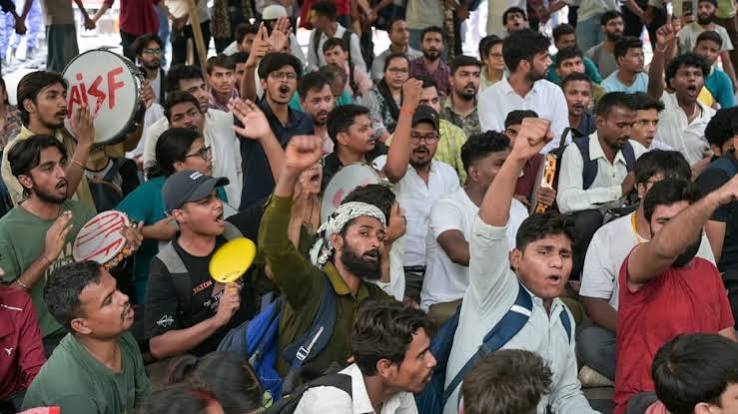
While several Right-wing accounts on X targeted the Jantar Mantar protesters with casteist slurs like ‘Bhimta’, many other users cried hoarse against the reservation system itself. New Delhi: A day after a protest march organised by the Cockroach Janta Party turned violent in Delhi, several accounts on X launched casteist attacks, claiming the demonstration was “rooted in Ambedkarism” and warning “general category people” to stay away from the party. On Monday, thousands of students took to the streets of Delhi against the NEET paper leak, and demanded the resignation of Union Education Minister Dharmendra Pradhan. In the afternoon, the protests turned violent, when the police lathi charged and shot tear gas shells at the protesting students. An account on X, with the username ‘Nyaksha’, wrote that the government and CJP is not on the “GC (general category)” side. “As for CJP, its core ideology is rooted in Ambedkarism, so it will always work against GC interests,” it wrote. Commenting on the tweets, Subhajit Naskar, a Dalit professor at Jadavpur University, said, “Two things are very difficult for the casteist campaigners against reservation and affirmative policies to digest. One, that the Cockroach Janata Party has been conceptualised by a Dalit young man. And second, that this movement is spreading across the youth, cutting across caste, privilege and age”. On the casteist remarks on X, Bhim Army chief Chandrashekhar Azad refused to comment, saying, “I don’t want to give importance to them”. ‘CJP protesters are Ambedkarites’ An X account, ‘Wokeflix’, with more than a lakh followers, called the protesters “Bhimtas”. The account posted a video on X claiming that there were “zero“ NEET aspirants in the protest. The post has about 1.6 lakh views and nearly 10 thousand likes. Another X account claimed, “It is a Universal Truth that where there are Ambedkarites, there is violence, unrest, and anti-national activities.“ Some accounts started claiming that most protesters were Dalit, just after the demonstration turned violent. An X account, ‘Alpakanya’, with nearly 30,000 followers, wrote, “‘Reservation was Ambedkar’s biggest mistake’ – she is stating pure facts, fully agree,” the account wrote alongside a video of an old lady talking about reservation. A protest spearheaded by a Dalit The Cockroach Janta Party led a street protest on 6 June in Delhi after Abhijeet Dipke came back from the US. A week later, since 13 June, they have been protesting at Delhi’s Jantar Mantar. “Abhijeet Dipke has been very clear that he is a Dalit and that he has high regard for Dr Ambedkar. They have consistently carried Dr Ambedkar’s image to assert that this is a constitutional and democratic protest–perhaps a more democratic response than what the government is giving,” said Naskar. Calling it an “organic movement”, Naskar said the movement has received support from influencers, actors, and politicians. “The response from these casteist accounts, under the garb of being anti-Modi or anti-government, is absolute hogwash. These are actually right-wing Brahminical accounts, but they are camouflaging themselves as people who simply want an equal society by removing reservation,” he said. Vaibhav Wankhede, a Dalit writer, told ThePrint that this is an attempt to reduce every public protest to “only Ambedkarites”. “[Asking] general category citizens to stay away is nothing but casteism dressed up as a political strategy. it only serves one purpose: to divide people who should be asking harder questions about unemployment, paper leaks, student suicides, shrinking opportunities, and the steady erosion of public institutions as an Ambedkarite,” Wankhede said. Dipke had also faced casteism on X after revealing his Dalit identity. Nikhil Sanjay-Rekha Adsule, a senior research scholar at IIT-Delhi and John Dewey Emerging Scholar, US, told ThePrint that such comments are made to “delegitimize the protest”. “It shifts the public debate away from state accountability and forces people back into their traditional social silos. It allows critics to dismiss an urgent, material crisis as a ‘fringe, motivated agenda’ rather than addressing the structural rot in our educational system,” he said. Manisha Mondal (Edited by Aamaan Alam Khan) Courtesy : The Print Note: This news is originally published on https:/theprint.com/bha and is used purely for non-profit/non-commercial purposes, especially human rights
Welfare Minister consoles slain Dalit woman’s family, hands over ex gratia

Social Welfare Minister Adluri Laxman Kumar on Tuesday handed over a cheque for ₹4.12 lakh as ex gratia to the bereaved family of slain Dalit woman Karre Sunitha at Chintalapet village in Jagtial district. Sources said that Sunitha was allegedly murdered by an assailant in Metpalli a week ago. The Minister consoled the bereaved family and handed over the cheque to the victim’s grandmother. Her said the second instalment of the compensation would be released as per government norms. He assured the bereaved family of justice and stringent action against those responsible for the gruesome murder. The Minister said the government would take full responsibility for the education of Sunitha’s two sons. The Hindu Bureau Courtesy : The Hindu Note: This news is originally published on https:/thehindu.com/bha and is used purely for non-profit/non-commercial purposes, especially human rights
CasteWhy Should Readers Across the World Care About Dalit Literature?

This article is a lightly edited version of the introduction to Touchable/Untouchable: Dalit Literature from India in Translation, edited by K. Satyanarayana and S. Shankar. Touchable/Untouchable is a special issue of the journal Mānoa: A Pacific Journal of International Writing, and also a standalone volume published by University of Hawai`i Press. The volume can be accessed on Project Muse here and ordered here. The journal can be subscribed to here. Why should readers across the world care about Dalit literature? For one thing, contemporary Dalit literature is among the most interesting, the most vibrant, of literary enterprises currently underway in India. Contemporary Dalit literature has borne gripping witness to the centuries-old atrocious institution of exclusion and oppression known as caste – at the bottom of which Dalits are located as the most excluded – and broken invigorating new literary ground. For these reasons alone, the value of reading Dalit literature should be evident. Dalit literature deserves a global audience, which it has begun to receive in recent years. What does it mean to say Dalit works constitute a literature of witnessing? Not surprisingly – and here one might draw comparisons to slave narratives in the African American tradition – many early works of the contemporary boom in Dalit literature are testimonies, autobiographies and memoirs. These works can certainly be read as testifying to the oppressive conditions under which Dalits and other “lower castes” live. As Omprakash Valmiki, celebrated Dalit author of the Hindi-language Joothan, declared in the preface to his autobiography: “After a long period of procrastination, I started to write. Once again, I had to relive all those miseries, torments, neglects, admonitions. I suffered a deep mental anguish while writing this book. How terribly painful was this unraveling of my self, layer upon layer”. Excerpts from Tulsiram’s Hindi autobiography Murdaihya as well as Pradnya Daya Pawar’s poem, a kind of biography-in-verse of a famous Dalit folk singer, both of which appear in Touchable/Untouchable, provide fine examples of this kind of witnessing. On the other hand, literary critics have wondered whether the view of Dalit works as a literature of witnessing diminishes their aesthetic value. These critics have called their colleagues to account for having a unidimensional approach to Dalit literature – for essentially shoehorning Dalit works into a “witnessing” function. Because of the dangers of such shoehorning, it is important to recognise the many ways in which the literature produced by Dalits in the last 50 years challenges established literary conventions. For example, many Dalit writers eschew a high literary style, deliberately adopting in its place a vernacular/spoken one. The veteran Tamil writer Bama, an influence on the poet Sukirtharani, included in Touchable/Untouchable, is a case in point. Translator Lakshmi Holmstrom notes of her: “Bama is doing something completely new in using the demotic and the colloquial regularly…. She uses a Dalit style of language which overturns the decorum and aesthetics of received upper-class, upper-caste Tamil”. Linguistically as well as formally, Dalit writers challenge contemporary Indian literature, as Baburao Bagul’s essay in Touchable/Untouchable ruminating on the aesthetics of Dalit literature suggests. In the end, both when it bears witness and when it innovates, Dalit literature presents a human story of struggle as well as triumph in startlingly powerful ways. This struggle is vividly brought out in the excerpts included in Touchable/Untouchable from Bojja Tharakam’s Telugu novel narrating the lives of a family of Dalit bonded labourers across generations. Of course, the same human story of struggle is found in different ways in all the pieces included. These human stories are also deeply Indian, as much Indian as the more celebrated Indian writing in English, largely “upper caste,” well known to global readers. The picture of India in Dalit literature may very well be familiar to readers in some respects. In others, to readers not familiar with Dalit literature, it will certainly be startling, evocative, shocking, moving, and more. Origins of the term The term “Dalit literature” was coined in the first Dalit Literary Conference held in Mumbai (then Bombay) in 1958. Marathi Dalit writers created history by publishing several collections of poetry, short stories and autobiographical narratives and critical essays in the 1960s and 1970s. Poisoned Bread, a classic anthology of these writings in English translation, was published in 1992. Marathi Dalit literature was widely translated into several Indian languages and served as an inspiration to Dalit writers in other Indian languages. Contemporary Dalit literature emerged as a powerful literary movement in Kannada, Telugu, Tamil and Malayalam from the 1970s to the 1990s (see No Alphabet in Sight and Steel Nibs, co-edited by K. Satyanarayana). It became a pan Indian phenomenon with the rise of Dalit literatures in Hindi, Bengali and other Indian languages after the 1990s. Dalit literature in English translation acquired national and global visibility with the publication of autobiographies, novels, poetry and essays by mainstream publishers. Dalit literature is not simply a literary trend but a literary movement for social change. It describes and analyses Dalit life worlds and struggles based on first-hand lived experience. The distinctive term “Dalit” (literally “crushed down” or “broken”) is both identity and perspective. The Dalit Panthers, a group of insurgent intellectuals, popularized “Dalit” as a term to claim a dignified identity for “untouchables,” while rejecting demeaning caste/jati names. They used the term to broadly refer to “untouchable” caste groups, Adivasis (aka “tribals”), and other minorities. In the course of history, “Dalit” became synonymous with the “untouchable” (also known as “scheduled caste”) groups. Dalit critics theorised “Dalit” as a collective identity based on self-respect and human dignity. Dalit is a revolutionary term born out of anti-caste struggles and has shaped a Dalit perspective. In this sense, Dalit literature invents a canon and a normative Dalit character, and inaugurates a shift from the old understanding of caste as a feudal relic to a contemporary form of power. It contests the view that untouchability is a cultural practice based on religious notions of “purity” and “impurity” and suggests that untouchability is a
Woman who went to worship at temple accused of assault: Case filed under various sections including SC/ST Act

A Dalit woman who went to worship at a temple in Harchandpur village, under the Subeha police station area of Barabanki district, has accused some villagers of assaulting her and using casteist slurs. The woman’s son was also allegedly assaulted. Based on the victim’s complaint, police have registered a case under various sections including the SC/ST Act and have begun an investigation. Harchandpur resident Sant Dulari Rawat, wife of Raj Bahadur Rawat, stated in her complaint to the police that the incident occurred on July 19, 2026, at around 9 a.m. She had gone to worship at a temple near her home. It is alleged that Raghav Ram Mishra, Rajit Ram Mishra, Avadharam Mishra, Sahaj Ram Mishra (sons of Ram Shankar Mishra), and Mansha Devi Mishra, daughter of Ram Shankar Mishra, arrived at the scene and attempted to remove Sant Dulari’s worship materials kept near the temple. According to the victim, when she protested, the accused abused her, used casteist slurs, and began assaulting her. Hearing the commotion, her son, Diwakar, rushed to her rescue, but the accused assaulted him as well. Both the woman and her son are reported to have sustained injuries in the incident. The woman also stated that during the assault, her mangalsutra, weighing approximately two tolas, fell somewhere and was not found despite extensive searching. Based on the victim’s complaint, the police have registered a case under the SC/ST Act and other relevant sections. Inspector-in-Charge Bechu Singh stated that a case has been registered and the matter is being investigated. Further legal action will be taken based on the facts that emerge from the investigation. Idrish | Haidergarh Courtesy: Hindi News
Dalit man laid to rest after 3-day standoff over cemetery rights in TN
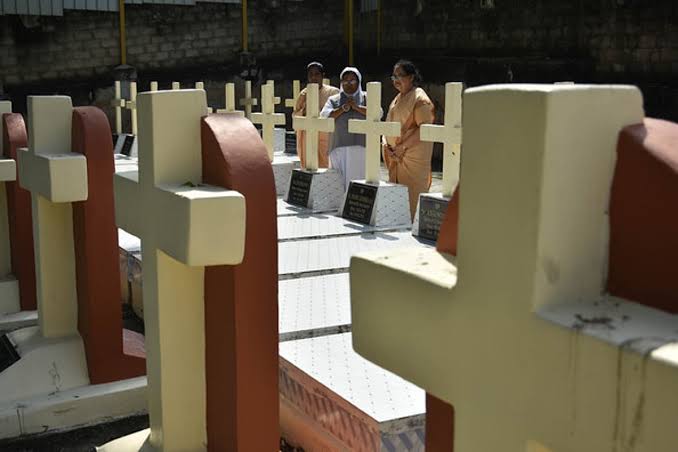
Dispute arose after A Raju, a retired government school teacher and Dalit Christian, died of age-related illness on July 17. His family sought to bury him in the common cemetery, citing the civil court decree. TIRUCHY: A Dalit Christian, whose body remained at his residence for three days allegedly over a dispute on burial rights at a common cemetery in Kottapalayam near Thuraiyur, was laid to rest in the early hours of Monday after district officials brokered a peace agreement between representatives of Dalit Christian and non-Dalit Christian communities. The burial was carried out with police protection following the peace meeting chaired by Musiri Sub-Collector Sushree Suvangi Khuntia. According to officials, Dalit Christians are allowed to use the village’s 0.55-acre common cemetery in line with a 2024 decree of the Thuraiyur District Munsif Court. The minutes of the Sunday meeting said both communities should continue to abide by the court’s order. Officials also decided the funeral mass should be conducted at St Sebastian’s Church, while the burial would take place under the supervision of the parish priest. Dispute arose after A Raju, a retired government school teacher and Dalit Christian, died of age-related illness on July 17. His family sought to bury him in the common cemetery, citing the civil court decree. However, non-Dalit Christians opposed the move, contending that Dalit Christians already had a separate burial ground, leaving the body at the family’s residence for three days. Revenue and police officials held talks with both communities for nearly five hours on Sunday, but failed to break the deadlock. Fresh negotiations on Monday resulted in an agreement, paving the way for the burial. J Doss Prakash, a resident of Kottapalayam, said Dalit Christians had fought for several decades to secure equal burial rights in the common cemetery, which is over 100 years old. He alleged that Dalit Christians were denied access because of caste-based discrimination and said Monday’s burial was carried out by enforcing the civil court’s order. “Several members of the non-Dalit Christian community also stood with us and extended their support during the peace talks. It is only a few groups that continue to raise objections and create divisions within the village,” he said. Pearson Lenekar SR Courtesy : TNIE Note: This news is originally published on https:/thenewindianexpress.com/bha and is used purely for non-profit/non-commercial purposes, especially human rights