
Rajasthan: Arson and attack on Dalit farmer’s field, accused still absconding, questions raised about police inaction
The victim’s family lives in fear due to the lack of arrest of the accused in the case, raising serious questions about police action. Tapra, Balotra: In the Tapra village of the district, accused Umed Singh has not yet been arrested in the case of violence and harassment against tribal farmer Mohanlal Bhil on the farm of Dalit farmer Chhagna Ram Meghwal. This has caused distress to the victim and his family. The victims say that the accused party is continuously applying social pressure to reach a settlement and are being mentally harassed. Farm owner Chhagna Ram is a taxi driver by profession and suffers from serious illnesses like diabetes, high blood pressure, and allergies. Despite this, they are not getting justice, and the police are hesitant to take action. According to the incident, laborers were clearing and plowing Chhagna Ram Meghwal’s field. Umed Singh was present in the field during this time, but did not respond. When Mohanlal went to build a fence with laborers, Ummed Singh suddenly appeared, verbally assaulted him, and threatened to kill him with a sword, forcing Mohanlal to stop work. Mohanlal, with the help of farm owner Chhagna Ram Meghwal and other villagers, tried to reason with the accused several times, but Ummed Singh refused and continued the assault. The most serious incident occurred on September 10th, when Ummed Singh brought a chemical flammable substance and attempted to burn down Chhagna Ram’s farm and fence. A video of this incident is available. Mohanlal and his fellow witnesses later filed a police complaint and gave statements at the DySP office, but no action has been taken yet. The victims allege that the police repeatedly mislead them, asking them to return in two or four days, and are attempting to hush up the matter. The victims and villagers are now fearful for their safety. Social workers and villagers are questioning the police’s inaction. Victims’ demands: – Immediate arrest of the accused, Umed Singh. – Fair and speedy investigation of the case. – Ensuring the safety of the victims and workers. Sharvan Kumar Courtesy: Hindi News
Rewind: Silent erasure of Dalit voices, this time by AI!

Dalit literature faces a new threat — biased algorithms, poor digitisation, and academic neglect are pushing this powerful movement rooted in resistance and equality to the margins again Dalit literature, a significant post-Independence literary movement, today faces an existential threat — not by fire or censorship, but by neglect, disinterest, and biased algorithms.In an increasingly digital world and an education system skewed toward dominant narratives, the true essence of Dalit literature and its role in understanding caste discrimination is being diluted, ignored, or distorted. Dalit literature represents a powerful body of writing rooted in the lived experience of caste-based oppression, resistance, and emancipation. Emerging from the voices of India’s most marginalised communities, Dalit literature is an assertion of identity, human dignity, and equality. However, the widespread use of artificial intelligence (AI), declining interest among non-social science students, the persistent non-digitisation of Dalit texts, institutional bias in acquiring books on Dalit literature, and the failure of India’s schooling system to integrate Dalit perspectives all mean that a generation relying on AI grows up with a distorted and incomplete understanding of caste realities in India. As defined by Arjun Dangle, Dalit literature aims to raise awareness about the caste system while examining it through a sociological lens. Rooted in principles of negativity, rebellion, and scientific rationality, Dalit writing challenges traditional hierarchies and advocates for social change. Its revolutionary nature reflects a conscious effort to resist marginalisation and assert the dignity and identity of Dalit communities. Thus, Dalit literature serves as both a form of protest and a catalyst for transformative discourse in Indian society. A Continuing Reality According to the National Crime Records Bureau (NCRB), crimes against Scheduled Castes (SCs) increased by over 17 per cent from 2018 to 2022. In education, dropout rates for Dalit students remain disproportionately high; in rural India, nearly 30 per cent of Dalit students leave school before completing Class 10. In employment, despite affirmative action policies, Dalits remain underrepresented in higher judiciary, corporate leadership, and academia. Caste discrimination is not just social but structural. From segregation in hostels and places of worship to violence for riding a horse at weddings, caste-based atrocities persist across States and class strata. Dalit literature documents these lived realities, which are often overlooked in mainstream media. Algorithms aren’t Neutral Algorithms are often seen as neutral tools that simply process data without bias. However, they reflect the prejudices present in the data they are trained on. In India, where data is shaped by deep-rooted caste hierarchies, this has serious consequences. Dalits and Muslims are often misrepresented or excluded by algorithms that classify their communities as “high risk” due to historical poverty. Elite institutions favour upper-caste applicants, reinforcing inequality in CV screening. As a result, instead of offering fairness, algorithms can amplify social discrimination, leading to systemic exclusion at scale — especially for marginalised groups like Dalits — despite the illusion of objectivity. Caste discrimination in academia also takes a serious psychological toll on marginalised students and faculty, causing stress, anxiety, and, in extreme cases, suicide. It leads to academic and professional setbacks, as biased treatment, lack of support, and exclusion from networks hinder progress and reduce career opportunities. These practices deepen educational inequality by denying marginalised communities equal access and representation in higher education and professional fields. New Form of Exclusion Caste-based bias in AI is emerging as a critical concern in India, paralleling global concerns about racial bias. This bias originates from the use of prejudiced and unrepresentative datasets that reflect dominant caste perspectives. The upper caste dominance in India extends across culture, academia, economy, politics, and now technology. AI is increasingly shaped by powerful groups, leading to underrepresentation and biased algorithms that serve their interests. While not inherently unethical, this use of AI exacerbates inequality and portrays the technology as a barrier to social justice, rather than a neutral tool. The unequal access and control over AI reflect broader systemic disparities, raising concerns about fairness and inclusivity in its development and application within Indian society. AI tools in India often fail to represent Dalit and marginalised communities due to a deep misalignment between Western-centric notions of algorithmic fairness and India’s complex socio-cultural realities. Imported models of fairness overlook caste, regional disparities, and structural inequities rooted in centuries of exclusion. The absence of reliable socio-technical infrastructure for Dalits, Adivasis, and women leads to their underrepresentation or complete erasure in datasets. This digital divide is stark — only 14.1 per cent of Scheduled Tribes (STs) and 13.5 per cent of Scheduled Castes (SCs) are computer literate, compared to 31.2 per cent of upper castes. Consequently, algorithmic outcomes in crucial sectors like policing, employment, and loans become skewed. Moreover, AI developers in India are predominantly from privileged caste and class backgrounds, often from elite institutions. Their detachment, combined with weak regulatory oversight, produces opaque, “black box” algorithms that evade public accountability. For AI to be fair, it must be re-imagined within local contexts. This means engaging marginalised communities, building inclusive data ecosystems, and fostering a culture of transparency and critique. Disinterested Academia Despite caste being a deeply embedded issue, most students in engineering, medical, business, and science fields graduate without any meaningful exposure to Dalit literature or caste dynamics. The Indian education system has confined caste-related discourse primarily to the social sciences, preventing a broader, cross-disciplinary understanding. Institutions like the IITs, IIMs, and AIIMS — which have faced serious allegations of caste-based discrimination, including the tragic suicides of Dalit students — offer minimal curricular engagement with anti-caste thought. This academic silence contributes to a lack of awareness and empathy among students, many of whom later occupy influential roles. Missing Archives Despite India’s push toward digital learning, much of Dalit literature remains un-digitised. Pioneering works in Marathi, Tamil, Telugu, Kannada, and Hindi are often published by small presses without access to digital archiving. As of 2024, the Digital Library of India and National Digital Library still lack comprehensive Dalit literature collections, particularly vernacular autobiographies, regional poetry, and essays. This exclusion from digital ecosystems
Shot 5 times, remained in coma for 2 months:Continuously taunted by wife, police in hospital; couldn’t even move, let alone speak
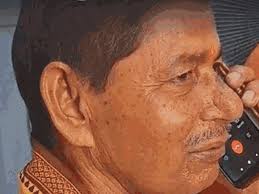
I am Arjun Paswan, from Jamuana village in Jehanabad district of Bihar. We did not own any land. Being Dalit, we survived on the mercy of landlords. We received millet to eat in exchange for working on their land. If we encountered landlords on the road, we would hold our shoes in our hands. Not only this, they kept an eye on our women. We even had separate wells. When famine struck the village, troubled by hunger, I came to Patna. When I opposed the smuggling of kerosene oil here, I was shot five times. I was in a coma for two months. My body could not move, but my mind was alert. I could hear everything—my wife’s sobs, the whispers of doctors and police officers—but could do nothing. Hearing the same kind of things repeatedly made me feel irritable inside. Actually, my story begins in the village, where I endured poverty, starvation, famine, the feudal system, and the caste system. We were a family of seven. I was the eldest among three brothers and two sisters. Therefore, I had the responsibility of running the entire family. I was married at the age of 13. Poverty was so severe that getting enough to eat was all that mattered. For that, I would go with my mother to dig soil from the canal so that water could easily reach the fields of landlords and upper castes. In return, we would get millet to eat. We had to grind the millet after bringing it home. For vegetables, we grew eggplants at home. Not just food, life itself was not easy there. If we encountered landlords while walking on the road, we would take off our shoes and hold them in our hands because wearing shoes was against their honour. Moreover, we had separate wells in the village. Bhumihar, Musahar, Kurmi, Rajput, and Dalits—all had separate wells. Additionally, if powerful landlords liked any woman from our house, they would abduct her. They would rape her. Even if we wanted to protest, we could not. Nobody would listen to us. In the name of justice, we would be given only a handful of grains. Life went on like this. Then in Bihar, there was continuous famine for three years in 1966, 1967, and 1968. The famine was so severe that people were on the verge of dying from hunger. Poor people and animals in our village began to die. To get news about the famine, we would go and listen to the radio at nearby wealthy landlords’ houses. Their rule was that they would sit on chairs in their courtyard while we sat on the ground. One day, the government announced on the radio that people from famine-affected villages should go to Punpun railway station from Jehanabad and bring fodder for their animals from there. Then four more bogies were added to the train for the 50-kilometre journey from Jehanabad to Punpun station. In the morning we would go to Punpun railway station and return by evening with grass for the animals. The entire day would be spent doing this. By then, there was nothing left to eat at home. During that time, for almost a year, our family survived by chewing sugarcane—the same sugarcane that had been brought as animal fodder during the famine. For breakfast, we would soak corn at night and eat it boiled in the morning. During the famine, a landlord falsely accused my father of theft. He was sent to jail. Then we faced new trouble. In a way, our problems were only increasing. At that time, my mother-in-law lived in Patna. She asked me to come to Patna with the family. After father went to jail, it was difficult to run the house. I felt it was better to go to Patna than to die of hunger there. We sold two cows and, with the money from that, I came to Patna with the family. After arriving in Patna, I started living with my mother-in-law in the Pirbamaria area. This is a Dalit settlement. Here, my mother-in-law got me work on the water ships running in the Ganges. These ships used to come from Kolkata to Patna. They carried oil, Dalda canisters, and sacks of sugar. Spices and makhana from Bihar’s Marufganj Mandi would go to Kolkata on these ships. I started working loading and unloading goods on them. Now, upon coming to Patna, there was just this much comfort: we did not have to sleep hungry. After a year, my father was released from jail and returned home. When he started managing the house by doing labour work, I felt that I should study; otherwise, I would have to load and unload goods all my life. I took admission in a school and started studying. I would stay in school from 10 AM to 4 PM, and after that would go to work on the water ship. There, I would work until 10 PM. This way, in 1971, I completed my education up to the 10th standard. After that, I did my intermediate from Bihar National College. During this time, I came under the influence of the leftist movement. Actually, when I was in my village, people in nearby Sikri village were also connected to leftism, whom I had seen in childhood. Here in Patna, the entire area where I lived was under leftist influence. Leftist leader Ram Avatar Shastri had been elected MP three times from here. He kept raising his voice against poverty, starvation, the feudal system, and the caste system, so I also joined them. After joining the movement, I started speaking out against the black marketing of kerosene in my area. The powerful people would loot the kerosene arriving at the depot and sell it at high prices. No one dared protest. My family members tried to stop me from opposing it, but I persisted. During this time, I began receiving threats. One day, when I left home in the morning for
From living in trains to heading transgender rights board: Sonalee Chaukekar’s journey of grit

With her appointment as co-chairperson of the Transgender Persons Protection of Rights and Welfare Board for the Konkan Division on Tuesday, Chaukekar hopes that transgender persons abandoned by their own will have a forum to approach. Mumbai: Once disowned by her family, Sonalee Chaukekar, 35, spent a month not just begging but living on Mumbai’s local trains. “I would sleep in the train, use public toilets to clean up, and ask someone for a vada pav whenever I got hungry. I had to forget about clean clothes and my mother’s cooking,” said Chaukekar. She now works in the front office of a private firm in a swanky building in Malad. With her appointment as co-chairperson of the Transgender Persons Protection of Rights and Welfare Board for the Konkan Division on Tuesday, Chaukekar hopes that transgender persons abandoned by their own will have a forum to approach. Chaukekar, one of two trans women appointed to the board, is aware that her experience will resonate with many, and she has resolved to work towards empowering transgender persons. “Most transgender persons have to separate from their families. They face many issues of housing, healthcare, harassment, bullying, and we will strive to get them the respect that every individual deserves,” said Chaukekar, a resident of Bandra East. The Konkan Division of the Board will cater to Mumbai, Thane, Palghar and the neighbouring coastal districts. “I’ve experienced everything. Bullying and harassment in school, ostracisation, mental torture, but I had nowhere to go. I kept it all to myself. But with our divisional board, I hope that our people (transgenders) become aware that there is a platform for them,” said Chaukekar, who studied in a school in Bandra East. She is currently pursuing a two-year MBA course in finance at Welingkar Institute of Management, and eventually found acceptance from her family. She lives close to her mother in the neighbourhood she grew up in. The board was constituted under the Maharashtra government’s social justice and special assistance department on December 13, 2018. It was formed under the chairmanship of the divisional commissioner (revenue). The functions of the divisional board include overseeing the implementation of the Transgender Persons (Protection of Rights) Act, 2019, protection against discrimination, access to welfare and grievance redressal, data collection and supporting the rescue and rehabilitation of transgender persons. Chaukekar said that the board will also have a remit for programmes on financial literacy, livelihoods, and skill development to help transgenders secure appropriate employment opportunities. Nilofer Maske, 42, also appointed a member of the divisional board, has been working for two decades as part of the Humsafar Trust to empower transgender people. She has worked extensively to sensitise law enforcement agencies, legal, medical, and educational institutions to the rights of transgender people. Maske, who has worked across India, said that there is greater awareness in metropolitan cities, but transgender persons in remote parts of the country still struggle with discrimination and acceptance. Maske, who has a Bachelor’s degree in science, said that her focus in the future would be on skill development for ageing transgender persons who struggle with finding shelter and making ends meet. By Mayura Janwalkar Courtesy : Hindustan Times Note: This news is originally published on https:/hindustantimes.com/bha and is used purely for non-profit/non-commercial purposes, especially human rights
Three arrested in Chittoor gang-rape case of minor Dalit girl
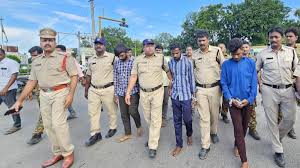
The accused, employed as loan recovery agents, used to target lone women and couples in secluded parks, secretly recording them to extort money, says the SP Chittoor district police on Friday arrested three men in the gang-rape case of a minor Dalit girl at Murakambattu city park on September 25. Superintendent of Police Tushar Dudi said the accused targeted women and couples in secluded parks, filming them to extort money. In some cases, they also resorted to sexual assault. On September 25, the trio, Mahesh (21), Kishore (31), and Hemant Prasad (27), all residents of Chittoor and working as loan recovery agents in a private firm—attacked a girl and her friend, both students, at the park. They assaulted the duo, robbed them of valuables, injured the boy, and raped the girl. The incident came to light on September 29, when the victim lodged a complaint at the Chittoor Taluk Police Station. Cases were filed under the Bharatiya Nyaya Sanhita (BNS), the POCSO Act, and the SC/ST (POA) Amendment Act, 2013. Special teams tracked the absconding accused across Andhra Pradesh, Chennai, and Bengaluru. Acting on a tip-off, police apprehended them at an isolated spot on the outskirts of Chittoor and seized their mobile phones. The accused were paraded from the AR Grounds junction to the Chittoor court complex, drawing crowds along the roadside, before being remanded to the sub-jail. The SP directed the Forest Department to strengthen security in isolated parks, install CCTV cameras, and coordinate with the police to prevent such crimes. K. Umashanker Courtesy : The Hindu Note: This news is originally published on https:/thehindu.com/bha and is used purely for non-profit/non-commercial purposes, especially human rights
Uproar over death of Dalit youth in Jaipur: Naresh Meena, accused of ‘slap incident’, camps in Raisar, protest continues with body
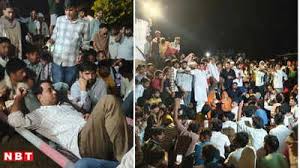
The suicide of Vikram Meena (26), a Dalit youth in the Jaipur rural area, has gained momentum. Naresh Meena arrived in Raisar to protest for justice for Vikram’s family. Along with his supporters, he announced that the protest will continue until Vikram Meena’s family’s demands are met. Jaipur: The suicide case of a Dalit youth in the Jaipur rural area has gained momentum. On Thursday, October 2, 26-year-old Vikram Meena hanged himself from a tree 100 meters away from the police station. The family alleges that Vikram was stripped and beaten by forest officials. Frustrated by the lack of police action, Vikram took his own life. Naresh Meena has now set up camp in Raisar to seek justice for Vikram’s family. Late last night, Naresh Meena arrived in Raisar with his supporters and began a sit-in protest. Naresh Meena announced that they would continue the protest until the demands of Vikram Meena’s family were met. Police fired in the air to disperse the crowd. Vikram Meena’s death angered villagers. They attacked and vandalized the forest office, forcing forest officials to flee. Later, the family and dozens of villagers reached the Raisar police station, demanding action against the forest officials who assaulted Vikram. Former Jamwaramgarh MLA Gopal Meena also joined the protest. A large crowd of villagers gathered outside the police station. Later, when BJP MLA Mahendra Pal Singh arrived, people began protesting. Stones were pelted at the police station. Subsequently, the police resorted to lathi charge, firing several rounds in the air, and dispersed the crowd by firing tear gas shells. Former MLA injured in lathicharge, detained Former MLA Gopal Meena, Aandhi Pradhan Mansi Meena, District Congress Treasurer Bhagwan Sahay Mukkad, District Councilor Vijay Meena, along with several villagers and family members of the deceased Vikram Meena, were injured in the lathicharge by the police. Villagers also pelted stones at the police in protest against the lathicharge. Police subsequently detained former MLA Gopal Meena and Pradhan Mansi Meena. Regarding the seriousness of the incident, several Congress leaders arrived at the scene. Congress MLAs Manish Yadav, Prashant Sharma, former MLA Indraj Gurjar, and Anil Chopra, the Congress candidate from the Jaipur Rural Lok Sabha constituency, also reached Raisar. Family and villagers put forward these demands to the administration: Family and villagers are sitting on a protest with Vikram Meena’s body. Several leaders, including Naresh Meena, are present with them. The family and villagers demand a judicial inquiry into Vikram Meena’s death. The forest officials who assaulted him should be immediately arrested and strict action taken against them. Action should also be taken against the policemen who threatened and drove Vikram away from the police station when he went to lodge a complaint. Action should also be taken against the police officers responsible for the lathicharge on those peacefully protesting demanding justice. Naresh Meena stated that Vikram’s family will negotiate with the administration. When the family agrees, they will end the protest and leave. Edited by: Sudhendra Pratap Singh•Reported by: Ramswaroop Lamrod About the Author Sudhendra Pratap Singh, Principal Content Producer at Navbharat Times Online. His journalism career began in Agra. He began his journey with the local newspaper Agrabharat. From there, the caravan grew through Kalpataru Express, Hindustan Newspaper, and News18, and then reached NBT.com. He currently covers politics, crime, current affairs, and off-beat news in Bihar, Jharkhand, and Rajasthan. Courtesy: Hindi News
‘Punishment’ for visiting a temple: Enraged after seeing the surname on an Aadhaar card, a Dalit laborer was beaten and asked, “How dare you?”
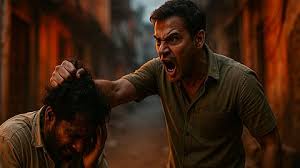
38-year-old Shailesh Solanki, who was visiting the Kaal Bhairav temple near Himmatnagar, Gujarat, was brutally assaulted. The accused assaulted him after seeing his surname on his Aadhaar card; a case has been filed under the SC/ST Act. Ahmedabad: A Dalit laborer in Himmatnagar, Gujarat, was allegedly beaten and threatened simply because he expressed his desire to visit a temple. After the victim showed his Aadhaar card for identification, the accused asked his caste and then attacked him. According to a complaint filed with the Himmatnagar rural police on Thursday, the accused hurled casteist slurs at the victim, beat him, and warned him not to enter the area again. What is the whole matter? Shailesh Solanki, a 38-year-old daily wage laborer from Khedawada Laxmipura village, stated in his FIR that the incident occurred on the evening of September 26th. He was waiting for a vehicle near an intersection in Balochpur to go to the Kaal Bhairav Temple. At that very moment, a man named Bharat Patel, a resident of Dhanupura, arrived on a scooter. He stopped Shailesh, accused him of moving suspiciously, and asked for his identification. When Shailesh explained that he was going to the temple, Patel did not believe him. When Shailesh gave his name, the accused asked him whether he belonged to the general category or the Scheduled Caste. When Shailesh showed his Aadhaar card to confirm his identity, Patel checked his surname. Upon learning that Shailesh was a Dalit, the accused became enraged and began abusing him. Shailesh stated in his complaint, “He asked me why I, a Dalit, had come to visit the temple after dark. He then slapped me several times, using casteist slurs.” Two people intervened Shortly after the attack, Narendra Singh Parmar and Jagat Singh Parmar, residents of Titpur village, arrived on a motorcycle. They intervened and stopped the fight. Despite this, Patel allegedly forced Shailesh onto his scooter, took him a short distance, and dropped him off near Ghorawada. He threatened Shailesh with dire consequences if he was seen in the area again. Shailesh said he informed his family about the incident and later contacted Narendra Singh and Jagat Singh, who offered to be witnesses. Based on Shailesh’s application, Himmatnagar Rural Police registered an FIR against the accused under sections of the Indian Penal Code for assault and intimidation and the SC/ST (Prevention of Atrocities) Act. Further investigation is underway. Rajan Chaudhary Courtesy: Hindi News
Her mother worked as a farm laborer, her father passed away, and she overcame poverty, thus becoming a Dalit daughter, Maheshwari, a DSP officer!
Modumpally Maheshwari of Karimnagar, Telangana, overcame poverty and hardship by passing the TGPSC Group I exam. Learn about her inspiring story. Telangana/Karimnagar: Modumpalli Maheshwari, a 29-year-old Dalit woman from Manakondur in Karimnagar district, has proven that determination and hard work can achieve anything. Overcoming poverty and hardship, she successfully passed the Telangana State Public Service Commission (TGPSC) Group I exam and secured the position of Deputy Superintendent of Police (DSP). Maheshwari’s achievement is a major step towards fulfilling her late father’s dream of seeing his daughter become a civil servant. Maheshwari credits her success to the Telangana SC Study Circle in Hyderabad, where she received coaching for the civil services exam. Maheshwari’s journey has been full of challenges, but financial constraints never hindered her educational and career goals. She completed her undergraduate studies from the Government Women’s Degree College in Karimnagar and then pursued an M.Sc. in Physics from the Satavahana University PG College in Godavarikhani, Peddapalli district. Her father, Lakshmana, worked as a migrant worker in the Gulf and passed away in 2021 due to a heart attack. After her father’s death, her mother, Shankaramma, a farm laborer, inspired her to continue her studies. “My father’s memories always inspire me and give me the strength to work hard to realize my full potential,” Maheshwari says. Maheshwari believes that the key to success in competitive exams is hard work, perseverance, and self-motivation. She explains that joining the Telangana SC Study Circle after her postgraduate studies was a turning point in her career. Speaking about her future plans, Maheshwari wants to promote cybersecurity awareness and work towards women’s empowerment through education. Her next goal is to pass the Civil Services Examination. Rajan Chaudhary Courtesy: Hindi News
Rahul Gandhi is not Ram… What angered Mulayam Singh Yadav’s younger daughter-in-law just after Dussehra?
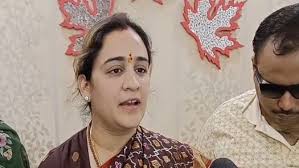
UP News: In Bulandshahr, BJP leader Aparna Yadav called for teaching the history of the RSS in universities. She supported strict action against rioters and Pakistan supporters in the Bareilly violence. She also hit back at a banner depicting Rahul Gandhi as Ram. Varun Sharma, Bulandshahr: A major statement has been made by BJP leader Aparna Yadav in Bulandshahr, Uttar Pradesh. She said that the history of the RSS should be taught in every university in the country so that the new generation can gain accurate knowledge of the organization’s contributions and working methods. Reacting to the Bareilly violence, Aparna Yadav said that the government has taken the right action against the rioters. She sternly stated that those who support Pakistan while living in India will not be spared under any circumstances and that the strictest action will be taken against them. Aparna Yadav also hit back at a banner at the Lucknow Congress office depicting Rahul Gandhi as Ram. Aparna Yadav’s statement Aparna said that Congress leaders consider themselves to be Ram, but in reality, they are making statements against India and tarnishing the country’s image. She sharply stated that Rahul Gandhi is merely engaging in “Pappugiri” and has nothing to do with the ideals of the real Ram. When questioned about the “I love love” slogan, Aparna Yadav clearly stated that it is a religious matter and every person in India has complete freedom to practice their religion. Regarding forming a government She said that our country cannot be run by one religion, because India is a secular country where every religion is respected. Expressing her views on the political future, Aparna Yadav claimed that the BJP will form the government in Uttar Pradesh with an absolute majority in the 2027 assembly elections. Edited by: Vishal Choubey About the author Vishal Choubey is a journalist at Navbharat Times Online. Vishal Choubey covers politics, crime, governance, and other issues in Uttar Pradesh and Uttarakhand. Vishal studied journalism at Lucknow University and has three years of experience in journalism. Courtesy: Hindi News
Supreme Court to Decide if 50% Quota Cap Applies to Colleges Built Exclusively for SCs
This case stems from an Allahabad High Court decision that struck down 70% reservation for Scheduled Castes in four SCP medical colleges in Uttar Pradesh. The High Court, citing the limit set in the Indra Sawhney case (1992), termed this 70% reservation as unconstitutional. New Delhi- The Supreme Court has decided to consider a very important question. The question is whether the 50% ceiling on reservations also applies to medical and educational institutions created specifically for Scheduled Castes (SCs) under the Special Component Plan (SCP). This case stems from an Allahabad High Court decision that struck down 70% reservation for Scheduled Castes in four SCP medical colleges in Uttar Pradesh. The High Court, citing the limit set in the Indra Sawhney case (1992), termed this 70% reservation as unconstitutional. Students affected by the High Court’s decision approached the Supreme Court. A bench led by Chief Justice of India BR Gavai and Justice K. Vinod Chandran has issued notices to the central and state governments, seeking their responses on the petition. What is the complete issue? The Special Component Plan (SCP) was launched in 1979 for the educational and social upliftment of backward classes, especially Scheduled Castes. Under this, separate hostels, scholarships, and even universities were established specifically for SC students. Four medical colleges were built under this plan in Ambedkar Nagar, Kannauj, Jalaun, and Saharanpur in Uttar Pradesh, where 70% of the seats were reserved for SC students. Funding for these colleges comes from a special central government scheme (DAPSC), which is meant solely for the welfare of the SC community. What do the petitioners say The petitioners argue that the High Court made a mistake. Their main point is that the Indra Sawhney case dealt with reservations in general institutions, not in institutions created specifically for the advancement of SC/STs. They warn that if the High Court’s decision is upheld, the consequences will be severe: It would endanger not only these four colleges in UP but also similar schemes running in states like Karnataka, Telangana, Andhra Pradesh, and Tamil Nadu. It could raise questions about special hostels, scholarships, and even central universities like Babasaheb Bhimrao Ambedkar University (BBAU) built for SC/ST students. It would deal a blow to decades of affirmative action meant to uplift marginalized communities. The Supreme Court’s ruling on this matter will have far-reaching implications. If the Court upholds the High Court’s decision, educational opportunities for students from backward classes could shrink. On the other hand, if the Court rules in favor of the petitioners, it would affirm that reservation exceeding 50% is constitutional in institutions created exclusively for disadvantaged groups. All eyes are now on the Supreme Court’s next hearing. Geetha Sunil Pillai Courtesy : The Mooknayak Note: This news is originally published on https:/themooknayak.com/bha and is used purely for non-profit/non-commercial purposes, especially human rights